AL402, E4.5Academic year: 2010-2011WINTERCHAPTER 6:LANGUAGE & THE BRAINTemplateLecturer: MeasSopheakGroup 1: Vorleak, Sopheap, LeangHy, Sakada, Rachna and Bandith
02ContentsIntroductionHow independent are the language of multilingual speakers?Multiple language structure in the brainRelationship between L1 & L2 in brain organizationLanguage when brain damage
Introduction03Paul Pierre Broca (1961, 1965) observed that an area in the left frontal lobe ( Broca’ s area) appeared to be responsible for the ability to speak.
He noted that an injury to the left side of the brain was much more likely to result in language loss than was an injury to the right side.Introduction (cont’)04Wernicke, 1874, identified a nearby area which is adjacent to the part of the cortex that processes audio input ( Wernicke’s area) are also being central to language processing.Introduction (cont’)05 For the vast majority of individuals, language is represented primarily in the left half (or hemisphere) of the brain within an area (including both Broca ‘s area and Wernicke’s area) around the Sylvian fissure (a cleavage that separates lobes in the brain.) Introduction (cont’)06Subsequent research has shown that many more areas of the brain are involved in language activity than was thought earlier: language activity is not localized, but core linguistic process are typically housed in the left hemisphere.
 As brain matures and has less plasticity: an area of the brain becomes less able to assume the functions of another in the event it is damaged.Introduction (cont’)07Lenneberge, 1967, proposed that children had only a limited number of years during which they could acquired their L1 flawlessly if they suffered brain damage to the language areas; brain plasticity in childhood would allow other areas of the brain to take over the language functions of the damage areas, but beyond a certain age, normal language would not be possible. This is the Critical Period Hypothesis.Introduction (cont’)08Lenneberge, 1967, proposed that children had only a limited number of years during which they could acquired their L1 flawlessly if they suffered brain damage to the language areas; brain plasticity in childhood would allow other areas of the brain to take over the language functions of the damage areas, but beyond a certain age, normal language would not be possible. This is the Critical Period Hypothesis.Introduction (cont’)09Oblerand Gjerlow emphasized that there are not language areas that are entirely “ responsible” for language, or even “dominant” for language, to be contrasted with areas that have nothing to do with it”. Introduction (cont’)10 Left hemisphere is for linguistic.
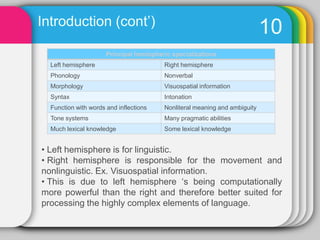
Right hemisphere is responsible for the movement and nonlinguistic. Ex. Visuospatialinformation.
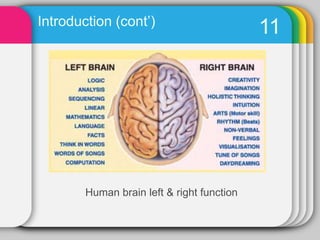
This is due to left hemisphere ‘s being computationally more powerful than the right and therefore better suited for processing the highly complex elements of language.Introduction (cont’)11Human brain left & right function
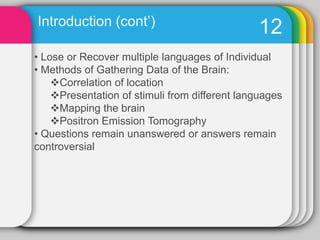
Introduction (cont’)12 Lose or Recover multiple languages of Individual
 Methods of Gathering Data of the Brain:
Correlation of location
Presentation of stimuli from different languages
Mapping the brain
Positron Emission Tomography
 Questions remain unanswered or answers remain controversialHow independent are the language of multilingual speakers?13Ervin and Osgood suggested a three ways possibly for how languages relate in  an individual’s mind which are call: CoordinateCompoundSubordinate bilingualism
How are multiple language structures organized in relation to one another in the brain? Are both languages stores in the same areas?14For at least some multilinguals, it appears that L1 and L2 are stored in somewhat different areas of the brain, but both are predominantly in (probably overlapping) areas of the left hemisphere. The area common to both L1 and L2 storage is near Sylvian fissure in the left hemisphere, but L1 or L2 (more likely L2) is disrupted by stimulation of points further away from the Sylvian fissure.
Does the organization of the brain for L2 in relation to L1 differ with the age of acquisition,  how it is learned or level of proficiency?15 The answer is: Yes
 Age of acquisition influences brain organization.   -  Vaid (1993): acquiring L2 later in life involves 	more right hemisphere.   -  Wuillemin and Richards (1994): acquiring L2 	(age 9-12) involves more right hemisphere than 	before age 4.
16Level of proficiency or how it is learned also influences the organization of knowledge in the brain.     -   The organization of L2 knowledge is more diffuse for lower levels of      	proficiency 	and more compact for higher level.     -   Fedio et al. 1992: A multilingual person may use more memorization for 	L2 and    	more direct processing of meaning for L1.     -   Other research: L2 learners increase reliance on meaning over memory   	as their 	proficiency in L2 increases.

Language and the brain

  • 1.
    AL402, E4.5Academic year:2010-2011WINTERCHAPTER 6:LANGUAGE & THE BRAINTemplateLecturer: MeasSopheakGroup 1: Vorleak, Sopheap, LeangHy, Sakada, Rachna and Bandith
  • 2.
    02ContentsIntroductionHow independent arethe language of multilingual speakers?Multiple language structure in the brainRelationship between L1 & L2 in brain organizationLanguage when brain damage
  • 3.
    Introduction03Paul Pierre Broca(1961, 1965) observed that an area in the left frontal lobe ( Broca’ s area) appeared to be responsible for the ability to speak.
  • 4.
    He noted thatan injury to the left side of the brain was much more likely to result in language loss than was an injury to the right side.Introduction (cont’)04Wernicke, 1874, identified a nearby area which is adjacent to the part of the cortex that processes audio input ( Wernicke’s area) are also being central to language processing.Introduction (cont’)05 For the vast majority of individuals, language is represented primarily in the left half (or hemisphere) of the brain within an area (including both Broca ‘s area and Wernicke’s area) around the Sylvian fissure (a cleavage that separates lobes in the brain.) Introduction (cont’)06Subsequent research has shown that many more areas of the brain are involved in language activity than was thought earlier: language activity is not localized, but core linguistic process are typically housed in the left hemisphere.
  • 5.
    As brainmatures and has less plasticity: an area of the brain becomes less able to assume the functions of another in the event it is damaged.Introduction (cont’)07Lenneberge, 1967, proposed that children had only a limited number of years during which they could acquired their L1 flawlessly if they suffered brain damage to the language areas; brain plasticity in childhood would allow other areas of the brain to take over the language functions of the damage areas, but beyond a certain age, normal language would not be possible. This is the Critical Period Hypothesis.Introduction (cont’)08Lenneberge, 1967, proposed that children had only a limited number of years during which they could acquired their L1 flawlessly if they suffered brain damage to the language areas; brain plasticity in childhood would allow other areas of the brain to take over the language functions of the damage areas, but beyond a certain age, normal language would not be possible. This is the Critical Period Hypothesis.Introduction (cont’)09Oblerand Gjerlow emphasized that there are not language areas that are entirely “ responsible” for language, or even “dominant” for language, to be contrasted with areas that have nothing to do with it”. Introduction (cont’)10 Left hemisphere is for linguistic.
  • 6.
    Right hemisphere isresponsible for the movement and nonlinguistic. Ex. Visuospatialinformation.
  • 7.
    This is dueto left hemisphere ‘s being computationally more powerful than the right and therefore better suited for processing the highly complex elements of language.Introduction (cont’)11Human brain left & right function
  • 8.
    Introduction (cont’)12 Loseor Recover multiple languages of Individual
  • 9.
    Methods ofGathering Data of the Brain:
  • 10.
  • 11.
    Presentation of stimulifrom different languages
  • 12.
  • 13.
  • 14.
    Questions remainunanswered or answers remain controversialHow independent are the language of multilingual speakers?13Ervin and Osgood suggested a three ways possibly for how languages relate in an individual’s mind which are call: CoordinateCompoundSubordinate bilingualism
  • 15.
    How are multiplelanguage structures organized in relation to one another in the brain? Are both languages stores in the same areas?14For at least some multilinguals, it appears that L1 and L2 are stored in somewhat different areas of the brain, but both are predominantly in (probably overlapping) areas of the left hemisphere. The area common to both L1 and L2 storage is near Sylvian fissure in the left hemisphere, but L1 or L2 (more likely L2) is disrupted by stimulation of points further away from the Sylvian fissure.
  • 16.
    Does the organizationof the brain for L2 in relation to L1 differ with the age of acquisition, how it is learned or level of proficiency?15 The answer is: Yes
  • 17.
    Age ofacquisition influences brain organization. - Vaid (1993): acquiring L2 later in life involves more right hemisphere. - Wuillemin and Richards (1994): acquiring L2 (age 9-12) involves more right hemisphere than before age 4.
  • 18.
    16Level of proficiencyor how it is learned also influences the organization of knowledge in the brain. - The organization of L2 knowledge is more diffuse for lower levels of proficiency and more compact for higher level. - Fedio et al. 1992: A multilingual person may use more memorization for L2 and more direct processing of meaning for L1. - Other research: L2 learners increase reliance on meaning over memory as their proficiency in L2 increases.