The document discusses DC and AC analysis of transistor amplifiers. It covers DC biasing circuits, voltage divider bias, graphical DC analysis using load lines and Q-point, AC equivalent circuits, and determining amplifier compliance from the AC load line. Key points are:
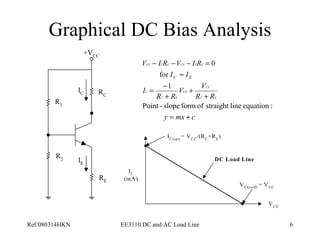
- DC load line shows all combinations of collector current (IC) and collector-emitter voltage (VCE) for given values of voltage and resistors.
- Q-point is the operating point where the load line intersects the transistor characteristic curve with no input signal.
- AC load line determines maximum output voltage compliance or swing based on saturation and cutoff points.
Lecture 07 DC and AC Load Line DC biasing circuits DC and AC equivalent circuit Q-point (Static operation point) DC and AC load line Saturation Cutoff Condition Compliance
2.
Book Reference ElectronicDevices and Circuit Theory by Robert Boylestad & Louis Nashelsky ( Prentice Hall ) Electronic Devices by Thomas L. Floyd ( Prentice Hall )
3.
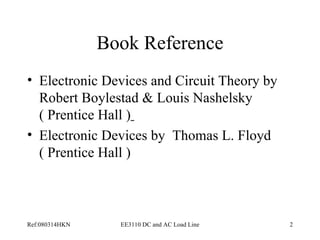
DC Biasing CircuitsThe ac operation of an amplifier depends on the initial dc values of I B , I C , and V CE . By varying I B around an initial dc value, I C and V CE are made to vary around their initial dc values. DC biasing is a static operation since it deals with setting a fixed (steady) level of current (through the device) with a desired fixed voltage drop across the device.
4.
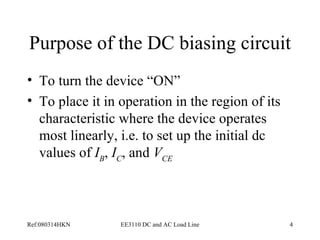
Purpose of theDC biasing circuit To turn the device “ON” To place it in operation in the region of its characteristic where the device operates most linearly, i.e. to set up the initial dc values of I B , I C , and V CE
5.
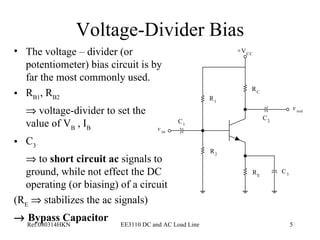
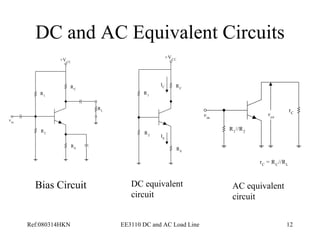
Voltage-Divider Bias Thevoltage – divider (or potentiometer) bias circuit is by far the most commonly used. R B1 , R B2 voltage-divider to set the value of V B , I B C 3 to short circuit ac signals to ground, while not effect the DC operating (or biasing) of a circuit (R E stabilizes the ac signals) Bypass Capacitor
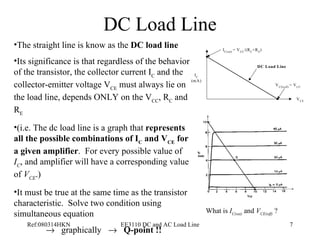
DC Load LineThe straight line is know as the DC load line Its significance is that regardless of the behavior of the transistor, the collector current I C and the collector-emitter voltage V CE must always lie on the load line, depends ONLY on the V CC , R C and R E (i.e. The dc load line is a graph that represents all the possible combinations of I C and V CE for a given amplifier . For every possible value of I C , and amplifier will have a corresponding value of V CE .) It must be true at the same time as the transistor characteristic. Solve two condition using simultaneous equation graphically Q-point !! What is I C(sat) and V CE(off) ?
8.
Q-Point (Static OperationPoint) When a transistor does not have an ac input , it will have specific dc values of I C and V CE . These values correspond to a specific point on the dc load line . This point is called the Q-point . The letter Q corresponds to the word (Latent) quiescent , meaning at rest . A quiescent amplifier is one that has no ac signal applied and therefore has constant dc values of I C and V CE .
9.
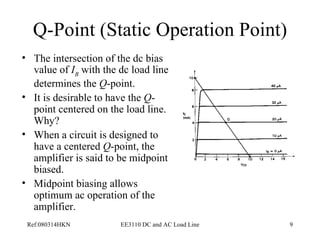
Q-Point (Static OperationPoint) The intersection of the dc bias value of I B with the dc load line determines the Q -point. It is desirable to have the Q -point centered on the load line. Why? When a circuit is designed to have a centered Q -point, the amplifier is said to be midpoint biased. Midpoint biasing allows optimum ac operation of the amplifier.
10.
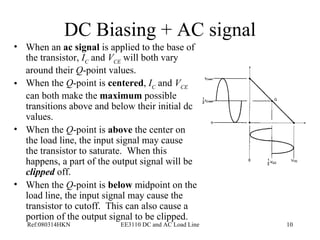
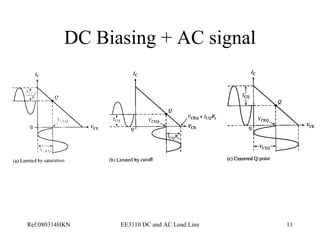
DC Biasing +AC signal When an ac signal is applied to the base of the transistor, I C and V CE will both vary around their Q -point values. When the Q -point is centered , I C and V CE can both make the maximum possible transitions above and below their initial dc values. When the Q -point is above the center on the load line, the input signal may cause the transistor to saturate. When this happens, a part of the output signal will be clipped off. When the Q -point is below midpoint on the load line, the input signal may cause the transistor to cutoff. This can also cause a portion of the output signal to be clipped.
DC and ACEquivalent Circuits Bias Circuit DC equivalent circuit AC equivalent circuit
13.
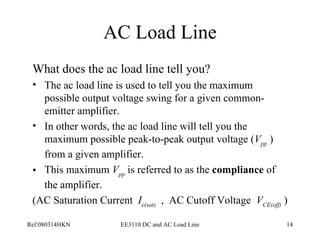
AC Load LineThe ac load line of a given amplifier will not follow the plot of the dc load line. This is due to the dc load of an amplifier is different from the ac load.
14.
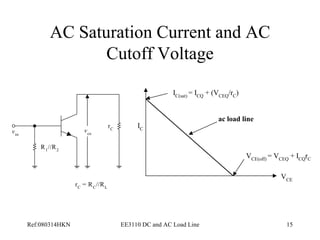
AC Load LineWhat does the ac load line tell you? The ac load line is used to tell you the maximum possible output voltage swing for a given common-emitter amplifier. In other words, the ac load line will tell you the maximum possible peak-to-peak output voltage ( V pp ) from a given amplifier. This maximum V pp is referred to as the compliance of the amplifier. (AC Saturation Current I c(sat) , AC Cutoff Voltage V CE(off) )
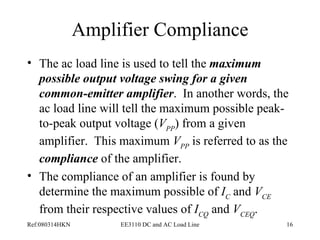
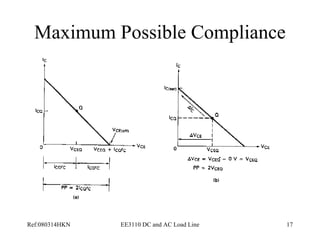
Amplifier Compliance Theac load line is used to tell the maximum possible output voltage swing for a given common-emitter amplifier . In another words, the ac load line will tell the maximum possible peak-to-peak output voltage ( V PP ) from a given amplifier. This maximum V PP is referred to as the compliance of the amplifier. The compliance of an amplifier is found by determine the maximum possible of I C and V CE from their respective values of I CQ and V CEQ .
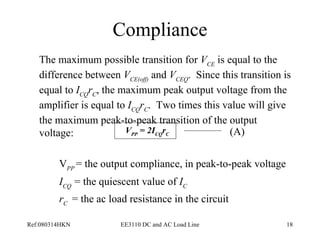
Compliance The maximumpossible transition for V CE is equal to the difference between V CE(off) and V CEQ . Since this transition is equal to I CQ r C , the maximum peak output voltage from the amplifier is equal to I CQ r C . Two times this value will give the maximum peak-to-peak transition of the output voltage: V PP = the output compliance, in peak-to-peak voltage I CQ = the quiescent value of I C r C = the ac load resistance in the circuit (A) V PP = 2I CQ r C
19.
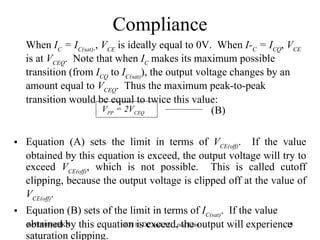
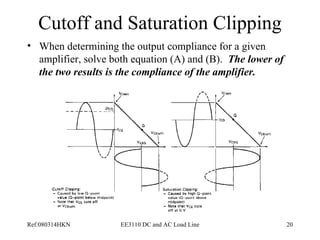
Compliance When I C = I C(sat) , V CE is ideally equal to 0V. When I C = I CQ , V CE is at V CEQ . Note that when I C makes its maximum possible transition (from I CQ to I C(sat) ), the output voltage changes by an amount equal to V CEQ . Thus the maximum peak-to-peak transition would be equal to twice this value: Equation (A) sets the limit in terms of V CE(off) . If the value obtained by this equation is exceed, the output voltage will try to exceed V CE(off) , which is not possible. This is called cutoff clipping, because the output voltage is clipped off at the value of V CE(off) . Equation (B) sets of the limit in terms of I C(sat) . If the value obtained by this equation is exceed, the output will experience saturation clipping. (B) V PP = 2V CEQ
20.
Cutoff and SaturationClipping When determining the output compliance for a given amplifier, solve both equation (A) and (B). The lower of the two results is the compliance of the amplifier.
21.
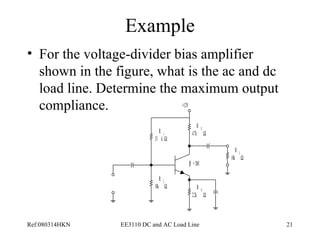
Example For thevoltage-divider bias amplifier shown in the figure, what is the ac and dc load line. Determine the maximum output compliance.