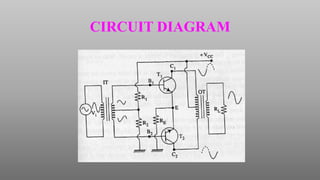
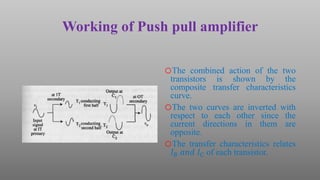
This document describes the push-pull amplifier circuit. A push-pull amplifier uses two transistors connected in a way that one transistor amplifies the positive half of the input signal while the other amplifies the negative half. This results in an output signal that is an amplified replica of the input signal with less distortion compared to a single transistor amplifier. The key components are two transistors, input and output transformers, and biasing resistors. The transistors are biased at cutoff so that they only conduct during one half of the input signal cycle. This alternating amplification of the signal halves is what gives the circuit its name - it "pushes" the signal high during one half and "pulls" it low during the other half.





![July07 4[1].1 power_amplifiers01](https://cdn.slidesharecdn.com/ss_thumbnails/july0741-200727121307-thumbnail.jpg?width=640&height=640&fit=bounds)


