ANALOG ELECTRONIC CIRCUITS
(ECE34)
MODULE 5
POWER AMPLIFIERS
Classifications of amplifiers
1. Audio and Radio amplifiers
2. Wideband and Narrowband amplifiers
3. Small signal and Large signal amplifiers
02/11/2017 Aravinda K., Dept. of E&C, NHCE 2
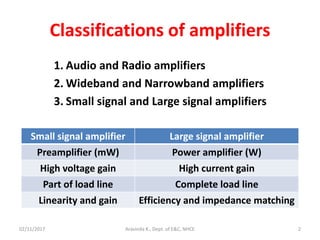
Small signal amplifier Large signal amplifier
Preamplifier (mW) Power amplifier (W)
High voltage gain High current gain
Part of load line Complete load line
Linearity and gain Efficiency and impedance matching
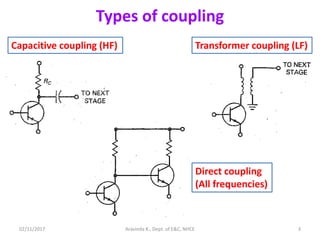
Types of coupling
02/11/2017 Aravinda K., Dept. of E&C, NHCE 3
Capacitive coupling (HF) Transformer coupling (LF)
Direct coupling
(All frequencies)
02/11/2017 Aravinda K., Dept. of E&C, NHCE 4
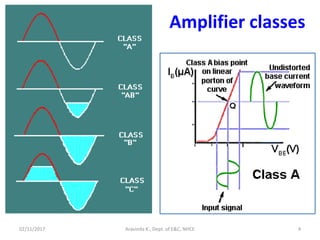
Amplifier classes
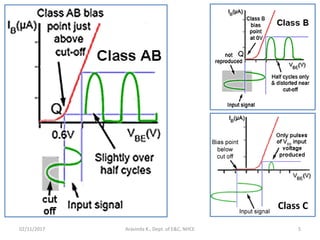
02/11/2017 Aravinda K., Dept. of E&C, NHCE 5
Class C
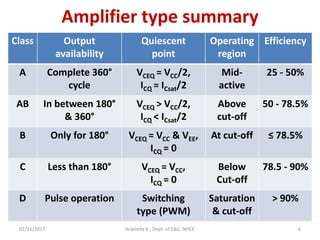
Amplifier type summary
02/11/2017 Aravinda K., Dept. of E&C, NHCE 6
Class Output
availability
Quiescent
point
Operating
region
Efficiency
A Complete 360°
cycle
VCEQ = VCC/2,
ICQ = ICsat/2
Mid-
active
25 - 50%
AB In between 180°
& 360°
VCEQ > VCC/2,
ICQ < ICsat/2
Above
cut-off
50 - 78.5%
B Only for 180° VCEQ = VCC & VEE,
ICQ = 0
At cut-off ≤ 78.5%
C Less than 180° VCEQ = VCC,
ICQ = 0
Below
Cut-off
78.5 - 90%
D Pulse operation Switching
type (PWM)
Saturation
& cut-off
> 90%
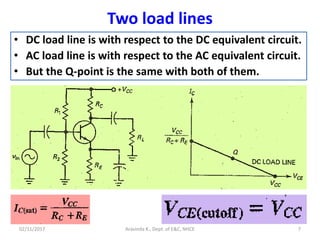
Two load lines
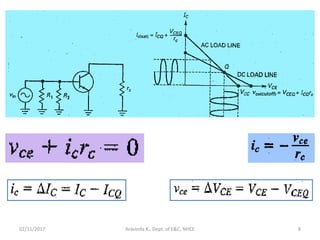
• DC load line is with respect to the DC equivalent circuit.
• AC load line is with respect to the AC equivalent circuit.
• But the Q-point is the same with both of them.
02/11/2017 Aravinda K., Dept. of E&C, NHCE 7
02/11/2017 Aravinda K., Dept. of E&C, NHCE 8
02/11/2017 Aravinda K., Dept. of E&C, NHCE 9
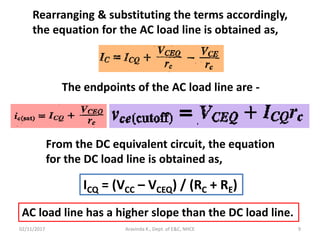
AC load line has a higher slope than the DC load line.
Rearranging & substituting the terms accordingly,
the equation for the AC load line is obtained as,
From the DC equivalent circuit, the equation
for the DC load line is obtained as,
ICQ = (VCC – VCEQ) / (RC + RE)
The endpoints of the AC load line are -
02/11/2017 Aravinda K., Dept. of E&C, NHCE 10
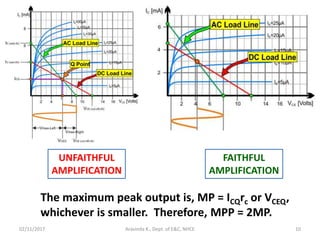
UNFAITHFUL
AMPLIFICATION
FAITHFUL
AMPLIFICATION
The maximum peak output is, MP = ICQrc or VCEQ,
whichever is smaller. Therefore, MPP = 2MP.
02/11/2017 Aravinda K., Dept. of E&C, NHCE 11
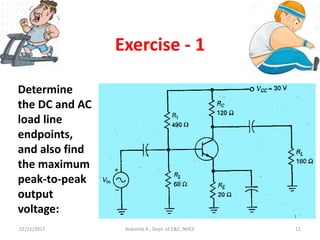
Exercise - 1
Determine
the DC and AC
load line
endpoints,
and also find
the maximum
peak-to-peak
output
voltage:
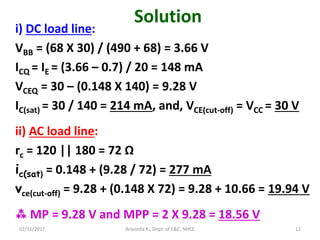
i) DC load line:
VBB = (68 X 30) / (490 + 68) = 3.66 V
ICQ = IE = (3.66 – 0.7) / 20 = 148 mA
VCEQ = 30 – (0.148 X 140) = 9.28 V
IC(sat) = 30 / 140 = 214 mA, and, VCE(cut-off) = VCC = 30 V
ii) AC load line:
rc = 120 || 180 = 72 Ω
ic(sat) = 0.148 + (9.28 / 72) = 277 mA
vce(cut-off) = 9.28 + (0.148 X 72) = 9.28 + 10.66 = 19.94 V
 MP = 9.28 V and MPP = 2 X 9.28 = 18.56 V
02/11/2017 Aravinda K., Dept. of E&C, NHCE 12
Solution
02/11/2017 Aravinda K., Dept. of E&C, NHCE 13
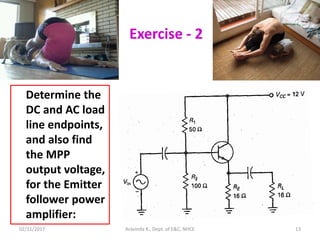
Exercise - 2
Determine the
DC and AC load
line endpoints,
and also find
the MPP
output voltage,
for the Emitter
follower power
amplifier:
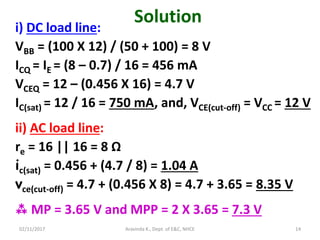
i) DC load line:
VBB = (100 X 12) / (50 + 100) = 8 V
ICQ = IE = (8 – 0.7) / 16 = 456 mA
VCEQ = 12 – (0.456 X 16) = 4.7 V
IC(sat) = 12 / 16 = 750 mA, and, VCE(cut-off) = VCC = 12 V
ii) AC load line:
re = 16 || 16 = 8 Ω
ic(sat) = 0.456 + (4.7 / 8) = 1.04 A
vce(cut-off) = 4.7 + (0.456 X 8) = 4.7 + 3.65 = 8.35 V
 MP = 3.65 V and MPP = 2 X 3.65 = 7.3 V
02/11/2017 Aravinda K., Dept. of E&C, NHCE 14
Solution
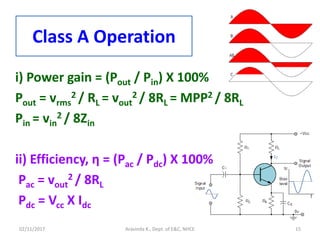
Class A Operation
i) Power gain = (Pout / Pin) X 100%
Pout = vrms
2 / RL = vout
2 / 8RL = MPP2 / 8RL
Pin = vin
2 / 8Zin
ii) Efficiency, η = (Pac / Pdc) X 100%
Pac = vout
2 / 8RL
Pdc = Vcc X Idc
02/11/2017 Aravinda K., Dept. of E&C, NHCE 15
02/11/2017 Aravinda K., Dept. of E&C, NHCE 16
Exercise - 3
Find out the transistor power dissipation, power gain and
efficiency for the circuit given in Exercise - 1, if the input
voltage is 200 mVpp, output voltage is 18 Vpp and the
input impedance of the base is 100 Ω.
02/11/2017 Aravinda K., Dept. of E&C, NHCE 17
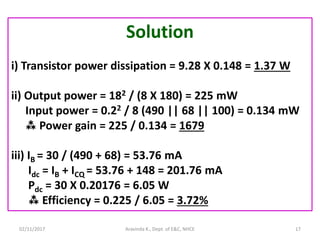
Solution
i) Transistor power dissipation = 9.28 X 0.148 = 1.37 W
ii) Output power = 182 / (8 X 180) = 225 mW
Input power = 0.22 / 8 (490 || 68 || 100) = 0.134 mW
 Power gain = 225 / 0.134 = 1679
iii) IB = 30 / (490 + 68) = 53.76 mA
Idc = IB + ICQ = 53.76 + 148 = 201.76 mA
Pdc = 30 X 0.20176 = 6.05 W
 Efficiency = 0.225 / 6.05 = 3.72%
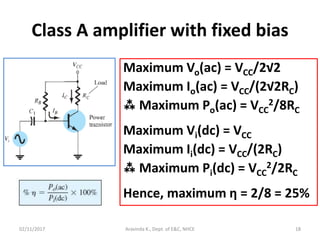
Class A amplifier with fixed bias
Maximum Vo(ac) = VCC/2√2
Maximum Io(ac) = VCC/(2√2RC)
 Maximum Po(ac) = VCC
2/8RC
Maximum Vi(dc) = VCC
Maximum Ii(dc) = VCC/(2RC)
 Maximum Pi(dc) = VCC
2/2RC
Hence, maximum η = 2/8 = 25%
02/11/2017 Aravinda K., Dept. of E&C, NHCE 18
02/11/2017 Aravinda K., Dept. of E&C, NHCE 19
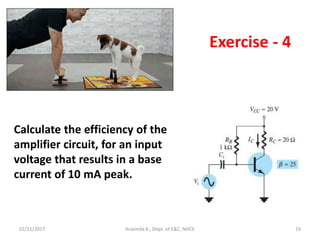
Exercise - 4
Calculate the efficiency of the
amplifier circuit, for an input
voltage that results in a base
current of 10 mA peak.
Solution
IBQ = (20 - 0.7) / 1K = 19.3 mA
ICQ = 19.3 mA X 25 = 482.5 mA
 Pi(dc) = 20 X (19.3 + 482.5)m = 10.036 W
ic (rms) = (10 mA X 25) / √2 = 177 mA
 Po(ac) = (177 mA)2 X 20 Ω = 626.58 mW
 Efficiency = 0.62658 / 10.036 = 6.24%
02/11/2017 Aravinda K., Dept. of E&C, NHCE 20
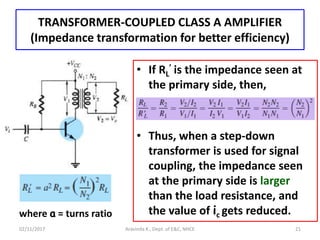
TRANSFORMER-COUPLED CLASS A AMPLIFIER
(Impedance transformation for better efficiency)
• If RL
′ is the impedance seen at
the primary side, then,
• Thus, when a step-down
transformer is used for signal
coupling, the impedance seen
at the primary side is larger
than the load resistance, and
the value of ic gets reduced.
02/11/2017 Aravinda K., Dept. of E&C, NHCE 21
where a = turns ratio
02/11/2017 Aravinda K., Dept. of E&C, NHCE 22
Exercise - 5: For the fixed bias transformer-coupled Class
A amplifier, if the load is a speaker of resistance 16 Ω,
find the turns ratio of the transformer such that the
effective primary resistance is 10 KΩ. Also, find the value
of ac current when VCC = 12 V.
Solution: N1 / N2 = √ (10 K / 16) = 25.
ic = VCEQ / RL
′ = VCC / RL
′ = 12 / 10 K = 1.2 mA.
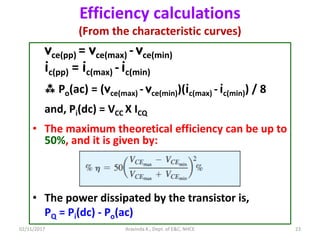
Efficiency calculations
(From the characteristic curves)
vce(pp) = vce(max) - vce(min)
ic(pp) = ic(max) - ic(min)
 Po(ac) = (vce(max) - vce(min))(ic(max) - ic(min)) / 8
and, Pi(dc) = VCC X ICQ
• The maximum theoretical efficiency can be up to
50%, and it is given by:
• The power dissipated by the transistor is,
PQ = Pi(dc) - Po(ac)
02/11/2017 Aravinda K., Dept. of E&C, NHCE 23
02/11/2017 Aravinda K., Dept. of E&C, NHCE 24
Exercise - 6
Calculate the efficiency of a transformer-coupled Class
A amplifier for a supply of 12 V and peak output of 10 V.
Solution:
vce(max) = VCEQ + vp = 12 + 10 = 22 V
vce(min) = VCEQ - vp = 12 - 10 = 2 V
 η = 50 (22 - 2) / (22 + 2) = 41.67%
CLASS B AMPLIFIER OPERATION
02/11/2017 Aravinda K., Dept. of E&C, NHCE 25
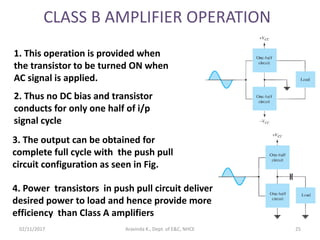
1. This operation is provided when
the transistor to be turned ON when
AC signal is applied.
2. Thus no DC bias and transistor
conducts for only one half of i/p
signal cycle
3. The output can be obtained for
complete full cycle with the push pull
circuit configuration as seen in Fig.
4. Power transistors in push pull circuit deliver
desired power to load and hence provide more
efficiency than Class A amplifiers
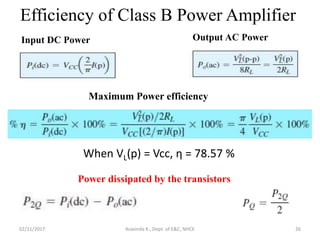
Efficiency of Class B Power Amplifier
02/11/2017 Aravinda K., Dept. of E&C, NHCE 26
Input DC Power Output AC Power
Maximum Power efficiency
When VL(p) = Vcc, η = 78.57 %
Power dissipated by the transistors
02/11/2017 Aravinda K., Dept. of E&C, NHCE 27
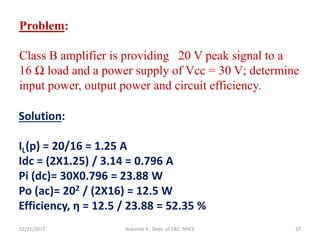
Problem:
Class B amplifier is providing 20 V peak signal to a
16 Ω load and a power supply of Vcc = 30 V; determine
input power, output power and circuit efficiency.
Solution:
IL(p) = 20/16 = 1.25 A
Idc = (2X1.25) / 3.14 = 0.796 A
Pi (dc)= 30X0.796 = 23.88 W
Po (ac)= 202 / (2X16) = 12.5 W
Efficiency, η = 12.5 / 23.88 = 52.35 %
02/11/2017 Aravinda K., Dept. of E&C, NHCE 28
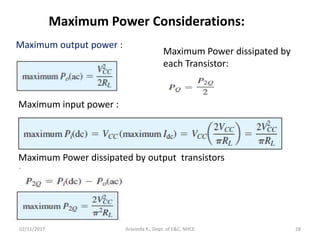
Maximum Power Considerations:
Maximum output power :
Maximum input power :
Maximum Power dissipated by
each Transistor:
Maximum Power dissipated by output transistors
:
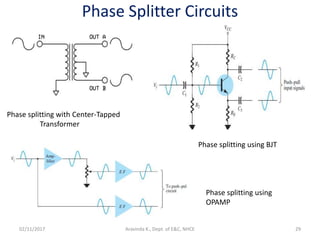
Phase Splitter Circuits
02/11/2017 Aravinda K., Dept. of E&C, NHCE 29
Phase splitting with Center-Tapped
Transformer
Phase splitting using BJT
Phase splitting using
OPAMP
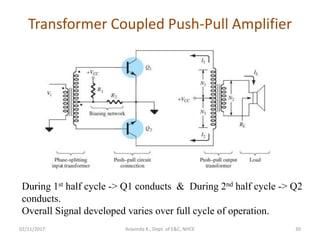
Transformer Coupled Push-Pull Amplifier
02/11/2017 Aravinda K., Dept. of E&C, NHCE 30
During 1st half cycle -> Q1 conducts & During 2nd half cycle -> Q2
conducts.
Overall Signal developed varies over full cycle of operation.
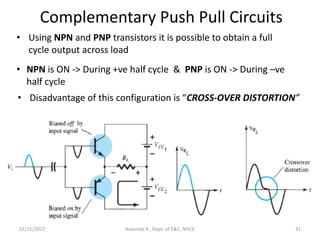
Complementary Push Pull Circuits
02/11/2017 Aravinda K., Dept. of E&C, NHCE 31
• Using NPN and PNP transistors it is possible to obtain a full
cycle output across load
• Disadvantage of this configuration is “CROSS-OVER DISTORTION”
• NPN is ON -> During +ve half cycle & PNP is ON -> During –ve
half cycle
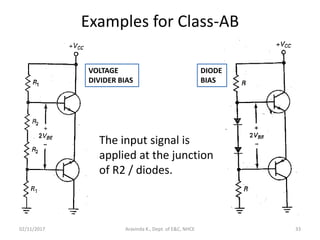
Class AB operation
• To eliminate cross-over distortion, a slight
forward bias needs to be applied to each BE
junction. This means that the Q-point gets
located slightly above cut-off.
• In general, an ICQ from 1% to 5% of IC(sat) is
enough to eliminate crossover distortion.
• Because of this slight forward bias, the
conduction angle will be slightly greater than
180°, and hence, this operation is referred to
as Class AB.
02/11/2017 Aravinda K., Dept. of E&C, NHCE 32
Examples for Class-AB
02/11/2017 Aravinda K., Dept. of E&C, NHCE 33
VOLTAGE
DIVIDER BIAS
DIODE
BIAS
The input signal is
applied at the junction
of R2 / diodes.
02/11/2017 Aravinda K., Dept. of E&C, NHCE 34
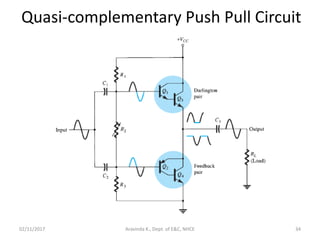
Quasi-complementary Push Pull Circuit
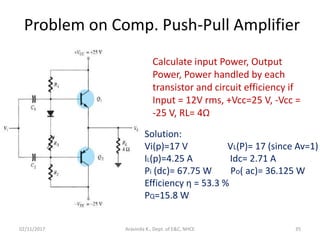
Problem on Comp. Push-Pull Amplifier
02/11/2017 Aravinda K., Dept. of E&C, NHCE 35
Calculate input Power, Output
Power, Power handled by each
transistor and circuit efficiency if
Input = 12V rms, +Vcc=25 V, -Vcc =
-25 V, RL= 4Ω
Solution:
Vi(p)=17 V VL(P)= 17 (since Av=1)
IL(p)=4.25 A Idc= 2.71 A
Pi (dc)= 67.75 W Po( ac)= 36.125 W
Efficiency η = 53.3 %
PQ=15.8 W
02/11/2017 Aravinda K., Dept. of E&C, NHCE 36
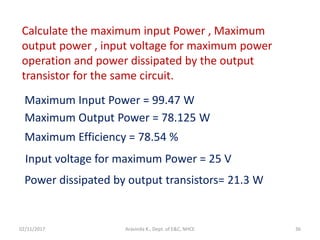
Calculate the maximum input Power , Maximum
output power , input voltage for maximum power
operation and power dissipated by the output
transistor for the same circuit.
Maximum Input Power = 99.47 W
Maximum Output Power = 78.125 W
Maximum Efficiency = 78.54 %
Input voltage for maximum Power = 25 V
Power dissipated by output transistors= 21.3 W
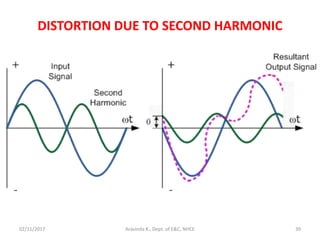
AMPLIFIER DISTORTION
• A pure sinusoidal signal has equal amounts of
variation in positive and negative cycles.
• But if any signal varies over less than the full
360° cycle, then it is called as “distortion”.
• Amplitude distortion occurs due to the non-
linear device characteristics.
• Frequency distortion occurs due to the
difference in frequency response of the
circuit elements.
02/11/2017 Aravinda K., Dept. of E&C, NHCE 37
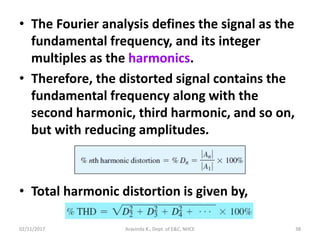
• The Fourier analysis defines the signal as the
fundamental frequency, and its integer
multiples as the harmonics.
• Therefore, the distorted signal contains the
fundamental frequency along with the
second harmonic, third harmonic, and so on,
but with reducing amplitudes.
• Total harmonic distortion is given by,
02/11/2017 Aravinda K., Dept. of E&C, NHCE 38
02/11/2017 Aravinda K., Dept. of E&C, NHCE 39
DISTORTION DUE TO SECOND HARMONIC
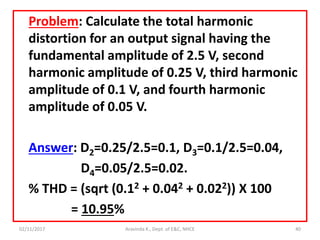
Problem: Calculate the total harmonic
distortion for an output signal having the
fundamental amplitude of 2.5 V, second
harmonic amplitude of 0.25 V, third harmonic
amplitude of 0.1 V, and fourth harmonic
amplitude of 0.05 V.
Answer: D2=0.25/2.5=0.1, D3=0.1/2.5=0.04,
D4=0.05/2.5=0.02.
% THD = (sqrt (0.12 + 0.042 + 0.022)) X 100
= 10.95%
02/11/2017 Aravinda K., Dept. of E&C, NHCE 40
Expression
for 2nd harmonic
distortion
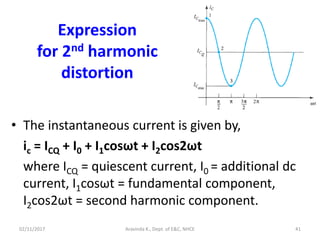
• The instantaneous current is given by,
ic = ICQ + I0 + I1cosωt + I2cos2ωt
where ICQ = quiescent current, I0 = additional dc
current, I1cosωt = fundamental component,
I2cos2ωt = second harmonic component.
02/11/2017 Aravinda K., Dept. of E&C, NHCE 41
• In the curve, at point 1,
ic = ICmax = ICQ+I0+I1cos0+I2cos0 = ICQ+I0+I1+I2
• In the curve, at point 2,
ic = ICQ = ICQ+I0+I1cos(π/2)+I2cos π = ICQ+I0-I2
• In the curve, at point 3,
ic = ICmin = ICQ+I0+I1cosπ+I2cos(2 π) = ICQ+I0-I1+I2
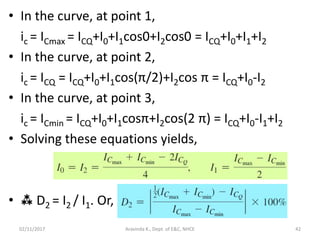
• Solving these equations yields,
•  D2 = I2 / I1. Or,
02/11/2017 Aravinda K., Dept. of E&C, NHCE 42
TRANSISTOR
POWER RATING
• The maximum power handled by a transistor is
specified at ambient temperature.
• When the temperature exceeds the ambient one,
then in order to prevent the destruction of the
transistor, either a larger heat sink has to be used,
or the power needs to be derated.
•  P2 = P1 - [(T2-T1)DF] where DF = Derating Factor.
02/11/2017 Aravinda K., Dept. of E&C, NHCE 43
Problem: Determine the maximum power
dissipation allowed for an 80 W Silicon transistor, if
derating is required above 25°C, by a derating factor
of 0.5 W/°C at a case temperature of 125°C.
Answer: Power at 125°C = 80-[(125-25)0.5] = 30 W.
02/11/2017 Aravinda K., Dept. of E&C, NHCE 44
CLASS C AMPLIFIER-INTRODUCTION
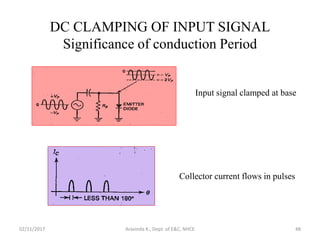
• In Class C operation, the collector current flows
for less than half cycle.
• The conduction period is less than 180˚
• The efficiency of class C amplifier is 100%
• Class C amplifier is intended to amplify narrow
band of frequencies on both sides of centre
frequency .
• The centre frequency is resonant frequency of
parallel resonant circuit connected at the
collector of Class C Amplifier.
02/11/2017 45Aravinda K., Dept. of E&C, NHCE
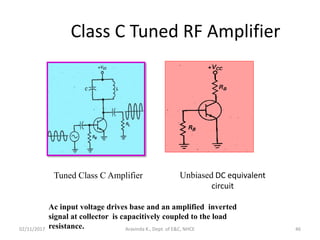
Class C Tuned RF Amplifier
Tuned Class C Amplifier Unbiased DC equivalent
circuit
Ac input voltage drives base and an amplified inverted
signal at collector is capacitively coupled to the load
resistance.02/11/2017 46Aravinda K., Dept. of E&C, NHCE
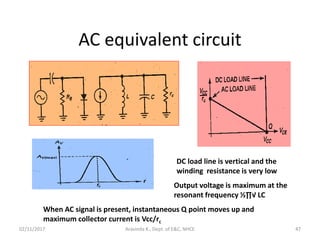
AC equivalent circuit
Output voltage is maximum at the
resonant frequency ½∏√ LC
DC load line is vertical and the
winding resistance is very low
When AC signal is present, instantaneous Q point moves up and
maximum collector current is Vcc/rc
02/11/2017 47Aravinda K., Dept. of E&C, NHCE
DC CLAMPING OF INPUT SIGNAL
Significance of conduction Period
Input signal clamped at base
Collector current flows in pulses
02/11/2017 48Aravinda K., Dept. of E&C, NHCE
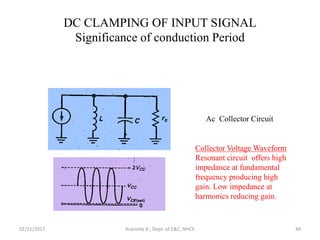
DC CLAMPING OF INPUT SIGNAL
Significance of conduction Period
Ac Collector Circuit
Collector Voltage Waveform
Resonant circuit offers high
impedance at fundamental
frequency producing high
gain. Low impedance at
harmonics reducing gain.
02/11/2017 49Aravinda K., Dept. of E&C, NHCE
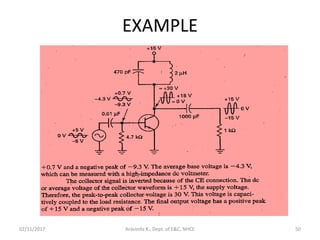
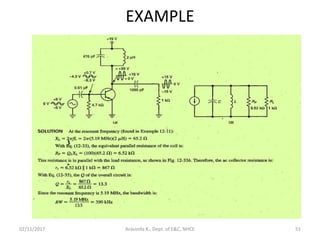
EXAMPLE
02/11/2017 50Aravinda K., Dept. of E&C, NHCE
EXAMPLE
02/11/2017 51Aravinda K., Dept. of E&C, NHCE
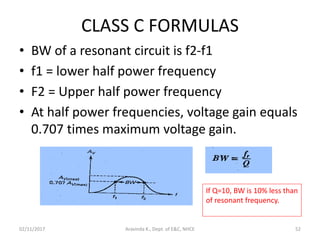
CLASS C FORMULAS
• BW of a resonant circuit is f2-f1
• f1 = lower half power frequency
• F2 = Upper half power frequency
• At half power frequencies, voltage gain equals
0.707 times maximum voltage gain.
If Q=10, BW is 10% less than
of resonant frequency.
02/11/2017 52Aravinda K., Dept. of E&C, NHCE
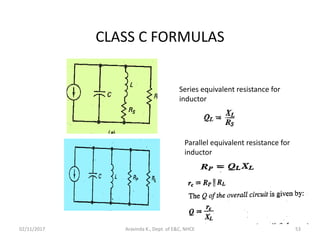
CLASS C FORMULAS
Series equivalent resistance for
inductor
Parallel equivalent resistance for
inductor
02/11/2017 53Aravinda K., Dept. of E&C, NHCE
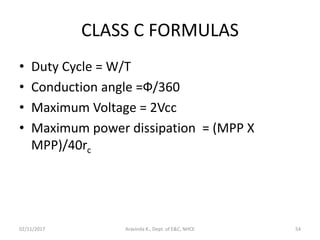
CLASS C FORMULAS
• Duty Cycle = W/T
• Conduction angle =Ф/360
• Maximum Voltage = 2Vcc
• Maximum power dissipation = (MPP X
MPP)/40rc
02/11/2017 54Aravinda K., Dept. of E&C, NHCE
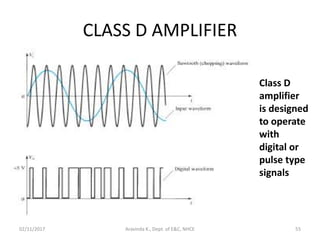
CLASS D AMPLIFIER
Class D
amplifier
is designed
to operate
with
digital or
pulse type
signals
02/11/2017 55Aravinda K., Dept. of E&C, NHCE
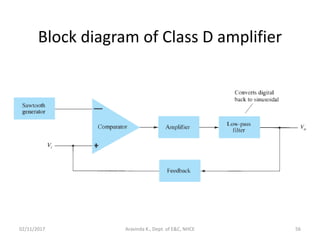
Block diagram of Class D amplifier
02/11/2017 56Aravinda K., Dept. of E&C, NHCE
02/11/2017 57Aravinda K., Dept. of E&C, NHCE
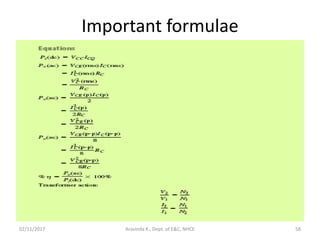
Important formulae
02/11/2017 58Aravinda K., Dept. of E&C, NHCE
02/11/2017 59Aravinda K., Dept. of E&C, NHCE

Analog Electronic Circuits - Module 5

  • 1.
  • 2.
    Classifications of amplifiers 1.Audio and Radio amplifiers 2. Wideband and Narrowband amplifiers 3. Small signal and Large signal amplifiers 02/11/2017 Aravinda K., Dept. of E&C, NHCE 2 Small signal amplifier Large signal amplifier Preamplifier (mW) Power amplifier (W) High voltage gain High current gain Part of load line Complete load line Linearity and gain Efficiency and impedance matching
  • 3.
    Types of coupling 02/11/2017Aravinda K., Dept. of E&C, NHCE 3 Capacitive coupling (HF) Transformer coupling (LF) Direct coupling (All frequencies)
  • 4.
    02/11/2017 Aravinda K.,Dept. of E&C, NHCE 4 Amplifier classes
  • 5.
    02/11/2017 Aravinda K.,Dept. of E&C, NHCE 5 Class C
  • 6.
    Amplifier type summary 02/11/2017Aravinda K., Dept. of E&C, NHCE 6 Class Output availability Quiescent point Operating region Efficiency A Complete 360° cycle VCEQ = VCC/2, ICQ = ICsat/2 Mid- active 25 - 50% AB In between 180° & 360° VCEQ > VCC/2, ICQ < ICsat/2 Above cut-off 50 - 78.5% B Only for 180° VCEQ = VCC & VEE, ICQ = 0 At cut-off ≤ 78.5% C Less than 180° VCEQ = VCC, ICQ = 0 Below Cut-off 78.5 - 90% D Pulse operation Switching type (PWM) Saturation & cut-off > 90%
  • 7.
    Two load lines •DC load line is with respect to the DC equivalent circuit. • AC load line is with respect to the AC equivalent circuit. • But the Q-point is the same with both of them. 02/11/2017 Aravinda K., Dept. of E&C, NHCE 7
  • 8.
    02/11/2017 Aravinda K.,Dept. of E&C, NHCE 8
  • 9.
    02/11/2017 Aravinda K.,Dept. of E&C, NHCE 9 AC load line has a higher slope than the DC load line. Rearranging & substituting the terms accordingly, the equation for the AC load line is obtained as, From the DC equivalent circuit, the equation for the DC load line is obtained as, ICQ = (VCC – VCEQ) / (RC + RE) The endpoints of the AC load line are -
  • 10.
    02/11/2017 Aravinda K.,Dept. of E&C, NHCE 10 UNFAITHFUL AMPLIFICATION FAITHFUL AMPLIFICATION The maximum peak output is, MP = ICQrc or VCEQ, whichever is smaller. Therefore, MPP = 2MP.
  • 11.
    02/11/2017 Aravinda K.,Dept. of E&C, NHCE 11 Exercise - 1 Determine the DC and AC load line endpoints, and also find the maximum peak-to-peak output voltage:
  • 12.
    i) DC loadline: VBB = (68 X 30) / (490 + 68) = 3.66 V ICQ = IE = (3.66 – 0.7) / 20 = 148 mA VCEQ = 30 – (0.148 X 140) = 9.28 V IC(sat) = 30 / 140 = 214 mA, and, VCE(cut-off) = VCC = 30 V ii) AC load line: rc = 120 || 180 = 72 Ω ic(sat) = 0.148 + (9.28 / 72) = 277 mA vce(cut-off) = 9.28 + (0.148 X 72) = 9.28 + 10.66 = 19.94 V  MP = 9.28 V and MPP = 2 X 9.28 = 18.56 V 02/11/2017 Aravinda K., Dept. of E&C, NHCE 12 Solution
  • 13.
    02/11/2017 Aravinda K.,Dept. of E&C, NHCE 13 Exercise - 2 Determine the DC and AC load line endpoints, and also find the MPP output voltage, for the Emitter follower power amplifier:
  • 14.
    i) DC loadline: VBB = (100 X 12) / (50 + 100) = 8 V ICQ = IE = (8 – 0.7) / 16 = 456 mA VCEQ = 12 – (0.456 X 16) = 4.7 V IC(sat) = 12 / 16 = 750 mA, and, VCE(cut-off) = VCC = 12 V ii) AC load line: re = 16 || 16 = 8 Ω ic(sat) = 0.456 + (4.7 / 8) = 1.04 A vce(cut-off) = 4.7 + (0.456 X 8) = 4.7 + 3.65 = 8.35 V  MP = 3.65 V and MPP = 2 X 3.65 = 7.3 V 02/11/2017 Aravinda K., Dept. of E&C, NHCE 14 Solution
  • 15.
    Class A Operation i)Power gain = (Pout / Pin) X 100% Pout = vrms 2 / RL = vout 2 / 8RL = MPP2 / 8RL Pin = vin 2 / 8Zin ii) Efficiency, η = (Pac / Pdc) X 100% Pac = vout 2 / 8RL Pdc = Vcc X Idc 02/11/2017 Aravinda K., Dept. of E&C, NHCE 15
  • 16.
    02/11/2017 Aravinda K.,Dept. of E&C, NHCE 16 Exercise - 3 Find out the transistor power dissipation, power gain and efficiency for the circuit given in Exercise - 1, if the input voltage is 200 mVpp, output voltage is 18 Vpp and the input impedance of the base is 100 Ω.
  • 17.
    02/11/2017 Aravinda K.,Dept. of E&C, NHCE 17 Solution i) Transistor power dissipation = 9.28 X 0.148 = 1.37 W ii) Output power = 182 / (8 X 180) = 225 mW Input power = 0.22 / 8 (490 || 68 || 100) = 0.134 mW  Power gain = 225 / 0.134 = 1679 iii) IB = 30 / (490 + 68) = 53.76 mA Idc = IB + ICQ = 53.76 + 148 = 201.76 mA Pdc = 30 X 0.20176 = 6.05 W  Efficiency = 0.225 / 6.05 = 3.72%
  • 18.
    Class A amplifierwith fixed bias Maximum Vo(ac) = VCC/2√2 Maximum Io(ac) = VCC/(2√2RC)  Maximum Po(ac) = VCC 2/8RC Maximum Vi(dc) = VCC Maximum Ii(dc) = VCC/(2RC)  Maximum Pi(dc) = VCC 2/2RC Hence, maximum η = 2/8 = 25% 02/11/2017 Aravinda K., Dept. of E&C, NHCE 18
  • 19.
    02/11/2017 Aravinda K.,Dept. of E&C, NHCE 19 Exercise - 4 Calculate the efficiency of the amplifier circuit, for an input voltage that results in a base current of 10 mA peak.
  • 20.
    Solution IBQ = (20- 0.7) / 1K = 19.3 mA ICQ = 19.3 mA X 25 = 482.5 mA  Pi(dc) = 20 X (19.3 + 482.5)m = 10.036 W ic (rms) = (10 mA X 25) / √2 = 177 mA  Po(ac) = (177 mA)2 X 20 Ω = 626.58 mW  Efficiency = 0.62658 / 10.036 = 6.24% 02/11/2017 Aravinda K., Dept. of E&C, NHCE 20
  • 21.
    TRANSFORMER-COUPLED CLASS AAMPLIFIER (Impedance transformation for better efficiency) • If RL ′ is the impedance seen at the primary side, then, • Thus, when a step-down transformer is used for signal coupling, the impedance seen at the primary side is larger than the load resistance, and the value of ic gets reduced. 02/11/2017 Aravinda K., Dept. of E&C, NHCE 21 where a = turns ratio
  • 22.
    02/11/2017 Aravinda K.,Dept. of E&C, NHCE 22 Exercise - 5: For the fixed bias transformer-coupled Class A amplifier, if the load is a speaker of resistance 16 Ω, find the turns ratio of the transformer such that the effective primary resistance is 10 KΩ. Also, find the value of ac current when VCC = 12 V. Solution: N1 / N2 = √ (10 K / 16) = 25. ic = VCEQ / RL ′ = VCC / RL ′ = 12 / 10 K = 1.2 mA.
  • 23.
    Efficiency calculations (From thecharacteristic curves) vce(pp) = vce(max) - vce(min) ic(pp) = ic(max) - ic(min)  Po(ac) = (vce(max) - vce(min))(ic(max) - ic(min)) / 8 and, Pi(dc) = VCC X ICQ • The maximum theoretical efficiency can be up to 50%, and it is given by: • The power dissipated by the transistor is, PQ = Pi(dc) - Po(ac) 02/11/2017 Aravinda K., Dept. of E&C, NHCE 23
  • 24.
    02/11/2017 Aravinda K.,Dept. of E&C, NHCE 24 Exercise - 6 Calculate the efficiency of a transformer-coupled Class A amplifier for a supply of 12 V and peak output of 10 V. Solution: vce(max) = VCEQ + vp = 12 + 10 = 22 V vce(min) = VCEQ - vp = 12 - 10 = 2 V  η = 50 (22 - 2) / (22 + 2) = 41.67%
  • 25.
    CLASS B AMPLIFIEROPERATION 02/11/2017 Aravinda K., Dept. of E&C, NHCE 25 1. This operation is provided when the transistor to be turned ON when AC signal is applied. 2. Thus no DC bias and transistor conducts for only one half of i/p signal cycle 3. The output can be obtained for complete full cycle with the push pull circuit configuration as seen in Fig. 4. Power transistors in push pull circuit deliver desired power to load and hence provide more efficiency than Class A amplifiers
  • 26.
    Efficiency of ClassB Power Amplifier 02/11/2017 Aravinda K., Dept. of E&C, NHCE 26 Input DC Power Output AC Power Maximum Power efficiency When VL(p) = Vcc, η = 78.57 % Power dissipated by the transistors
  • 27.
    02/11/2017 Aravinda K.,Dept. of E&C, NHCE 27 Problem: Class B amplifier is providing 20 V peak signal to a 16 Ω load and a power supply of Vcc = 30 V; determine input power, output power and circuit efficiency. Solution: IL(p) = 20/16 = 1.25 A Idc = (2X1.25) / 3.14 = 0.796 A Pi (dc)= 30X0.796 = 23.88 W Po (ac)= 202 / (2X16) = 12.5 W Efficiency, η = 12.5 / 23.88 = 52.35 %
  • 28.
    02/11/2017 Aravinda K.,Dept. of E&C, NHCE 28 Maximum Power Considerations: Maximum output power : Maximum input power : Maximum Power dissipated by each Transistor: Maximum Power dissipated by output transistors :
  • 29.
    Phase Splitter Circuits 02/11/2017Aravinda K., Dept. of E&C, NHCE 29 Phase splitting with Center-Tapped Transformer Phase splitting using BJT Phase splitting using OPAMP
  • 30.
    Transformer Coupled Push-PullAmplifier 02/11/2017 Aravinda K., Dept. of E&C, NHCE 30 During 1st half cycle -> Q1 conducts & During 2nd half cycle -> Q2 conducts. Overall Signal developed varies over full cycle of operation.
  • 31.
    Complementary Push PullCircuits 02/11/2017 Aravinda K., Dept. of E&C, NHCE 31 • Using NPN and PNP transistors it is possible to obtain a full cycle output across load • Disadvantage of this configuration is “CROSS-OVER DISTORTION” • NPN is ON -> During +ve half cycle & PNP is ON -> During –ve half cycle
  • 32.
    Class AB operation •To eliminate cross-over distortion, a slight forward bias needs to be applied to each BE junction. This means that the Q-point gets located slightly above cut-off. • In general, an ICQ from 1% to 5% of IC(sat) is enough to eliminate crossover distortion. • Because of this slight forward bias, the conduction angle will be slightly greater than 180°, and hence, this operation is referred to as Class AB. 02/11/2017 Aravinda K., Dept. of E&C, NHCE 32
  • 33.
    Examples for Class-AB 02/11/2017Aravinda K., Dept. of E&C, NHCE 33 VOLTAGE DIVIDER BIAS DIODE BIAS The input signal is applied at the junction of R2 / diodes.
  • 34.
    02/11/2017 Aravinda K.,Dept. of E&C, NHCE 34 Quasi-complementary Push Pull Circuit
  • 35.
    Problem on Comp.Push-Pull Amplifier 02/11/2017 Aravinda K., Dept. of E&C, NHCE 35 Calculate input Power, Output Power, Power handled by each transistor and circuit efficiency if Input = 12V rms, +Vcc=25 V, -Vcc = -25 V, RL= 4Ω Solution: Vi(p)=17 V VL(P)= 17 (since Av=1) IL(p)=4.25 A Idc= 2.71 A Pi (dc)= 67.75 W Po( ac)= 36.125 W Efficiency η = 53.3 % PQ=15.8 W
  • 36.
    02/11/2017 Aravinda K.,Dept. of E&C, NHCE 36 Calculate the maximum input Power , Maximum output power , input voltage for maximum power operation and power dissipated by the output transistor for the same circuit. Maximum Input Power = 99.47 W Maximum Output Power = 78.125 W Maximum Efficiency = 78.54 % Input voltage for maximum Power = 25 V Power dissipated by output transistors= 21.3 W
  • 37.
    AMPLIFIER DISTORTION • Apure sinusoidal signal has equal amounts of variation in positive and negative cycles. • But if any signal varies over less than the full 360° cycle, then it is called as “distortion”. • Amplitude distortion occurs due to the non- linear device characteristics. • Frequency distortion occurs due to the difference in frequency response of the circuit elements. 02/11/2017 Aravinda K., Dept. of E&C, NHCE 37
  • 38.
    • The Fourieranalysis defines the signal as the fundamental frequency, and its integer multiples as the harmonics. • Therefore, the distorted signal contains the fundamental frequency along with the second harmonic, third harmonic, and so on, but with reducing amplitudes. • Total harmonic distortion is given by, 02/11/2017 Aravinda K., Dept. of E&C, NHCE 38
  • 39.
    02/11/2017 Aravinda K.,Dept. of E&C, NHCE 39 DISTORTION DUE TO SECOND HARMONIC
  • 40.
    Problem: Calculate thetotal harmonic distortion for an output signal having the fundamental amplitude of 2.5 V, second harmonic amplitude of 0.25 V, third harmonic amplitude of 0.1 V, and fourth harmonic amplitude of 0.05 V. Answer: D2=0.25/2.5=0.1, D3=0.1/2.5=0.04, D4=0.05/2.5=0.02. % THD = (sqrt (0.12 + 0.042 + 0.022)) X 100 = 10.95% 02/11/2017 Aravinda K., Dept. of E&C, NHCE 40
  • 41.
    Expression for 2nd harmonic distortion •The instantaneous current is given by, ic = ICQ + I0 + I1cosωt + I2cos2ωt where ICQ = quiescent current, I0 = additional dc current, I1cosωt = fundamental component, I2cos2ωt = second harmonic component. 02/11/2017 Aravinda K., Dept. of E&C, NHCE 41
  • 42.
    • In thecurve, at point 1, ic = ICmax = ICQ+I0+I1cos0+I2cos0 = ICQ+I0+I1+I2 • In the curve, at point 2, ic = ICQ = ICQ+I0+I1cos(π/2)+I2cos π = ICQ+I0-I2 • In the curve, at point 3, ic = ICmin = ICQ+I0+I1cosπ+I2cos(2 π) = ICQ+I0-I1+I2 • Solving these equations yields, •  D2 = I2 / I1. Or, 02/11/2017 Aravinda K., Dept. of E&C, NHCE 42
  • 43.
    TRANSISTOR POWER RATING • Themaximum power handled by a transistor is specified at ambient temperature. • When the temperature exceeds the ambient one, then in order to prevent the destruction of the transistor, either a larger heat sink has to be used, or the power needs to be derated. •  P2 = P1 - [(T2-T1)DF] where DF = Derating Factor. 02/11/2017 Aravinda K., Dept. of E&C, NHCE 43
  • 44.
    Problem: Determine themaximum power dissipation allowed for an 80 W Silicon transistor, if derating is required above 25°C, by a derating factor of 0.5 W/°C at a case temperature of 125°C. Answer: Power at 125°C = 80-[(125-25)0.5] = 30 W. 02/11/2017 Aravinda K., Dept. of E&C, NHCE 44
  • 45.
    CLASS C AMPLIFIER-INTRODUCTION •In Class C operation, the collector current flows for less than half cycle. • The conduction period is less than 180˚ • The efficiency of class C amplifier is 100% • Class C amplifier is intended to amplify narrow band of frequencies on both sides of centre frequency . • The centre frequency is resonant frequency of parallel resonant circuit connected at the collector of Class C Amplifier. 02/11/2017 45Aravinda K., Dept. of E&C, NHCE
  • 46.
    Class C TunedRF Amplifier Tuned Class C Amplifier Unbiased DC equivalent circuit Ac input voltage drives base and an amplified inverted signal at collector is capacitively coupled to the load resistance.02/11/2017 46Aravinda K., Dept. of E&C, NHCE
  • 47.
    AC equivalent circuit Outputvoltage is maximum at the resonant frequency ½∏√ LC DC load line is vertical and the winding resistance is very low When AC signal is present, instantaneous Q point moves up and maximum collector current is Vcc/rc 02/11/2017 47Aravinda K., Dept. of E&C, NHCE
  • 48.
    DC CLAMPING OFINPUT SIGNAL Significance of conduction Period Input signal clamped at base Collector current flows in pulses 02/11/2017 48Aravinda K., Dept. of E&C, NHCE
  • 49.
    DC CLAMPING OFINPUT SIGNAL Significance of conduction Period Ac Collector Circuit Collector Voltage Waveform Resonant circuit offers high impedance at fundamental frequency producing high gain. Low impedance at harmonics reducing gain. 02/11/2017 49Aravinda K., Dept. of E&C, NHCE
  • 50.
  • 51.
  • 52.
    CLASS C FORMULAS •BW of a resonant circuit is f2-f1 • f1 = lower half power frequency • F2 = Upper half power frequency • At half power frequencies, voltage gain equals 0.707 times maximum voltage gain. If Q=10, BW is 10% less than of resonant frequency. 02/11/2017 52Aravinda K., Dept. of E&C, NHCE
  • 53.
    CLASS C FORMULAS Seriesequivalent resistance for inductor Parallel equivalent resistance for inductor 02/11/2017 53Aravinda K., Dept. of E&C, NHCE
  • 54.
    CLASS C FORMULAS •Duty Cycle = W/T • Conduction angle =Ф/360 • Maximum Voltage = 2Vcc • Maximum power dissipation = (MPP X MPP)/40rc 02/11/2017 54Aravinda K., Dept. of E&C, NHCE
  • 55.
    CLASS D AMPLIFIER ClassD amplifier is designed to operate with digital or pulse type signals 02/11/2017 55Aravinda K., Dept. of E&C, NHCE
  • 56.
    Block diagram ofClass D amplifier 02/11/2017 56Aravinda K., Dept. of E&C, NHCE
  • 57.
    02/11/2017 57Aravinda K.,Dept. of E&C, NHCE
  • 58.
  • 59.
    02/11/2017 59Aravinda K.,Dept. of E&C, NHCE