L-16 and 17
Biochemical Oxygen Demand
(BOD)
Environmental Engineering-II
Definition
• Biochemical oxygen demand or
B.O.D. is the amount of dissolved
oxygen needed by aerobic biological
organisms in a body of water ororganisms in a body of water or
wastewater sample to break down
organic material present in a given
water or wastewater sample at certain
temperature (200C) over a specific
time period (5 days).
• Used to assess the relative strength of
a waste
• The amount of oxygen required to
stabilize a waste if discharged to a
surface water.surface water.
• This is not a precise quantitative test,
although it is widely used as an
indication of the organic quality of
water.
• The BOD value is most commonly
expressed in milligrams of oxygen
consumed per litre of sample duringconsumed per litre of sample during
5 days of incubation at 20 °C and
is often used as a indicator of the
degree of organic pollution of
water.
Background
• Most natural waters and wastewaters
contain small quantities of organic
compounds.
• Aquatic microorganisms have evolved
to use some of these compounds asto use some of these compounds as
food.
• Microorganisms living in oxygenated
waters use dissolved oxygen to convert
the organic compounds into energy for
growth and reproduction.
• Populations of these
microorganisms tend to increase
in proportion to the amount of
food available.
• This microbial metabolism
creates an oxygen demand
proportional to the amount of
organic compounds useful as
food.
• Under some circumstances,
microbial metabolism can consume
dissolved oxygen faster than
atmospheric oxygen can dissolve into
the water.the water.
• Fish and aquatic animals and plants
may die when oxygen is depleted by
microbial metabolism
Types of BOD
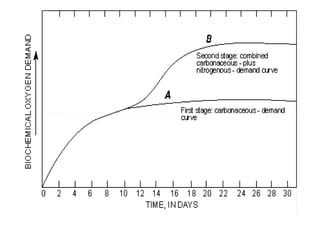
• There are two stages of
decomposition in the BOD test:
i. a carbonaceous stage and
ii. a nitrogenous stage.ii. a nitrogenous stage.
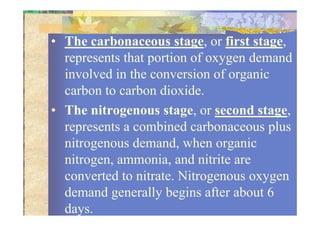
• The carbonaceous stage, or first stage,
represents that portion of oxygen demand
involved in the conversion of organic
carbon to carbon dioxide.
• The nitrogenous stage, or second stage,• The nitrogenous stage, or second stage,
represents a combined carbonaceous plus
nitrogenous demand, when organic
nitrogen, ammonia, and nitrite are
converted to nitrate. Nitrogenous oxygen
demand generally begins after about 6
days.
TEST
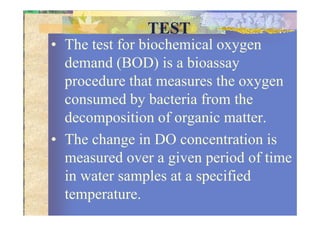
• The test for biochemical oxygen
demand (BOD) is a bioassay
procedure that measures the oxygen
consumed by bacteria from the
decomposition of organic matter.decomposition of organic matter.
• The change in DO concentration is
measured over a given period of time
in water samples at a specified
temperature.
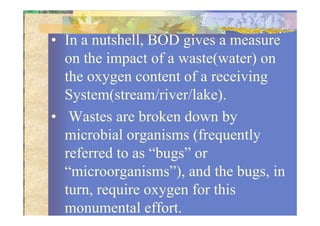
• In a nutshell, BOD gives a measure
on the impact of a waste(water) on
the oxygen content of a receiving
System(stream/river/lake).
• Wastes are broken down by• Wastes are broken down by
microbial organisms (frequently
referred to as “bugs” or
“microorganisms”), and the bugs, in
turn, require oxygen for this
monumental effort.
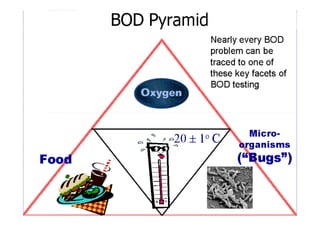
• Thus, in order for this test to "work",
you need
(1) a food source (Organic matter),
(2) a nice population of bugs,(2) a nice population of bugs,
(3) available oxygen (DO) to drive
the bugs, and
(4) a system which provides a
hospitable environment for the
bugs (incubation temp.).
Procedure
A. Dilution
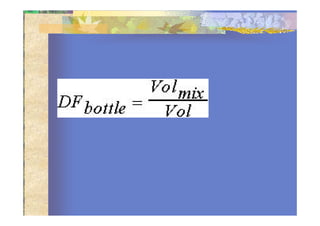
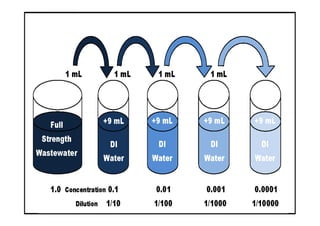
• Dilution Factor. The dilution factor, DF,
is the ratio of the final volume (e.g., for
the bottle method, the volume of the BOD
bottle, usually 300 mL; for the graduated
cylinder method, the volume of thecylinder method, the volume of the
cylinder, usually 1,000 mL) to the volume
of sample therein. DF for the bottle
method = Volume of Diluted
Mixture/Volume of Sample in Mixture.
B. DO fixation
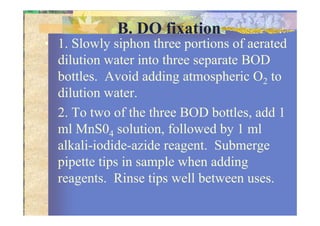
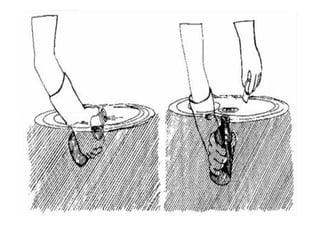
• 1. Slowly siphon three portions of aerated
dilution water into three separate BOD
bottles. Avoid adding atmospheric O2 to
dilution water.
2. To two of the three BOD bottles, add 12. To two of the three BOD bottles, add 1
ml MnS04 solution, followed by 1 ml
alkali-iodide-azide reagent. Submerge
pipette tips in sample when adding
reagents. Rinse tips well between uses.
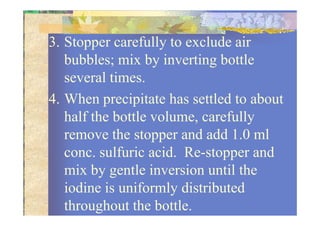
3. Stopper carefully to exclude air
bubbles; mix by inverting bottle
several times.
4. When precipitate has settled to about
half the bottle volume, carefullyhalf the bottle volume, carefully
remove the stopper and add 1.0 ml
conc. sulfuric acid. Re-stopper and
mix by gentle inversion until the
iodine is uniformly distributed
throughout the bottle.
C. DO Measurement
5. Transfer 203 ml of sample into conical
flask and titrate with 0.0250N sodium
thiosulfate to a pale straw color.
6. Add 1-2 ml of starch solution and
continue to titrate to first disappearancecontinue to titrate to first disappearance
of the blue color. (200 ml of original
dilution water is equal to 203 ml of
dilution water plus reagents.)
•
• Determine the initial
concentration of dissolved
oxygen in one bottle of the
mixture of sample and dilution
water (DO ), and in one of thewater (DOinitial), and in one of the
bottles containing only dilution
water.
• Place the other bottles in the
incubator
• Incubate the blank dilution water and the
diluted samples for 5 days in the dark at
20 °C.
• After 5 days, remove the bottles, fix the
DO and measure the DO (DOfinal)DO and measure the DO (DOfinal)
• Calculate BOD5
• BOD5 (mg/L) = {DOinitial (mg/L) of first
bottle - DOfinal (mg/L) of second bottle}
x dilution factor
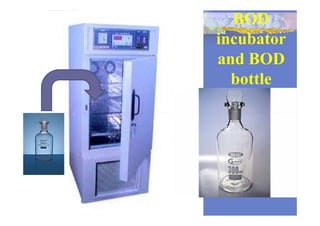
BOD
incubator
and BOD
bottle
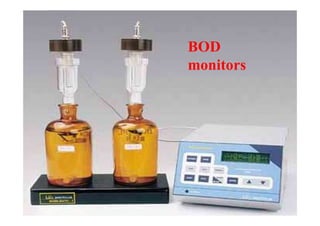
BOD
monitors
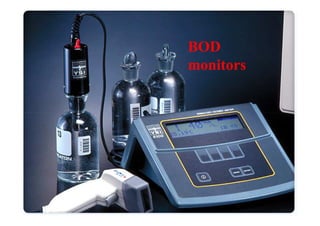
BOD
monitors
Chemical Oxygen Demand (COD)
• Like BOD, COD provides a measure
of the amount of organic compounds
in water. The difference is that COD
is less specific since it measuresis less specific since it measures
everything that can be chemically
oxidized rather than just levels of
bio-degradable organic matter.
• COD also is different in that it reflects the
oxidation based on a specific chemical
oxidant (dichromate).
• COD value is always greater than
BOD for every wastewater sample.BOD for every wastewater sample.
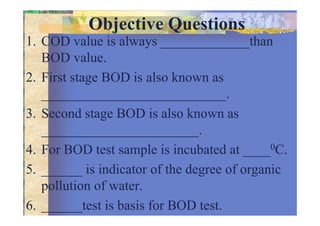
Objective Questions
1. COD value is always _____________than
BOD value.
2. First stage BOD is also known as
___________________________.
3. Second stage BOD is also known as3. Second stage BOD is also known as
_______________________.
4. For BOD test sample is incubated at ____0C.
5. ______ is indicator of the degree of organic
pollution of water.
6. ______test is basis for BOD test.
Theory Questions
Q1. Define the following
i. BOD
ii. Dilution factor
iii. COD
Q2. Explain ‘BOD test’.

L 16 and 17 bod

  • 1.
    L-16 and 17 BiochemicalOxygen Demand (BOD) Environmental Engineering-II
  • 2.
    Definition • Biochemical oxygendemand or B.O.D. is the amount of dissolved oxygen needed by aerobic biological organisms in a body of water ororganisms in a body of water or wastewater sample to break down organic material present in a given water or wastewater sample at certain temperature (200C) over a specific time period (5 days).
  • 3.
    • Used toassess the relative strength of a waste • The amount of oxygen required to stabilize a waste if discharged to a surface water.surface water. • This is not a precise quantitative test, although it is widely used as an indication of the organic quality of water.
  • 4.
    • The BODvalue is most commonly expressed in milligrams of oxygen consumed per litre of sample duringconsumed per litre of sample during 5 days of incubation at 20 °C and is often used as a indicator of the degree of organic pollution of water.
  • 5.
    Background • Most naturalwaters and wastewaters contain small quantities of organic compounds. • Aquatic microorganisms have evolved to use some of these compounds asto use some of these compounds as food. • Microorganisms living in oxygenated waters use dissolved oxygen to convert the organic compounds into energy for growth and reproduction.
  • 6.
    • Populations ofthese microorganisms tend to increase in proportion to the amount of food available. • This microbial metabolism creates an oxygen demand proportional to the amount of organic compounds useful as food.
  • 7.
    • Under somecircumstances, microbial metabolism can consume dissolved oxygen faster than atmospheric oxygen can dissolve into the water.the water. • Fish and aquatic animals and plants may die when oxygen is depleted by microbial metabolism
  • 8.
    Types of BOD •There are two stages of decomposition in the BOD test: i. a carbonaceous stage and ii. a nitrogenous stage.ii. a nitrogenous stage.
  • 9.
    • The carbonaceousstage, or first stage, represents that portion of oxygen demand involved in the conversion of organic carbon to carbon dioxide. • The nitrogenous stage, or second stage,• The nitrogenous stage, or second stage, represents a combined carbonaceous plus nitrogenous demand, when organic nitrogen, ammonia, and nitrite are converted to nitrate. Nitrogenous oxygen demand generally begins after about 6 days.
  • 11.
    TEST • The testfor biochemical oxygen demand (BOD) is a bioassay procedure that measures the oxygen consumed by bacteria from the decomposition of organic matter.decomposition of organic matter. • The change in DO concentration is measured over a given period of time in water samples at a specified temperature.
  • 12.
    • In anutshell, BOD gives a measure on the impact of a waste(water) on the oxygen content of a receiving System(stream/river/lake). • Wastes are broken down by• Wastes are broken down by microbial organisms (frequently referred to as “bugs” or “microorganisms”), and the bugs, in turn, require oxygen for this monumental effort.
  • 13.
    • Thus, inorder for this test to "work", you need (1) a food source (Organic matter), (2) a nice population of bugs,(2) a nice population of bugs, (3) available oxygen (DO) to drive the bugs, and (4) a system which provides a hospitable environment for the bugs (incubation temp.).
  • 15.
    Procedure A. Dilution • DilutionFactor. The dilution factor, DF, is the ratio of the final volume (e.g., for the bottle method, the volume of the BOD bottle, usually 300 mL; for the graduated cylinder method, the volume of thecylinder method, the volume of the cylinder, usually 1,000 mL) to the volume of sample therein. DF for the bottle method = Volume of Diluted Mixture/Volume of Sample in Mixture.
  • 18.
    B. DO fixation •1. Slowly siphon three portions of aerated dilution water into three separate BOD bottles. Avoid adding atmospheric O2 to dilution water. 2. To two of the three BOD bottles, add 12. To two of the three BOD bottles, add 1 ml MnS04 solution, followed by 1 ml alkali-iodide-azide reagent. Submerge pipette tips in sample when adding reagents. Rinse tips well between uses.
  • 20.
    3. Stopper carefullyto exclude air bubbles; mix by inverting bottle several times. 4. When precipitate has settled to about half the bottle volume, carefullyhalf the bottle volume, carefully remove the stopper and add 1.0 ml conc. sulfuric acid. Re-stopper and mix by gentle inversion until the iodine is uniformly distributed throughout the bottle.
  • 21.
    C. DO Measurement 5.Transfer 203 ml of sample into conical flask and titrate with 0.0250N sodium thiosulfate to a pale straw color. 6. Add 1-2 ml of starch solution and continue to titrate to first disappearancecontinue to titrate to first disappearance of the blue color. (200 ml of original dilution water is equal to 203 ml of dilution water plus reagents.) •
  • 22.
    • Determine theinitial concentration of dissolved oxygen in one bottle of the mixture of sample and dilution water (DO ), and in one of thewater (DOinitial), and in one of the bottles containing only dilution water. • Place the other bottles in the incubator
  • 23.
    • Incubate theblank dilution water and the diluted samples for 5 days in the dark at 20 °C. • After 5 days, remove the bottles, fix the DO and measure the DO (DOfinal)DO and measure the DO (DOfinal) • Calculate BOD5 • BOD5 (mg/L) = {DOinitial (mg/L) of first bottle - DOfinal (mg/L) of second bottle} x dilution factor
  • 24.
  • 25.
  • 26.
  • 27.
    Chemical Oxygen Demand(COD) • Like BOD, COD provides a measure of the amount of organic compounds in water. The difference is that COD is less specific since it measuresis less specific since it measures everything that can be chemically oxidized rather than just levels of bio-degradable organic matter.
  • 28.
    • COD alsois different in that it reflects the oxidation based on a specific chemical oxidant (dichromate). • COD value is always greater than BOD for every wastewater sample.BOD for every wastewater sample.
  • 29.
    Objective Questions 1. CODvalue is always _____________than BOD value. 2. First stage BOD is also known as ___________________________. 3. Second stage BOD is also known as3. Second stage BOD is also known as _______________________. 4. For BOD test sample is incubated at ____0C. 5. ______ is indicator of the degree of organic pollution of water. 6. ______test is basis for BOD test.
  • 30.
    Theory Questions Q1. Definethe following i. BOD ii. Dilution factor iii. COD Q2. Explain ‘BOD test’.