SEWAGE TREATMENT: 
1 
By- 
VIJAY KARHALE 
SHANKAR DHADAM 
AKASHAY ZENDE 
SHAILESH BANGAR 
GAJANAN GUTTHE
Sewage: 
It is an domestic sewage comprises spent water from kitchens ,bathrooms, 
lavatories etc. 
Sewage is nearly 99.9% water and 0.1% waste matter. 
It is this small amount of effluents that bring about grossly polluted 
conditions. 
2
Sewage Characteristics 
Physical Characteristics 
Chemical Characteristics 
Biological Characteristics 
3
Sewage Characteristics Table: 
Item Range Of Value Contributed in Waste 
Water(mg/l) 
BOD5 170-250 
COD (1.6-1.9) BOD5 
Total Solids 600-800 
Suspended Solids 400-600 
Grit 20-55 
Oil and Grease 60-120 
Phosphorus 03-15 
Nitrogen 40-80 
4
Pollutional Effects Of Sewage 
The Following materials can cause pollution 
1) Organic Matter 
2) Suspended Solids 
3) Oils and Greases 
4) Micro Organisms 
5
Treatment Of Sewage 
Preliminary Treatment 
Primary Treatment 
Secondary Treatment 
Tertiary Treatment 
6
Preliminary Treatment 
7 
It consists of Screens and Grit Chambers units. 
1) Screens 
Coarse Screens(50mm to 75mm) 
Medium Screens(20mm to 50mm) 
Fine Screens(Less than 20mm) 
2) Grit Chambers 
It removes sand, gravel, silt, cinders, broken glass, inorganic solids, 
eggshells, bone chips, etc.
Primary Treatment 
8 
The tanks are used to settle sludge while grease and oils rise to the surface 
and are skimmed off. 
Fig. Primary Sedimentation tank.
Primary Sedimentation Tank: 
BOD removal is 30 to 35 % 
Suspended solids removal 50 to 60 % 
Detention Time 2 to 2.5 hours 
Average Over flow Rate is 35 to 50 m3/m2/D 
9
Secondary Treatment 
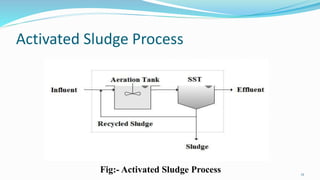
It consists of Activated sludge process and Secondary Sedimentation. 
Activated sludge process: 
It is an aerobic process, in which oxygen is supplied from outside. 
In this process microorganism convert or reduce organic content of sewage. 
1) Oxidation: 
COHNP + O2 + Microorganism CO2+ H2O + NH3 + End Products + 
(Organic Matter) +Energy 
10
Activated Sludge Process 
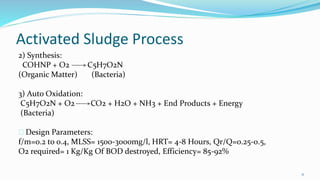
2) Synthesis: 
COHNP + O2 C5H7O2N 
(Organic Matter) (Bacteria) 
3) Auto Oxidation: 
C5H7O2N + O2 CO2 + H2O + NH3 + End Products + Energy 
(Bacteria) 
Design Parameters: 
f/m=0.2 to 0.4, MLSS= 1500-3000mg/l, HRT= 4-8 Hours, Qr/Q=0.25-0.5, 
O2 required= 1 Kg/Kg Of BOD destroyed, Efficiency= 85-92% 
11
Activated Sludge Process 
12 Fig:- Activated Sludge Process
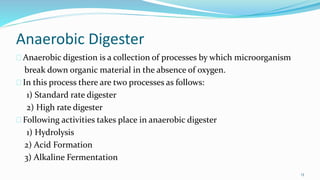
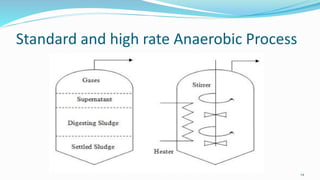
Anaerobic Digester 
Anaerobic digestion is a collection of processes by which microorganism 
break down organic material in the absence of oxygen. 
In this process there are two processes as follows: 
1) Standard rate digester 
2) High rate digester 
Following activities takes place in anaerobic digester 
1) Hydrolysis 
2) Acid Formation 
3) Alkaline Fermentation 
13
Standard and high rate Anaerobic Process 
14
Sludge Drying Bed 
15 
Sludge is dewatered to reduce the volumes so that it is easy for 
transportation to disposal site.
Chlorination 
The purpose of chlorination in the treatment of waste water is to 
substantially reduce the number of microorganisms in the water to be 
discharged back into the environment for the later use of drinking, 
bathing, irrigation, etc. 
16
Flow Diagram For Sewage Treatment 
17
References: 
Sewage manual 
http://nzic.org.nz/ChemProcesses 
http://water.worldbank.org/shw-resource-guide/infrastructure/menu-technical- 
options/wastewater-treatment 
http://www.fao.org/docrep/t0551e/t0551e05.htm 
http://www.actew.com.au/Water%20and%20Sewerage%20Systems/ACT 
%20Sewerage%20System/What%20is%20sewage/Sewage%20Treatment% 
20Process.aspx 
18
19

Sewage ppt new vijay2

  • 1.
    SEWAGE TREATMENT: 1 By- VIJAY KARHALE SHANKAR DHADAM AKASHAY ZENDE SHAILESH BANGAR GAJANAN GUTTHE
  • 2.
    Sewage: It isan domestic sewage comprises spent water from kitchens ,bathrooms, lavatories etc. Sewage is nearly 99.9% water and 0.1% waste matter. It is this small amount of effluents that bring about grossly polluted conditions. 2
  • 3.
    Sewage Characteristics PhysicalCharacteristics Chemical Characteristics Biological Characteristics 3
  • 4.
    Sewage Characteristics Table: Item Range Of Value Contributed in Waste Water(mg/l) BOD5 170-250 COD (1.6-1.9) BOD5 Total Solids 600-800 Suspended Solids 400-600 Grit 20-55 Oil and Grease 60-120 Phosphorus 03-15 Nitrogen 40-80 4
  • 5.
    Pollutional Effects OfSewage The Following materials can cause pollution 1) Organic Matter 2) Suspended Solids 3) Oils and Greases 4) Micro Organisms 5
  • 6.
    Treatment Of Sewage Preliminary Treatment Primary Treatment Secondary Treatment Tertiary Treatment 6
  • 7.
    Preliminary Treatment 7 It consists of Screens and Grit Chambers units. 1) Screens Coarse Screens(50mm to 75mm) Medium Screens(20mm to 50mm) Fine Screens(Less than 20mm) 2) Grit Chambers It removes sand, gravel, silt, cinders, broken glass, inorganic solids, eggshells, bone chips, etc.
  • 8.
    Primary Treatment 8 The tanks are used to settle sludge while grease and oils rise to the surface and are skimmed off. Fig. Primary Sedimentation tank.
  • 9.
    Primary Sedimentation Tank: BOD removal is 30 to 35 % Suspended solids removal 50 to 60 % Detention Time 2 to 2.5 hours Average Over flow Rate is 35 to 50 m3/m2/D 9
  • 10.
    Secondary Treatment Itconsists of Activated sludge process and Secondary Sedimentation. Activated sludge process: It is an aerobic process, in which oxygen is supplied from outside. In this process microorganism convert or reduce organic content of sewage. 1) Oxidation: COHNP + O2 + Microorganism CO2+ H2O + NH3 + End Products + (Organic Matter) +Energy 10
  • 11.
    Activated Sludge Process 2) Synthesis: COHNP + O2 C5H7O2N (Organic Matter) (Bacteria) 3) Auto Oxidation: C5H7O2N + O2 CO2 + H2O + NH3 + End Products + Energy (Bacteria) Design Parameters: f/m=0.2 to 0.4, MLSS= 1500-3000mg/l, HRT= 4-8 Hours, Qr/Q=0.25-0.5, O2 required= 1 Kg/Kg Of BOD destroyed, Efficiency= 85-92% 11
  • 12.
    Activated Sludge Process 12 Fig:- Activated Sludge Process
  • 13.
    Anaerobic Digester Anaerobicdigestion is a collection of processes by which microorganism break down organic material in the absence of oxygen. In this process there are two processes as follows: 1) Standard rate digester 2) High rate digester Following activities takes place in anaerobic digester 1) Hydrolysis 2) Acid Formation 3) Alkaline Fermentation 13
  • 14.
    Standard and highrate Anaerobic Process 14
  • 15.
    Sludge Drying Bed 15 Sludge is dewatered to reduce the volumes so that it is easy for transportation to disposal site.
  • 16.
    Chlorination The purposeof chlorination in the treatment of waste water is to substantially reduce the number of microorganisms in the water to be discharged back into the environment for the later use of drinking, bathing, irrigation, etc. 16
  • 17.
    Flow Diagram ForSewage Treatment 17
  • 18.
    References: Sewage manual http://nzic.org.nz/ChemProcesses http://water.worldbank.org/shw-resource-guide/infrastructure/menu-technical- options/wastewater-treatment http://www.fao.org/docrep/t0551e/t0551e05.htm http://www.actew.com.au/Water%20and%20Sewerage%20Systems/ACT %20Sewerage%20System/What%20is%20sewage/Sewage%20Treatment% 20Process.aspx 18
  • 19.