DEMAND
ANALYSIS
BY,
J.SAM
DISSOLVED OXYGEN (DO):
• Amount of oxygen dissolved (and hence available to sustain
marine life) in a body of water such as lake, river or stream .
• Dissolved oxygen is the indicator of water pollution.
• DO levels in natural and waste water depend on physical,
chemical and biological activities in water body.
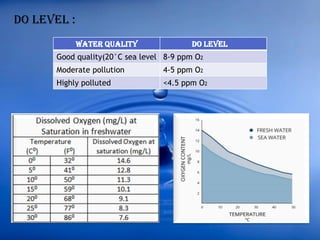
• Amounts of oxygen that can be dissolved in water by
temperature.
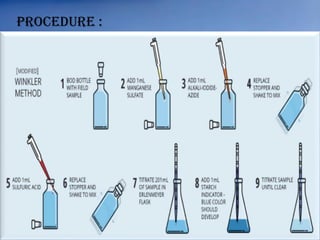
• It is usually determined by Winkler’s method known as
iodometric method.
• Method was developed by L.W.Winkler , a hungarian
chemist in 1888 .
The Winkler method with azide modification:
 Alsterberg azide modification.
 Rideal stewart modification .
 Alum flocculation modification .
 Copper sulfate sulfanic acid flocculation
modification .
 Alkaline hypochlorite modification .
Principle :
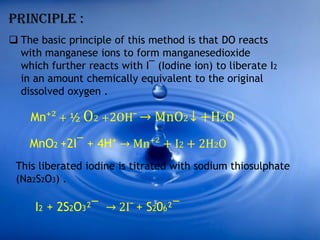
 The basic principle of this method is that DO reacts
with manganese ions to form manganesedioxide
which further reacts with I¯ (Iodine ion) to liberate I2
in an amount chemically equivalent to the original
dissolved oxygen .
Mn⁺² + ½ O2 +2OH¯ → MnO2 ↓ +H2O
MnO2 +2I¯ + 4H⁺ → Mn⁺² + I2 + 2H2O
This liberated iodine is titrated with sodium thiosulphate
(Na2S2O3) .
I2 + 2S2O3²¯ → 2I¯ + S206²¯
 Manganese sulphate
 Alkali iodide – azide reagent
 Sulphuric acid
 Starch indicator
REAGENT :
 Standard sodium thiosulphate 0.025N
PROCEDURE :
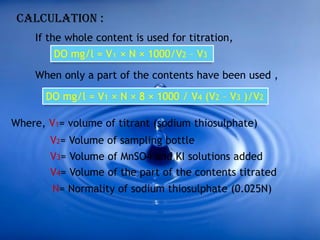
CALCULATION :
If the whole content is used for titration,
DO mg/l = V₁ × N × 1000/V2 – V3
When only a part of the contents have been used ,
DO mg/l = V1 × N × 8 × 1000 / V4 (V2 – V3 )/V2
Where, V1= volume of titrant (sodium thiosulphate)
V2= Volume of sampling bottle
V3= Volume of MnSO4 and KI solutions added
V4= Volume of the part of the contents titrated
N= Normality of sodium thiosulphate (0.025N)
DO LEVEL :
Water quality DO LEVEL
Good quality(20°C sea level 8-9 ppm O2
Moderate pollution 4-5 ppm O2
Highly polluted <4.5 ppm O2
CHEMICAL OXYGEN DEMAND (COD ) :
• COD is an empiric laboratory assay which measured the
amount of organic matter contained in a water sample
with the help of chemical oxidizing agents such as
potassium dichromate and potassium permanganate .
 COD is a means of measuring all organic matter
(biodegradable and non- biodegradable ) .
 This test is useful in studying pollution strength of
domestic and wastewater .
 COD values are greater than BOD values .
 The open reflux method is suitable for a wide range
of wastes is discussed here .
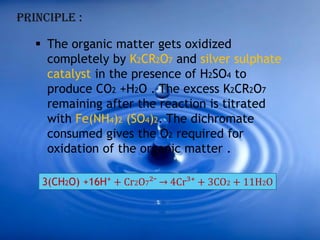
PRINCIPLE :
 The organic matter gets oxidized
completely by K2CR2O7 and silver sulphate
catalyst in the presence of H2SO4 to
produce CO2 +H2O . The excess K2CR2O7
remaining after the reaction is titrated
with Fe(NH4)2 (SO4)2. The dichromate
consumed gives the O2 required for
oxidation of the organic matter .
3(CH2O) +16H⁺ + Cr2O7²¯ → 4Cr³⁺ + 3CO2 + 11H2O
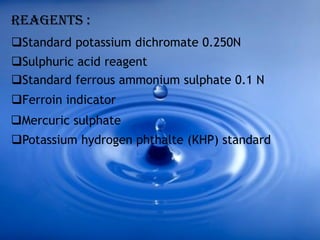
REAGENTS :
Standard potassium dichromate 0.250N
Sulphuric acid reagent
Standard ferrous ammonium sulphate 0.1 N
Ferroin indicator
Mercuric sulphate
Potassium hydrogen phthalte (KHP) standard
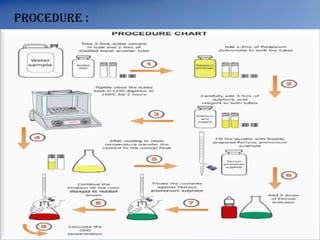
Procedure :
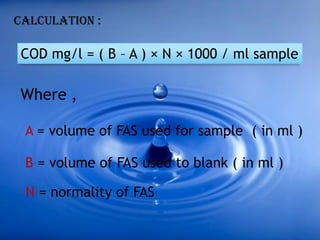
Calculation :
COD mg/l = ( B – A ) × N × 1000 / ml sample
Where ,
A = volume of FAS used for sample ( in ml )
B = volume of FAS used to blank ( in ml )
N = normality of FAS
COD LEVEL :
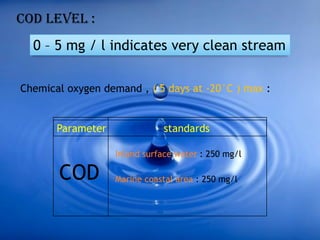
0 – 5 mg / l indicates very clean stream
Chemical oxygen demand , ( 5 days at -20°C ) max :
Parameter standards
COD
Inland surface water : 250 mg/l
Marine coastal area : 250 mg/l
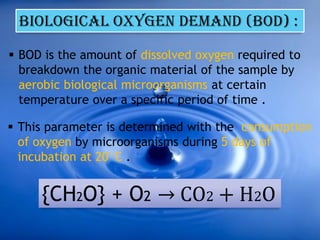
BIOLOGICAL OXYGEN DEMAND (BOD) :
 BOD is the amount of dissolved oxygen required to
breakdown the organic material of the sample by
aerobic biological microorganisms at certain
temperature over a specific period of time .
 This parameter is determined with the consumption
of oxygen by microorganisms during 5 days of
incubation at 20°C .
{CH2O} + O2 → CO2 + H2O
 BOD indicates a amount of pollution of water bodies.
 Lower BOD indicates the water is a good quality for
aquatic life or little aerobic acitivity whereas the
higher BOD indicates the water is highly polluted.
 When BOD is higher , then DO becomes lower .
 so, aquatic organisms are unable to survive at
normal rate , it becomes stressed , asphyxiate and
may die .
Determination of BOD :
 The most common and popular method for
determination of biological oxygen demand is
standard method which is recognized by U.S . EPA .
 It is not accurate quantitative test , although it
is widely used as an indicates the amount of
pollution .
Procedure :
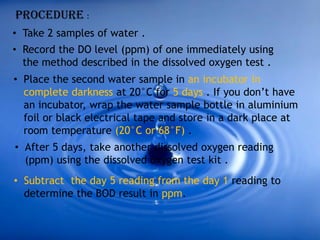
• Take 2 samples of water .
• Record the DO level (ppm) of one immediately using
the method described in the dissolved oxygen test .
• Place the second water sample in an incubator in
complete darkness at 20°C for 5 days . If you don’t have
an incubator, wrap the water sample bottle in aluminium
foil or black electrical tape and store in a dark place at
room temperature (20°C or 68°F) .
• After 5 days, take another dissolved oxygen reading
(ppm) using the dissolved oxygen test kit .
• Subtract the day 5 reading from the day 1 reading to
determine the BOD result in ppm.
CALCULATION :
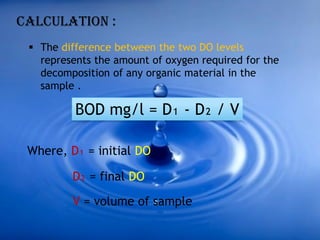
 The difference between the two DO levels
represents the amount of oxygen required for the
decomposition of any organic material in the
sample .
BOD mg/l = D₁ - D₂ / V
Where, D₁ = initial DO
D₂ = final DO
V = volume of sample
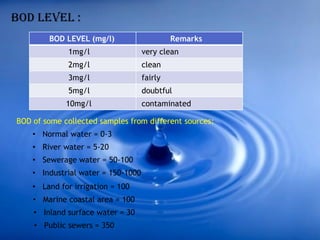
BOD LEVEL :
BOD LEVEL (mg/l) Remarks
1mg/l very clean
2mg/l clean
3mg/l fairly
5mg/l doubtful
10mg/l contaminated
BOD of some collected samples from different sources:
• Normal water = 0-3
• River water = 5-20
• Sewerage water = 50-100
• Industrial water = 150-1000
• Land for irrigation = 100
• Marine coastal area = 100
• Inland surface water = 30
• Public sewers = 350
THANK
YOU

Do,cod,bod

  • 1.
  • 2.
    DISSOLVED OXYGEN (DO): •Amount of oxygen dissolved (and hence available to sustain marine life) in a body of water such as lake, river or stream . • Dissolved oxygen is the indicator of water pollution. • DO levels in natural and waste water depend on physical, chemical and biological activities in water body. • Amounts of oxygen that can be dissolved in water by temperature. • It is usually determined by Winkler’s method known as iodometric method. • Method was developed by L.W.Winkler , a hungarian chemist in 1888 .
  • 3.
    The Winkler methodwith azide modification:  Alsterberg azide modification.  Rideal stewart modification .  Alum flocculation modification .  Copper sulfate sulfanic acid flocculation modification .  Alkaline hypochlorite modification .
  • 4.
    Principle :  Thebasic principle of this method is that DO reacts with manganese ions to form manganesedioxide which further reacts with I¯ (Iodine ion) to liberate I2 in an amount chemically equivalent to the original dissolved oxygen . Mn⁺² + ½ O2 +2OH¯ → MnO2 ↓ +H2O MnO2 +2I¯ + 4H⁺ → Mn⁺² + I2 + 2H2O This liberated iodine is titrated with sodium thiosulphate (Na2S2O3) . I2 + 2S2O3²¯ → 2I¯ + S206²¯
  • 5.
     Manganese sulphate Alkali iodide – azide reagent  Sulphuric acid  Starch indicator REAGENT :  Standard sodium thiosulphate 0.025N
  • 6.
  • 7.
    CALCULATION : If thewhole content is used for titration, DO mg/l = V₁ × N × 1000/V2 – V3 When only a part of the contents have been used , DO mg/l = V1 × N × 8 × 1000 / V4 (V2 – V3 )/V2 Where, V1= volume of titrant (sodium thiosulphate) V2= Volume of sampling bottle V3= Volume of MnSO4 and KI solutions added V4= Volume of the part of the contents titrated N= Normality of sodium thiosulphate (0.025N)
  • 8.
    DO LEVEL : Waterquality DO LEVEL Good quality(20°C sea level 8-9 ppm O2 Moderate pollution 4-5 ppm O2 Highly polluted <4.5 ppm O2
  • 9.
    CHEMICAL OXYGEN DEMAND(COD ) : • COD is an empiric laboratory assay which measured the amount of organic matter contained in a water sample with the help of chemical oxidizing agents such as potassium dichromate and potassium permanganate .  COD is a means of measuring all organic matter (biodegradable and non- biodegradable ) .  This test is useful in studying pollution strength of domestic and wastewater .  COD values are greater than BOD values .  The open reflux method is suitable for a wide range of wastes is discussed here .
  • 10.
    PRINCIPLE :  Theorganic matter gets oxidized completely by K2CR2O7 and silver sulphate catalyst in the presence of H2SO4 to produce CO2 +H2O . The excess K2CR2O7 remaining after the reaction is titrated with Fe(NH4)2 (SO4)2. The dichromate consumed gives the O2 required for oxidation of the organic matter . 3(CH2O) +16H⁺ + Cr2O7²¯ → 4Cr³⁺ + 3CO2 + 11H2O
  • 11.
    REAGENTS : Standard potassiumdichromate 0.250N Sulphuric acid reagent Standard ferrous ammonium sulphate 0.1 N Ferroin indicator Mercuric sulphate Potassium hydrogen phthalte (KHP) standard
  • 12.
  • 13.
    Calculation : COD mg/l= ( B – A ) × N × 1000 / ml sample Where , A = volume of FAS used for sample ( in ml ) B = volume of FAS used to blank ( in ml ) N = normality of FAS
  • 14.
    COD LEVEL : 0– 5 mg / l indicates very clean stream Chemical oxygen demand , ( 5 days at -20°C ) max : Parameter standards COD Inland surface water : 250 mg/l Marine coastal area : 250 mg/l
  • 15.
    BIOLOGICAL OXYGEN DEMAND(BOD) :  BOD is the amount of dissolved oxygen required to breakdown the organic material of the sample by aerobic biological microorganisms at certain temperature over a specific period of time .  This parameter is determined with the consumption of oxygen by microorganisms during 5 days of incubation at 20°C . {CH2O} + O2 → CO2 + H2O
  • 16.
     BOD indicatesa amount of pollution of water bodies.  Lower BOD indicates the water is a good quality for aquatic life or little aerobic acitivity whereas the higher BOD indicates the water is highly polluted.  When BOD is higher , then DO becomes lower .  so, aquatic organisms are unable to survive at normal rate , it becomes stressed , asphyxiate and may die .
  • 17.
    Determination of BOD:  The most common and popular method for determination of biological oxygen demand is standard method which is recognized by U.S . EPA .  It is not accurate quantitative test , although it is widely used as an indicates the amount of pollution .
  • 18.
    Procedure : • Take2 samples of water . • Record the DO level (ppm) of one immediately using the method described in the dissolved oxygen test . • Place the second water sample in an incubator in complete darkness at 20°C for 5 days . If you don’t have an incubator, wrap the water sample bottle in aluminium foil or black electrical tape and store in a dark place at room temperature (20°C or 68°F) . • After 5 days, take another dissolved oxygen reading (ppm) using the dissolved oxygen test kit . • Subtract the day 5 reading from the day 1 reading to determine the BOD result in ppm.
  • 19.
    CALCULATION :  Thedifference between the two DO levels represents the amount of oxygen required for the decomposition of any organic material in the sample . BOD mg/l = D₁ - D₂ / V Where, D₁ = initial DO D₂ = final DO V = volume of sample
  • 20.
    BOD LEVEL : BODLEVEL (mg/l) Remarks 1mg/l very clean 2mg/l clean 3mg/l fairly 5mg/l doubtful 10mg/l contaminated BOD of some collected samples from different sources: • Normal water = 0-3 • River water = 5-20 • Sewerage water = 50-100 • Industrial water = 150-1000 • Land for irrigation = 100 • Marine coastal area = 100 • Inland surface water = 30 • Public sewers = 350
  • 21.