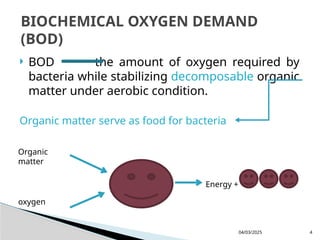
BOD theamount of oxygen required by
bacteria while stabilizing decomposable organic
matter under aerobic condition.
Organic matter serve as food for bacteria
04/03/2025 4
BIOCHEMICAL OXYGEN DEMAND
(BOD)
Organic
matter
oxygen
Energy +
5.
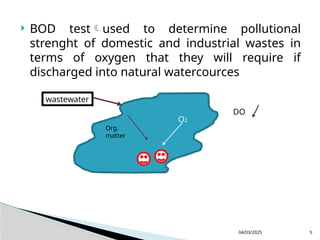
BOD testusedto determine pollutional
strenght of domestic and industrial wastes in
terms of oxygen that they will require if
discharged into natural watercources
04/03/2025 5
wastewater
Org.
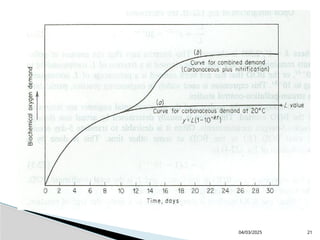
matter
O2
DO
6.
BOD test
◦Bioassay procedure.
◦ Measures oxygen consumed by living organisms while
utilizing organic matter present in waste.
Conditions as similar as possible to those that occur
in nature
To be quantitative protect from the air to prevent
reaeration.
Env. conditions should be suitable for m.o.
No toxic substance.
04/03/2025 6
7.
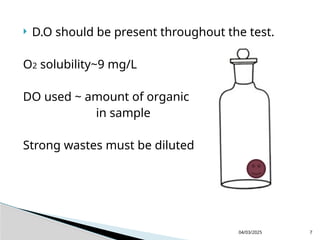
D.O shouldbe present throughout the test.
O2 solubility~9 mg/L
DO used ~ amount of organic
in sample
Strong wastes must be diluted
04/03/2025 7
8.
All necessarynutrients needed for bacterial
growth. (N,P, trace elements)
Diverse group of m.org. (seed) carry the
oxidation to CO2
BOD test a wet oxidation process
Living organisms serve as the medium for
oxidation of org. matter to water and CO2
04/03/2025 8
9.
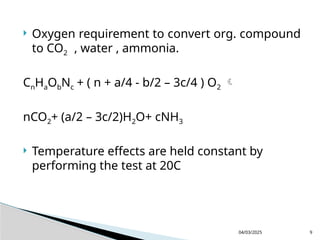
Oxygen requirementto convert org. compound
to CO2 , water , ammonia.
CnHaObNc + ( n + a/4 - b/2 – 3c/4 ) O2
nCO2+ (a/2 – 3c/2)H2O+ cNH3
Temperature effects are held constant by
performing the test at 20C
04/03/2025 9
10.
İnfinite timeis required for complete biological
oxidation of organic matter
Practically the reaction considered complete in 20
days =>BOD ultimate
Large percentage of the total BOD is exerted in
5days
The test has been developed on the basis of a 5-
day incubation period.=> 5 day BOD
5 day test was selected also to minimize
interference from oxidation of ammonia.
04/03/2025 10
11.
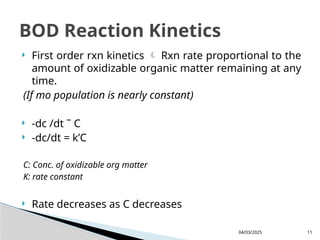
First orderrxn kinetics Rxn rate proportional to the
amount of oxidizable organic matter remaining at any
time.
(If mo population is nearly constant)
-dc /dt ˜ C
-dc/dt = k’C
C: Conc. of oxidizable org matter
K: rate constant
Rate decreases as C decreases
04/03/2025 11
BOD Reaction Kinetics
12.
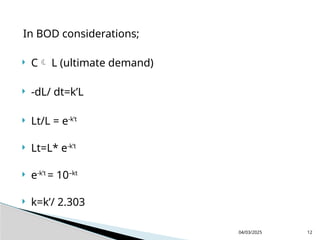
In BOD considerations;
C L (ultimate demand)
-dL/ dt=k’L
Lt/L = e-k’t
Lt=L* e-k’t
e-k’t
= 10–kt
k=k’/ 2.303
04/03/2025 12
13.
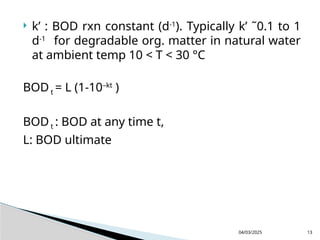
k’ :BOD rxn constant (d-1
). Typically k’ ˜0.1 to 1
d-1
for degradable org. matter in natural water
at ambient temp 10 < T < 30 °C
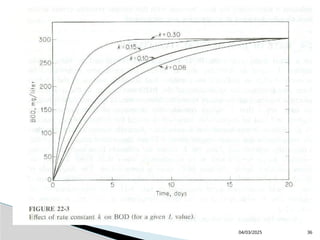
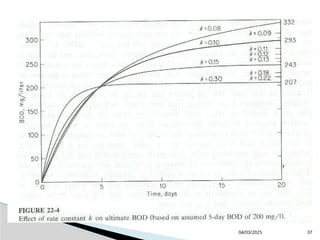
BODt = L (1-10–kt
)
BODt : BOD at any time t,
L: BOD ultimate
04/03/2025 13
14.
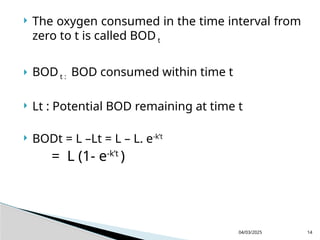
The oxygenconsumed in the time interval from
zero to t is called BOD t
BODt : BOD consumed within time t
Lt : Potential BOD remaining at time t
BODt = L –Lt = L – L. e-k’t
= L (1- e-k’t
)
04/03/2025 14
15.
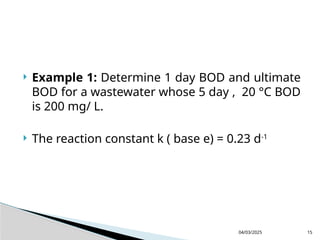
Example 1:Determine 1 day BOD and ultimate
BOD for a wastewater whose 5 day , 20 °C BOD
is 200 mg/ L.
The reaction constant k ( base e) = 0.23 d-1
04/03/2025 15
16.
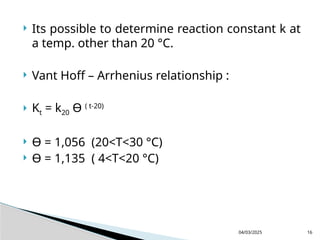
Its possibleto determine reaction constant k at
a temp. other than 20 °C.
Vant Hoff – Arrhenius relationship :
Kt = k20 Ɵ ( t-20)
Ɵ = 1,056 (20<T<30 °C)
Ɵ = 1,135 ( 4<T<20 °C)
04/03/2025 16
17.
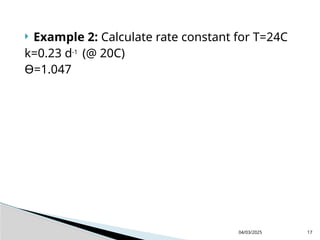
Example 2:Calculate rate constant for T=24C
k=0.23 d-1
(@ 20C)
Ɵ=1.047
04/03/2025 17
18.
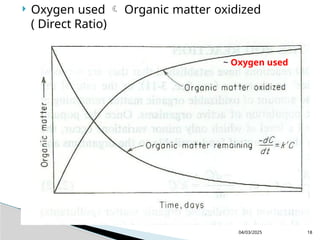
Oxygen used Organic matter oxidized
( Direct Ratio)
04/03/2025 18
~ Oxygen used
19.
BOD oroxygen-used curve is similar to organic
matter oxidation curve during the first 8-10
days.
For proper measurement of BOD, cultures used
in BOD test should contain heterotrophic
bacteria and other organisms that utilize the
carbonaceous matter.
04/03/2025 19
Influence of Nitrification on
BOD
20.
Additionally theycontain certain autotrophic
bacteria, particularly nitrifying bacteria.
nitrifying bacteria oxidizes noncarbonaceous matter for
energy
Nitrifying bacteria present small amounts in
untreated domestic ww.
@20 °C their populations do not become sufficiently
large to exert oxygen demand until 8-10 days.
Interference of nitrification eliminated by taking
test period 5 days BOD 5
04/03/2025 20
Untreated domesticww contains little amount
of nitrifying bacteria, but effluent from
biological treatment units such as Activated
sludge and Trickling filter do contain nitrifying
bacteria that can also consume D.O. in 5 days.
Inhibit the action of nitrifying bacteria by
specific inhibiting agents 2-Chloro-6
( trichloromethyl) pyridine (TCMP) or
Allylthiourea (ATU).
04/03/2025 22
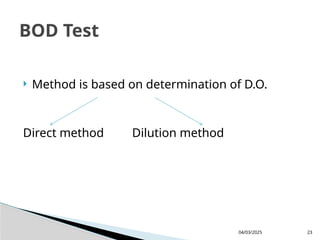
23.
Method isbased on determination of D.O.
Direct method Dilution method
04/03/2025 23
BOD Test
24.
Direct Method :
IfBOD5 < 7 mg/L no dilution required.
Ex: River waters
Adjust the sample to 20 °C , aerate with diffused air to
increase or decrease dissolved gas content to near
saturation.
Fill BOD bottles. Measure D.O. İmmediately in first bottle.
Incubate 5 day Measure D.O. BOD =DO1-DO2
04/03/2025 24
25.
Dilution Method
Rateat which oxygen is used in dilution of
wastes is in direct ratio to percent of waste in
dilution.
10% dilution uses oxygen at 1/10 the rate of a
100% sample.
04/03/2025 25
26.
Control all environmentconditions in the
bioassay test.
Free of toxic materials
Favourable pH and osmotic cond.
Presence of available nutrients
Standard Temp.
Presence of mixed organisms of soil origin
04/03/2025 26
27.
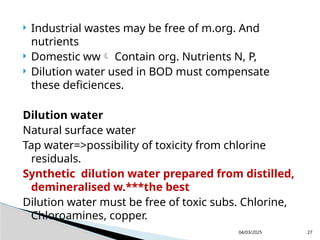
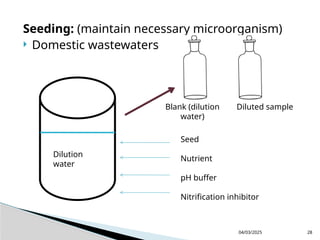
Industrial wastesmay be free of m.org. And
nutrients
Domestic ww Contain org. Nutrients N, P,
Dilution water used in BOD must compensate
these deficiences.
Dilution water
Natural surface water
Tap water=>possibility of toxicity from chlorine
residuals.
Synthetic dilution water prepared from distilled,
demineralised w.***the best
Dilution water must be free of toxic subs. Chlorine,
Chloroamines, copper.
04/03/2025 27
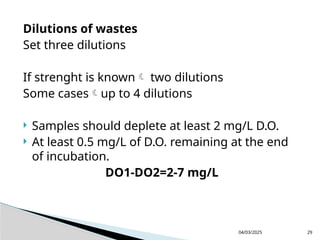
Dilutions of wastes
Setthree dilutions
If strenght is known two dilutions
Some casesup to 4 dilutions
Samples should deplete at least 2 mg/L D.O.
At least 0.5 mg/L of D.O. remaining at the end
of incubation.
DO1-DO2=2-7 mg/L
04/03/2025 29
30.
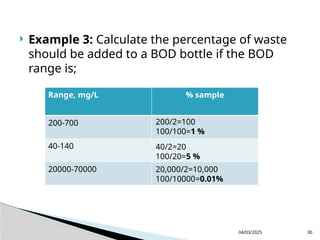
Example 3:Calculate the percentage of waste
should be added to a BOD bottle if the BOD
range is;
04/03/2025 30
Range, mg/L % sample
200-700
40-140
20000-70000
200/2=100
100/100=1 %
40/2=20
100/20=5 %
20,000/2=10,000
100/10000=0.01%
31.
Incubation bottles:
Glassstoppers
Prevent air trapping during incubation
Water seal.
Bottles should be free of organic matter.
Clean with chromic acid or detergent.
Rinse carefully
All cleaning agents removed from bottle
◦ 4 rinse with tap water,
◦ final rinse with Distilled or deionized water
04/03/2025 31
32.
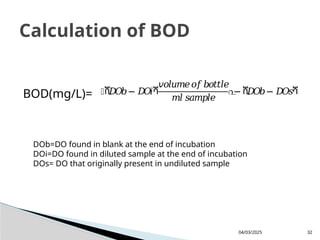
BOD(mg/L)=
04/03/2025 32
Calculation ofBOD
ሺ
𝐷
𝑂
𝑏− 𝐷
𝑂
𝑖ሻ
𝑣𝑜𝑙𝑢𝑚𝑒𝑜𝑓𝑏𝑜𝑡𝑡𝑙𝑒
𝑚𝑙 𝑠𝑎𝑚𝑝𝑙𝑒
൨
− ሺ
𝐷
𝑂
𝑏− 𝐷
𝑂
𝑠ሻ
DOb=DO found in blank at the end of incubation
DOi=DO found in diluted sample at the end of incubation
DOs= DO that originally present in undiluted sample
33.
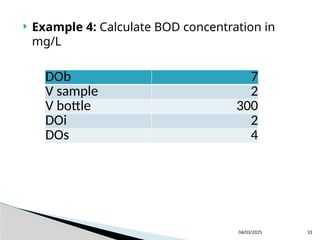
Example 4:Calculate BOD concentration in
mg/L
04/03/2025 33
DOb 7
V sample 2
V bottle 300
DOi 2
DOs 4
34.
04/03/2025 34
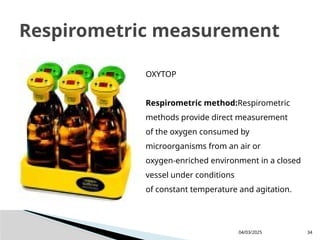
Respirometric measurement
OXYTOP
Respirometricmethod:Respirometric
methods provide direct measurement
of the oxygen consumed by
microorganisms from an air or
oxygen-enriched environment in a closed
vessel under conditions
of constant temperature and agitation.
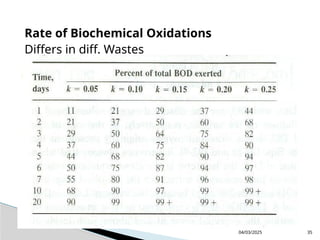
Effluent frombioligical wwtp different from raw
wastes
◦ Nature of the org. Matter
◦ The ability of the organisms present to utilize the org.
Matter
◦ Rate of hydrolysis and diffusion
Ex: Glucose high k
Lignin, Synthetic detergents
slowly attacked by bacteria
04/03/2025 38
39.
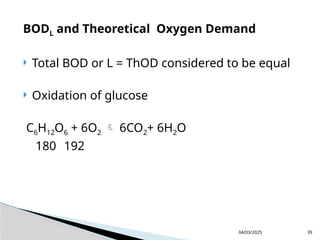
BODL and TheoreticalOxygen Demand
Total BOD or L = ThOD considered to be equal
Oxidation of glucose
C6H12O6 + 6O2 6CO2+ 6H2O
180 192
04/03/2025 39
40.
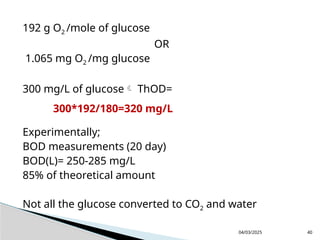
192 g O2/mole of glucose
OR
1.065 mg O2 /mg glucose
300 mg/L of glucose ThOD=
Experimentally;
BOD measurements (20 day)
BOD(L)= 250-285 mg/L
85% of theoretical amount
Not all the glucose converted to CO2 and water
04/03/2025 40
300*192/180=320 mg/L
41.
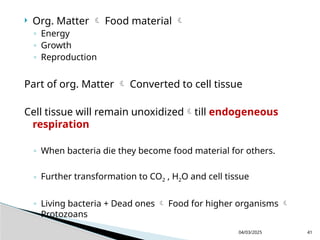
Org. Matter Food material
◦ Energy
◦ Growth
◦ Reproduction
Part of org. Matter Converted to cell tissue
Cell tissue will remain unoxidizedtill endogeneous
respiration
◦ When bacteria die they become food material for others.
◦ Further transformation to CO2 , H2O and cell tissue
◦ Living bacteria + Dead ones Food for higher organisms
Protozoans
04/03/2025 41
42.
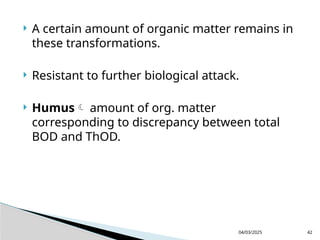
A certainamount of organic matter remains in
these transformations.
Resistant to further biological attack.
Humus amount of org. matter
corresponding to discrepancy between total
BOD and ThOD.
04/03/2025 42
43.
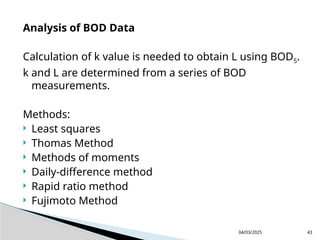
Analysis of BODData
Calculation of k value is needed to obtain L using BOD5.
k and L are determined from a series of BOD
measurements.
Methods:
Least squares
Thomas Method
Methods of moments
Daily-difference method
Rapid ratio method
Fujimoto Method
04/03/2025 43
44.
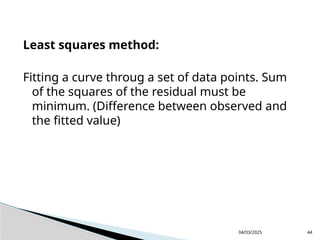
Least squares method:
Fittinga curve throug a set of data points. Sum
of the squares of the residual must be
minimum. (Difference between observed and
the fitted value)
04/03/2025 44
45.
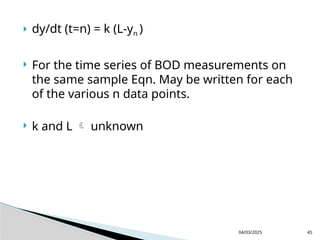
dy/dt (t=n)= k (L-yn )
For the time series of BOD measurements on
the same sample Eqn. May be written for each
of the various n data points.
k and L unknown
04/03/2025 45
46.
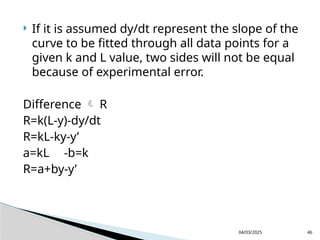
If itis assumed dy/dt represent the slope of the
curve to be fitted through all data points for a
given k and L value, two sides will not be equal
because of experimental error.
Difference R
R=k(L-y)-dy/dt
R=kL-ky-y’
a=kL -b=k
R=a+by-y’
04/03/2025 46