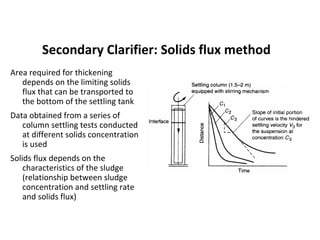
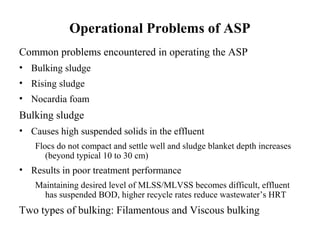
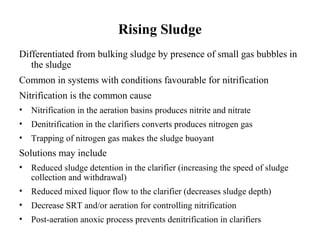
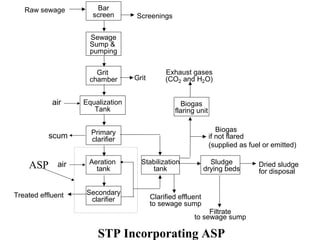
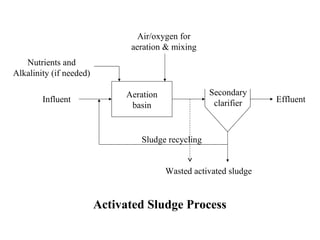
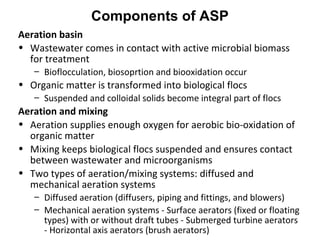
The activated sludge process is a widely used secondary treatment method for wastewater that harnesses microbial activity to remove biodegradable organic matter, nutrients, pathogens, and heavy metals. Key components include aeration tanks for mixing and oxygen supply, secondary sedimentation tanks for clarifying and recycling biological flocs, and potential nutrient additions to enhance treatment efficiency. Through bioflocculation and oxidation, the process converts soluble organic matter into biomass, which is managed through controlled sludge recycling and wastage.



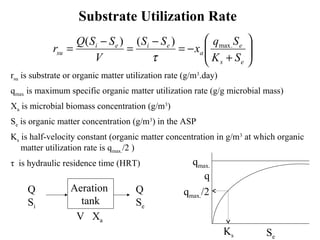


![Treated effluent BODU (Se)
Use of this equation requires
– Primary variable SRT (assumed)
(typical values are 5 to 15 days)
– Ks, kd, qmax and Y are ASP kinetic parameters
Obtained from the following through solving for Se
Note that the Se is independent of influent bCOD (or BODu)
[ ]
( ) 1.
)(1
.max −−
+
=
d
ds
e
kYqSRT
SRTkK
S
d
es
e
k
SK
Sq
Y
SRT
−
+
= max1
)()(
)(
ratewastagesludgeorrategenerationsludgenet
systemtheofsludgetotal
SRT =](https://image.slidesharecdn.com/activatedsludgeprocess-160302090539/85/Activated-sludge-process-16-320.jpg)


![Oxygen Demand Rate
Here ‘n’ is oxygen equivalence of microbial biomass(1.42!)
The oxygen demanded is supplied by
Surface (floating or fixed) aerators
Diffused aeration systems (introduce oxygen/air into liquid)
Turbine mixers can disperse introduced air bubbles
Hydraulic shear devices can reduce bubble size
Suppliers of aeration systems indicate oxygen transfer rates of
their equipment at standard conditions (SOTE/SOTR)
– These rates require correction to actual operating conditions
(AOTE/AOTR)
−
=
CDGRplusNBSR
ofequivalentOxygen
substrateloadedof
equivalentOxygen
demand
Oxygen
( ) [ ]CDGRNBSRnSSQdemandO ei +−−=2](https://image.slidesharecdn.com/activatedsludgeprocess-160302090539/85/Activated-sludge-process-23-320.jpg)