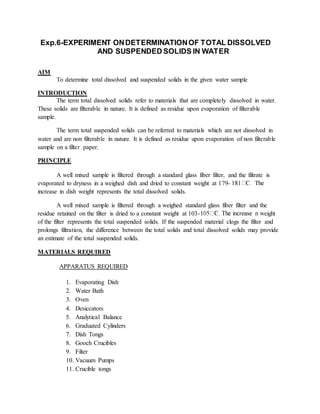
Exp.6-EXPERIMENT ONDETERMINATIONOF TOTAL DISSOLVED
AND SUSPENDED SOLIDS IN WATER
AIM
To determine total dissolved and suspended solids in the given water sample
INTRODUCTION
The term total dissolved solids refer to materials that are completely dissolved in water.
These solids are filterable in nature. It is defined as residue upon evaporation of filterable
sample.
The term total suspended solids can be referred to materials which are not dissolved in
water and are non filterable in nature. It is defined as residue upon evaporation of non filterable
sample on a filter paper.
PRINCIPLE
A well mixed sample is filtered through a standard glass fiber filter, and the filtrate is
evaporated to dryness in a weighed dish and dried to constant weight at 179-
increase in dish weight represents the total dissolved solids.
A well mixed sample is filtered through a weighed standard glass fiber filter and the
residue retained on the filter is dried to a constant weight at 103- eight
of the filter represents the total suspended solids. If the suspended material clogs the filter and
prolongs filtration, the difference between the total solids and total dissolved solids may provide
an estimate of the total suspended solids.
MATERIALS REQUIRED
APPARATUS REQUIRED
1. Evaporating Dish
2. Water Bath
3. Oven
4. Desiccators
5. Analytical Balance
6. Graduated Cylinders
7. Dish Tongs
8. Gooch Crucibles
9. Filter
10. Vacuum Pumps
11. Crucible tongs
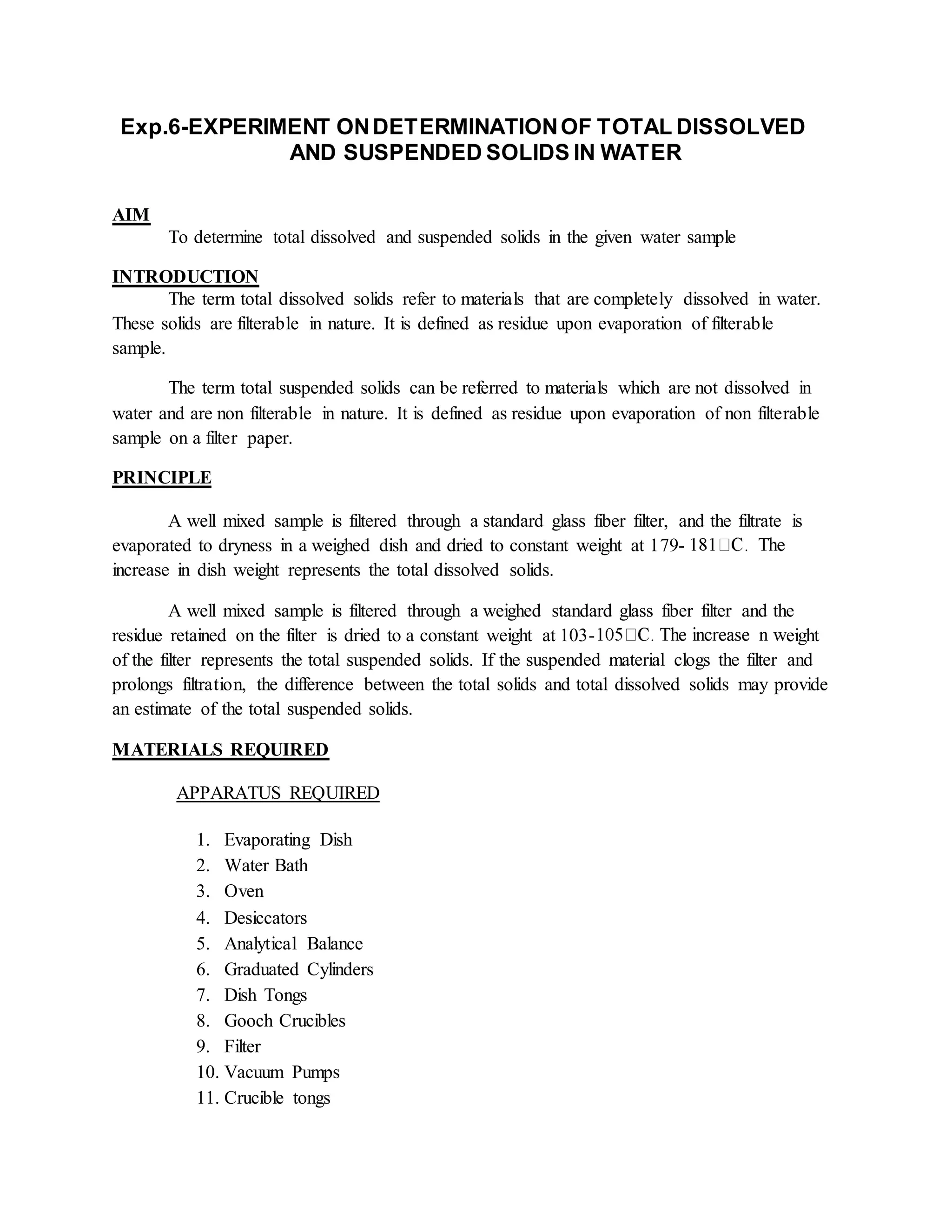
12. Forceps, Smooth -tipped
PRECAUTIONS
The following precautions should be observed while performing the experiment:
 Water or Wastewater samples which contain high concentrations of calcium, chloride,
magnesium or sulfate can rapidly absorb moisture from the air.
 Such samples may need to be dried for a longer period of time, cooled under proper
desiccation and weighed rapidly in order to achieve a reasonable constant weight.
 We should be aware prolonged drying may result in loss of constituents, particularly
nitrates and chlorides.
 Volume of sample should be adjusted to have residue left after drying as 100 to 200mg.
It is mainly to prevent large amount of residue in entrapping water during evaporation.
 Samples with high concentrations or bicarbonate require additional drying at 180ºC to
ensure that all of the bicarbonate is converted to carbonate.
PROCEDURE
TESTING OF SAMPLE FOR TOTAL DISSOLVED SOLIDS
To measure total dissolved solids, take a clean porcelain dish which has been washed and dried
in a hot air oven at 1800C for one hour.
 Now weigh the empty evaporating dish in analytical balance. Let’s denote the weight
measured as W1 = g.
 Mix sample well and pour into a funnel with filter paper. Filter approximately 80 -100
mL of sample.
 Using pipette transfer 75mL of unfiltered sample in the porcelain dish.
 Switch on the oven and allowed to reach 105°C. Check and regulate oven and furnace
temperatures frequently to maintain the desired temperature range.
 Place it in the hot air oven and care should be taken to prevent splattering of sample
during evaporation or boiling.
 Dry the sample to get constant mass. Drying for long duration usually 1 to 2 hours is
done to eliminate necessity of checking for constant mass.
 Cool the container in a desiccator. Desiccators are designed to provide an environment
of standard dryness. This is maintained by the desiccant found inside. Don't leave the
lid off for prolonged periods or the desiccant will soon be exhausted. Keep desiccator
cover greased with the appropriate type of lubricant in order to seal the desiccator and
prevent moisture from entering the desiccator as the test glassware cools.
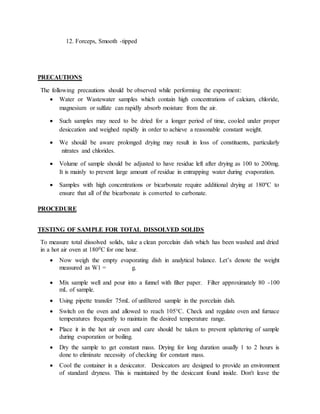
 We should weigh the dish as soon as it has cooled to avoid absorption of moisture due
to its hygroscopic nature. Samples need to be measured accurately, weighed carefully,
and dried and cooled completely.
 Note the weight with residue as W2 = g
TESTING OF SAMPLE FOR TOTAL SUSPENDED SOLIDS
 Place filtration apparatus with weighed filter in filter flask.
 Mix sample well and pour into a graduated cylinder to the selected volume.
 Apply suction to filter flask and seat filter with a small amount of distilled water.
 Pour selected volume into filtration apparatus.
 Draw sample through filter into filter flask.
 Rinse graduated cylinder into filtration apparatus with three successive 10 mL portions
of distilled water, allowing complete drainage between each rinsing.
 Continue suction for three minutes after filtration of final rinse is completed.
 Dry filter in an oven at 103-105°C for at least 1 hour.
 Cool filter in desiccator to room temperature.
 When cool, weigh the filter and support.
CALCULATION
TABLE
TotalDissolvedSolids
Description Weight (g)
Weight of the clean porcelain evaporating dish (g) W1
Weight of the dish and the residue (g) W2
Weight of residue(g) W
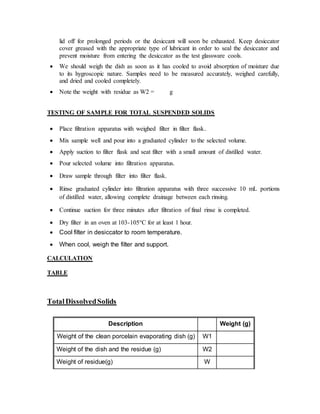
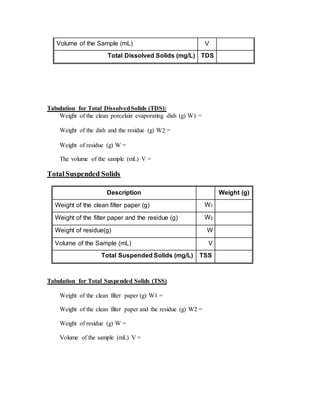
Volume of the Sample (mL) V
Total Dissolved Solids (mg/L) TDS
Tabulation for Total DissolvedSolids (TDS):
Weight of the clean porcelain evaporating dish (g) W1 =
Weight of the dish and the residue (g) W2 =
Weight of residue (g) W =
The volume of the sample (mL) V =
TotalSuspended Solids
Description Weight (g)
Weight of the clean filter paper (g) W1
Weight of the filter paper and the residue (g) W2
Weight of residue(g) W
Volume of the Sample (mL) V
Total Suspended Solids (mg/L) TSS
Tabulation for Total Suspended Solids (TSS)
Weight of the clean filter paper (g) W1 =
Weight of the clean filter paper and the residue (g) W2 =
Weight of residue (g) W =
Volume of the sample (mL) V =
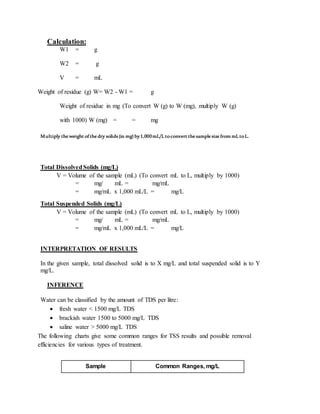
Calculation:
W1 = g
W2 = g
V = mL
Weight of residue (g) W= W2 - W1 = g
Weight of residue in mg (To convert W (g) to W (mg), multiply W (g)
with 1000) W (mg) = = mg
Multiply the weight ofthe dry solids (in mg) by1,000mL/Ltoconvert the sample size from mLtoL.
Total DissolvedSolids (mg/L)
V = Volume of the sample (mL) (To convert mL to L, multiply by 1000)
= mg/ mL = mg/mL
= mg/mL x 1,000 mL/L = mg/L
Total Suspended Solids (mg/L)
V = Volume of the sample (mL) (To convert mL to L, multiply by 1000)
= mg/ mL = mg/mL
= mg/mL x 1,000 mL/L = mg/L
INTERPRETATION OF RESULTS
In the given sample, total dissolved solid is to X mg/L and total suspended solid is to Y
mg/L.
INFERENCE
Water can be classified by the amount of TDS per litre:
 fresh water < 1500 mg/L TDS
 brackish water 1500 to 5000 mg/L TDS
 saline water > 5000 mg/L TDS
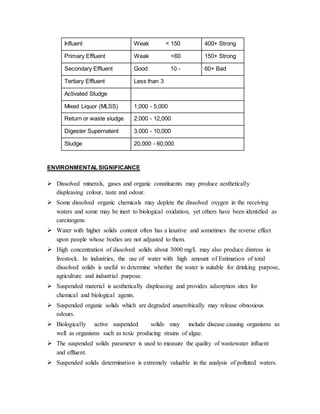
The following charts give some common ranges for TSS results and possible removal
efficiencies for various types of treatment.
Sample Common Ranges, mg/L
Influent Weak < 150 400+ Strong
Primary Effluent Weak <60 150+ Strong
Secondary Effluent Good 10 - 60+ Bad
Tertiary Effluent Less than 3
Activated Sludge
Mixed Liquor (MLSS) 1,000 - 5,000
Return or waste sludge 2,000 - 12,000
Digester Supernatent 3,000 - 10,000
Sludge 20,000 - 60,000
ENVIRONMENTALSIGNIFICANCE
 Dissolved minerals, gases and organic constituents may produce aesthetically
displeasing colour, taste and odour.
 Some dissolved organic chemicals may deplete the dissolved oxygen in the receiving
waters and some may be inert to biological oxidation, yet others have been identified as
carcinogens.
 Water with higher solids content often has a laxative and sometimes the reverse effect
upon people whose bodies are not adjusted to them.
 High concentration of dissolved solids about 3000 mg/L may also produce distress in
livestock. In industries, the use of water with high amount of Estimation of total
dissolved solids is useful to determine whether the water is suitable for drinking purpose,
agriculture and industrial purpose.
 Suspended material is aesthetically displeasing and provides adsorption sites for
chemical and biological agents.
 Suspended organic solids which are degraded anaerobically may release obnoxious
odours.
 Biologically active suspended solids may include disease causing organisms as
well as organisms such as toxic producing strains of algae.
 The suspended solids parameter is used to measure the quality of wastewater influent
and effluent.
 Suspended solids determination is extremely valuable in the analysis of polluted waters.
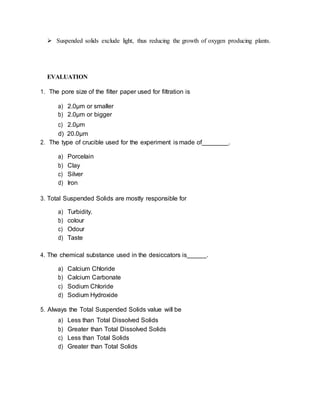
 Suspended solids exclude light, thus reducing the growth of oxygen producing plants.
EVALUATION
1. The pore size of the filter paper used for filtration is
a) 2.0µm or smaller
b) 2.0µm or bigger
c) 2.0µm
d) 20.0µm
2. The type of crucible used for the experiment is made of .
a) Porcelain
b) Clay
c) Silver
d) Iron
3. Total Suspended Solids are mostly responsible for
a) Turbidity.
b) colour
c) Odour
d) Taste
4. The chemical substance used in the desiccators is .
a) Calcium Chloride
b) Calcium Carbonate
c) Sodium Chloride
d) Sodium Hydroxide
5. Always the Total Suspended Solids value will be
a) Less than Total Dissolved Solids
b) Greater than Total Dissolved Solids
c) Less than Total Solids
d) Greater than Total Solids
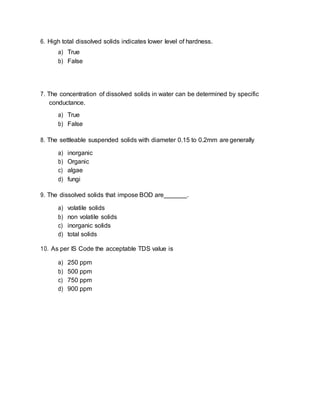
6. High total dissolved solids indicates lower level of hardness.
a) True
b) False
7. The concentration of dissolved solids in water can be determined by specific
conductance.
a) True
b) False
8. The settleable suspended solids with diameter 0.15 to 0.2mm are generally
a) inorganic
b) Organic
c) algae
d) fungi
9. The dissolved solids that impose BOD are .
a) volatile solids
b) non volatile solids
c) inorganic solids
d) total solids
10. As per IS Code the acceptable TDS value is
a) 250 ppm
b) 500 ppm
c) 750 ppm
d) 900 ppm

Exp 7

  • 1.
    Exp.6-EXPERIMENT ONDETERMINATIONOF TOTALDISSOLVED AND SUSPENDED SOLIDS IN WATER AIM To determine total dissolved and suspended solids in the given water sample INTRODUCTION The term total dissolved solids refer to materials that are completely dissolved in water. These solids are filterable in nature. It is defined as residue upon evaporation of filterable sample. The term total suspended solids can be referred to materials which are not dissolved in water and are non filterable in nature. It is defined as residue upon evaporation of non filterable sample on a filter paper. PRINCIPLE A well mixed sample is filtered through a standard glass fiber filter, and the filtrate is evaporated to dryness in a weighed dish and dried to constant weight at 179- increase in dish weight represents the total dissolved solids. A well mixed sample is filtered through a weighed standard glass fiber filter and the residue retained on the filter is dried to a constant weight at 103- eight of the filter represents the total suspended solids. If the suspended material clogs the filter and prolongs filtration, the difference between the total solids and total dissolved solids may provide an estimate of the total suspended solids. MATERIALS REQUIRED APPARATUS REQUIRED 1. Evaporating Dish 2. Water Bath 3. Oven 4. Desiccators 5. Analytical Balance 6. Graduated Cylinders 7. Dish Tongs 8. Gooch Crucibles 9. Filter 10. Vacuum Pumps 11. Crucible tongs
  • 2.
    12. Forceps, Smooth-tipped PRECAUTIONS The following precautions should be observed while performing the experiment:  Water or Wastewater samples which contain high concentrations of calcium, chloride, magnesium or sulfate can rapidly absorb moisture from the air.  Such samples may need to be dried for a longer period of time, cooled under proper desiccation and weighed rapidly in order to achieve a reasonable constant weight.  We should be aware prolonged drying may result in loss of constituents, particularly nitrates and chlorides.  Volume of sample should be adjusted to have residue left after drying as 100 to 200mg. It is mainly to prevent large amount of residue in entrapping water during evaporation.  Samples with high concentrations or bicarbonate require additional drying at 180ºC to ensure that all of the bicarbonate is converted to carbonate. PROCEDURE TESTING OF SAMPLE FOR TOTAL DISSOLVED SOLIDS To measure total dissolved solids, take a clean porcelain dish which has been washed and dried in a hot air oven at 1800C for one hour.  Now weigh the empty evaporating dish in analytical balance. Let’s denote the weight measured as W1 = g.  Mix sample well and pour into a funnel with filter paper. Filter approximately 80 -100 mL of sample.  Using pipette transfer 75mL of unfiltered sample in the porcelain dish.  Switch on the oven and allowed to reach 105°C. Check and regulate oven and furnace temperatures frequently to maintain the desired temperature range.  Place it in the hot air oven and care should be taken to prevent splattering of sample during evaporation or boiling.  Dry the sample to get constant mass. Drying for long duration usually 1 to 2 hours is done to eliminate necessity of checking for constant mass.  Cool the container in a desiccator. Desiccators are designed to provide an environment of standard dryness. This is maintained by the desiccant found inside. Don't leave the
  • 3.
    lid off forprolonged periods or the desiccant will soon be exhausted. Keep desiccator cover greased with the appropriate type of lubricant in order to seal the desiccator and prevent moisture from entering the desiccator as the test glassware cools.  We should weigh the dish as soon as it has cooled to avoid absorption of moisture due to its hygroscopic nature. Samples need to be measured accurately, weighed carefully, and dried and cooled completely.  Note the weight with residue as W2 = g TESTING OF SAMPLE FOR TOTAL SUSPENDED SOLIDS  Place filtration apparatus with weighed filter in filter flask.  Mix sample well and pour into a graduated cylinder to the selected volume.  Apply suction to filter flask and seat filter with a small amount of distilled water.  Pour selected volume into filtration apparatus.  Draw sample through filter into filter flask.  Rinse graduated cylinder into filtration apparatus with three successive 10 mL portions of distilled water, allowing complete drainage between each rinsing.  Continue suction for three minutes after filtration of final rinse is completed.  Dry filter in an oven at 103-105°C for at least 1 hour.  Cool filter in desiccator to room temperature.  When cool, weigh the filter and support. CALCULATION TABLE TotalDissolvedSolids Description Weight (g) Weight of the clean porcelain evaporating dish (g) W1 Weight of the dish and the residue (g) W2 Weight of residue(g) W
  • 4.
    Volume of theSample (mL) V Total Dissolved Solids (mg/L) TDS Tabulation for Total DissolvedSolids (TDS): Weight of the clean porcelain evaporating dish (g) W1 = Weight of the dish and the residue (g) W2 = Weight of residue (g) W = The volume of the sample (mL) V = TotalSuspended Solids Description Weight (g) Weight of the clean filter paper (g) W1 Weight of the filter paper and the residue (g) W2 Weight of residue(g) W Volume of the Sample (mL) V Total Suspended Solids (mg/L) TSS Tabulation for Total Suspended Solids (TSS) Weight of the clean filter paper (g) W1 = Weight of the clean filter paper and the residue (g) W2 = Weight of residue (g) W = Volume of the sample (mL) V =
  • 5.
    Calculation: W1 = g W2= g V = mL Weight of residue (g) W= W2 - W1 = g Weight of residue in mg (To convert W (g) to W (mg), multiply W (g) with 1000) W (mg) = = mg Multiply the weight ofthe dry solids (in mg) by1,000mL/Ltoconvert the sample size from mLtoL. Total DissolvedSolids (mg/L) V = Volume of the sample (mL) (To convert mL to L, multiply by 1000) = mg/ mL = mg/mL = mg/mL x 1,000 mL/L = mg/L Total Suspended Solids (mg/L) V = Volume of the sample (mL) (To convert mL to L, multiply by 1000) = mg/ mL = mg/mL = mg/mL x 1,000 mL/L = mg/L INTERPRETATION OF RESULTS In the given sample, total dissolved solid is to X mg/L and total suspended solid is to Y mg/L. INFERENCE Water can be classified by the amount of TDS per litre:  fresh water < 1500 mg/L TDS  brackish water 1500 to 5000 mg/L TDS  saline water > 5000 mg/L TDS The following charts give some common ranges for TSS results and possible removal efficiencies for various types of treatment. Sample Common Ranges, mg/L
  • 6.
    Influent Weak <150 400+ Strong Primary Effluent Weak <60 150+ Strong Secondary Effluent Good 10 - 60+ Bad Tertiary Effluent Less than 3 Activated Sludge Mixed Liquor (MLSS) 1,000 - 5,000 Return or waste sludge 2,000 - 12,000 Digester Supernatent 3,000 - 10,000 Sludge 20,000 - 60,000 ENVIRONMENTALSIGNIFICANCE  Dissolved minerals, gases and organic constituents may produce aesthetically displeasing colour, taste and odour.  Some dissolved organic chemicals may deplete the dissolved oxygen in the receiving waters and some may be inert to biological oxidation, yet others have been identified as carcinogens.  Water with higher solids content often has a laxative and sometimes the reverse effect upon people whose bodies are not adjusted to them.  High concentration of dissolved solids about 3000 mg/L may also produce distress in livestock. In industries, the use of water with high amount of Estimation of total dissolved solids is useful to determine whether the water is suitable for drinking purpose, agriculture and industrial purpose.  Suspended material is aesthetically displeasing and provides adsorption sites for chemical and biological agents.  Suspended organic solids which are degraded anaerobically may release obnoxious odours.  Biologically active suspended solids may include disease causing organisms as well as organisms such as toxic producing strains of algae.  The suspended solids parameter is used to measure the quality of wastewater influent and effluent.  Suspended solids determination is extremely valuable in the analysis of polluted waters.
  • 7.
     Suspended solidsexclude light, thus reducing the growth of oxygen producing plants. EVALUATION 1. The pore size of the filter paper used for filtration is a) 2.0µm or smaller b) 2.0µm or bigger c) 2.0µm d) 20.0µm 2. The type of crucible used for the experiment is made of . a) Porcelain b) Clay c) Silver d) Iron 3. Total Suspended Solids are mostly responsible for a) Turbidity. b) colour c) Odour d) Taste 4. The chemical substance used in the desiccators is . a) Calcium Chloride b) Calcium Carbonate c) Sodium Chloride d) Sodium Hydroxide 5. Always the Total Suspended Solids value will be a) Less than Total Dissolved Solids b) Greater than Total Dissolved Solids c) Less than Total Solids d) Greater than Total Solids
  • 8.
    6. High totaldissolved solids indicates lower level of hardness. a) True b) False 7. The concentration of dissolved solids in water can be determined by specific conductance. a) True b) False 8. The settleable suspended solids with diameter 0.15 to 0.2mm are generally a) inorganic b) Organic c) algae d) fungi 9. The dissolved solids that impose BOD are . a) volatile solids b) non volatile solids c) inorganic solids d) total solids 10. As per IS Code the acceptable TDS value is a) 250 ppm b) 500 ppm c) 750 ppm d) 900 ppm