Chapter 4
Measurement of Dissolved Oxygen (DO) and Chemical Oxygen
Demand (COD)
 Dissolved Oxygen (DO) is a measure of the amount of gaseous
oxygen dissolved in the water that is available and essential for the
survival of aquatic organisms.
Oxygen is measured in its dissolved form as dissolved oxygen (DO).
If more oxygen is consumed than is produced, DO levels decline and
some sensitive animals may move away, weaken, or die.
 Very low or very high concentrations of oxygen in the water
would not support life and would therefore indicate poor quality.
• BOD is a measure of the amount of DO required for microbial
metabolism of to break down the organic material in a given
volume of water through aerobic biological activity. It is used in
water quality management and assessment, ecology and
environmental science.
1
• BOD is the amount of dissolved oxygen needed by aerobic
biological organisms in a body of water to break down organic
metals present in a given water sample at certain temperature over a
specific time period.
• Most of the bacteria in the aquatic columns are aerobic.
E.g., Escherichia coli , Bacillus
 Measuring DO is probably the most significant water quality test
to determine the suitability of a stream for fish and many other
aquatic organisms. However, it is not an accurate quantitative
test, although it is considered as an indication of the quality of a
water source.
2
3
 Measuring BOD is a chemical procedure for determining the rate
of DO uptake by biological organisms in a body of water use up
oxygen.
Oxygen is removed from the water by chemical reactions, the
decay process and respiration.
The BOD value is most commonly expressed in milligrams of
oxygen consumed per liter of sample during 5 days of incubation
at 20 °C.
 BOD can be used as a gauge of the effectiveness of wastewater
treatment plants. BOD is similar in function to chemical oxygen
demand (COD), in that both measure the amount of organic
compounds in water.
BOD is often used as a quality parameter to assess the extent of
organic pollutants in municipal wastewaters.
4
Factors affecting the solubility of DO
BOD can be impacted by different factors such as temperature, sewage
(human & animal waste ), nutrient levels, turbidity, organic wastes,
natural process, seasonal variation, atmospheric pressure, water
depth salinity etc
 Temperature: Metabolic rate and reproduction activities of aquatic
life are controlled by water temperature.
• Metabolic activity increases with a rise in temperature, thus
increasing a fish’s demand for oxygen; however; an increase in
stream/water temperature also causes a decrease in DO, limiting the
amount of oxygen available to these aquatic organisms.
 Water at higher elevations holds less DO since the atmospheric
pressure is less.
 Sewage (Human and animal waste ): Addition of organic waste in
the form of sewage and animal manure, organic fibers from textile
and paper processing, and food wastes. These organic materials are
decomposed by microorganisms that use up oxygen
5
Factors affecting the solubility of DO . . . contd
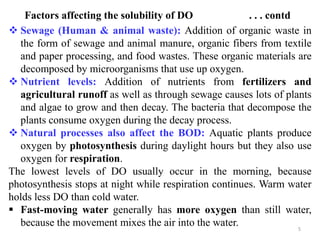
 Sewage (Human & animal waste): Addition of organic waste in
the form of sewage and animal manure, organic fibers from textile
and paper processing, and food wastes. These organic materials are
decomposed by microorganisms that use up oxygen.
 Nutrient levels: Addition of nutrients from fertilizers and
agricultural runoff as well as through sewage causes lots of plants
and algae to grow and then decay. The bacteria that decompose the
plants consume oxygen during the decay process.
 Natural processes also affect the BOD: Aquatic plants produce
oxygen by photosynthesis during daylight hours but they also use
oxygen for respiration.
The lowest levels of DO usually occur in the morning, because
photosynthesis stops at night while respiration continues. Warm water
holds less DO than cold water.
 Fast-moving water generally has more oxygen than still water,
because the movement mixes the air into the water.
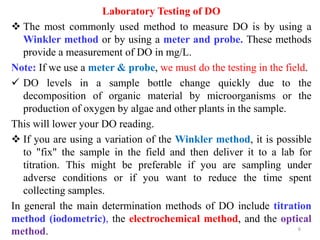
Laboratory Testing of DO
 The most commonly used method to measure DO is by using a
Winkler method or by using a meter and probe. These methods
provide a measurement of DO in mg/L.
Note: If we use a meter & probe, we must do the testing in the field.
 DO levels in a sample bottle change quickly due to the
decomposition of organic material by microorganisms or the
production of oxygen by algae and other plants in the sample.
This will lower your DO reading.
 If you are using a variation of the Winkler method, it is possible
to "fix" the sample in the field and then deliver it to a lab for
titration. This might be preferable if you are sampling under
adverse conditions or if you want to reduce the time spent
collecting samples.
In general the main determination methods of DO include titration
method (iodometric), the electrochemical method, and the optical
method. 6
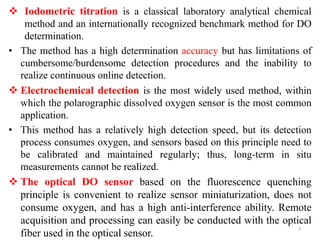
 Iodometric titration is a classical laboratory analytical chemical
method and an internationally recognized benchmark method for DO
determination.
• The method has a high determination accuracy but has limitations of
cumbersome/burdensome detection procedures and the inability to
realize continuous online detection.
 Electrochemical detection is the most widely used method, within
which the polarographic dissolved oxygen sensor is the most common
application.
• This method has a relatively high detection speed, but its detection
process consumes oxygen, and sensors based on this principle need to
be calibrated and maintained regularly; thus, long-term in situ
measurements cannot be realized.
 The optical DO sensor based on the fluorescence quenching
principle is convenient to realize sensor miniaturization, does not
consume oxygen, and has a high anti-interference ability. Remote
acquisition and processing can easily be conducted with the optical
fiber used in the optical sensor.
7
8
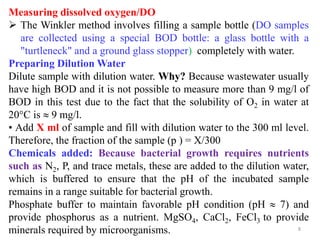
Measuring dissolved oxygen/DO
 The Winkler method involves filling a sample bottle (DO samples
are collected using a special BOD bottle: a glass bottle with a
"turtleneck" and a ground glass stopper) completely with water.
Preparing Dilution Water
Dilute sample with dilution water. Why? Because wastewater usually
have high BOD and it is not possible to measure more than 9 mg/l of
BOD in this test due to the fact that the solubility of O2 in water at
20C is  9 mg/l.
• Add X ml of sample and fill with dilution water to the 300 ml level.
Therefore, the fraction of the sample (p ) = X/300
Chemicals added: Because bacterial growth requires nutrients
such as N2, P, and trace metals, these are added to the dilution water,
which is buffered to ensure that the pH of the incubated sample
remains in a range suitable for bacterial growth.
Phosphate buffer to maintain favorable pH condition (pH  7) and
provide phosphorus as a nutrient. MgSO4, CaCl2, FeCl3 to provide
minerals required by microorganisms.
9
The BOD test is performed by incubating a sealed wastewater sample
for the standard 5-day period, then determining the change in DO
content.
Complete stabilization of a sample may require a period of incubation
too long for practical purposes; therefore, 5-day period has been
accepted as the standard incubation period.
 The bottle size, incubation temperature, and incubation period are
all specified.
Most wastewaters contain more oxygen demanding materials than
the amount of DO available in air-saturated water. Therefore, it is
necessary to dilute the sample before incubation to bring the
oxygen demand and supply into appropriate balance.
10
Procedure for BOD measurement
• Take four 300 ml glass stoppered bottles (2 for the sample & 2 for the
blank)
• Add 10 ml of the sample to each of the bod bottles and the fill the
remaining quantity with the dilution .
• The remaining 2 bottles are for blank to these bottles & dilution water
alone. After the addition immediately place the glass stopper over BOD
bottle and note down the numbers of the bottle for identification
 Preserve 1 blank solution & 1 sample solution bottle for 5 days
• Other bottle needs to be analyzed immediately
• Add 2 ml of manganese sulfate and 2 ml of alkali iodide azide reagent in
the same manner.
• Allow it to settle for sufficient time in order to react completely with
oxygen. When this flock has settled to the bottom , shake the contents
thoroughly by turning it upside down.
• Add 2 ml of conc. H2SO4 via a pipette and then titrate the solution with
standard sodium thiosulphate solution until the yellow color of liberated I2 is
almost faded out. Continue the titration until the blue color disappears to
colorless. After 5 days take out the sample and blank solution as this manner.
Concept: O2 measurement depends on the fact that O2 oxidizes Mn2+
under alkaline conditions:
Mn2+ + 2OH + ½O2 MnO2 + H2O
MnO2 is capable of oxidizing iodide (I (to free iodine (I2) under
acidic conditions:
MnO2 + 2 I + 4H+ Mn2+ + I2 + H2O
The amount of free iodine released is equivalent to the DO.
BOD5 (mg/L) = [(DOInitial - DOFinal )] x 300/sample volume
12
Meter and Probe
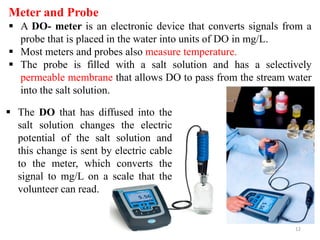
 A DO- meter is an electronic device that converts signals from a
probe that is placed in the water into units of DO in mg/L.
 Most meters and probes also measure temperature.
 The probe is filled with a salt solution and has a selectively
permeable membrane that allows DO to pass from the stream water
into the salt solution.
 The DO that has diffused into the
salt solution changes the electric
potential of the salt solution and
this change is sent by electric cable
to the meter, which converts the
signal to mg/L on a scale that the
volunteer can read.
13
 DO meters are expensive compared to field kits that use the
titration method.
The advantage of a meter/probe is that we can measure DO &
temperature quickly at any point in the stream that we can reach
with the probe.
 The meter/probe must be carefully maintained, and it must be
calibrated before each sample run and, if we are doing many
tests, in between samplings.
 The results are read directly as mg/L, unlike the titration
methods, in which the final titration result might have to be
converted by an equation to mg/L.
 Most aquatic life needs a minimum of 3 mg/L of DO to survive.
At 2 mg/l, organisms become stressed and can die.
 In general, DO from ranges of:
 0-2 mg/L: not enough oxygen to support most animals
 2-4 mg/L: only a few kinds of fish and insects can survive
 4-7 mg/L: good for most kinds of pond animals
 7-11 mg/L: very good for most stream fish
14
Challenges to monitoring BOD
 the test is time consuming & expensive; it fails to recreate natural
processes (i.e. the test involves a 5-day incubation conducted in the
dark)
 results are not always simple to interpret as a low value can be
due to high organic content that is not readily degraded or that
degradation is inhibited by toxins;
 it is imprecise and has a high minimum detection limit thus is not
applicable to clean/uncontaminated river samples;
 the accuracy/repeatability is low with measurement variability
in certified laboratories as high as 20%; and that is just the
measurement in the laboratory and does not involve all of the
potential issues of the sampling and transportation process
 It is clear that a move from traditional laboratory testing to in-situ
(real-time) monitoring would help to alleviate most of the problems
outlined above.
15
Applications of BOD
The applications of BOD are mainly in the following aspects:
 Evaluation of surface water quality: BOD is an important indicator
to measure the degree of surface water contaminated by organic
matter, and can be used to evaluate the pollution status of rivers,
lakes, reservoirs and other water bodies.
 Evaluation of wastewater quality: BOD is an important indicator
of wastewater discharge, which can be used to evaluate the
biochemistry of wastewater and provide a basis for the selection and
design of wastewater treatment process.
BOD is used to confirm wastewater discharge and the waste
treatment procedure meets criteria set by regulators.
 Evaluation of water quality of sewage treatment plant:
BOD is an important water quality indicator of sewage treatment
plant, which can be used to evaluate the treatment effect of sewage
treatment plant.
COD/BOD is also used as an indicator of the size of a wastewater
treatment plant required for a specific location.
16
Chemical Oxygen Demand (COD)
 COD analysis is a measurement of the oxygen-depletion capacity
of a water sample contaminated with organic wastes. It is a
measure of the total quantity of oxygen required to oxidize all
organic material into carbon dioxide and water.
 It is a measure of the oxygen equivalent of the organic matter in
a water sample that is susceptible to oxidation by a strong
chemical oxidant. It is the amount of oxygen required to
chemically breakdown the pollutants.
 COD is widely used as a measure of the susceptibility to oxidation
of the organic and inorganic materials present in water bodies
and in the municipal and industrial wastes.
 The COD determines the amount of oxygen required for chemical
oxidation of organic matter using a strong chemical oxidant, such
as, potassium dichromate under reflux conditions.
17
COD is widely used to determine:
 Degree of pollution in water bodies & their self-purification
capacity,
 Efficiency of treatment plants, Pollution loads, and
 Provides rough idea of BOD which can be used to determine
sample volume for BOD estimation.
In a BOD test, only biologically reactive carbon is oxidized while in a
COD test, all organic matter is converted to carbon dioxide.
 The test for COD does not identify the oxidizable material or
differentiate between the organic material and inorganic material
present. Similarly, it does not indicate the total organic carbon
present. Consequently, the COD values are higher compared to
BOD. Nevertheless, COD is a useful variable that can be rapidly
measured; the COD test can be performed in 3 hours against 5
days required for a BOD5 test.
COD values are always greater than BOD values
Measurement of COD
There are two methods available for COD determination namely open
reflux and closed reflux.
1. Open Reflux Principle: Suitable for a wide range of wastes with a
large sample size.
Due to it higher oxidizing ability dichromate reflux method is
preferred over other procedures using other oxidants (e.g.
potassium permanganate).
Oxidation of most organic compounds is up to 95-100% of the
theoretical value.
2. Closed Reflux Principle: This method is conducted with ampules
and culture tubes with pre-measured reagents. Measurement of
sample volume and reagent volume are critical.
This method is economical in the use of metallic salt reagents and
generate smaller quantity of hazardous wastes.
Volatile organic compounds (VOC) gets completely oxidized in a
closed system than the open because of longer contact time with
oxidants.
 Mostly use the Open Reflux Method because close reflux method
produces minimum hazaradous wastes but cost advantage 18
• When measuring COD, a strong chemical oxidizing agent,
such as K2Cr2O7 or KMnO4, is used in order to chemically
oxidize organic material in water samples.
• Most of the organic matters are-destroyed when boiled with a
mixture of K2Cr2O7 and H2SO4 producing CO2 and water.
• A sample is refluxed with a known amount of K2Cr2O7 in
H2SO4 medium and the excess of dichromate is titrated
against ferrous ammonium sulphate, FAS.
• The amount of dichromate consumed is proportional to the
oxygen required to oxidize the oxidizable organic matter.
• This is done under heated and strongly acidic conditions.
• COD increases as the concentration of organic material
increases.
• It also increases if inorganic compounds susceptible to
oxidation by the oxidant (typically dichromate) are present.
19
20
 Wash culture tubes and caps with 20% H2SO4 before using to prevent
contamination.
 Place sample (2.5 mL) in culture tube & add K2Cr2O7 digestion solution
(1.5 mL).
 Carefully run sulphuric acid reagent (3.5 mL) down inside of vessel so an
acid layer is formed under the sample-digestion solution layer and tightly
cap tubes or seal ampules, and invert each several times to mix
completely.
 Place tubes in block digester preheated to 150°C and reflux for 2 h behind
a protective shield.
Cool to room temperature and place vessels in test tube rack. Some mercuric
sulphate may precipitate out but this will not affect the analysis. Add 1 to 2
drops of Ferroin indicator and stir rapidly on magnetic stirrer while titrating
with standardized 0.10 M FAS (ferrous ammonium sulphate,
(NH₄)₂Fe(SO₄)₂·6H₂O also known as Mohr's salt.
 The end point is a sharp colour change from blue-green to reddish
brown, although the blue green may reappear within minutes.
In the same manner reflux and titrate a blank containing the reagents and a
volume of distilled water equal to that of the sample.
21
COD is given by
COD (mg O2 /L) = [(A-B) × M] ×8000/ V sample
Where: A = volume of FAS used for blank (mL). B = volume of FAS used
for sample (mL), M = molarity of FAS, 8000 = milli equivalent weight of
oxygen (8) ×1000 mL/L
 Water with high COD typically contains high levels of decaying
plant matter, human waste, or industrial effluent.
 COD test is carried out on the sewage to determine the extent of
readily oxidizable organic matter, which is of two types:
(a) Organic matter which can be biologically oxidized is called
biologically active (b) Organic matter which cannot be oxidized
biologically is called biologically inactive.
• COD gives the oxygen required for the complete oxidation of both
biodegradable and non-biodegradable matter.
• It is a measure of the oxygen equivalent of the organic matter
content of a sample that is susceptible to oxidation by a strong
chemical oxidant.
• It is an indirect method to measure the amount of organic
compounds in water.
• It is expressed in (mg/L), which indicates the mass of oxygen
consumed per liter of solution
22
 Similar to COD, BOD is a general indicator of water quality. In
contrast to BOD, COD testing only takes a few hours to
complete. COD results can be obtained in 3-4 hrs as compared to
3-5days required for BOD test.
• The test is relatively easy, precise, and is unaffected by
interferences as in the BOD test.
 The intrinsic limitation of the test lies in its inability to differentiate
between the biologically oxidizable and biologically inert material
and to find out the system rate constant of aerobic biological
stabilization.
23
Why measuring COD is needed?
• High levels of wastewater COD indicate concentrations of organics
that can deplete DO in the water, leading to negative environmental
and regulatory consequences.
• To determine the impact and ultimately limit the amount of
organic pollution in water, OD is an essential measurement.
 COD tests are widely used to determine:
a) Degree of pollution in water bodies & their self-purification
capacity
b) Efficiency of treatment plants
c) Pollution loads, and
d) Provides rough idea of BOD which can be used to determine
sample volume for BOD estimation.
24
Applications of COD
COD is often used as a measurement of pollutants in water,
wastewater, and aqueous hazardous wastes.
 to measure soluble COD in wastewater,
 to rapidly infer biodegradability of samples from the COD tests.
In general there are four important applications of COD in wastewater
treatment are:
• To determine the concentration of oxidizable pollutants present in
wastewater
• As an index to determine overall water quality
• To ascertain the effectiveness of wastewater treatment solutions
• To determine the effect of wastewater disposal on the receiving
environment
• The ratio between BOD and COD is indicative of the
biodegradable fraction of wastewater effluent.
25

Chap 4 BOD and CODnoonpodefgpnmopoon.pdf

  • 1.
    Chapter 4 Measurement ofDissolved Oxygen (DO) and Chemical Oxygen Demand (COD)  Dissolved Oxygen (DO) is a measure of the amount of gaseous oxygen dissolved in the water that is available and essential for the survival of aquatic organisms. Oxygen is measured in its dissolved form as dissolved oxygen (DO). If more oxygen is consumed than is produced, DO levels decline and some sensitive animals may move away, weaken, or die.  Very low or very high concentrations of oxygen in the water would not support life and would therefore indicate poor quality. • BOD is a measure of the amount of DO required for microbial metabolism of to break down the organic material in a given volume of water through aerobic biological activity. It is used in water quality management and assessment, ecology and environmental science. 1
  • 2.
    • BOD isthe amount of dissolved oxygen needed by aerobic biological organisms in a body of water to break down organic metals present in a given water sample at certain temperature over a specific time period. • Most of the bacteria in the aquatic columns are aerobic. E.g., Escherichia coli , Bacillus  Measuring DO is probably the most significant water quality test to determine the suitability of a stream for fish and many other aquatic organisms. However, it is not an accurate quantitative test, although it is considered as an indication of the quality of a water source. 2
  • 3.
    3  Measuring BODis a chemical procedure for determining the rate of DO uptake by biological organisms in a body of water use up oxygen. Oxygen is removed from the water by chemical reactions, the decay process and respiration. The BOD value is most commonly expressed in milligrams of oxygen consumed per liter of sample during 5 days of incubation at 20 °C.  BOD can be used as a gauge of the effectiveness of wastewater treatment plants. BOD is similar in function to chemical oxygen demand (COD), in that both measure the amount of organic compounds in water. BOD is often used as a quality parameter to assess the extent of organic pollutants in municipal wastewaters.
  • 4.
    4 Factors affecting thesolubility of DO BOD can be impacted by different factors such as temperature, sewage (human & animal waste ), nutrient levels, turbidity, organic wastes, natural process, seasonal variation, atmospheric pressure, water depth salinity etc  Temperature: Metabolic rate and reproduction activities of aquatic life are controlled by water temperature. • Metabolic activity increases with a rise in temperature, thus increasing a fish’s demand for oxygen; however; an increase in stream/water temperature also causes a decrease in DO, limiting the amount of oxygen available to these aquatic organisms.  Water at higher elevations holds less DO since the atmospheric pressure is less.  Sewage (Human and animal waste ): Addition of organic waste in the form of sewage and animal manure, organic fibers from textile and paper processing, and food wastes. These organic materials are decomposed by microorganisms that use up oxygen
  • 5.
    5 Factors affecting thesolubility of DO . . . contd  Sewage (Human & animal waste): Addition of organic waste in the form of sewage and animal manure, organic fibers from textile and paper processing, and food wastes. These organic materials are decomposed by microorganisms that use up oxygen.  Nutrient levels: Addition of nutrients from fertilizers and agricultural runoff as well as through sewage causes lots of plants and algae to grow and then decay. The bacteria that decompose the plants consume oxygen during the decay process.  Natural processes also affect the BOD: Aquatic plants produce oxygen by photosynthesis during daylight hours but they also use oxygen for respiration. The lowest levels of DO usually occur in the morning, because photosynthesis stops at night while respiration continues. Warm water holds less DO than cold water.  Fast-moving water generally has more oxygen than still water, because the movement mixes the air into the water.
  • 6.
    Laboratory Testing ofDO  The most commonly used method to measure DO is by using a Winkler method or by using a meter and probe. These methods provide a measurement of DO in mg/L. Note: If we use a meter & probe, we must do the testing in the field.  DO levels in a sample bottle change quickly due to the decomposition of organic material by microorganisms or the production of oxygen by algae and other plants in the sample. This will lower your DO reading.  If you are using a variation of the Winkler method, it is possible to "fix" the sample in the field and then deliver it to a lab for titration. This might be preferable if you are sampling under adverse conditions or if you want to reduce the time spent collecting samples. In general the main determination methods of DO include titration method (iodometric), the electrochemical method, and the optical method. 6
  • 7.
     Iodometric titrationis a classical laboratory analytical chemical method and an internationally recognized benchmark method for DO determination. • The method has a high determination accuracy but has limitations of cumbersome/burdensome detection procedures and the inability to realize continuous online detection.  Electrochemical detection is the most widely used method, within which the polarographic dissolved oxygen sensor is the most common application. • This method has a relatively high detection speed, but its detection process consumes oxygen, and sensors based on this principle need to be calibrated and maintained regularly; thus, long-term in situ measurements cannot be realized.  The optical DO sensor based on the fluorescence quenching principle is convenient to realize sensor miniaturization, does not consume oxygen, and has a high anti-interference ability. Remote acquisition and processing can easily be conducted with the optical fiber used in the optical sensor. 7
  • 8.
    8 Measuring dissolved oxygen/DO The Winkler method involves filling a sample bottle (DO samples are collected using a special BOD bottle: a glass bottle with a "turtleneck" and a ground glass stopper) completely with water. Preparing Dilution Water Dilute sample with dilution water. Why? Because wastewater usually have high BOD and it is not possible to measure more than 9 mg/l of BOD in this test due to the fact that the solubility of O2 in water at 20C is  9 mg/l. • Add X ml of sample and fill with dilution water to the 300 ml level. Therefore, the fraction of the sample (p ) = X/300 Chemicals added: Because bacterial growth requires nutrients such as N2, P, and trace metals, these are added to the dilution water, which is buffered to ensure that the pH of the incubated sample remains in a range suitable for bacterial growth. Phosphate buffer to maintain favorable pH condition (pH  7) and provide phosphorus as a nutrient. MgSO4, CaCl2, FeCl3 to provide minerals required by microorganisms.
  • 9.
    9 The BOD testis performed by incubating a sealed wastewater sample for the standard 5-day period, then determining the change in DO content. Complete stabilization of a sample may require a period of incubation too long for practical purposes; therefore, 5-day period has been accepted as the standard incubation period.  The bottle size, incubation temperature, and incubation period are all specified. Most wastewaters contain more oxygen demanding materials than the amount of DO available in air-saturated water. Therefore, it is necessary to dilute the sample before incubation to bring the oxygen demand and supply into appropriate balance.
  • 10.
    10 Procedure for BODmeasurement • Take four 300 ml glass stoppered bottles (2 for the sample & 2 for the blank) • Add 10 ml of the sample to each of the bod bottles and the fill the remaining quantity with the dilution . • The remaining 2 bottles are for blank to these bottles & dilution water alone. After the addition immediately place the glass stopper over BOD bottle and note down the numbers of the bottle for identification  Preserve 1 blank solution & 1 sample solution bottle for 5 days • Other bottle needs to be analyzed immediately • Add 2 ml of manganese sulfate and 2 ml of alkali iodide azide reagent in the same manner. • Allow it to settle for sufficient time in order to react completely with oxygen. When this flock has settled to the bottom , shake the contents thoroughly by turning it upside down. • Add 2 ml of conc. H2SO4 via a pipette and then titrate the solution with standard sodium thiosulphate solution until the yellow color of liberated I2 is almost faded out. Continue the titration until the blue color disappears to colorless. After 5 days take out the sample and blank solution as this manner.
  • 11.
    Concept: O2 measurementdepends on the fact that O2 oxidizes Mn2+ under alkaline conditions: Mn2+ + 2OH + ½O2 MnO2 + H2O MnO2 is capable of oxidizing iodide (I (to free iodine (I2) under acidic conditions: MnO2 + 2 I + 4H+ Mn2+ + I2 + H2O The amount of free iodine released is equivalent to the DO. BOD5 (mg/L) = [(DOInitial - DOFinal )] x 300/sample volume
  • 12.
    12 Meter and Probe A DO- meter is an electronic device that converts signals from a probe that is placed in the water into units of DO in mg/L.  Most meters and probes also measure temperature.  The probe is filled with a salt solution and has a selectively permeable membrane that allows DO to pass from the stream water into the salt solution.  The DO that has diffused into the salt solution changes the electric potential of the salt solution and this change is sent by electric cable to the meter, which converts the signal to mg/L on a scale that the volunteer can read.
  • 13.
    13  DO metersare expensive compared to field kits that use the titration method. The advantage of a meter/probe is that we can measure DO & temperature quickly at any point in the stream that we can reach with the probe.  The meter/probe must be carefully maintained, and it must be calibrated before each sample run and, if we are doing many tests, in between samplings.  The results are read directly as mg/L, unlike the titration methods, in which the final titration result might have to be converted by an equation to mg/L.  Most aquatic life needs a minimum of 3 mg/L of DO to survive. At 2 mg/l, organisms become stressed and can die.  In general, DO from ranges of:  0-2 mg/L: not enough oxygen to support most animals  2-4 mg/L: only a few kinds of fish and insects can survive  4-7 mg/L: good for most kinds of pond animals  7-11 mg/L: very good for most stream fish
  • 14.
    14 Challenges to monitoringBOD  the test is time consuming & expensive; it fails to recreate natural processes (i.e. the test involves a 5-day incubation conducted in the dark)  results are not always simple to interpret as a low value can be due to high organic content that is not readily degraded or that degradation is inhibited by toxins;  it is imprecise and has a high minimum detection limit thus is not applicable to clean/uncontaminated river samples;  the accuracy/repeatability is low with measurement variability in certified laboratories as high as 20%; and that is just the measurement in the laboratory and does not involve all of the potential issues of the sampling and transportation process  It is clear that a move from traditional laboratory testing to in-situ (real-time) monitoring would help to alleviate most of the problems outlined above.
  • 15.
    15 Applications of BOD Theapplications of BOD are mainly in the following aspects:  Evaluation of surface water quality: BOD is an important indicator to measure the degree of surface water contaminated by organic matter, and can be used to evaluate the pollution status of rivers, lakes, reservoirs and other water bodies.  Evaluation of wastewater quality: BOD is an important indicator of wastewater discharge, which can be used to evaluate the biochemistry of wastewater and provide a basis for the selection and design of wastewater treatment process. BOD is used to confirm wastewater discharge and the waste treatment procedure meets criteria set by regulators.  Evaluation of water quality of sewage treatment plant: BOD is an important water quality indicator of sewage treatment plant, which can be used to evaluate the treatment effect of sewage treatment plant. COD/BOD is also used as an indicator of the size of a wastewater treatment plant required for a specific location.
  • 16.
    16 Chemical Oxygen Demand(COD)  COD analysis is a measurement of the oxygen-depletion capacity of a water sample contaminated with organic wastes. It is a measure of the total quantity of oxygen required to oxidize all organic material into carbon dioxide and water.  It is a measure of the oxygen equivalent of the organic matter in a water sample that is susceptible to oxidation by a strong chemical oxidant. It is the amount of oxygen required to chemically breakdown the pollutants.  COD is widely used as a measure of the susceptibility to oxidation of the organic and inorganic materials present in water bodies and in the municipal and industrial wastes.  The COD determines the amount of oxygen required for chemical oxidation of organic matter using a strong chemical oxidant, such as, potassium dichromate under reflux conditions.
  • 17.
    17 COD is widelyused to determine:  Degree of pollution in water bodies & their self-purification capacity,  Efficiency of treatment plants, Pollution loads, and  Provides rough idea of BOD which can be used to determine sample volume for BOD estimation. In a BOD test, only biologically reactive carbon is oxidized while in a COD test, all organic matter is converted to carbon dioxide.  The test for COD does not identify the oxidizable material or differentiate between the organic material and inorganic material present. Similarly, it does not indicate the total organic carbon present. Consequently, the COD values are higher compared to BOD. Nevertheless, COD is a useful variable that can be rapidly measured; the COD test can be performed in 3 hours against 5 days required for a BOD5 test. COD values are always greater than BOD values
  • 18.
    Measurement of COD Thereare two methods available for COD determination namely open reflux and closed reflux. 1. Open Reflux Principle: Suitable for a wide range of wastes with a large sample size. Due to it higher oxidizing ability dichromate reflux method is preferred over other procedures using other oxidants (e.g. potassium permanganate). Oxidation of most organic compounds is up to 95-100% of the theoretical value. 2. Closed Reflux Principle: This method is conducted with ampules and culture tubes with pre-measured reagents. Measurement of sample volume and reagent volume are critical. This method is economical in the use of metallic salt reagents and generate smaller quantity of hazardous wastes. Volatile organic compounds (VOC) gets completely oxidized in a closed system than the open because of longer contact time with oxidants.  Mostly use the Open Reflux Method because close reflux method produces minimum hazaradous wastes but cost advantage 18
  • 19.
    • When measuringCOD, a strong chemical oxidizing agent, such as K2Cr2O7 or KMnO4, is used in order to chemically oxidize organic material in water samples. • Most of the organic matters are-destroyed when boiled with a mixture of K2Cr2O7 and H2SO4 producing CO2 and water. • A sample is refluxed with a known amount of K2Cr2O7 in H2SO4 medium and the excess of dichromate is titrated against ferrous ammonium sulphate, FAS. • The amount of dichromate consumed is proportional to the oxygen required to oxidize the oxidizable organic matter. • This is done under heated and strongly acidic conditions. • COD increases as the concentration of organic material increases. • It also increases if inorganic compounds susceptible to oxidation by the oxidant (typically dichromate) are present. 19
  • 20.
    20  Wash culturetubes and caps with 20% H2SO4 before using to prevent contamination.  Place sample (2.5 mL) in culture tube & add K2Cr2O7 digestion solution (1.5 mL).  Carefully run sulphuric acid reagent (3.5 mL) down inside of vessel so an acid layer is formed under the sample-digestion solution layer and tightly cap tubes or seal ampules, and invert each several times to mix completely.  Place tubes in block digester preheated to 150°C and reflux for 2 h behind a protective shield. Cool to room temperature and place vessels in test tube rack. Some mercuric sulphate may precipitate out but this will not affect the analysis. Add 1 to 2 drops of Ferroin indicator and stir rapidly on magnetic stirrer while titrating with standardized 0.10 M FAS (ferrous ammonium sulphate, (NH₄)₂Fe(SO₄)₂·6H₂O also known as Mohr's salt.  The end point is a sharp colour change from blue-green to reddish brown, although the blue green may reappear within minutes. In the same manner reflux and titrate a blank containing the reagents and a volume of distilled water equal to that of the sample.
  • 21.
    21 COD is givenby COD (mg O2 /L) = [(A-B) × M] ×8000/ V sample Where: A = volume of FAS used for blank (mL). B = volume of FAS used for sample (mL), M = molarity of FAS, 8000 = milli equivalent weight of oxygen (8) ×1000 mL/L  Water with high COD typically contains high levels of decaying plant matter, human waste, or industrial effluent.
  • 22.
     COD testis carried out on the sewage to determine the extent of readily oxidizable organic matter, which is of two types: (a) Organic matter which can be biologically oxidized is called biologically active (b) Organic matter which cannot be oxidized biologically is called biologically inactive. • COD gives the oxygen required for the complete oxidation of both biodegradable and non-biodegradable matter. • It is a measure of the oxygen equivalent of the organic matter content of a sample that is susceptible to oxidation by a strong chemical oxidant. • It is an indirect method to measure the amount of organic compounds in water. • It is expressed in (mg/L), which indicates the mass of oxygen consumed per liter of solution 22
  • 23.
     Similar toCOD, BOD is a general indicator of water quality. In contrast to BOD, COD testing only takes a few hours to complete. COD results can be obtained in 3-4 hrs as compared to 3-5days required for BOD test. • The test is relatively easy, precise, and is unaffected by interferences as in the BOD test.  The intrinsic limitation of the test lies in its inability to differentiate between the biologically oxidizable and biologically inert material and to find out the system rate constant of aerobic biological stabilization. 23
  • 24.
    Why measuring CODis needed? • High levels of wastewater COD indicate concentrations of organics that can deplete DO in the water, leading to negative environmental and regulatory consequences. • To determine the impact and ultimately limit the amount of organic pollution in water, OD is an essential measurement.  COD tests are widely used to determine: a) Degree of pollution in water bodies & their self-purification capacity b) Efficiency of treatment plants c) Pollution loads, and d) Provides rough idea of BOD which can be used to determine sample volume for BOD estimation. 24
  • 25.
    Applications of COD CODis often used as a measurement of pollutants in water, wastewater, and aqueous hazardous wastes.  to measure soluble COD in wastewater,  to rapidly infer biodegradability of samples from the COD tests. In general there are four important applications of COD in wastewater treatment are: • To determine the concentration of oxidizable pollutants present in wastewater • As an index to determine overall water quality • To ascertain the effectiveness of wastewater treatment solutions • To determine the effect of wastewater disposal on the receiving environment • The ratio between BOD and COD is indicative of the biodegradable fraction of wastewater effluent. 25