by
Prof V. V. Sasane (Assistant Professor)
Department of Civil Engineering
Sanjivani College of Engineering, Kopargaon, 423603
Subject: Environmental Engineering-II
B.E. Civil
Unit-II: Sewage Treatment
2.4 Grit Chamber
Sanjivani Rural Education Society’s
Sanjivani College of Engineering, Kopargaon, 423603
An Autonomous Institute Affiliated to Savitribai Phule Pune University, Pune
Contents
1. Introduction to Grit Chamber
2. Types of Grit Chambers
3. Design of Grit Chamber
4. Cleaning and Disposal of Grit
Introduction to Grit Chamber
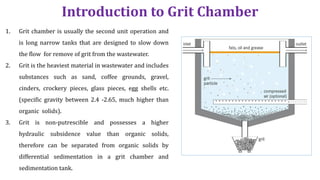
1. Grit chamber is usually the second unit operation and
is long narrow tanks that are designed to slow down
the flow for remove of grit from the wastewater.
2. Grit is the heaviest material in wastewater and includes
substances such as sand, coffee grounds, gravel,
cinders, crockery pieces, glass pieces, egg shells etc.
(specific gravity between 2.4 ‐2.65, much higher than
organic solids).
3. Grit is non‐putrescible and possesses a higher
hydraulic subsidence value than organic solids,
therefore can be separated from organic solids by
differential sedimentation in a grit chamber and
sedimentation tank.
A grit chamber is an enlarged channel or a long basin in which cross section is increased so as to reduce
the flow velocity of the sewage, so that heavy inorganic solids do settle down by gravity.
Grit removal is necessary to protect the moving mechanical equipment and pump elements from abrasion
and abnormal wear and tear. Removal of grit also reduces the frequency of cleaning of digesters and
settling tanks.
Objective of Grit Chamber
• To protect the pumps and other equipment
• To avoid overloading on further treatments.
• To reduce the frequency of cleaning of sludge digesters and settling tank.
• To reduce the clogging of sludge pipes.
• A grit chamber is usually installed before primary sedimentation tanks. There are basically
three different types of grit chambers.
1. Horizontal flow type 2. Aerated grit chamber 3. Vortex type.
Types of Grit Chamber
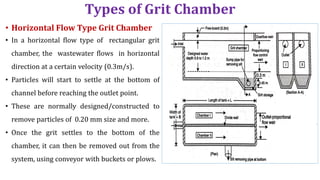
• Horizontal Flow Type Grit Chamber
• In a horizontal flow type of rectangular grit
chamber, the wastewater flows in horizontal
direction at a certain velocity (0.3m/s).
• Particles will start to settle at the bottom of
channel before reaching the outlet point.
• These are normally designed/constructed to
remove particles of 0.20 mm size and more.
• Once the grit settles to the bottom of the
chamber, it can then be removed out from the
system, using conveyor with buckets or plows.
• Aerated Grit Chamber
Aerated grit chamber consists of an aeration tank, which
is designed to create a spiral flow of wastewater as it
moves through the chamber.
• Air is introduced along one side of a rectangular tank to
create a spiral flow pattern perpendicular to the flow
through the tank.
• If the velocity is too great, grit will be carried out of the
chamber; if it is too small, organic material will be
removed with the grit.
• Normally designed to remove 0.21-mm-diameter or
larger, with 2-5-minute detention periods at the peak
hourly rate of flow.
• Air diffusers are located about 0.45 to 0.6m above the
normal plane of the bottom.
Vortex Type Grit Chamber
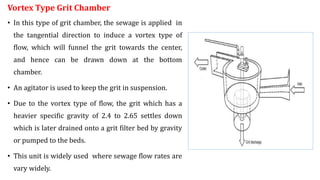
• In this type of grit chamber, the sewage is applied in
the tangential direction to induce a vortex type of
flow, which will funnel the grit towards the center,
and hence can be drawn down at the bottom
chamber.
• An agitator is used to keep the grit in suspension.
• Due to the vortex type of flow, the grit which has a
heavier specific gravity of 2.4 to 2.65 settles down
which is later drained onto a grit filter bed by gravity
or pumped to the beds.
• This unit is widely used where sewage flow rates are
vary widely.
Design of Grit Chamber
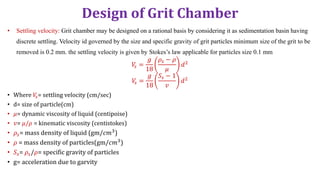
• Settling velocity: Grit chamber may be designed on a rational basis by considering it as sedimentation basin having
discrete settling. Velocity id governed by the size and specific gravity of grit particles minimum size of the grit to be
removed is 0.2 mm. the settling velocity is given by Stokes’s law applicable for particles size 0.1 mm
𝑉
𝑠 =
𝑔
18
𝜌𝑠 − 𝜌
𝜇
𝑑2
𝑉
𝑠 =
𝑔
18
𝑆𝑠 − 1
𝑣
𝑑2
• Where 𝑉
𝑠= settling velocity (cm/sec)
• d= size of particle(cm)
• 𝜇= dynamic viscosity of liquid (centipoise)
• 𝑣= 𝜇/𝜌 = kinematic viscosity (centistokes)
• 𝜌𝑠= mass density of liquid (gm/𝑐𝑚3)
• 𝜌 = mass density of particles(gm/𝑐𝑚3)
• 𝑆𝑠= 𝜌𝑠/𝜌= specific gravity of particles
• g= acceleration due to garvity
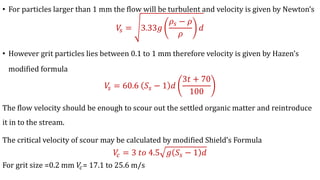
• For particles larger than 1 mm the flow will be turbulent and velocity is given by Newton’s
𝑉
𝑠 = 3.33𝑔
𝜌𝑠 − 𝜌
𝜌
𝑑
• However grit particles lies between 0.1 to 1 mm therefore velocity is given by Hazen’s
modified formula
𝑉
𝑠 = 60.6 𝑆𝑠 − 1 𝑑
3𝑡 + 70
100
The flow velocity should be enough to scour out the settled organic matter and reintroduce
it in to the stream.
The critical velocity of scour may be calculated by modified Shield’s Formula
𝑉
𝑐 = 3 𝑡𝑜 4.5 𝑔 𝑆𝑠 − 1 𝑑
For grit size =0.2 mm 𝑉
𝑐= 17.1 to 25.6 m/s
Other Design Parameters
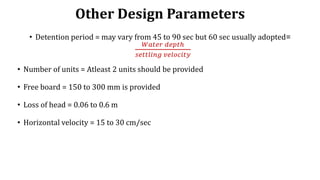
• Detention period = may vary from 45 to 90 sec but 60 sec usually adopted=
𝑊𝑎𝑡𝑒𝑟 𝑑𝑒𝑝𝑡ℎ
𝑠𝑒𝑡𝑡𝑙𝑖𝑛𝑔 𝑣𝑒𝑙𝑜𝑐𝑖𝑡𝑦
• Number of units = Atleast 2 units should be provided
• Free board = 150 to 300 mm is provided
• Loss of head = 0.06 to 0.6 m
• Horizontal velocity = 15 to 30 cm/sec
Clearing of the Grit
1. Grits can be removed manually or mechanically, however manual clearing should be avoided
except in the case of very small STPs (< 1 MLD) where velocity controlled channels can be
cleared by the operator using a shovel.
2. In mechanical clearing, equipment are provided for collection as well as washing of grit
(mostly by agitation mechanisms), and can be operated on either a continuous or intermittent
basis.
3. The settled grit on the floor is collected by scrapper blades or ploughs and elevated to the
ground level by various mechanisms such as bucket elevators, jet pump, screws and air lift.
4. In intermittently (normally once or twice a day) operated type, sufficient storage capacity to
hold the grit between intervals of grit elevation should be provided.
Disposal of Grit
1. Clean grit is odourless and may be disposed by dumping or burying or by sanitary
landfill.
2. If not washed, grit particles may contain organic matter which adds odour and is not
suitable for disposal.
3. However, the ultimate method of disposal depends on the quantity and other
characteristics of the particles and further on the availability of the land for dumping or
burial.
4. The odorous grit particles are preferably buried, unless
Thank you

3. grit chamber

  • 1.
    by Prof V. V.Sasane (Assistant Professor) Department of Civil Engineering Sanjivani College of Engineering, Kopargaon, 423603 Subject: Environmental Engineering-II B.E. Civil Unit-II: Sewage Treatment 2.4 Grit Chamber Sanjivani Rural Education Society’s Sanjivani College of Engineering, Kopargaon, 423603 An Autonomous Institute Affiliated to Savitribai Phule Pune University, Pune
  • 2.
    Contents 1. Introduction toGrit Chamber 2. Types of Grit Chambers 3. Design of Grit Chamber 4. Cleaning and Disposal of Grit
  • 3.
    Introduction to GritChamber 1. Grit chamber is usually the second unit operation and is long narrow tanks that are designed to slow down the flow for remove of grit from the wastewater. 2. Grit is the heaviest material in wastewater and includes substances such as sand, coffee grounds, gravel, cinders, crockery pieces, glass pieces, egg shells etc. (specific gravity between 2.4 ‐2.65, much higher than organic solids). 3. Grit is non‐putrescible and possesses a higher hydraulic subsidence value than organic solids, therefore can be separated from organic solids by differential sedimentation in a grit chamber and sedimentation tank.
  • 4.
    A grit chamberis an enlarged channel or a long basin in which cross section is increased so as to reduce the flow velocity of the sewage, so that heavy inorganic solids do settle down by gravity. Grit removal is necessary to protect the moving mechanical equipment and pump elements from abrasion and abnormal wear and tear. Removal of grit also reduces the frequency of cleaning of digesters and settling tanks. Objective of Grit Chamber • To protect the pumps and other equipment • To avoid overloading on further treatments. • To reduce the frequency of cleaning of sludge digesters and settling tank. • To reduce the clogging of sludge pipes. • A grit chamber is usually installed before primary sedimentation tanks. There are basically three different types of grit chambers. 1. Horizontal flow type 2. Aerated grit chamber 3. Vortex type.
  • 5.
    Types of GritChamber • Horizontal Flow Type Grit Chamber • In a horizontal flow type of rectangular grit chamber, the wastewater flows in horizontal direction at a certain velocity (0.3m/s). • Particles will start to settle at the bottom of channel before reaching the outlet point. • These are normally designed/constructed to remove particles of 0.20 mm size and more. • Once the grit settles to the bottom of the chamber, it can then be removed out from the system, using conveyor with buckets or plows.
  • 6.
    • Aerated GritChamber Aerated grit chamber consists of an aeration tank, which is designed to create a spiral flow of wastewater as it moves through the chamber. • Air is introduced along one side of a rectangular tank to create a spiral flow pattern perpendicular to the flow through the tank. • If the velocity is too great, grit will be carried out of the chamber; if it is too small, organic material will be removed with the grit. • Normally designed to remove 0.21-mm-diameter or larger, with 2-5-minute detention periods at the peak hourly rate of flow. • Air diffusers are located about 0.45 to 0.6m above the normal plane of the bottom.
  • 7.
    Vortex Type GritChamber • In this type of grit chamber, the sewage is applied in the tangential direction to induce a vortex type of flow, which will funnel the grit towards the center, and hence can be drawn down at the bottom chamber. • An agitator is used to keep the grit in suspension. • Due to the vortex type of flow, the grit which has a heavier specific gravity of 2.4 to 2.65 settles down which is later drained onto a grit filter bed by gravity or pumped to the beds. • This unit is widely used where sewage flow rates are vary widely.
  • 8.
    Design of GritChamber • Settling velocity: Grit chamber may be designed on a rational basis by considering it as sedimentation basin having discrete settling. Velocity id governed by the size and specific gravity of grit particles minimum size of the grit to be removed is 0.2 mm. the settling velocity is given by Stokes’s law applicable for particles size 0.1 mm 𝑉 𝑠 = 𝑔 18 𝜌𝑠 − 𝜌 𝜇 𝑑2 𝑉 𝑠 = 𝑔 18 𝑆𝑠 − 1 𝑣 𝑑2 • Where 𝑉 𝑠= settling velocity (cm/sec) • d= size of particle(cm) • 𝜇= dynamic viscosity of liquid (centipoise) • 𝑣= 𝜇/𝜌 = kinematic viscosity (centistokes) • 𝜌𝑠= mass density of liquid (gm/𝑐𝑚3) • 𝜌 = mass density of particles(gm/𝑐𝑚3) • 𝑆𝑠= 𝜌𝑠/𝜌= specific gravity of particles • g= acceleration due to garvity
  • 9.
    • For particleslarger than 1 mm the flow will be turbulent and velocity is given by Newton’s 𝑉 𝑠 = 3.33𝑔 𝜌𝑠 − 𝜌 𝜌 𝑑 • However grit particles lies between 0.1 to 1 mm therefore velocity is given by Hazen’s modified formula 𝑉 𝑠 = 60.6 𝑆𝑠 − 1 𝑑 3𝑡 + 70 100 The flow velocity should be enough to scour out the settled organic matter and reintroduce it in to the stream. The critical velocity of scour may be calculated by modified Shield’s Formula 𝑉 𝑐 = 3 𝑡𝑜 4.5 𝑔 𝑆𝑠 − 1 𝑑 For grit size =0.2 mm 𝑉 𝑐= 17.1 to 25.6 m/s
  • 10.
    Other Design Parameters •Detention period = may vary from 45 to 90 sec but 60 sec usually adopted= 𝑊𝑎𝑡𝑒𝑟 𝑑𝑒𝑝𝑡ℎ 𝑠𝑒𝑡𝑡𝑙𝑖𝑛𝑔 𝑣𝑒𝑙𝑜𝑐𝑖𝑡𝑦 • Number of units = Atleast 2 units should be provided • Free board = 150 to 300 mm is provided • Loss of head = 0.06 to 0.6 m • Horizontal velocity = 15 to 30 cm/sec
  • 11.
    Clearing of theGrit 1. Grits can be removed manually or mechanically, however manual clearing should be avoided except in the case of very small STPs (< 1 MLD) where velocity controlled channels can be cleared by the operator using a shovel. 2. In mechanical clearing, equipment are provided for collection as well as washing of grit (mostly by agitation mechanisms), and can be operated on either a continuous or intermittent basis. 3. The settled grit on the floor is collected by scrapper blades or ploughs and elevated to the ground level by various mechanisms such as bucket elevators, jet pump, screws and air lift. 4. In intermittently (normally once or twice a day) operated type, sufficient storage capacity to hold the grit between intervals of grit elevation should be provided.
  • 12.
    Disposal of Grit 1.Clean grit is odourless and may be disposed by dumping or burying or by sanitary landfill. 2. If not washed, grit particles may contain organic matter which adds odour and is not suitable for disposal. 3. However, the ultimate method of disposal depends on the quantity and other characteristics of the particles and further on the availability of the land for dumping or burial. 4. The odorous grit particles are preferably buried, unless
  • 13.