Trickling Filter
By Dewaka Poudel
7th semester
Environmental Biotechnology
29/08/2022
Content:
Introduction, Principle
Design, Operation
Type, Advantage and Disadvantage
Conclusion
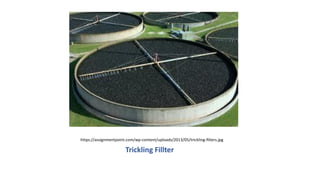
https://assignmentpoint.com/wp-content/uploads/2013/05/trickling-filters.jpg
Trickling Fillter
https://civildigital.com/wp-content/uploads/2014/03/Attache
d-Growth.jpg
https://5.imimg.com/data5/BO/KQ/MY-402
0393/trickling-filter-500x500.jpg
Introduction
• A trickling filter is a type of wastewater treatment system.
• A trickling filter , also called trickling biofilter, biofilter, biological filter and biological trickling filter , is a fixed-bed, biological
reactor that operates under (mostly) aerobic conditions.
• Trickling filters are conventional aerobic biological wastewater treatment units, such as active sludge systems or rotating biological
contactors.
• Trickling filters are a secondary treatment after a primary setting process (see also septic tanks or pre treatment).
• Trickling filter process can define as the biological system, which tends to separate or degrade the maximum organic and inorganic
waste (up to 85%) out of the primary or raw sludge via the slime layer.
Principle:
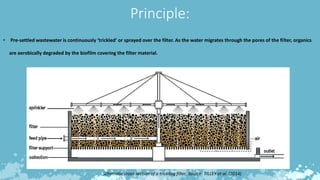
• Pre-settled wastewater is continuously ‘trickled’ or sprayed over the filter. As the water migrates through the pores of the filter, organics
are aerobically degraded by the biofilm covering the filter material.
Schematic cross-section of a trickling filter. Source: TILLEY et al. (2014)
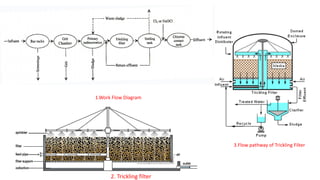
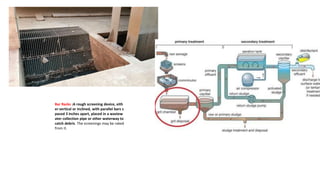
1.Work Flow Diagram
2. Trickling filter
3.Flow pathway of Trickling Filter
Bar Racks :A rough screening device, eith
er vertical or inclined, with parallel bars s
paced 3 inches apart, placed in a wastew
ater collection pipe or other waterway to
catch debris. The screenings may be raked
from it.
Operation:
The trickling filter process goes through a series of operation, which involves the following stages:
1.Filter bed: It is a bed chiefly containing crushed rock or other coarse media.
The construction of a filter bed is roughly 6 feet deep and 200 feet in thickness.
Settled sewage is flushed evenly over the filter bed containing organic and
inorganic waste via continuously rotating distributor’s arm. Holes within the
rotary distributor arm facilitates the trickling of primary influent and settled
sewage throughout the filter bed.
2.Microbial film: Within the filter media some aerobic microbes are found on the
surface, and some anaerobic microorganisms are found below the filter media.
As the wastewater trickles downward, the microorganisms associated with the
filter media starts utilizing the organic matter of the wastewater and forms a
later called microbial slime. Thus, the microorganisms in the filter media play a
pivotal role in degrading the organic matter in the sewage, thereby minimizes
BOD and COD from the sewage.
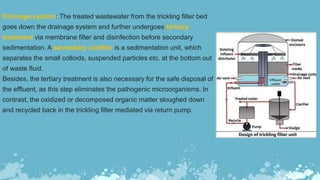
Drainage system: The treated wastewater from the trickling filter bed
goes down the drainage system and further undergoes tertiary
treatment via membrane filter and disinfection before secondary
sedimentation. A secondary clarifier is a sedimentation unit, which
separates the small colloids, suspended particles etc. at the bottom out
of waste fluid.
Besides, the tertiary treatment is also necessary for the safe disposal of
the effluent, as this step eliminates the pathogenic microorganisms. In
contrast, the oxidized or decomposed organic matter sloughed down
and recycled back in the trickling filter mediated via return pump.
Types of Trickling Filters:
Depending upon the hydraulic and organic shock load, trickling filters can be categorized into two types,
namely high rate and Standard rate trickling filter. The hydraulic loading rate can define as the sewa
ge flow (Q) per unit volume (V) of filter bed in a day, while the organic loading rate can define as the kil
ograms of BOD (Y5) introduced into the per unit volume (V) in a day.
1.The BOD removal efficiency of both standard and high rate trickling filter is about 75 to 90%. The nitrif
ication of the primary effluent is relatively higher in standard rate filters, whereas high rate trickling filters
produce partially nitrified effluent.
2.Standard rate and high rate trickling filter are suitable for the treatment of low to high strength domestic
wastewaters and industrial wastewater.
Recirculation of the effluent is not provided in the Standard rate filters. In contrast, high rate filters are
provided with return pump between the trickling filter tank and secondary clarifier that aids in efflu
ent recirculation.
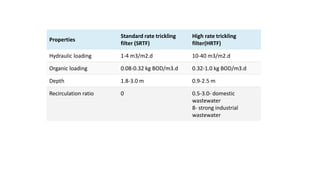
To identify the characteristic difference between the two, one can look upon the table given below t
hat specifies the efficiency and depth of the standardand high rate trickling filter. Recirculation ratio
is recirculation discharge upon incoming discharge.
Properties
Standard rate trickling
filter (SRTF)
High rate trickling
filter(HRTF)
Hydraulic loading 1-4 m3/m2.d 10-40 m3/m2.d
Organic loading 0.08-0.32 kg BOD/m3.d 0.32-1.0 kg BOD/m3.d
Depth 1.8-3.0 m 0.9-2.5 m
Recirculation ratio 0 0.5-3.0- domestic
wastewater
8- strong industrial
wastewater
Advantage and Disadvantage:
Advantages:
1. Can be operated at a range of organic and hydraulic loading rates
2. High effluent quality in terms of BOD and suspended solids removal; in com
bination with a primary and tertiary treatment also in terms of pathogens
3. It is a simple and reliable secondary treatment unit of the wastewater.
4. It can be used to degrade a variety of organic waste.
5. Trickling filter can resist shock loadings.
6. It efficiently oxidizes the ammonia or efficient in ammonium oxidation.
7. Trickling filter aids to produce effluent free of BOD, COD, nutrients, suspend
ed colloids etc.
8. Its construction requires a small land area, unlike constructed wetland.
Disadvantages:
1. Its designing requires high capital costs.
2. The designing of a trickling filter requires expert skills.
3. Its operation and maintenance require regular attention by the skilled
labour personnel.
4. The trickling filter process is a continuous process, which needs an
uninterrupted supply of electricity and wastewater distribution.
5. It sometimes causes flies breeding and odour problem.
6. The effluent produced by the trickling filter needs to treated further by
the chemical disinfectants.
7. Accumulation of excessive biomass may cause clogging of the TF-unit.
8. Not all parts and materials may be locally available.
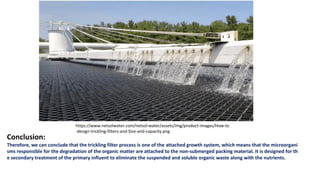
Conclusion:
Therefore, we can conclude that the trickling filter process is one of the attached growth system, which means that the microorgani
sms responsible for the degradation of the organic matter are attached to the non-submerged packing material. It is designed for th
e secondary treatment of the primary influent to eliminate the suspended and soluble organic waste along with the nutrients.
https://www.netsolwater.com/netsol-water/assets/img/product-images/How-to
-design-trickling-filters-and-Size-and-capacity.png
References:
1. ^ Jump up to:a b c "Biological wastewater treatment processes; secondary treatment". Staffordshire University.
Archived from the original on 18 April 2011. Retrieved 13 December 2019.
2. ^ "Updates on the wastewater treatment plant stench". Christchurch City Council. Retrieved 13 June 2022.
3. ^ Saudi Aramco. "Saudi Aramco Engineering Development Program" (PPT). King Fahd University of Petroleum and
Minerals. pp. 62–65. Archived from the original (PPT) on 2011-07-28.
4. ^ US patent 4351729, Enrique R. Witt, "Biological filter and process", issued September 28, 1982
5. ^ Davis, Allen. "Recirculating Systems" (PDF). Auburn University. p. 6. Archived from the original (PDF) on October
23, 2015.
6. ^ Beychok, Milton R. (1967). Aqueous Wastes from Petroleum and Petrochemical Plants (1st ed.). John Wiley &
Sons Ltd. LCCN 67019834.
7. ^ Bryan, E.H.; Moeller, D.H. (April 20, 1960). Aerobic Biological Oxidation Using Dowpac. Conference on Biological
Waste Treatment. Manhattan College.
8. ^ Van Sperling, Marcus (2007). Activated Sludge and Aerobic Biofilm Reactors. IWA Publications. ISBN 978-1-
84339-165-4.
9. https://biologyreader.com/trickling-filter-process.html
https://media.istockphoto.com/vectors/children-silhouette-holding-letters-colored-of-the-word-thank-you-vector-id804761394?k=20&m=80
4761394&s=612x612&w=0&h=6USylMeHxczUY2SdPBu4qGK-5Jmd742kpFsgnVR7JBo=
http://www.indiacarbonltd.com/images/queries.png

Trickling Filter, Wastewater Treatment method

  • 1.
    Trickling Filter By DewakaPoudel 7th semester Environmental Biotechnology 29/08/2022
  • 2.
    Content: Introduction, Principle Design, Operation Type,Advantage and Disadvantage Conclusion
  • 3.
  • 4.
  • 5.
    Introduction • A tricklingfilter is a type of wastewater treatment system. • A trickling filter , also called trickling biofilter, biofilter, biological filter and biological trickling filter , is a fixed-bed, biological reactor that operates under (mostly) aerobic conditions. • Trickling filters are conventional aerobic biological wastewater treatment units, such as active sludge systems or rotating biological contactors. • Trickling filters are a secondary treatment after a primary setting process (see also septic tanks or pre treatment). • Trickling filter process can define as the biological system, which tends to separate or degrade the maximum organic and inorganic waste (up to 85%) out of the primary or raw sludge via the slime layer.
  • 6.
    Principle: • Pre-settled wastewateris continuously ‘trickled’ or sprayed over the filter. As the water migrates through the pores of the filter, organics are aerobically degraded by the biofilm covering the filter material. Schematic cross-section of a trickling filter. Source: TILLEY et al. (2014)
  • 7.
    1.Work Flow Diagram 2.Trickling filter 3.Flow pathway of Trickling Filter
  • 8.
    Bar Racks :Arough screening device, eith er vertical or inclined, with parallel bars s paced 3 inches apart, placed in a wastew ater collection pipe or other waterway to catch debris. The screenings may be raked from it.
  • 9.
    Operation: The trickling filterprocess goes through a series of operation, which involves the following stages:
  • 10.
    1.Filter bed: Itis a bed chiefly containing crushed rock or other coarse media. The construction of a filter bed is roughly 6 feet deep and 200 feet in thickness. Settled sewage is flushed evenly over the filter bed containing organic and inorganic waste via continuously rotating distributor’s arm. Holes within the rotary distributor arm facilitates the trickling of primary influent and settled sewage throughout the filter bed. 2.Microbial film: Within the filter media some aerobic microbes are found on the surface, and some anaerobic microorganisms are found below the filter media. As the wastewater trickles downward, the microorganisms associated with the filter media starts utilizing the organic matter of the wastewater and forms a later called microbial slime. Thus, the microorganisms in the filter media play a pivotal role in degrading the organic matter in the sewage, thereby minimizes BOD and COD from the sewage.
  • 11.
    Drainage system: Thetreated wastewater from the trickling filter bed goes down the drainage system and further undergoes tertiary treatment via membrane filter and disinfection before secondary sedimentation. A secondary clarifier is a sedimentation unit, which separates the small colloids, suspended particles etc. at the bottom out of waste fluid. Besides, the tertiary treatment is also necessary for the safe disposal of the effluent, as this step eliminates the pathogenic microorganisms. In contrast, the oxidized or decomposed organic matter sloughed down and recycled back in the trickling filter mediated via return pump.
  • 12.
    Types of TricklingFilters: Depending upon the hydraulic and organic shock load, trickling filters can be categorized into two types, namely high rate and Standard rate trickling filter. The hydraulic loading rate can define as the sewa ge flow (Q) per unit volume (V) of filter bed in a day, while the organic loading rate can define as the kil ograms of BOD (Y5) introduced into the per unit volume (V) in a day. 1.The BOD removal efficiency of both standard and high rate trickling filter is about 75 to 90%. The nitrif ication of the primary effluent is relatively higher in standard rate filters, whereas high rate trickling filters produce partially nitrified effluent. 2.Standard rate and high rate trickling filter are suitable for the treatment of low to high strength domestic wastewaters and industrial wastewater. Recirculation of the effluent is not provided in the Standard rate filters. In contrast, high rate filters are provided with return pump between the trickling filter tank and secondary clarifier that aids in efflu ent recirculation. To identify the characteristic difference between the two, one can look upon the table given below t hat specifies the efficiency and depth of the standardand high rate trickling filter. Recirculation ratio is recirculation discharge upon incoming discharge.
  • 13.
    Properties Standard rate trickling filter(SRTF) High rate trickling filter(HRTF) Hydraulic loading 1-4 m3/m2.d 10-40 m3/m2.d Organic loading 0.08-0.32 kg BOD/m3.d 0.32-1.0 kg BOD/m3.d Depth 1.8-3.0 m 0.9-2.5 m Recirculation ratio 0 0.5-3.0- domestic wastewater 8- strong industrial wastewater
  • 14.
    Advantage and Disadvantage: Advantages: 1.Can be operated at a range of organic and hydraulic loading rates 2. High effluent quality in terms of BOD and suspended solids removal; in com bination with a primary and tertiary treatment also in terms of pathogens 3. It is a simple and reliable secondary treatment unit of the wastewater. 4. It can be used to degrade a variety of organic waste. 5. Trickling filter can resist shock loadings. 6. It efficiently oxidizes the ammonia or efficient in ammonium oxidation. 7. Trickling filter aids to produce effluent free of BOD, COD, nutrients, suspend ed colloids etc. 8. Its construction requires a small land area, unlike constructed wetland. Disadvantages: 1. Its designing requires high capital costs. 2. The designing of a trickling filter requires expert skills. 3. Its operation and maintenance require regular attention by the skilled labour personnel. 4. The trickling filter process is a continuous process, which needs an uninterrupted supply of electricity and wastewater distribution. 5. It sometimes causes flies breeding and odour problem. 6. The effluent produced by the trickling filter needs to treated further by the chemical disinfectants. 7. Accumulation of excessive biomass may cause clogging of the TF-unit. 8. Not all parts and materials may be locally available.
  • 15.
    Conclusion: Therefore, we canconclude that the trickling filter process is one of the attached growth system, which means that the microorgani sms responsible for the degradation of the organic matter are attached to the non-submerged packing material. It is designed for th e secondary treatment of the primary influent to eliminate the suspended and soluble organic waste along with the nutrients. https://www.netsolwater.com/netsol-water/assets/img/product-images/How-to -design-trickling-filters-and-Size-and-capacity.png
  • 16.
    References: 1. ^ Jumpup to:a b c "Biological wastewater treatment processes; secondary treatment". Staffordshire University. Archived from the original on 18 April 2011. Retrieved 13 December 2019. 2. ^ "Updates on the wastewater treatment plant stench". Christchurch City Council. Retrieved 13 June 2022. 3. ^ Saudi Aramco. "Saudi Aramco Engineering Development Program" (PPT). King Fahd University of Petroleum and Minerals. pp. 62–65. Archived from the original (PPT) on 2011-07-28. 4. ^ US patent 4351729, Enrique R. Witt, "Biological filter and process", issued September 28, 1982 5. ^ Davis, Allen. "Recirculating Systems" (PDF). Auburn University. p. 6. Archived from the original (PDF) on October 23, 2015. 6. ^ Beychok, Milton R. (1967). Aqueous Wastes from Petroleum and Petrochemical Plants (1st ed.). John Wiley & Sons Ltd. LCCN 67019834. 7. ^ Bryan, E.H.; Moeller, D.H. (April 20, 1960). Aerobic Biological Oxidation Using Dowpac. Conference on Biological Waste Treatment. Manhattan College. 8. ^ Van Sperling, Marcus (2007). Activated Sludge and Aerobic Biofilm Reactors. IWA Publications. ISBN 978-1- 84339-165-4. 9. https://biologyreader.com/trickling-filter-process.html
  • 17.
  • 18.