
Biochemical Oxygen Demand
BY
HANU PRATAP
DefinitionDefinition
• The Biochemical (or Biological) oxygen
demand (BOD) is a measure of the
amount of dissolved oxygen required to
break down the organic material in a given
volume of water through aerobic biological
activity. ( By Micro-organism)
Biochemical oxygen demandBiochemical oxygen demand
• Biochemical oxygen demand (BOD) (also called biological
oxygen demand) is the amount of dissolved oxygen needed (i. e.,
demanded) by aerobic biological organisms to break down organic
material present in a given water sample at certain temperature over
a specific time period. The BOD value is most commonly expressed
in milligrams of oxygen consumed per litre of sample during 5 days
of incubation at 20 °C and is often used as a surrogate of the
degree of organic pollution of water.
• BOD can be used as a gauge of the effectiveness of
wastewater treatment plants. It is listed as a conventional pollutant
in the U.S. Clean Water Act.
• BOD is similar in function to chemical oxygen demand (COD), in
that both measure the amount of organic compounds in water.
However,
DefinitionDefinition
• Biochemical oxygen demand or BOD is
a chemical procedure for determining the
rate of uptake of dissolved oxygen by the
rate biological organisms in a body of
water use up oxygen. It is not an precise
quantitative test, although it is widely used
as an indication of the quality of water.
Method for the measuring of BODMethod for the measuring of BOD
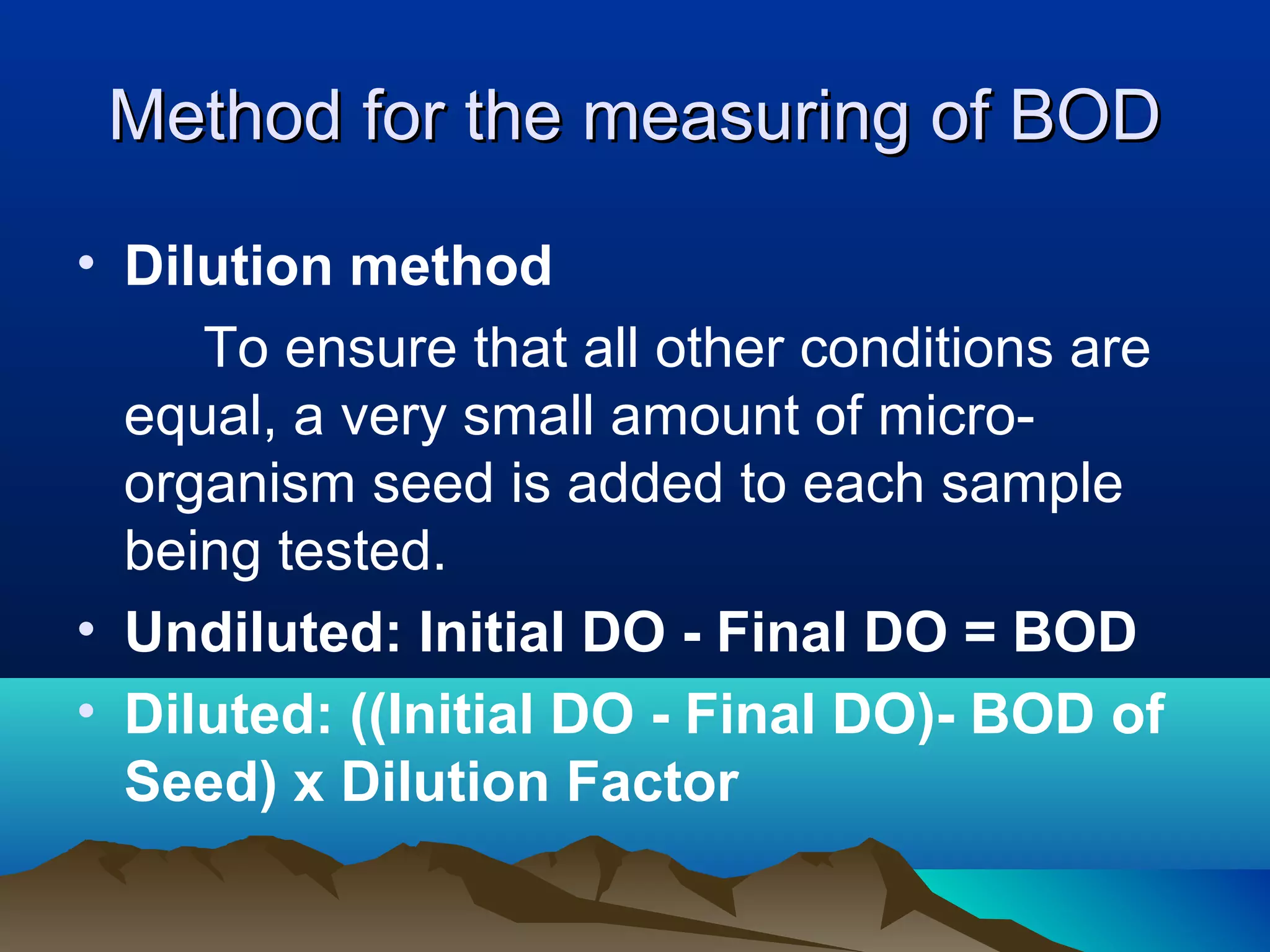
• Dilution method
To ensure that all other conditions are
equal, a very small amount of micro-
organism seed is added to each sample
being tested.
• Undiluted: Initial DO - Final DO = BOD
• Diluted: ((Initial DO - Final DO)- BOD of
Seed) x Dilution Factor
Test ProcedureTest Procedure
• The BOD test takes 5 days to complete and is
performed using a dissolved oxygen test kit. The
BOD level is determined by comparing the DO
level of a water sample taken immediately with
the DO level of a water sample that has been
incubated in a dark location for 5 days. The
difference between the two DO levels represents
the amount of oxygen required for the
decomposition of any organic material in the
sample and is a good approximation of the BOD
level.
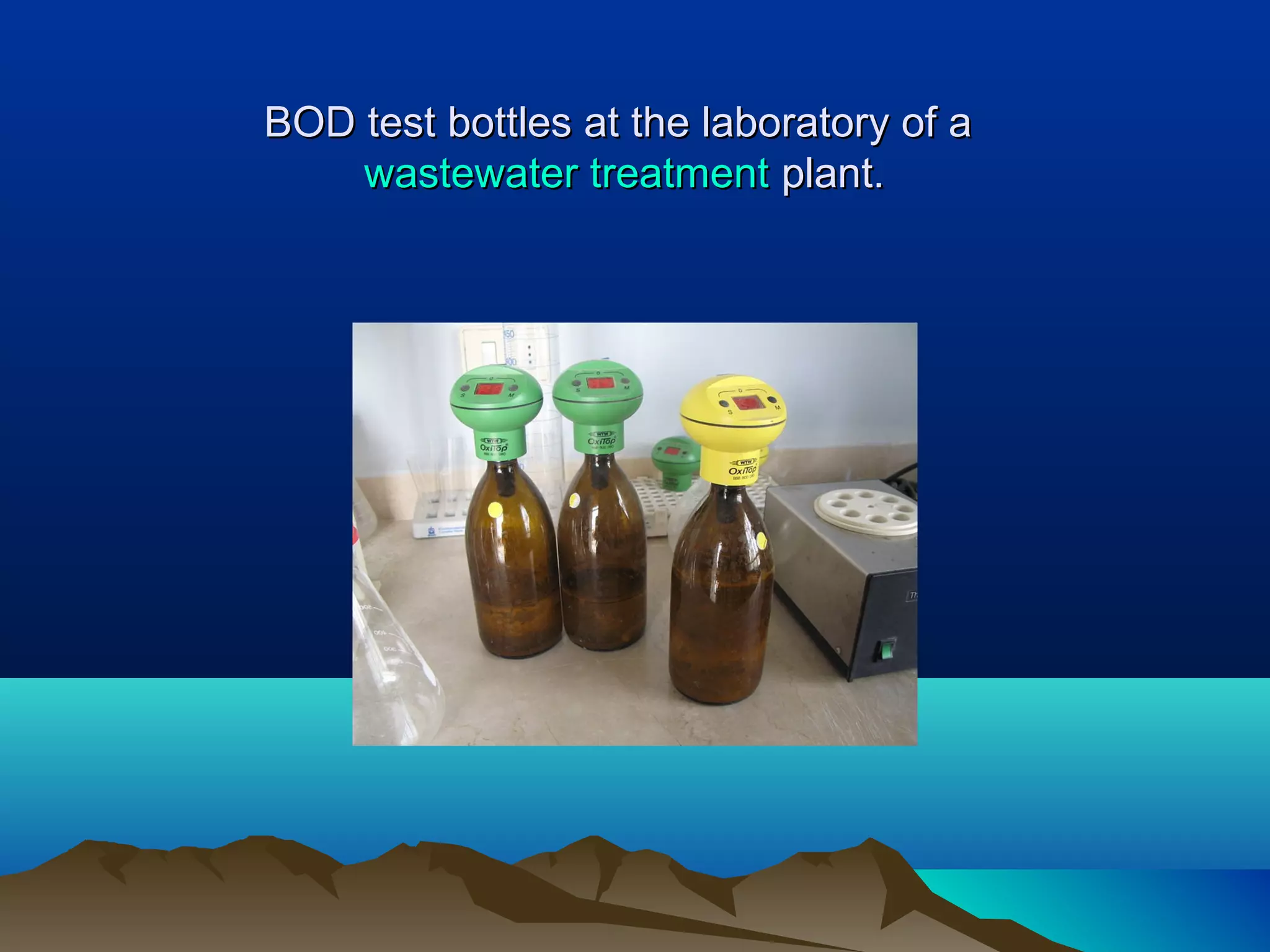
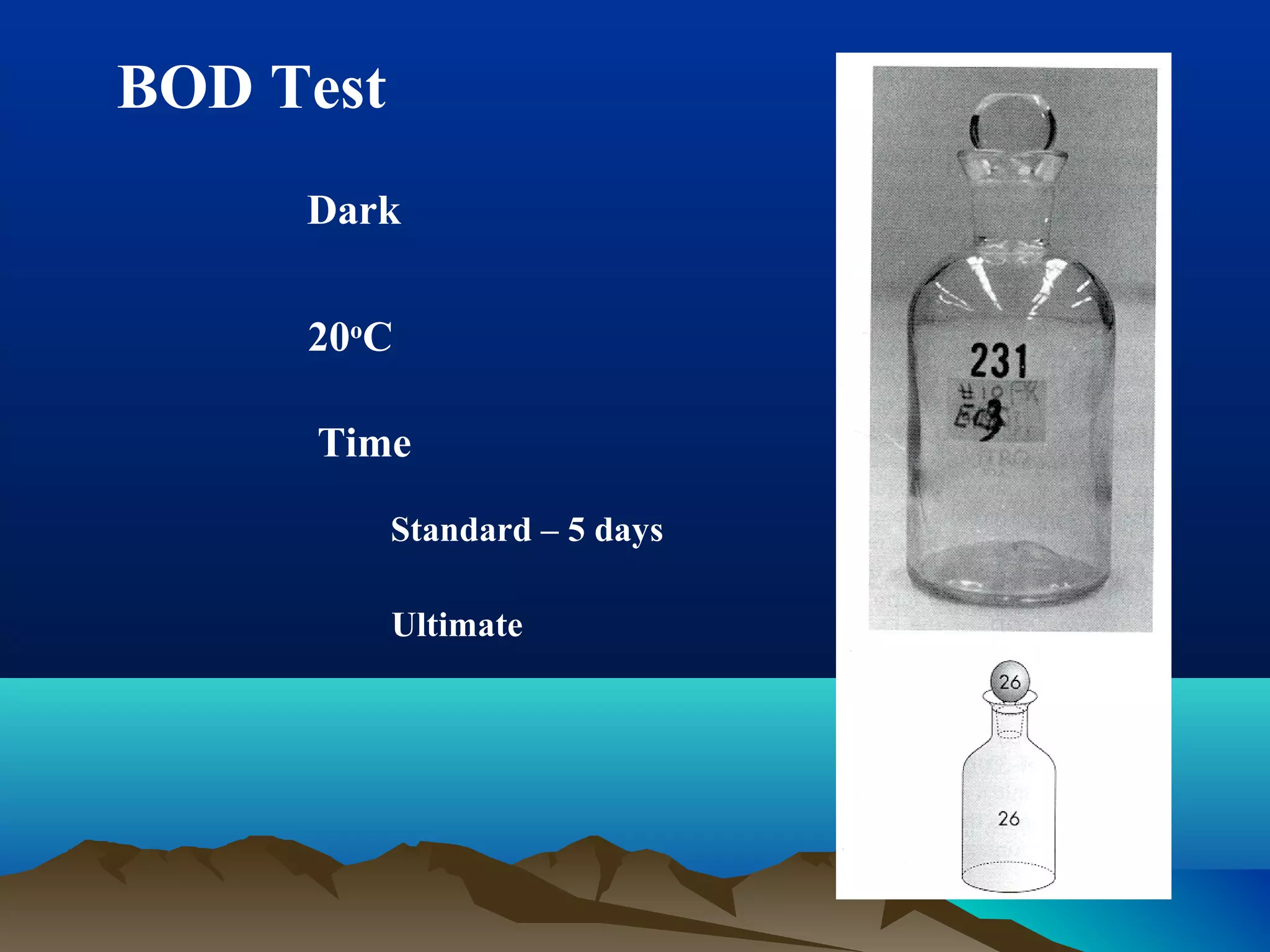
BOD test bottles at the laboratory of aBOD test bottles at the laboratory of a
wastewater treatmentwastewater treatment plant.plant.
Taking samples from the influent rawTaking samples from the influent raw wastewaterwastewater streamstream
for BOD measurements at afor BOD measurements at a wastewater treatmentwastewater treatment plant .plant .
Method for the measuring of BODMethod for the measuring of BOD
• Manometric method
• This method is limited to the measurement
of the oxygen consumption due only to
carbonaceous oxidation. Ammonia
oxidation is inhibited.
Applications
Water Quality
Measures of Water Quality
Some of the Most basic and Important Measures
Dissolved Oxygen
Biochemical Oxygen Demand
Solids
Nitrogen
Bacteriological
Dissolved Oxygen (DO)
Typically Measured by DO probe and Meter
Electrochemical Half Cell Reaction
COD and BODCOD and BOD
• The standard BOD test requires five
days to complete - unable to provide
continuous monitoring of organic load.
• COD is often used for BOD screening.
• Both involve a 2 step process:
Step 1 - Oxidation of organic matter
Step 2 - Measurement of extent of oxidation
BOD Test
Dark
20o
C
Time
Standard – 5 days
Ultimate
BOD = I - F
I = Initial DO
F = Final DO
If all the DO is used up the test is invalid, as in B
above
To get a valid test dilute the sample, as in C above. In this
case the sample was diluted by 1:10. The BOD can then be
calculated by:
BOD = (I – F) D D = dilution as a fraction
D = volume of bottle/(volume of bottle – volume of dilution water)
BOD = (8 – 4) 10 = 40 mg/L
COD and BODCOD and BOD
• Biochemical Oxygen Demand (BOD) and Chemical Oxygen
Demand (COD) are ubiquitous measurements of overall water
quality.
• Among the most diagnostic parameters for the
determination of water quality in natural waterways and
waste streams.
• COD measures the equivalent amount of oxygen
required to chemically oxidize the organic compounds in
water
• BOD measures the equivalent amount of oxygen
required to biologically (microbes) oxidize the organic
compounds in water
COD and BODCOD and BOD
• The standard BOD test requires five days
to complete - unable to provide continuous
monitoring of organic load.
• COD is often used for BOD screening.
• Both involve a 2 step process:
Step 1 - Oxidation of organic matter
Step 2 - Measurement of extent of oxidation
Standard COD MethodStandard COD Method
(Dichromate)(Dichromate)
• Uses hazardous chemicals (dichromate,
concentrated acid, mercury) to oxidize organic
carbon in water into CO--
2 and H2O.
• Samples are digested at 150°C, 2-3 hour
process with cooling time
• The oxygen demand is determined by the
amount of oxidant consumed, using a
spectrophotometer or titration method.
Nanotechnology basedNanotechnology based
approachapproach
• Patented sensor consists of a UV-activated
TiO2 (titanium dioxide) photocatalyst
• Powerful oxidizing potential of TiO2 gives a true
measure of COD
• COD analysis can now be done by any operations staff
member
Nanotechnology basedNanotechnology based
approachapproach
COD ApplicationsCOD Applications
Municipal
•Incoming COD monitoring
•In-plant COD monitoring
•Potable water analysis
Industrial
•In-plant COD monitoring
•Process optimization
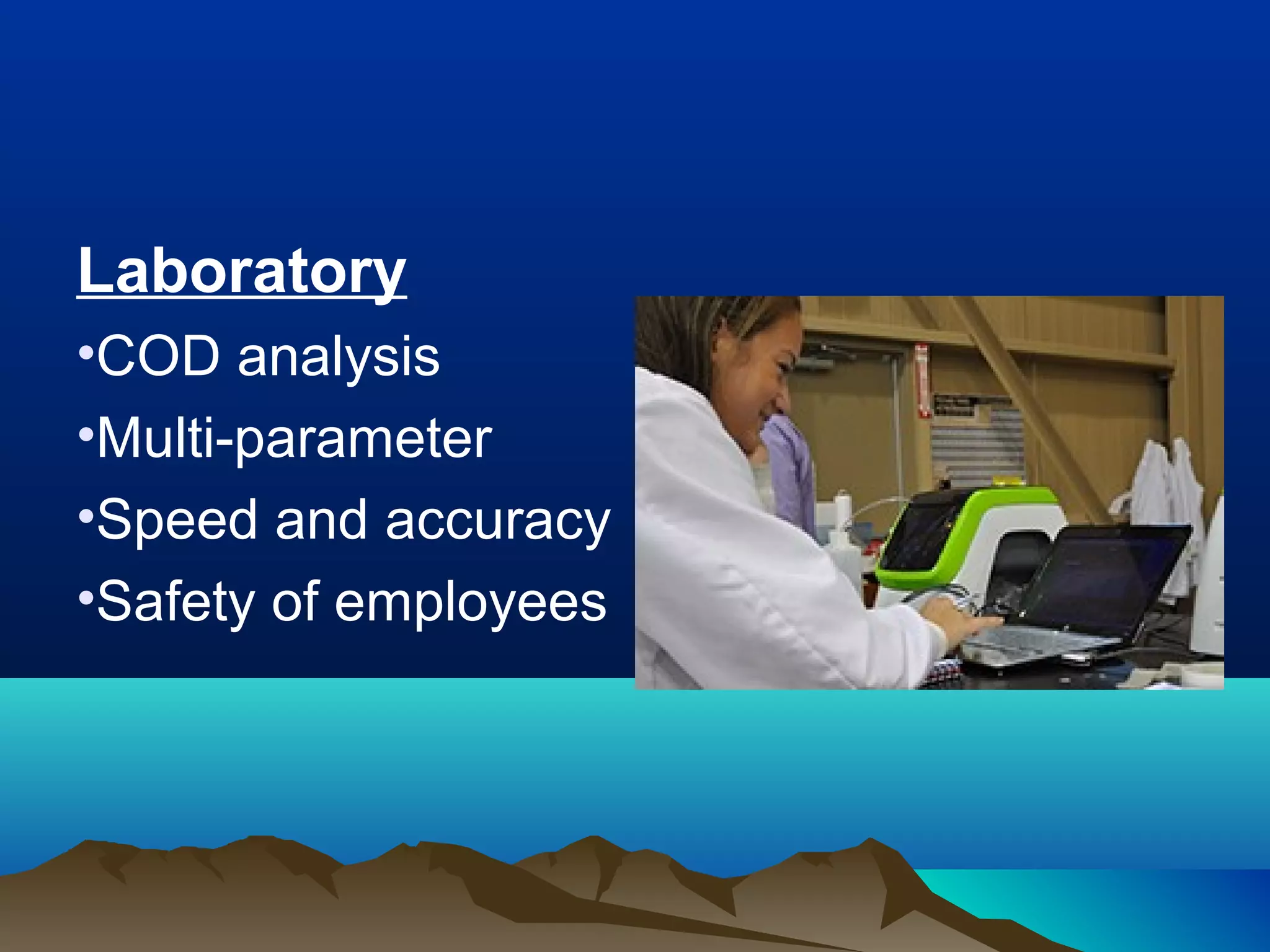
Laboratory
•COD analysis
•Multi-parameter
•Speed and accuracy
•Safety of employees
ConclusionConclusion
• Overcomes the weaknesses of traditional COD analysis
– Results in only 15 minutes
– No use of dichromate or harmful reagents
– Easy to use system for all operations staff
• Nanotechnology provides more accurate measure of
COD
• Excellent screening tool for BOD
• Recognized and used by the Ontario Ministry of
Environment
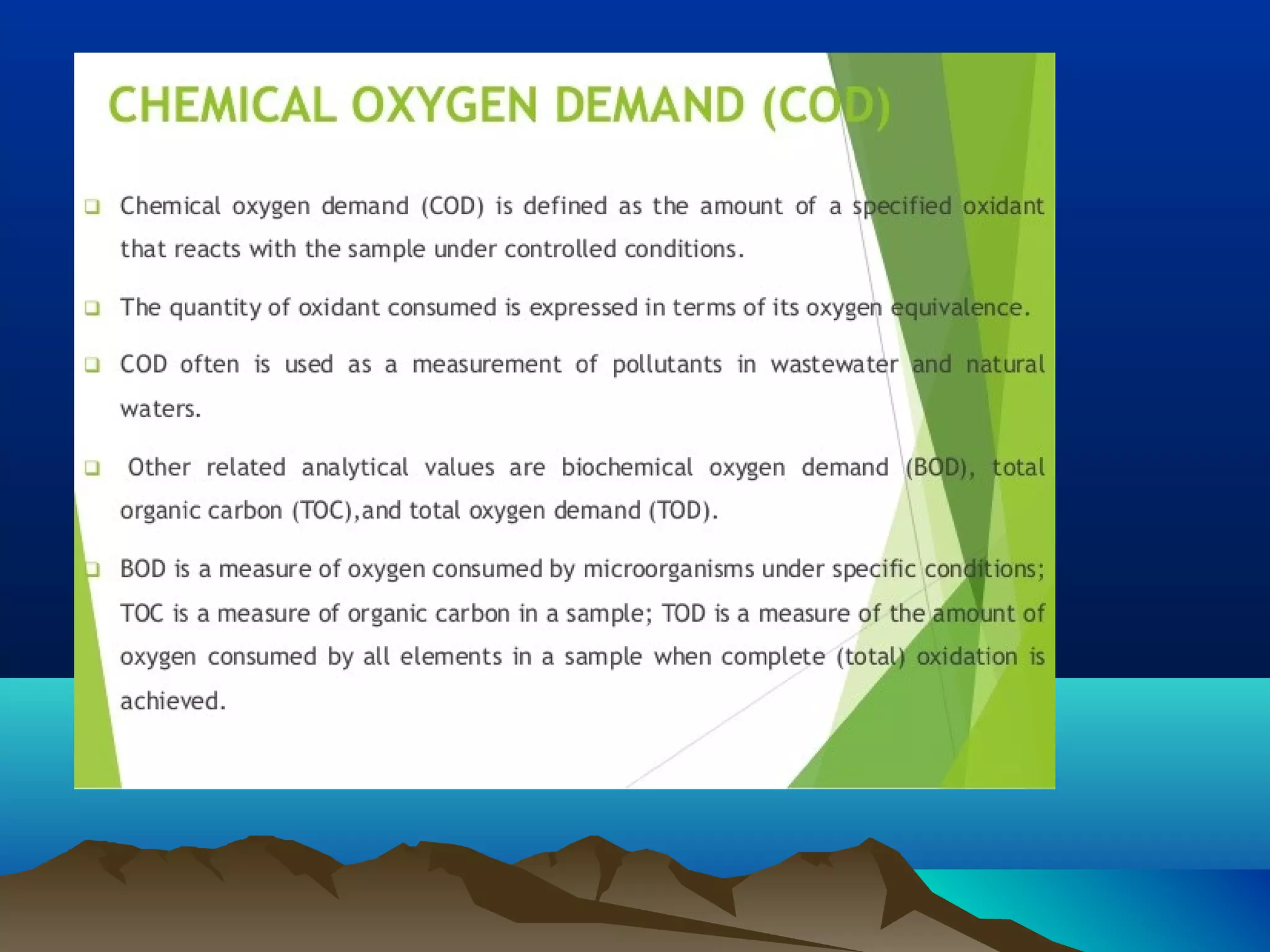
Chemical oxygen demandChemical oxygen demand
• In environmental chemistry, the chemical oxygen
demand (COD) test is commonly used to indirectly
measure the amount of organic compounds in water.
Most applications of COD determine the amount
of organic pollutants found in surface
water (e.g. lakes and rivers) or wastewater, making COD
a useful measure of water quality. It is expressed in
milligrams per liter (mg/L), which indicates the mass of
oxygen consumed per liter of solution.
ConclusionConclusion
• Overcomes the weaknesses of traditional COD analysis
– Results in only 15 minutes
– No use of dichromate or harmful reagents
– Easy to use system for all operations staff
• Nanotechnology provides more accurate measure of
COD
• Excellent screening tool for BOD
• Recognized and used by the Ontario Ministry of
Environment
Thank you

BIOLOGICAL OXYGEN DEMAND

  • 1.
  • 2.
    DefinitionDefinition • The Biochemical(or Biological) oxygen demand (BOD) is a measure of the amount of dissolved oxygen required to break down the organic material in a given volume of water through aerobic biological activity. ( By Micro-organism)
  • 3.
    Biochemical oxygen demandBiochemicaloxygen demand • Biochemical oxygen demand (BOD) (also called biological oxygen demand) is the amount of dissolved oxygen needed (i. e., demanded) by aerobic biological organisms to break down organic material present in a given water sample at certain temperature over a specific time period. The BOD value is most commonly expressed in milligrams of oxygen consumed per litre of sample during 5 days of incubation at 20 °C and is often used as a surrogate of the degree of organic pollution of water. • BOD can be used as a gauge of the effectiveness of wastewater treatment plants. It is listed as a conventional pollutant in the U.S. Clean Water Act. • BOD is similar in function to chemical oxygen demand (COD), in that both measure the amount of organic compounds in water. However,
  • 4.
    DefinitionDefinition • Biochemical oxygendemand or BOD is a chemical procedure for determining the rate of uptake of dissolved oxygen by the rate biological organisms in a body of water use up oxygen. It is not an precise quantitative test, although it is widely used as an indication of the quality of water.
  • 5.
    Method for themeasuring of BODMethod for the measuring of BOD • Dilution method To ensure that all other conditions are equal, a very small amount of micro- organism seed is added to each sample being tested. • Undiluted: Initial DO - Final DO = BOD • Diluted: ((Initial DO - Final DO)- BOD of Seed) x Dilution Factor
  • 6.
    Test ProcedureTest Procedure •The BOD test takes 5 days to complete and is performed using a dissolved oxygen test kit. The BOD level is determined by comparing the DO level of a water sample taken immediately with the DO level of a water sample that has been incubated in a dark location for 5 days. The difference between the two DO levels represents the amount of oxygen required for the decomposition of any organic material in the sample and is a good approximation of the BOD level.
  • 7.
    BOD test bottlesat the laboratory of aBOD test bottles at the laboratory of a wastewater treatmentwastewater treatment plant.plant.
  • 8.
    Taking samples fromthe influent rawTaking samples from the influent raw wastewaterwastewater streamstream for BOD measurements at afor BOD measurements at a wastewater treatmentwastewater treatment plant .plant .
  • 9.
    Method for themeasuring of BODMethod for the measuring of BOD • Manometric method • This method is limited to the measurement of the oxygen consumption due only to carbonaceous oxidation. Ammonia oxidation is inhibited.
  • 10.
  • 11.
    Measures of WaterQuality Some of the Most basic and Important Measures Dissolved Oxygen Biochemical Oxygen Demand Solids Nitrogen Bacteriological
  • 12.
    Dissolved Oxygen (DO) TypicallyMeasured by DO probe and Meter Electrochemical Half Cell Reaction
  • 13.
    COD and BODCODand BOD • The standard BOD test requires five days to complete - unable to provide continuous monitoring of organic load. • COD is often used for BOD screening. • Both involve a 2 step process: Step 1 - Oxidation of organic matter Step 2 - Measurement of extent of oxidation
  • 14.
  • 15.
    BOD = I- F I = Initial DO F = Final DO If all the DO is used up the test is invalid, as in B above To get a valid test dilute the sample, as in C above. In this case the sample was diluted by 1:10. The BOD can then be calculated by: BOD = (I – F) D D = dilution as a fraction D = volume of bottle/(volume of bottle – volume of dilution water) BOD = (8 – 4) 10 = 40 mg/L
  • 16.
    COD and BODCODand BOD • Biochemical Oxygen Demand (BOD) and Chemical Oxygen Demand (COD) are ubiquitous measurements of overall water quality. • Among the most diagnostic parameters for the determination of water quality in natural waterways and waste streams. • COD measures the equivalent amount of oxygen required to chemically oxidize the organic compounds in water • BOD measures the equivalent amount of oxygen required to biologically (microbes) oxidize the organic compounds in water
  • 17.
    COD and BODCODand BOD • The standard BOD test requires five days to complete - unable to provide continuous monitoring of organic load. • COD is often used for BOD screening. • Both involve a 2 step process: Step 1 - Oxidation of organic matter Step 2 - Measurement of extent of oxidation
  • 18.
    Standard COD MethodStandardCOD Method (Dichromate)(Dichromate) • Uses hazardous chemicals (dichromate, concentrated acid, mercury) to oxidize organic carbon in water into CO-- 2 and H2O. • Samples are digested at 150°C, 2-3 hour process with cooling time • The oxygen demand is determined by the amount of oxidant consumed, using a spectrophotometer or titration method.
  • 19.
    Nanotechnology basedNanotechnology based approachapproach •Patented sensor consists of a UV-activated TiO2 (titanium dioxide) photocatalyst • Powerful oxidizing potential of TiO2 gives a true measure of COD • COD analysis can now be done by any operations staff member
  • 20.
  • 21.
    COD ApplicationsCOD Applications Municipal •IncomingCOD monitoring •In-plant COD monitoring •Potable water analysis
  • 22.
  • 23.
  • 24.
    ConclusionConclusion • Overcomes theweaknesses of traditional COD analysis – Results in only 15 minutes – No use of dichromate or harmful reagents – Easy to use system for all operations staff • Nanotechnology provides more accurate measure of COD • Excellent screening tool for BOD • Recognized and used by the Ontario Ministry of Environment
  • 25.
    Chemical oxygen demandChemicaloxygen demand • In environmental chemistry, the chemical oxygen demand (COD) test is commonly used to indirectly measure the amount of organic compounds in water. Most applications of COD determine the amount of organic pollutants found in surface water (e.g. lakes and rivers) or wastewater, making COD a useful measure of water quality. It is expressed in milligrams per liter (mg/L), which indicates the mass of oxygen consumed per liter of solution.
  • 31.
    ConclusionConclusion • Overcomes theweaknesses of traditional COD analysis – Results in only 15 minutes – No use of dichromate or harmful reagents – Easy to use system for all operations staff • Nanotechnology provides more accurate measure of COD • Excellent screening tool for BOD • Recognized and used by the Ontario Ministry of Environment
  • 32.