Indoor Air Pollution
Air Pollution and Control
Elective -I
Indoor air pollution
• Indoor air contains higher concentrations of pollutants than
outdoor air (up to 70x)
• Indoor air pollution usually is a greater threat to human
health than outdoor air pollution.
• Pollution levels inside cars in traffic clogged urban areas
can be up to 18 times higher.
Indoor Air Pollution--Developing World
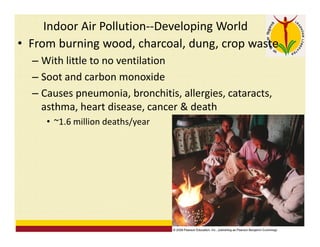
• From burning wood, charcoal, dung, crop waste
– With little to no ventilation
– Soot and carbon monoxide
– Causes pneumonia, bronchitis, allergies, cataracts,
asthma, heart disease, cancer & death
• ~1.6 million deaths/year
• According to the EPA, the 4 most dangerous indoor
air pollutants in developed countries are:
– Tobacco smoke
– Formaldehyde
– Radioactive radon-222 gas
– Very small fine & ultrafine particles
Indoor Air Pollution--Developed World
• Other Important Indoor
Air pollutants
– Nitrogen dioxide
– Carbon monoxide
– Volatile Organic
Compounds (VOCs)
– House dust mites (&
other allergens… from
pets)
– Chlorinated organic
compounds (ex.
pesticides)
– Asbestos & man-made
mineral fibers
• Sources
– Building materials
– Furnishings & fabrics
– Glues
– Cleaning products
– Combustion
appliances (cooking
& heating)
– Open fires
– Smoking
– Living organisms
– Outdoor air
Tobacco Smoke
• The most dangerous indoor pollutants in the
developed world
– Secondhand smoke from cigarettes is especially
dangerous
• Containing over 4000 dangerous chemicals
• Causes eye, nose, and throat irritation
• Smoking has declined in developed nations
Volatile Organic Compounds (VOCs)
• The most diverse group of indoor air pollutants
– Released by everything from plastics and oils to
perfumes and paints
• Ex. formaldehyde, which leaks from pressed wood and
insulation, irritates mucous membranes and induces skin
allergies
• Ex. pesticides, which are found indoors more often than
outdoors due to seepage
• Most VOCs are released in very small amounts
– Unclear health effects due to low concentrations
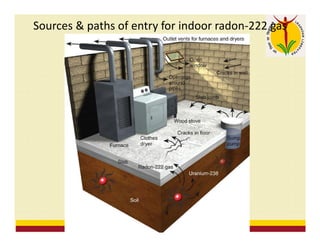
Radon-222
• colorless, tasteless, odorless, radioactive gas from decay of U-
238 found in some soils & rocks
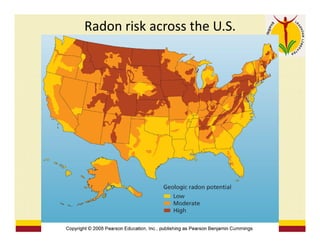
• can seep into some houses
– Most homes are now radon resistant
• 55% of our exposure to radiation comes from radon
– May harm lungs from long term exposure.
• increases the risk of lung cancer
– Chance increase more if a smoker (synergistic effect)
– causes 20,000 deaths a year in the U.S.
• Reducing the risk
– Sealing cracks in floors and walls
– Simple systems using pipes and fans
Sources & paths of entry for indoor radon-222 gas
Radon risk across the U.S.
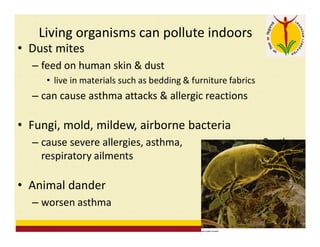
Living organisms can pollute indoors
• Dust mites
– feed on human skin & dust
• live in materials such as bedding & furniture fabrics
– can cause asthma attacks & allergic reactions
• Fungi, mold, mildew, airborne bacteria
– cause severe allergies, asthma, & other
respiratory ailments
• Animal dander
– worsen asthma
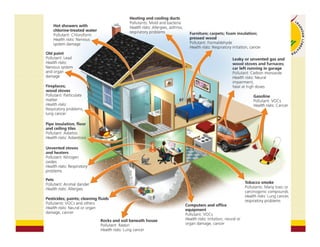
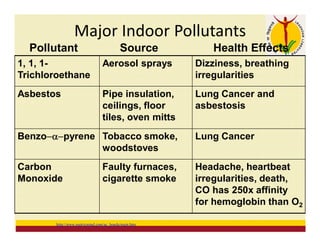
Major Indoor Pollutants
1, 1, 1-
Trichloroethane
Aerosol sprays Dizziness, breathing
irregularities
Asbestos Pipe insulation,
ceilings, floor
tiles, oven mitts
Lung Cancer and
asbestosis
Benzo-a-pyrene Tobacco smoke,
woodstoves
Lung Cancer
Carbon
Monoxide
Faulty furnaces,
cigarette smoke
Headache, heartbeat
irregularities, death,
CO has 250x affinity
for hemoglobin than O2
http://www.metricmind.com/ac_honda/main.htm
Pollutant Source Health Effects
http://www.metricmind.com/ac_honda/main.htm
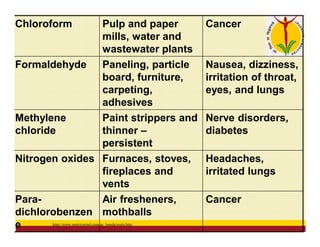
Chloroform Pulp and paper
mills, water and
wastewater plants
Cancer
Formaldehyde Paneling, particle
board, furniture,
carpeting,
adhesives
Nausea, dizziness,
irritation of throat,
eyes, and lungs
Methylene
chloride
Paint strippers and
thinner –
persistent
Nerve disorders,
diabetes
Nitrogen oxides Furnaces, stoves,
fireplaces and
vents
Headaches,
irritated lungs
Para-
dichlorobenzen
e
Air fresheners,
mothballs
Cancer
http://www.metricmind.com/ac_honda/main.htm
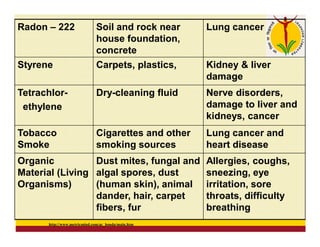
Radon – 222 Soil and rock near
house foundation,
concrete
Lung cancer
Styrene Carpets, plastics, Kidney & liver
damage
Tetrachlor-
ethylene
Dry-cleaning fluid Nerve disorders,
damage to liver and
kidneys, cancer
Tobacco
Smoke
Cigarettes and other
smoking sources
Lung cancer and
heart disease
Organic
Material (Living
Organisms)
Dust mites, fungal and
algal spores, dust
(human skin), animal
dander, hair, carpet
fibers, fur
Allergies, coughs,
sneezing, eye
irritation, sore
throats, difficulty
breathing
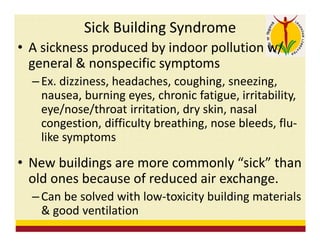
Sick Building Syndrome
• A sickness produced by indoor pollution w/
general & nonspecific symptoms
– Ex. dizziness, headaches, coughing, sneezing,
nausea, burning eyes, chronic fatigue, irritability,
eye/nose/throat irritation, dry skin, nasal
congestion, difficulty breathing, nose bleeds, flu-
like symptoms
• New buildings are more commonly “sick” than
old ones because of reduced air exchange.
– Can be solved with low-toxicity building materials
& good ventilation
Building Related Illness
• Also due to exposure to indoor air pollutants
• Recognizable Causes
• Clinically Recognized Disease
–Examples
• Humidifier Fever
• Asthma
• Allergy
• Respiratory Disease
–Chronic Obstructive Pulmonary Disease
Reducing Indoor Air Pollution
•Little effort has been devoted to reducing indoor
air pollution even though it is more harmful to
human health than outdoor air pollution
•Environmental & health scientists call for us to
focus on preventing air pollution (especially
indoor) in developing countries.
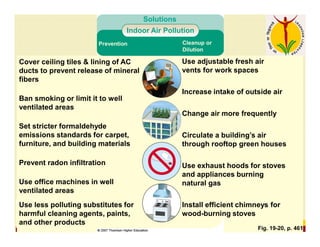
Fig. 19-20, p. 461
Solutions
Indoor Air Pollution
Prevention
Cover ceiling tiles & lining of AC
ducts to prevent release of mineral
fibers
Use adjustable fresh air
vents for work spaces
Increase intake of outside air
Ban smoking or limit it to well
ventilated areas
Change air more frequently
Set stricter formaldehyde
emissions standards for carpet,
furniture, and building materials
Circulate a building’s air
through rooftop green houses
Prevent radon infiltration Use exhaust hoods for stoves
and appliances burning
natural gas
Use office machines in well
ventilated areas
Use less polluting substitutes for
harmful cleaning agents, paints,
and other products
Install efficient chimneys for
wood-burning stoves
Cleanup or
Dilution
We can reduce indoor air pollution
• In developed countries:
– Use low-toxicity material
– Monitor air quality
– Keep rooms clean
– Limit exposure to chemicals
– Allow for better mixing of indoor & outdoor air
• In developing countries:
– Dry wood before burning
– Cook outside
– Use less-polluting fuels (natural gas)
• The amount of air available (for mixing of
indoor & outdoor air) to dilute pollutants is an
important indicator of the likely contaminant
concentration
– Indoor air can mix with outside air by 3
mechanisms
• infiltration
• natural ventilation
• forced ventilation
We can reduce indoor air pollution
• Infiltration
– natural air exchange that occurs between a
building & its environment when doors &
windows are closed
• leakage through holes or openings in the
building
Mixing of Indoor & Outdoor Air
• Natural ventilation
– air exchange that occurs when windows or doors
are opened to increase air circulation
• Forced ventilation
– mechanical air handling systems used to induce
air exchange using fans & blowers
Mixing of Indoor & Outdoor Air
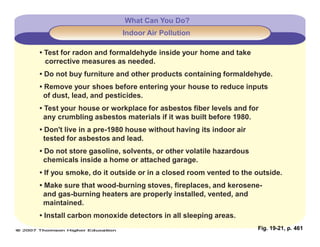
Fig. 19-21, p. 461
What Can You Do?
Indoor Air Pollution
• Test for radon and formaldehyde inside your home and take
corrective measures as needed.
• Do not buy furniture and other products containing formaldehyde.
• Remove your shoes before entering your house to reduce inputs
of dust, lead, and pesticides.
• Test your house or workplace for asbestos fiber levels and for
any crumbling asbestos materials if it was built before 1980.
• Don't live in a pre-1980 house without having its indoor air
tested for asbestos and lead.
• Do not store gasoline, solvents, or other volatile hazardous
chemicals inside a home or attached garage.
• If you smoke, do it outside or in a closed room vented to the outside.
• Make sure that wood-burning stoves, fireplaces, and kerosene-
and gas-burning heaters are properly installed, vented, and
maintained.
• Install carbon monoxide detectors in all sleeping areas.
ODOUR POLLUTION
Definition
• Odour can be defined as the “perception of smell”
or in scientific terms as “a sensation resulting from
the reception of stimulus by the olfactory sensory
system”. Whether pleasant or unpleasant, odour is
induced by inhaling air-borne volatile organics or
inorganics.
Characteristics of odour
• Substances of similar or dissimilar chemical
constitution may have similar odour.
• Nature and strength of odour may change on dilution.
• Weak odour is not perceived in presence of strong
odour.
• Odour of same strength blends to produce a
combination in which one or both may be
unrecognizable.
• Constant intensity of odour causes an individual to
quickly loose awareness of the sensation and only
noticed when it varies in intensity.
• Fatigue for one odour may not affect the perception
of dissimilar odour but will interfere with the
perception of similar odour.
• An unfamiliar odour is more likely to cause complaint
than a familiar one.
• Two or more odorous substances may cancel the
smell of each other.
• Odour travels downwind.
• Person can smell at a distance.
• Many animals have keener sense of olfaction than
man.
• Likes and dislikes often depend on association of the
scent with pleasant or unpleasant experiences.
Odour sources
• Odour sources can be classified as:
• Point Sources: Point sources are confined emissions from
vents, stacks and exhausts.
• Area Sources: Area sources may be unconfined like
sewage treatment plant, waste water treatment plant,
solid waste landfill, composting, household manure
spreading, settling lagoons etc.
• Building Sources: Building sources of odour like pig sheds
and hog confinement chicken.
• Fugitive Sources: In this source of odour, emissions are of
fugitive nature like odour emissions from soil bed or bio-
filter surface.

Indoor Air Pollution .......................

  • 1.
    Indoor Air Pollution AirPollution and Control Elective -I
  • 2.
    Indoor air pollution •Indoor air contains higher concentrations of pollutants than outdoor air (up to 70x) • Indoor air pollution usually is a greater threat to human health than outdoor air pollution. • Pollution levels inside cars in traffic clogged urban areas can be up to 18 times higher.
  • 3.
    Indoor Air Pollution--DevelopingWorld • From burning wood, charcoal, dung, crop waste – With little to no ventilation – Soot and carbon monoxide – Causes pneumonia, bronchitis, allergies, cataracts, asthma, heart disease, cancer & death • ~1.6 million deaths/year
  • 4.
    • According tothe EPA, the 4 most dangerous indoor air pollutants in developed countries are: – Tobacco smoke – Formaldehyde – Radioactive radon-222 gas – Very small fine & ultrafine particles Indoor Air Pollution--Developed World
  • 5.
    • Other ImportantIndoor Air pollutants – Nitrogen dioxide – Carbon monoxide – Volatile Organic Compounds (VOCs) – House dust mites (& other allergens… from pets) – Chlorinated organic compounds (ex. pesticides) – Asbestos & man-made mineral fibers • Sources – Building materials – Furnishings & fabrics – Glues – Cleaning products – Combustion appliances (cooking & heating) – Open fires – Smoking – Living organisms – Outdoor air
  • 6.
    Tobacco Smoke • Themost dangerous indoor pollutants in the developed world – Secondhand smoke from cigarettes is especially dangerous • Containing over 4000 dangerous chemicals • Causes eye, nose, and throat irritation • Smoking has declined in developed nations
  • 7.
    Volatile Organic Compounds(VOCs) • The most diverse group of indoor air pollutants – Released by everything from plastics and oils to perfumes and paints • Ex. formaldehyde, which leaks from pressed wood and insulation, irritates mucous membranes and induces skin allergies • Ex. pesticides, which are found indoors more often than outdoors due to seepage • Most VOCs are released in very small amounts – Unclear health effects due to low concentrations
  • 8.
    Radon-222 • colorless, tasteless,odorless, radioactive gas from decay of U- 238 found in some soils & rocks • can seep into some houses – Most homes are now radon resistant • 55% of our exposure to radiation comes from radon – May harm lungs from long term exposure. • increases the risk of lung cancer – Chance increase more if a smoker (synergistic effect) – causes 20,000 deaths a year in the U.S. • Reducing the risk – Sealing cracks in floors and walls – Simple systems using pipes and fans
  • 9.
    Sources & pathsof entry for indoor radon-222 gas
  • 10.
  • 11.
    Living organisms canpollute indoors • Dust mites – feed on human skin & dust • live in materials such as bedding & furniture fabrics – can cause asthma attacks & allergic reactions • Fungi, mold, mildew, airborne bacteria – cause severe allergies, asthma, & other respiratory ailments • Animal dander – worsen asthma
  • 13.
    Major Indoor Pollutants 1,1, 1- Trichloroethane Aerosol sprays Dizziness, breathing irregularities Asbestos Pipe insulation, ceilings, floor tiles, oven mitts Lung Cancer and asbestosis Benzo-a-pyrene Tobacco smoke, woodstoves Lung Cancer Carbon Monoxide Faulty furnaces, cigarette smoke Headache, heartbeat irregularities, death, CO has 250x affinity for hemoglobin than O2 http://www.metricmind.com/ac_honda/main.htm Pollutant Source Health Effects
  • 14.
    http://www.metricmind.com/ac_honda/main.htm Chloroform Pulp andpaper mills, water and wastewater plants Cancer Formaldehyde Paneling, particle board, furniture, carpeting, adhesives Nausea, dizziness, irritation of throat, eyes, and lungs Methylene chloride Paint strippers and thinner – persistent Nerve disorders, diabetes Nitrogen oxides Furnaces, stoves, fireplaces and vents Headaches, irritated lungs Para- dichlorobenzen e Air fresheners, mothballs Cancer
  • 15.
    http://www.metricmind.com/ac_honda/main.htm Radon – 222Soil and rock near house foundation, concrete Lung cancer Styrene Carpets, plastics, Kidney & liver damage Tetrachlor- ethylene Dry-cleaning fluid Nerve disorders, damage to liver and kidneys, cancer Tobacco Smoke Cigarettes and other smoking sources Lung cancer and heart disease Organic Material (Living Organisms) Dust mites, fungal and algal spores, dust (human skin), animal dander, hair, carpet fibers, fur Allergies, coughs, sneezing, eye irritation, sore throats, difficulty breathing
  • 16.
    Sick Building Syndrome •A sickness produced by indoor pollution w/ general & nonspecific symptoms – Ex. dizziness, headaches, coughing, sneezing, nausea, burning eyes, chronic fatigue, irritability, eye/nose/throat irritation, dry skin, nasal congestion, difficulty breathing, nose bleeds, flu- like symptoms • New buildings are more commonly “sick” than old ones because of reduced air exchange. – Can be solved with low-toxicity building materials & good ventilation
  • 17.
    Building Related Illness •Also due to exposure to indoor air pollutants • Recognizable Causes • Clinically Recognized Disease –Examples • Humidifier Fever • Asthma • Allergy • Respiratory Disease –Chronic Obstructive Pulmonary Disease
  • 18.
    Reducing Indoor AirPollution •Little effort has been devoted to reducing indoor air pollution even though it is more harmful to human health than outdoor air pollution •Environmental & health scientists call for us to focus on preventing air pollution (especially indoor) in developing countries.
  • 19.
    Fig. 19-20, p.461 Solutions Indoor Air Pollution Prevention Cover ceiling tiles & lining of AC ducts to prevent release of mineral fibers Use adjustable fresh air vents for work spaces Increase intake of outside air Ban smoking or limit it to well ventilated areas Change air more frequently Set stricter formaldehyde emissions standards for carpet, furniture, and building materials Circulate a building’s air through rooftop green houses Prevent radon infiltration Use exhaust hoods for stoves and appliances burning natural gas Use office machines in well ventilated areas Use less polluting substitutes for harmful cleaning agents, paints, and other products Install efficient chimneys for wood-burning stoves Cleanup or Dilution
  • 20.
    We can reduceindoor air pollution • In developed countries: – Use low-toxicity material – Monitor air quality – Keep rooms clean – Limit exposure to chemicals – Allow for better mixing of indoor & outdoor air • In developing countries: – Dry wood before burning – Cook outside – Use less-polluting fuels (natural gas)
  • 21.
    • The amountof air available (for mixing of indoor & outdoor air) to dilute pollutants is an important indicator of the likely contaminant concentration – Indoor air can mix with outside air by 3 mechanisms • infiltration • natural ventilation • forced ventilation We can reduce indoor air pollution
  • 22.
    • Infiltration – naturalair exchange that occurs between a building & its environment when doors & windows are closed • leakage through holes or openings in the building Mixing of Indoor & Outdoor Air
  • 23.
    • Natural ventilation –air exchange that occurs when windows or doors are opened to increase air circulation • Forced ventilation – mechanical air handling systems used to induce air exchange using fans & blowers Mixing of Indoor & Outdoor Air
  • 24.
    Fig. 19-21, p.461 What Can You Do? Indoor Air Pollution • Test for radon and formaldehyde inside your home and take corrective measures as needed. • Do not buy furniture and other products containing formaldehyde. • Remove your shoes before entering your house to reduce inputs of dust, lead, and pesticides. • Test your house or workplace for asbestos fiber levels and for any crumbling asbestos materials if it was built before 1980. • Don't live in a pre-1980 house without having its indoor air tested for asbestos and lead. • Do not store gasoline, solvents, or other volatile hazardous chemicals inside a home or attached garage. • If you smoke, do it outside or in a closed room vented to the outside. • Make sure that wood-burning stoves, fireplaces, and kerosene- and gas-burning heaters are properly installed, vented, and maintained. • Install carbon monoxide detectors in all sleeping areas.
  • 25.
  • 26.
    Definition • Odour canbe defined as the “perception of smell” or in scientific terms as “a sensation resulting from the reception of stimulus by the olfactory sensory system”. Whether pleasant or unpleasant, odour is induced by inhaling air-borne volatile organics or inorganics.
  • 27.
    Characteristics of odour •Substances of similar or dissimilar chemical constitution may have similar odour. • Nature and strength of odour may change on dilution. • Weak odour is not perceived in presence of strong odour. • Odour of same strength blends to produce a combination in which one or both may be unrecognizable. • Constant intensity of odour causes an individual to quickly loose awareness of the sensation and only noticed when it varies in intensity.
  • 28.
    • Fatigue forone odour may not affect the perception of dissimilar odour but will interfere with the perception of similar odour. • An unfamiliar odour is more likely to cause complaint than a familiar one. • Two or more odorous substances may cancel the smell of each other. • Odour travels downwind. • Person can smell at a distance. • Many animals have keener sense of olfaction than man. • Likes and dislikes often depend on association of the scent with pleasant or unpleasant experiences.
  • 29.
    Odour sources • Odoursources can be classified as: • Point Sources: Point sources are confined emissions from vents, stacks and exhausts. • Area Sources: Area sources may be unconfined like sewage treatment plant, waste water treatment plant, solid waste landfill, composting, household manure spreading, settling lagoons etc. • Building Sources: Building sources of odour like pig sheds and hog confinement chicken. • Fugitive Sources: In this source of odour, emissions are of fugitive nature like odour emissions from soil bed or bio- filter surface.