Presented By               Submitted to
Ashish Agarwal          Imran Ahmad
Civil Engg. III yr.   H.O.D. Civil Dept.
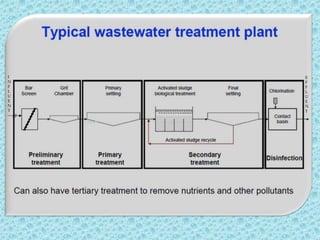
Preliminary Treatment

 Primary Treatment

 Secondary Treatment

Tertiary Treatment
Preliminary Treatment
Removal of waste water constituents
such as rags, sticks, floatable grit, and
grease that may cause maintenance or
     operational problem with the
 treatment operations, processes, and
          ancil1ary systems
Preliminary Treatment
Preliminary treatment consists of following units
•   Screening         For removal of floating matter.
•   Grit Chamber      For removal of sand and grits.
•   Comminuters       For grinding large size suspended solids
•   Floatation Units For removal of oil and grease
•   Skimming Tanks
•   Flow Measuring units such as partial flume
•   Pumps
•   Pre-aeration Units
Primary Treatment
Removal of a portion of the suspended
   solids and organic matter from
           the wastewater.
Advanced Primary Treatment
 Enhanced removal of suspended
solids and organic matter from the
       wastewater. Typically
    accomplished by chemical
  addition or filtration known as
  Coagulation and Flocculation.
Primary Treatment
Primary treatment consists of following
processes/units
• Sedimentation   Primary Settling Tanks
• Coagulation     Secondary Settling Tank
• Flocculation
Secondary Treatment
 Removal of biodegradable organic
matter [insoluble or suspension state}
and suspended solids. Disinfection is
    also typically included in the
definition of conventional secondary
               treatment
Secondary Treatment with
    Nutrient Removal
    Removal of biodegradable
 organics, suspended solids, and
nutrients (nitrogen phosphorus, or
 both nitrogen and phosphorus)
Secondary Treatment
Secondary Treatment Process for Wastewater
Applications:
• Aeration Systems
• Biological Treatment Systems
• Sludge and Bio solids Processing Systems
Secondary treatment consists of following
processes.
• Activated Sludge Process
• Oxidation Ponds and lagoons
• Trickling Filter
Removal of residual suspended solids
       (after secondary treatment),
usually by granular medium filtration or
       micro screens. Disinfection is
also typically a part of tertiary treatment.
        Nutrient removal is often
        included in this definition
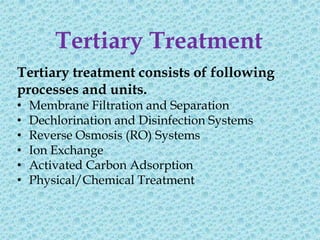
Tertiary Treatment
Tertiary treatment consists of following
processes and units.
•   Membrane Filtration and Separation
•   Dechlorination and Disinfection Systems

•   Reverse Osmosis (RO) Systems
•   Ion Exchange
•   Activated Carbon Adsorption
•   Physical/Chemical Treatment
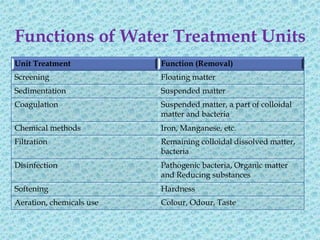
Functions of Water Treatment Units
Unit Treatment            Function (Removal)
Screening                 Floating matter
Sedimentation             Suspended matter
Coagulation               Suspended matter, a part of colloidal
                          matter and bacteria
Chemical methods          Iron, Manganese, etc.
Filtration                Remaining colloidal dissolved matter,
                          bacteria
Disinfection              Pathogenic bacteria, Organic matter
                          and Reducing substances
Softening                 Hardness
Aeration, chemicals use   Colour, Odour, Taste
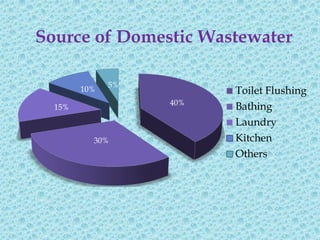
Source of Domestic Wastewater

              5%
        10%              Toilet Flushing
                   40%
  15%                    Bathing
                         Laundry
          30%            Kitchen
                         Others
I   E
N   F
F   F
L   L
U   U
E   E
N   N
T   T
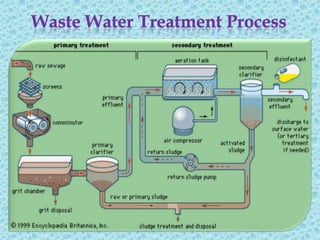
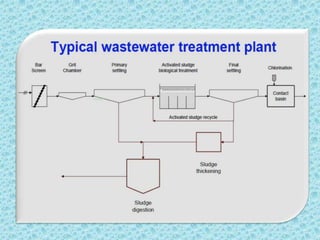
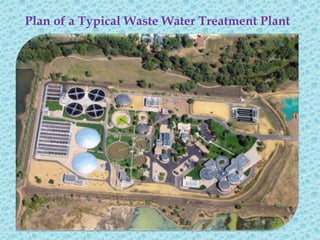
Plan of a Typical Waste Water Treatment Plant
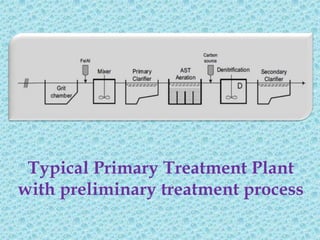
Primary Treatment Process
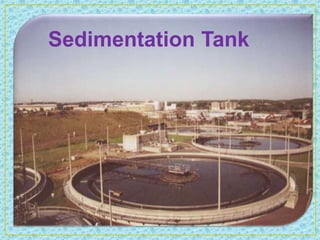
Sedimentation is primary treatment
Process.
Sedimentation is a physical water
treatment process used to settle out
suspended solids in water under
the influence of gravity.
Removal Efficiency of Primary
    Treatment Process :
• Removal efficiency of Biological Oxygen
  Demand (B. O.D.) in primary treatment
  process is 30%

• Removal efficiency of Total Suspended
  Solids (T.S.S.) in primary treatment process
  is 60%
Typical Primary Treatment Plant
with preliminary treatment process
Sedimentation Tank
Secondary Treatment Process
Stabilization ponds & Lagoons:
• The stabilization ponds are open flow through
  basins specifically designed and constructed to treat
  sewage and biodegradable industrial wastes.
• They provide long detention periods extending from
  a few to several days.
• Pond systems, in which oxygen is provided through
  mechanical aeration rather than algal photosynthesis
  are called aerated lagoons.
• Lightly loaded ponds used as tertiary step in waste
  treatment for polishing of secondary effluents and
  removal of bacteria are called maturation ponds.
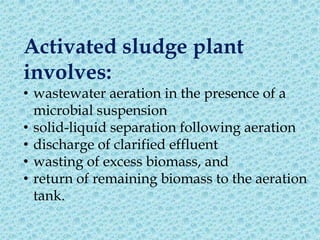
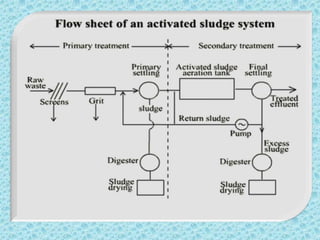
Activate Sludge Process
In activated sludge process wastewater
containing organic matter is aerated in an
aeration basin in which micro-organisms
metabolize the suspended and soluble
organic matter.
Activated sludge plant
involves:
• wastewater aeration in the presence of a
  microbial suspension
• solid-liquid separation following aeration
• discharge of clarified effluent
• wasting of excess biomass, and
• return of remaining biomass to the aeration
  tank.
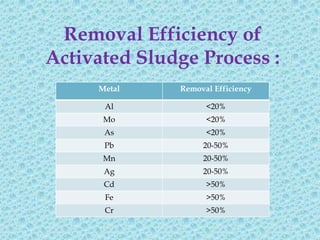
Removal Efficiency of
Activated Sludge Process :
     Metal    Removal Efficiency

      Al            <20%
      Mo            <20%
      As            <20%
      Pb           20-50%
      Mn           20-50%
      Ag           20-50%
      Cd            >50%
      Fe            >50%
      Cr            >50%
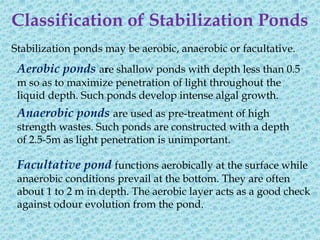
Classification of Stabilization Ponds
Stabilization ponds may be aerobic, anaerobic or facultative.
 Aerobic ponds are shallow ponds with depth less than 0.5
 m so as to maximize penetration of light throughout the
 liquid depth. Such ponds develop intense algal growth.
 Anaerobic ponds are used as pre-treatment of high
 strength wastes. Such ponds are constructed with a depth
 of 2.5-5m as light penetration is unimportant.

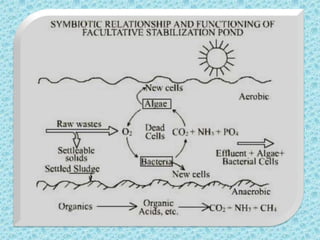
 Facultative pond functions aerobically at the surface while
 anaerobic conditions prevail at the bottom. They are often
 about 1 to 2 m in depth. The aerobic layer acts as a good check
 against odour evolution from the pond.
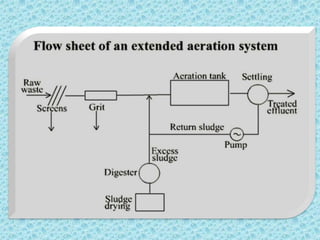
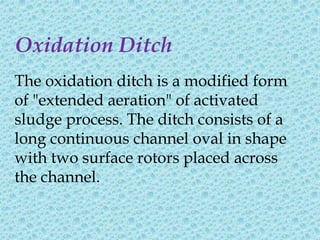
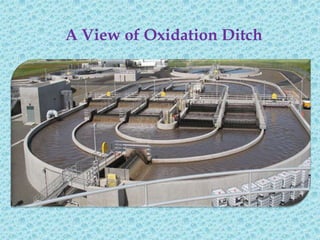
Oxidation Ditch
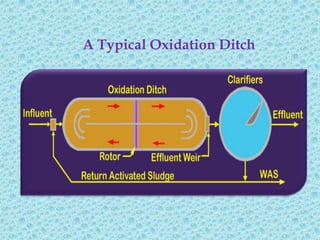
The oxidation ditch is a modified form
of "extended aeration" of activated
sludge process. The ditch consists of a
long continuous channel oval in shape
with two surface rotors placed across
the channel.
A Typical Oxidation Ditch
A View of Oxidation Ditch
Tertiary Treatment
Process
Tertiary treatment process consists of following
process.
• Filtration Process (Trickling Filter)
• Disinfection Process

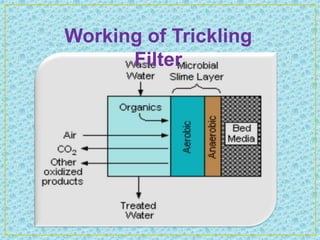
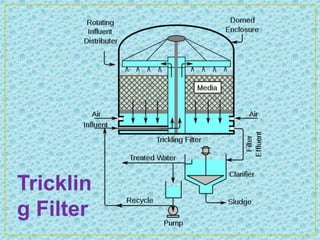
 Trickling Filter is an attached growth
 process i.e. process in which
 microorganisms responsible for treatment
 are attached to an inert packing material.
Removal Efficiency of
    Trickling Filter
The Removal efficiency of Total
Organic Carbon (T. O. C.) from
 Trickling Filter is greater than
               90%
Working of Trickling
      Filter
Tricklin
g Filter
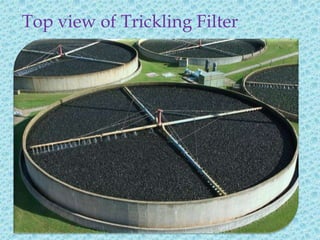
Top view of Trickling Filter
Thank
 You

Waste water treatment processes

  • 1.
    Presented By Submitted to Ashish Agarwal Imran Ahmad Civil Engg. III yr. H.O.D. Civil Dept.
  • 2.
    Preliminary Treatment PrimaryTreatment Secondary Treatment Tertiary Treatment
  • 4.
    Preliminary Treatment Removal ofwaste water constituents such as rags, sticks, floatable grit, and grease that may cause maintenance or operational problem with the treatment operations, processes, and ancil1ary systems
  • 5.
    Preliminary Treatment Preliminary treatmentconsists of following units • Screening For removal of floating matter. • Grit Chamber For removal of sand and grits. • Comminuters For grinding large size suspended solids • Floatation Units For removal of oil and grease • Skimming Tanks • Flow Measuring units such as partial flume • Pumps • Pre-aeration Units
  • 6.
    Primary Treatment Removal ofa portion of the suspended solids and organic matter from the wastewater.
  • 7.
    Advanced Primary Treatment Enhanced removal of suspended solids and organic matter from the wastewater. Typically accomplished by chemical addition or filtration known as Coagulation and Flocculation.
  • 8.
    Primary Treatment Primary treatmentconsists of following processes/units • Sedimentation Primary Settling Tanks • Coagulation Secondary Settling Tank • Flocculation
  • 9.
    Secondary Treatment Removalof biodegradable organic matter [insoluble or suspension state} and suspended solids. Disinfection is also typically included in the definition of conventional secondary treatment
  • 10.
    Secondary Treatment with Nutrient Removal Removal of biodegradable organics, suspended solids, and nutrients (nitrogen phosphorus, or both nitrogen and phosphorus)
  • 11.
    Secondary Treatment Secondary TreatmentProcess for Wastewater Applications: • Aeration Systems • Biological Treatment Systems • Sludge and Bio solids Processing Systems Secondary treatment consists of following processes. • Activated Sludge Process • Oxidation Ponds and lagoons • Trickling Filter
  • 12.
    Removal of residualsuspended solids (after secondary treatment), usually by granular medium filtration or micro screens. Disinfection is also typically a part of tertiary treatment. Nutrient removal is often included in this definition
  • 13.
    Tertiary Treatment Tertiary treatmentconsists of following processes and units. • Membrane Filtration and Separation • Dechlorination and Disinfection Systems • Reverse Osmosis (RO) Systems • Ion Exchange • Activated Carbon Adsorption • Physical/Chemical Treatment
  • 14.
    Functions of WaterTreatment Units Unit Treatment Function (Removal) Screening Floating matter Sedimentation Suspended matter Coagulation Suspended matter, a part of colloidal matter and bacteria Chemical methods Iron, Manganese, etc. Filtration Remaining colloidal dissolved matter, bacteria Disinfection Pathogenic bacteria, Organic matter and Reducing substances Softening Hardness Aeration, chemicals use Colour, Odour, Taste
  • 15.
    Source of DomesticWastewater 5% 10% Toilet Flushing 40% 15% Bathing Laundry 30% Kitchen Others
  • 17.
    I E N F F F L L U U E E N N T T
  • 18.
    Plan of aTypical Waste Water Treatment Plant
  • 19.
    Primary Treatment Process Sedimentationis primary treatment Process. Sedimentation is a physical water treatment process used to settle out suspended solids in water under the influence of gravity.
  • 20.
    Removal Efficiency ofPrimary Treatment Process : • Removal efficiency of Biological Oxygen Demand (B. O.D.) in primary treatment process is 30% • Removal efficiency of Total Suspended Solids (T.S.S.) in primary treatment process is 60%
  • 21.
    Typical Primary TreatmentPlant with preliminary treatment process
  • 22.
  • 23.
    Secondary Treatment Process Stabilizationponds & Lagoons: • The stabilization ponds are open flow through basins specifically designed and constructed to treat sewage and biodegradable industrial wastes. • They provide long detention periods extending from a few to several days. • Pond systems, in which oxygen is provided through mechanical aeration rather than algal photosynthesis are called aerated lagoons. • Lightly loaded ponds used as tertiary step in waste treatment for polishing of secondary effluents and removal of bacteria are called maturation ponds.
  • 24.
    Activate Sludge Process Inactivated sludge process wastewater containing organic matter is aerated in an aeration basin in which micro-organisms metabolize the suspended and soluble organic matter.
  • 25.
    Activated sludge plant involves: •wastewater aeration in the presence of a microbial suspension • solid-liquid separation following aeration • discharge of clarified effluent • wasting of excess biomass, and • return of remaining biomass to the aeration tank.
  • 26.
    Removal Efficiency of ActivatedSludge Process : Metal Removal Efficiency Al <20% Mo <20% As <20% Pb 20-50% Mn 20-50% Ag 20-50% Cd >50% Fe >50% Cr >50%
  • 29.
    Classification of StabilizationPonds Stabilization ponds may be aerobic, anaerobic or facultative. Aerobic ponds are shallow ponds with depth less than 0.5 m so as to maximize penetration of light throughout the liquid depth. Such ponds develop intense algal growth. Anaerobic ponds are used as pre-treatment of high strength wastes. Such ponds are constructed with a depth of 2.5-5m as light penetration is unimportant. Facultative pond functions aerobically at the surface while anaerobic conditions prevail at the bottom. They are often about 1 to 2 m in depth. The aerobic layer acts as a good check against odour evolution from the pond.
  • 31.
    Oxidation Ditch The oxidationditch is a modified form of "extended aeration" of activated sludge process. The ditch consists of a long continuous channel oval in shape with two surface rotors placed across the channel.
  • 32.
  • 33.
    A View ofOxidation Ditch
  • 34.
    Tertiary Treatment Process Tertiary treatmentprocess consists of following process. • Filtration Process (Trickling Filter) • Disinfection Process Trickling Filter is an attached growth process i.e. process in which microorganisms responsible for treatment are attached to an inert packing material.
  • 35.
    Removal Efficiency of Trickling Filter The Removal efficiency of Total Organic Carbon (T. O. C.) from Trickling Filter is greater than 90%
  • 36.
  • 37.
  • 38.
    Top view ofTrickling Filter
  • 39.