SLUDGE DIGESTION PROCESS
-Presentation by
VIJAYA SUBRAMANIAM P R
M.E Environmental Engineering
Kumaraguru College of Technology,
Coimbatore.
SLUDGE DIGESTION
 Raw sludge contains a lot putrescible organic matter, if disposed
without any treatment the organic matter may decompose producing
foul gases and health hazards.
 To avoid these problems the sludge is stabilized by decomposing the
organic matter by controlled anaerobic conditions; this process of
stabilization is called sludge digestion and done in sludge digestion
tanks.
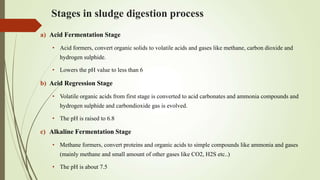
Stages in sludge digestion process
a) Acid Fermentation Stage
• Acid formers, convert organic solids to volatile acids and gases like methane, carbon dioxide and
hydrogen sulphide.
• Lowers the pH value to less than 6
b) Acid Regression Stage
• Volatile organic acids from first stage is converted to acid carbonates and ammonia compounds and
hydrogen sulphide and carbondioxide gas is evolved.
• The pH is raised to 6.8
c) Alkaline Fermentation Stage
• Methane formers, convert proteins and organic acids to simple compounds like ammonia and gases
(mainly methane and small amount of other gases like CO2, H2S etc..)
• The pH is about 7.5
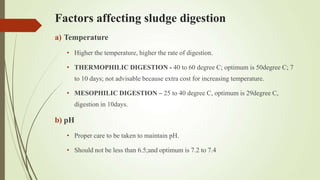
Factors affecting sludge digestion
a) Temperature
• Higher the temperature, higher the rate of digestion.
• THERMOPHILIC DIGESTION - 40 to 60 degree C; optimum is 50degree C; 7
to 10 days; not advisable because extra cost for increasing temperature.
• MESOPHILIC DIGESTION – 25 to 40 degree C, optimum is 29degree C,
digestion in 10days.
b) pH
• Proper care to be taken to maintain pH.
• Should not be less than 6.5;and optimum is 7.2 to 7.4
c) Seeding with digested sludge
• For a new sludge digestion tank, seeding with digested sludge from another plant is
highly beneficial, without seeding it may take a few months for a new plant to
operate properly.
d) Mixing raw sludge with digested sludge
• Incoming raw sewage thoroughly mixed with partly digested sludge to make a
homogeneous mixture by slow moving mechanical devices, so that bacterial mass
from digested sludge decomposes the raw sludge.
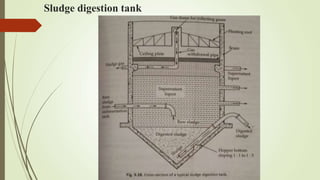
Sludge digestion tank
Design of sludge digestion tank
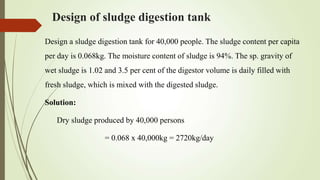
Design a sludge digestion tank for 40,000 people. The sludge content per capita
per day is 0.068kg. The moisture content of sludge is 94%. The sp. gravity of
wet sludge is 1.02 and 3.5 per cent of the digestor volume is daily filled with
fresh sludge, which is mixed with the digested sludge.
Solution:
Dry sludge produced by 40,000 persons
= 0.068 x 40,000kg = 2720kg/day
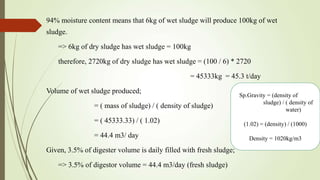
94% moisture content means that 6kg of wet sludge will produce 100kg of wet
sludge.
=> 6kg of dry sludge has wet sludge = 100kg
therefore, 2720kg of dry sludge has wet sludge = (100 / 6) * 2720
= 45333kg = 45.3 t/day
Volume of wet sludge produced;
= ( mass of sludge) / ( density of sludge)
= ( 45333.33) / ( 1.02)
= 44.4 m3/ day
Given, 3.5% of digester volume is daily filled with fresh sludge;
=> 3.5% of digestor volume = 44.4 m3/day (fresh sludge)
Sp.Gravity = (density of
sludge) / ( density of
water)
(1.02) = (density) / (1000)
Density = 1020kg/m3
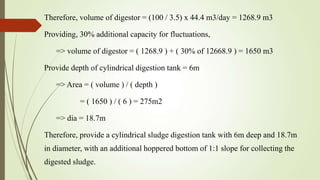
Therefore, volume of digestor = (100 / 3.5) x 44.4 m3/day = 1268.9 m3
Providing, 30% additional capacity for fluctuations,
=> volume of digestor = ( 1268.9 ) + ( 30% of 12668.9 ) = 1650 m3
Provide depth of cylindrical digestion tank = 6m
=> Area = ( volume ) / ( depth )
= ( 1650 ) / ( 6 ) = 275m2
=> dia = 18.7m
Therefore, provide a cylindrical sludge digestion tank with 6m deep and 18.7m
in diameter, with an additional hoppered bottom of 1:1 slope for collecting the
digested sludge.
Sludge digestion process

Sludge digestion process

  • 1.
    SLUDGE DIGESTION PROCESS -Presentationby VIJAYA SUBRAMANIAM P R M.E Environmental Engineering Kumaraguru College of Technology, Coimbatore.
  • 2.
    SLUDGE DIGESTION  Rawsludge contains a lot putrescible organic matter, if disposed without any treatment the organic matter may decompose producing foul gases and health hazards.  To avoid these problems the sludge is stabilized by decomposing the organic matter by controlled anaerobic conditions; this process of stabilization is called sludge digestion and done in sludge digestion tanks.
  • 3.
    Stages in sludgedigestion process a) Acid Fermentation Stage • Acid formers, convert organic solids to volatile acids and gases like methane, carbon dioxide and hydrogen sulphide. • Lowers the pH value to less than 6 b) Acid Regression Stage • Volatile organic acids from first stage is converted to acid carbonates and ammonia compounds and hydrogen sulphide and carbondioxide gas is evolved. • The pH is raised to 6.8 c) Alkaline Fermentation Stage • Methane formers, convert proteins and organic acids to simple compounds like ammonia and gases (mainly methane and small amount of other gases like CO2, H2S etc..) • The pH is about 7.5
  • 4.
    Factors affecting sludgedigestion a) Temperature • Higher the temperature, higher the rate of digestion. • THERMOPHILIC DIGESTION - 40 to 60 degree C; optimum is 50degree C; 7 to 10 days; not advisable because extra cost for increasing temperature. • MESOPHILIC DIGESTION – 25 to 40 degree C, optimum is 29degree C, digestion in 10days. b) pH • Proper care to be taken to maintain pH. • Should not be less than 6.5;and optimum is 7.2 to 7.4
  • 5.
    c) Seeding withdigested sludge • For a new sludge digestion tank, seeding with digested sludge from another plant is highly beneficial, without seeding it may take a few months for a new plant to operate properly. d) Mixing raw sludge with digested sludge • Incoming raw sewage thoroughly mixed with partly digested sludge to make a homogeneous mixture by slow moving mechanical devices, so that bacterial mass from digested sludge decomposes the raw sludge.
  • 6.
  • 7.
    Design of sludgedigestion tank Design a sludge digestion tank for 40,000 people. The sludge content per capita per day is 0.068kg. The moisture content of sludge is 94%. The sp. gravity of wet sludge is 1.02 and 3.5 per cent of the digestor volume is daily filled with fresh sludge, which is mixed with the digested sludge. Solution: Dry sludge produced by 40,000 persons = 0.068 x 40,000kg = 2720kg/day
  • 8.
    94% moisture contentmeans that 6kg of wet sludge will produce 100kg of wet sludge. => 6kg of dry sludge has wet sludge = 100kg therefore, 2720kg of dry sludge has wet sludge = (100 / 6) * 2720 = 45333kg = 45.3 t/day Volume of wet sludge produced; = ( mass of sludge) / ( density of sludge) = ( 45333.33) / ( 1.02) = 44.4 m3/ day Given, 3.5% of digester volume is daily filled with fresh sludge; => 3.5% of digestor volume = 44.4 m3/day (fresh sludge) Sp.Gravity = (density of sludge) / ( density of water) (1.02) = (density) / (1000) Density = 1020kg/m3
  • 9.
    Therefore, volume ofdigestor = (100 / 3.5) x 44.4 m3/day = 1268.9 m3 Providing, 30% additional capacity for fluctuations, => volume of digestor = ( 1268.9 ) + ( 30% of 12668.9 ) = 1650 m3 Provide depth of cylindrical digestion tank = 6m => Area = ( volume ) / ( depth ) = ( 1650 ) / ( 6 ) = 275m2 => dia = 18.7m Therefore, provide a cylindrical sludge digestion tank with 6m deep and 18.7m in diameter, with an additional hoppered bottom of 1:1 slope for collecting the digested sludge.