L-31
Water Pollution Control
Act 1974 and other
topics
Unit-VIII
Industrial Waste Treatment
Contents
• Water pollution control act,
Organizational set up of central and
state boards for water pollution
control, classification of river on water
use, minimal national standards, and
socioeconomic aspects of water
pollution control.
Introduction and
background
• According to the Article 51 A (g) it is
the fundamental duty of every citizen
of India to protect and improve the
natural environment included Forest,
Lakes, Rivers and Wildlife and to
have compassion for living creatures.
• After the Stockholm conference on
Human Environment on June, 1972, it
was considered appropriate to have
uniform law all over country for broad
Environment problems endangering
the health and safety of our people as
well as of our flora and fauna.
• The Water (Prevention & Control of
Pollution) Act, 1974 is the first
enactment by the Parliament in this
direction.
• This is also the first specific and
comprehensive legislation
institutionalizing simultaneously the
regulatory agencies for controlling
water pollution.
• The Pollution Control Board at the
Centre and in the State came into
being in terms of this Act.
Important Definitions
• Pollution means contamination of water or such
alteration of the Physical, Chemical or
Biological properties of water or such discharge
of any sewage or trade effluent or of any other
liquid, gas and Solid substance into water
(whether directly or indirectly) as may be the
case or is likely to create nuisance or render
such water harmful or injurious to public health
or safety or to domestic, commercial, industrial,
agricultural or other legitimate uses, or to the
life and health of animals or plant or of aquatic
organizations.
• Trade effluent includes any liquid or
solid substance which is discharged
from any premises used for carrying
on any industry operation or process
or treatment and disposal system,
other domestic sewage.
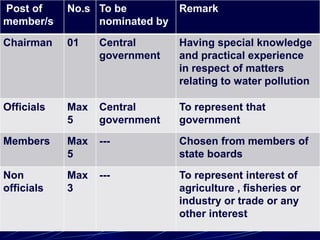
CONSTITUTION OF
CENTRAL BOARD
Organizational setup
Post of
member/s
No.s To be
nominated by
Remark
Chairman 01 Central
government
Having special knowledge
and practical experience
in respect of matters
relating to water pollution
Officials Max
5
Central
government
To represent that
government
Members Max
5
--- Chosen from members of
state boards
Non
officials
Max
3
--- To represent interest of
agriculture , fisheries or
industry or trade or any
other interest
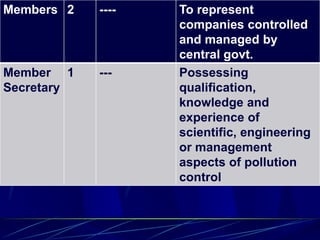
Members 2 ---- To represent
companies controlled
and managed by
central govt.
Member
Secretary
1 --- Possessing
qualification,
knowledge and
experience of
scientific, engineering
or management
aspects of pollution
control
CONSTITUTION OF STATE
BOARDS
Organizational setup
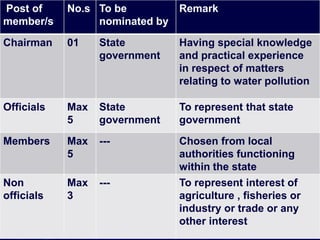
Post of
member/s
No.s To be
nominated by
Remark
Chairman 01 State
government
Having special knowledge
and practical experience
in respect of matters
relating to water pollution
Officials Max
5
State
government
To represent that state
government
Members Max
5
--- Chosen from local
authorities functioning
within the state
Non
officials
Max
3
--- To represent interest of
agriculture , fisheries or
industry or trade or any
other interest
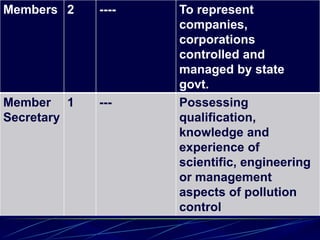
Members 2 ---- To represent
companies,
corporations
controlled and
managed by state
govt.
Member
Secretary
1 --- Possessing
qualification,
knowledge and
experience of
scientific, engineering
or management
aspects of pollution
control
FUNCTIONS OF CENTRAL
BOARD
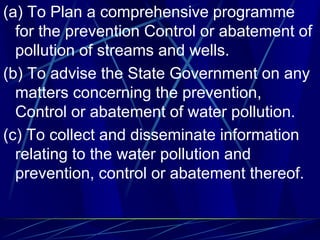
(a) To Plan a comprehensive programme
for the prevention Control or abatement of
pollution of streams and wells.
(b) To advise the State Government on any
matters concerning the prevention,
Control or abatement of water pollution.
(c) To collect and disseminate information
relating to the water pollution and
prevention, control or abatement thereof.
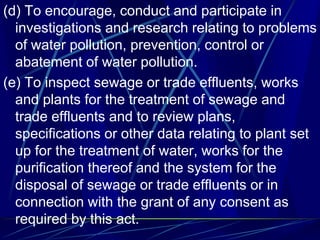
(d) To encourage, conduct and participate in
investigations and research relating to problems
of water pollution, prevention, control or
abatement of water pollution.
(e) To inspect sewage or trade effluents, works
and plants for the treatment of sewage and
trade effluents and to review plans,
specifications or other data relating to plant set
up for the treatment of water, works for the
purification thereof and the system for the
disposal of sewage or trade effluents or in
connection with the grant of any consent as
required by this act.
(f) Lay down, modify or annual effluent
standards for the sewage and trade effluents
and for the quantity of receiving water (not
being) water in an inter-state stream) resulting
from the discharge of effluents and to classify
waters in the state.
(g) To evolve economical and reliable methods
of treatment of sewage and trade effluents,
having regard to the peculiar conditions of
soils, climate and water resources of different
region and more especially the prevailing flow
characteristics of water in streams and wells,
which render it impossible to attain
FUNCTIONS OF STATE
BOARDS
(a) To plan a comprehensive programme
for the prevention, control or abatement
of pollution of streams and wells in the
state and to secure the execution
thereof.
(b) To advice the State Government on
any mater concerning the prevention
control or abatement of water pollution.
(c) To collect and disseminate information
relating to water pollution and the
prevention, control or abatement thereof.
(d) To encourage, conduct and participate
in investigations and research relating to
problems of water pollution and
prevention, control or abatement of water
pollution.
(e) to collaborate with the control Board in
organizing the training of persons
engaged or to be engaged in programmes
relating to prevention, control or
abatement of water pollution and to
organize mass education programmes
relating thereof.
(f)To inspect sewage or trade effluents,
works and plants for the treatment of

sewage and trade effluents and to
review plants, specifications or other
data relating to plants set up for the
purification thereof and the system for
the disposal of sewage or trade
effluents or in connection with the
grant of any consent as required by
this Act.
• (g) lay down, modify or annual effluent
standards for the sewage and trade
effluents and for the quality of receiving
waters (not being water in an inter state
stream) resulting from the discharge of
effluents and to classify waters of the
State.
(h) to evolve methods of utilization of
sewage and suitable trade effluents in
agriculture.
(i) to evolve economical and reliable
methods of treatment of sewage and trade
effluents, having regard to the peculiar
conditions of soils, climate and water
resources of difference regions and more
specially the prevailing flow characteristics
of water in streams and wells which
render it impossible to attain even the
minimum degree of dilution.
(j) To evolve efficient methods of disposal of
sewage and trade effluents on land as are
necessary on account of the predominant
conditions of scant stream flows that do not
provide for major part of the year the minimum
degree of dilution.
(k) To lay down standards of treatment of sewage
and trade effluents to be discharged into any
particular stream taking into account the
minimum fair weather dilution available in that
stream and the tolerance limits of pollution
permissible in the water of the stream after the
discharge of such effluents.
To advice the State Government with respect to
the location of any industry the carrying on of
which is likely to pollute a stream or well;
To perform such other functions as may be
prescribed or as may, from time to time be
entrusted to it by the Central Board or the State
Government.
Other important provisions
Power to give directions to obtain
information from any industry or person.
Power to take samples of effluents from
any treatment plant.
Power of entry and inspection in any
industrial premises
Power to take emergency measures in
case of pollution of stream or well
Power to give directions for closure of
industry
Central board has Power to give direction
to the State Board
Special power is given to the central
board to supersede the State Board
Person found guilty of an offence is On
conviction, the failure shall be punishable
with imprisonment up to 3 months or fine
up to Rs. 10,000 or both if the failure
continues, an additional fine of Rs. 5000
per day.
If offence is made by companies , then the
person in charge at that instance shall be
held responsible
COMMON EFFLUENT
TREATMENT PLANT
(CETP)
Miscellaneous topics
• Small-scale industries (SSIs) have a very
important role in overall industrial
development in India and growth of SSI units
has been actively promoted by Government of
India to induce balanced economic growth
and to distribute the benefits of industrial
development in an equitable manner.
• Industries having capital investment up to
Rs.10 millions are classified as SSI units. It is
estimated that more than 300,000 SSI units
are spread all over India, mainly in about 867
clusters/industrial estates of the country.
• It is difficult for each industrial unit to
provide and operate individual wastewater
treatment plant because of the scale of
operations or lack of space or technical
manpower.
• However, the quantum of pollutants
emitted by SSIs clusters may be more
than an equivalent large scale industry,
since the specific rate of generation of
pollutants is generally higher because of
the inefficient production technologies
adopted by SSIs.
• Hence the desirable option is of the shared or
combined treatment, wherein,
managerial and operational aspects are
collectively addressed and the cost of treatment
, becomes affordable as enunciated in
the scheme of the common effluent treatment
plants, which are proving to be a boon
especially for small entrepreneurs, given
the methodical planning, regular operation a
nd equitable contribution of member units.
Such common facilities also facilitate proper
management of effluent and compliance of the
effluent quality standards.
• Advantages of Common Treatment
1. Saving in Capital and operating cost of
treatment plant. Combined treatment is always
cheaper than small scattered treatment units.
2. Availability of land which is difficult to be
ensured by all individual units in the event they
go for individual treatment plants. This is
particularly important in case of existing old
industries which simply do not have any
space.
3. Contribution of nutrient and diluting potential,
making the complex industrial waste more
amenable to degradation.
4. The neutralization and equalization of
heterogeneous waste makes its
treatment techno-economically viable.
5. Professional and trained staff can be
made available for operation of CETP
which is not possible in case of individual
plants.
6. Disposal of treated wastewater & sludge
becomes more organized.
7. Reduced burden of various regulatory
authorities in ensuring pollution control
requirement.
ACCLIMATIZATION OF
BACTERIA
• Many processes in the chemical,
pharmaceutical, plastic, petrochemical
industries, etc., generate Waste Water
which contains organic toxic compounds.
• The utilization of biological treatments is
based on the capacity of microorganisms,
specifically bacteria, to degrade a great
quantity of toxic substances.
• The pollutants are treated as food by the
bacteria and these, while feeding,
increase their population at the same time
as the water gets treated.
• Some microorganisms perform the
treatment process in the presence of
oxygen and others in its absence.
• Due to its toxicity, biological treatment of
Waste Water containing a toxic substrate
is difficult, since the microorganisms are
initially not able to treat that substance.
• Therefore, the first step to make a SBR
(Sequential Batch Reactor) operative is
the acclimatization, i.e., the adaptation of
the microorganisms to a particular
toxic substrate.
• Acclimatization is commonly practiced in
case of toxic wastes such as phenol,
arsenic, cyanide etc.
• For example to treat a phenolic waste of
500 mg/lit. bacteria are exposed gradually
from initial concentration of 20 mg/lit to
500 mg/lit
• Nutrients are also added to the waste in
the form of urea, superphosphate or any
other compound containing N and P
MINAS
• The Central Pollution Control Board (CPCB)
developed Minimum National Standards
(MINAS) for all types of industries with
regards to their effluent discharge (water
pollutants), emissions (air pollutants), noise
levels and solid waste.
• The proposed model for evolving industry
specific standards envisages specifying limits
of pollutants to protect the environment.
• The standards thus developed will be
applicable to the concerned industries
throughout the country.
• The Minimal National Standards {MINAS)
for a particular industry is the effluent
standard achievable by the industry by
installing pollution control measures which
are within the techno- economic capability
of the industry.
• Depending on the gravity of the pollution
and1echno-economic assessment of the
requisite pollution control measures the
MINAS may be attained in one stroke or in
phases
• The evolution of MINAS thus remain
independent of the characteristics of the
recipient environment: The Central and State
Boards for Pollution Control have come to an
agreement that under no circumstances
MINAS would be relaxed as because the
same is techno-economically acceptable to
the industry.
• On the contrary, at situations where the
recipient environment demands stricter quality
of the effluent of the industry, the State
Boards are required to prescribe standards
stricter than MINAS.
• While deciding the MINAS for disposal
The following factors are to be noted:
—Degree of dilution available in receiving
system.
—Protection of important biotic species.
—Mean tolerance limit for pollutants to the
identified biotic species.
—Application factors in respect of mean
tolerance limit.
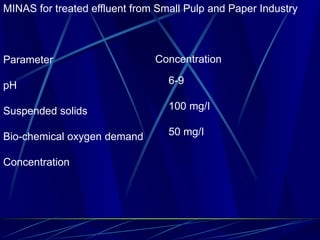
MINAS for treated effluent from Small Pulp and Paper Industry
Parameter
pH
Suspended solids
Bio-chemical oxygen demand
Concentration
6-9
100 mg/I
50 mg/I
Concentration
WASTE AUDIT
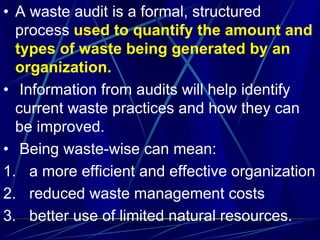
• A waste audit is a formal, structured
process used to quantify the amount and
types of waste being generated by an
organization.
• Information from audits will help identify
current waste practices and how they can
be improved.
• Being waste-wise can mean:
1. a more efficient and effective organization
2. reduced waste management costs
3. better use of limited natural resources.
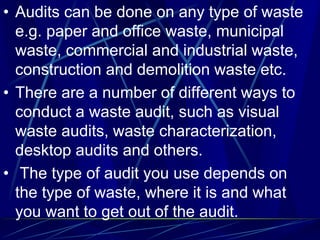
• Audits can be done on any type of waste
e.g. paper and office waste, municipal
waste, commercial and industrial waste,
construction and demolition waste etc.
• There are a number of different ways to
conduct a waste audit, such as visual
waste audits, waste characterization,
desktop audits and others.
• The type of audit you use depends on
the type of waste, where it is and what
you want to get out of the audit.
• The audit's objectives will largely determine the
waste types and physical locations to be
audited.
• Some examples of audit objectives could be:
1. to determine composition and quantities of
waste being generated
2. to measure effectiveness of existing waste
management systems
3. to identify opportunities for improving waste
management systems and strategies
4. to collect baseline data for measuring the
effectiveness of waste minimization strategies.
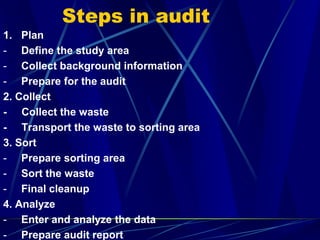
Steps in audit
1. Plan
- Define the study area
- Collect background information
- Prepare for the audit
2. Collect
- Collect the waste
- Transport the waste to sorting area
3. Sort
- Prepare sorting area
- Sort the waste
- Final cleanup
4. Analyze
- Enter and analyze the data
- Prepare audit report

L 31 Water Pollution act and other topics

  • 1.
    L-31 Water Pollution Control Act1974 and other topics Unit-VIII Industrial Waste Treatment
  • 2.
    Contents • Water pollutioncontrol act, Organizational set up of central and state boards for water pollution control, classification of river on water use, minimal national standards, and socioeconomic aspects of water pollution control.
  • 3.
    Introduction and background • Accordingto the Article 51 A (g) it is the fundamental duty of every citizen of India to protect and improve the natural environment included Forest, Lakes, Rivers and Wildlife and to have compassion for living creatures.
  • 4.
    • After theStockholm conference on Human Environment on June, 1972, it was considered appropriate to have uniform law all over country for broad Environment problems endangering the health and safety of our people as well as of our flora and fauna. • The Water (Prevention & Control of Pollution) Act, 1974 is the first enactment by the Parliament in this direction.
  • 5.
    • This isalso the first specific and comprehensive legislation institutionalizing simultaneously the regulatory agencies for controlling water pollution. • The Pollution Control Board at the Centre and in the State came into being in terms of this Act.
  • 6.
    Important Definitions • Pollutionmeans contamination of water or such alteration of the Physical, Chemical or Biological properties of water or such discharge of any sewage or trade effluent or of any other liquid, gas and Solid substance into water (whether directly or indirectly) as may be the case or is likely to create nuisance or render such water harmful or injurious to public health or safety or to domestic, commercial, industrial, agricultural or other legitimate uses, or to the life and health of animals or plant or of aquatic organizations.
  • 7.
    • Trade effluentincludes any liquid or solid substance which is discharged from any premises used for carrying on any industry operation or process or treatment and disposal system, other domestic sewage.
  • 8.
  • 9.
    Post of member/s No.s Tobe nominated by Remark Chairman 01 Central government Having special knowledge and practical experience in respect of matters relating to water pollution Officials Max 5 Central government To represent that government Members Max 5 --- Chosen from members of state boards Non officials Max 3 --- To represent interest of agriculture , fisheries or industry or trade or any other interest
  • 10.
    Members 2 ----To represent companies controlled and managed by central govt. Member Secretary 1 --- Possessing qualification, knowledge and experience of scientific, engineering or management aspects of pollution control
  • 11.
  • 12.
    Post of member/s No.s Tobe nominated by Remark Chairman 01 State government Having special knowledge and practical experience in respect of matters relating to water pollution Officials Max 5 State government To represent that state government Members Max 5 --- Chosen from local authorities functioning within the state Non officials Max 3 --- To represent interest of agriculture , fisheries or industry or trade or any other interest
  • 13.
    Members 2 ----To represent companies, corporations controlled and managed by state govt. Member Secretary 1 --- Possessing qualification, knowledge and experience of scientific, engineering or management aspects of pollution control
  • 14.
  • 15.
    (a) To Plana comprehensive programme for the prevention Control or abatement of pollution of streams and wells. (b) To advise the State Government on any matters concerning the prevention, Control or abatement of water pollution. (c) To collect and disseminate information relating to the water pollution and prevention, control or abatement thereof.
  • 16.
    (d) To encourage,conduct and participate in investigations and research relating to problems of water pollution, prevention, control or abatement of water pollution. (e) To inspect sewage or trade effluents, works and plants for the treatment of sewage and trade effluents and to review plans, specifications or other data relating to plant set up for the treatment of water, works for the purification thereof and the system for the disposal of sewage or trade effluents or in connection with the grant of any consent as required by this act.
  • 17.
    (f) Lay down,modify or annual effluent standards for the sewage and trade effluents and for the quantity of receiving water (not being) water in an inter-state stream) resulting from the discharge of effluents and to classify waters in the state. (g) To evolve economical and reliable methods of treatment of sewage and trade effluents, having regard to the peculiar conditions of soils, climate and water resources of different region and more especially the prevailing flow characteristics of water in streams and wells, which render it impossible to attain
  • 18.
  • 19.
    (a) To plana comprehensive programme for the prevention, control or abatement of pollution of streams and wells in the state and to secure the execution thereof. (b) To advice the State Government on any mater concerning the prevention control or abatement of water pollution. (c) To collect and disseminate information relating to water pollution and the prevention, control or abatement thereof.
  • 20.
    (d) To encourage,conduct and participate in investigations and research relating to problems of water pollution and prevention, control or abatement of water pollution. (e) to collaborate with the control Board in organizing the training of persons engaged or to be engaged in programmes relating to prevention, control or abatement of water pollution and to organize mass education programmes relating thereof.
  • 21.
    (f)To inspect sewageor trade effluents, works and plants for the treatment of sewage and trade effluents and to review plants, specifications or other data relating to plants set up for the purification thereof and the system for the disposal of sewage or trade effluents or in connection with the grant of any consent as required by this Act.
  • 22.
    • (g) laydown, modify or annual effluent standards for the sewage and trade effluents and for the quality of receiving waters (not being water in an inter state stream) resulting from the discharge of effluents and to classify waters of the State. (h) to evolve methods of utilization of sewage and suitable trade effluents in agriculture.
  • 23.
    (i) to evolveeconomical and reliable methods of treatment of sewage and trade effluents, having regard to the peculiar conditions of soils, climate and water resources of difference regions and more specially the prevailing flow characteristics of water in streams and wells which render it impossible to attain even the minimum degree of dilution.
  • 24.
    (j) To evolveefficient methods of disposal of sewage and trade effluents on land as are necessary on account of the predominant conditions of scant stream flows that do not provide for major part of the year the minimum degree of dilution. (k) To lay down standards of treatment of sewage and trade effluents to be discharged into any particular stream taking into account the minimum fair weather dilution available in that stream and the tolerance limits of pollution permissible in the water of the stream after the discharge of such effluents.
  • 25.
    To advice theState Government with respect to the location of any industry the carrying on of which is likely to pollute a stream or well; To perform such other functions as may be prescribed or as may, from time to time be entrusted to it by the Central Board or the State Government.
  • 26.
    Other important provisions Powerto give directions to obtain information from any industry or person. Power to take samples of effluents from any treatment plant. Power of entry and inspection in any industrial premises Power to take emergency measures in case of pollution of stream or well Power to give directions for closure of industry
  • 27.
    Central board hasPower to give direction to the State Board Special power is given to the central board to supersede the State Board Person found guilty of an offence is On conviction, the failure shall be punishable with imprisonment up to 3 months or fine up to Rs. 10,000 or both if the failure continues, an additional fine of Rs. 5000 per day.
  • 28.
    If offence ismade by companies , then the person in charge at that instance shall be held responsible
  • 29.
  • 30.
    • Small-scale industries(SSIs) have a very important role in overall industrial development in India and growth of SSI units has been actively promoted by Government of India to induce balanced economic growth and to distribute the benefits of industrial development in an equitable manner. • Industries having capital investment up to Rs.10 millions are classified as SSI units. It is estimated that more than 300,000 SSI units are spread all over India, mainly in about 867 clusters/industrial estates of the country.
  • 31.
    • It isdifficult for each industrial unit to provide and operate individual wastewater treatment plant because of the scale of operations or lack of space or technical manpower. • However, the quantum of pollutants emitted by SSIs clusters may be more than an equivalent large scale industry, since the specific rate of generation of pollutants is generally higher because of the inefficient production technologies adopted by SSIs.
  • 32.
    • Hence thedesirable option is of the shared or combined treatment, wherein, managerial and operational aspects are collectively addressed and the cost of treatment , becomes affordable as enunciated in the scheme of the common effluent treatment plants, which are proving to be a boon especially for small entrepreneurs, given the methodical planning, regular operation a nd equitable contribution of member units. Such common facilities also facilitate proper management of effluent and compliance of the effluent quality standards.
  • 33.
    • Advantages ofCommon Treatment 1. Saving in Capital and operating cost of treatment plant. Combined treatment is always cheaper than small scattered treatment units. 2. Availability of land which is difficult to be ensured by all individual units in the event they go for individual treatment plants. This is particularly important in case of existing old industries which simply do not have any space. 3. Contribution of nutrient and diluting potential, making the complex industrial waste more amenable to degradation.
  • 34.
    4. The neutralizationand equalization of heterogeneous waste makes its treatment techno-economically viable. 5. Professional and trained staff can be made available for operation of CETP which is not possible in case of individual plants. 6. Disposal of treated wastewater & sludge becomes more organized. 7. Reduced burden of various regulatory authorities in ensuring pollution control requirement.
  • 35.
  • 36.
    • Many processesin the chemical, pharmaceutical, plastic, petrochemical industries, etc., generate Waste Water which contains organic toxic compounds. • The utilization of biological treatments is based on the capacity of microorganisms, specifically bacteria, to degrade a great quantity of toxic substances. • The pollutants are treated as food by the bacteria and these, while feeding, increase their population at the same time as the water gets treated.
  • 37.
    • Some microorganismsperform the treatment process in the presence of oxygen and others in its absence. • Due to its toxicity, biological treatment of Waste Water containing a toxic substrate is difficult, since the microorganisms are initially not able to treat that substance. • Therefore, the first step to make a SBR (Sequential Batch Reactor) operative is the acclimatization, i.e., the adaptation of the microorganisms to a particular toxic substrate.
  • 38.
    • Acclimatization iscommonly practiced in case of toxic wastes such as phenol, arsenic, cyanide etc. • For example to treat a phenolic waste of 500 mg/lit. bacteria are exposed gradually from initial concentration of 20 mg/lit to 500 mg/lit • Nutrients are also added to the waste in the form of urea, superphosphate or any other compound containing N and P
  • 39.
  • 40.
    • The CentralPollution Control Board (CPCB) developed Minimum National Standards (MINAS) for all types of industries with regards to their effluent discharge (water pollutants), emissions (air pollutants), noise levels and solid waste. • The proposed model for evolving industry specific standards envisages specifying limits of pollutants to protect the environment. • The standards thus developed will be applicable to the concerned industries throughout the country.
  • 41.
    • The MinimalNational Standards {MINAS) for a particular industry is the effluent standard achievable by the industry by installing pollution control measures which are within the techno- economic capability of the industry. • Depending on the gravity of the pollution and1echno-economic assessment of the requisite pollution control measures the MINAS may be attained in one stroke or in phases
  • 42.
    • The evolutionof MINAS thus remain independent of the characteristics of the recipient environment: The Central and State Boards for Pollution Control have come to an agreement that under no circumstances MINAS would be relaxed as because the same is techno-economically acceptable to the industry. • On the contrary, at situations where the recipient environment demands stricter quality of the effluent of the industry, the State Boards are required to prescribe standards stricter than MINAS.
  • 43.
    • While decidingthe MINAS for disposal The following factors are to be noted: —Degree of dilution available in receiving system. —Protection of important biotic species. —Mean tolerance limit for pollutants to the identified biotic species. —Application factors in respect of mean tolerance limit.
  • 44.
    MINAS for treatedeffluent from Small Pulp and Paper Industry Parameter pH Suspended solids Bio-chemical oxygen demand Concentration 6-9 100 mg/I 50 mg/I Concentration
  • 45.
  • 46.
    • A wasteaudit is a formal, structured process used to quantify the amount and types of waste being generated by an organization. • Information from audits will help identify current waste practices and how they can be improved. • Being waste-wise can mean: 1. a more efficient and effective organization 2. reduced waste management costs 3. better use of limited natural resources.
  • 47.
    • Audits canbe done on any type of waste e.g. paper and office waste, municipal waste, commercial and industrial waste, construction and demolition waste etc. • There are a number of different ways to conduct a waste audit, such as visual waste audits, waste characterization, desktop audits and others. • The type of audit you use depends on the type of waste, where it is and what you want to get out of the audit.
  • 48.
    • The audit'sobjectives will largely determine the waste types and physical locations to be audited. • Some examples of audit objectives could be: 1. to determine composition and quantities of waste being generated 2. to measure effectiveness of existing waste management systems 3. to identify opportunities for improving waste management systems and strategies 4. to collect baseline data for measuring the effectiveness of waste minimization strategies.
  • 49.
    Steps in audit 1.Plan - Define the study area - Collect background information - Prepare for the audit 2. Collect - Collect the waste - Transport the waste to sorting area 3. Sort - Prepare sorting area - Sort the waste - Final cleanup 4. Analyze - Enter and analyze the data - Prepare audit report