Tejaswini Uppuluri
PALB9109, I Ph.D,
Seed science and technology
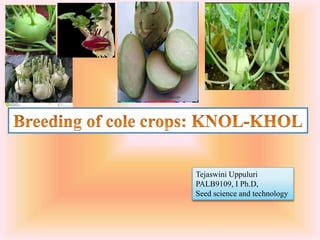
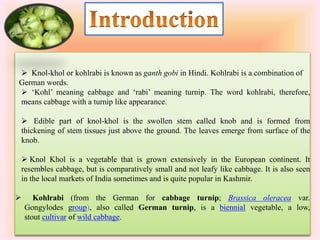
 Knol-khol or kohlrabi is known as ganth gobi in Hindi. Kohlrabi is a combination of
German words.
 ‘Kohl’ meaning cabbage and ‘rabi’ meaning turnip. The word kohlrabi, therefore,
means cabbage with a turnip like appearance.
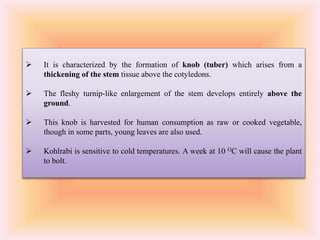
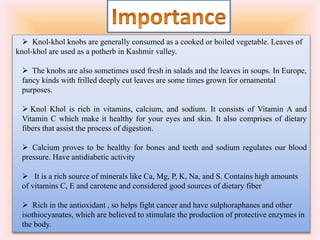
 Edible part of knol-khol is the swollen stem called knob and is formed from
thickening of stem tissues just above the ground. The leaves emerge from surface of the
knob.
 Knol Khol is a vegetable that is grown extensively in the European continent. It
resembles cabbage, but is comparatively small and not leafy like cabbage. It is also seen
in the local markets of India sometimes and is quite popular in Kashmir.
 Kohlrabi (from the German for cabbage turnip; Brassica oleracea var.
Gongylodes group), also called German turnip, is a biennial vegetable, a low,
stout cultivar of wild cabbage.
 It is characterized by the formation of knob (tuber) which arises from a
thickening of the stem tissue above the cotyledons.
 The fleshy turnip-like enlargement of the stem develops entirely above the
ground.
 This knob is harvested for human consumption as raw or cooked vegetable,
though in some parts, young leaves are also used.
 Kohlrabi is sensitive to cold temperatures. A week at 10 OC will cause the plant
to bolt.
 Knol-khol knobs are generally consumed as a cooked or boiled vegetable. Leaves of
knol-khol are used as a potherb in Kashmir valley.
 The knobs are also sometimes used fresh in salads and the leaves in soups. In Europe,
fancy kinds with frilled deeply cut leaves are some times grown for ornamental
purposes.
 Knol Khol is rich in vitamins, calcium, and sodium. It consists of Vitamin A and
Vitamin C which make it healthy for your eyes and skin. It also comprises of dietary
fibers that assist the process of digestion.
 Calcium proves to be healthy for bones and teeth and sodium regulates our blood
pressure. Have antidiabetic activity
 It is a rich source of minerals like Ca, Mg, P, K, Na, and S. Contains high amounts
of vitamins C, E and carotene and considered good sources of dietary fiber
 Rich in the antioxidant , so helps fight cancer and have sulphoraphanes and other
isothiocyanates, which are believed to stimulate the production of protective enzymes in
the body.
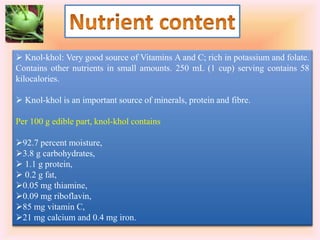
 Knol-khol: Very good source of Vitamins A and C; rich in potassium and folate.
Contains other nutrients in small amounts. 250 mL (1 cup) serving contains 58
kilocalories.
 Knol-khol is an important source of minerals, protein and fibre.
Per 100 g edible part, knol-khol contains
92.7 percent moisture,
3.8 g carbohydrates,
 1.1 g protein,
 0.2 g fat,
0.05 mg thiamine,
0.09 mg riboflavin,
85 mg vitamin C,
21 mg calcium and 0.4 mg iron.
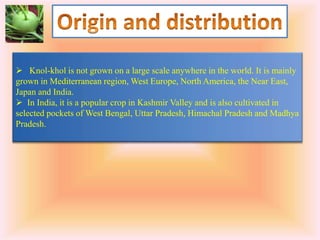
 Knol-khol is not grown on a large scale anywhere in the world. It is mainly
grown in Mediterranean region, West Europe, North America, the Near East,
Japan and India.
 In India, it is a popular crop in Kashmir Valley and is also cultivated in
selected pockets of West Bengal, Uttar Pradesh, Himachal Pradesh and Madhya
Pradesh.
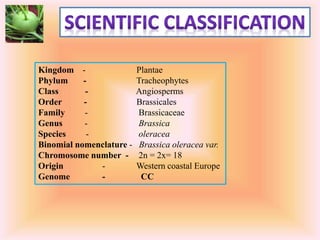
Kingdom - Plantae
Phylum - Tracheophytes
Class - Angiosperms
Order - Brassicales
Family - Brassicaceae
Genus - Brassica
Species - oleracea
Binomial nomenclature - Brassica oleracea var.
Chromosome number - 2n = 2x= 18
Origin - Western coastal Europe
Genome - CC
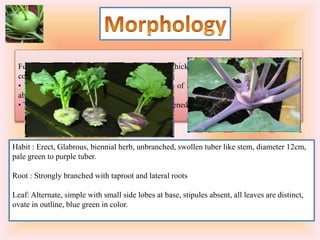
Formation of knob (tuber) which arises from a thickening of the stem tissue above the
cotyledons
• The fleshy edible portion is an enlargement of the stem, which develops entirely
above ground and is used as a vegetable
• The edible portion is globular to a slightly flattened stem.
Habit : Erect, Glabrous, biennial herb, unbranched, swollen tuber like stem, diameter 12cm,
pale green to purple tuber.
Root : Strongly branched with taproot and lateral roots
Leaf: Alternate, simple with small side lobes at base, stipules absent, all leaves are distinct,
ovate in outline, blue green in color.
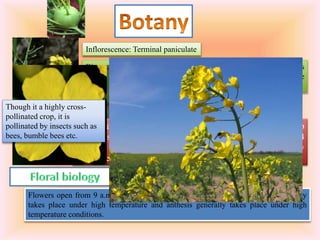
Inflorescence: Terminal paniculate
Bisexual, hermaphrodite, regular, pedicle up to 2cm long, sepals
oblong 1cm length and erect, petals are obovate, clawed and pale
yellow/whitish, 6 stamens, superior ovary.
Flowers are generally borne on terminal racemes which develop
on main stem yellow, protogynous, perfect and regular having 4
sepals, 4 petals, 6 stamens and bi-celled ovary possessing many
ovules per cell.
Flowers open from 9 a.m. onwards depending on temperature and anthesis generally
takes place under high temperature and anthesis generally takes place under high
temperature conditions.
Though it a highly cross-
pollinated crop, it is
pollinated by insects such as
bees, bumble bees etc.
 Khol rabi is highly cross-pollinated due to the mechanism of self-incompatibility and
the extent of natural cross-pollination has been reported to be 91.0% (Watts, 1968).
 The incompatibility is due to the fact that the germination of the pollen on the stigma
of the flowers borne on the same plant is not proper and the pollen tubes formed are
twisted and rudimentary.
 The self-incompatibility is strongest in freshly opened flowers. When young buds are
selfed, seed setting is much better than at later stages and is comparable to cross-
pollination.
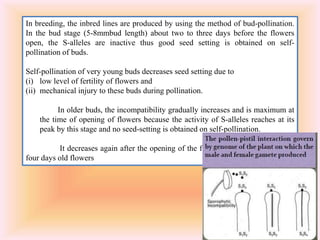
In breeding, the inbred lines are produced by using the method of bud-pollination.
In the bud stage (5-8mmbud length) about two to three days before the flowers
open, the S-alleles are inactive thus good seed setting is obtained on self-
pollination of buds.
Self-pollination of very young buds decreases seed setting due to
(i) low level of fertility of flowers and
(ii) mechanical injury to these buds during pollination.
In older buds, the incompatibility gradually increases and is maximum at
the time of opening of flowers because the activity of S-alleles reaches at its
peak by this stage and no seed-setting is obtained on self-pollination.
It decreases again after the opening of the flowers and selfing of two to
four days old flowers
1. Soft, mature bulbs at edible stage
2. High yield
3. Spherical swollen bulb like stem
4. Resistance to Fusarium wilt, Xanthomonas
campestris and club root (Plasmodiophora
brassicae)
5. Tolerance to cold
6. Free from bolting
Breeding Objectives of Knol-khol
At IARI, Regional Station, Katrain (Kullu Valley), Himachal Pradesh (India),
 Population improvement methods - Mass selection, Line breeding/family selection
 Hybrid breeding could be utilised for improvement of knolkhol- Heterosis
Breeding Methods of Knol-khol
Khol rabi, being consumed in some areas of the world, is not a
cosmopolitan crop as are cabbage and cauliflower. Therefore, the progress
in the exploitation of heterosis in this crop has been limited.
Mass selection:
In this method the best individual plants are selected in the population and their
seeds are composited for following generation. Since the mass selection is made exclusively
based on the phenotype of the plants without any progeny testing, the success of selection
depends upon the heritability of the characters under selection.
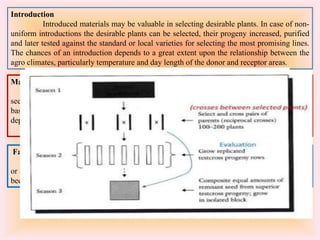
Introduction
Introduced materials may be valuable in selecting desirable plants. In case of non-
uniform introductions the desirable plants can be selected, their progeny increased, purified
and later tested against the standard or local varieties for selecting the most promising lines.
The chances of an introduction depends to a great extent upon the relationship between the
agro climates, particularly temperature and day length of the donor and receptor areas.
Family breeding
There is elaborate testing of progenies not only in F1 generation but also in later 2
or 3 generations and usually more than one cycle of selection. This method is practised in
beet and can also be adopted in radish, carrot and cauliflower.
Polyploidy breeding
Polyploidy breeding refers to induced chromosome manipulation. Success is
wholly dependent on the control of chromosome pairing and recombination in
polyploids and their hybrid derivatives. Breeding strategies for transferring genes
across ploidy levels depend on their origin. Using colchicine seed treatment
Combination breeding/ Back cross method
It has been used to transfer genes of interest through backcrossing. The
donor parent is crossed to the recurrent parent followed by progenies that are then
crossed to the recurrent parent. The progeny of this cross is selected for the trait of
interest and crossed back to the recurrent parent. This process is repeated for as many
backcrosses as needed to create a line that is the recurrent parent with the gene of
interest from the donor parent. The goal of backcrossing is to obtain a line as identical
to the recurrent parent with the addition of a gene of interest.
HETEROSIS
Heterosis has been exploited for the improvement of vegetable crops in different aspects,
viz., earliness, winter-hardiness, resistance to biotic and abiotic factors, uniformity and
higher yields.
Among the cross-pollination mechanisms, self-incompatibility has been utilized
successfully to economize the hybrid seed production and can be exploited it. The main
advantage of using self-incompatibility is that it is possible to obtain F1 hybrid seed from
both the male and female parental inbred lines.
On the contrary, the hand emasculation and hand pollination of individual flowers
of khol rabi is not economical due to less number of seeds per pod resulting from a single
pollination.
Disease-resistant genes can also be incorporated to produce multiple disease-
resistant hybrids. Keeping in view the heterotic advantages, there is a need to make a
concerted approach in this crop.
Rubatzky and Hang (1996) reported significant heterosis in weight and width of the
enlarged stem and height and width of the plant of khol rabi with increased yields of 58.7-
95.3% in the heterotic combinations.
At IARI, Regional Station, Katrain (Kullu Valley), Himachal Pradesh (India),
one F1 hybrid KKH-1 of khol rabi developed by hand emasculation and hand pollination
method has performed well with respect to earliness, shape and size of knobs and higher
yield and possessing no fibre even at full maturity.
Heterosis breeding : for high yield and earliness
Prag trub x 1176 , Weisser trub x 1176, Rogglis trub x1176
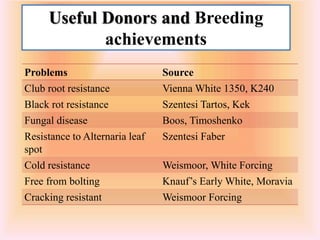
Useful Donors and Breeding
achievements
Problems Source
Club root resistance Vienna White 1350, K240
Black rot resistance Szentesi Tartos, Kek
Fungal disease Boos, Timoshenko
Resistance to Alternaria leaf
spot
Szentesi Faber
Cold resistance Weismoor, White Forcing
Free from bolting Knauf’s Early White, Moravia
Cracking resistant Weismoor Forcing
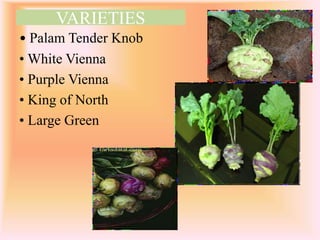
VARIETIES
• Palam Tender Knob
• White Vienna
• Purple Vienna
• King of North
• Large Green
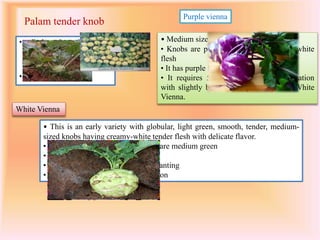
Palam tender knob
• Early variety with light
green knobs and gives
average yield of 250-
275q/ha.
• Better shelf life.
Purple vienna
• Medium size
• Knobs are purplish-blue with greenish-white
flesh
• It has purple leaves
• It requires 55–65 days for knob formation
with slightly better yield potential than White
Vienna.
White Vienna
• This is an early variety with globular, light green, smooth, tender, medium-
sized knobs having creamy-white tender flesh with delicate flavor.
• Plants are dwarf, leaves and stems are medium green
• Yield potential of 150–200q/ha
• It matures 55–65 days after transplanting
• Takes 50–60 days for knob formation
KING OF NORTH
• Plant height of 20–30cm foliage is dark green, knob flattish
round, leaf sheath large and well-spread over the knob
• It matures 60–65 days after transplanting
• Early varieties mature 30–45 days after planting & characterized
by the horizontal position of the lower leaves
• The late varieties mature 70–100 days after planting
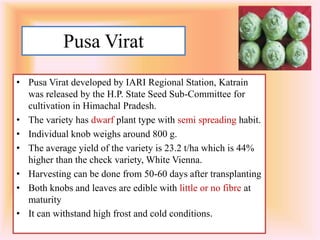
Pusa Virat
• Pusa Virat developed by IARI Regional Station, Katrain
was released by the H.P. State Seed Sub-Committee for
cultivation in Himachal Pradesh.
• The variety has dwarf plant type with semi spreading habit.
• Individual knob weighs around 800 g.
• The average yield of the variety is 23.2 t/ha which is 44%
higher than the check variety, White Vienna.
• Harvesting can be done from 50-60 days after transplanting
• Both knobs and leaves are edible with little or no fibre at
maturity
• It can withstand high frost and cold conditions.
Knol khol

Knol khol

  • 1.
    Tejaswini Uppuluri PALB9109, IPh.D, Seed science and technology
  • 2.
     Knol-khol orkohlrabi is known as ganth gobi in Hindi. Kohlrabi is a combination of German words.  ‘Kohl’ meaning cabbage and ‘rabi’ meaning turnip. The word kohlrabi, therefore, means cabbage with a turnip like appearance.  Edible part of knol-khol is the swollen stem called knob and is formed from thickening of stem tissues just above the ground. The leaves emerge from surface of the knob.  Knol Khol is a vegetable that is grown extensively in the European continent. It resembles cabbage, but is comparatively small and not leafy like cabbage. It is also seen in the local markets of India sometimes and is quite popular in Kashmir.  Kohlrabi (from the German for cabbage turnip; Brassica oleracea var. Gongylodes group), also called German turnip, is a biennial vegetable, a low, stout cultivar of wild cabbage.
  • 3.
     It ischaracterized by the formation of knob (tuber) which arises from a thickening of the stem tissue above the cotyledons.  The fleshy turnip-like enlargement of the stem develops entirely above the ground.  This knob is harvested for human consumption as raw or cooked vegetable, though in some parts, young leaves are also used.  Kohlrabi is sensitive to cold temperatures. A week at 10 OC will cause the plant to bolt.
  • 4.
     Knol-khol knobsare generally consumed as a cooked or boiled vegetable. Leaves of knol-khol are used as a potherb in Kashmir valley.  The knobs are also sometimes used fresh in salads and the leaves in soups. In Europe, fancy kinds with frilled deeply cut leaves are some times grown for ornamental purposes.  Knol Khol is rich in vitamins, calcium, and sodium. It consists of Vitamin A and Vitamin C which make it healthy for your eyes and skin. It also comprises of dietary fibers that assist the process of digestion.  Calcium proves to be healthy for bones and teeth and sodium regulates our blood pressure. Have antidiabetic activity  It is a rich source of minerals like Ca, Mg, P, K, Na, and S. Contains high amounts of vitamins C, E and carotene and considered good sources of dietary fiber  Rich in the antioxidant , so helps fight cancer and have sulphoraphanes and other isothiocyanates, which are believed to stimulate the production of protective enzymes in the body.
  • 5.
     Knol-khol: Verygood source of Vitamins A and C; rich in potassium and folate. Contains other nutrients in small amounts. 250 mL (1 cup) serving contains 58 kilocalories.  Knol-khol is an important source of minerals, protein and fibre. Per 100 g edible part, knol-khol contains 92.7 percent moisture, 3.8 g carbohydrates,  1.1 g protein,  0.2 g fat, 0.05 mg thiamine, 0.09 mg riboflavin, 85 mg vitamin C, 21 mg calcium and 0.4 mg iron.
  • 6.
     Knol-khol isnot grown on a large scale anywhere in the world. It is mainly grown in Mediterranean region, West Europe, North America, the Near East, Japan and India.  In India, it is a popular crop in Kashmir Valley and is also cultivated in selected pockets of West Bengal, Uttar Pradesh, Himachal Pradesh and Madhya Pradesh.
  • 7.
    Kingdom - Plantae Phylum- Tracheophytes Class - Angiosperms Order - Brassicales Family - Brassicaceae Genus - Brassica Species - oleracea Binomial nomenclature - Brassica oleracea var. Chromosome number - 2n = 2x= 18 Origin - Western coastal Europe Genome - CC
  • 8.
    Formation of knob(tuber) which arises from a thickening of the stem tissue above the cotyledons • The fleshy edible portion is an enlargement of the stem, which develops entirely above ground and is used as a vegetable • The edible portion is globular to a slightly flattened stem. Habit : Erect, Glabrous, biennial herb, unbranched, swollen tuber like stem, diameter 12cm, pale green to purple tuber. Root : Strongly branched with taproot and lateral roots Leaf: Alternate, simple with small side lobes at base, stipules absent, all leaves are distinct, ovate in outline, blue green in color.
  • 9.
    Inflorescence: Terminal paniculate Bisexual,hermaphrodite, regular, pedicle up to 2cm long, sepals oblong 1cm length and erect, petals are obovate, clawed and pale yellow/whitish, 6 stamens, superior ovary. Flowers are generally borne on terminal racemes which develop on main stem yellow, protogynous, perfect and regular having 4 sepals, 4 petals, 6 stamens and bi-celled ovary possessing many ovules per cell. Flowers open from 9 a.m. onwards depending on temperature and anthesis generally takes place under high temperature and anthesis generally takes place under high temperature conditions. Though it a highly cross- pollinated crop, it is pollinated by insects such as bees, bumble bees etc.
  • 10.
     Khol rabiis highly cross-pollinated due to the mechanism of self-incompatibility and the extent of natural cross-pollination has been reported to be 91.0% (Watts, 1968).  The incompatibility is due to the fact that the germination of the pollen on the stigma of the flowers borne on the same plant is not proper and the pollen tubes formed are twisted and rudimentary.  The self-incompatibility is strongest in freshly opened flowers. When young buds are selfed, seed setting is much better than at later stages and is comparable to cross- pollination.
  • 11.
    In breeding, theinbred lines are produced by using the method of bud-pollination. In the bud stage (5-8mmbud length) about two to three days before the flowers open, the S-alleles are inactive thus good seed setting is obtained on self- pollination of buds. Self-pollination of very young buds decreases seed setting due to (i) low level of fertility of flowers and (ii) mechanical injury to these buds during pollination. In older buds, the incompatibility gradually increases and is maximum at the time of opening of flowers because the activity of S-alleles reaches at its peak by this stage and no seed-setting is obtained on self-pollination. It decreases again after the opening of the flowers and selfing of two to four days old flowers
  • 12.
    1. Soft, maturebulbs at edible stage 2. High yield 3. Spherical swollen bulb like stem 4. Resistance to Fusarium wilt, Xanthomonas campestris and club root (Plasmodiophora brassicae) 5. Tolerance to cold 6. Free from bolting Breeding Objectives of Knol-khol
  • 13.
    At IARI, RegionalStation, Katrain (Kullu Valley), Himachal Pradesh (India),
  • 14.
     Population improvementmethods - Mass selection, Line breeding/family selection  Hybrid breeding could be utilised for improvement of knolkhol- Heterosis Breeding Methods of Knol-khol Khol rabi, being consumed in some areas of the world, is not a cosmopolitan crop as are cabbage and cauliflower. Therefore, the progress in the exploitation of heterosis in this crop has been limited.
  • 15.
    Mass selection: In thismethod the best individual plants are selected in the population and their seeds are composited for following generation. Since the mass selection is made exclusively based on the phenotype of the plants without any progeny testing, the success of selection depends upon the heritability of the characters under selection. Introduction Introduced materials may be valuable in selecting desirable plants. In case of non- uniform introductions the desirable plants can be selected, their progeny increased, purified and later tested against the standard or local varieties for selecting the most promising lines. The chances of an introduction depends to a great extent upon the relationship between the agro climates, particularly temperature and day length of the donor and receptor areas. Family breeding There is elaborate testing of progenies not only in F1 generation but also in later 2 or 3 generations and usually more than one cycle of selection. This method is practised in beet and can also be adopted in radish, carrot and cauliflower.
  • 16.
    Polyploidy breeding Polyploidy breedingrefers to induced chromosome manipulation. Success is wholly dependent on the control of chromosome pairing and recombination in polyploids and their hybrid derivatives. Breeding strategies for transferring genes across ploidy levels depend on their origin. Using colchicine seed treatment Combination breeding/ Back cross method It has been used to transfer genes of interest through backcrossing. The donor parent is crossed to the recurrent parent followed by progenies that are then crossed to the recurrent parent. The progeny of this cross is selected for the trait of interest and crossed back to the recurrent parent. This process is repeated for as many backcrosses as needed to create a line that is the recurrent parent with the gene of interest from the donor parent. The goal of backcrossing is to obtain a line as identical to the recurrent parent with the addition of a gene of interest.
  • 17.
    HETEROSIS Heterosis has beenexploited for the improvement of vegetable crops in different aspects, viz., earliness, winter-hardiness, resistance to biotic and abiotic factors, uniformity and higher yields. Among the cross-pollination mechanisms, self-incompatibility has been utilized successfully to economize the hybrid seed production and can be exploited it. The main advantage of using self-incompatibility is that it is possible to obtain F1 hybrid seed from both the male and female parental inbred lines. On the contrary, the hand emasculation and hand pollination of individual flowers of khol rabi is not economical due to less number of seeds per pod resulting from a single pollination. Disease-resistant genes can also be incorporated to produce multiple disease- resistant hybrids. Keeping in view the heterotic advantages, there is a need to make a concerted approach in this crop. Rubatzky and Hang (1996) reported significant heterosis in weight and width of the enlarged stem and height and width of the plant of khol rabi with increased yields of 58.7- 95.3% in the heterotic combinations. At IARI, Regional Station, Katrain (Kullu Valley), Himachal Pradesh (India), one F1 hybrid KKH-1 of khol rabi developed by hand emasculation and hand pollination method has performed well with respect to earliness, shape and size of knobs and higher yield and possessing no fibre even at full maturity. Heterosis breeding : for high yield and earliness Prag trub x 1176 , Weisser trub x 1176, Rogglis trub x1176
  • 18.
    Useful Donors andBreeding achievements Problems Source Club root resistance Vienna White 1350, K240 Black rot resistance Szentesi Tartos, Kek Fungal disease Boos, Timoshenko Resistance to Alternaria leaf spot Szentesi Faber Cold resistance Weismoor, White Forcing Free from bolting Knauf’s Early White, Moravia Cracking resistant Weismoor Forcing
  • 19.
    VARIETIES • Palam TenderKnob • White Vienna • Purple Vienna • King of North • Large Green
  • 20.
    Palam tender knob •Early variety with light green knobs and gives average yield of 250- 275q/ha. • Better shelf life. Purple vienna • Medium size • Knobs are purplish-blue with greenish-white flesh • It has purple leaves • It requires 55–65 days for knob formation with slightly better yield potential than White Vienna. White Vienna • This is an early variety with globular, light green, smooth, tender, medium- sized knobs having creamy-white tender flesh with delicate flavor. • Plants are dwarf, leaves and stems are medium green • Yield potential of 150–200q/ha • It matures 55–65 days after transplanting • Takes 50–60 days for knob formation
  • 21.
    KING OF NORTH •Plant height of 20–30cm foliage is dark green, knob flattish round, leaf sheath large and well-spread over the knob • It matures 60–65 days after transplanting • Early varieties mature 30–45 days after planting & characterized by the horizontal position of the lower leaves • The late varieties mature 70–100 days after planting
  • 22.
    Pusa Virat • PusaVirat developed by IARI Regional Station, Katrain was released by the H.P. State Seed Sub-Committee for cultivation in Himachal Pradesh. • The variety has dwarf plant type with semi spreading habit. • Individual knob weighs around 800 g. • The average yield of the variety is 23.2 t/ha which is 44% higher than the check variety, White Vienna. • Harvesting can be done from 50-60 days after transplanting • Both knobs and leaves are edible with little or no fibre at maturity • It can withstand high frost and cold conditions.