YAMS
Vaishnavi
2019-11-172
Introduction
• Yam is the common name for some plant species in the
genus Dioscorea (family Dioscoreaceae) that form
edible tubers.
• Yams are perennial herbaceous vines cultivated for the
consumption of their starchy tubers in
many temperate and tropical regions, especially in Africa,
South America and the Caribbean, Asia, and Oceania.
• The tubers themselves, also called "yams", come in a
variety of forms owing to numerous cultivars and related
species.
Etymology
• The name "yam" appears to derive from
Portuguese inhame or Canarian (Spain) ñame, which
derived from West African languages during trade.
• The main derivations borrow from verbs meaning "to
eat".
• True yams have various common names across multiple
world regions.
• A monocot related to lilies and grasses, yams are
vigorous herbaceous vines providing an edible tuber.
• They are native to Africa, Asia, and the Americas
• . Some yams are also invasive plants, often considered a
"noxious weed", outside cultivated areas.
• Some 870 species of yams are known, and 95% of these
crops are grown in Africa.
Many cultivated species
• Many cultivated species of Dioscorea yams are found
throughout the humid tropics.
• The most economically important are discussed below.
• Non-Dioscorea tubers that were historically important in
Africa include Plectranthus rotundifolius (the Hausa
potato) and Plectranthus esculentus (the Livingstone
potato); these two tuber crops have now been largely
displaced by the introduction of cassava.
D. rotundata
• Dioscorea rotundata, the white yam,
• most important cultivated yams.
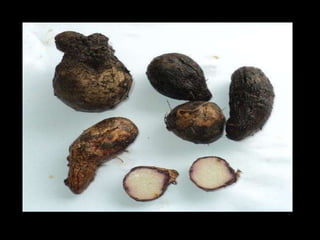
• White yam tuber is roughly cylindrical in shape, the skin
is smooth and brown, and the flesh is usually white and
firm..
• The Kokoro variety is important in making dried yam
chips.
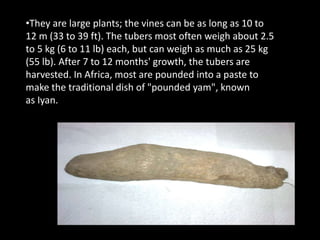
•They are large plants; the vines can be as long as 10 to
12 m (33 to 39 ft). The tubers most often weigh about 2.5
to 5 kg (6 to 11 lb) each, but can weigh as much as 25 kg
(55 lb). After 7 to 12 months' growth, the tubers are
harvested. In Africa, most are pounded into a paste to
make the traditional dish of "pounded yam", known
as Iyan.
D. cayennensis
• D. cayennensis, the yellow yam- native to Africa.
• most important cultivated yams
• Yellow yam has yellow flesh, caused by the presence of
carotenoids. It looks similar to the white yam in outer
appearance; its tuber skin is usually a bit firmer and less
extensively grooved. The yellow yam has a longer period
of vegetation and a shorter dormancy than white yam
D. alata
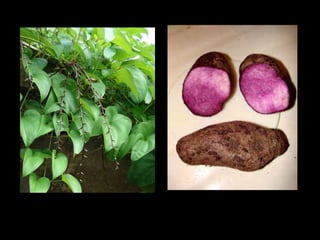
• D. alata, called "white yam", winged yam, water yam,
and purple yam (not to be confused with the Okinawan
purple "yam", which is a sweet potato), was first
cultivated in Southeast Asia.
• Although not grown in the same quantities as the
African yams, it has the largest distribution worldwide of
any cultivated yam, being grown in Asia, the Pacific
islands, Africa, and the West Indies.
• Even in Africa, the popularity of water yam is second only
to white yam. The tuber shape is generally cylindrical,
but can vary. Tuber flesh is white and watery in texture.
D. polystachya
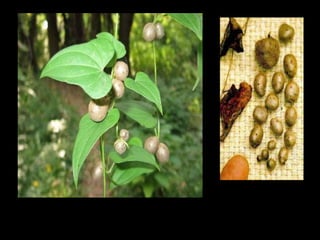
• D. polystachya, Chinese yam, is native to China. The
Chinese yam plant is somewhat smaller than the African,
with the vines about 3 m (10 ft) long. It is tolerant to
frost and can be grown in much cooler conditions than
other yams. It is also grown in Korea and Japan.
• It was introduced to Europe in the 19th century, when
the potato crop there was falling victim to disease, and is
still grown in France for the Asian food market.
• The tubers are harvested after about 6 months of
growth. Some are eaten right after harvesting and some
are used as ingredients for other dishes, including
noodles, and for traditional medicines.
D. bulbifera
• D. bulbifera, the air potato, is found in both Africa and
Asia, with slight differences between those found in
each place.
• It is a large vine, 6 m (20 ft) or more in length. It
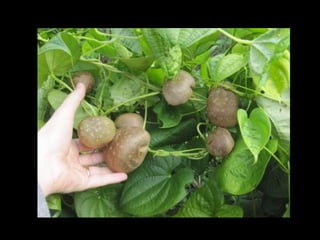
produces tubers, but the bulbils which grow at the
base of its leaves are the more important food product.
• They are about the size of potatoes (hence the name
"air potato"), weighing from 0.5 to 2.0 kg (1 lb 2 oz to
4 lb 7 oz).
• Some varieties can be eaten raw, while some require
soaking or boiling for detoxification before eating.
• It is not grown much commercially since the flavor of
other yams is preferred by most people.
• However, it is popular in home vegetable gardens
because it produces a crop after only four months of
growth and continues producing for the life of the vine,
as long as two years. Also, the bulbils are easy to harvest
and cook.
• In 1905, the air potato was introduced to Florida and has
since become an invasive species in much of the state.
• Its rapid growth crowds out native vegetation and it is
very difficult to remove since it can grow back from the
tubers, and new vines can grow from the bulbils even
after being cut down or burned.
D. esculenta
• D. esculenta, the lesser yam, was one of the first yam
species cultivated.
• It is native to Southeast Asia and is the third-most
commonly cultivated species there, although it is
cultivated very little in other parts of the world.
• Its vines seldom reach more than 3 m (10 ft) in length
and the tubers are fairly small in most varieties.
• The tubers are eaten baked, boiled, or fried much like
potatoes.
• Because of the small size of the tubers, mechanical
cultivation is possible, which along with its easy
preparation and good flavour, could help the lesser yam
to become more popular in the future.
D. dumetorum
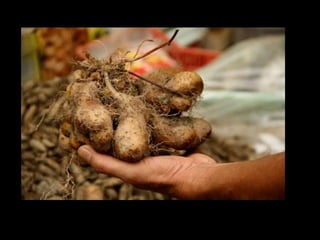
• D. dumetorum, the bitter yam, is popular as a vegetable
in parts of West Africa, in part because their cultivation
requires less labour than other yams.
• The wild forms are very toxic and are sometimes used to
poison animals when mixed with bait.
• It is said that they have also been used for criminal
purposes.
D. trifida
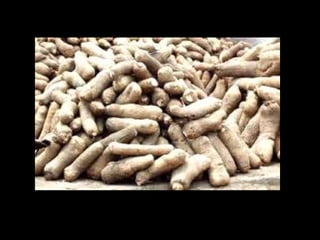
• D. trifida, the cush-cush yam, is native to
the Guyana region of South America and is the most
important cultivated New World yam
• . Since they originated in tropical rainforest conditions,
their growth cycle is less related to seasonal changes
than other yams.
• Because of their relative ease of cultivation and their
good flavour, they are considered to have a great
potential for increased production.
BOTANY
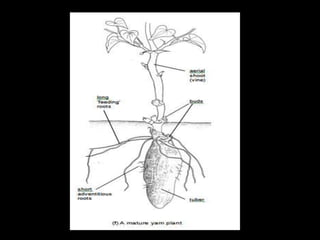
• Yam plants can grow up to 15 m (49 ft) in length and 7.6 to
15.2 cm (3 to 6 in) high.
• The tuber may grow into the soil up to 1.5 m (4 ft 11 in) deep.
• The plant disperses by seed.
• The edible tuber has a rough skin that is difficult to peel but
readily softened by heating.
• The skins vary in color from dark brown to light pink. The
majority of the vegetable is composed of a much softer
substance known as the "meat".
• This substance ranges in color from white or yellow to purple
or pink in mature yams.
Inflorescence
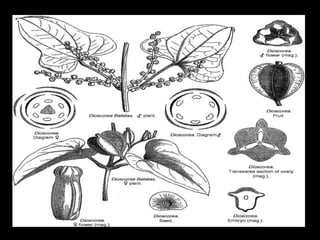
• MALE FLOWERS : Borne on terminal or axillary
panicles.
• Axillary panicles -10- 30 cm long, while
terminal panicle – 45- 110 cm long
• Sessile, globular and closely arranged on spike
• FEMALE FLOWER : produced on hanging
axillary spikes
• No of flowers on spike – 8-35
• Perianth consists of six fleshy tepals
Anthesis
• Anthesis occur in male flowers by 12.30 h and
in female flowers between 13.00 h and 14.30
h.
• Male flowers remain open for 4–5 hours and
female flowers for 9–11 days.
• Natural pollination was practically absent but
parthenocarpic fruit development was
observed in rare cases
• Both male and female flower exhibit a strong
scent on anthesis.
• No of flowers opening in a spike usually range
from 3-5 in female and 2-3 in male.
• In male spikes, flowers open in acropetal
succession, but female flowers open
irregularly
Hand pollination
• Pollen remain viable for 4–5 hours whereas
stigma receptivity last for 9–10 days.
• The optimum time of pollination was found to
be between 12.00 h and 15.00 h.
• Several factors like high relative humidity,
atmospheric temperatures below 30C and
non-bagging the female flowers were found to
promote fruit set.
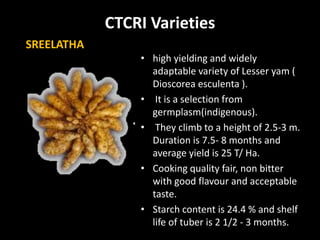
CTCRI Varieties
• high yielding and widely
adaptable variety of Lesser yam (
Dioscorea esculenta ).
• It is a selection from
germplasm(indigenous).
• They climb to a height of 2.5-3 m.
Duration is 7.5- 8 months and
average yield is 25 T/ Ha.
• Cooking quality fair, non bitter
with good flavour and acceptable
taste.
• Starch content is 24.4 % and shelf
life of tuber is 2 1/2 - 3 months.
SREELATHA
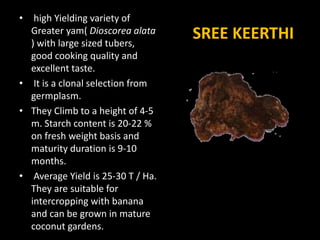
SREE KEERTHI
• high Yielding variety of
Greater yam( Dioscorea alata
) with large sized tubers,
good cooking quality and
excellent taste.
• It is a clonal selection from
germplasm.
• They Climb to a height of 4-5
m. Starch content is 20-22 %
on fresh weight basis and
maturity duration is 9-10
months.
• Average Yield is 25-30 T / Ha.
They are suitable for
intercropping with banana
and can be grown in mature
coconut gardens.
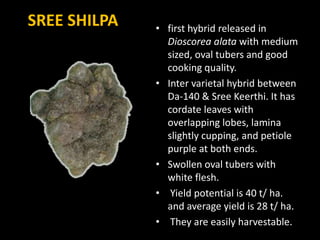
SREE SHILPA • first hybrid released in
Dioscorea alata with medium
sized, oval tubers and good
cooking quality.
• Inter varietal hybrid between
Da-140 & Sree Keerthi. It has
cordate leaves with
overlapping lobes, lamina
slightly cupping, and petiole
purple at both ends.
• Swollen oval tubers with
white flesh.
• Yield potential is 40 t/ ha.
and average yield is 28 t/ ha.
• They are easily harvestable.
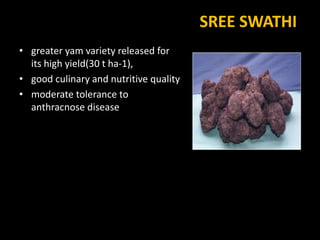
SREE SWATHI
• greater yam variety released for
its high yield(30 t ha-1),
• good culinary and nutritive quality
• moderate tolerance to
anthracnose disease
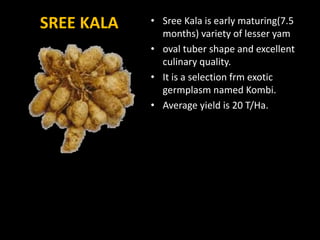
SREE KALA • Sree Kala is early maturing(7.5
months) variety of lesser yam
• oval tuber shape and excellent
culinary quality.
• It is a selection frm exotic
germplasm named Kombi.
• Average yield is 20 T/Ha.
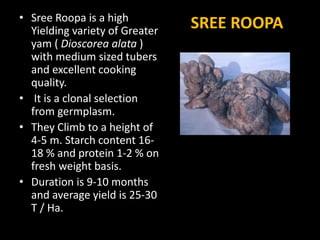
SREE ROOPA• Sree Roopa is a high
Yielding variety of Greater
yam ( Dioscorea alata )
with medium sized tubers
and excellent cooking
quality.
• It is a clonal selection
from germplasm.
• They Climb to a height of
4-5 m. Starch content 16-
18 % and protein 1-2 % on
fresh weight basis.
• Duration is 9-10 months
and average yield is 25-30
T / Ha.
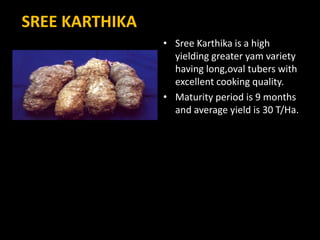
SREE KARTHIKA
• Sree Karthika is a high
yielding greater yam variety
having long,oval tubers with
excellent cooking quality.
• Maturity period is 9 months
and average yield is 30 T/Ha.
VARIETIES OF KERALA:
• Lesser yam/ Nanakizhangu : Sree Latha , Sree
Kala
• Greater yam / Kachil : Sree Keerthi, Sree Roopa,
Indu and Sree Shilpa.
• White yam : Sree Subhra, Sree Priya and Sree
Dhanya.
Breeding objectives
• High and stable tuber yields
• Resistance to pests and diseases (nematodes, yam
mosaic virus and other viruses, anthracnose, and
scale insects)
• Tuber quality
• Ease of harvest and long storage
• suitability to cropping systems and markets,
tolerance to abiotic stresses, and textural and
nutritional attributes.
Breeding methods
1.HYBRIDIZATION
• Yam species are mostly dioecious, and they produce male
and female flowers on separate plants.
• Hence, separate crossing blocks of male and female parents
are established with multiple planting dates to enhance
synchronization of the flowering in crossing blocks.
• The female flowers are bagged for two to seven days before
the flower opens, depending on the spike length.
• The pollinated flowers are then kept bagged for two weeks
to ensure the purity of offspring from crosses.
• It usually takes one to two days for a flower bud to show a
sign of crack to open fully, and the stigma of the open
flower remains receptive for six to seven days.
• Fruit setting usually takes place in about ten days after
pollination, and in about 12 weeks, the fruits start showing
signs of maturity (yellowing).
• The botanical seeds from the controlled bi‐parental crosses
or the natural open pollination are collected from dried
fruits before they disperse from the capsules.
• The seeds are then processed and stored under room
temperature until the end of dormancy which is three to
four months in the case of D. rotundata , or until the
desired time of planting as in D. alata , which has no seed
dormancy (Abraham, 1992).
Interspecific hybridisation
• Interspecific hybridization has been less exploited
due to cross-incompatibility and non-synchronization
of flowering.
• Successful interspecific hybridization was reported
between D. japonica and D. opposita under natural
open pollination (Araki, Harada, & Yakuwa, 1983) and
between D. alata and D. nummularia under artificial
hand pollination (Lebot, Abraham, et al., 2019).
Selection
• Phenotypic selection of the variants within natural
barriers is a core yam breeding effort by different
programmes.
• Three to four clonal selection and testing cycles
(from tuber family evaluation to advanced
performance trial) are often attempted to identify
superior recombinants for further assessment under
a wider range of environments and user preferences
Polyploidy breeding
• Ploidy manipulation through induced polyploid or
conventional hybridization, however, in many crops has
been reported as a potent breeding tool for improving
yield potential and also resistance to biotic and tolerance
for abiotic stresses.
• Association of ploidy variation with yield potential and
other plant traits has also been reported in yams
• Higher vigour and tuber yield advantage were reported
with tetraploid (2n = 80) and triploid (2n = 60) water yam
compared to its diploid (2n = 40) counterpart (Arnau et
al., 2007; Lebot, 2009).
THANK YOU

Yams.

  • 1.
  • 2.
    Introduction • Yam isthe common name for some plant species in the genus Dioscorea (family Dioscoreaceae) that form edible tubers. • Yams are perennial herbaceous vines cultivated for the consumption of their starchy tubers in many temperate and tropical regions, especially in Africa, South America and the Caribbean, Asia, and Oceania. • The tubers themselves, also called "yams", come in a variety of forms owing to numerous cultivars and related species.
  • 3.
    Etymology • The name"yam" appears to derive from Portuguese inhame or Canarian (Spain) ñame, which derived from West African languages during trade. • The main derivations borrow from verbs meaning "to eat". • True yams have various common names across multiple world regions.
  • 4.
    • A monocotrelated to lilies and grasses, yams are vigorous herbaceous vines providing an edible tuber. • They are native to Africa, Asia, and the Americas • . Some yams are also invasive plants, often considered a "noxious weed", outside cultivated areas. • Some 870 species of yams are known, and 95% of these crops are grown in Africa.
  • 5.
    Many cultivated species •Many cultivated species of Dioscorea yams are found throughout the humid tropics. • The most economically important are discussed below. • Non-Dioscorea tubers that were historically important in Africa include Plectranthus rotundifolius (the Hausa potato) and Plectranthus esculentus (the Livingstone potato); these two tuber crops have now been largely displaced by the introduction of cassava.
  • 6.
    D. rotundata • Dioscorearotundata, the white yam, • most important cultivated yams. • White yam tuber is roughly cylindrical in shape, the skin is smooth and brown, and the flesh is usually white and firm.. • The Kokoro variety is important in making dried yam chips.
  • 7.
    •They are largeplants; the vines can be as long as 10 to 12 m (33 to 39 ft). The tubers most often weigh about 2.5 to 5 kg (6 to 11 lb) each, but can weigh as much as 25 kg (55 lb). After 7 to 12 months' growth, the tubers are harvested. In Africa, most are pounded into a paste to make the traditional dish of "pounded yam", known as Iyan.
  • 8.
    D. cayennensis • D.cayennensis, the yellow yam- native to Africa. • most important cultivated yams • Yellow yam has yellow flesh, caused by the presence of carotenoids. It looks similar to the white yam in outer appearance; its tuber skin is usually a bit firmer and less extensively grooved. The yellow yam has a longer period of vegetation and a shorter dormancy than white yam
  • 9.
    D. alata • D.alata, called "white yam", winged yam, water yam, and purple yam (not to be confused with the Okinawan purple "yam", which is a sweet potato), was first cultivated in Southeast Asia. • Although not grown in the same quantities as the African yams, it has the largest distribution worldwide of any cultivated yam, being grown in Asia, the Pacific islands, Africa, and the West Indies. • Even in Africa, the popularity of water yam is second only to white yam. The tuber shape is generally cylindrical, but can vary. Tuber flesh is white and watery in texture.
  • 11.
    D. polystachya • D.polystachya, Chinese yam, is native to China. The Chinese yam plant is somewhat smaller than the African, with the vines about 3 m (10 ft) long. It is tolerant to frost and can be grown in much cooler conditions than other yams. It is also grown in Korea and Japan. • It was introduced to Europe in the 19th century, when the potato crop there was falling victim to disease, and is still grown in France for the Asian food market. • The tubers are harvested after about 6 months of growth. Some are eaten right after harvesting and some are used as ingredients for other dishes, including noodles, and for traditional medicines.
  • 13.
    D. bulbifera • D.bulbifera, the air potato, is found in both Africa and Asia, with slight differences between those found in each place. • It is a large vine, 6 m (20 ft) or more in length. It produces tubers, but the bulbils which grow at the base of its leaves are the more important food product. • They are about the size of potatoes (hence the name "air potato"), weighing from 0.5 to 2.0 kg (1 lb 2 oz to 4 lb 7 oz). • Some varieties can be eaten raw, while some require soaking or boiling for detoxification before eating. • It is not grown much commercially since the flavor of other yams is preferred by most people.
  • 15.
    • However, itis popular in home vegetable gardens because it produces a crop after only four months of growth and continues producing for the life of the vine, as long as two years. Also, the bulbils are easy to harvest and cook. • In 1905, the air potato was introduced to Florida and has since become an invasive species in much of the state. • Its rapid growth crowds out native vegetation and it is very difficult to remove since it can grow back from the tubers, and new vines can grow from the bulbils even after being cut down or burned.
  • 16.
    D. esculenta • D.esculenta, the lesser yam, was one of the first yam species cultivated. • It is native to Southeast Asia and is the third-most commonly cultivated species there, although it is cultivated very little in other parts of the world. • Its vines seldom reach more than 3 m (10 ft) in length and the tubers are fairly small in most varieties. • The tubers are eaten baked, boiled, or fried much like potatoes. • Because of the small size of the tubers, mechanical cultivation is possible, which along with its easy preparation and good flavour, could help the lesser yam to become more popular in the future.
  • 18.
    D. dumetorum • D.dumetorum, the bitter yam, is popular as a vegetable in parts of West Africa, in part because their cultivation requires less labour than other yams. • The wild forms are very toxic and are sometimes used to poison animals when mixed with bait. • It is said that they have also been used for criminal purposes.
  • 20.
    D. trifida • D.trifida, the cush-cush yam, is native to the Guyana region of South America and is the most important cultivated New World yam • . Since they originated in tropical rainforest conditions, their growth cycle is less related to seasonal changes than other yams. • Because of their relative ease of cultivation and their good flavour, they are considered to have a great potential for increased production.
  • 22.
    BOTANY • Yam plantscan grow up to 15 m (49 ft) in length and 7.6 to 15.2 cm (3 to 6 in) high. • The tuber may grow into the soil up to 1.5 m (4 ft 11 in) deep. • The plant disperses by seed. • The edible tuber has a rough skin that is difficult to peel but readily softened by heating. • The skins vary in color from dark brown to light pink. The majority of the vegetable is composed of a much softer substance known as the "meat". • This substance ranges in color from white or yellow to purple or pink in mature yams.
  • 24.
    Inflorescence • MALE FLOWERS: Borne on terminal or axillary panicles. • Axillary panicles -10- 30 cm long, while terminal panicle – 45- 110 cm long • Sessile, globular and closely arranged on spike
  • 26.
    • FEMALE FLOWER: produced on hanging axillary spikes • No of flowers on spike – 8-35 • Perianth consists of six fleshy tepals
  • 27.
    Anthesis • Anthesis occurin male flowers by 12.30 h and in female flowers between 13.00 h and 14.30 h. • Male flowers remain open for 4–5 hours and female flowers for 9–11 days. • Natural pollination was practically absent but parthenocarpic fruit development was observed in rare cases
  • 28.
    • Both maleand female flower exhibit a strong scent on anthesis. • No of flowers opening in a spike usually range from 3-5 in female and 2-3 in male. • In male spikes, flowers open in acropetal succession, but female flowers open irregularly
  • 29.
    Hand pollination • Pollenremain viable for 4–5 hours whereas stigma receptivity last for 9–10 days. • The optimum time of pollination was found to be between 12.00 h and 15.00 h. • Several factors like high relative humidity, atmospheric temperatures below 30C and non-bagging the female flowers were found to promote fruit set.
  • 30.
    CTCRI Varieties • highyielding and widely adaptable variety of Lesser yam ( Dioscorea esculenta ). • It is a selection from germplasm(indigenous). • They climb to a height of 2.5-3 m. Duration is 7.5- 8 months and average yield is 25 T/ Ha. • Cooking quality fair, non bitter with good flavour and acceptable taste. • Starch content is 24.4 % and shelf life of tuber is 2 1/2 - 3 months. SREELATHA
  • 31.
    SREE KEERTHI • highYielding variety of Greater yam( Dioscorea alata ) with large sized tubers, good cooking quality and excellent taste. • It is a clonal selection from germplasm. • They Climb to a height of 4-5 m. Starch content is 20-22 % on fresh weight basis and maturity duration is 9-10 months. • Average Yield is 25-30 T / Ha. They are suitable for intercropping with banana and can be grown in mature coconut gardens.
  • 32.
    SREE SHILPA •first hybrid released in Dioscorea alata with medium sized, oval tubers and good cooking quality. • Inter varietal hybrid between Da-140 & Sree Keerthi. It has cordate leaves with overlapping lobes, lamina slightly cupping, and petiole purple at both ends. • Swollen oval tubers with white flesh. • Yield potential is 40 t/ ha. and average yield is 28 t/ ha. • They are easily harvestable.
  • 33.
    SREE SWATHI • greateryam variety released for its high yield(30 t ha-1), • good culinary and nutritive quality • moderate tolerance to anthracnose disease
  • 34.
    SREE KALA •Sree Kala is early maturing(7.5 months) variety of lesser yam • oval tuber shape and excellent culinary quality. • It is a selection frm exotic germplasm named Kombi. • Average yield is 20 T/Ha.
  • 35.
    SREE ROOPA• SreeRoopa is a high Yielding variety of Greater yam ( Dioscorea alata ) with medium sized tubers and excellent cooking quality. • It is a clonal selection from germplasm. • They Climb to a height of 4-5 m. Starch content 16- 18 % and protein 1-2 % on fresh weight basis. • Duration is 9-10 months and average yield is 25-30 T / Ha.
  • 36.
    SREE KARTHIKA • SreeKarthika is a high yielding greater yam variety having long,oval tubers with excellent cooking quality. • Maturity period is 9 months and average yield is 30 T/Ha.
  • 37.
    VARIETIES OF KERALA: •Lesser yam/ Nanakizhangu : Sree Latha , Sree Kala • Greater yam / Kachil : Sree Keerthi, Sree Roopa, Indu and Sree Shilpa. • White yam : Sree Subhra, Sree Priya and Sree Dhanya.
  • 38.
    Breeding objectives • Highand stable tuber yields • Resistance to pests and diseases (nematodes, yam mosaic virus and other viruses, anthracnose, and scale insects) • Tuber quality • Ease of harvest and long storage • suitability to cropping systems and markets, tolerance to abiotic stresses, and textural and nutritional attributes.
  • 39.
    Breeding methods 1.HYBRIDIZATION • Yamspecies are mostly dioecious, and they produce male and female flowers on separate plants. • Hence, separate crossing blocks of male and female parents are established with multiple planting dates to enhance synchronization of the flowering in crossing blocks. • The female flowers are bagged for two to seven days before the flower opens, depending on the spike length. • The pollinated flowers are then kept bagged for two weeks to ensure the purity of offspring from crosses.
  • 40.
    • It usuallytakes one to two days for a flower bud to show a sign of crack to open fully, and the stigma of the open flower remains receptive for six to seven days. • Fruit setting usually takes place in about ten days after pollination, and in about 12 weeks, the fruits start showing signs of maturity (yellowing). • The botanical seeds from the controlled bi‐parental crosses or the natural open pollination are collected from dried fruits before they disperse from the capsules. • The seeds are then processed and stored under room temperature until the end of dormancy which is three to four months in the case of D. rotundata , or until the desired time of planting as in D. alata , which has no seed dormancy (Abraham, 1992).
  • 41.
    Interspecific hybridisation • Interspecifichybridization has been less exploited due to cross-incompatibility and non-synchronization of flowering. • Successful interspecific hybridization was reported between D. japonica and D. opposita under natural open pollination (Araki, Harada, & Yakuwa, 1983) and between D. alata and D. nummularia under artificial hand pollination (Lebot, Abraham, et al., 2019).
  • 42.
    Selection • Phenotypic selectionof the variants within natural barriers is a core yam breeding effort by different programmes. • Three to four clonal selection and testing cycles (from tuber family evaluation to advanced performance trial) are often attempted to identify superior recombinants for further assessment under a wider range of environments and user preferences
  • 43.
    Polyploidy breeding • Ploidymanipulation through induced polyploid or conventional hybridization, however, in many crops has been reported as a potent breeding tool for improving yield potential and also resistance to biotic and tolerance for abiotic stresses. • Association of ploidy variation with yield potential and other plant traits has also been reported in yams • Higher vigour and tuber yield advantage were reported with tetraploid (2n = 80) and triploid (2n = 60) water yam compared to its diploid (2n = 40) counterpart (Arnau et al., 2007; Lebot, 2009).
  • 44.