MANGO BREEDING
Lecture #1
• MANGO (Mangifera indica L.)
• Origin : Indo-Burma Region.
• Chromosome number: (2n=4x=40)
• Choicest fruit crop India
• King of fruits
• The name Mangifera is given by “Botinus” first time in 1658.
• It belongs to family “Anacardaceae”
• Indo-Burma region is believed to be the primary centre of
mango.
• The name Mangifera indica is given by Linnaeus in 1753.
• The Mangifera indica germplasm is divided into 2
groups.
• 1. Seedling races
• 2. Horticultural races
• Seedling races are wild and cultivated types, which
are most common in Tropical Asia and almost all
commercial cultivars of mango are from this type.
• Horticultural races: these are vegetatively
propagating types. These include both Mono and
Polyembryonic types. Monoembryonic types are
predominant in India, South America, Africa and
Florida.
• Polyembryonic types are predominant in North
India.
• Germplasm resources:
• India is home for Mango diversity where more than
1000 varieties are existing, which are widely
distributed over agro-ecological regions of India.
• CISH (Central Institute for Subtropical Horticulture),
Lucknow has largest collection of mango (633
accessions), further, IIHR, IARI, Sabour(Bihar) are
also maintaining the germplasm.
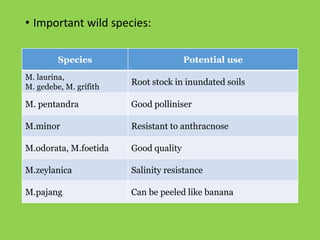
• Important wild species:
Species Potential use
M. laurina,
M. gedebe, M. grifith
Root stock in inundated soils
M. pentandra Good polliniser
M.minor Resistant to anthracnose
M.odorata, M.foetida Good quality
M.zeylanica Salinity resistance
M.pajang Can be peeled like banana
• Breeding problems in Mango:
• long juvenility.
• high clonal Heterozygosity.
• one seed per fruit.
• recalcitrant seeds.
• Polyembryony.
• early post-zygotic auto-incompatibility.
• large area requirement for assessment of hybrids.
• Breeding objectives:
• Dwarfness
• Precocity
• Profuse and regular bearing
• Attractive, good sized and quality fruit
• Absence of physiological disorders
• Disease and pest resistance and improved shelf life
• High Productivity
• REPRODCUTIVE PHYIOLOGY
• Floral biology: Mango inflorescence is terminal
with frequent emergence of the multiple axillary
panicles.
• Both perfect (2-70%) and hermaphrodite flowers
occur on the same panicle. Total number of flowers
in each panicle is 1000-6000 depending upon the
variety.
• Percentage of perfect flower varies from variety to
variety (0.74-Rumani, 30.6% Dasheri, 42.9%
Chausa, 69.8%Langra)
• Critical time of May-June and September-October.
• Sex ratio and pollen abnormalities are the main
problems in pollination eg: Occurrence of few
abnormal flowers
• Anthesis starts early in the morning and completes
at noon. Stigma receptivity remains for 72 h but
most receptive period is for the first 6 h. Minimum
pollen germination time is 1.5 h.
• Initial fruit set depends upon the ratio of the
perfect to male flowers. Proportion of perfect
flowers required for optimum fruit set must not be
less than 1%.
• Pollination:
• Mango is self-fertile but cross pollination increases
fruit set.
• The pollination is mainly entemophilous. It was
found that under natural pollination, about 40-60%
perfect flowers failed to receive any pollen grain.
• Musca domestica, Melionia sps. Are reported to be
mainly involved in pollination
• Self incompatibility reported in “Dasheri” and self
unfruitfulness is reported in Langra, Chausa,
Bombay green cultivars.
• Hybridization:
• Mango inflorescence is amenable to Hybridization. There
fore several hybrids are produced so far.
• In 1911 Burns and Prayag has initiated Hybridization work in
Mango in Pune.
• Later, hybridization work begun at Research Stations Sabour
and Kodur during early forties.
• Sabour has released two hybrids “Mahmud bahar” and
“Prabha Shankar” from parental combination of Bombai X
Kalapady.
• Later research work started in Sharanpur (UP) in 1950’s
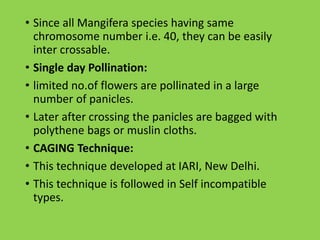
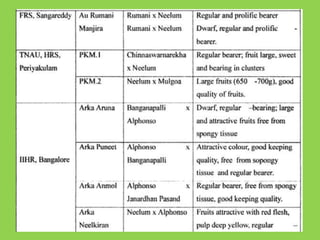
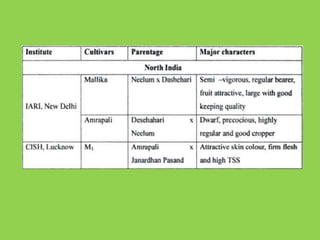
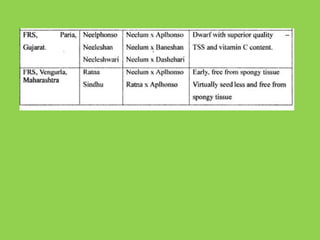
• Later on several hybrids are released from IARI,IIHR, CISH,
FRS Sangareddy, FRS Periakulam, AES Peria, FRS Vengurla.
• Since all Mangifera species having same
chromosome number i.e. 40, they can be easily
inter crossable.
• Single day Pollination:
• limited no.of flowers are pollinated in a large
number of panicles.
• Later after crossing the panicles are bagged with
polythene bags or muslin cloths.
• CAGING Technique:
• This technique developed at IARI, New Delhi.
• This technique is followed in Self incompatible
types.
• Introduction:
• For incorporation of good colour and to boost the Mango
exports some varieties are introduced.
• Eg. Tommy, Zilete, Haden, Sensation, Julie are colored
varieties are introduced from Miami, Florida.
• PI24927, M 4336 (Cabrao) from USA.
• EC201556 (Cabrao) from Philippines were introduced for
regular bearing.
• Amolie and Sweet were Introduced from Belgium and
Thailand resp.
• Selection:
• The Florida varieties are leading varieties of world.
• In 1889 Introduction made from India in which
Mulgoba became popular.
• Cultivar Haden was a seedling of Mulgoba.
• Subsequently many promising varieties became
popular cultivars.
• Tommy Atkins from Haden, Keitt from Mulgoba, Dyke
and Palmer from Unknown origin, Irwin from Lippins,
Sensation from Unknown origin are some promising
seedlings.
• Clonal Selection:
• Dasheri 51 a clonal selection from CISH, Lucknow.
• Subhash a chance seedling from Zardalu (Sabour)
• Dasheri 35 a new clone from FRS, Sangareddy.
• Polyploidy:
• Vallaicollamban is tetraploid in nature.
• Biotechnology:
• Arka Anmol a somatic embryo is achieved through
Somatic embryogenesis.
Mango breeding

Mango breeding

  • 1.
  • 2.
    • MANGO (Mangiferaindica L.) • Origin : Indo-Burma Region. • Chromosome number: (2n=4x=40) • Choicest fruit crop India • King of fruits • The name Mangifera is given by “Botinus” first time in 1658. • It belongs to family “Anacardaceae” • Indo-Burma region is believed to be the primary centre of mango. • The name Mangifera indica is given by Linnaeus in 1753.
  • 3.
    • The Mangiferaindica germplasm is divided into 2 groups. • 1. Seedling races • 2. Horticultural races • Seedling races are wild and cultivated types, which are most common in Tropical Asia and almost all commercial cultivars of mango are from this type. • Horticultural races: these are vegetatively propagating types. These include both Mono and Polyembryonic types. Monoembryonic types are predominant in India, South America, Africa and Florida. • Polyembryonic types are predominant in North India.
  • 4.
    • Germplasm resources: •India is home for Mango diversity where more than 1000 varieties are existing, which are widely distributed over agro-ecological regions of India. • CISH (Central Institute for Subtropical Horticulture), Lucknow has largest collection of mango (633 accessions), further, IIHR, IARI, Sabour(Bihar) are also maintaining the germplasm.
  • 5.
    • Important wildspecies: Species Potential use M. laurina, M. gedebe, M. grifith Root stock in inundated soils M. pentandra Good polliniser M.minor Resistant to anthracnose M.odorata, M.foetida Good quality M.zeylanica Salinity resistance M.pajang Can be peeled like banana
  • 6.
    • Breeding problemsin Mango: • long juvenility. • high clonal Heterozygosity. • one seed per fruit. • recalcitrant seeds. • Polyembryony. • early post-zygotic auto-incompatibility. • large area requirement for assessment of hybrids.
  • 7.
    • Breeding objectives: •Dwarfness • Precocity • Profuse and regular bearing • Attractive, good sized and quality fruit • Absence of physiological disorders • Disease and pest resistance and improved shelf life • High Productivity
  • 8.
    • REPRODCUTIVE PHYIOLOGY •Floral biology: Mango inflorescence is terminal with frequent emergence of the multiple axillary panicles. • Both perfect (2-70%) and hermaphrodite flowers occur on the same panicle. Total number of flowers in each panicle is 1000-6000 depending upon the variety. • Percentage of perfect flower varies from variety to variety (0.74-Rumani, 30.6% Dasheri, 42.9% Chausa, 69.8%Langra) • Critical time of May-June and September-October.
  • 9.
    • Sex ratioand pollen abnormalities are the main problems in pollination eg: Occurrence of few abnormal flowers • Anthesis starts early in the morning and completes at noon. Stigma receptivity remains for 72 h but most receptive period is for the first 6 h. Minimum pollen germination time is 1.5 h. • Initial fruit set depends upon the ratio of the perfect to male flowers. Proportion of perfect flowers required for optimum fruit set must not be less than 1%.
  • 10.
    • Pollination: • Mangois self-fertile but cross pollination increases fruit set. • The pollination is mainly entemophilous. It was found that under natural pollination, about 40-60% perfect flowers failed to receive any pollen grain. • Musca domestica, Melionia sps. Are reported to be mainly involved in pollination • Self incompatibility reported in “Dasheri” and self unfruitfulness is reported in Langra, Chausa, Bombay green cultivars.
  • 11.
    • Hybridization: • Mangoinflorescence is amenable to Hybridization. There fore several hybrids are produced so far. • In 1911 Burns and Prayag has initiated Hybridization work in Mango in Pune. • Later, hybridization work begun at Research Stations Sabour and Kodur during early forties. • Sabour has released two hybrids “Mahmud bahar” and “Prabha Shankar” from parental combination of Bombai X Kalapady. • Later research work started in Sharanpur (UP) in 1950’s • Later on several hybrids are released from IARI,IIHR, CISH, FRS Sangareddy, FRS Periakulam, AES Peria, FRS Vengurla.
  • 12.
    • Since allMangifera species having same chromosome number i.e. 40, they can be easily inter crossable. • Single day Pollination: • limited no.of flowers are pollinated in a large number of panicles. • Later after crossing the panicles are bagged with polythene bags or muslin cloths. • CAGING Technique: • This technique developed at IARI, New Delhi. • This technique is followed in Self incompatible types.
  • 16.
    • Introduction: • Forincorporation of good colour and to boost the Mango exports some varieties are introduced. • Eg. Tommy, Zilete, Haden, Sensation, Julie are colored varieties are introduced from Miami, Florida. • PI24927, M 4336 (Cabrao) from USA. • EC201556 (Cabrao) from Philippines were introduced for regular bearing. • Amolie and Sweet were Introduced from Belgium and Thailand resp.
  • 17.
    • Selection: • TheFlorida varieties are leading varieties of world. • In 1889 Introduction made from India in which Mulgoba became popular. • Cultivar Haden was a seedling of Mulgoba. • Subsequently many promising varieties became popular cultivars. • Tommy Atkins from Haden, Keitt from Mulgoba, Dyke and Palmer from Unknown origin, Irwin from Lippins, Sensation from Unknown origin are some promising seedlings.
  • 18.
    • Clonal Selection: •Dasheri 51 a clonal selection from CISH, Lucknow. • Subhash a chance seedling from Zardalu (Sabour) • Dasheri 35 a new clone from FRS, Sangareddy. • Polyploidy: • Vallaicollamban is tetraploid in nature. • Biotechnology: • Arka Anmol a somatic embryo is achieved through Somatic embryogenesis.