7/15/20201
PRESENTATION
ON
7/15/20202
Definition of
succession
Causes of
succession
Mechanism of
succession
Stages of
succession
Types of
succession
Content
s
What actually the succession
is?
7/15/20203
 Ecological Succession: The series of changes in
an ecosystem when one community is replaced
by another community as a result of changes in
biotic and abiotic factors.
 Occurs in all types of ecosystems i.e., forests,
ponds, coral reefs, etc.
Ecological succession is
characterised by
7/15/20204
 Increased productivity
 The shift of nutrients from the reservoir
 Increased diversity of organisms with increased
niche development
 Gradual increase in the complexity of food webs.
Ecological Succession
7/15/20205
Causes of plant succession:
7/15/20206
Autogenic succession- can be brought by changes in the soil caused by
the organisms there.
For example, when larger species like trees mature, they produce shade on to
the developing forest floor that tends to exclude light-requiring species.
Shade-tolerant species will invade the area.
Allogenic succession-caused by external environmental influences and not
by the vegetation.
For example, soil changes due to erosion, leaching or the deposition of silt and clays
can alter the nutrient content and water relationships in the ecosystems.
Causes of ecological
succession
7/15/20207
 Physical environment
 Natural disturbance
 Human disturbance
Can result in gradual changes in the physical
environment or from sudden disturbance.
 Clearing land
 Climate change
 Introduction of non native species
 Natural disasters such as volcanic, eruptions, forest
fires, hurricanes and floods.
Why Does Ecological Succession
Occur?
7/15/20208
• Because it is the process of life for plants, soil and
other living organisms.
• Because organisms alter soil structure, chemistry,
and microclimates, the species composition of
ecological communities constantly changes over time.
• Succession will continue until the environment
reaches it’s final stage…the Climax Community.
Mechanism of succession
7/15/20209
According to Clements, succession is a process involving several phases:
Nudation: Succession begins with the development of a bare site, called Nudation
(disturbance).
Migration: It refers to arrival of propagules.
Ecesis: It involves establishment and initial growth of vegetation.
Competition: As vegetation becomes well established, grow, and spread, various
species begin to compete for space, light and nutrients.
Reaction: During this phase autogenic changes such as the buildup of humus
affect the habitat, and one plant community replaces another.
Stabilization: A supposedly stable climax community forms.[
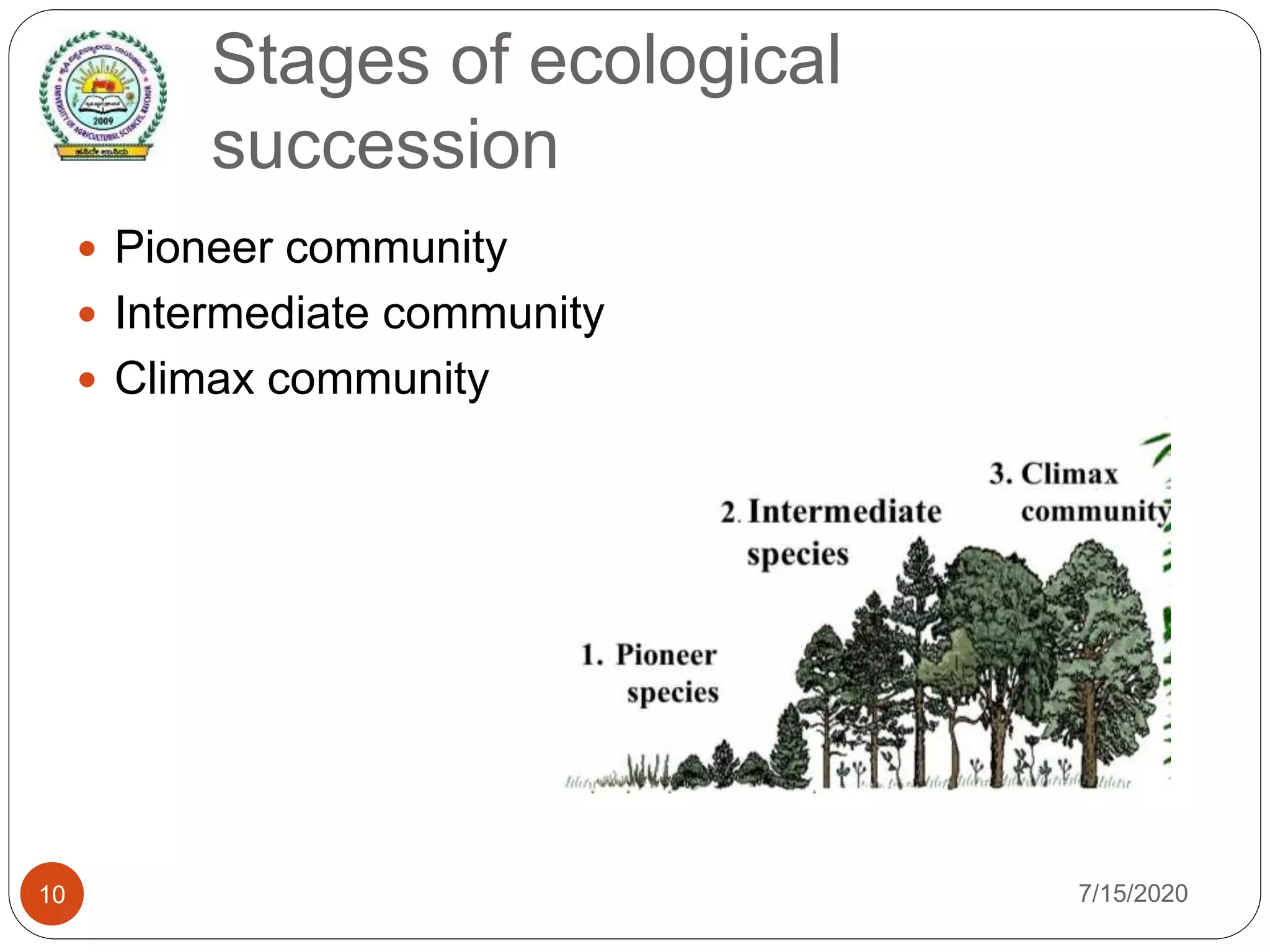
Stages of ecological
succession
7/15/202010
 Pioneer community
 Intermediate community
 Climax community
Types of succession
7/15/202011
• Primary succession
• Seconday succession
Types of succession
7/15/202012
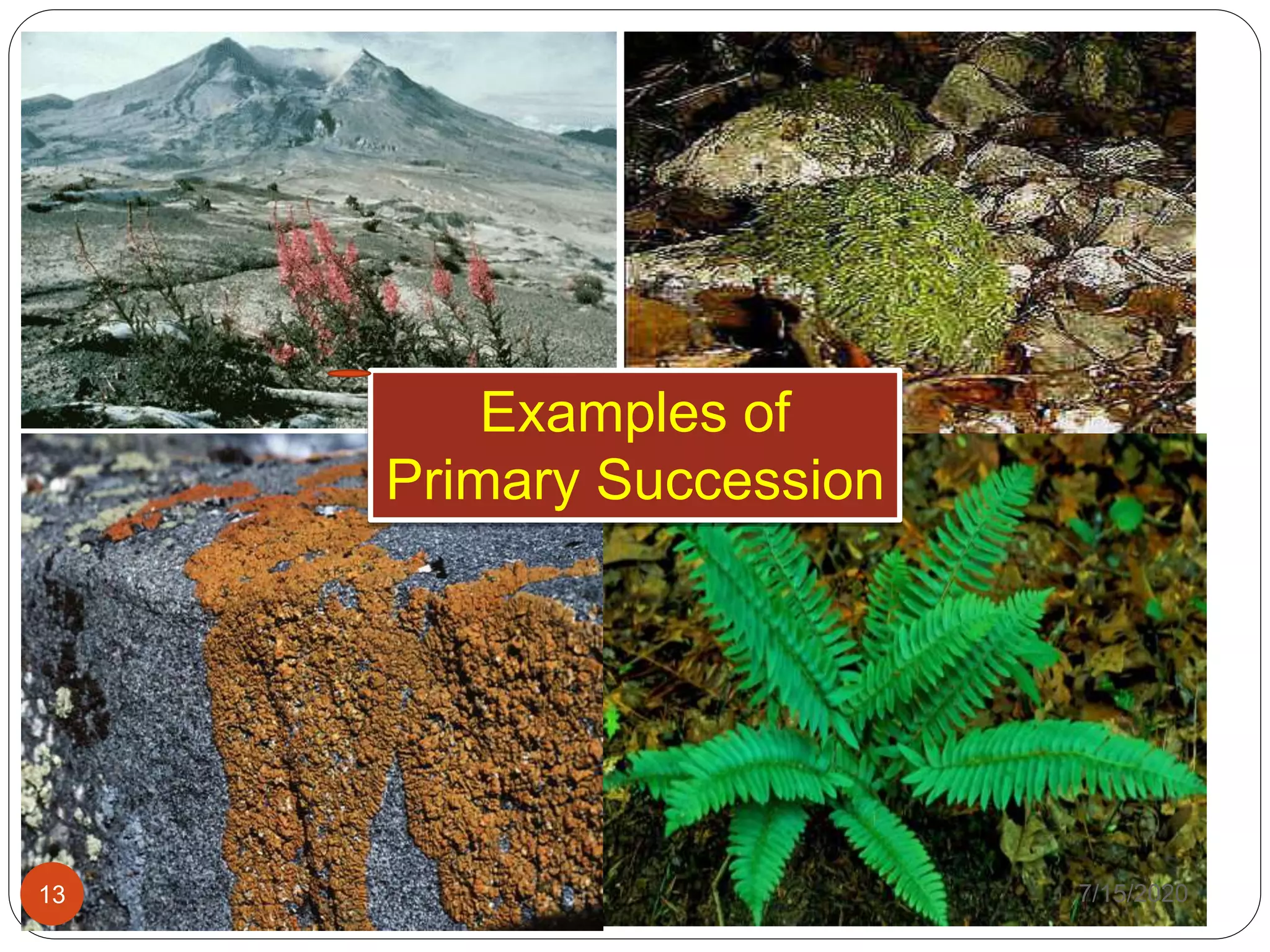
Primary Succession
The process of creating and developing an ecosystem
in an area that was previously uninhabited.
Examples of uninhabited areas:
• Sides of volcanoes
• Sites of glacier recession
Examples of
Primary Succession
7/15/202013
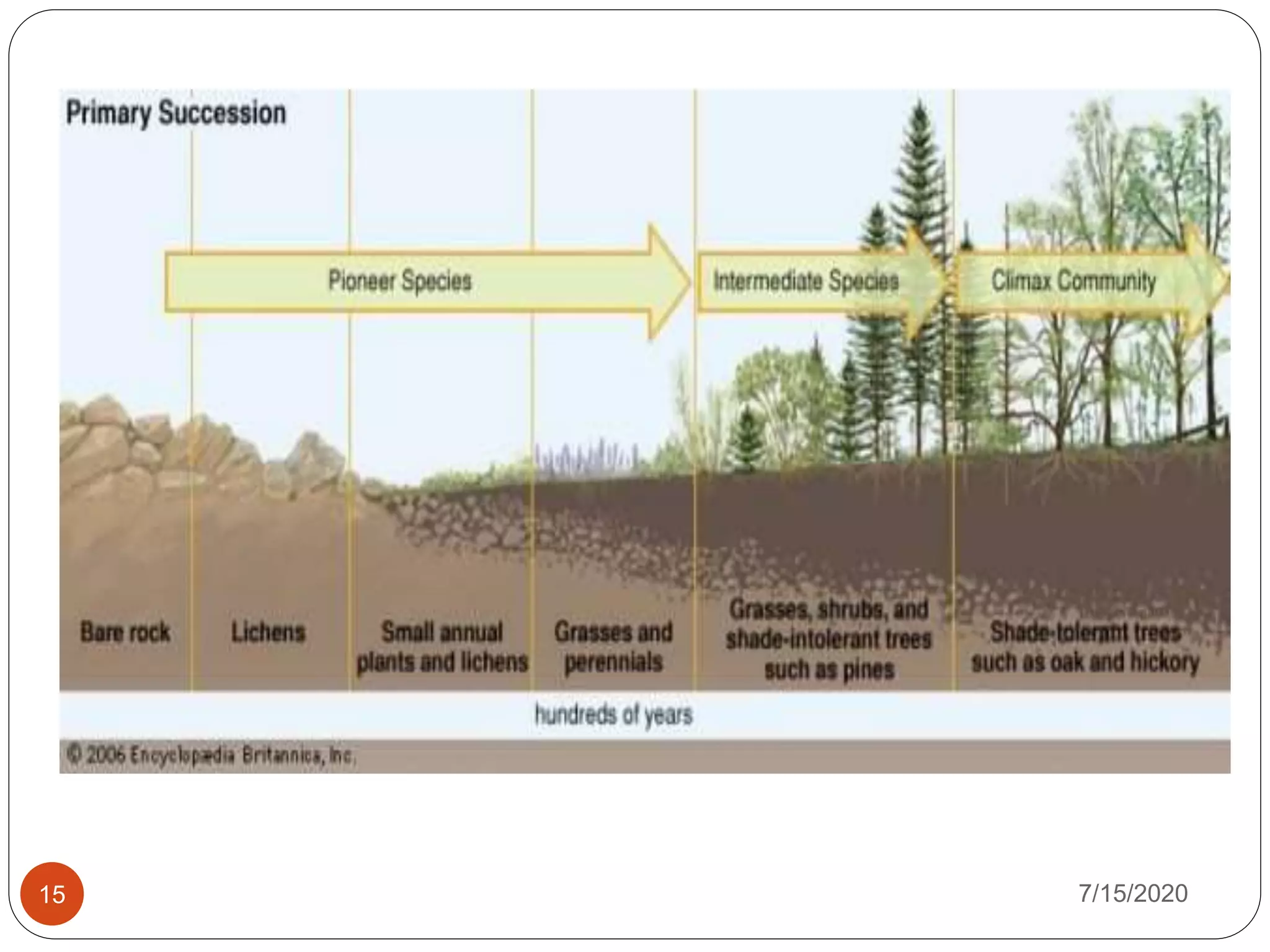
1. In this example, a volcanic eruption has destroyed the previous ecosystem.
2. The first organisms to appear are lichens.
3. Mosses soon appear, and grasses take root in the thin layer of soil.
4. Eventually, tree seedlings and shrubs sprout among the plant community.
7/15/202014
7/15/202015
Secondary succession
7/15/202016
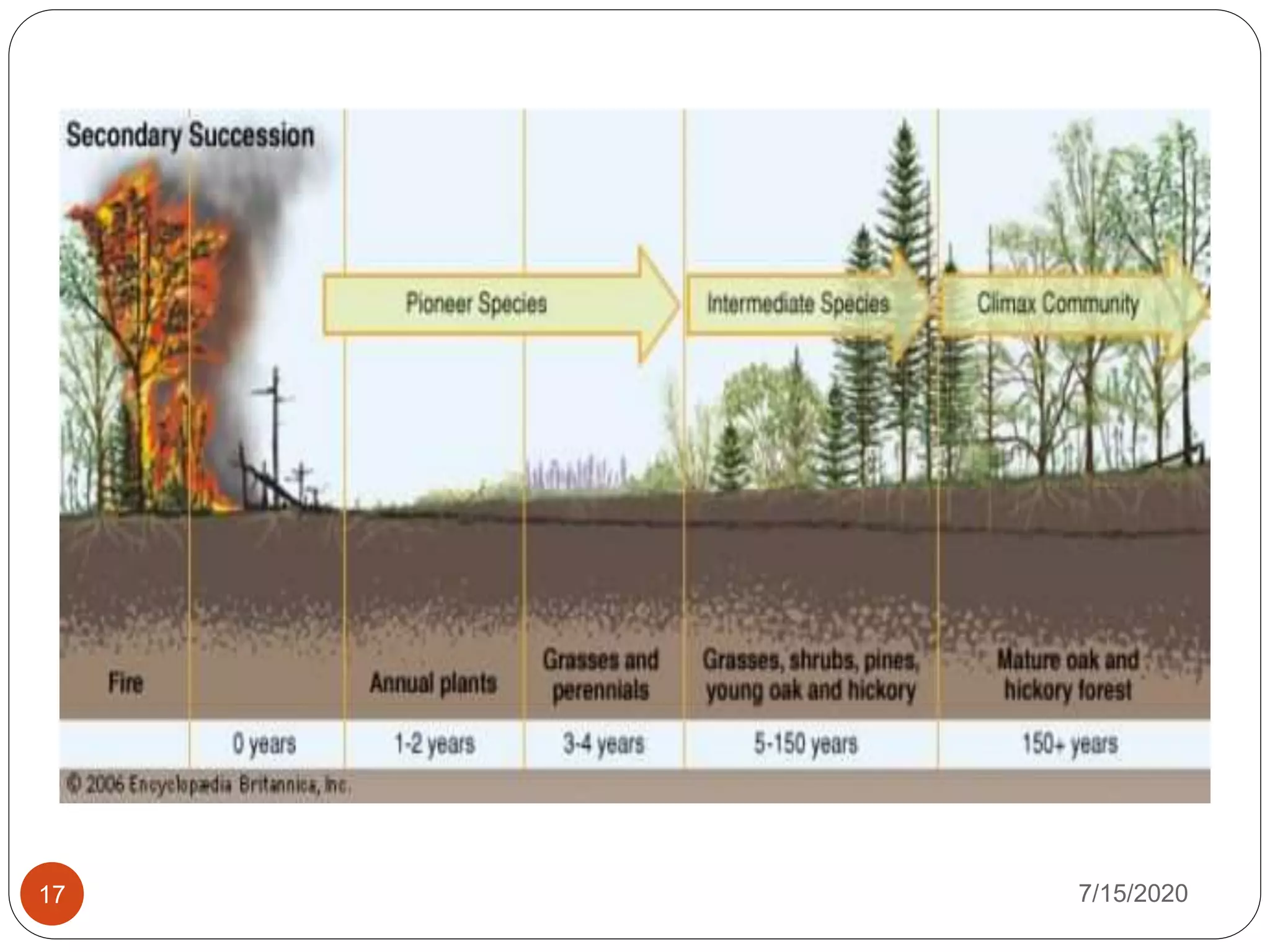
The disturbed area undergo series of changes similar to
primary succession in which smaller, faster growing species
are gradually replaced by larger and more stable species.
Secondary succession is a never ending process.
7/15/202017
7/15/202018
7/15/202019
AN EXAMPLE OF SECONDARY SUCCESSION7/15/202020
An example of Secondary Succession
by stages:
1. A stable deciduous forest community
2. A disturbance, such as a wild fire, destroys the forest
3. The fire burns the forest to the ground
4. The fire leaves behind empty, but not destroyed, soil
5. Grasses and other herbaceous plants grow back first
6. Small bushes and trees begin to colonize the area
7. Fast growing evergreen trees develop to their fullest, while
shade-tolerant trees develop in the understory
8. The short-lived and shade intolerant evergreen trees die as
the larger deciduous trees overtop them. The ecosystem is now
back to a similar state to where it began.
7/15/202021
7/15/202022
7/15/202023
Threats to Succession
• The grasses that move in as pioneer species are often
thought of as weeds
• The subsequent growth of shrubs are considered
undesirable "brush".
• Without these intermediate stages, the disturbed habitat
can't return to a natural forest.
• The fragility and stability of the ecological community are
dependent upon several factors.
7/15/202024
• Also, over long periods of time (“geological time”) the
climate conditions and other fundamental aspects of an
ecosystem change.
• These geological time scale changes are not observable
in our “ ecological” time, but their fundamental existence
and historical reality cannot be disputed.
• No ecosystem, then, has existed or will exist unchanged
or unchanging over a geological time scale.
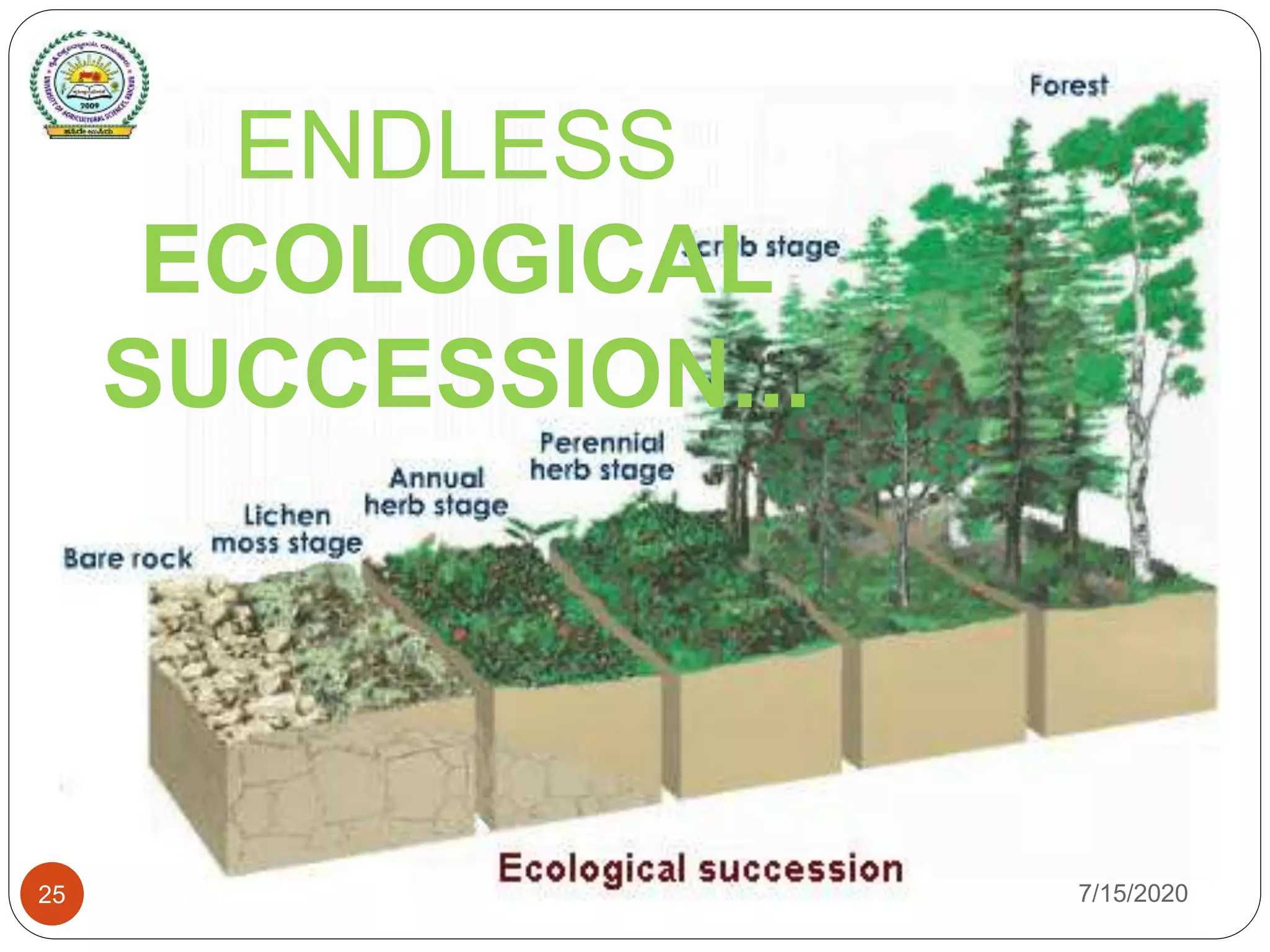
ECOLOGICAL SUCCESSION NEVER
ENDS
7/15/202025
ENDLESS
ECOLOGICAL
SUCCESSION...
7/15/202026
References
Modern concepts of ecology - H D Kumar
https://en.wikipedia.org/wiki/Ecological_succession
https://www.britannica.com/science/ecological-
succession
7/15/202027

Ecological succession

  • 1.
  • 2.
    7/15/20202 Definition of succession Causes of succession Mechanismof succession Stages of succession Types of succession Content s
  • 3.
    What actually thesuccession is? 7/15/20203  Ecological Succession: The series of changes in an ecosystem when one community is replaced by another community as a result of changes in biotic and abiotic factors.  Occurs in all types of ecosystems i.e., forests, ponds, coral reefs, etc.
  • 4.
    Ecological succession is characterisedby 7/15/20204  Increased productivity  The shift of nutrients from the reservoir  Increased diversity of organisms with increased niche development  Gradual increase in the complexity of food webs.
  • 5.
  • 6.
    Causes of plantsuccession: 7/15/20206 Autogenic succession- can be brought by changes in the soil caused by the organisms there. For example, when larger species like trees mature, they produce shade on to the developing forest floor that tends to exclude light-requiring species. Shade-tolerant species will invade the area. Allogenic succession-caused by external environmental influences and not by the vegetation. For example, soil changes due to erosion, leaching or the deposition of silt and clays can alter the nutrient content and water relationships in the ecosystems.
  • 7.
    Causes of ecological succession 7/15/20207 Physical environment  Natural disturbance  Human disturbance Can result in gradual changes in the physical environment or from sudden disturbance.  Clearing land  Climate change  Introduction of non native species  Natural disasters such as volcanic, eruptions, forest fires, hurricanes and floods.
  • 8.
    Why Does EcologicalSuccession Occur? 7/15/20208 • Because it is the process of life for plants, soil and other living organisms. • Because organisms alter soil structure, chemistry, and microclimates, the species composition of ecological communities constantly changes over time. • Succession will continue until the environment reaches it’s final stage…the Climax Community.
  • 9.
    Mechanism of succession 7/15/20209 Accordingto Clements, succession is a process involving several phases: Nudation: Succession begins with the development of a bare site, called Nudation (disturbance). Migration: It refers to arrival of propagules. Ecesis: It involves establishment and initial growth of vegetation. Competition: As vegetation becomes well established, grow, and spread, various species begin to compete for space, light and nutrients. Reaction: During this phase autogenic changes such as the buildup of humus affect the habitat, and one plant community replaces another. Stabilization: A supposedly stable climax community forms.[
  • 10.
    Stages of ecological succession 7/15/202010 Pioneer community  Intermediate community  Climax community
  • 11.
    Types of succession 7/15/202011 •Primary succession • Seconday succession
  • 12.
    Types of succession 7/15/202012 PrimarySuccession The process of creating and developing an ecosystem in an area that was previously uninhabited. Examples of uninhabited areas: • Sides of volcanoes • Sites of glacier recession
  • 13.
  • 14.
    1. In thisexample, a volcanic eruption has destroyed the previous ecosystem. 2. The first organisms to appear are lichens. 3. Mosses soon appear, and grasses take root in the thin layer of soil. 4. Eventually, tree seedlings and shrubs sprout among the plant community. 7/15/202014
  • 15.
  • 16.
    Secondary succession 7/15/202016 The disturbedarea undergo series of changes similar to primary succession in which smaller, faster growing species are gradually replaced by larger and more stable species. Secondary succession is a never ending process.
  • 17.
  • 18.
  • 19.
  • 20.
    AN EXAMPLE OFSECONDARY SUCCESSION7/15/202020
  • 21.
    An example ofSecondary Succession by stages: 1. A stable deciduous forest community 2. A disturbance, such as a wild fire, destroys the forest 3. The fire burns the forest to the ground 4. The fire leaves behind empty, but not destroyed, soil 5. Grasses and other herbaceous plants grow back first 6. Small bushes and trees begin to colonize the area 7. Fast growing evergreen trees develop to their fullest, while shade-tolerant trees develop in the understory 8. The short-lived and shade intolerant evergreen trees die as the larger deciduous trees overtop them. The ecosystem is now back to a similar state to where it began. 7/15/202021
  • 22.
  • 23.
    7/15/202023 Threats to Succession •The grasses that move in as pioneer species are often thought of as weeds • The subsequent growth of shrubs are considered undesirable "brush". • Without these intermediate stages, the disturbed habitat can't return to a natural forest. • The fragility and stability of the ecological community are dependent upon several factors.
  • 24.
    7/15/202024 • Also, overlong periods of time (“geological time”) the climate conditions and other fundamental aspects of an ecosystem change. • These geological time scale changes are not observable in our “ ecological” time, but their fundamental existence and historical reality cannot be disputed. • No ecosystem, then, has existed or will exist unchanged or unchanging over a geological time scale. ECOLOGICAL SUCCESSION NEVER ENDS
  • 25.
  • 26.
    7/15/202026 References Modern concepts ofecology - H D Kumar https://en.wikipedia.org/wiki/Ecological_succession https://www.britannica.com/science/ecological- succession
  • 27.