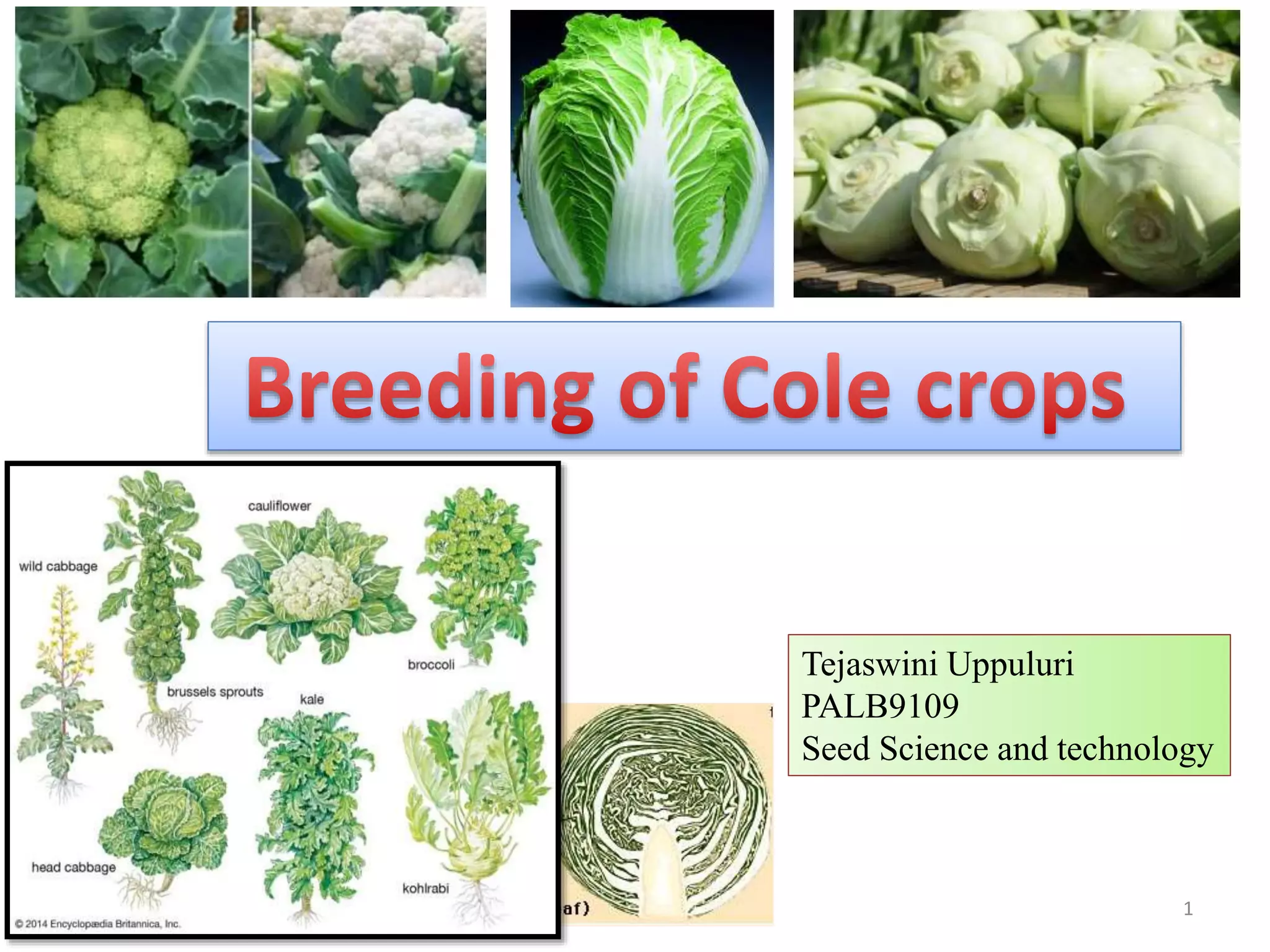
Tejaswini Uppuluri
PALB9109
Seed Science and technology
1
2
 The terms "cold" and "cole" sound the same but have different meanings. "Cold" refers to
temperature.
 "Cole" refers to any of various plants belonging to the Cruciferae or mustard family.
 The mustard family includes cool season crops such as Brussels sprout, cabbage, cauliflower.
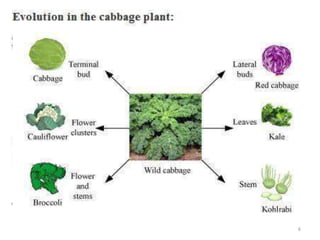
 The close kinship of these crops enable diversified usage of plant parts.
 The flowers, seeds, stalks, and tender leaves of many species of Brassica can be eaten raw or
cooked. Almost all parts of some species have been developed for food, including the root
(rutabaga, turnip), stems - kohlrabi, leaves - cabbage, collard greens, kale, flowers -
cauliflower, broccoli, buds - Brussels sprouts, cabbage, and seeds (many, including mustard seed, and
oil-producing rapeseed).
 Cole crops are rich source of vitamins A and C. They also contain appreciable amount of minerals
like phosphorus, potash, calcium, sodium and iron.
Dhaliwal, 2017
3
Nath, 1976
• Culinaryuse-rangingfromeatingrawandsimplesteamingtopickling,stewing,braising.
• Lowincarbohydrates,fats,calories.Goodsourceofprotein(balanced),minerals,vitaminA,
vitaminC andvitaminD.
• Knownfor anticancerproperties(-indole-3-carbinol).
• Cabbagejuice:againstpoisonousmushroom.
• Consists of Flavonouscompound:Sinigrin
• Includes antioxidants are ascorbic acid, tocopherols, carotenoids, isothiocyanates, indoles,
flavanoids.
• As a medicinal herb to prevent the effects of alcohol, as compresses for ulcers and breast
abscesses,treatmentsfor rheumatism,sorethroat,hoarseness,colic,andetc.
4
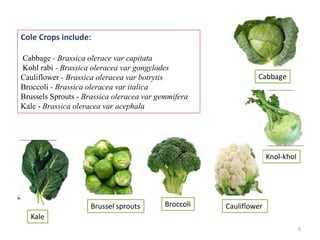
Cole Crops include:
Cabbage - Brassica olerace var capitata
Kohl rabi - Brassica oleracea var gongylodes
Cauliflower - Brassica oleracea var botrytis
Broccoli - Brassica oleracea var italica
Brussels Sprouts - Brassica oleracea var gemmifera
Kale - Brassica oleracea var acephala
Cabbage
Knol-khol
CauliflowerBroccoliBrussel sprouts
Kale
5
6
7
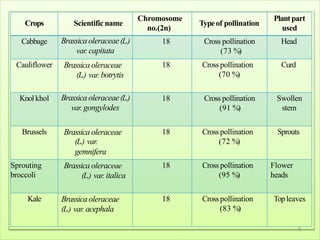
Crops Scientific name
Chromosome
no.(2n)
Typeof pollination
Plantpart
used
Cabbage Brassica oleraceae(L.)
var. capitata
18 Cross pollination
(73 %)
Head
Cauliflower Brassica oleraceae
(L.) var. botrytis
18 Crosspollination
(70 %)
Curd
Knolkhol Brassica oleraceae(L.)
var. gongylodes
18 Cross pollination
(91 %)
Swollen
stem
Brussels Brassica oleraceae
(L.) var.
gemnifera
18 Crosspollination
(72 %)
Sprouts
Sprouting
broccoli
Brassica oleraceae
(L.) var. italica
18 Crosspollination
(95 %)
Flower
heads
Kale Brassica oleraceae
(L.) var. acephala
18 Crosspollination
(83 %)
Topleaves
8
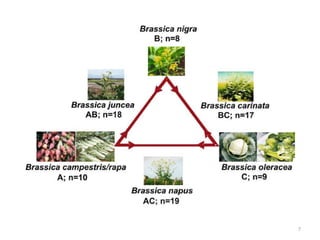
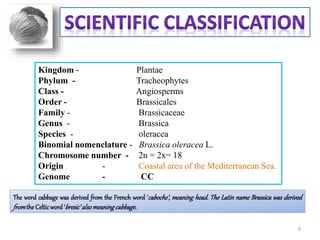
Kingdom - Plantae
Phylum - Tracheophytes
Class - Angiosperms
Order - Brassicales
Family - Brassicaceae
Genus - Brassica
Species - oleracea
Binomial nomenclature - Brassica oleracea L.
Chromosome number - 2n = 2x= 18
Origin - Coastal area of the Mediterranean Sea.
Genome - CC
The word cabbage was derived from the French word ‘caboche’, meaning head. The Latin name Brassica was derived
fromthe Celticword‘bresic’alsomeaningcabbage.
9
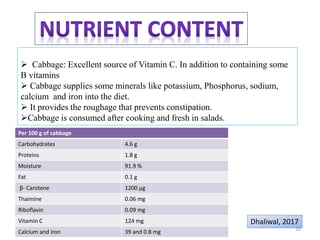
 Cabbage: Excellent source of Vitamin C. In addition to containing some
B vitamins
 Cabbage supplies some minerals like potassium, Phosphorus, sodium,
calcium and iron into the diet.
 It provides the roughage that prevents constipation.
Cabbage is consumed after cooking and fresh in salads.
Dhaliwal, 2017
Per 100 g of cabbage
Carbohydrates 4.6 g
Proteins 1.8 g
Moisture 91.9 %
Fat 0.1 g
β- Carotene 1200 μg
Thaimine 0.06 mg
Riboflavin 0.09 mg
Vitamin C 124 mg
Calcium and iron 39 and 0.8 mg
10
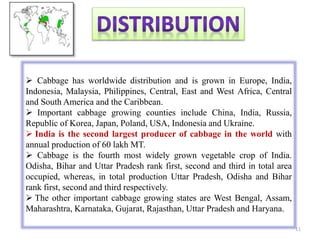
 Cabbage has worldwide distribution and is grown in Europe, India,
Indonesia, Malaysia, Philippines, Central, East and West Africa, Central
and South America and the Caribbean.
 Important cabbage growing counties include China, India, Russia,
Republic of Korea, Japan, Poland, USA, Indonesia and Ukraine.
 India is the second largest producer of cabbage in the world with
annual production of 60 lakh MT.
 Cabbage is the fourth most widely grown vegetable crop of India.
Odisha, Bihar and Uttar Pradesh rank first, second and third in total area
occupied, whereas, in total production Uttar Pradesh, Odisha and Bihar
rank first, second and third respectively.
 The other important cabbage growing states are West Bengal, Assam,
Maharashtra, Karnataka, Gujarat, Rajasthan, Uttar Pradesh and Haryana.
11
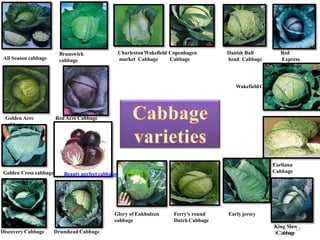
Discovery Cabbage Drumhead Cabbage
Early jersey
WakefieldCabbage
Ferry’s round
Dutch Cabbage
Glory of Enkhulzen
cabbage
King Slaw
3C2abbage
Golden Acre
cabbage
Red Acre Cabbage
Beauty perfect cabbageGolden Cross cabbage
All Season cabbage
Brunswick
cabbage
Charleston Wakefield Copenhagen
market Cabbage Cabbage
Danish Ball
head Cabbage
Red
Express
Cabbage
Earliana
Cabbage
12
33
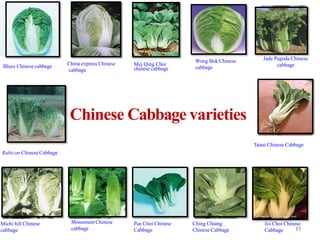
Blues Chinese cabbage
China express Chinese
cabbage
Jade Pagoda Chinese
cabbage
Joi Choi Chinese
Cabbage
Ching Chiang
Chinese Cabbage
Pae Choi Chinese
Cabbage
Monument Chinese
cabbage
Michi hill Chinese
cabbage
Wong Bok Chinese
cabbage
Rubicon ChineseCabbage
Taisai Chinese Cabbage
Chinese Cabbage varieties
Mej Qing Choi
chinese cabbage
13
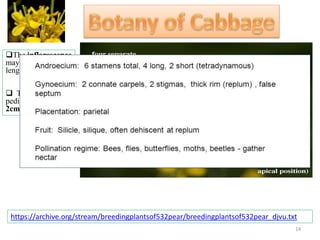
The inflorescence
may attend the
length of 1-2 m.
 The slender
pedicels are 1.5-
2cm long.
https://archive.org/stream/breedingplantsof532pear/breedingplantsof532pear_djvu.txt
14
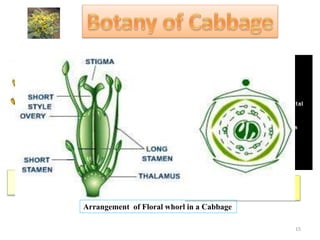
Arrangement of Floral whorl in a Cabbage
15
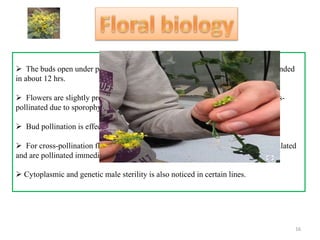
 The buds open under pressure of rapidly growing petals and become fully expanded
in about 12 hrs.
 Flowers are slightly protogynous (5 days earlier) and cabbage is naturally cross-
pollinated due to sporophytic self-incompatibility.
 Bud pollination is effective to achieve selfing.
 For cross-pollination flower buds expected to open within 1-2 days are emasculated
and are pollinated immediately with desired pollen using a brush/flower stamens.
 Cytoplasmic and genetic male sterility is also noticed in certain lines.
16
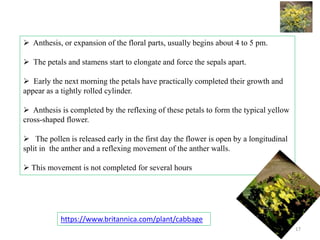
 Anthesis, or expansion of the floral parts, usually begins about 4 to 5 pm.
 The petals and stamens start to elongate and force the sepals apart.
 Early the next morning the petals have practically completed their growth and
appear as a tightly rolled cylinder.
 Anthesis is completed by the reflexing of these petals to form the typical yellow
cross-shaped flower.
 The pollen is released early in the first day the flower is open by a longitudinal
split in the anther and a reflexing movement of the anther walls.
 This movement is not completed for several hours
https://www.britannica.com/plant/cabbage
17
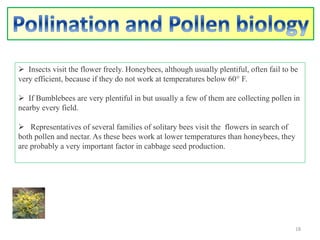
 Insects visit the flower freely. Honeybees, although usually plentiful, often fail to be
very efficient, because if they do not work at temperatures below 60° F.
 If Bumblebees are very plentiful in but usually a few of them are collecting pollen in
nearby every field.
 Representatives of several families of solitary bees visit the flowers in search of
both pollen and nectar. As these bees work at lower temperatures than honeybees, they
are probably a very important factor in cabbage seed production.
18
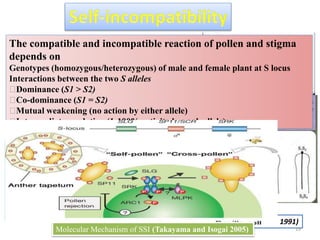
Homomorphic system type Sporophytic self
incompatibility (SSI) i.e. in cabbage it is confirmed
by (Adamson 1965).
It is controlled by single s-locus with multiple allele
but also reported more than one loci, more than 80 s-
alleles reported in Brassica family.
A classical genetic analysis has grouped the
Brassica S-alleles into two categories based on their
phenotypic effect on self-incompatibility
characteristics.
First group of alleles
High activity
Second group of alleles
Low activity
The first group of alleles (high-
activity) are placed relatively
high on the dominance scale and
exhibit a strong self-
incompatible phenotype in which
an average of 0 to 10 pollen
tubes develop per selfpollinated
stigma
The second group of alleles (low-
activity) demonstrate a weak or leaky
self incompatible phenotypic
effect in which 10 to 30 pollen tubes
develop per self-pollinated stigma and
they are considered to be recessive
(Nasrallah et al. 1991)
The compatible and incompatible reaction of pollen and stigma
depends on
Genotypes (homozygous/heterozygous) of male and female plant at S locus
Interactions between the two S alleles
Dominance (S1 > S2)
Co-dominance (S1 = S2)
Mutual weakening (no action by either allele)
Intermediate gradation (1-100% activity by each allele)
Molecular Mechanism of SSI (Takayama and Isogai 2005) 19
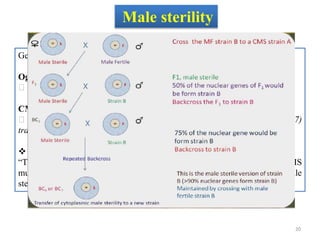
Male sterility
Genic male sterility has been reported in cabbage (Rundfeldt 1960).
Ogura CMS system (Intergeneric crosses)
Ogura male sterilitywas reported in Japanese radish, (Ogura 1968)
CMS induced by interspecific cross
B. oleracea with rutabaga – B. napobrassica (Chiang, Crete 1985, 1987)
transfer resistance against Plasmodiophora brassicae.
 EGMS is more popularly termed as “Two line Hybrid Breeding” as against
“Three Line Hybrid Breeding” in case of CMS system. In Cabbage the TGMS
mutant is activated at temperature <10o C, Which makes the parent male
sterile. (Rundfeldt, 1961).
20
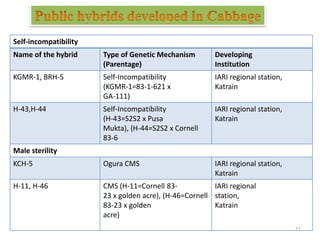
Self-incompatibility
Name of the hybrid Type of Genetic Mechanism
(Parentage)
Developing
Institution
KGMR-1, BRH-5 Self-Incompatibility
(KGMR-1=83-1-621 x
GA-111)
IARI regional station,
Katrain
H-43,H-44 Self-Incompatibility
(H-43=S2S2 x Pusa
Mukta), (H-44=S2S2 x Cornell
83-6
IARI regional station,
Katrain
Male sterility
KCH-5 Ogura CMS IARI regional station,
Katrain
H-11, H-46 CMS (H-11=Cornell 83-
23 x golden acre), (H-46=Cornell
83-23 x golden
acre)
IARI regional
station,
Katrain
21
22
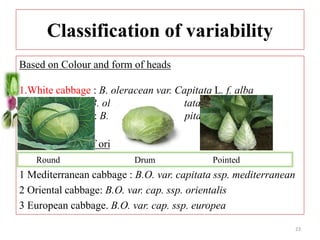
Classification of variability
Based on Colour and form of heads
1.White cabbage : B. oleracean var. Capitata L. f. alba
2.Red cabbage : B. oleracean var. capitata L. f. rubra
3.Savoy cabbage : B. oleraceae var. capitata L. f. sabauda
Based on Place of origin:
1 Mediterranean cabbage : B.O. var. capitata ssp. mediterranean
2 Oriental cabbage: B.O. var. cap. ssp. orientalis
3 European cabbage. B.O. var. cap. ssp. europea
Round Drum Pointed
23
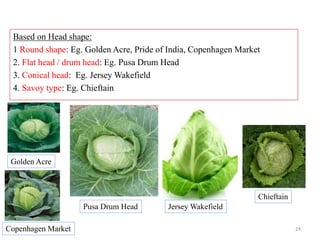
Based on Head shape:
1 Round shape: Eg. Golden Acre, Pride of India, Copenhagen Market
2. Flat head / drum head: Eg. Pusa Drum Head
3. Conical head: Eg. Jersey Wakefield
4. Savoy type: Eg. Chieftain
Golden Acre
Copenhagen Market
Pusa Drum Head Jersey Wakefield
Chieftain
24
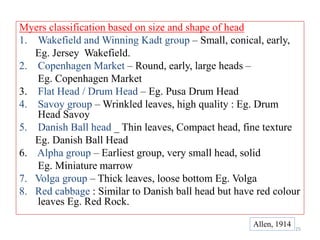
Myers classification based on size and shape of head
1. Wakefield and Winning Kadt group – Small, conical, early,
Eg. Jersey Wakefield.
2. Copenhagen Market – Round, early, large heads –
Eg. Copenhagen Market
3. Flat Head / Drum Head – Eg. Pusa Drum Head
4. Savoy group – Wrinkled leaves, high quality : Eg. Drum
Head Savoy
5. Danish Ball head _ Thin leaves, Compact head, fine texture
Eg. Danish Ball Head
6. Alpha group – Earliest group, very small head, solid
Eg. Miniature marrow
7. Volga group – Thick leaves, loose bottom Eg. Volga
8. Red cabbage : Similar to Danish ball head but have red colour
leaves Eg. Red Rock.
Allen, 1914
25
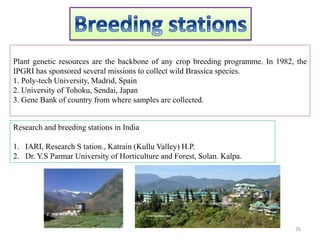
Plant genetic resources are the backbone of any crop breeding programme. In 1982, the
IPGRI has sponsored several missions to collect wild Brassica species.
1. Poly-tech University, Madrid, Spain
2. University of Tohoku, Sendai, Japan
3. Gene Bank of country from where samples are collected.
Research and breeding stations in India
1. IARI, Research S tation., Katrain (Kullu Valley) H.P.
2. Dr. Y.S Parmar University of Horticulture and Forest, Solan. Kalpa.
26
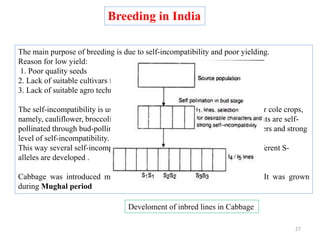
The main purpose of breeding is due to self-incompatibility and poor yielding.
Reason for low yield:
1. Poor quality seeds
2. Lack of suitable cultivars for mild winter.
3. Lack of suitable agro techniques.
The self-incompatibility is used to produce hybrid seeds in cabbage and other cole crops,
namely, cauliflower, broccoli, Brussels sprouts, and kale. The individual plants are self-
pollinated through bud-pollination. Selection is applied for desirable characters and strong
level of self-incompatibility.
This way several self-incompatible, but cross-compatible inbreds having different S-
alleles are developed .
Cabbage was introduced much earlier than cauliflower by Portuguese. It was grown
during Mughal period
Breeding in India
Develoment of inbred lines in Cabbage
27
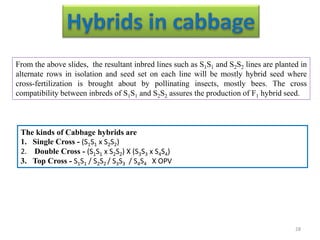
From the above slides, the resultant inbred lines such as S1S1 and S2S2 lines are planted in
alternate rows in isolation and seed set on each line will be mostly hybrid seed where
cross-fertilization is brought about by pollinating insects, mostly bees. The cross
compatibility between inbreds of S1S1 and S2S2 assures the production of F1 hybrid seed.
The kinds of Cabbage hybrids are
1. Single Cross - (S1S1 x S2S2)
2. Double Cross - (S1S1 x S2S2) X (S3S3 x S4S4)
3. Top Cross - S1S1 / S2S2 / S3S3 / S4S4 X OPV
28
1. High yield
2. Longer staying capacity in field after head formation/greater field holding capacity
3. Desirable head weight (1 – 1.5 kg)
4. Early head formation/early maturity
5. Storage ability (Storability)
6. Head shape and colour as per preference of consumers (essentially round heads, light
green-green colour)
7. Less proportion of outer/wrapper leaves
8. Short and narrow cone
9. Firm head with short internal stem
10. Ability to tolerate frost
11. Resistance to diseases:
i. Black rot (Xanthomonas campestris)
ii. Alternaria leaf spot (Altemaria ssp.)
iii. Black leg (Leptosphaeria maculans)
12. Tolerance to insect – Pests
Diamond back moth (Plutella xylostella), cabbage moth (Mamestra brassicae), cabbage
root fly (Delia radicum), cabbage maggot (Hylemya brassicae) and cabbage white
butterfly(Pieris rapae)
29
1. Conventional Breeding methods
In conventional breeding, progeny inherit genes for both desirable and
undesirable traits from both parents. Breeders conserve desired
characteristics and suppress undesirable ones by repeatedly selecting
meritorious individuals from each generation to be the parents of the next.
2. Non-conventional Breeding methods
In non-conventional breeding, encompasses essential all cell and
tissue culture technique that assist in propagating studying and manipulating
the plant gene without use of sexual cycle.
30
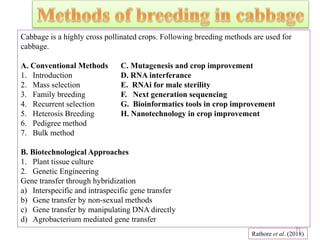
Cabbage is a highly cross pollinated crops. Following breeding methods are used for
cabbage.
A. Conventional Methods C. Mutagenesis and crop improvement
1. Introduction D. RNA interferance
2. Mass selection E. RNAi for male sterility
3. Family breeding F. Next generation sequencing
4. Recurrent selection G. Bioinformatics tools in crop improvement
5. Heterosis Breeding H. Nanotechnology in crop improvement
6. Pedigree method
7. Bulk method
B. Biotechnological Approaches
1. Plant tissue culture
2. Genetic Engineering
Gene transfer through hybridization
a) Interspecific and intraspecific gene transfer
b) Gene transfer by non-sexual methods
c) Gene transfer by manipulating DNA directly
d) Agrobacterium mediated gene transfer
Rathore et al. (2018)
31
1. Introduction
Introduced materials may be valuable in selecting desirable plants. In case of non-
uniform introductions the desirable plants can be selected, their progeny increased, purified
and later tested against the standard or local varieties for selecting the most promising lines.
The chances of an introduction depends to a great extent upon the relationship between the
agro climates, particularly temperature and day length of the donor and receptor areas.
Promising in India – Golden Acre, August, Copenhagen Market.
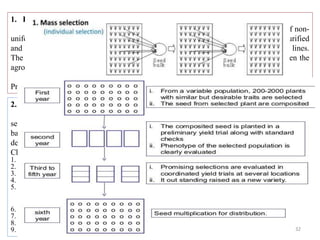
2. Mass selection:
In this method the best individual plants are selected in the population and their
seeds are composited for following generation. Since the mass selection is made exclusively
based on the phenotype of the plants without any progeny testing, the success of selection
depends upon the heritability of the characters under selection.
Characters which can be improved are
1. Maturity: days to 50 per cent heading (earliness)
2. Stalk length
3. Number of non wrapper leaves
4. Frame or plant spread
5. Shape of head – polar and equatorial diameter. Normal or spherical head: 0.8- 1.0 shape index(SI).
Drum head ;
SI < 0.5, conical head SI > 1.0
6. Compactness of head – associated with short sized core
7. Net weight of head < 750 g
8. Number of marketable heads
9. Yield 32
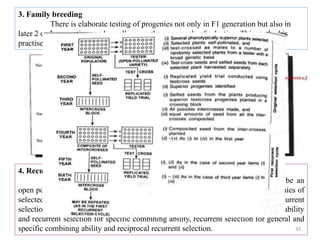
3. Family breeding
There is elaborate testing of progenies not only in F1 generation but also in
later 2 or 3 generations and usually more than one cycle of selection. This method is
practised in beet and can also be adopted in radish, carrot and cauliflower.
4. Recurrent selection
The source population of recurrent selection is heterozygous. It may be an
open pollinated variety, single cross or double cross F1 hybrid, intercrossed progenies of
selected inbred lines, a synthetic variety or a composite. There are four types of recurrent
selection viz. simple recurrent selection, recurrent selection for general combining ability
and recurrent selection for specific combining ability, recurrent selection for general and
specific combining ability and reciprocal recurrent selection. 33
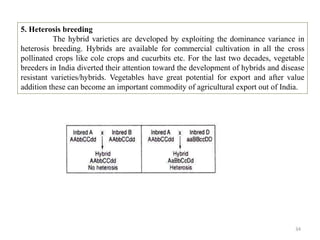
5. Heterosis breeding
The hybrid varieties are developed by exploiting the dominance variance in
heterosis breeding. Hybrids are available for commercial cultivation in all the cross
pollinated crops like cole crops and cucurbits etc. For the last two decades, vegetable
breeders in India diverted their attention toward the development of hybrids and disease
resistant varieties/hybrids. Vegetables have great potential for export and after value
addition these can become an important commodity of agricultural export out of India.
34
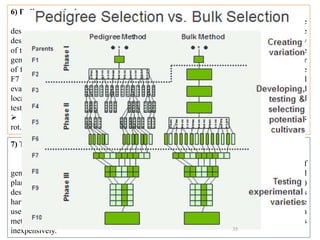
6) Pedigree method
It starts with the crossing of two genotypes, each of which have one or more
desirable characters lacked by the other. If the two original parents do not provide all of the
desired characters, a third parent can be included by crossing it to one of the hybrid progeny
of the first generation (F1). In the pedigree method superior types are selected in successive
generations, and a record is maintained of parent–progeny relationships. When the number
of families has been reduced to manageable proportions by visual selection, usually by the
F7 or F8 generation, precise evaluation for performance and quality begins. The final
evaluation of promising strains involves (1) observation, usually in a number of years and
locations, to detect weaknesses that may not have appeared previously; (2) precise yield
testing; and (3) quality testing.
 Selection 8 (Pusa Mukta) is a selection from EC 10109 X EC 24855, resistant to Black
rot. Developed at Katrain
7) The bulk-population method
The breeding differs from the pedigree method primarily in the handling of
generations following hybridization. The F2 generation is sown at normal commercial
planting rates in a large plot. Two types of artificial selection also are often applied: (1)
destruction of plants that carry undesirable major genes and (2) mass techniques such as
harvesting when only part of the seeds are mature to select for early maturing plants or the
use of screens to select for increased seed size. The chief advantage of the bulk population
method is that it allows the breeder to handle very large numbers of individuals
inexpensively. 35
1. Plant tissue culture in crop improvement
 The things required for the plant tissue culture are the plant tissues
(explants), medium containing organic and inorganic compounds on which the plant
could grow and develop.
A high amount of growth hormones particularly Auxin and cytokinin.
Crops used to produce from this technology facilitate the interspecific and
intergeneric crosses to overcome physiological based self-incompatibility. A vast
variety of crops has been recovered through IVF via pollination of pistils and self and
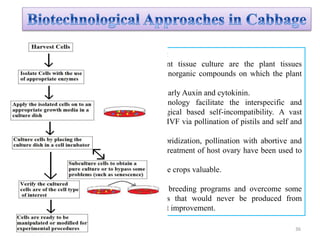
cross pollination of ovules.
the use of delayed pollination, distant hybridization, pollination with abortive and
irradiated pollen and physical and chemical treatment of host ovary have been used to
implied haploidy.
Embryo culture is another kind used to make crops valuable.
These technologies could easily simplify breeding programs and overcome some
important economical and agronomic traits that would never be produced from
conventional ways of plant breeding and plant improvement.
36
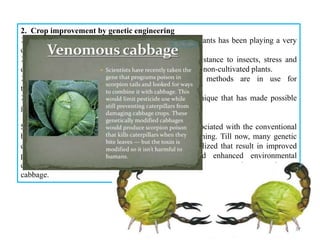
2. Crop improvement by genetic engineering
 Gene transfer between unrelated species of plants has been playing a very
crucial role in Cole crop improvement.
 By transforming genes many useful traits like resistance to insects, stress and
disease has been transferred to many crop varieties from non-cultivated plants.
 Recombinant DNA methods and many other methods are in use for
transformation of genetic information.
 Genetic engineering is a DNA recombination technique that has made possible
gene transfer between dissimilar genera or species.
Secondly, as it avoids the problem of linkage drag associated with the conventional
breeding it is more effective and it is less time consuming. Till now, many genetic
engineered crops have been developed and commercialized that result in improved
production efficiency, increased market focus and enhanced environmental
conservation. Such crops include longer post-harvest storage insect resistance
cabbage.
37
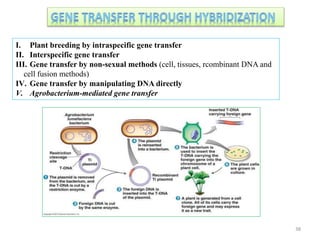
I. Plant breeding by intraspecific gene transfer
II. Interspecific gene transfer
III. Gene transfer by non-sexual methods (cell, tissues, rcombinant DNA and
cell fusion methods)
IV. Gene transfer by manipulating DNA directly
V. Agrobacterium-mediated gene transfer
38
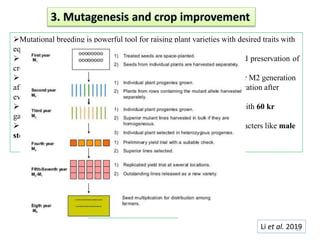
Mutational breeding is powerful tool for raising plant varieties with desired traits with
equally beneficial to food crop as well horticulture.
Induced mutations can play an important role in the conservation and preservation of
crop biodiversity.
In this approach, mutants with desired traits were selected in the M1 or M2 generation
after treatment with mutagens and then released as new variety for cultivation after
evaluation and trials.
Mutant 19P-2 of variety Kjure17 was induced by irradiating seeds with 60 kr
gamma rays was semi sterile.
 Mutation breeding is resorted to eliminate defects and to induce characters like male
sterility.
Non-heading mutant fg-1
Li et al. 201939
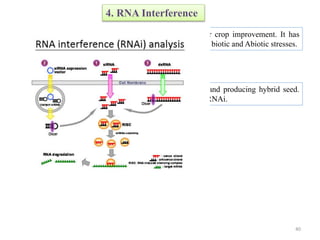
4. RNA Interference
RNA interference is an emerging tool in biotechnology for crop improvement. It has
been widely used for increasing crop yield, resistance against biotic and Abiotic stresses.
5. RNAi for Male Sterility
RNAi has also been used for generating sterility in seeds and producing hybrid seed.
Genes that involved in pollen production can be targeted by RNAi.
40
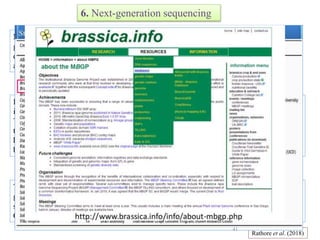
Next-generation sequencing (NGS) technology is the cutting-edge technology for
genome sequencing of several species. It has been proved an essential gadget for
development of novel or atypical molecular markers and determining genes of
agricultural importance.
6. Next-generation sequencing
Bioinformatics resources in addition to different web databases are providing vast
information about the genomic data that is largely required for the research purpose.
The bioinformatics is providing crucial information about the genomic data of crops and
the sequence of many genes are being explored by this technology. This could possibly
help us to sequence the corps which is economically important and the traits that are more
beneficial.
The positive effects observed by using these Nano-particles include enhanced
germination, enhanced length of roots and shoots, and increased vegetative biomass of
seedlings in many crops. Ti02 Nano-particles have been known to enhance the growth of
Cabbage
Rathore et al. (2018)
41
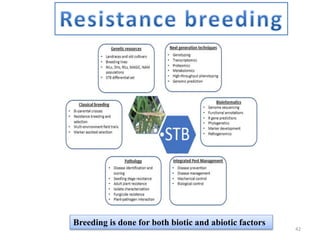
Breeding is done for both biotic and abiotic factors
42
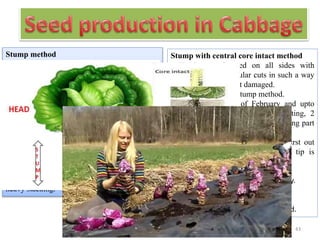
Stump method
• Heads examined for trueness to type
• Heads are cut just below the base by means of
sharp knife, keeping the stem with outer whorl
of leaves.
• Beheaded portion of plant is called stump.
• After dormancy is broken , buds sprout from
axils of all leaves and leaf scars.
Advantages:
• Extra income
• Matures 12 - 15 days earlier.
• Seed yield is increased.
Disadvantages:
• Flowering shoots are decumbent and requires
heavy stacking.
Stump with central core intact method
• Heads are chopped on all sides with
downward perpendicular cuts in such a way
that central core is not damaged.
• Improvement over stump method.
• During last week of February and upto
15th March when head starts bursting, 2
vertical cuts are given.(Central growing part
not injured)
• In absence of such cuts, heads burst out
irregularly and sometimes growing tip is
broken.
Advantages:
• Very heavy stacking is not necessary.
• Seed yield is increased.
Disadvantages:
• Chopped heads cannot be marketed.
43
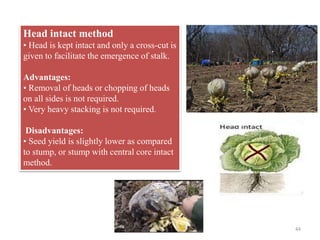
Head intact method
• Head is kept intact and only a cross-cut is
given to facilitate the emergence of stalk.
Advantages:
• Removal of heads or chopping of heads
on all sides is not required.
• Very heavy stacking is not required.
Disadvantages:
• Seed yield is slightly lower as compared
to stump, or stump with central core intact
method.
44
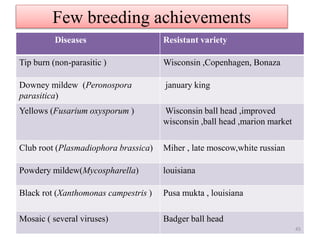
Few breeding achievements
Diseases Resistant variety
Tip burn (non-parasitic ) Wisconsin ,Copenhagen, Bonaza
Downey mildew (Peronospora
parasitica)
january king
Yellows (Fusarium oxysporum ) Wisconsin ball head ,improved
wisconsin ,ball head ,marion market
Club root (Plasmadiophora brassica) Miher , late moscow,white russian
Powdery mildew(Mycospharella) louisiana
Black rot (Xanthomonas campestris ) Pusa mukta , louisiana
Mosaic ( several viruses) Badger ball head
45
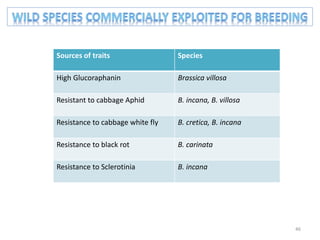
Sources of traits Species
High Glucoraphanin Brassica villosa
Resistant to cabbage Aphid B. incana, B. villosa
Resistance to cabbage white fly B. cretica, B. incana
Resistance to black rot B. carinata
Resistance to Sclerotinia B. incana
46
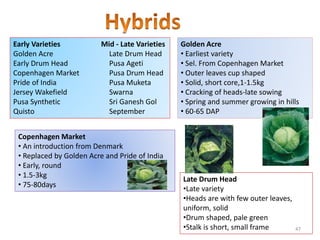
Early Varieties Mid - Late Varieties
Golden Acre Late Drum Head
Early Drum Head Pusa Ageti
Copenhagen Market Pusa Drum Head
Pride of India Pusa Muketa
Jersey Wakefield Swarna
Pusa Synthetic Sri Ganesh Gol
Quisto September
Copenhagen Market
• An introduction from Denmark
• Replaced by Golden Acre and Pride of India
• Early, round
• 1.5-3kg
• 75-80days
Golden Acre
• Earliest variety
• Sel. From Copenhagen Market
• Outer leaves cup shaped
• Solid, short core,1-1.5kg
• Cracking of heads-late sowing
• Spring and summer growing in hills
• 60-65 DAP
Late Drum Head
•Late variety
•Heads are with few outer leaves,
uniform, solid
•Drum shaped, pale green
•Stalk is short, small frame 47
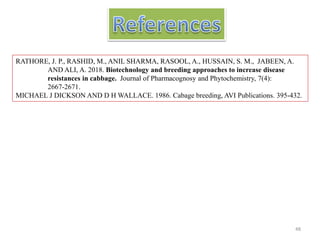
RATHORE, J. P., RASHID, M., ANIL SHARMA, RASOOL, A., HUSSAIN, S. M., JABEEN, A.
AND ALI, A. 2018. Biotechnology and breeding approaches to increase disease
resistances in cabbage. Journal of Pharmacognosy and Phytochemistry, 7(4):
2667-2671.
MICHAEL J DICKSON AND D H WALLACE. 1986. Cabage breeding, AVI Publications. 395-432.
48
49

Cole crops: Cabbage

  • 1.
  • 2.
  • 3.
     The terms"cold" and "cole" sound the same but have different meanings. "Cold" refers to temperature.  "Cole" refers to any of various plants belonging to the Cruciferae or mustard family.  The mustard family includes cool season crops such as Brussels sprout, cabbage, cauliflower.  The close kinship of these crops enable diversified usage of plant parts.  The flowers, seeds, stalks, and tender leaves of many species of Brassica can be eaten raw or cooked. Almost all parts of some species have been developed for food, including the root (rutabaga, turnip), stems - kohlrabi, leaves - cabbage, collard greens, kale, flowers - cauliflower, broccoli, buds - Brussels sprouts, cabbage, and seeds (many, including mustard seed, and oil-producing rapeseed).  Cole crops are rich source of vitamins A and C. They also contain appreciable amount of minerals like phosphorus, potash, calcium, sodium and iron. Dhaliwal, 2017 3
  • 4.
    Nath, 1976 • Culinaryuse-rangingfromeatingrawandsimplesteamingtopickling,stewing,braising. •Lowincarbohydrates,fats,calories.Goodsourceofprotein(balanced),minerals,vitaminA, vitaminC andvitaminD. • Knownfor anticancerproperties(-indole-3-carbinol). • Cabbagejuice:againstpoisonousmushroom. • Consists of Flavonouscompound:Sinigrin • Includes antioxidants are ascorbic acid, tocopherols, carotenoids, isothiocyanates, indoles, flavanoids. • As a medicinal herb to prevent the effects of alcohol, as compresses for ulcers and breast abscesses,treatmentsfor rheumatism,sorethroat,hoarseness,colic,andetc. 4
  • 5.
    Cole Crops include: Cabbage- Brassica olerace var capitata Kohl rabi - Brassica oleracea var gongylodes Cauliflower - Brassica oleracea var botrytis Broccoli - Brassica oleracea var italica Brussels Sprouts - Brassica oleracea var gemmifera Kale - Brassica oleracea var acephala Cabbage Knol-khol CauliflowerBroccoliBrussel sprouts Kale 5
  • 6.
  • 7.
  • 8.
    Crops Scientific name Chromosome no.(2n) Typeofpollination Plantpart used Cabbage Brassica oleraceae(L.) var. capitata 18 Cross pollination (73 %) Head Cauliflower Brassica oleraceae (L.) var. botrytis 18 Crosspollination (70 %) Curd Knolkhol Brassica oleraceae(L.) var. gongylodes 18 Cross pollination (91 %) Swollen stem Brussels Brassica oleraceae (L.) var. gemnifera 18 Crosspollination (72 %) Sprouts Sprouting broccoli Brassica oleraceae (L.) var. italica 18 Crosspollination (95 %) Flower heads Kale Brassica oleraceae (L.) var. acephala 18 Crosspollination (83 %) Topleaves 8
  • 9.
    Kingdom - Plantae Phylum- Tracheophytes Class - Angiosperms Order - Brassicales Family - Brassicaceae Genus - Brassica Species - oleracea Binomial nomenclature - Brassica oleracea L. Chromosome number - 2n = 2x= 18 Origin - Coastal area of the Mediterranean Sea. Genome - CC The word cabbage was derived from the French word ‘caboche’, meaning head. The Latin name Brassica was derived fromthe Celticword‘bresic’alsomeaningcabbage. 9
  • 10.
     Cabbage: Excellentsource of Vitamin C. In addition to containing some B vitamins  Cabbage supplies some minerals like potassium, Phosphorus, sodium, calcium and iron into the diet.  It provides the roughage that prevents constipation. Cabbage is consumed after cooking and fresh in salads. Dhaliwal, 2017 Per 100 g of cabbage Carbohydrates 4.6 g Proteins 1.8 g Moisture 91.9 % Fat 0.1 g β- Carotene 1200 μg Thaimine 0.06 mg Riboflavin 0.09 mg Vitamin C 124 mg Calcium and iron 39 and 0.8 mg 10
  • 11.
     Cabbage hasworldwide distribution and is grown in Europe, India, Indonesia, Malaysia, Philippines, Central, East and West Africa, Central and South America and the Caribbean.  Important cabbage growing counties include China, India, Russia, Republic of Korea, Japan, Poland, USA, Indonesia and Ukraine.  India is the second largest producer of cabbage in the world with annual production of 60 lakh MT.  Cabbage is the fourth most widely grown vegetable crop of India. Odisha, Bihar and Uttar Pradesh rank first, second and third in total area occupied, whereas, in total production Uttar Pradesh, Odisha and Bihar rank first, second and third respectively.  The other important cabbage growing states are West Bengal, Assam, Maharashtra, Karnataka, Gujarat, Rajasthan, Uttar Pradesh and Haryana. 11
  • 12.
    Discovery Cabbage DrumheadCabbage Early jersey WakefieldCabbage Ferry’s round Dutch Cabbage Glory of Enkhulzen cabbage King Slaw 3C2abbage Golden Acre cabbage Red Acre Cabbage Beauty perfect cabbageGolden Cross cabbage All Season cabbage Brunswick cabbage Charleston Wakefield Copenhagen market Cabbage Cabbage Danish Ball head Cabbage Red Express Cabbage Earliana Cabbage 12
  • 13.
    33 Blues Chinese cabbage Chinaexpress Chinese cabbage Jade Pagoda Chinese cabbage Joi Choi Chinese Cabbage Ching Chiang Chinese Cabbage Pae Choi Chinese Cabbage Monument Chinese cabbage Michi hill Chinese cabbage Wong Bok Chinese cabbage Rubicon ChineseCabbage Taisai Chinese Cabbage Chinese Cabbage varieties Mej Qing Choi chinese cabbage 13
  • 14.
    The inflorescence may attendthe length of 1-2 m.  The slender pedicels are 1.5- 2cm long. https://archive.org/stream/breedingplantsof532pear/breedingplantsof532pear_djvu.txt 14
  • 15.
    Arrangement of Floralwhorl in a Cabbage 15
  • 16.
     The budsopen under pressure of rapidly growing petals and become fully expanded in about 12 hrs.  Flowers are slightly protogynous (5 days earlier) and cabbage is naturally cross- pollinated due to sporophytic self-incompatibility.  Bud pollination is effective to achieve selfing.  For cross-pollination flower buds expected to open within 1-2 days are emasculated and are pollinated immediately with desired pollen using a brush/flower stamens.  Cytoplasmic and genetic male sterility is also noticed in certain lines. 16
  • 17.
     Anthesis, orexpansion of the floral parts, usually begins about 4 to 5 pm.  The petals and stamens start to elongate and force the sepals apart.  Early the next morning the petals have practically completed their growth and appear as a tightly rolled cylinder.  Anthesis is completed by the reflexing of these petals to form the typical yellow cross-shaped flower.  The pollen is released early in the first day the flower is open by a longitudinal split in the anther and a reflexing movement of the anther walls.  This movement is not completed for several hours https://www.britannica.com/plant/cabbage 17
  • 18.
     Insects visitthe flower freely. Honeybees, although usually plentiful, often fail to be very efficient, because if they do not work at temperatures below 60° F.  If Bumblebees are very plentiful in but usually a few of them are collecting pollen in nearby every field.  Representatives of several families of solitary bees visit the flowers in search of both pollen and nectar. As these bees work at lower temperatures than honeybees, they are probably a very important factor in cabbage seed production. 18
  • 19.
    Homomorphic system typeSporophytic self incompatibility (SSI) i.e. in cabbage it is confirmed by (Adamson 1965). It is controlled by single s-locus with multiple allele but also reported more than one loci, more than 80 s- alleles reported in Brassica family. A classical genetic analysis has grouped the Brassica S-alleles into two categories based on their phenotypic effect on self-incompatibility characteristics. First group of alleles High activity Second group of alleles Low activity The first group of alleles (high- activity) are placed relatively high on the dominance scale and exhibit a strong self- incompatible phenotype in which an average of 0 to 10 pollen tubes develop per selfpollinated stigma The second group of alleles (low- activity) demonstrate a weak or leaky self incompatible phenotypic effect in which 10 to 30 pollen tubes develop per self-pollinated stigma and they are considered to be recessive (Nasrallah et al. 1991) The compatible and incompatible reaction of pollen and stigma depends on Genotypes (homozygous/heterozygous) of male and female plant at S locus Interactions between the two S alleles Dominance (S1 > S2) Co-dominance (S1 = S2) Mutual weakening (no action by either allele) Intermediate gradation (1-100% activity by each allele) Molecular Mechanism of SSI (Takayama and Isogai 2005) 19
  • 20.
    Male sterility Genic malesterility has been reported in cabbage (Rundfeldt 1960). Ogura CMS system (Intergeneric crosses) Ogura male sterilitywas reported in Japanese radish, (Ogura 1968) CMS induced by interspecific cross B. oleracea with rutabaga – B. napobrassica (Chiang, Crete 1985, 1987) transfer resistance against Plasmodiophora brassicae.  EGMS is more popularly termed as “Two line Hybrid Breeding” as against “Three Line Hybrid Breeding” in case of CMS system. In Cabbage the TGMS mutant is activated at temperature <10o C, Which makes the parent male sterile. (Rundfeldt, 1961). 20
  • 21.
    Self-incompatibility Name of thehybrid Type of Genetic Mechanism (Parentage) Developing Institution KGMR-1, BRH-5 Self-Incompatibility (KGMR-1=83-1-621 x GA-111) IARI regional station, Katrain H-43,H-44 Self-Incompatibility (H-43=S2S2 x Pusa Mukta), (H-44=S2S2 x Cornell 83-6 IARI regional station, Katrain Male sterility KCH-5 Ogura CMS IARI regional station, Katrain H-11, H-46 CMS (H-11=Cornell 83- 23 x golden acre), (H-46=Cornell 83-23 x golden acre) IARI regional station, Katrain 21
  • 22.
  • 23.
    Classification of variability Basedon Colour and form of heads 1.White cabbage : B. oleracean var. Capitata L. f. alba 2.Red cabbage : B. oleracean var. capitata L. f. rubra 3.Savoy cabbage : B. oleraceae var. capitata L. f. sabauda Based on Place of origin: 1 Mediterranean cabbage : B.O. var. capitata ssp. mediterranean 2 Oriental cabbage: B.O. var. cap. ssp. orientalis 3 European cabbage. B.O. var. cap. ssp. europea Round Drum Pointed 23
  • 24.
    Based on Headshape: 1 Round shape: Eg. Golden Acre, Pride of India, Copenhagen Market 2. Flat head / drum head: Eg. Pusa Drum Head 3. Conical head: Eg. Jersey Wakefield 4. Savoy type: Eg. Chieftain Golden Acre Copenhagen Market Pusa Drum Head Jersey Wakefield Chieftain 24
  • 25.
    Myers classification basedon size and shape of head 1. Wakefield and Winning Kadt group – Small, conical, early, Eg. Jersey Wakefield. 2. Copenhagen Market – Round, early, large heads – Eg. Copenhagen Market 3. Flat Head / Drum Head – Eg. Pusa Drum Head 4. Savoy group – Wrinkled leaves, high quality : Eg. Drum Head Savoy 5. Danish Ball head _ Thin leaves, Compact head, fine texture Eg. Danish Ball Head 6. Alpha group – Earliest group, very small head, solid Eg. Miniature marrow 7. Volga group – Thick leaves, loose bottom Eg. Volga 8. Red cabbage : Similar to Danish ball head but have red colour leaves Eg. Red Rock. Allen, 1914 25
  • 26.
    Plant genetic resourcesare the backbone of any crop breeding programme. In 1982, the IPGRI has sponsored several missions to collect wild Brassica species. 1. Poly-tech University, Madrid, Spain 2. University of Tohoku, Sendai, Japan 3. Gene Bank of country from where samples are collected. Research and breeding stations in India 1. IARI, Research S tation., Katrain (Kullu Valley) H.P. 2. Dr. Y.S Parmar University of Horticulture and Forest, Solan. Kalpa. 26
  • 27.
    The main purposeof breeding is due to self-incompatibility and poor yielding. Reason for low yield: 1. Poor quality seeds 2. Lack of suitable cultivars for mild winter. 3. Lack of suitable agro techniques. The self-incompatibility is used to produce hybrid seeds in cabbage and other cole crops, namely, cauliflower, broccoli, Brussels sprouts, and kale. The individual plants are self- pollinated through bud-pollination. Selection is applied for desirable characters and strong level of self-incompatibility. This way several self-incompatible, but cross-compatible inbreds having different S- alleles are developed . Cabbage was introduced much earlier than cauliflower by Portuguese. It was grown during Mughal period Breeding in India Develoment of inbred lines in Cabbage 27
  • 28.
    From the aboveslides, the resultant inbred lines such as S1S1 and S2S2 lines are planted in alternate rows in isolation and seed set on each line will be mostly hybrid seed where cross-fertilization is brought about by pollinating insects, mostly bees. The cross compatibility between inbreds of S1S1 and S2S2 assures the production of F1 hybrid seed. The kinds of Cabbage hybrids are 1. Single Cross - (S1S1 x S2S2) 2. Double Cross - (S1S1 x S2S2) X (S3S3 x S4S4) 3. Top Cross - S1S1 / S2S2 / S3S3 / S4S4 X OPV 28
  • 29.
    1. High yield 2.Longer staying capacity in field after head formation/greater field holding capacity 3. Desirable head weight (1 – 1.5 kg) 4. Early head formation/early maturity 5. Storage ability (Storability) 6. Head shape and colour as per preference of consumers (essentially round heads, light green-green colour) 7. Less proportion of outer/wrapper leaves 8. Short and narrow cone 9. Firm head with short internal stem 10. Ability to tolerate frost 11. Resistance to diseases: i. Black rot (Xanthomonas campestris) ii. Alternaria leaf spot (Altemaria ssp.) iii. Black leg (Leptosphaeria maculans) 12. Tolerance to insect – Pests Diamond back moth (Plutella xylostella), cabbage moth (Mamestra brassicae), cabbage root fly (Delia radicum), cabbage maggot (Hylemya brassicae) and cabbage white butterfly(Pieris rapae) 29
  • 30.
    1. Conventional Breedingmethods In conventional breeding, progeny inherit genes for both desirable and undesirable traits from both parents. Breeders conserve desired characteristics and suppress undesirable ones by repeatedly selecting meritorious individuals from each generation to be the parents of the next. 2. Non-conventional Breeding methods In non-conventional breeding, encompasses essential all cell and tissue culture technique that assist in propagating studying and manipulating the plant gene without use of sexual cycle. 30
  • 31.
    Cabbage is ahighly cross pollinated crops. Following breeding methods are used for cabbage. A. Conventional Methods C. Mutagenesis and crop improvement 1. Introduction D. RNA interferance 2. Mass selection E. RNAi for male sterility 3. Family breeding F. Next generation sequencing 4. Recurrent selection G. Bioinformatics tools in crop improvement 5. Heterosis Breeding H. Nanotechnology in crop improvement 6. Pedigree method 7. Bulk method B. Biotechnological Approaches 1. Plant tissue culture 2. Genetic Engineering Gene transfer through hybridization a) Interspecific and intraspecific gene transfer b) Gene transfer by non-sexual methods c) Gene transfer by manipulating DNA directly d) Agrobacterium mediated gene transfer Rathore et al. (2018) 31
  • 32.
    1. Introduction Introduced materialsmay be valuable in selecting desirable plants. In case of non- uniform introductions the desirable plants can be selected, their progeny increased, purified and later tested against the standard or local varieties for selecting the most promising lines. The chances of an introduction depends to a great extent upon the relationship between the agro climates, particularly temperature and day length of the donor and receptor areas. Promising in India – Golden Acre, August, Copenhagen Market. 2. Mass selection: In this method the best individual plants are selected in the population and their seeds are composited for following generation. Since the mass selection is made exclusively based on the phenotype of the plants without any progeny testing, the success of selection depends upon the heritability of the characters under selection. Characters which can be improved are 1. Maturity: days to 50 per cent heading (earliness) 2. Stalk length 3. Number of non wrapper leaves 4. Frame or plant spread 5. Shape of head – polar and equatorial diameter. Normal or spherical head: 0.8- 1.0 shape index(SI). Drum head ; SI < 0.5, conical head SI > 1.0 6. Compactness of head – associated with short sized core 7. Net weight of head < 750 g 8. Number of marketable heads 9. Yield 32
  • 33.
    3. Family breeding Thereis elaborate testing of progenies not only in F1 generation but also in later 2 or 3 generations and usually more than one cycle of selection. This method is practised in beet and can also be adopted in radish, carrot and cauliflower. 4. Recurrent selection The source population of recurrent selection is heterozygous. It may be an open pollinated variety, single cross or double cross F1 hybrid, intercrossed progenies of selected inbred lines, a synthetic variety or a composite. There are four types of recurrent selection viz. simple recurrent selection, recurrent selection for general combining ability and recurrent selection for specific combining ability, recurrent selection for general and specific combining ability and reciprocal recurrent selection. 33
  • 34.
    5. Heterosis breeding Thehybrid varieties are developed by exploiting the dominance variance in heterosis breeding. Hybrids are available for commercial cultivation in all the cross pollinated crops like cole crops and cucurbits etc. For the last two decades, vegetable breeders in India diverted their attention toward the development of hybrids and disease resistant varieties/hybrids. Vegetables have great potential for export and after value addition these can become an important commodity of agricultural export out of India. 34
  • 35.
    6) Pedigree method Itstarts with the crossing of two genotypes, each of which have one or more desirable characters lacked by the other. If the two original parents do not provide all of the desired characters, a third parent can be included by crossing it to one of the hybrid progeny of the first generation (F1). In the pedigree method superior types are selected in successive generations, and a record is maintained of parent–progeny relationships. When the number of families has been reduced to manageable proportions by visual selection, usually by the F7 or F8 generation, precise evaluation for performance and quality begins. The final evaluation of promising strains involves (1) observation, usually in a number of years and locations, to detect weaknesses that may not have appeared previously; (2) precise yield testing; and (3) quality testing.  Selection 8 (Pusa Mukta) is a selection from EC 10109 X EC 24855, resistant to Black rot. Developed at Katrain 7) The bulk-population method The breeding differs from the pedigree method primarily in the handling of generations following hybridization. The F2 generation is sown at normal commercial planting rates in a large plot. Two types of artificial selection also are often applied: (1) destruction of plants that carry undesirable major genes and (2) mass techniques such as harvesting when only part of the seeds are mature to select for early maturing plants or the use of screens to select for increased seed size. The chief advantage of the bulk population method is that it allows the breeder to handle very large numbers of individuals inexpensively. 35
  • 36.
    1. Plant tissueculture in crop improvement  The things required for the plant tissue culture are the plant tissues (explants), medium containing organic and inorganic compounds on which the plant could grow and develop. A high amount of growth hormones particularly Auxin and cytokinin. Crops used to produce from this technology facilitate the interspecific and intergeneric crosses to overcome physiological based self-incompatibility. A vast variety of crops has been recovered through IVF via pollination of pistils and self and cross pollination of ovules. the use of delayed pollination, distant hybridization, pollination with abortive and irradiated pollen and physical and chemical treatment of host ovary have been used to implied haploidy. Embryo culture is another kind used to make crops valuable. These technologies could easily simplify breeding programs and overcome some important economical and agronomic traits that would never be produced from conventional ways of plant breeding and plant improvement. 36
  • 37.
    2. Crop improvementby genetic engineering  Gene transfer between unrelated species of plants has been playing a very crucial role in Cole crop improvement.  By transforming genes many useful traits like resistance to insects, stress and disease has been transferred to many crop varieties from non-cultivated plants.  Recombinant DNA methods and many other methods are in use for transformation of genetic information.  Genetic engineering is a DNA recombination technique that has made possible gene transfer between dissimilar genera or species. Secondly, as it avoids the problem of linkage drag associated with the conventional breeding it is more effective and it is less time consuming. Till now, many genetic engineered crops have been developed and commercialized that result in improved production efficiency, increased market focus and enhanced environmental conservation. Such crops include longer post-harvest storage insect resistance cabbage. 37
  • 38.
    I. Plant breedingby intraspecific gene transfer II. Interspecific gene transfer III. Gene transfer by non-sexual methods (cell, tissues, rcombinant DNA and cell fusion methods) IV. Gene transfer by manipulating DNA directly V. Agrobacterium-mediated gene transfer 38
  • 39.
    Mutational breeding ispowerful tool for raising plant varieties with desired traits with equally beneficial to food crop as well horticulture. Induced mutations can play an important role in the conservation and preservation of crop biodiversity. In this approach, mutants with desired traits were selected in the M1 or M2 generation after treatment with mutagens and then released as new variety for cultivation after evaluation and trials. Mutant 19P-2 of variety Kjure17 was induced by irradiating seeds with 60 kr gamma rays was semi sterile.  Mutation breeding is resorted to eliminate defects and to induce characters like male sterility. Non-heading mutant fg-1 Li et al. 201939
  • 40.
    4. RNA Interference RNAinterference is an emerging tool in biotechnology for crop improvement. It has been widely used for increasing crop yield, resistance against biotic and Abiotic stresses. 5. RNAi for Male Sterility RNAi has also been used for generating sterility in seeds and producing hybrid seed. Genes that involved in pollen production can be targeted by RNAi. 40
  • 41.
    Next-generation sequencing (NGS)technology is the cutting-edge technology for genome sequencing of several species. It has been proved an essential gadget for development of novel or atypical molecular markers and determining genes of agricultural importance. 6. Next-generation sequencing Bioinformatics resources in addition to different web databases are providing vast information about the genomic data that is largely required for the research purpose. The bioinformatics is providing crucial information about the genomic data of crops and the sequence of many genes are being explored by this technology. This could possibly help us to sequence the corps which is economically important and the traits that are more beneficial. The positive effects observed by using these Nano-particles include enhanced germination, enhanced length of roots and shoots, and increased vegetative biomass of seedlings in many crops. Ti02 Nano-particles have been known to enhance the growth of Cabbage Rathore et al. (2018) 41
  • 42.
    Breeding is donefor both biotic and abiotic factors 42
  • 43.
    Stump method • Headsexamined for trueness to type • Heads are cut just below the base by means of sharp knife, keeping the stem with outer whorl of leaves. • Beheaded portion of plant is called stump. • After dormancy is broken , buds sprout from axils of all leaves and leaf scars. Advantages: • Extra income • Matures 12 - 15 days earlier. • Seed yield is increased. Disadvantages: • Flowering shoots are decumbent and requires heavy stacking. Stump with central core intact method • Heads are chopped on all sides with downward perpendicular cuts in such a way that central core is not damaged. • Improvement over stump method. • During last week of February and upto 15th March when head starts bursting, 2 vertical cuts are given.(Central growing part not injured) • In absence of such cuts, heads burst out irregularly and sometimes growing tip is broken. Advantages: • Very heavy stacking is not necessary. • Seed yield is increased. Disadvantages: • Chopped heads cannot be marketed. 43
  • 44.
    Head intact method •Head is kept intact and only a cross-cut is given to facilitate the emergence of stalk. Advantages: • Removal of heads or chopping of heads on all sides is not required. • Very heavy stacking is not required. Disadvantages: • Seed yield is slightly lower as compared to stump, or stump with central core intact method. 44
  • 45.
    Few breeding achievements DiseasesResistant variety Tip burn (non-parasitic ) Wisconsin ,Copenhagen, Bonaza Downey mildew (Peronospora parasitica) january king Yellows (Fusarium oxysporum ) Wisconsin ball head ,improved wisconsin ,ball head ,marion market Club root (Plasmadiophora brassica) Miher , late moscow,white russian Powdery mildew(Mycospharella) louisiana Black rot (Xanthomonas campestris ) Pusa mukta , louisiana Mosaic ( several viruses) Badger ball head 45
  • 46.
    Sources of traitsSpecies High Glucoraphanin Brassica villosa Resistant to cabbage Aphid B. incana, B. villosa Resistance to cabbage white fly B. cretica, B. incana Resistance to black rot B. carinata Resistance to Sclerotinia B. incana 46
  • 47.
    Early Varieties Mid- Late Varieties Golden Acre Late Drum Head Early Drum Head Pusa Ageti Copenhagen Market Pusa Drum Head Pride of India Pusa Muketa Jersey Wakefield Swarna Pusa Synthetic Sri Ganesh Gol Quisto September Copenhagen Market • An introduction from Denmark • Replaced by Golden Acre and Pride of India • Early, round • 1.5-3kg • 75-80days Golden Acre • Earliest variety • Sel. From Copenhagen Market • Outer leaves cup shaped • Solid, short core,1-1.5kg • Cracking of heads-late sowing • Spring and summer growing in hills • 60-65 DAP Late Drum Head •Late variety •Heads are with few outer leaves, uniform, solid •Drum shaped, pale green •Stalk is short, small frame 47
  • 48.
    RATHORE, J. P.,RASHID, M., ANIL SHARMA, RASOOL, A., HUSSAIN, S. M., JABEEN, A. AND ALI, A. 2018. Biotechnology and breeding approaches to increase disease resistances in cabbage. Journal of Pharmacognosy and Phytochemistry, 7(4): 2667-2671. MICHAEL J DICKSON AND D H WALLACE. 1986. Cabage breeding, AVI Publications. 395-432. 48
  • 49.