Keratoprosthesis – A Long term
review

Br J Ophthalmol, 1983 July ; 67 (7) 468 -474
JJ Barnham and MJ Roper Hall
AIM of the study


The aim of this study was to review the 35
patients with 55 KP insertions with regard to
visual outcome, length of time vision
maintained,retention time and complications
Patients and methods






Thirty five patients were reviewed with a total of
55 KP insertions of which 39 were 1 st timers, 8
were 2 nd, 4 were 3 rd, 3 were 4 th 1 was 5 th in a
single eye.
Follow up time ranged from 1 month to 15 yrs with
only 4 patients been followed up for less than 6
months.
A preoperative diagnosis of Bullous keratopathy
was made in 20 patients of which 16 followed
cataract extraction, 1 followed lens dislocation,3
had fuch’s dystrophy - surgery unrelated.




Of remaining 15 pts ,3 had corneal damage
following perforating injury , 2 followed
explosion, 1 followed lime burn, 1 had thermal
burn sustained in road accident . 4 had
herpetic keratitis , 1 interstitial keratitis, 2 had
band keratopathy following iridocyclitis , 1 had
SJ syndrome.
49 underwent penetrating KP and 6 underwent
Intralamellar KP.
References
1.DeVoe AG . A current evaluation of Corneal
prosthetic devices. Arch Ophthalmol
1967;78:269-71
2. Giles CL. Henderson JW . Keratoprosthesis :
current status.Am J Med Sci 1967 ; 253:239-42
3.Girard IJ . Hawkin RS. Nieves R, et al.
Keratoprosthesis : a 12 – year follow up.Trans
Am Acad Ophthalmol Otolaryngol 1977;83:25267


Keratoprosthesis is a surgical procedure
where a severely damaged or diseased
cornea is replaced with an artificial cornea to
restore useful vision or to make the eye
comfortable in painful keratopathy






It is a double plated PMMA device with a
central rigid optic that perforates Cornea .
Type 1 is a collar button shaped device with
front plate ,central optic stem, back plate .
Type 2 is a through – the – lid design with a 2
mm anterior nub designed to penetrate
through a tarsorrhaphy
When use a Boston type 1
Keratoprosthesis ?


When corneal transplant carries a particular
poor prognosis
1. Multiple corneal transplant rejection & failures
2. Tear deficiency syndromes
3.Eyelid contour irregularities
4.Aniridia
5.Chemical /thermal injury
When use a Boston type 2
Keratoprosthesis ?



Severe Cicatrical ocular surface diseases
1.Steven Johnson syndrome/ Toxic epidermal
necrolysis
2.Severe Alkali burn
3. Mucous membrane pemphigoid
4. Severe Aqueous tear deficiency


Indications of Type 2 Boston Keratoprothesis:

When not likely to successful type 1
keratoprosthesis
- Symblepharon and loss of conjunctival fornices
- Severe keratinizing dry eye
Threaded design

Snap in design
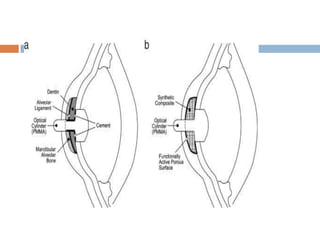
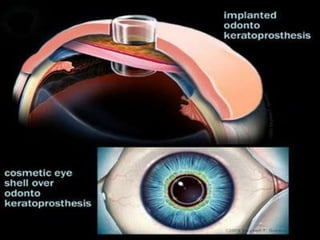
MOOKP – Eye tooth




Originally described by Strampelli later it was
Giancario Falcinelli who modified the
technique.
This technique uses a composite bone-tooth
lamina to help anchor a polymethyl
methacrylate cylinder to the cornea.
Proble
ms





Need for atleast two lengthy surgeries
Need for oral surgery
[minimum tooth size & good dental health]
Cosmetic result unacceptable
[tooth loss, protuding eye, prosthetic shell help]
Keratoprosthesis
Keratoprosthesis
Keratoprosthesis
Keratoprosthesis
Keratoprosthesis
Keratoprosthesis

Keratoprosthesis

  • 1.
    Keratoprosthesis – ALong term review Br J Ophthalmol, 1983 July ; 67 (7) 468 -474 JJ Barnham and MJ Roper Hall
  • 2.
    AIM of thestudy  The aim of this study was to review the 35 patients with 55 KP insertions with regard to visual outcome, length of time vision maintained,retention time and complications
  • 3.
    Patients and methods    Thirtyfive patients were reviewed with a total of 55 KP insertions of which 39 were 1 st timers, 8 were 2 nd, 4 were 3 rd, 3 were 4 th 1 was 5 th in a single eye. Follow up time ranged from 1 month to 15 yrs with only 4 patients been followed up for less than 6 months. A preoperative diagnosis of Bullous keratopathy was made in 20 patients of which 16 followed cataract extraction, 1 followed lens dislocation,3 had fuch’s dystrophy - surgery unrelated.
  • 4.
      Of remaining 15pts ,3 had corneal damage following perforating injury , 2 followed explosion, 1 followed lime burn, 1 had thermal burn sustained in road accident . 4 had herpetic keratitis , 1 interstitial keratitis, 2 had band keratopathy following iridocyclitis , 1 had SJ syndrome. 49 underwent penetrating KP and 6 underwent Intralamellar KP.
  • 10.
    References 1.DeVoe AG .A current evaluation of Corneal prosthetic devices. Arch Ophthalmol 1967;78:269-71 2. Giles CL. Henderson JW . Keratoprosthesis : current status.Am J Med Sci 1967 ; 253:239-42 3.Girard IJ . Hawkin RS. Nieves R, et al. Keratoprosthesis : a 12 – year follow up.Trans Am Acad Ophthalmol Otolaryngol 1977;83:25267
  • 11.
     Keratoprosthesis is asurgical procedure where a severely damaged or diseased cornea is replaced with an artificial cornea to restore useful vision or to make the eye comfortable in painful keratopathy
  • 12.
       It is adouble plated PMMA device with a central rigid optic that perforates Cornea . Type 1 is a collar button shaped device with front plate ,central optic stem, back plate . Type 2 is a through – the – lid design with a 2 mm anterior nub designed to penetrate through a tarsorrhaphy
  • 13.
    When use aBoston type 1 Keratoprosthesis ?  When corneal transplant carries a particular poor prognosis 1. Multiple corneal transplant rejection & failures 2. Tear deficiency syndromes 3.Eyelid contour irregularities 4.Aniridia 5.Chemical /thermal injury
  • 14.
    When use aBoston type 2 Keratoprosthesis ?  Severe Cicatrical ocular surface diseases 1.Steven Johnson syndrome/ Toxic epidermal necrolysis 2.Severe Alkali burn 3. Mucous membrane pemphigoid 4. Severe Aqueous tear deficiency
  • 15.
     Indications of Type2 Boston Keratoprothesis: When not likely to successful type 1 keratoprosthesis - Symblepharon and loss of conjunctival fornices - Severe keratinizing dry eye
  • 18.
  • 19.
    MOOKP – Eyetooth   Originally described by Strampelli later it was Giancario Falcinelli who modified the technique. This technique uses a composite bone-tooth lamina to help anchor a polymethyl methacrylate cylinder to the cornea.
  • 20.
    Proble ms    Need for atleasttwo lengthy surgeries Need for oral surgery [minimum tooth size & good dental health] Cosmetic result unacceptable [tooth loss, protuding eye, prosthetic shell help]