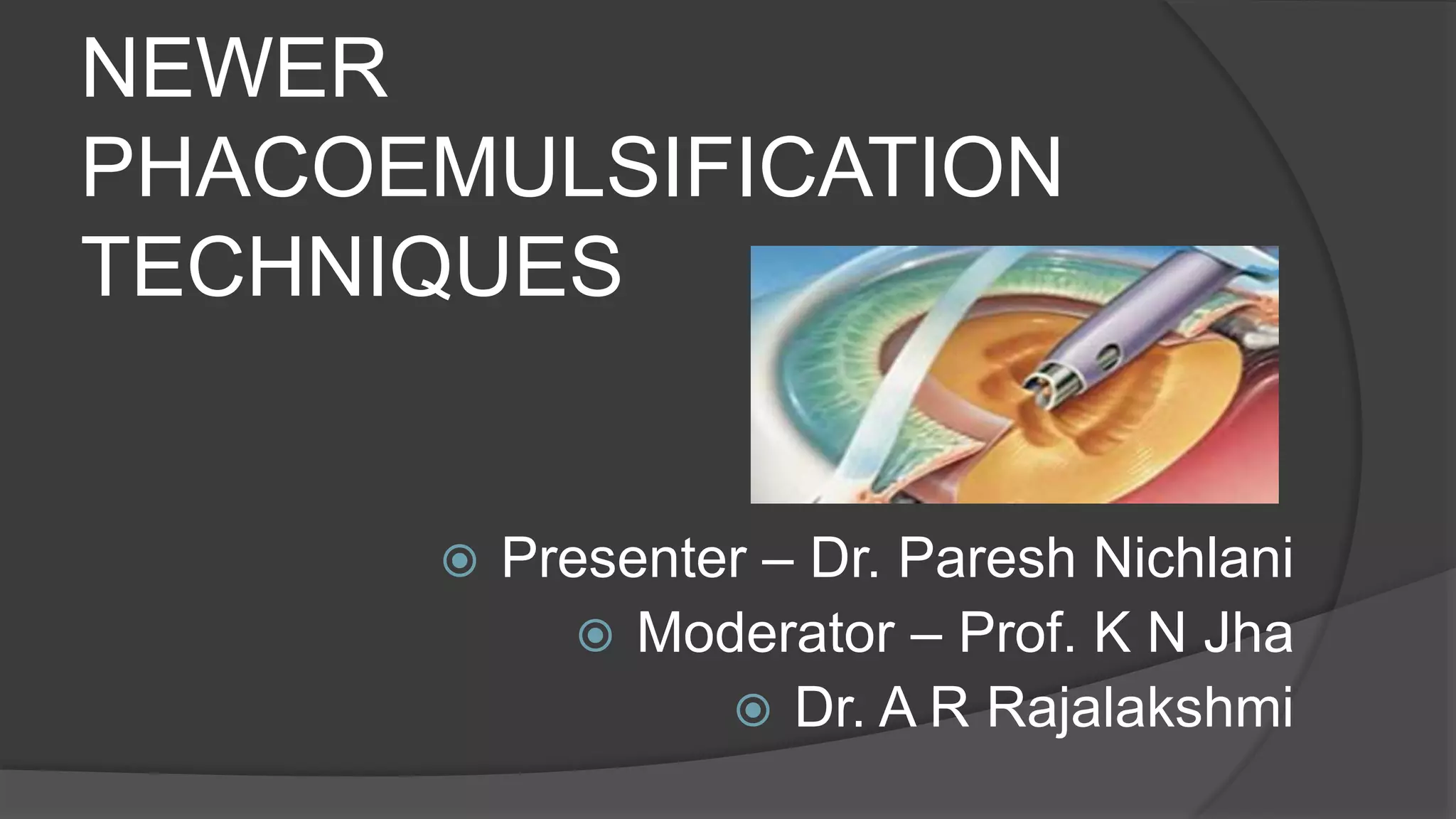
NEWER
PHACOEMULSIFICATION
TECHNIQUES
 Presenter – Dr. Paresh Nichlani
 Moderator – Prof. K N Jha
 Dr. A R Rajalakshmi
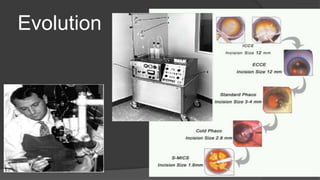
Evolution
Aims of good phaco surgery
 Low endothelial damage
 Emulsification of nucleus in less time and
using minimal power.
 No complications.
 Maintain the anterior chamber – Less
fluctuation.
 Great post operative visual acuity- Less
astigmatism.
Components of Phaco
 Ultrasound energy – Phaco power
 Fluidics-:
 Irrigation
 Aspiration
Terminologies
 Phaco Power
 Vacuum is the suction force applied
 Flow Rate is the rate of fluid flowing out of
the eye
 Rise Time is the time taken for the vacuum
to rise to the preset maximum
 Pump speed is the speed of the rotation of
the peristaltic pump.
 Venting means breaking of vacuum
 Compliance-Is inversely related to the
outflow resistance
 Followability means the ability of the phaco
tip to attract nuclear pieces.
 Holding ability is the ability of the tip to hold
the nuclear piece
 Surge – Sudden swallowing of AC
 Chatter - tendency of the vibrating phaco
tip to push away material.
 Duty cycle –Phaco power used per min
Ultrasound energy
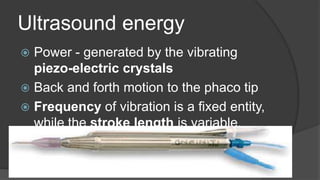
 Power - generated by the vibrating
piezo-electric crystals
 Back and forth motion to the phaco tip
 Frequency of vibration is a fixed entity,
while the stroke length is variable.
 Absolute phaco time
Fluidics
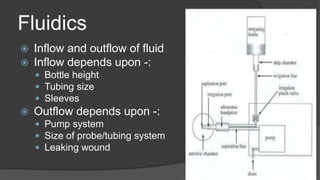
 Inflow and outflow of fluid
 Inflow depends upon -:
 Bottle height
 Tubing size
 Sleeves
 Outflow depends upon -:
 Pump system
 Size of probe/tubing system
 Leaking wound
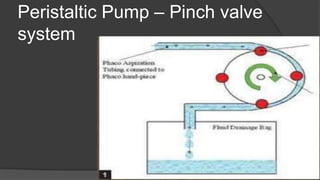
Peristaltic Pump – Pinch valve
system
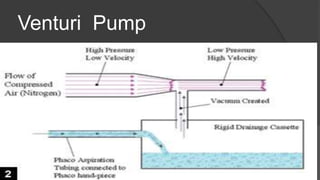
Venturi Pump
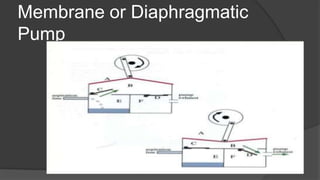
Membrane or Diaphragmatic
Pump
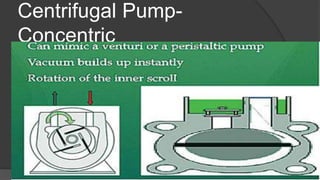
Centrifugal Pump-
Concentric
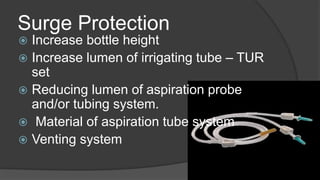
Surge Protection
 Increase bottle height
 Increase lumen of irrigating tube – TUR
set
 Reducing lumen of aspiration probe
and/or tubing system.
 Material of aspiration tube system
 Venting system
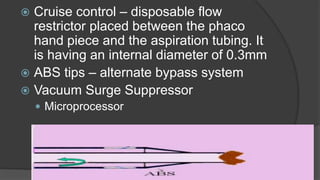
 Cruise control – disposable flow
restrictor placed between the phaco
hand piece and the aspiration tubing. It
is having an internal diameter of 0.3mm
 ABS tips – alternate bypass system
 Vacuum Surge Suppressor
 Microprocessor
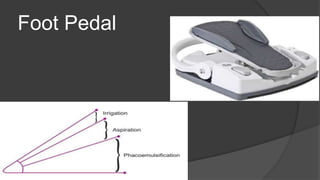
Foot Pedal
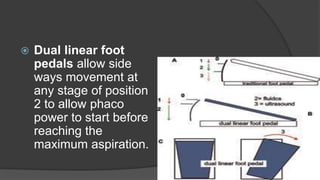
 Dual linear foot
pedals allow side
ways movement at
any stage of position
2 to allow phaco
power to start before
reaching the
maximum aspiration.
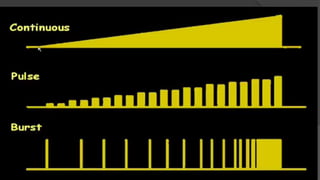
Phaco power modulation
 Panel mode – All or none
 Continuous mode
 Burst Mode
 Pulse mode
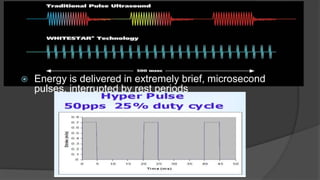
 Hyper pulse mode – Cold phaco
 Energy is delivered in extremely brief, microsecond
pulses, interrupted by rest periods
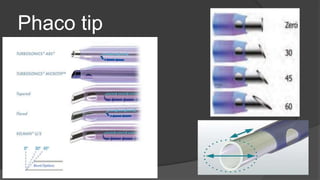
Phaco tip
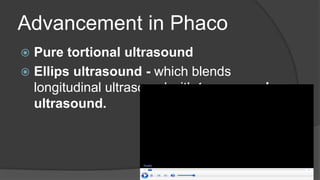
Advancement in Phaco
 Pure tortional ultrasound
 Ellips ultrasound - which blends
longitudinal ultrasound with transversal
ultrasound.
 OZil Intelligent Phaco
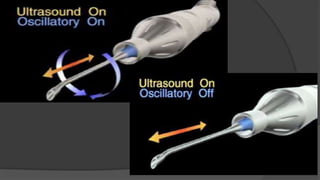
 NeoSoniX
 Uses both ultrasound and mechanical oscillation
 Control both the amplitude of the oscillation and
the threshold of ultrasound power independently
 Minimizes risk of thermal burns
 Oscillation automatically breaks occlusion and
reposition for more efficient lens removal
 AquaLase Liquefaction Device
 Uses pulsed surgical solution to safely break up
and remove the natural lens material.
 generates 4-microliter pulses of surgical solution
 Pulses are warmed at 55 degrees and
propelled by a smooth, rounded-bevel
polymer reflective tip that disperses fluid for
enhanced safety and "tissue specificity.“
 Minimizes risk of thermal incision burns almost
completely.
 Active fluidics
Foot pedal
 Non-zero start
 When you push down on the foot pedal in
foot-position three, the machine can start
at whatever power you want
 Less time spent getting to the power you
want and this makes the system more
efficient
 Wireless foot pedal
Bimanual phaco
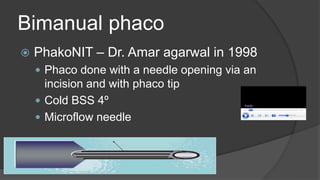
 PhakoNIT – Dr. Amar agarwal in 1998
 Phaco done with a needle opening via an
incision and with phaco tip
 Cold BSS 4º
 Microflow needle
Hand piece
 Weight – reduced from 97 grams to 46
grams
 size of phaco tip – 21g with outer
diameter of 0.8mm and inner 0.6mm
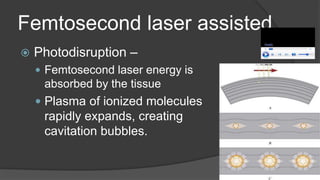
Femtosecond laser assisted
 Photodisruption –
 Femtosecond laser energy is
absorbed by the tissue
 Plasma of ionized molecules
rapidly expands, creating
cavitation bubbles.
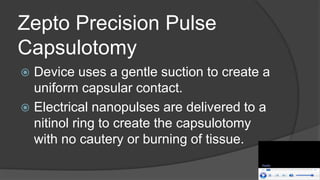
Zepto Precision Pulse
Capsulotomy
 Device uses a gentle suction to create a
uniform capsular contact.
 Electrical nanopulses are delivered to a
nitinol ring to create the capsulotomy
with no cautery or burning of tissue.
To Summarise
 Cataract in today’s time is considered a refractive
surgery.
 Phaco probe -:
 Combination of longitudinal and transverse motion.
 Mechanical rotatory motion.
 AquaLase – Use of no ultrasound energy.
 Bimanual phaco
 Different phaco energy delivery modes
 Phaco tip
 Angulation
 ABS
 Size of tip
 Microflow tip
 Surge protection
 TUR set – tuning system
 Venting system
 ABS
 Microprocessor
 Active fluidics
 Pump System
 Concentric pump system
 Foot pedal
 Dual linear system
 Wireless foot pedal
 Femtosecond laser
 Zepto pulse capsulotomy
Newer phacoemulsification techniques

Newer phacoemulsification techniques

  • 1.
    NEWER PHACOEMULSIFICATION TECHNIQUES  Presenter –Dr. Paresh Nichlani  Moderator – Prof. K N Jha  Dr. A R Rajalakshmi
  • 2.
  • 3.
    Aims of goodphaco surgery  Low endothelial damage  Emulsification of nucleus in less time and using minimal power.  No complications.  Maintain the anterior chamber – Less fluctuation.  Great post operative visual acuity- Less astigmatism.
  • 4.
    Components of Phaco Ultrasound energy – Phaco power  Fluidics-:  Irrigation  Aspiration
  • 5.
    Terminologies  Phaco Power Vacuum is the suction force applied  Flow Rate is the rate of fluid flowing out of the eye  Rise Time is the time taken for the vacuum to rise to the preset maximum  Pump speed is the speed of the rotation of the peristaltic pump.
  • 6.
     Venting meansbreaking of vacuum  Compliance-Is inversely related to the outflow resistance  Followability means the ability of the phaco tip to attract nuclear pieces.  Holding ability is the ability of the tip to hold the nuclear piece  Surge – Sudden swallowing of AC  Chatter - tendency of the vibrating phaco tip to push away material.  Duty cycle –Phaco power used per min
  • 7.
    Ultrasound energy  Power- generated by the vibrating piezo-electric crystals  Back and forth motion to the phaco tip  Frequency of vibration is a fixed entity, while the stroke length is variable.  Absolute phaco time
  • 8.
    Fluidics  Inflow andoutflow of fluid  Inflow depends upon -:  Bottle height  Tubing size  Sleeves  Outflow depends upon -:  Pump system  Size of probe/tubing system  Leaking wound
  • 9.
    Peristaltic Pump –Pinch valve system
  • 10.
  • 11.
  • 12.
  • 13.
    Surge Protection  Increasebottle height  Increase lumen of irrigating tube – TUR set  Reducing lumen of aspiration probe and/or tubing system.  Material of aspiration tube system  Venting system
  • 14.
     Cruise control– disposable flow restrictor placed between the phaco hand piece and the aspiration tubing. It is having an internal diameter of 0.3mm  ABS tips – alternate bypass system  Vacuum Surge Suppressor  Microprocessor
  • 15.
  • 16.
     Dual linearfoot pedals allow side ways movement at any stage of position 2 to allow phaco power to start before reaching the maximum aspiration.
  • 17.
    Phaco power modulation Panel mode – All or none  Continuous mode  Burst Mode  Pulse mode  Hyper pulse mode – Cold phaco
  • 19.
     Energy isdelivered in extremely brief, microsecond pulses, interrupted by rest periods
  • 20.
  • 21.
    Advancement in Phaco Pure tortional ultrasound  Ellips ultrasound - which blends longitudinal ultrasound with transversal ultrasound.
  • 22.
  • 23.
     NeoSoniX  Usesboth ultrasound and mechanical oscillation  Control both the amplitude of the oscillation and the threshold of ultrasound power independently  Minimizes risk of thermal burns  Oscillation automatically breaks occlusion and reposition for more efficient lens removal
  • 25.
     AquaLase LiquefactionDevice  Uses pulsed surgical solution to safely break up and remove the natural lens material.  generates 4-microliter pulses of surgical solution  Pulses are warmed at 55 degrees and propelled by a smooth, rounded-bevel polymer reflective tip that disperses fluid for enhanced safety and "tissue specificity.“  Minimizes risk of thermal incision burns almost completely.
  • 27.
  • 28.
    Foot pedal  Non-zerostart  When you push down on the foot pedal in foot-position three, the machine can start at whatever power you want  Less time spent getting to the power you want and this makes the system more efficient  Wireless foot pedal
  • 29.
    Bimanual phaco  PhakoNIT– Dr. Amar agarwal in 1998  Phaco done with a needle opening via an incision and with phaco tip  Cold BSS 4º  Microflow needle
  • 30.
    Hand piece  Weight– reduced from 97 grams to 46 grams  size of phaco tip – 21g with outer diameter of 0.8mm and inner 0.6mm
  • 31.
    Femtosecond laser assisted Photodisruption –  Femtosecond laser energy is absorbed by the tissue  Plasma of ionized molecules rapidly expands, creating cavitation bubbles.
  • 32.
    Zepto Precision Pulse Capsulotomy Device uses a gentle suction to create a uniform capsular contact.  Electrical nanopulses are delivered to a nitinol ring to create the capsulotomy with no cautery or burning of tissue.
  • 33.
    To Summarise  Cataractin today’s time is considered a refractive surgery.  Phaco probe -:  Combination of longitudinal and transverse motion.  Mechanical rotatory motion.  AquaLase – Use of no ultrasound energy.  Bimanual phaco  Different phaco energy delivery modes  Phaco tip  Angulation  ABS  Size of tip  Microflow tip
  • 34.
     Surge protection TUR set – tuning system  Venting system  ABS  Microprocessor  Active fluidics  Pump System  Concentric pump system  Foot pedal  Dual linear system  Wireless foot pedal  Femtosecond laser  Zepto pulse capsulotomy

Editor's Notes

  • #21 Kelman tip – increased surface area, also goes in core of nucleus , holdablity is better, for higher grate nucleus – while emulsification – sidawase – increase surface area
  • #22 Heat desperation, flowablity increase, chattering decreases,