Refractive
Surgery
Dr. Mohamed F Elbarghathi
By
Assistant lecturer , Ophthalmology department
Faculty of medicine, University of Benghazi
Explain the steps - including history, ocular examination, and
investigations - in evaluating whether a patient is an appropriate
candidate for refractive surgery.
1
INTENDEDLEARNINGOUTCOMES“ILOs”
Identify the various techniques used in refractive surgeries.
2
For (LASIK), describe surgical techniques and complications.
3
State possible contraindications to corneal based refractive surgery in
patients with pre-existing ocular or systemic disease.
4
Refractive surgeries
INTRO
Group of procedures that may be surgical or laser assisted,
on cornea or lens.
The surgeries on cornea are done far more frequently than
on the lens
Principle in corneal refractive surgeries is to change the
corneal curvature to change its refractive power
Some of the eyes that may benefit visually by surgery
cannot be operated due to existing contraindications.
Refractive surgeries
HISTORY
1965 1970 1983 1991 1996
JOS - IGNACIO BARRAQUER
Introduction of Keratomileusis
.
FYODOROV
invents Radial
Keratotomy
Invention of the
Excimer Laser
PRK and LASIK
approved by
FDA
SLADE / BRINT
1ST LASIK surgery
Evolution of
Femtosecond Laser in
Refractive Surgery
2001
Refractive surgeries
CLASSIFICATION
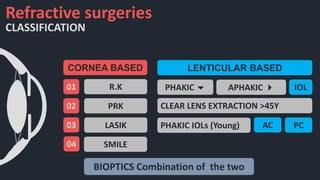
CORNEA BASED
R.K
01
PRK
02
LASIK
03
SMILE
04
LENTICULAR BASED
PHAKIC  APHAKIC  IOL
CLEAR LENS EXTRACTION >45Y
PHAKIC IOLs (Young) AC PC
BIOPTICS Combination of the two
Refractive surgeries
Preoperative assessment (History )
Corneal ectasia (KC) January December
Refractive surgeries
Preoperative assessment (History )
Why age is important ?
Ranges between
20 and 45 years
Under 20 years have higher
chances of being unstable
over 45 years have following
drawbacks:
01- Is the age of presbyopia.
02- Many of them will develop lenticular
changes ( Cataract).
Refractive surgeries
Preoperative assessment (stabilization ofrefraction )
 The procedures should be
done only on eyes that have
unchanged errors of
refraction, at least 1 year
prior to surgery.
January
December
Refractive surgeries
Preoperative assessment (Contraindications)
Absolute C/I
Infection
01
Keratoconus
02
Glaucoma
03
Posterior segment anomalies
04
Immune suppression
05
Amblyopia
07
Corneal dystrophies
06
Relative C/I
Dry eyes
01
Allergic keratoconjunctivitis
02
Diabetes mellitus
03
Pregnancy
04
1- No improvement.
Organic pathology , Amblyopia
Pin hole
2- Improvement.
Refractive surgeries
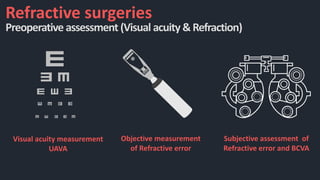
Preoperative assessment (Visual acuity&Refraction)
Subjective assessment of
Refractive error and BCVA
Objective measurement
of Refractive error
Visual acuity measurement
UAVA
Refractive surgeries
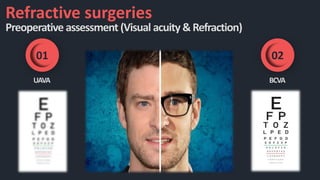
Preoperative assessment (Visual acuity&Refraction)
BCVA
02
UAVA
01
Refractive surgeries
Preoperative assessment (Visual acuity&Refraction)
Cycloplegia should be performed
to all cases .
to refine the sphere.
By neutralizing accommodation .
Refractive surgeries
Preoperative assessment (Visual acuity&Refraction)
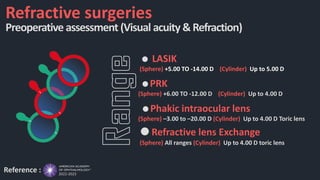
 LASIK
(Sphere) +5.00 TO -14.00 D (Cylinder) Up to 5.00 D
PRK
(Sphere) +6.00 TO -12.00 D (Cylinder) Up to 4.00 D
Phakic intraocular lens
(Sphere) –3.00 to –20.00 D (Cylinder) Up to 4.00 D Toric lens
Refractive lens Exchange
(Sphere) All ranges (Cylinder) Up to 4.00 D toric lens
Refractive surgeries
Preoperative assessment (Visual acuity&Refraction)
Reference : 2022-2023
Rule out any of these :
 Corneal dystrophy.
 Vascularization.
 Active HSV .
 Corneal ectasia .”Keratoconus”
Refractive surgeries
Preoperative assessment (Identifies aCo-Pathology)
Cornea
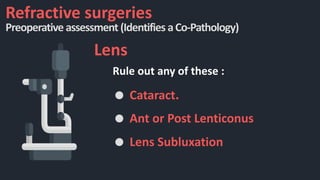
Rule out any of these :
 Cataract.
 Ant or Post Lenticonus
 Lens Subluxation
Refractive surgeries
Preoperative assessment (Identifies aCo-Pathology)
Lens
 Tear meniscus height .
 Tear film break up time .
 Schirmer test .
EXCLUDE :-
 Severe dry eye .
 Autoimmune disease .
Refractive surgeries
Preoperative assessment (Identifies aCo-Pathology)
Pre ocular tear film
Dilated Fundus Exam
Essential
Refractive surgeries
Preoperative assessment (Identifies aCo-Pathology)
Corneal Tomography.
Refractive surgeries
Preoperative assessment (Investigation)
Keratometry measurements
01
Corneal thicknes
measurements
02
Pentacam
CORNEAL REFRACTIVE
PROCEDURE
Radial keratectomy
Series of 4-8 deep, radial corneal stromal incision
01
Weaken the paracentral & peripheral cornea &
flatten the central cornea
02
Complications
• Bullous keratopathy
• Low stability of refraction
Radial keratectomy
PHOTOREFRACTIVE KERATECTOMY ( PRK )
Outer layer of cornea is removed then excimer laser is
applied.
01
No flap created
02
Vision improves as surface heals from 7 to 21 days.
03
Longer recovery period (> 2 weeks)
04
Discomfort present during healing
05
PHOTOREFRACTIVE KERATECTOMY ( PRK )
LASIK (Laser-assisted in situ keratomileusis)
Most commonly performed refractive surgery
01
Excimer laser ablation of corneal stroma beneath
a corneal flap that is created with a mechanical or
femtosecond laser microkeratome
02
LASIK (Laser-assisted in situ keratomileusis)
Steps of LASIK
Flap creation
Apply excimer laser
Flap returned
LASIK Illustrative
Animation
Start animation
Femto LASIK Illustrative
Animation
Start animation
LASIK Vs PRK
Unwanted astigmatism
05
Corneal ectasia
04
Flap complication
03
Epithelial trauma
02
Under/over correction
01
Laser vision correction complications
Excimer & Femto laser machine
Femto SMILE
LENTICULAR REFRACTIVE
PROCEDURE
Phakic Intra ocular lenses (IOL)
 Artificial lenses implanted in the anterior or
posterior chamber in the presence of the natural
crystalline lens to correct refractive errors.
Types
•AC iris-fixated ( Artisan )
•Posterior chamber IOL ( ICL )
AC iris-fixated ( Artisan )
Posterior chamber IOL (ICL )
Complication of phakic IOLs
 PC IOLs
- Pupillary block .
- Dislocation.
- 2ry Glaucoma .
- Iritis, Cataract.
 AC IOLs
- Pupillary block .
- Dislocation.
- 2ry Glaucoma .
- Iritis.
Thanks
Dr Mohamed Elbarghathi

REFRACTIVE SURGERY.pptx

  • 1.
    Refractive Surgery Dr. Mohamed FElbarghathi By Assistant lecturer , Ophthalmology department Faculty of medicine, University of Benghazi
  • 2.
    Explain the steps- including history, ocular examination, and investigations - in evaluating whether a patient is an appropriate candidate for refractive surgery. 1 INTENDEDLEARNINGOUTCOMES“ILOs” Identify the various techniques used in refractive surgeries. 2 For (LASIK), describe surgical techniques and complications. 3 State possible contraindications to corneal based refractive surgery in patients with pre-existing ocular or systemic disease. 4
  • 3.
    Refractive surgeries INTRO Group ofprocedures that may be surgical or laser assisted, on cornea or lens. The surgeries on cornea are done far more frequently than on the lens Principle in corneal refractive surgeries is to change the corneal curvature to change its refractive power Some of the eyes that may benefit visually by surgery cannot be operated due to existing contraindications.
  • 4.
    Refractive surgeries HISTORY 1965 19701983 1991 1996 JOS - IGNACIO BARRAQUER Introduction of Keratomileusis . FYODOROV invents Radial Keratotomy Invention of the Excimer Laser PRK and LASIK approved by FDA SLADE / BRINT 1ST LASIK surgery Evolution of Femtosecond Laser in Refractive Surgery 2001
  • 5.
    Refractive surgeries CLASSIFICATION CORNEA BASED R.K 01 PRK 02 LASIK 03 SMILE 04 LENTICULARBASED PHAKIC  APHAKIC  IOL CLEAR LENS EXTRACTION >45Y PHAKIC IOLs (Young) AC PC BIOPTICS Combination of the two
  • 6.
    Refractive surgeries Preoperative assessment(History ) Corneal ectasia (KC) January December
  • 7.
    Refractive surgeries Preoperative assessment(History ) Why age is important ? Ranges between 20 and 45 years Under 20 years have higher chances of being unstable over 45 years have following drawbacks: 01- Is the age of presbyopia. 02- Many of them will develop lenticular changes ( Cataract).
  • 8.
    Refractive surgeries Preoperative assessment(stabilization ofrefraction )  The procedures should be done only on eyes that have unchanged errors of refraction, at least 1 year prior to surgery. January December
  • 9.
    Refractive surgeries Preoperative assessment(Contraindications) Absolute C/I Infection 01 Keratoconus 02 Glaucoma 03 Posterior segment anomalies 04 Immune suppression 05 Amblyopia 07 Corneal dystrophies 06 Relative C/I Dry eyes 01 Allergic keratoconjunctivitis 02 Diabetes mellitus 03 Pregnancy 04
  • 10.
    1- No improvement. Organicpathology , Amblyopia Pin hole 2- Improvement. Refractive surgeries Preoperative assessment (Visual acuity&Refraction)
  • 11.
    Subjective assessment of Refractiveerror and BCVA Objective measurement of Refractive error Visual acuity measurement UAVA Refractive surgeries Preoperative assessment (Visual acuity&Refraction)
  • 12.
  • 13.
    Cycloplegia should beperformed to all cases . to refine the sphere. By neutralizing accommodation . Refractive surgeries Preoperative assessment (Visual acuity&Refraction)
  • 14.
     LASIK (Sphere) +5.00TO -14.00 D (Cylinder) Up to 5.00 D PRK (Sphere) +6.00 TO -12.00 D (Cylinder) Up to 4.00 D Phakic intraocular lens (Sphere) –3.00 to –20.00 D (Cylinder) Up to 4.00 D Toric lens Refractive lens Exchange (Sphere) All ranges (Cylinder) Up to 4.00 D toric lens Refractive surgeries Preoperative assessment (Visual acuity&Refraction) Reference : 2022-2023
  • 15.
    Rule out anyof these :  Corneal dystrophy.  Vascularization.  Active HSV .  Corneal ectasia .”Keratoconus” Refractive surgeries Preoperative assessment (Identifies aCo-Pathology) Cornea
  • 16.
    Rule out anyof these :  Cataract.  Ant or Post Lenticonus  Lens Subluxation Refractive surgeries Preoperative assessment (Identifies aCo-Pathology) Lens
  • 17.
     Tear meniscusheight .  Tear film break up time .  Schirmer test . EXCLUDE :-  Severe dry eye .  Autoimmune disease . Refractive surgeries Preoperative assessment (Identifies aCo-Pathology) Pre ocular tear film
  • 18.
    Dilated Fundus Exam Essential Refractivesurgeries Preoperative assessment (Identifies aCo-Pathology)
  • 19.
    Corneal Tomography. Refractive surgeries Preoperativeassessment (Investigation) Keratometry measurements 01 Corneal thicknes measurements 02 Pentacam
  • 20.
  • 21.
    Radial keratectomy Series of4-8 deep, radial corneal stromal incision 01 Weaken the paracentral & peripheral cornea & flatten the central cornea 02 Complications • Bullous keratopathy • Low stability of refraction
  • 22.
  • 23.
    PHOTOREFRACTIVE KERATECTOMY (PRK ) Outer layer of cornea is removed then excimer laser is applied. 01 No flap created 02 Vision improves as surface heals from 7 to 21 days. 03 Longer recovery period (> 2 weeks) 04 Discomfort present during healing 05
  • 24.
  • 25.
    LASIK (Laser-assisted insitu keratomileusis) Most commonly performed refractive surgery 01 Excimer laser ablation of corneal stroma beneath a corneal flap that is created with a mechanical or femtosecond laser microkeratome 02
  • 26.
    LASIK (Laser-assisted insitu keratomileusis) Steps of LASIK Flap creation Apply excimer laser Flap returned
  • 27.
  • 28.
  • 29.
  • 30.
    Unwanted astigmatism 05 Corneal ectasia 04 Flapcomplication 03 Epithelial trauma 02 Under/over correction 01 Laser vision correction complications
  • 31.
    Excimer & Femtolaser machine
  • 32.
  • 33.
  • 34.
    Phakic Intra ocularlenses (IOL)  Artificial lenses implanted in the anterior or posterior chamber in the presence of the natural crystalline lens to correct refractive errors. Types •AC iris-fixated ( Artisan ) •Posterior chamber IOL ( ICL )
  • 35.
  • 36.
  • 37.
    Complication of phakicIOLs  PC IOLs - Pupillary block . - Dislocation. - 2ry Glaucoma . - Iritis, Cataract.  AC IOLs - Pupillary block . - Dislocation. - 2ry Glaucoma . - Iritis.
  • 38.