Toric IOLs overview and current clinical
outcomes in patients with regular astigmatism
14/2/18
Nimrod Dar
Ehud Assia
Introduction
• In modern cataract surgery, spectacle freedom is becoming more and more
important
• 20% to 30% of patients who have cataract surgery have corneal astigmatism of
1.25D or higher and approximately 10% of patients have 2.00 D or higher
• Patients are 34 times more likely to use spectacles per diopter of astigmatic error in
the better eye
Toric intraocular lenses: historical overview, patient selection, IOL calculation, surgical techniques, clinical outcomes, and complications. Nienke Visser, Noël J. C.
Bauer, Rudy M. M. A. Nuijts J Cataract Refract Surg. 2013 Apr; 39(4): 624–637
The beginning
• In 1992, Shimizu designed the first toric IOL, it was a 3-piece, nonfoldable
PMMA, oval optic and loop haptics, requiring a 5.7 mm incision
• In 1994, Shimizu introduced the first foldable 1-piece toric IOL, it was made of
silicone and required 3.2 mm incision
• The first clinical results with these IOLs were promising; 23% of patients
achieved UDVA of 20/25 or better compared Vs 4% of patients with a standard
IOL
• The problem was: high postoperative rotation rate (> 10⁰ in 20% to 30% of eyes)
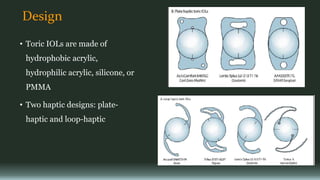
Design
• Toric IOLs are made of
hydrophobic acrylic,
hydrophilic acrylic, silicone, or
PMMA
• Two haptic designs: plate-
haptic and loop-haptic
Frequently used Toric IOLs
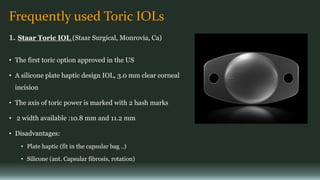
1. Staar Toric IOL (Staar Surgical, Monrovia, Ca)
• The first toric option approved in the US
• A silicone plate haptic design IOL, 3.0 mm clear corneal
incision
• The axis of toric power is marked with 2 hash marks
• 2 width available :10.8 mm and 11.2 mm
• Disadvantages:
• Plate haptic (fit in the capsular bag ..)
• Silicone (ant. Capsular fibrosis, rotation)
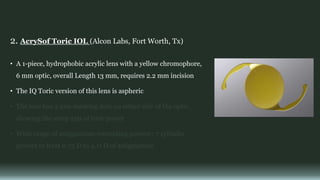
2. AcrySof Toric IOL (Alcon Labs, Fort Worth, Tx)
• A 1-piece, hydrophobic acrylic lens with a yellow chromophore,
6 mm optic, overall Length 13 mm, requires 2.2 mm incision
• The IQ Toric version of this lens is aspheric
• The lens has 3 axis marking dots on either side of the optic,
showing the steep axis of toric power
• Wide range of astigmatism-correcting powers : 7 cylinder
powers to treat 0.75 D to 4.11 D of astigmatism
3. AMO Tecnis Toric IOL (Abbott Medical Optics, CA)
• 1-piece, aspheric, hydrophobic acrylic, 2.2 mm incision,
square edge
• Cylinder Powers: 1.03 D to 4.11 D
• Less chromatic aberration
Rotation of the IOL
• For every degree of misalignment, about 3 percent
of the lens cylinder power is lost
• A misalignment of more than 10 degrees is
generally regarded as the indication for surgical
repositioning
• Several factors may influence IOL rotation :
• Adhesion
• IOL diameter
• Haptic design
Toric intraocular lenses: historical overview, patient selection, IOL calculation, surgical techniques, clinical outcomes, and complications.
Nienke Visser, Noël J. C. Bauer, Rudy M. M. A. Nuijts J Cataract Refract Surg. 2013 Apr; 39(4): 624–637
1. Adhesion
• After implantation in the capsular bag, the anterior and posterior
capsules fuse with the IOL, preventing IOL rotation
• In vitro and rabbits studies showed the strongest IOL–capsular bag
adhesions for acrylic IOLs, followed by PMMA and silicone
• Extracellular matrix proteins such as fibronectin, may be involved in
IOL adhesion to the capsular bag, and different IOL biomaterials
show differences in affinity to proteins (acrylic > silicone)
Toric intraocular lenses: historical overview, patient selection, IOL calculation, surgical techniques, clinical outcomes, and complications.
Nienke Visser, Noël J. C. Bauer, Rudy M. M. A. Nuijts J Cataract Refract Surg. 2013 Apr; 39(4): 624–637
2. Diameter
• Overall diameter has been shown to be a major factor
in the prevention of IOL rotation
• Chang* compared 2 sizes of the Staar IOL - 10.8 and
11.2 mm in diameter
• 10% of the longer IOLs rotated more than 10 degrees
compared with 45% of the shorter IOLs
* Chang DF. Early rotational stability of the longer Staar toric in-traocular lens; fifty consecutive
cases. J Cataract Refract Surg 2003; 29:935–940
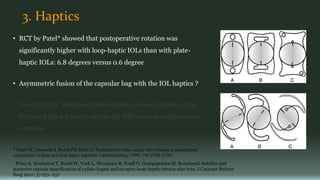
3. Haptics
• RCT by Patel* showed that postoperative rotation was
significantly higher with loop-haptic IOLs than with plate-
haptic IOLs: 6.8 degrees versus 0.6 degree
• Asymmetric fusion of the capsular bag with the IOL haptics ?
• In 2011 Prinz+ compared plate-haptic and loop-haptic acrylic
IOLs and did not find a significant difference in postoperative
rotation
* Patel CK, Ormonde S, Rosen PH, BronAJ. Postoperative intra- ocular lens rotation: a randomized
comparison of plate and loop haptic implants. Ophthalmology 1999; 106:2190–2195;
+ Prinz A, Neumayer T, Buehl W, Vock L, Menapace R, Findl O, Georgopoulos M. Rotational stability and
posterior capsule opacification of a plate-haptic and an open-loop-haptic intraoc ular lens. J Cataract Refract
Surg 2011; 37:251–257
Patients selection
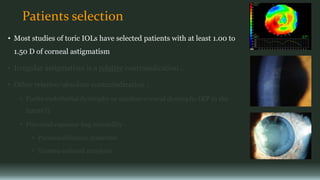
• Most studies of toric IOLs have selected patients with at least 1.00 to
1.50 D of corneal astigmatism
• Irregular astigmatism is a relative contraindication …
• Other relative/absolute contraindication :
• Fuchs endothelial dystrophy or another corneal dystrophy (KP in the
future?)
• Potential capsular bag instability :
• Pseudoexfoliation syndrome
• Trauma-induced zonulysis
Lens calculating
• Various methods to measure corneal astigmatism-
• Automated/manual keratometry, corneal topography, and Scheimpflug
imaging
• Scheimpflug imaging has the advantage of measuring both anterior and
posterior corneal surfaces
• The posterior cornea acts as a minus lens and affects differently the WTR
(decreasing astigmatism by 0.5 D) and ATR (increasing astigmatism by
0.3 D)
• Koch had incorporated the effect of the posterior corneal surface in toric
IOL calculations
Toric intraocular lenses: historical overview, patient selection, IOL calculation, surgical techniques, clinical outcomes, and complications.
Nienke Visser, Noël J. C. Bauer, Rudy M. M. A. Nuijts J Cataract Refract Surg. 2013 Apr; 39(4): 624–637
Lens calculating - SIA
• The expected amount of surgically induced astigmatism (SIA) must be
incorporated into the toric IOL power calculation
• The amount of SIA is difficult to predict ..
• SIA depends on serval factors:
• The location of the incision
• The size of the incision
• Amount of preoperative corneal astigmatism
• Suture use
• Patient age
Methods
• Systematic review and meta-analysis, 8/2015
• Only RCTs comparing the result after toric versus non-toric IOL implantation in
patients with preoperative regular corneal astigmatism and cataract
• 13 studies included, 707 eyes were randomized to toric IOL implantation and 706 eyes to
non-toric IOL implantation
• Of those implemented with non-toric IOL, 225 eyes received relaxing incisions
• The level of preoperative corneal astigmatism was approximately 0.75 to 3 D in the
included RCTs
Un-corrected distance visual acuity
Each letter
counts 0.02
units when
visual acuity is
tested using the
logMAR chart at
a distance of 20
feet
Results - UCDVA
• For patients randomized to toric IOL implantation, 35.2% did not achieve
20/25 UCDVA versus 60.4% in patients randomized to non-toric IOL (in
both sub-groups)
• The difference in UCDVA between eyes randomized to toric or non-toric
IOL was highly significant (RR, 0.59; 95% CI, 0.50e0.70; P < 0.00001)
Results - distance spectacle independence
• The number of patients who required spectacles for distance viewing
(sometimes.. ) was significantly lower in patients randomized to toric IOL
implantation (29.7%) VS the non-toric IOL implantation (53.2%) (RR, 0.51; 95%
CI, 0.36-0.71)
• Again, There was no difference between subgroups (toric vs. non-toric, toric vs.
non-toric plus relaxing incision)
Results - residual astigmatism
More results
• There was no significant difference between the groups regarding
post-operative complications
• On average, the toric IOLs rotated less than 5 degrees except for
1 IOL (Lentis Unico - removed from the market)
• There were no significant differences between the amount of
residual astigmatism at 3 and 6 months follow-up in the toric
group (P=0.61)
Prediction of refractive outcomes
• Residual astigmatism is still not always predictable
• Reasons :
• Intraocular lens tilt
• IOL rotational misalignment
• Unexpected surgically induced astigmatism (SIA)
• Various studies have emphasize the importance of net
corneal astigmatic power
Toric calculators
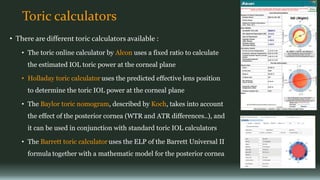
• There are different toric calculators available :
• The toric online calculator by Alcon uses a fixed ratio to calculate
the estimated IOL toric power at the corneal plane
• Holladay toric calculator uses the predicted effective lens position
to determine the toric IOL power at the corneal plane
• The Baylor toric nomogram, described by Koch, takes into account
the effect of the posterior cornea (WTR and ATR differences..), and
it can be used in conjunction with standard toric IOL calculators
• The Barrett toric calculator uses the ELP of the Barrett Universal II
formula together with a mathematic model for the posterior cornea
• Retrospective case series
• Aim: To evaluate and compare the accuracy of different methods
to measure and predict post-operative astigmatism with toric
IOLs implantation
• Three devices were used:
• IOLMaster 500 (PCI)
• Lenstar LS 900 (OLCR)
• Placido disk–based Atlas
corneal topographer (sim/mean K)
simulated K= values along the steepest and flattest meridians at the central 3.0 mm
mean K= values from all measured points within the central 3.0 mm
• Methods of calculation evaluated:
1. The online toric calculator by Alcon
• with and without the Baylor toric IOL nomogram adjustment
2. The Holladay toric calculator
• with and without the Baylor toric IOL nomogram adjustment
3. The online Barrett toric calculator
Evaluation of the error in predicted residual astigmatism
• The predicted residual astigmatism at the corneal plane was calculated by :
The assumed toric IOL cylinder power at the corneal plane
+
Measured corneal astigmatism taken by each device
• The error in the predicted residual astigmatism was calculated by :
Postoperative subjective refraction at the corneal plane
-
Predicted residual astigmatism at the corneal plane
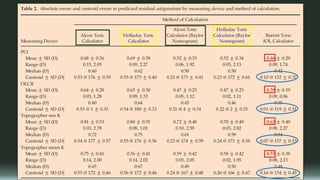
Proportion of eyes with absolute error in predicted residual astigmatism below or equal to
0.50 D, 0.75 D, and 1.00 D
Conclusions
• The PCI and OLCR keratometers were better than the corneal
topographer
• The Baylor toric IOL nomogram significantly reduced errors
in residual astigmatism
• The OLCR device and the Barrett toric calculator provided the lowest
residual astigmatism prediction errors
• A new regression formula (Abulafia-Koch) that calculates an
estimated net corneal astigmatism using standard K
measurements (based on the anterior cornea)
Immerging Technology
• Image-guided system for Toric Lens Implantation
• Alcon’s VERION™
• SensoMotoric Instruments’s SG3000
Toric IOls
Toric IOls

Toric IOls

  • 1.
    Toric IOLs overviewand current clinical outcomes in patients with regular astigmatism 14/2/18 Nimrod Dar Ehud Assia
  • 2.
    Introduction • In moderncataract surgery, spectacle freedom is becoming more and more important • 20% to 30% of patients who have cataract surgery have corneal astigmatism of 1.25D or higher and approximately 10% of patients have 2.00 D or higher • Patients are 34 times more likely to use spectacles per diopter of astigmatic error in the better eye Toric intraocular lenses: historical overview, patient selection, IOL calculation, surgical techniques, clinical outcomes, and complications. Nienke Visser, Noël J. C. Bauer, Rudy M. M. A. Nuijts J Cataract Refract Surg. 2013 Apr; 39(4): 624–637
  • 3.
    The beginning • In1992, Shimizu designed the first toric IOL, it was a 3-piece, nonfoldable PMMA, oval optic and loop haptics, requiring a 5.7 mm incision • In 1994, Shimizu introduced the first foldable 1-piece toric IOL, it was made of silicone and required 3.2 mm incision • The first clinical results with these IOLs were promising; 23% of patients achieved UDVA of 20/25 or better compared Vs 4% of patients with a standard IOL • The problem was: high postoperative rotation rate (> 10⁰ in 20% to 30% of eyes)
  • 4.
    Design • Toric IOLsare made of hydrophobic acrylic, hydrophilic acrylic, silicone, or PMMA • Two haptic designs: plate- haptic and loop-haptic
  • 5.
    Frequently used ToricIOLs 1. Staar Toric IOL (Staar Surgical, Monrovia, Ca) • The first toric option approved in the US • A silicone plate haptic design IOL, 3.0 mm clear corneal incision • The axis of toric power is marked with 2 hash marks • 2 width available :10.8 mm and 11.2 mm • Disadvantages: • Plate haptic (fit in the capsular bag ..) • Silicone (ant. Capsular fibrosis, rotation)
  • 6.
    2. AcrySof ToricIOL (Alcon Labs, Fort Worth, Tx) • A 1-piece, hydrophobic acrylic lens with a yellow chromophore, 6 mm optic, overall Length 13 mm, requires 2.2 mm incision • The IQ Toric version of this lens is aspheric • The lens has 3 axis marking dots on either side of the optic, showing the steep axis of toric power • Wide range of astigmatism-correcting powers : 7 cylinder powers to treat 0.75 D to 4.11 D of astigmatism
  • 7.
    3. AMO TecnisToric IOL (Abbott Medical Optics, CA) • 1-piece, aspheric, hydrophobic acrylic, 2.2 mm incision, square edge • Cylinder Powers: 1.03 D to 4.11 D • Less chromatic aberration
  • 8.
    Rotation of theIOL • For every degree of misalignment, about 3 percent of the lens cylinder power is lost • A misalignment of more than 10 degrees is generally regarded as the indication for surgical repositioning • Several factors may influence IOL rotation : • Adhesion • IOL diameter • Haptic design Toric intraocular lenses: historical overview, patient selection, IOL calculation, surgical techniques, clinical outcomes, and complications. Nienke Visser, Noël J. C. Bauer, Rudy M. M. A. Nuijts J Cataract Refract Surg. 2013 Apr; 39(4): 624–637
  • 9.
    1. Adhesion • Afterimplantation in the capsular bag, the anterior and posterior capsules fuse with the IOL, preventing IOL rotation • In vitro and rabbits studies showed the strongest IOL–capsular bag adhesions for acrylic IOLs, followed by PMMA and silicone • Extracellular matrix proteins such as fibronectin, may be involved in IOL adhesion to the capsular bag, and different IOL biomaterials show differences in affinity to proteins (acrylic > silicone) Toric intraocular lenses: historical overview, patient selection, IOL calculation, surgical techniques, clinical outcomes, and complications. Nienke Visser, Noël J. C. Bauer, Rudy M. M. A. Nuijts J Cataract Refract Surg. 2013 Apr; 39(4): 624–637
  • 10.
    2. Diameter • Overalldiameter has been shown to be a major factor in the prevention of IOL rotation • Chang* compared 2 sizes of the Staar IOL - 10.8 and 11.2 mm in diameter • 10% of the longer IOLs rotated more than 10 degrees compared with 45% of the shorter IOLs * Chang DF. Early rotational stability of the longer Staar toric in-traocular lens; fifty consecutive cases. J Cataract Refract Surg 2003; 29:935–940
  • 11.
    3. Haptics • RCTby Patel* showed that postoperative rotation was significantly higher with loop-haptic IOLs than with plate- haptic IOLs: 6.8 degrees versus 0.6 degree • Asymmetric fusion of the capsular bag with the IOL haptics ? • In 2011 Prinz+ compared plate-haptic and loop-haptic acrylic IOLs and did not find a significant difference in postoperative rotation * Patel CK, Ormonde S, Rosen PH, BronAJ. Postoperative intra- ocular lens rotation: a randomized comparison of plate and loop haptic implants. Ophthalmology 1999; 106:2190–2195; + Prinz A, Neumayer T, Buehl W, Vock L, Menapace R, Findl O, Georgopoulos M. Rotational stability and posterior capsule opacification of a plate-haptic and an open-loop-haptic intraoc ular lens. J Cataract Refract Surg 2011; 37:251–257
  • 12.
    Patients selection • Moststudies of toric IOLs have selected patients with at least 1.00 to 1.50 D of corneal astigmatism • Irregular astigmatism is a relative contraindication … • Other relative/absolute contraindication : • Fuchs endothelial dystrophy or another corneal dystrophy (KP in the future?) • Potential capsular bag instability : • Pseudoexfoliation syndrome • Trauma-induced zonulysis
  • 13.
    Lens calculating • Variousmethods to measure corneal astigmatism- • Automated/manual keratometry, corneal topography, and Scheimpflug imaging • Scheimpflug imaging has the advantage of measuring both anterior and posterior corneal surfaces • The posterior cornea acts as a minus lens and affects differently the WTR (decreasing astigmatism by 0.5 D) and ATR (increasing astigmatism by 0.3 D) • Koch had incorporated the effect of the posterior corneal surface in toric IOL calculations Toric intraocular lenses: historical overview, patient selection, IOL calculation, surgical techniques, clinical outcomes, and complications. Nienke Visser, Noël J. C. Bauer, Rudy M. M. A. Nuijts J Cataract Refract Surg. 2013 Apr; 39(4): 624–637
  • 14.
    Lens calculating -SIA • The expected amount of surgically induced astigmatism (SIA) must be incorporated into the toric IOL power calculation • The amount of SIA is difficult to predict .. • SIA depends on serval factors: • The location of the incision • The size of the incision • Amount of preoperative corneal astigmatism • Suture use • Patient age
  • 16.
    Methods • Systematic reviewand meta-analysis, 8/2015 • Only RCTs comparing the result after toric versus non-toric IOL implantation in patients with preoperative regular corneal astigmatism and cataract • 13 studies included, 707 eyes were randomized to toric IOL implantation and 706 eyes to non-toric IOL implantation • Of those implemented with non-toric IOL, 225 eyes received relaxing incisions • The level of preoperative corneal astigmatism was approximately 0.75 to 3 D in the included RCTs
  • 17.
    Un-corrected distance visualacuity Each letter counts 0.02 units when visual acuity is tested using the logMAR chart at a distance of 20 feet
  • 18.
    Results - UCDVA •For patients randomized to toric IOL implantation, 35.2% did not achieve 20/25 UCDVA versus 60.4% in patients randomized to non-toric IOL (in both sub-groups) • The difference in UCDVA between eyes randomized to toric or non-toric IOL was highly significant (RR, 0.59; 95% CI, 0.50e0.70; P < 0.00001)
  • 19.
    Results - distancespectacle independence • The number of patients who required spectacles for distance viewing (sometimes.. ) was significantly lower in patients randomized to toric IOL implantation (29.7%) VS the non-toric IOL implantation (53.2%) (RR, 0.51; 95% CI, 0.36-0.71) • Again, There was no difference between subgroups (toric vs. non-toric, toric vs. non-toric plus relaxing incision)
  • 20.
    Results - residualastigmatism
  • 21.
    More results • Therewas no significant difference between the groups regarding post-operative complications • On average, the toric IOLs rotated less than 5 degrees except for 1 IOL (Lentis Unico - removed from the market) • There were no significant differences between the amount of residual astigmatism at 3 and 6 months follow-up in the toric group (P=0.61)
  • 22.
    Prediction of refractiveoutcomes • Residual astigmatism is still not always predictable • Reasons : • Intraocular lens tilt • IOL rotational misalignment • Unexpected surgically induced astigmatism (SIA) • Various studies have emphasize the importance of net corneal astigmatic power
  • 23.
    Toric calculators • Thereare different toric calculators available : • The toric online calculator by Alcon uses a fixed ratio to calculate the estimated IOL toric power at the corneal plane • Holladay toric calculator uses the predicted effective lens position to determine the toric IOL power at the corneal plane • The Baylor toric nomogram, described by Koch, takes into account the effect of the posterior cornea (WTR and ATR differences..), and it can be used in conjunction with standard toric IOL calculators • The Barrett toric calculator uses the ELP of the Barrett Universal II formula together with a mathematic model for the posterior cornea
  • 25.
    • Retrospective caseseries • Aim: To evaluate and compare the accuracy of different methods to measure and predict post-operative astigmatism with toric IOLs implantation • Three devices were used: • IOLMaster 500 (PCI) • Lenstar LS 900 (OLCR) • Placido disk–based Atlas corneal topographer (sim/mean K) simulated K= values along the steepest and flattest meridians at the central 3.0 mm mean K= values from all measured points within the central 3.0 mm
  • 26.
    • Methods ofcalculation evaluated: 1. The online toric calculator by Alcon • with and without the Baylor toric IOL nomogram adjustment 2. The Holladay toric calculator • with and without the Baylor toric IOL nomogram adjustment 3. The online Barrett toric calculator
  • 27.
    Evaluation of theerror in predicted residual astigmatism • The predicted residual astigmatism at the corneal plane was calculated by : The assumed toric IOL cylinder power at the corneal plane + Measured corneal astigmatism taken by each device • The error in the predicted residual astigmatism was calculated by : Postoperative subjective refraction at the corneal plane - Predicted residual astigmatism at the corneal plane
  • 30.
    Proportion of eyeswith absolute error in predicted residual astigmatism below or equal to 0.50 D, 0.75 D, and 1.00 D
  • 31.
    Conclusions • The PCIand OLCR keratometers were better than the corneal topographer • The Baylor toric IOL nomogram significantly reduced errors in residual astigmatism • The OLCR device and the Barrett toric calculator provided the lowest residual astigmatism prediction errors
  • 33.
    • A newregression formula (Abulafia-Koch) that calculates an estimated net corneal astigmatism using standard K measurements (based on the anterior cornea)
  • 35.
    Immerging Technology • Image-guidedsystem for Toric Lens Implantation • Alcon’s VERION™ • SensoMotoric Instruments’s SG3000

Editor's Notes

  • #6 Fit -  If you have an eye with a very large capsular bag, such as a myopic eye, then you might need a slightly larger lens to get a good fit and prevent rotation Silicone - anterior capsular fibrosis and opacification, rotation