KENNEDY’S CLASSIFICATION AND
APPLEGATE’S RULES
DR. AAMIR GODIL
DEPARTMENT OF PROSTHODONTICS
M.A.R.D.C.
UNDERSTANDING PARTIAL EDENTULISM
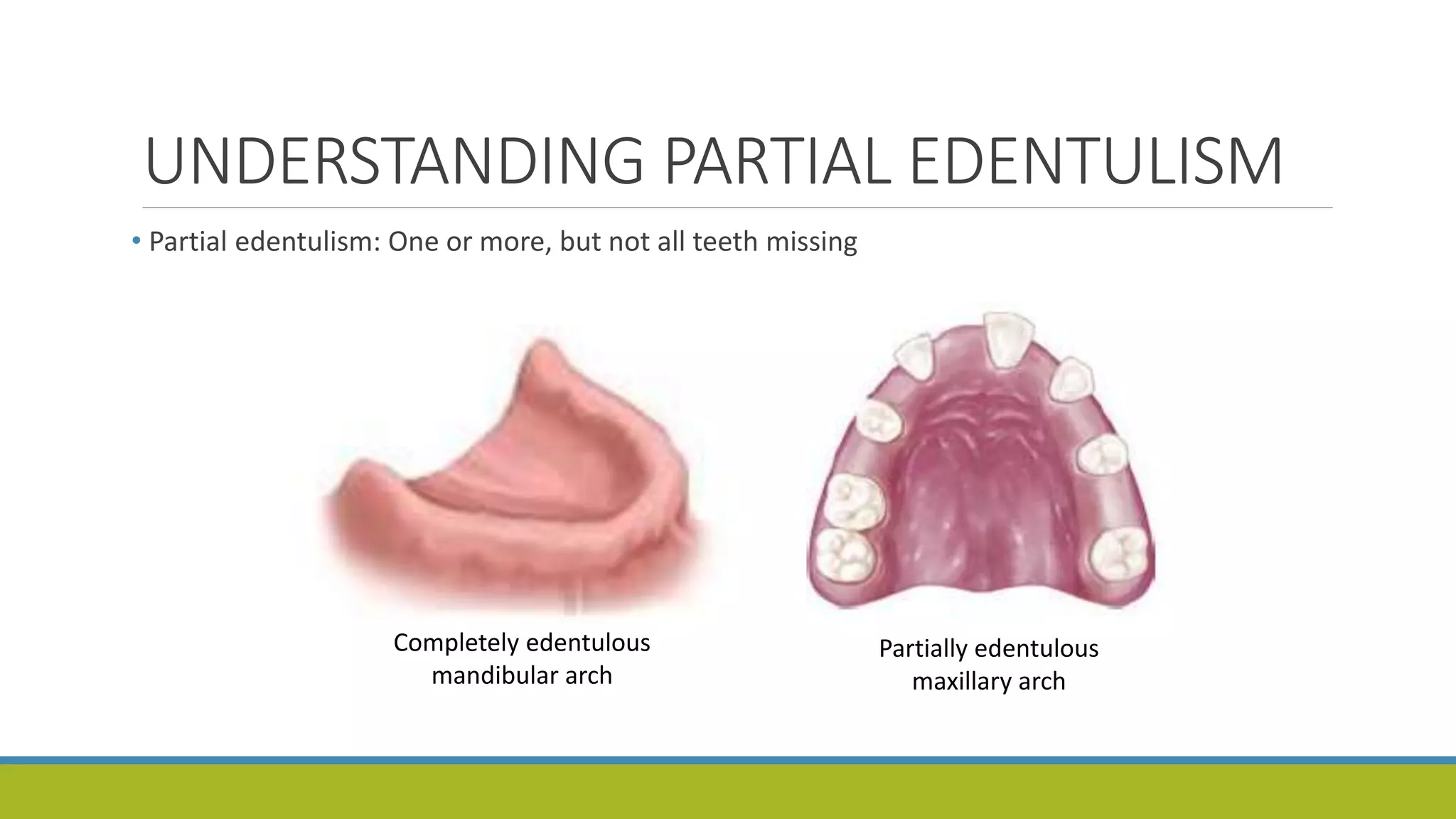
• Partial edentulism: One or more, but not all teeth missing
Completely edentulous
mandibular arch
Partially edentulous
maxillary arch
CAST PARTIAL DENTURES
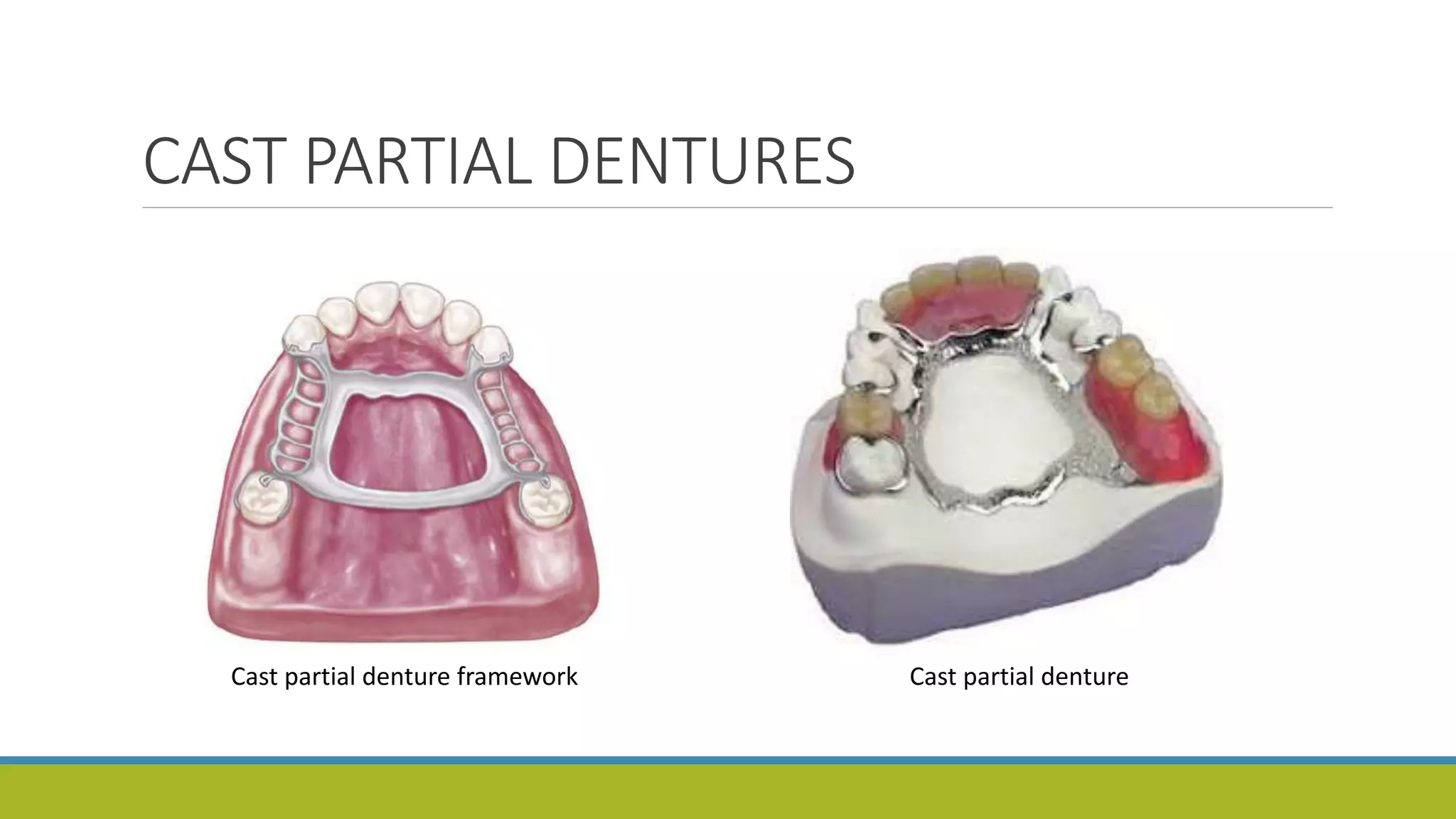
Cast partial denture framework Cast partial denture
NEED FOR CLASSIFICATION
oTo formulate a good treatment plan.
oTo anticipate the difficulties commonly to occur for that particular design.
oTo communicate with a professional about a case.
oTo design the denture according to the occlusal load usually expected for a
particular group.
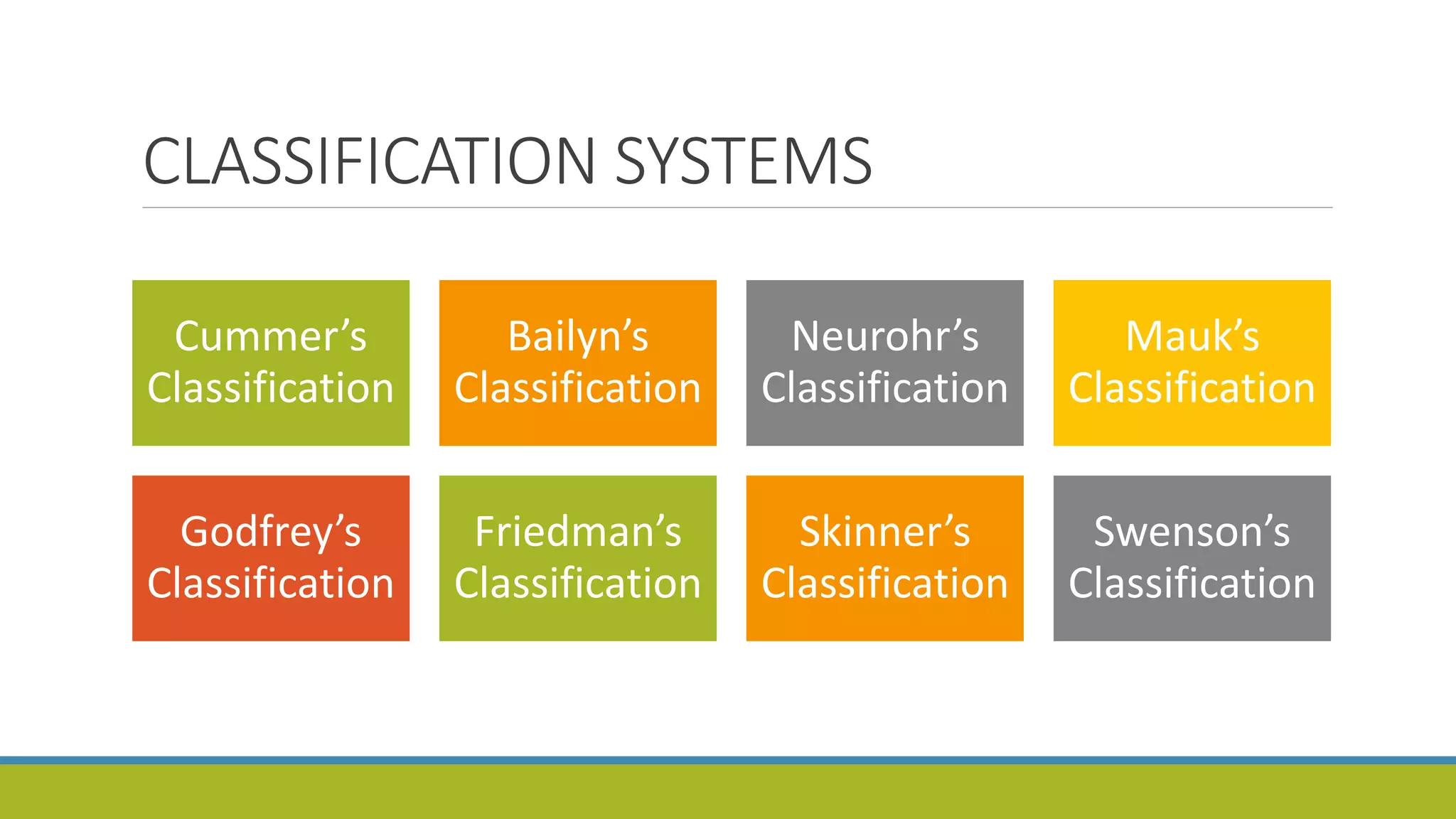
CLASSIFICATION SYSTEMS
Cummer’s
Classification
Bailyn’s
Classification
Neurohr’s
Classification
Mauk’s
Classification
Godfrey’s
Classification
Friedman’s
Classification
Skinner’s
Classification
Swenson’s
Classification
KENNEDY’S CLASSIFICATION
Kennedy’s Classification
oDr Edward Kennedy of New York proposed this classification in 1925.
oThis is the most popular classification.
oKennedy divided all partially edentulous arches into four basic classes. Edentulous areas other
than those that determine the basic classes were designated as modification spaces
oKennedy’s classification is positional or anatomical and conveys a picture of certain teeth and
their relationships, but gives little information about the teeth present and their positional
relationships.
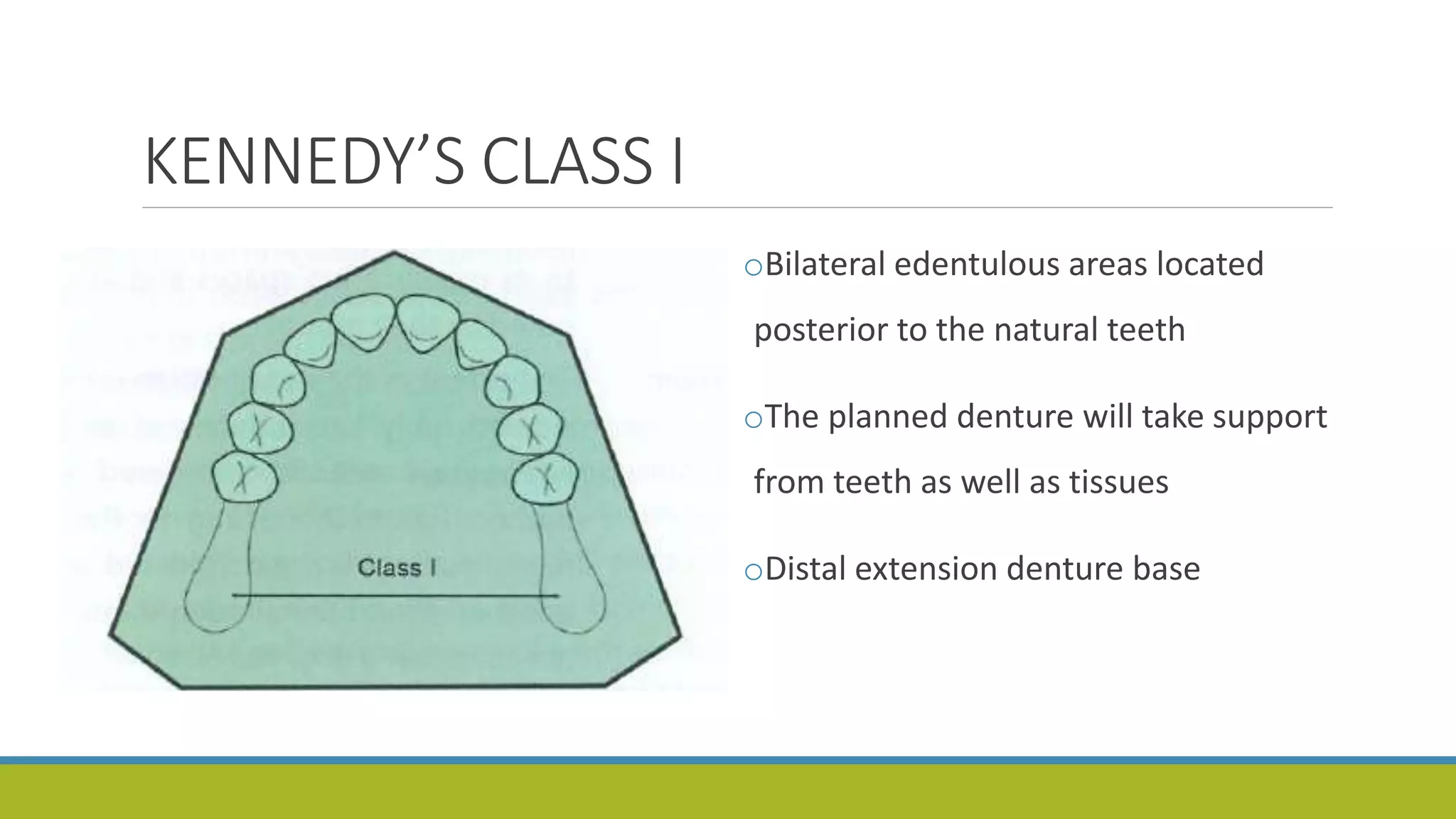
KENNEDY’S CLASS I
oBilateral edentulous areas located
posterior to the natural teeth
oThe planned denture will take support
from teeth as well as tissues
oDistal extension denture base
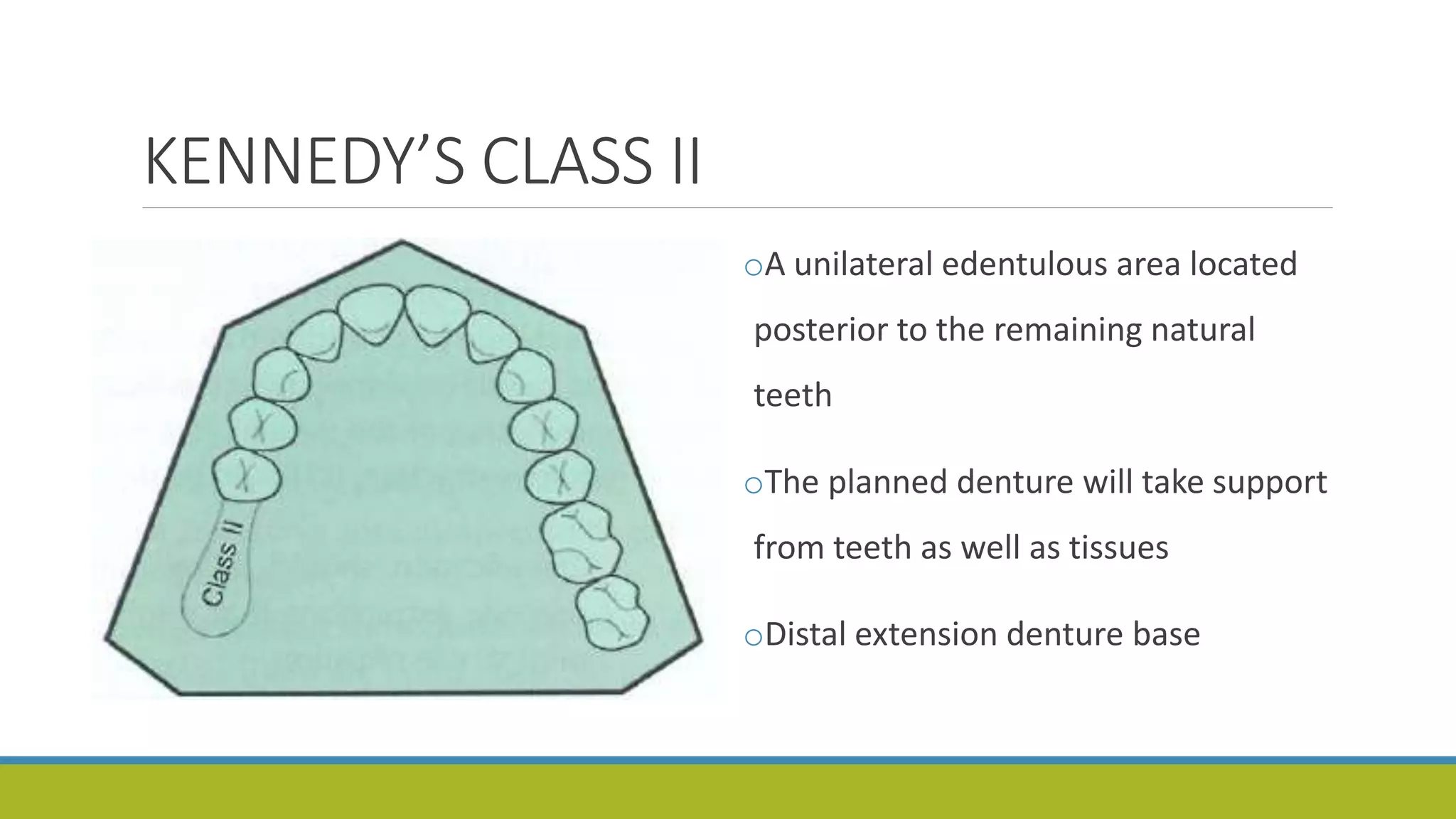
KENNEDY’S CLASS II
oA unilateral edentulous area located
posterior to the remaining natural
teeth
oThe planned denture will take support
from teeth as well as tissues
oDistal extension denture base
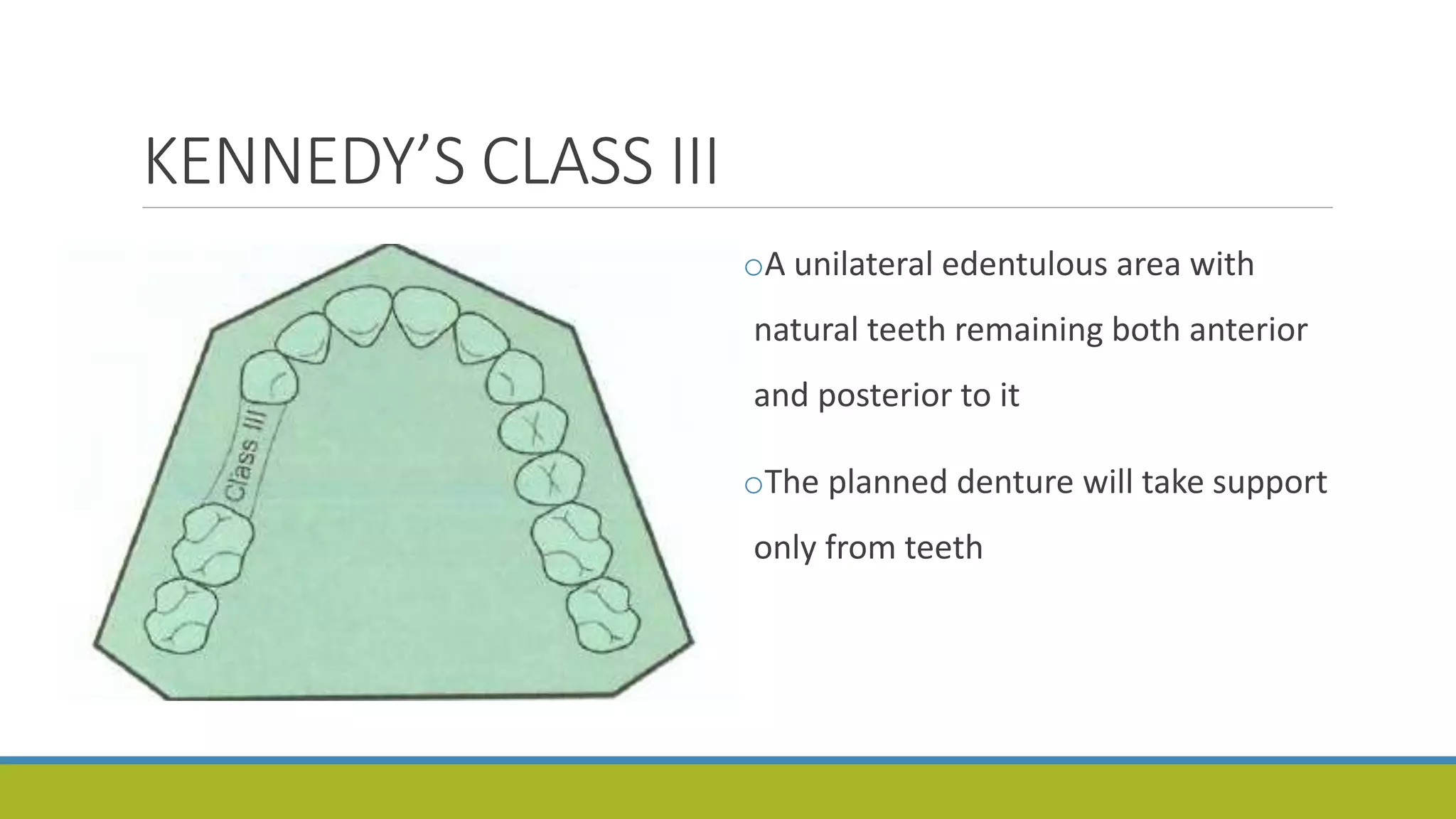
KENNEDY’S CLASS III
oA unilateral edentulous area with
natural teeth remaining both anterior
and posterior to it
oThe planned denture will take support
only from teeth
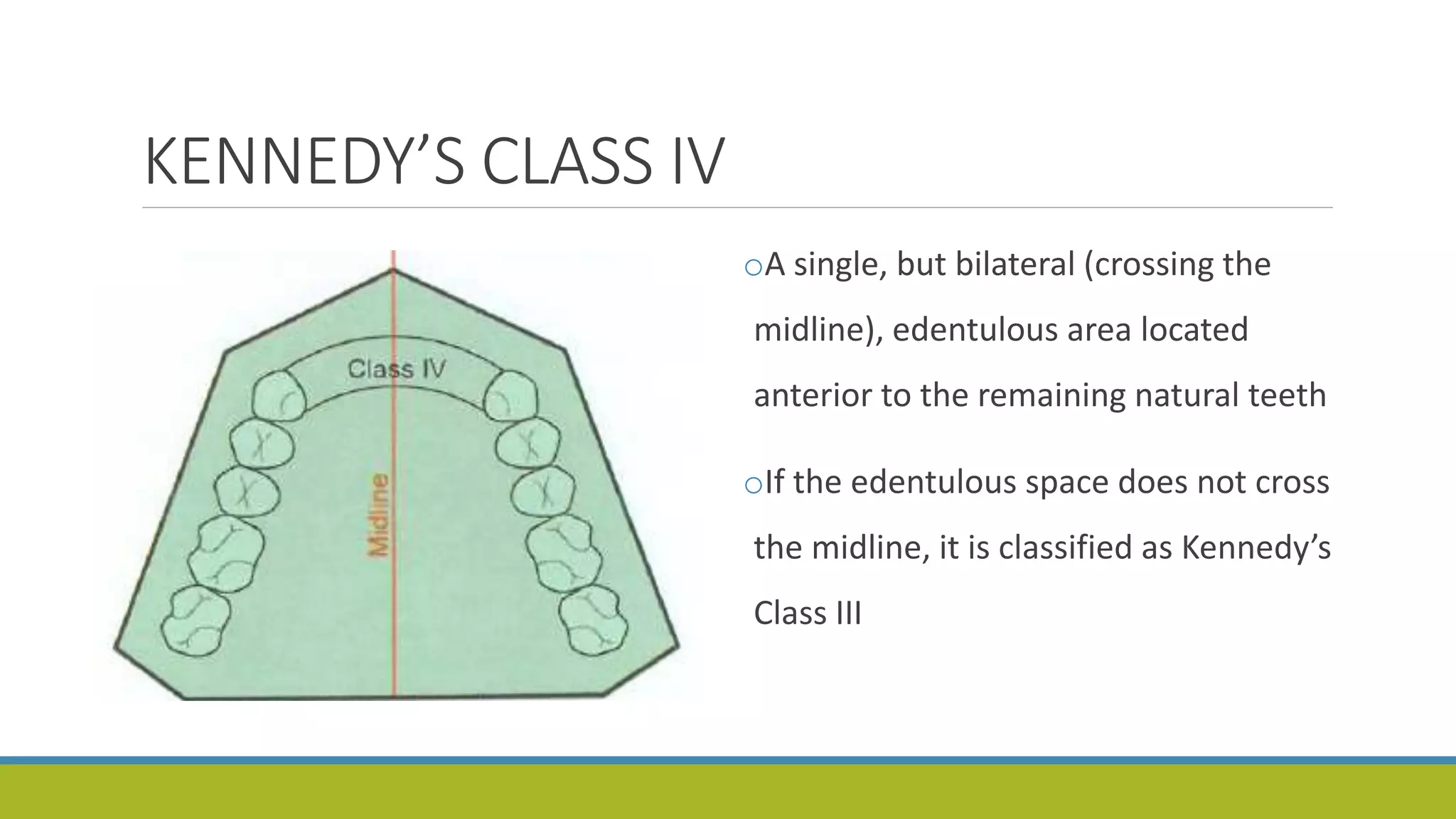
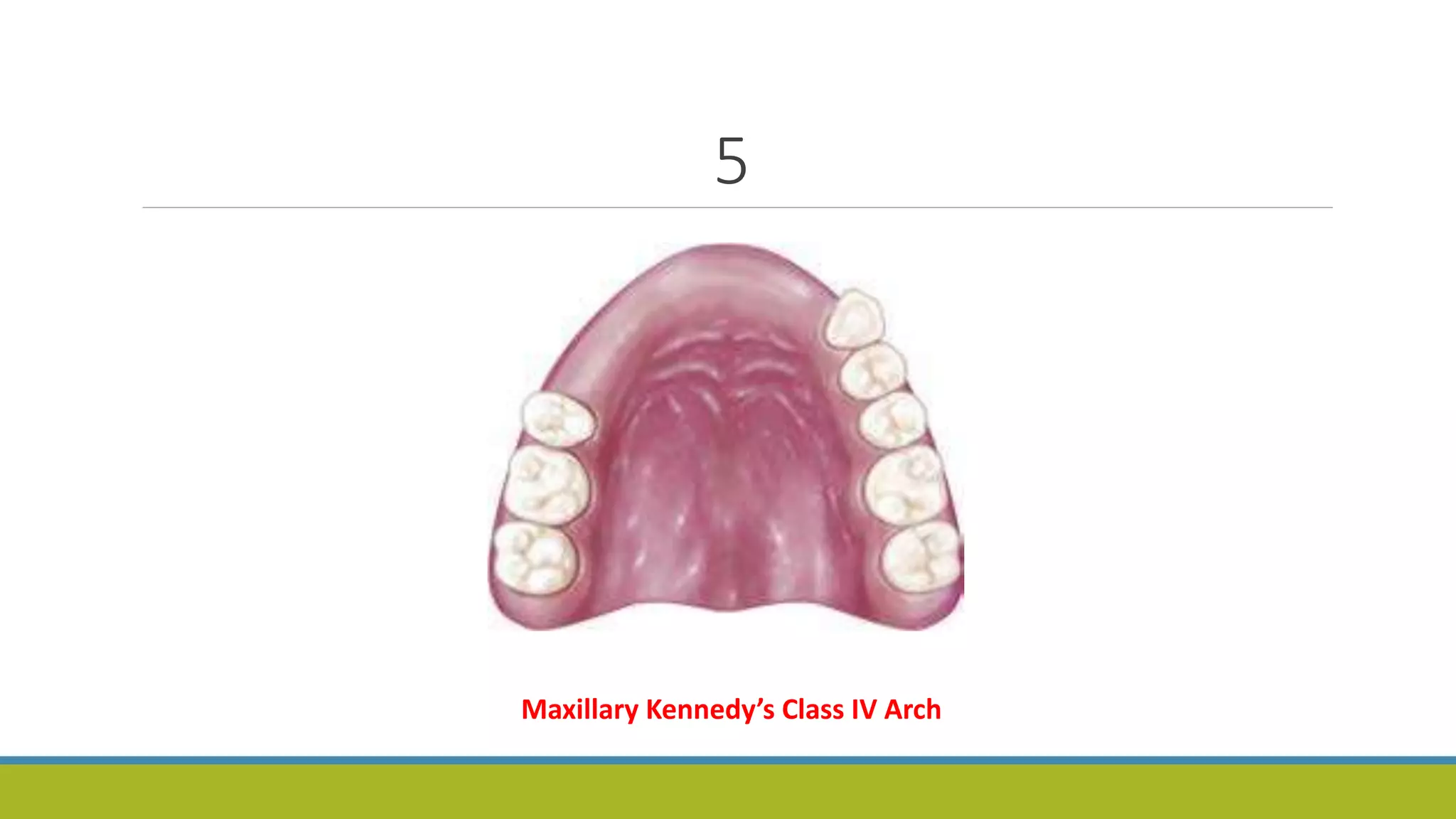
KENNEDY’S CLASS IV
oA single, but bilateral (crossing the
midline), edentulous area located
anterior to the remaining natural teeth
oIf the edentulous space does not cross
the midline, it is classified as Kennedy’s
Class III
KENNEDY’S APPLEGATE’S CLASS V
oEdentulous area bounded anteriorly and posteriorly by natural teeth but in
which the anterior abutment (e.g. lateral incisor) is not suitable for support.
oIt is basically a class III situation where the anterior abutment cannot be used
for any support.
oHence, it cannot be treated like a conventional class III edentulous space
KENNEDY APPLEGATE’S CLASS VI
oEdentulous area in which the teeth adjacent to the space are capable of total
support of the required prosthesis.
oThis denture hardly requires any tissue support. Most of the removable partial
dentures are tooth tissue supported.
oHence, this condition is classified as a separate group
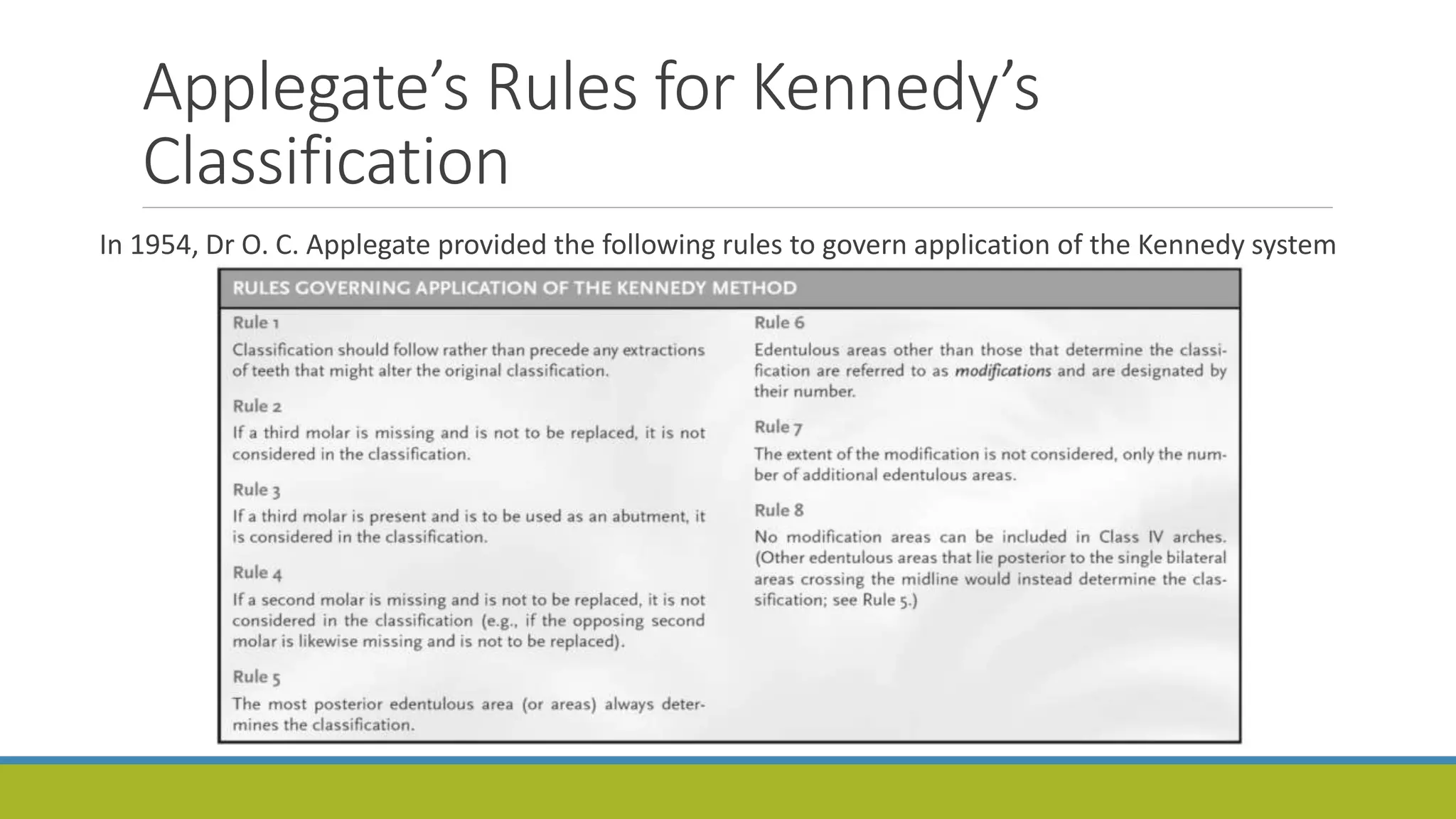
APPLEGATE’S RULES
Applegate’s Rules for Kennedy’s
Classification
In 1954, Dr O. C. Applegate provided the following rules to govern application of the Kennedy system
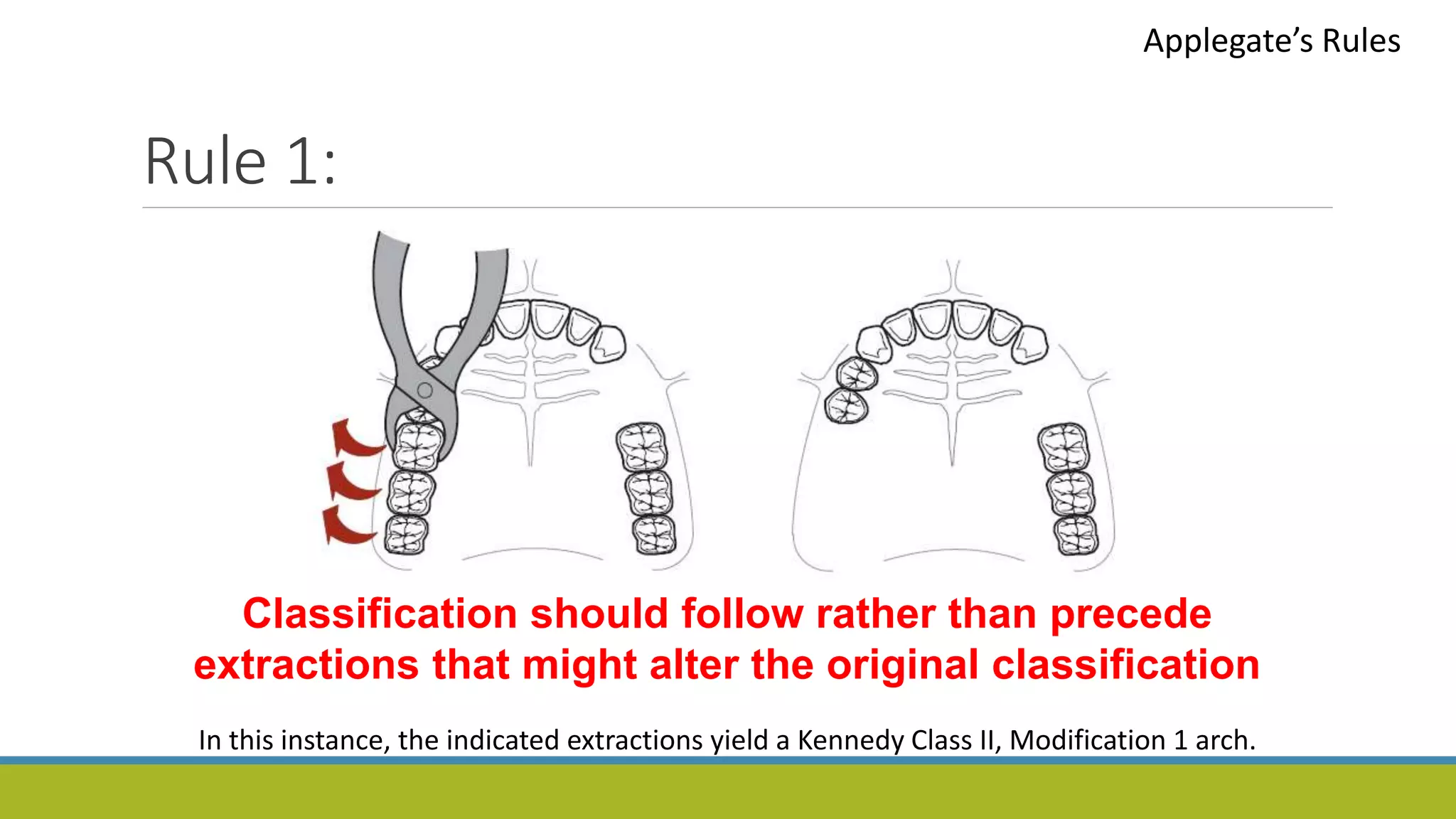
Rule 1:
Applegate’s Rules
Classification should follow rather than precede
extractions that might alter the original classification
In this instance, the indicated extractions yield a Kennedy Class II, Modification 1 arch.
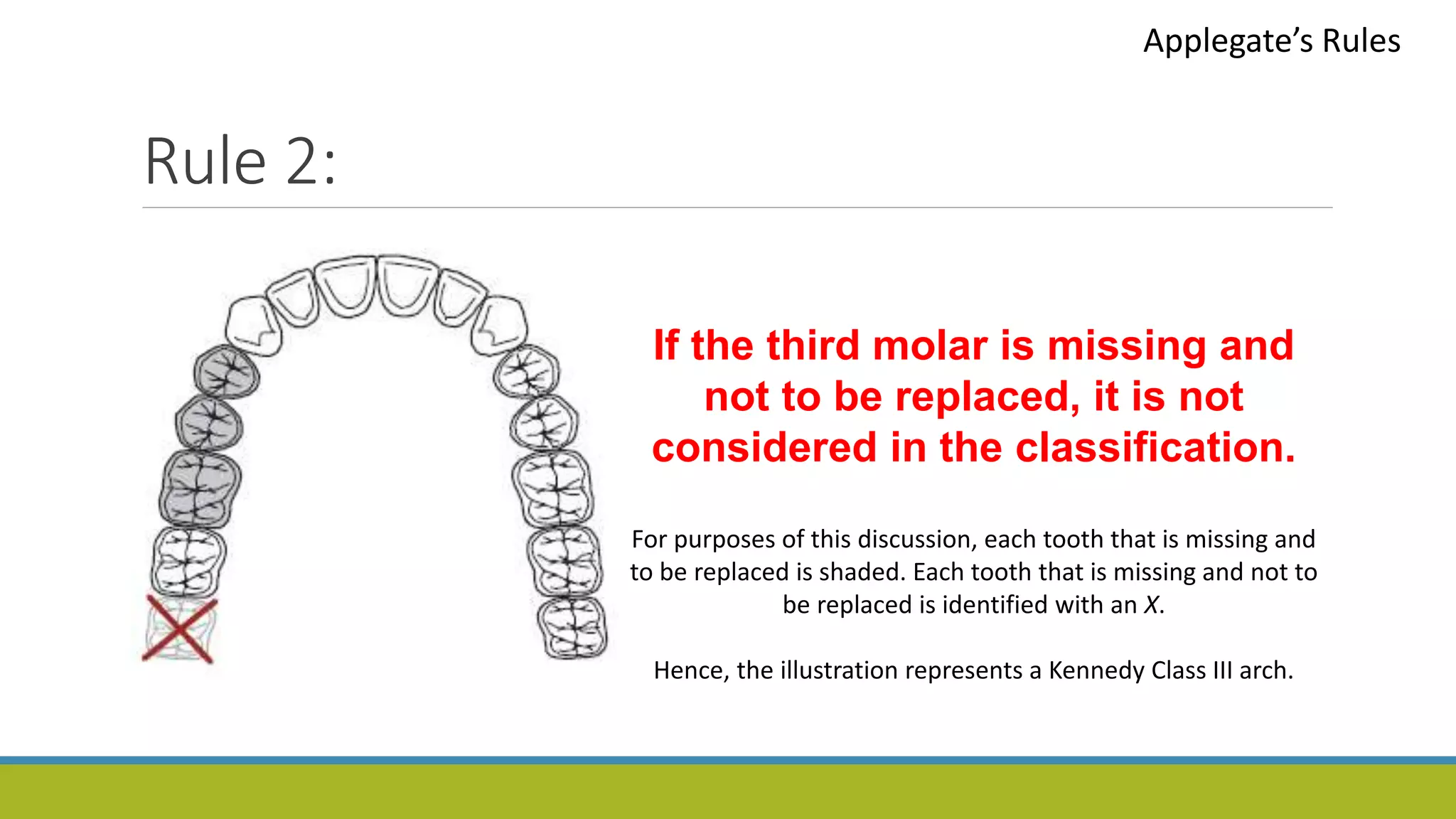
Rule 2:
Applegate’s Rules
If the third molar is missing and
not to be replaced, it is not
considered in the classification.
For purposes of this discussion, each tooth that is missing and
to be replaced is shaded. Each tooth that is missing and not to
be replaced is identified with an X.
Hence, the illustration represents a Kennedy Class III arch.
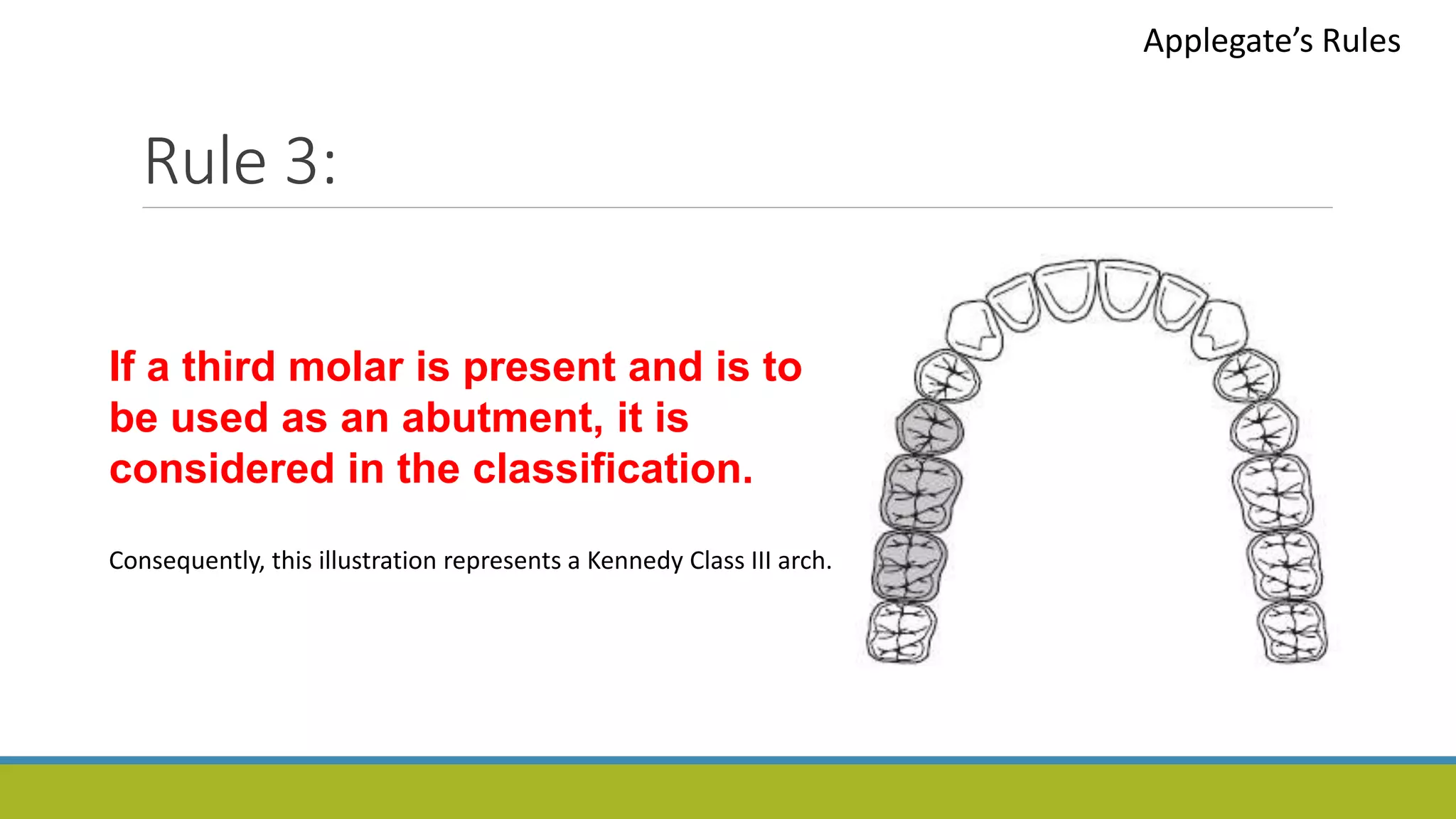
Rule 3:
Applegate’s Rules
If a third molar is present and is to
be used as an abutment, it is
considered in the classification.
Consequently, this illustration represents a Kennedy Class III arch.
Rule 4:
Applegate’s Rules
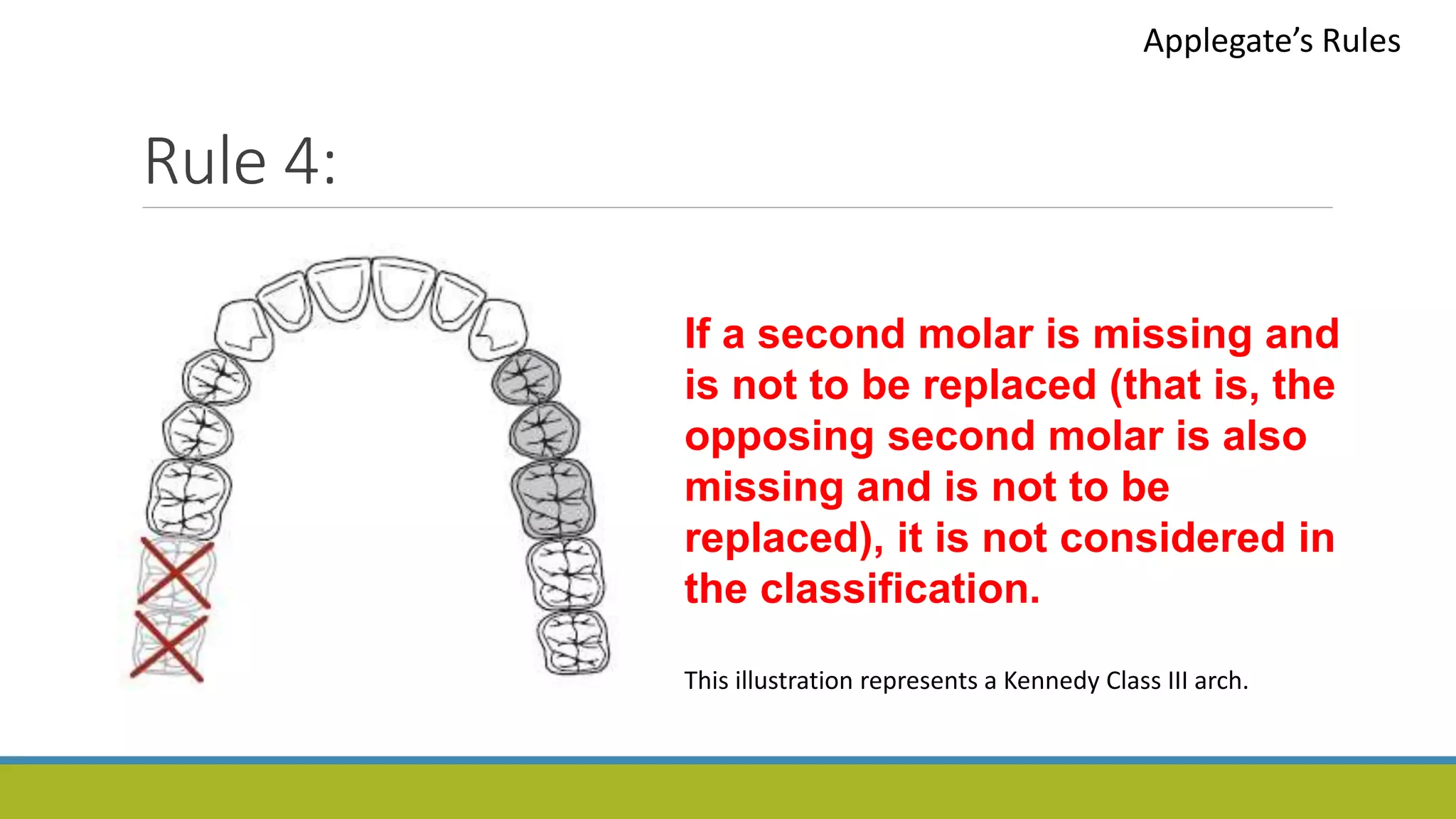
If a second molar is missing and
is not to be replaced (that is, the
opposing second molar is also
missing and is not to be
replaced), it is not considered in
the classification.
This illustration represents a Kennedy Class III arch.
Rule 5:
Applegate’s Rules
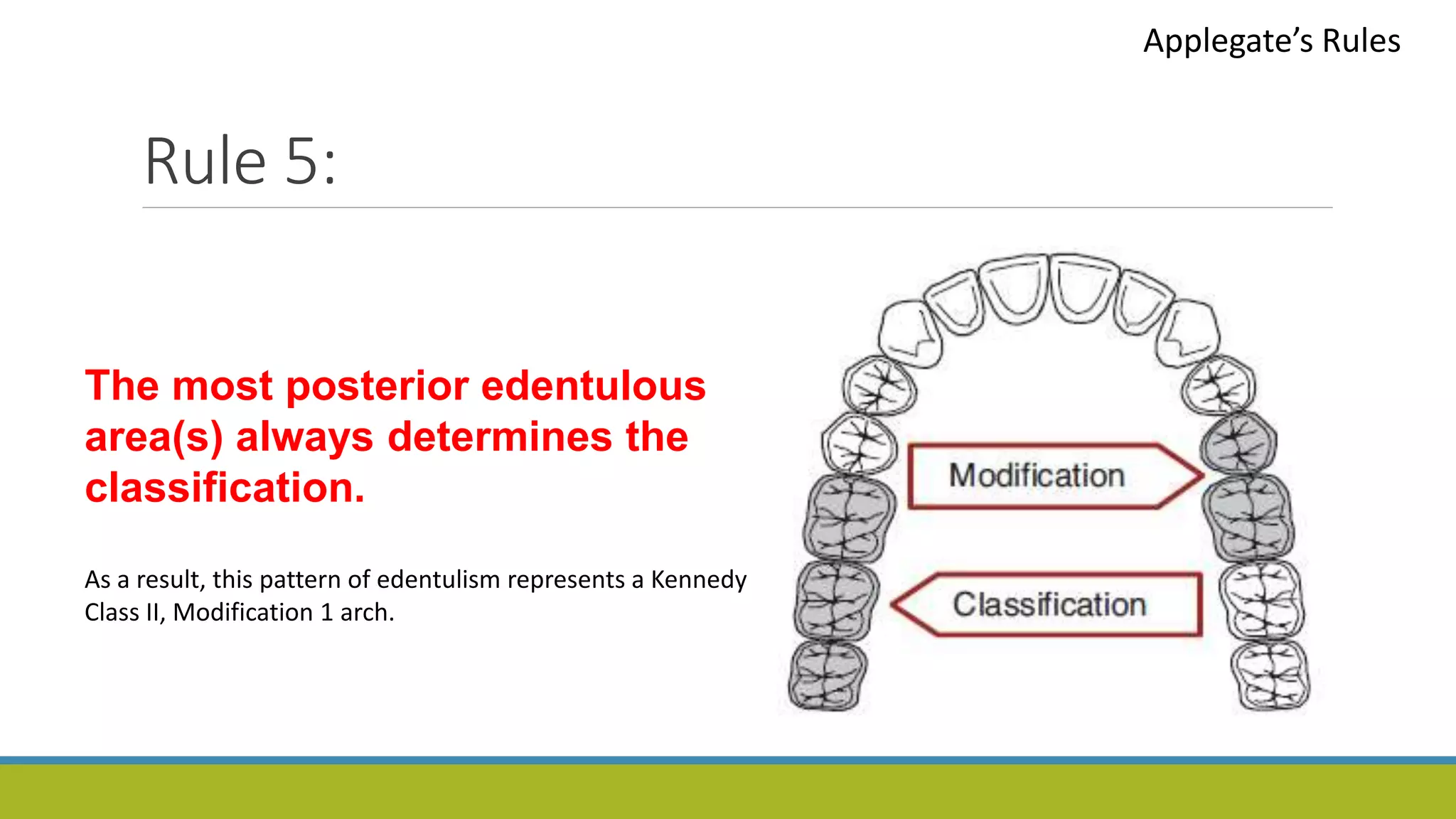
The most posterior edentulous
area(s) always determines the
classification.
As a result, this pattern of edentulism represents a Kennedy
Class II, Modification 1 arch.
Rule 6:
Applegate’s Rules
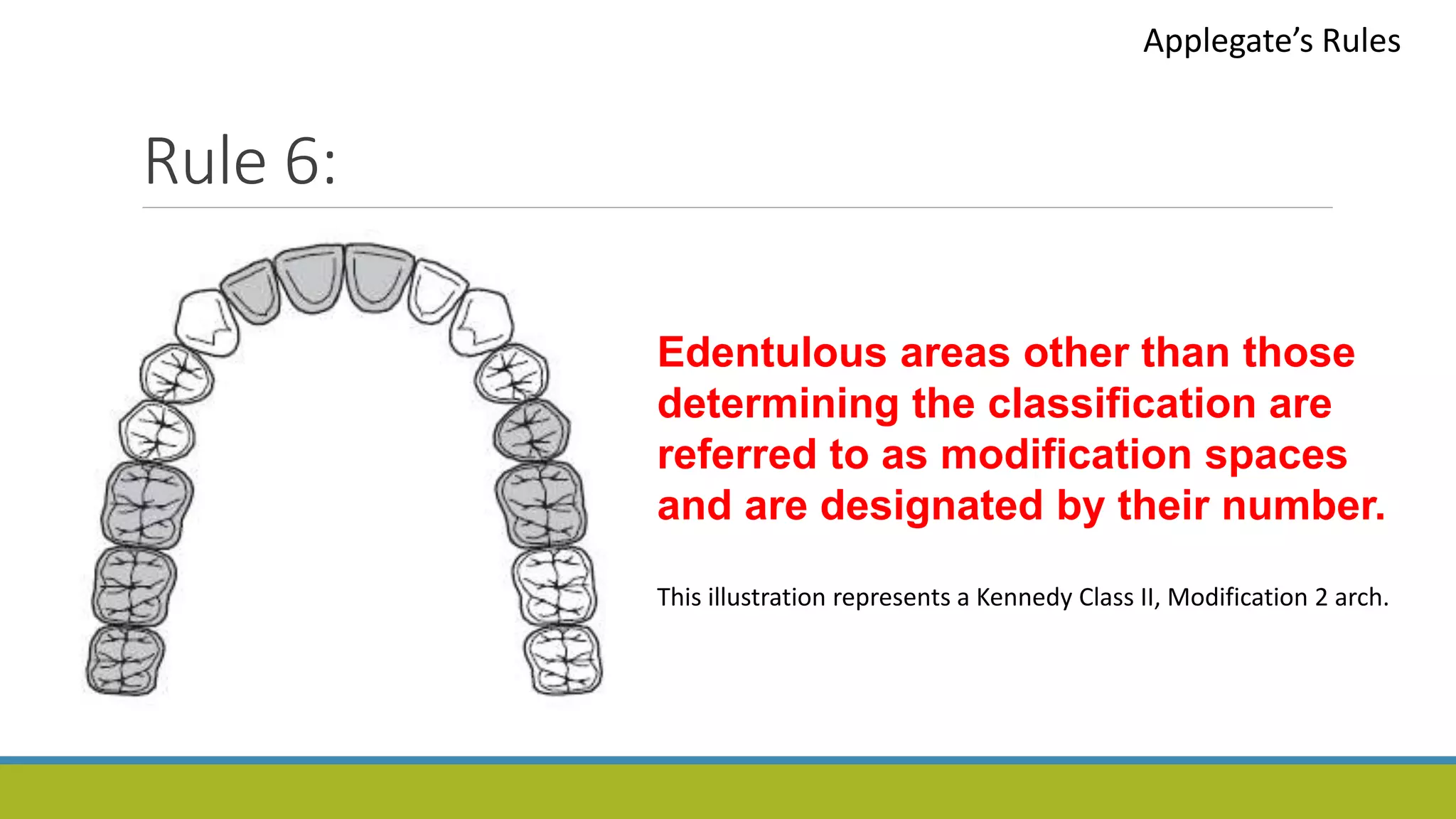
Edentulous areas other than those
determining the classification are
referred to as modification spaces
and are designated by their number.
This illustration represents a Kennedy Class II, Modification 2 arch.
Rule 7:
Applegate’s Rules
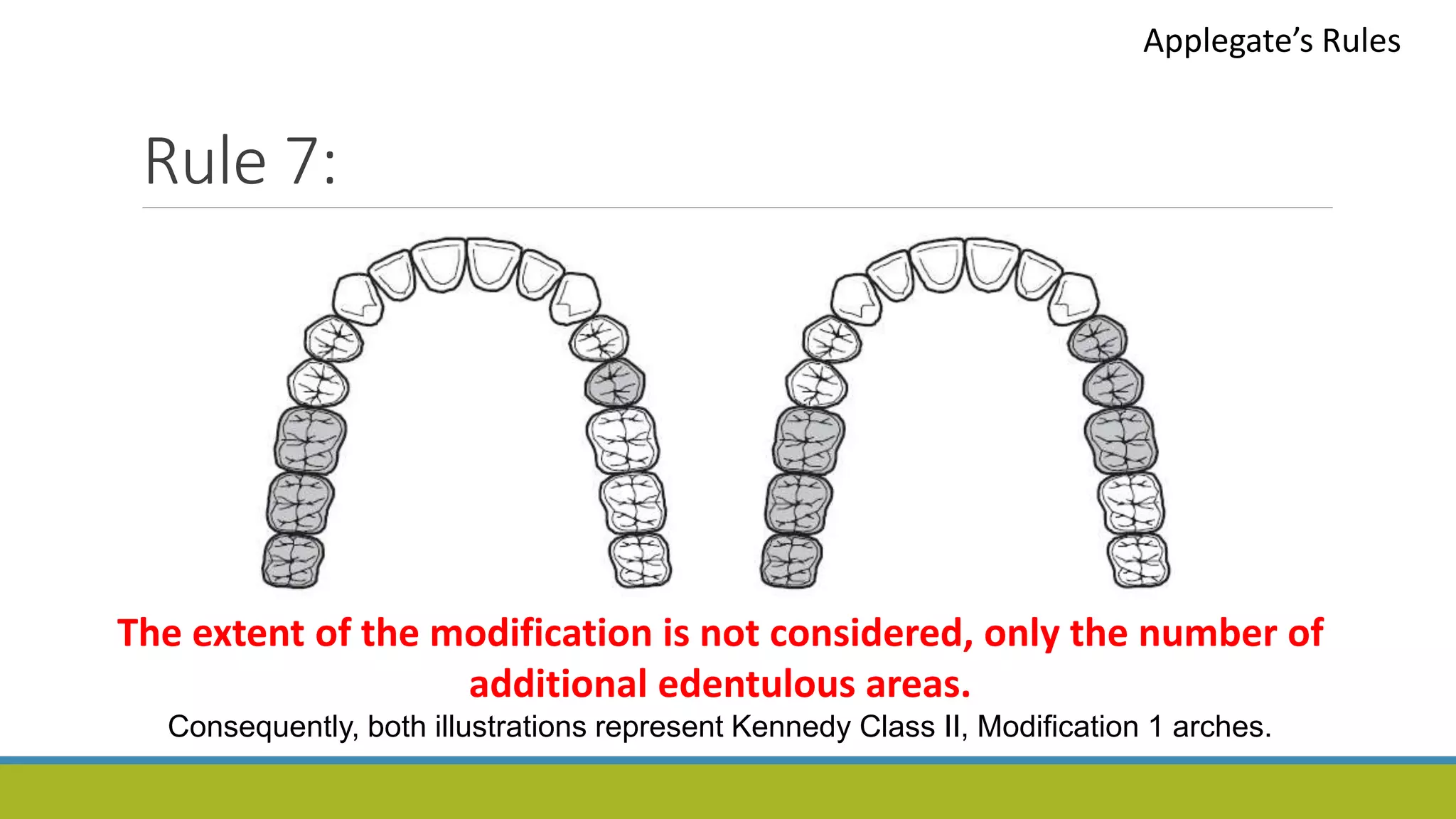
The extent of the modification is not considered, only the number of
additional edentulous areas.
Consequently, both illustrations represent Kennedy Class II, Modification 1 arches.
Rule 8:
Applegate’s Rules
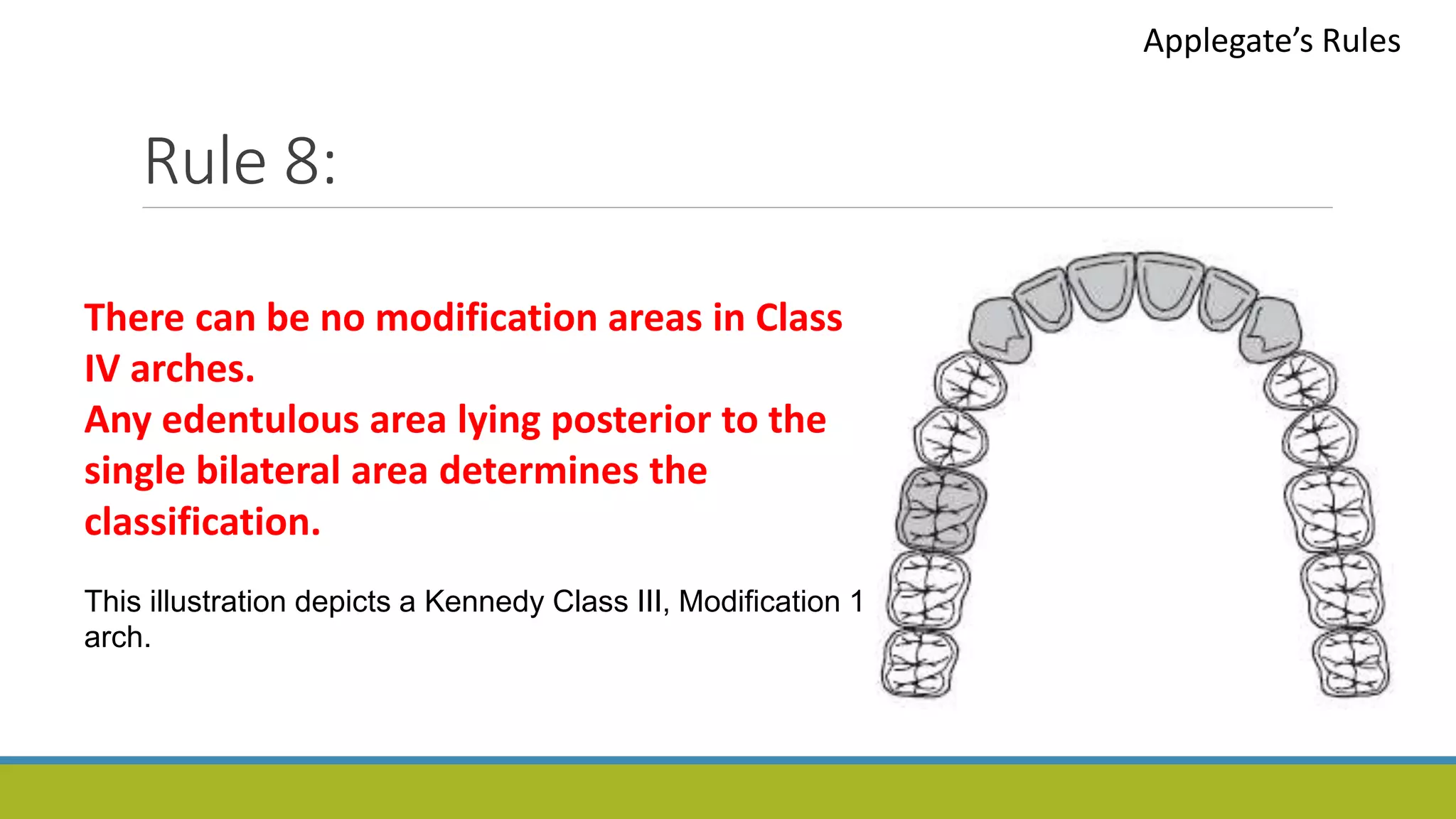
There can be no modification areas in Class
IV arches.
Any edentulous area lying posterior to the
single bilateral area determines the
classification.
This illustration depicts a Kennedy Class III, Modification 1
arch.
CLINICAL SCENARIOS
QUICK GUIDELINES
After you identify the partially edentulous arch/ cast (Maxilla/ Mandible),
1. Consider extractions if any
2. Determine the most posterior edentulous space
3. Determine the replacement of third molars and second molars
4. Determine the primary classification
5. Count the number of edentulous spaces other than the primary classification
6. Denote them as modification spaces. Number of modification spaces is added to the primary
classification
7. Join all the information and provide the final classification
EXAMPLE
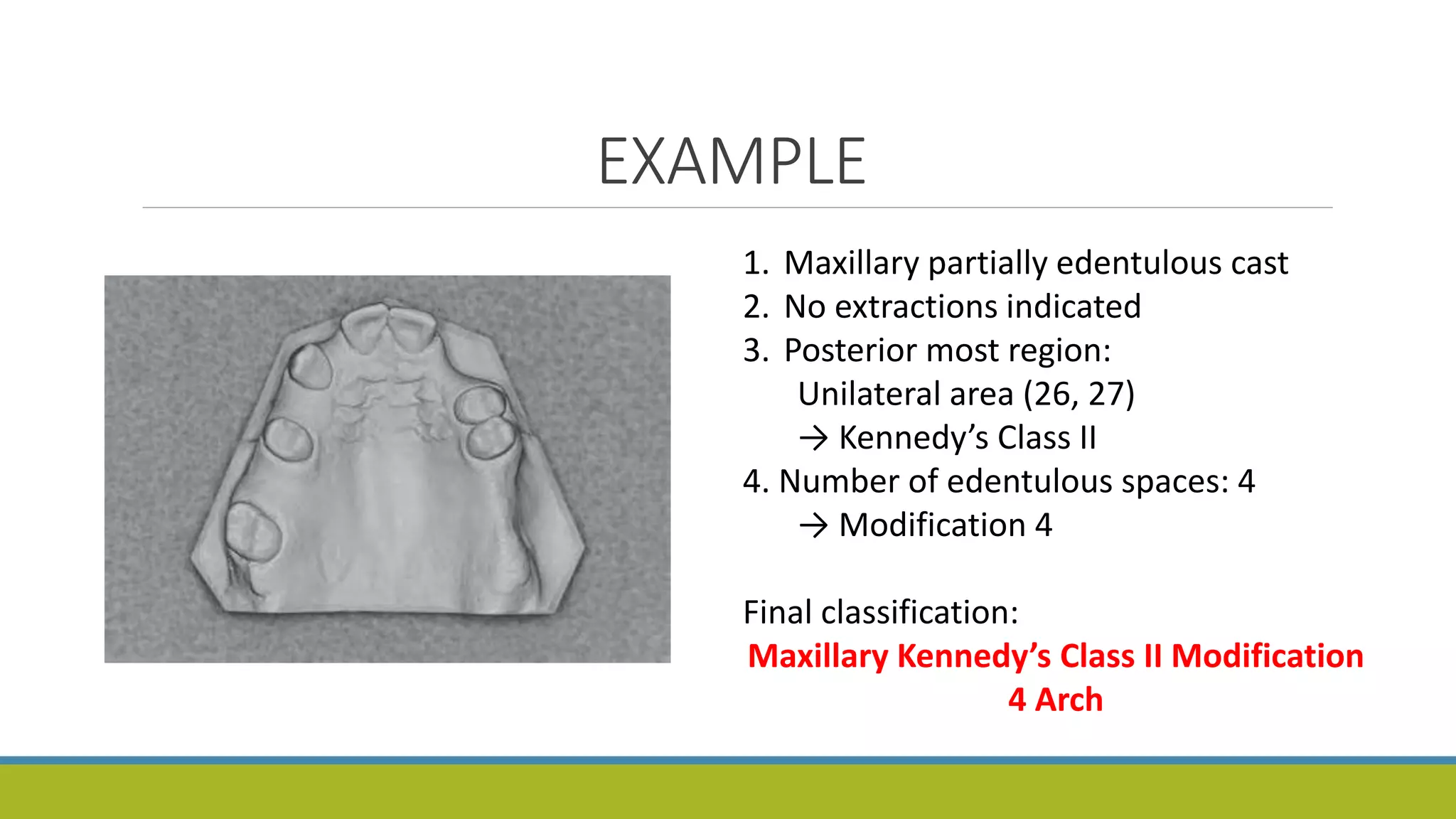
1. Maxillary partially edentulous cast
2. No extractions indicated
3. Posterior most region:
Unilateral area (26, 27)
→ Kennedy’s Class II
4. Number of edentulous spaces: 4
→ Modification 4
Final classification:
Maxillary Kennedy’s Class II Modification
4 Arch
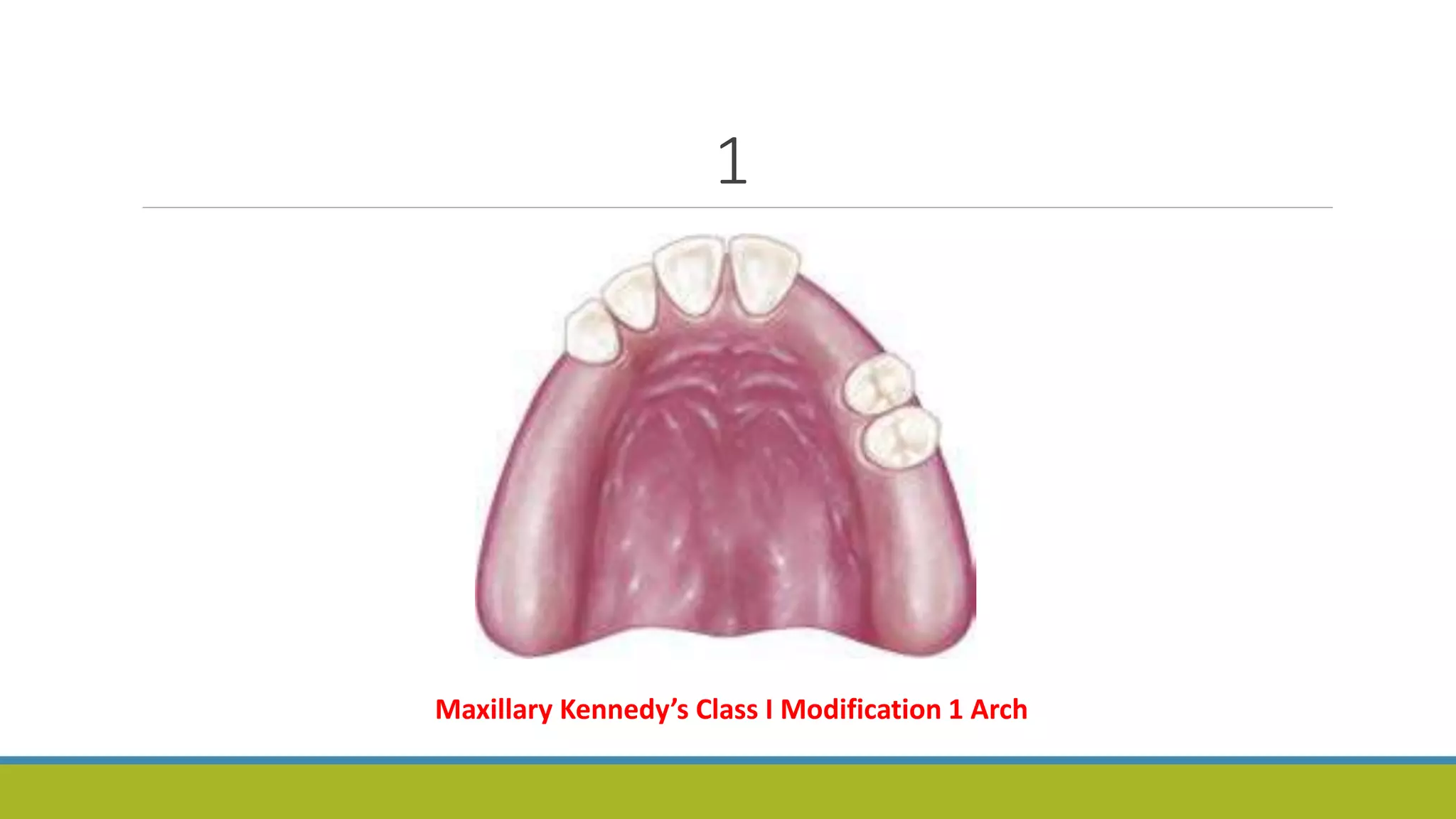
1
Maxillary Kennedy’s Class I Modification 1 Arch
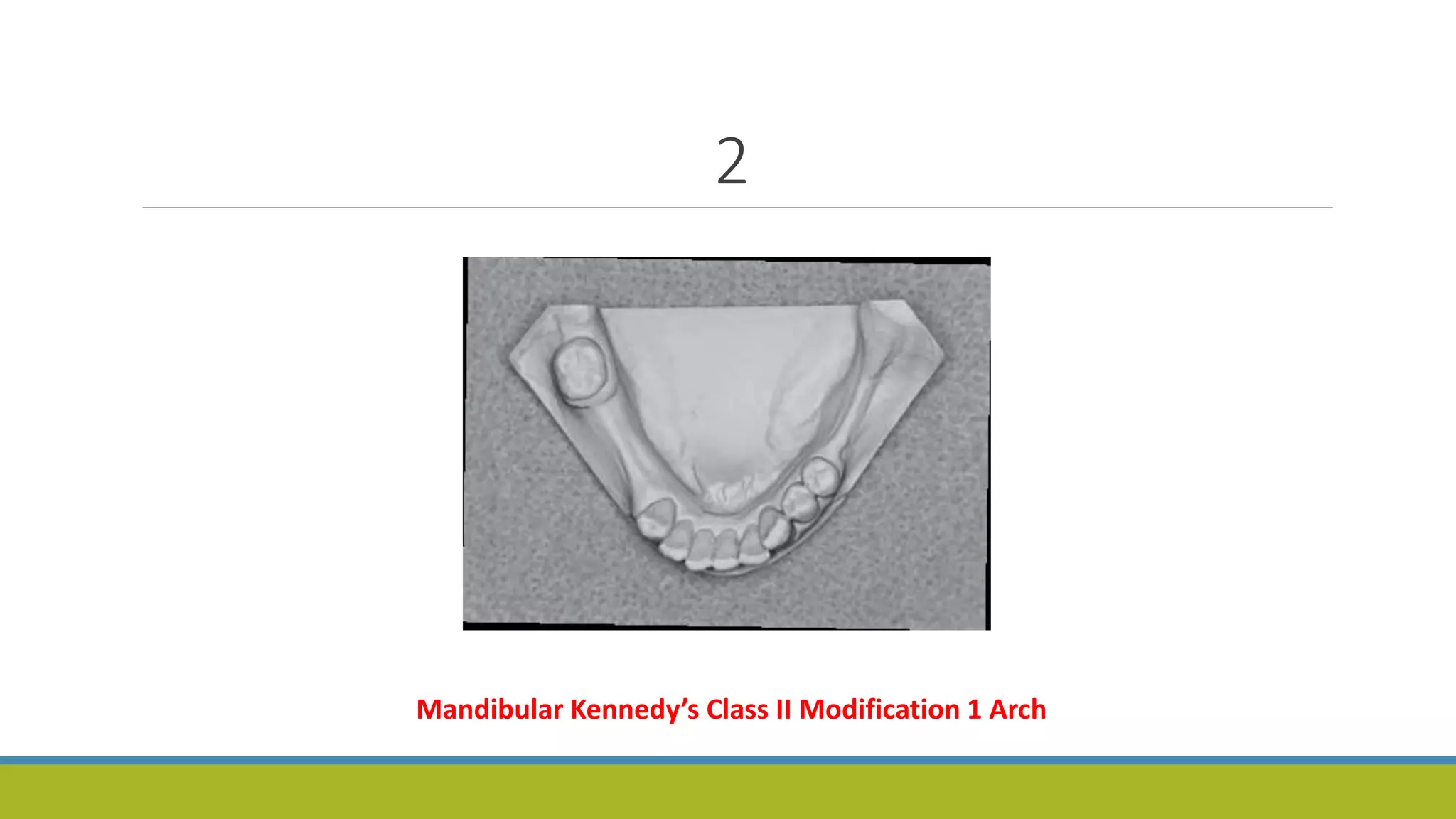
2
Mandibular Kennedy’s Class II Modification 1 Arch
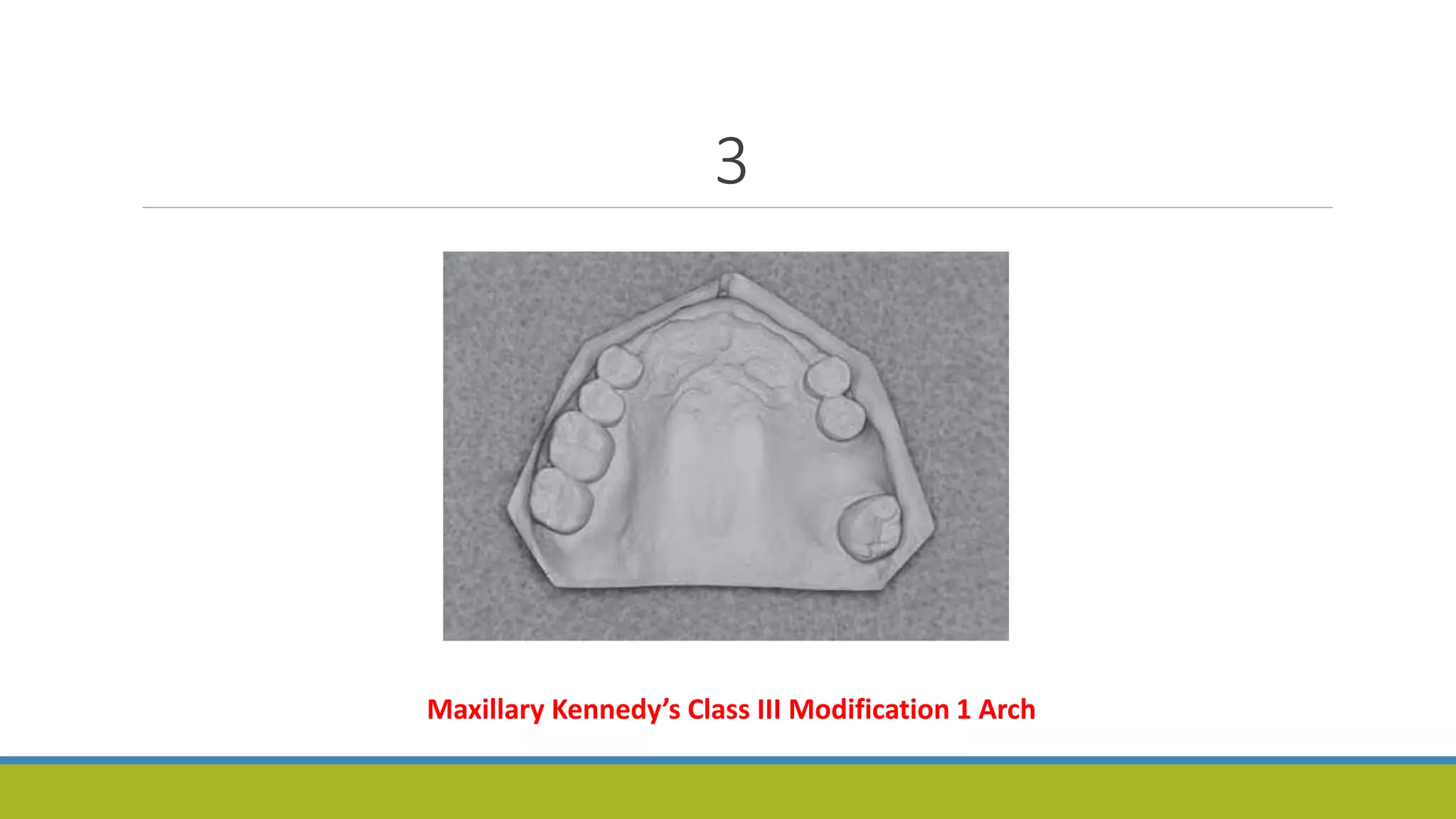
3
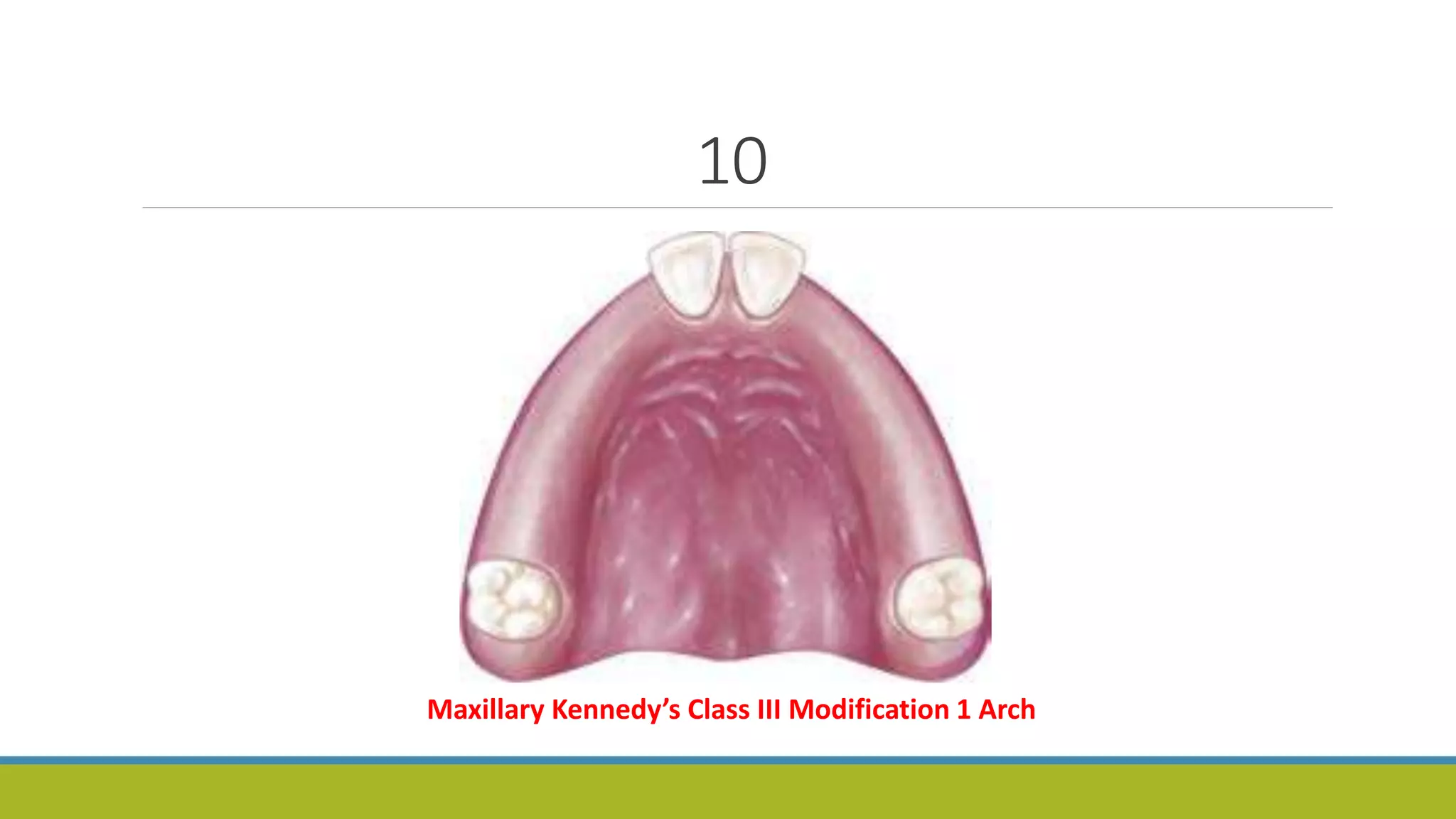
Maxillary Kennedy’s Class III Modification 1 Arch
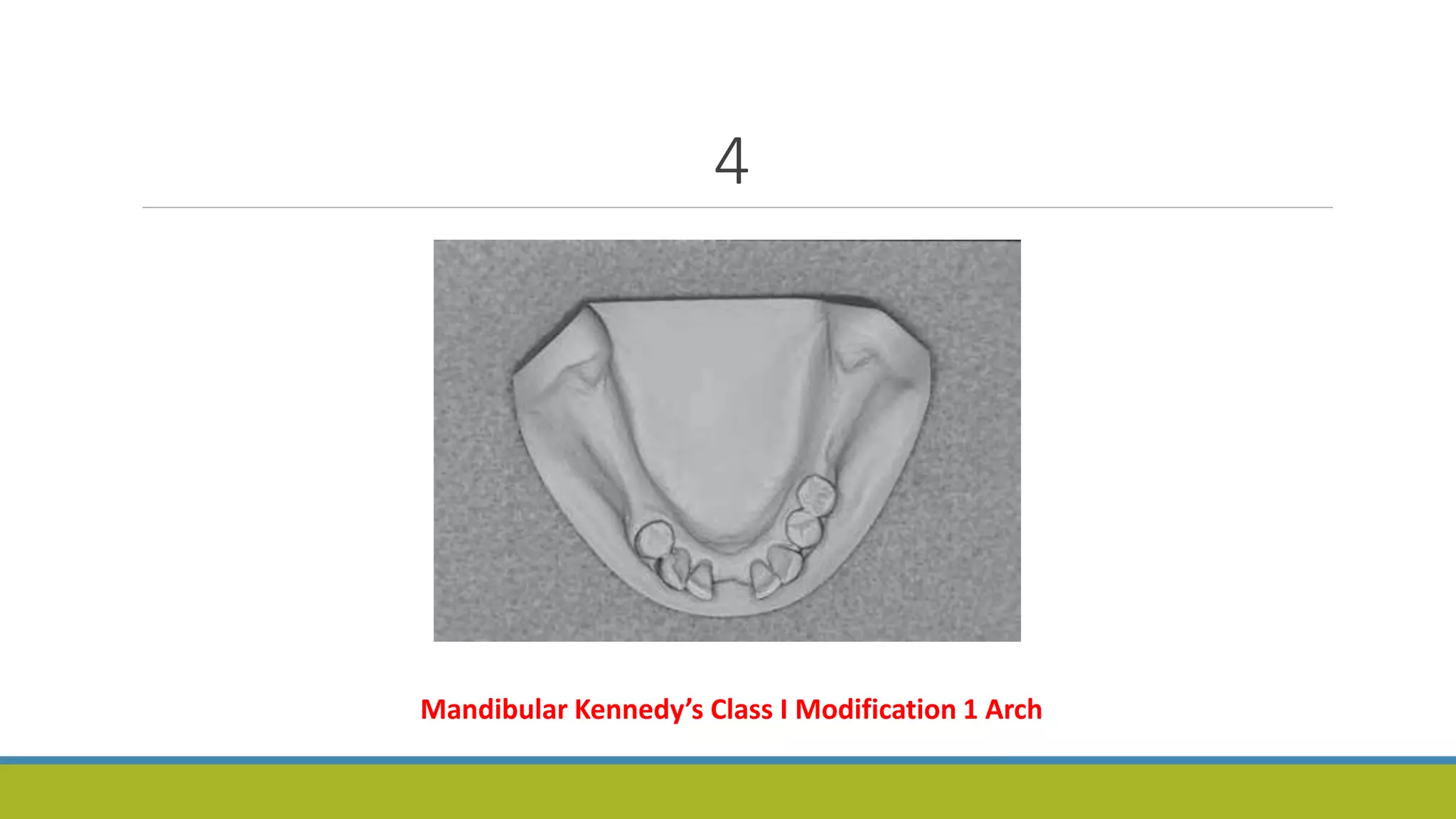
4
Mandibular Kennedy’s Class I Modification 1 Arch
5
Maxillary Kennedy’s Class IV Arch
6
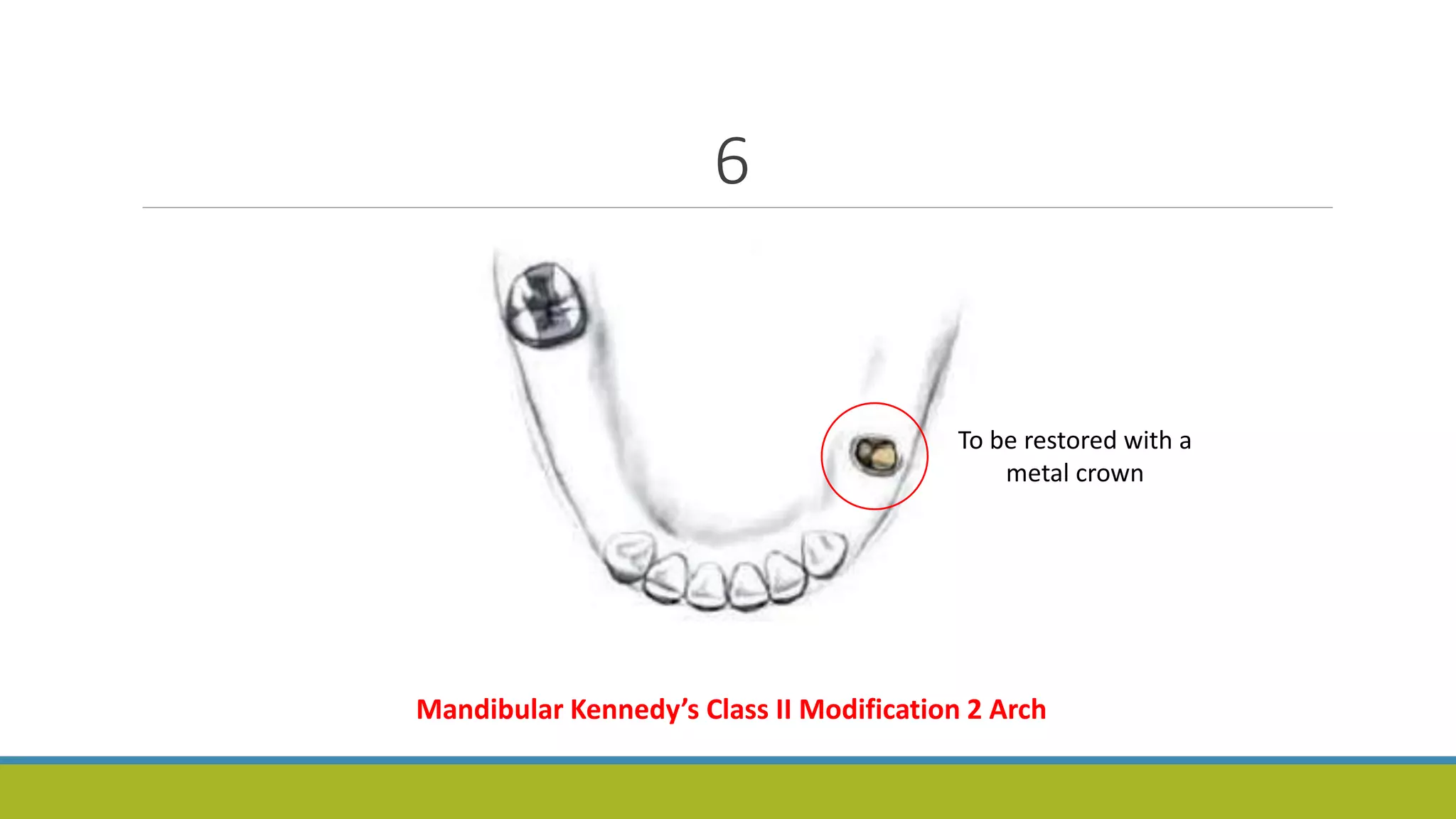
To be restored with a
metal crown
Mandibular Kennedy’s Class II Modification 2 Arch
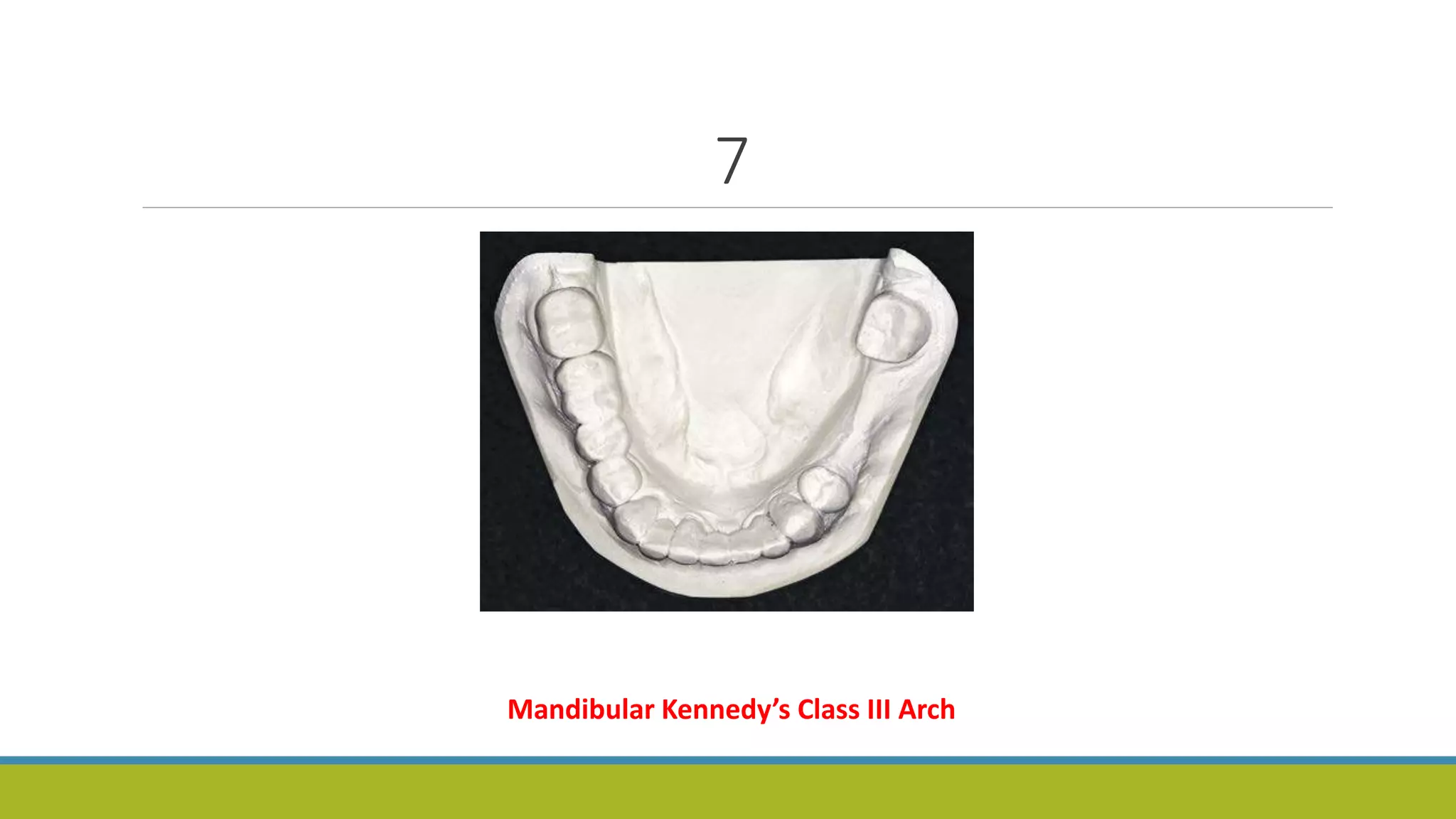
7
Mandibular Kennedy’s Class III Arch
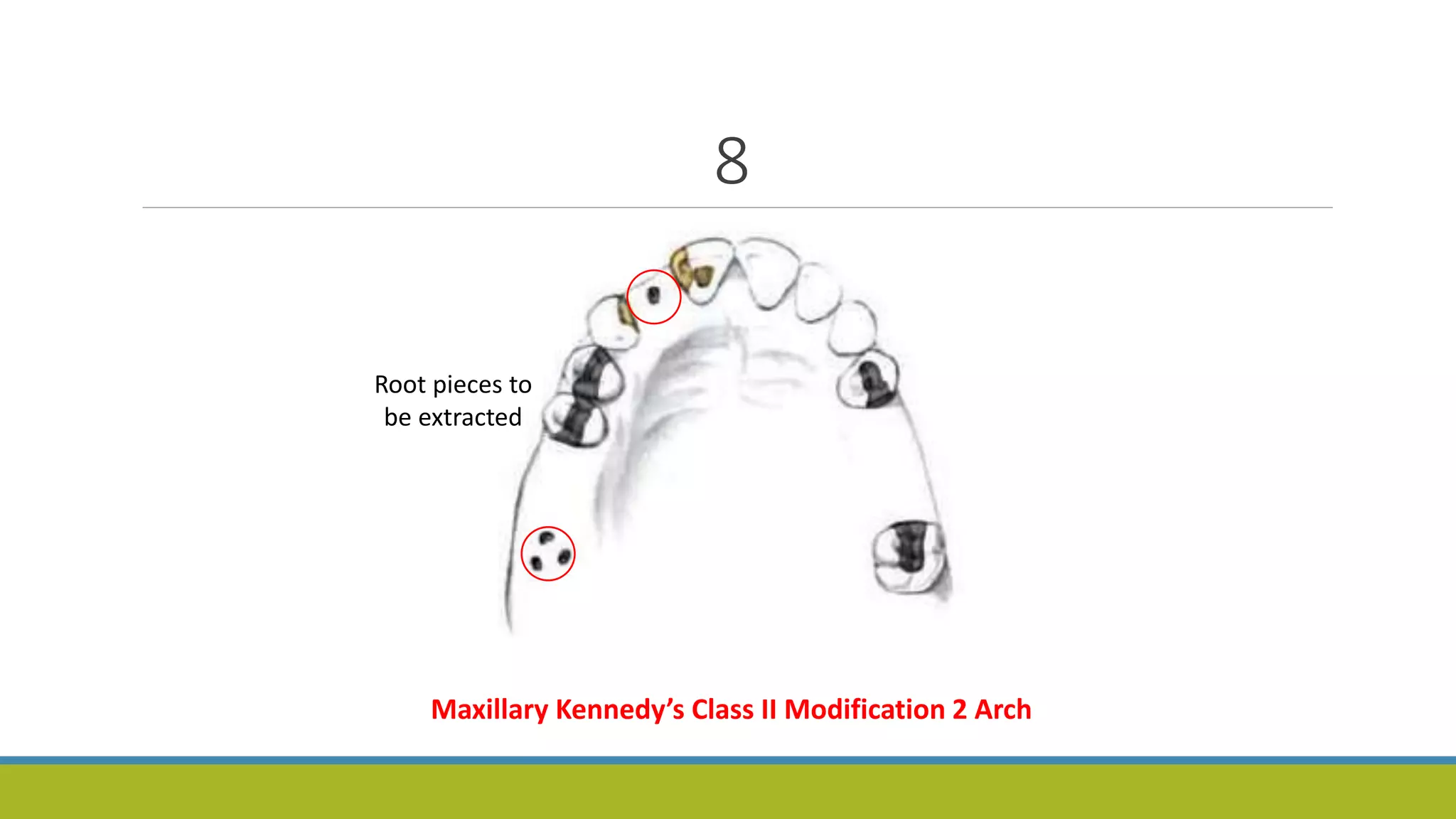
8
Root pieces to
be extracted
Maxillary Kennedy’s Class II Modification 2 Arch
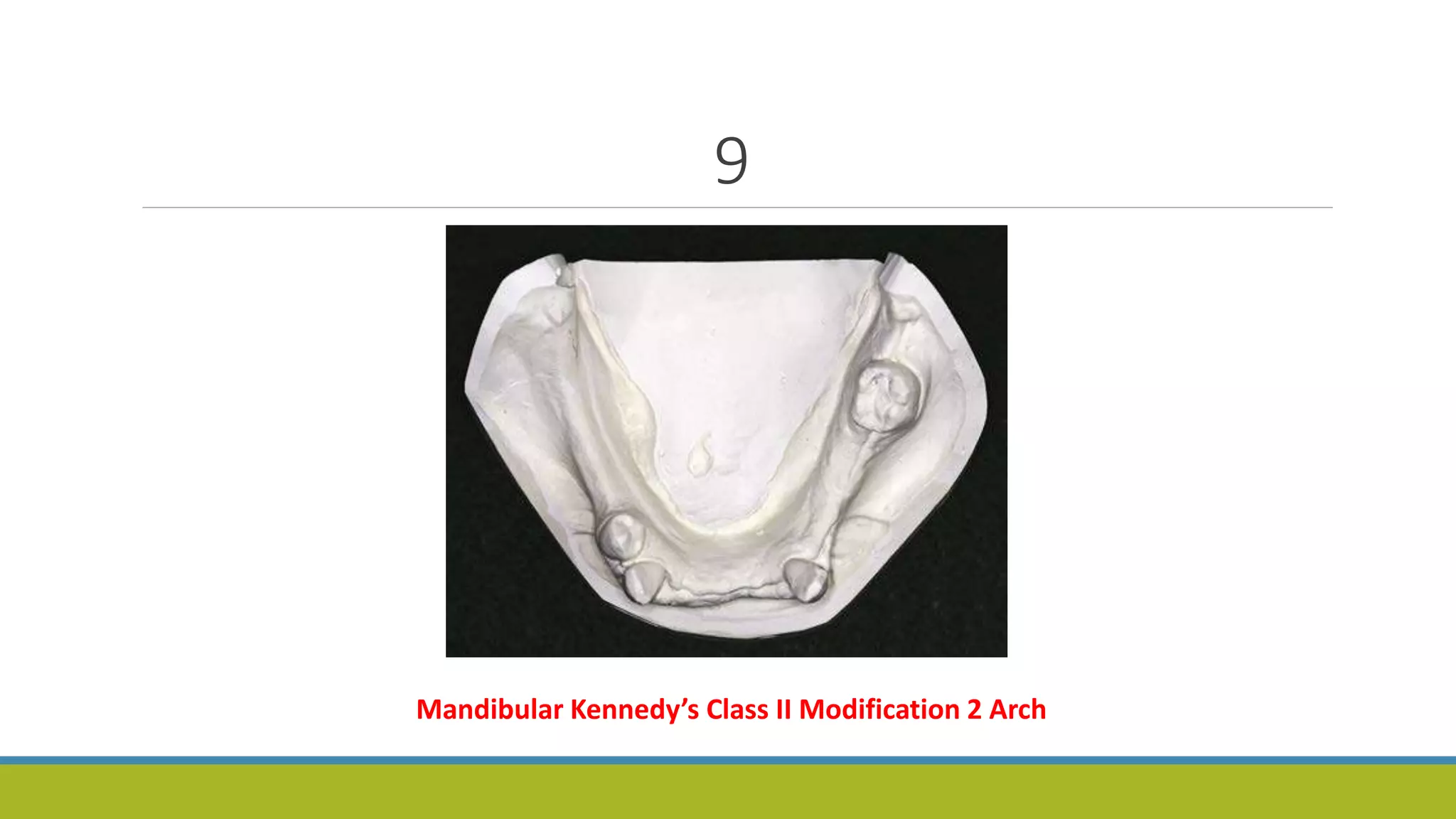
9
Mandibular Kennedy’s Class II Modification 2 Arch
10
Maxillary Kennedy’s Class III Modification 1 Arch
References
THANK YOU

Kennedy’s Classification in Cast Partial Denture

  • 1.
    KENNEDY’S CLASSIFICATION AND APPLEGATE’SRULES DR. AAMIR GODIL DEPARTMENT OF PROSTHODONTICS M.A.R.D.C.
  • 2.
    UNDERSTANDING PARTIAL EDENTULISM •Partial edentulism: One or more, but not all teeth missing Completely edentulous mandibular arch Partially edentulous maxillary arch
  • 3.
    CAST PARTIAL DENTURES Castpartial denture framework Cast partial denture
  • 4.
    NEED FOR CLASSIFICATION oToformulate a good treatment plan. oTo anticipate the difficulties commonly to occur for that particular design. oTo communicate with a professional about a case. oTo design the denture according to the occlusal load usually expected for a particular group.
  • 5.
  • 6.
  • 7.
    Kennedy’s Classification oDr EdwardKennedy of New York proposed this classification in 1925. oThis is the most popular classification. oKennedy divided all partially edentulous arches into four basic classes. Edentulous areas other than those that determine the basic classes were designated as modification spaces oKennedy’s classification is positional or anatomical and conveys a picture of certain teeth and their relationships, but gives little information about the teeth present and their positional relationships.
  • 8.
    KENNEDY’S CLASS I oBilateraledentulous areas located posterior to the natural teeth oThe planned denture will take support from teeth as well as tissues oDistal extension denture base
  • 9.
    KENNEDY’S CLASS II oAunilateral edentulous area located posterior to the remaining natural teeth oThe planned denture will take support from teeth as well as tissues oDistal extension denture base
  • 10.
    KENNEDY’S CLASS III oAunilateral edentulous area with natural teeth remaining both anterior and posterior to it oThe planned denture will take support only from teeth
  • 11.
    KENNEDY’S CLASS IV oAsingle, but bilateral (crossing the midline), edentulous area located anterior to the remaining natural teeth oIf the edentulous space does not cross the midline, it is classified as Kennedy’s Class III
  • 12.
    KENNEDY’S APPLEGATE’S CLASSV oEdentulous area bounded anteriorly and posteriorly by natural teeth but in which the anterior abutment (e.g. lateral incisor) is not suitable for support. oIt is basically a class III situation where the anterior abutment cannot be used for any support. oHence, it cannot be treated like a conventional class III edentulous space
  • 13.
    KENNEDY APPLEGATE’S CLASSVI oEdentulous area in which the teeth adjacent to the space are capable of total support of the required prosthesis. oThis denture hardly requires any tissue support. Most of the removable partial dentures are tooth tissue supported. oHence, this condition is classified as a separate group
  • 14.
  • 15.
    Applegate’s Rules forKennedy’s Classification In 1954, Dr O. C. Applegate provided the following rules to govern application of the Kennedy system
  • 16.
    Rule 1: Applegate’s Rules Classificationshould follow rather than precede extractions that might alter the original classification In this instance, the indicated extractions yield a Kennedy Class II, Modification 1 arch.
  • 17.
    Rule 2: Applegate’s Rules Ifthe third molar is missing and not to be replaced, it is not considered in the classification. For purposes of this discussion, each tooth that is missing and to be replaced is shaded. Each tooth that is missing and not to be replaced is identified with an X. Hence, the illustration represents a Kennedy Class III arch.
  • 18.
    Rule 3: Applegate’s Rules Ifa third molar is present and is to be used as an abutment, it is considered in the classification. Consequently, this illustration represents a Kennedy Class III arch.
  • 19.
    Rule 4: Applegate’s Rules Ifa second molar is missing and is not to be replaced (that is, the opposing second molar is also missing and is not to be replaced), it is not considered in the classification. This illustration represents a Kennedy Class III arch.
  • 20.
    Rule 5: Applegate’s Rules Themost posterior edentulous area(s) always determines the classification. As a result, this pattern of edentulism represents a Kennedy Class II, Modification 1 arch.
  • 21.
    Rule 6: Applegate’s Rules Edentulousareas other than those determining the classification are referred to as modification spaces and are designated by their number. This illustration represents a Kennedy Class II, Modification 2 arch.
  • 22.
    Rule 7: Applegate’s Rules Theextent of the modification is not considered, only the number of additional edentulous areas. Consequently, both illustrations represent Kennedy Class II, Modification 1 arches.
  • 23.
    Rule 8: Applegate’s Rules Therecan be no modification areas in Class IV arches. Any edentulous area lying posterior to the single bilateral area determines the classification. This illustration depicts a Kennedy Class III, Modification 1 arch.
  • 24.
  • 25.
    QUICK GUIDELINES After youidentify the partially edentulous arch/ cast (Maxilla/ Mandible), 1. Consider extractions if any 2. Determine the most posterior edentulous space 3. Determine the replacement of third molars and second molars 4. Determine the primary classification 5. Count the number of edentulous spaces other than the primary classification 6. Denote them as modification spaces. Number of modification spaces is added to the primary classification 7. Join all the information and provide the final classification
  • 26.
    EXAMPLE 1. Maxillary partiallyedentulous cast 2. No extractions indicated 3. Posterior most region: Unilateral area (26, 27) → Kennedy’s Class II 4. Number of edentulous spaces: 4 → Modification 4 Final classification: Maxillary Kennedy’s Class II Modification 4 Arch
  • 27.
    1 Maxillary Kennedy’s ClassI Modification 1 Arch
  • 28.
    2 Mandibular Kennedy’s ClassII Modification 1 Arch
  • 29.
    3 Maxillary Kennedy’s ClassIII Modification 1 Arch
  • 30.
    4 Mandibular Kennedy’s ClassI Modification 1 Arch
  • 31.
  • 32.
    6 To be restoredwith a metal crown Mandibular Kennedy’s Class II Modification 2 Arch
  • 33.
  • 34.
    8 Root pieces to beextracted Maxillary Kennedy’s Class II Modification 2 Arch
  • 35.
    9 Mandibular Kennedy’s ClassII Modification 2 Arch
  • 36.
    10 Maxillary Kennedy’s ClassIII Modification 1 Arch
  • 37.
  • 38.