DEFINITION IDEAL REQUIREMENTS PROBLEMS IN BONDING OF DENTIN  CHRONOLOGY OF DEVOLPMENT BONDING TO DENTIN ROLE OF SMEAR LAYER IN DENTIN BONNDING CONDITIONING OF DENTIN DENTIN BONDING AGENTS AND GENERATIONS COMPONENTS OF  BONDING AGENTS INDICATIONS FOR CLINICAL EXAMINATION CRITICAL STEPS IN BONDING
 
Biocompatible Non toxic, Non irritant, Non poisonous Low film thickness, Low viscosity Form strong permanent bond Good dimensional stability Similar C.O.T.E as tooth Low thermal conductivity Good shelf life Prevent micro leakage
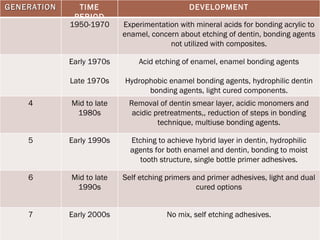
GENERATION TIME PERIOD DEVELOPMENT 1950-1970 Experimentation with mineral acids for bonding acrylic to enamel, concern about etching of dentin, bonding agents not utilized with composites. Early 1970s Late 1970s Acid etching of enamel, enamel bonding agents Hydrophobic enamel bonding agents, hydrophilic dentin bonding agents, light cured components. 4 Mid to late 1980s Removal of dentin smear layer, acidic monomers and acidic pretreatments,, reduction of steps in bonding technique, multiuse bonding agents. 5 Early 1990s Etching to achieve hybrid layer in dentin, hydrophilic agents for both enamel and dentin, bonding to moist tooth structure, single bottle primer adhesives. 6 Mid to late 1990s Self etching primers and primer adhesives, light and dual cured options 7 Early 2000s No mix, self etching adhesives.
ETCHENTS / CONDITIONERS PRIMERS ADHESIVES
ORGANIC ACID:- Maleic acid ,EDTA ,citric  acid, tartaric acid. POLYMERIC ACID:- poly acrylic acid INORGANIC ACID:- phosphoric acid, nitric acid.
NTG-GMA PMDM BPDM PENTA HEMA
Hydrophobic monomers BIS-GMA UDMA Diluent TEGDMA Wetting agent HEMA
Dentin is a dynamic tissue that shows changes due to ageing, caries or restorative procedures Dentinal tubules are filled with dentinal fluid which constantly flow outward from the pulp Dentin has a considerable amount of organic material and water Dentin is close to pulp, so different chemical used for bonding and etching may irritate the pulp.
The molecule designed for dentin bonding were represented by an M-R-X molecule. M- methacrylate group for bonding to resin matrix of composite resin R- spacer such as hydrocarbon chain X-functional group for bonding to organic or inorganic component of dentin.
Whenever tooth surface is cut with hand or rotary instruments , it causes small particles of the cut tooth surface to the tooth producing the smear layer  Smear layer is defined as any debris ,calcific in nature ,produced by reduction or instrumentation of enamel, of dentin or cementum
It has two phases Solid phase-made up of cutting debris , primarily denaturated collagen and mineral Liquid phase- made up of tortuous fluid filled channels around the cutting debris Bacteria entrapped in smear layer can survive and multiply beneath the restoration
Retention of smear layer:- 1)lowers dentin permeability 2)prevent decrease in bond strength 3)lowers effect of pulpal pressure on bond strength Recent generations adhesives involves modification of smear layer to facilitate bonding
Conditioning of dentin is defined as an alteration of dentin surface  including the smear layer with the objective of producing a substrate capable of micromechanical and possibly chemical bonding to dentin adhesive 1.Acid conditioners ;-several acids like phosphoric acid, maleic acid citric acid ,nitric acid, oxalic acid and hydrochloric acid
2.chelators- remove the smear layer without decalcification or significant physical changes on underlying dentin substrate Chelates refers to a compound with a central metal ion surrounded by covalently bonded atoms ,legands which posses additional bonds for chemical reaction Best known chelator conditioner is EDTA 3.thermal conditioning- recent trend is to use lasers in conditioning of teeth Studies have conformed increased  bond strengths with lased dentin compared to those with unlased dentin
Water act as a plasticizer for collagen and keep it in soft state  If dentin is excessively dried it will leads to collapse of dentin  If critical water concentration exists, that prevents collapse of collagen network and allows expansion of dried dentin. Critical amount of water is essential  for bonding but an over wet condition decreases bond strength and formation of blister like structures at the interface
This is the zone where the adhesive resin of the dentin bonding agent micromechanically interlocks within the inter tubular dentin and surrounding  collagen fibers Hybrid layer is formed in following manner:- 1.etching removes smear layer and exposes collagen fibers It also removes hydroxy apetite with in the intertubular dentin
2. Primers penetrate the collagen network. 3.Adhesive resins along with the primers form resin microtags within the intertubular dentin Hybrid layer also called resin-dentin interpenetration/  interdiffusion zone
Development of NPG-GMA, a surface active co-monomer was the basis of first commercially available dentin bonding agent. Theoretically NPG-GMA was supposed to chelate with calcium in dentin to form water resistant chemical bond to dentin In this M -un saturated methyl methacrylate group X -acidic phosphate group to react with calcium of dentin But bond strength produced by this agent very low (2-3 mpa). Clinically this agent did not successfully bond composite resin to dentin.
Introduced in 1970s and attempted to bond chemically to either inorganic or organic components of dentin But they produced only limited bond strength (5-6 mpa). Materials tried were:- halogen phosphoric acid esters of Bis-GMA, NPG-GMA, PHENYL-P Examples:- Clear fill bonds system F scotch bond bond lite.
Third generation attempted to deal with smear layer and dentinal fluid They employed two approaches:- Modification of smear layer to improve its property Or Removal of smear layer without disturbing smear plugs that occlude the dentinal tubules. The idea was to avoid aggressive etching of dentin because it cause pulpitis
2% nitric acid 2.5% maleic acid  with HEMA 10% citric acid with 3% ferric chloride 10% phosphoric acid Eg:- Tenure, Scotch bond, Gluma C&B metabond
Developed in 1990s Multiple bottles Etching with phosphoric acid required Rinsing required Light and dual cured formulations available. ETCHANT:-  Phosphoric acid, citric acid/ calcium chloride, oxalic acid/ aluminum nitrate. PRIMER:-  NTG-GMA/BPDM,HEMA/GPDM,4META ADHESIVES:-  Bis-GMA,TEGMA SOLVENT:-  acetone, ethanol/water. Eg:- all bond 2 ,panavia 21.
This are simplified version of fourth generation In fifth generation bonding agents primer and adhesives are in same bottle.  Etching  and rinsing required ETCHANT:-  Phosphoric acid, PRIMER:-  PENTA, Methacrylated phosphonates SOLVENT:-  acetone, ethanol/water. These agents are inferior to fourth generation bonding agents in terms of bond strength. Eg:- single bond3,Gluma comfort bond.
These includes self etching primers where the etchant and primer are in one bottle and adhesive resin in another bottle. Manipulation is easy , show good bond strength  to dentin but not to enamel Etching and rinsing not required Primer applied first then adhesive. ACIDIC PRIMER ADHESIVE:-  Methacrylated phosphates SOLVENT:-  Water Eg:- clear fill SE bond,XENO
One bottle- no mixing required. Etching and rinsing not required Light cured formulation Useful for direct applications with light cured restorative material. ACIDIC PRIMER ADHESIVE:-  Methacrylated phosphates SOLVENT:-  Water
All direct composite resin restoration,both anterior& posterior For bonding indirect composite resin inlays, onlays and veneers. For bonding indirect ceramic veneers , inlays and onlays. Bonded amalgam restorations Management of dentin hypersensitivity Luting post and core restorations
Proper isolation:- by using rubberdam , saliva contamination can block mechanical bonding. Pulp protection:- by using calcium hydroxide liner. Acid etching of enamel and dentin:- by using 37% phosphoric acid for 15 sec. then wash Dentin surface must be kept moist. If dentin is over dried it would result in collapse of exposed collagen fibers. Careful application and curing of bonding agents. Placing the composite resin.
CLINICAL OPERATIVE DENTISTRY- PRINCIPLES AND PRACTICE – RAMYA RAGHU CRAIG’S RESTORATIVE DENTAL MATERIALS OPERATIVE DENTISTRY – VIMAL.K.SIKRI SCIENCE OF DENTAL MATERIALS – V .SHAMA BHUTT
 

DENTIN BONDING AGENTS

  • 1.
  • 2.
    DEFINITION IDEAL REQUIREMENTSPROBLEMS IN BONDING OF DENTIN CHRONOLOGY OF DEVOLPMENT BONDING TO DENTIN ROLE OF SMEAR LAYER IN DENTIN BONNDING CONDITIONING OF DENTIN DENTIN BONDING AGENTS AND GENERATIONS COMPONENTS OF BONDING AGENTS INDICATIONS FOR CLINICAL EXAMINATION CRITICAL STEPS IN BONDING
  • 3.
  • 4.
    Biocompatible Non toxic,Non irritant, Non poisonous Low film thickness, Low viscosity Form strong permanent bond Good dimensional stability Similar C.O.T.E as tooth Low thermal conductivity Good shelf life Prevent micro leakage
  • 5.
    GENERATION TIME PERIODDEVELOPMENT 1950-1970 Experimentation with mineral acids for bonding acrylic to enamel, concern about etching of dentin, bonding agents not utilized with composites. Early 1970s Late 1970s Acid etching of enamel, enamel bonding agents Hydrophobic enamel bonding agents, hydrophilic dentin bonding agents, light cured components. 4 Mid to late 1980s Removal of dentin smear layer, acidic monomers and acidic pretreatments,, reduction of steps in bonding technique, multiuse bonding agents. 5 Early 1990s Etching to achieve hybrid layer in dentin, hydrophilic agents for both enamel and dentin, bonding to moist tooth structure, single bottle primer adhesives. 6 Mid to late 1990s Self etching primers and primer adhesives, light and dual cured options 7 Early 2000s No mix, self etching adhesives.
  • 6.
    ETCHENTS / CONDITIONERSPRIMERS ADHESIVES
  • 7.
    ORGANIC ACID:- Maleicacid ,EDTA ,citric acid, tartaric acid. POLYMERIC ACID:- poly acrylic acid INORGANIC ACID:- phosphoric acid, nitric acid.
  • 8.
  • 9.
    Hydrophobic monomers BIS-GMAUDMA Diluent TEGDMA Wetting agent HEMA
  • 10.
    Dentin is adynamic tissue that shows changes due to ageing, caries or restorative procedures Dentinal tubules are filled with dentinal fluid which constantly flow outward from the pulp Dentin has a considerable amount of organic material and water Dentin is close to pulp, so different chemical used for bonding and etching may irritate the pulp.
  • 11.
    The molecule designedfor dentin bonding were represented by an M-R-X molecule. M- methacrylate group for bonding to resin matrix of composite resin R- spacer such as hydrocarbon chain X-functional group for bonding to organic or inorganic component of dentin.
  • 12.
    Whenever tooth surfaceis cut with hand or rotary instruments , it causes small particles of the cut tooth surface to the tooth producing the smear layer Smear layer is defined as any debris ,calcific in nature ,produced by reduction or instrumentation of enamel, of dentin or cementum
  • 13.
    It has twophases Solid phase-made up of cutting debris , primarily denaturated collagen and mineral Liquid phase- made up of tortuous fluid filled channels around the cutting debris Bacteria entrapped in smear layer can survive and multiply beneath the restoration
  • 14.
    Retention of smearlayer:- 1)lowers dentin permeability 2)prevent decrease in bond strength 3)lowers effect of pulpal pressure on bond strength Recent generations adhesives involves modification of smear layer to facilitate bonding
  • 15.
    Conditioning of dentinis defined as an alteration of dentin surface including the smear layer with the objective of producing a substrate capable of micromechanical and possibly chemical bonding to dentin adhesive 1.Acid conditioners ;-several acids like phosphoric acid, maleic acid citric acid ,nitric acid, oxalic acid and hydrochloric acid
  • 16.
    2.chelators- remove thesmear layer without decalcification or significant physical changes on underlying dentin substrate Chelates refers to a compound with a central metal ion surrounded by covalently bonded atoms ,legands which posses additional bonds for chemical reaction Best known chelator conditioner is EDTA 3.thermal conditioning- recent trend is to use lasers in conditioning of teeth Studies have conformed increased bond strengths with lased dentin compared to those with unlased dentin
  • 17.
    Water act asa plasticizer for collagen and keep it in soft state If dentin is excessively dried it will leads to collapse of dentin If critical water concentration exists, that prevents collapse of collagen network and allows expansion of dried dentin. Critical amount of water is essential for bonding but an over wet condition decreases bond strength and formation of blister like structures at the interface
  • 18.
    This is thezone where the adhesive resin of the dentin bonding agent micromechanically interlocks within the inter tubular dentin and surrounding collagen fibers Hybrid layer is formed in following manner:- 1.etching removes smear layer and exposes collagen fibers It also removes hydroxy apetite with in the intertubular dentin
  • 19.
    2. Primers penetratethe collagen network. 3.Adhesive resins along with the primers form resin microtags within the intertubular dentin Hybrid layer also called resin-dentin interpenetration/ interdiffusion zone
  • 20.
    Development of NPG-GMA,a surface active co-monomer was the basis of first commercially available dentin bonding agent. Theoretically NPG-GMA was supposed to chelate with calcium in dentin to form water resistant chemical bond to dentin In this M -un saturated methyl methacrylate group X -acidic phosphate group to react with calcium of dentin But bond strength produced by this agent very low (2-3 mpa). Clinically this agent did not successfully bond composite resin to dentin.
  • 21.
    Introduced in 1970sand attempted to bond chemically to either inorganic or organic components of dentin But they produced only limited bond strength (5-6 mpa). Materials tried were:- halogen phosphoric acid esters of Bis-GMA, NPG-GMA, PHENYL-P Examples:- Clear fill bonds system F scotch bond bond lite.
  • 22.
    Third generation attemptedto deal with smear layer and dentinal fluid They employed two approaches:- Modification of smear layer to improve its property Or Removal of smear layer without disturbing smear plugs that occlude the dentinal tubules. The idea was to avoid aggressive etching of dentin because it cause pulpitis
  • 23.
    2% nitric acid2.5% maleic acid with HEMA 10% citric acid with 3% ferric chloride 10% phosphoric acid Eg:- Tenure, Scotch bond, Gluma C&B metabond
  • 24.
    Developed in 1990sMultiple bottles Etching with phosphoric acid required Rinsing required Light and dual cured formulations available. ETCHANT:- Phosphoric acid, citric acid/ calcium chloride, oxalic acid/ aluminum nitrate. PRIMER:- NTG-GMA/BPDM,HEMA/GPDM,4META ADHESIVES:- Bis-GMA,TEGMA SOLVENT:- acetone, ethanol/water. Eg:- all bond 2 ,panavia 21.
  • 25.
    This are simplifiedversion of fourth generation In fifth generation bonding agents primer and adhesives are in same bottle. Etching and rinsing required ETCHANT:- Phosphoric acid, PRIMER:- PENTA, Methacrylated phosphonates SOLVENT:- acetone, ethanol/water. These agents are inferior to fourth generation bonding agents in terms of bond strength. Eg:- single bond3,Gluma comfort bond.
  • 26.
    These includes selfetching primers where the etchant and primer are in one bottle and adhesive resin in another bottle. Manipulation is easy , show good bond strength to dentin but not to enamel Etching and rinsing not required Primer applied first then adhesive. ACIDIC PRIMER ADHESIVE:- Methacrylated phosphates SOLVENT:- Water Eg:- clear fill SE bond,XENO
  • 27.
    One bottle- nomixing required. Etching and rinsing not required Light cured formulation Useful for direct applications with light cured restorative material. ACIDIC PRIMER ADHESIVE:- Methacrylated phosphates SOLVENT:- Water
  • 28.
    All direct compositeresin restoration,both anterior& posterior For bonding indirect composite resin inlays, onlays and veneers. For bonding indirect ceramic veneers , inlays and onlays. Bonded amalgam restorations Management of dentin hypersensitivity Luting post and core restorations
  • 29.
    Proper isolation:- byusing rubberdam , saliva contamination can block mechanical bonding. Pulp protection:- by using calcium hydroxide liner. Acid etching of enamel and dentin:- by using 37% phosphoric acid for 15 sec. then wash Dentin surface must be kept moist. If dentin is over dried it would result in collapse of exposed collagen fibers. Careful application and curing of bonding agents. Placing the composite resin.
  • 30.
    CLINICAL OPERATIVE DENTISTRY-PRINCIPLES AND PRACTICE – RAMYA RAGHU CRAIG’S RESTORATIVE DENTAL MATERIALS OPERATIVE DENTISTRY – VIMAL.K.SIKRI SCIENCE OF DENTAL MATERIALS – V .SHAMA BHUTT
  • 31.