Classification of partially edentulous arches          By Bibinbhaskaran
Introduction
Need for classification
Requirements of a classification
Various classification systems
ACP classification
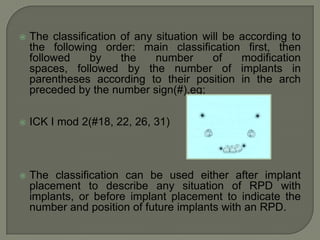
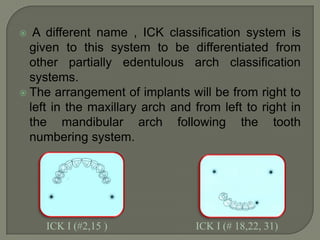
ICK classification
ConclusionIntroductionPrime  purpose : to enable dentist to clearly communicate to a listener. A workable Classification helps to create order from the many number of possible combinations of missing teeth and edentulous spaces.An aid in learning of the fundamentals of design
Need for classificationTo formulate a good treatment plan.To anticipate the difficulties common to occur for that particular design.To communicate with a professional about a case.To design the denture according to the occlusal load usually expected for a particular group.
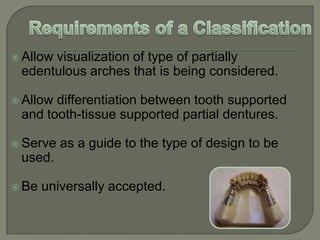
Requirements of a ClassificationAllow visualization of type of partially edentulous arches that is being considered.Allow differentiation between tooth supported and tooth-tissue supported partial dentures.Serve as a guide to the type of design to be used.Be universally accepted.
Various classification systemsThere are many classifications available for classifying edentulous arches. The most common ones are:CummerKennedy’sApplegate-KennedyBailynNeurohrMaukFriedman GodfreySkinner Austin and LidgeCraddockWildWatt et alCosta Osborne and LammieBeckettSwenson ACP classification    ICK classification
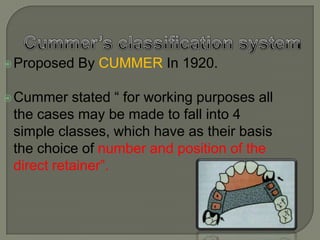
Cummer’s classification systemProposed By CUMMERIn 1920.Cummer stated “ for working purposes all  the cases may be made to fall into 4 simple classes, which have as their basis the choice of number and position of the direct retainer”.
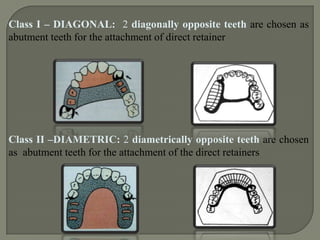
Class I – DIAGONAL:  2 diagonally opposite teethare chosen as abutment teeth for the attachment of direct retainerClass II –DIAMETRIC: 2 diametrically opposite teethare chosen as  abutment teeth for the attachment of the direct retainers
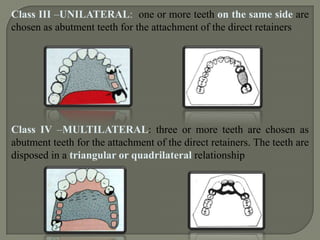
Class III –UNILATERAL:  one or more teeth on the same sideare chosen as abutment teeth for the attachment of the direct retainers Class IV –MULTILATERAL: three or more teeth are chosen as abutment teeth for the attachment of the direct retainers. The teeth are disposed in a triangular or quadrilateral relationship
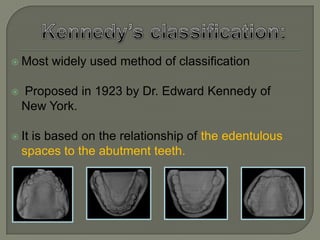
 Kennedy’s classification:Most widely used method of classificationProposed in 1923 by Dr. Edward Kennedy of New York. It is based on the relationship of the edentulous spaces to the abutment teeth.
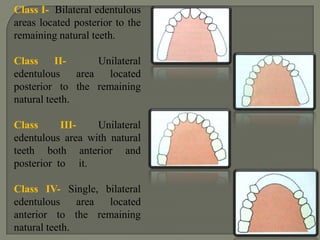
Class I-  Bilateral edentulous areas located posterior to the remaining natural teeth.Class II-  Unilateral edentulous area located posterior to the remaining natural teeth.Class III- Unilateral edentulous area with natural teeth both anterior and posterior  to     it.Class IV- Single, bilateral edentulous area located anterior to the remaining natural teeth.
Applegate Kennedy’s system:It is a modification of the Kennedy’s system.It is based less on the number and location of the remaining teeth and edentulous spaces. It takes into consideration the capabilities of the teeth, which bound the spaces to serve as abutments for the prosthesis
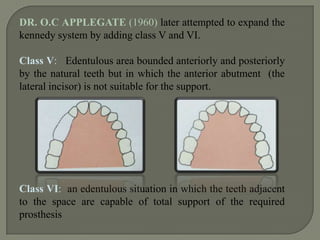
DR. O.C APPLEGATE (1960) later attempted to expand the kennedy system by adding class V and VI.Class V:   Edentulous area bounded anteriorly and posteriorly by the natural teeth but in which the anterior abutment  (the lateral incisor) is not suitable for the support.Class VI:  an edentulous situation in which the teeth adjacent to the space are capable of total support of the required prosthesis
Applegate’s Rules:Applegate also provided the following 8 rules to govern the application of the Kennedy system:Rule 1: Classification should follow rather than precede extractions that might alter the original classification.Rule 2:If the third molar is missing and not to be replaced it is not considered in the classification.Rule 3:If the third molar is present and is to be used as an abutment, it is considered in the classification.
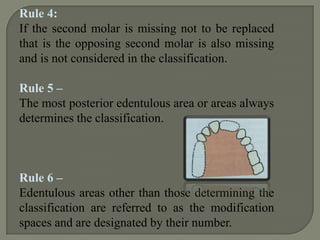
Rule 4:If the second molar is missing not to be replaced that is the opposing second molar is also missing and is not considered in the classification.Rule 5 – The most posterior edentulous area or areas always determines the classification.Rule 6 –Edentulous areas other than those determining the classification are referred to as the modification spaces and are designated by their number.
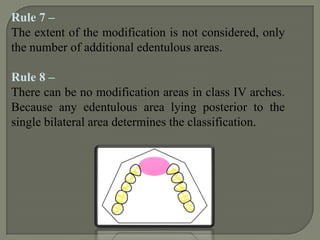
Rule 7 –The extent of the modification is not considered, only the number of additional edentulous areas.Rule 8 –There can be no modification areas in class IV arches. Because any edentulous area lying posterior to the single bilateral area determines the classification.
Bailyn’s system:Based on whether the prosthesis is tooth borne, tissue borne or a combination of the two:Bailyn divided all R.P.Ds into-A: Anterior restorations: saddle area 	anterior to the 1st bicuspidsP: Posterior restorations: saddle area 	posterior to the cuspids.
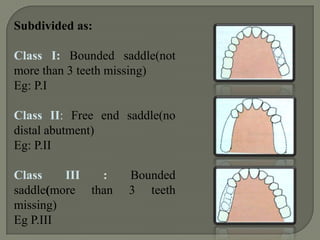
Subdivided as:ClassI:Bounded saddle(not more than 3 teeth missing)Eg: P.IClass II: Free end saddle(no distal abutment)Eg: P.IIClassIII : Bounded saddle(more than 3 teeth missing)Eg P.III
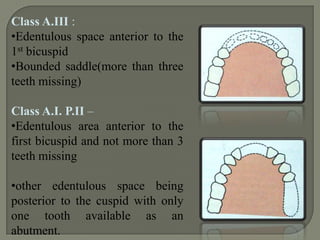
Class A.III : Edentulous space anterior to the 1st bicuspid
Bounded saddle(more than three teeth missing)Class A.I. P.II – Edentulous area anterior to the first bicuspid and not more than 3 teeth missing
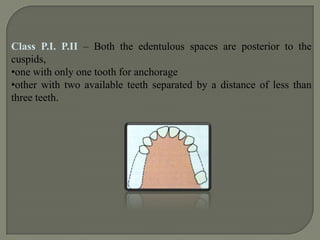
other edentulous space being posterior to the cuspid with only one tooth available as an abutment.Class P.I. P.II– Both the edentulous spaces are posterior to the cuspids, one with only one tooth for anchorage
other with two available teeth separated by a distance of less than three teeth.Neurohr’s classification:Proposed in 1939, this classification is also based on the support derived. It is not commonly used due to its complexity. Many of his denture designs did not match his principles of classification.
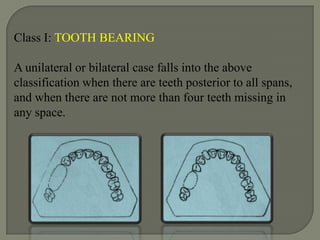
Class I: TOOTH BEARING A unilateral or bilateral case falls into the above classification when there are teeth posterior to all spans, and when there are not more than four teeth missing in any space.
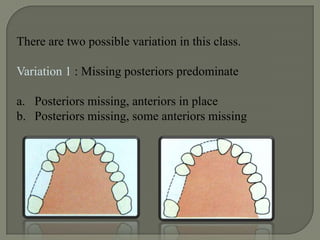
There are two possible variation in this class.Variation 1 : Missing posteriors predominatePosteriors missing, anteriors in placePosteriors missing, some anteriors missing
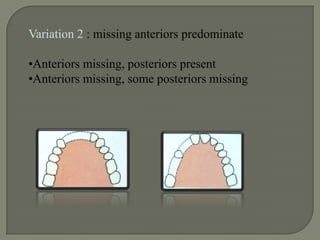
Variation 2 : missing anteriors predominateAnteriors missing, posteriors present
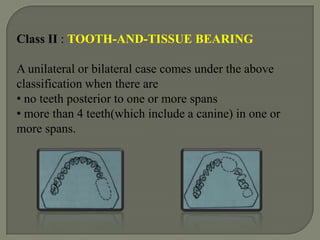
Anteriors missing, some posteriors missingClass II : TOOTH-AND-TISSUE BEARINGA unilateral or bilateral case comes under the above classification when there are no teeth posterior to one or more spans
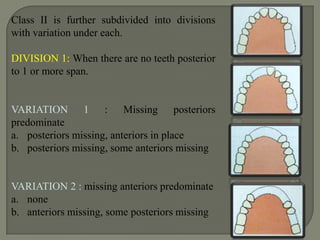
 more than 4 teeth(which include a canine) in one or more spans. Class II is further subdivided into divisions with variation under each.DIVISION 1: When there are no teeth posterior to 1 or more span.VARIATION1 : Missing posteriors predominateposteriors missing, anteriors in placeposteriors missing, some anteriors missing VARIATION 2 : missing anteriors predominatenoneanteriors missing, some posteriors missing
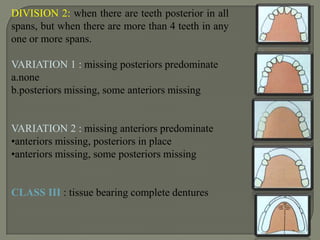
DIVISION 2: when there are teeth posterior in all spans, but when there are more than 4 teeth in any one or more spans.VARIATION 1 : missing posteriors predominatea.noneb.posteriors missing, some anteriors missingVARIATION 2 : missing anteriors predominateanteriors missing, posteriors in place
anteriors missing, some posteriors missingCLASS III : tissue bearing complete dentures
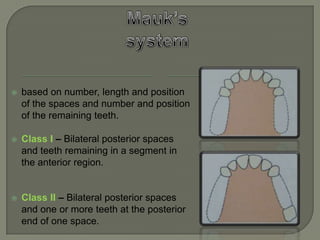
Mauk’s systembased on number, length and position of the spaces and number and position of the remaining teeth.Class I – Bilateral posterior spaces and teeth remaining in a segment in the anterior region.Class II – Bilateral posterior spaces and one or more teeth at the posterior end of one space.
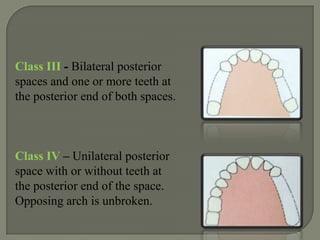
Class III - Bilateral posterior spaces and one or more teeth at the posterior end of both spaces.Class IV – Unilateral posterior space with or without teeth at the posterior end of the space. Opposing arch is unbroken.
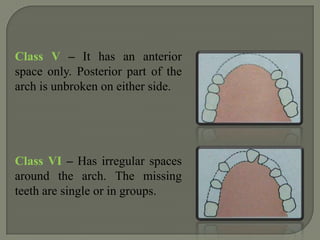
Class V – It has an anterior space only. Posterior part of the arch is unbroken on either side.Class VI – Has irregular spaces around the arch. The missing teeth are single or in groups.
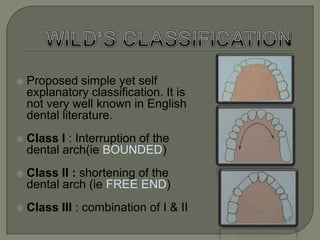
WILD’S CLASSIFICATIONProposed simple yet self explanatory classification. It is not very well known in English dental literature.Class I : Interruption of the dental arch(ieBOUNDED)Class II : shortening of the dental arch (ieFREE END)Class III : combination of I & II
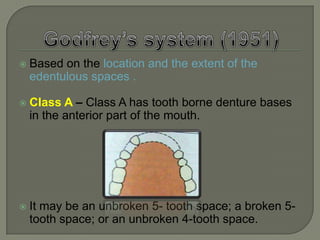
Godfrey’s system (1951)Based on the location and the extent of the edentulous spaces .Class A – Class A has tooth borne denture bases in the anterior part of the mouth. It may be an unbroken 5- tooth space; a broken 5-tooth space; or an unbroken 4-tooth space.
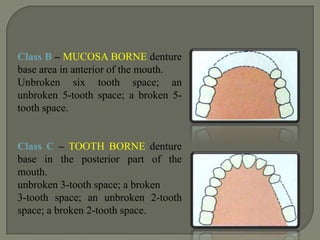
Class B –MUCOSA BORNE denture base area in anterior of the mouth.Unbroken six tooth space; an unbroken 5-tooth space; a broken 5-tooth space.Class C –TOOTH BORNE denture base in the posterior part of the mouth. unbroken 3-tooth space; a broken 3-tooth space; an unbroken 2-tooth space; a broken 2-tooth space.
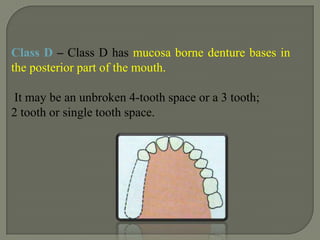
Class D – Class D has mucosa borne denture bases in the posterior part of the mouth. It may be an unbroken 4-tooth space or a 3 tooth; 2 tooth or single tooth space.
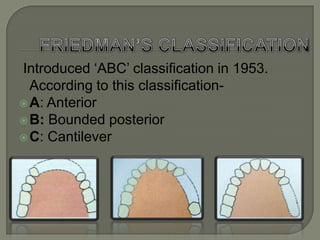
FRIEDMAN’S CLASSIFICATION Introduced ‘ABC’ classification in 1953. According to this classification-A: AnteriorB: Bounded posteriorC: Cantilever
BECKETT AND WILSON CLASSIFICATIONBeckett (1953) and Wilson(1957) based their ideas on bailyn’s classification(1928).Based on proportionate amount of support provided by the teeth and tissues.
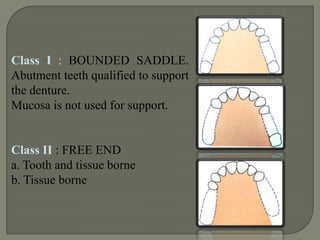
Class I : BOUNDED SADDLE. Abutment teeth qualified to support the denture. Mucosa is not used for support.Class II: FREE ENDa. Tooth and tissue borneb. Tissue borne
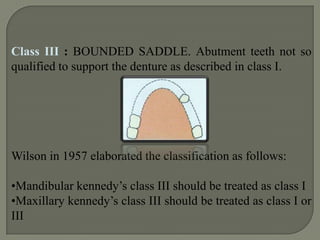
Class III : BOUNDED SADDLE. Abutment teeth not so qualified to support the denture as described in class I.Wilson in 1957 elaborated the classification as follows:Mandibularkennedy’s class III should be treated as class I
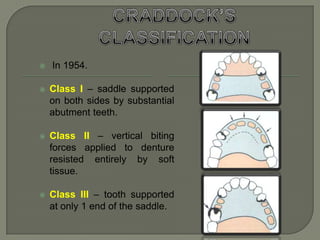
Maxillary kennedy’s class III should be treated as class I or IIICRADDOCK’S CLASSIFICATION In 1954. Class I – saddle supported on both sides by substantial abutment teeth.Class II – vertical biting forces applied to denture resisted entirely by soft tissue.Class III– tooth supported at only 1 end of the saddle. 
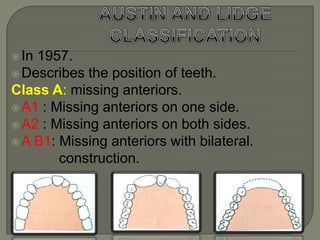
AUSTIN AND LIDGE CLASSIFICATIONIn 1957.Describes the position of teeth.Class A: missing anteriors.A1 : Missing anteriors on one side.A2 : Missing anteriors on both sides.A B1: Missing anteriors with bilateral.      		    construction.
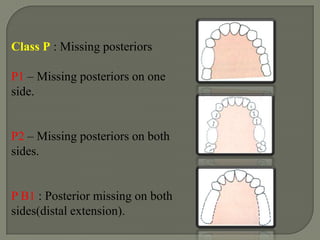
Class P: Missing posteriorsP1 – Missing posteriors on one side.P2 – Missing posteriors on both sides.P B1 : Posterior missing on both sides(distal extension).
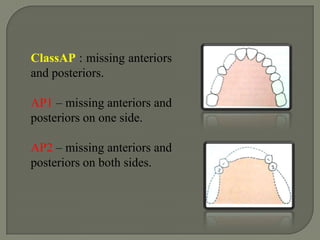
ClassAP: missing anteriors and posteriors.AP1 – missing anteriors and posteriors on one side.AP2 – missing anteriors and posteriors on both sides.
SKINNER’S SYSTEM:(1957)This system was based on the relationship of the abutment teeth to the supporting residual alveolar ridge.He said that the value of RPD is directly related to quantity and the degree of support, which it receives, from the abutment teeth and residual ridge.
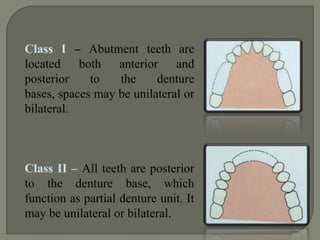
Class I – Abutment teeth are located both anterior and posterior to the denture bases, spaces may be unilateral or bilateral.Class II –All teeth areposterior to the denture base, which function as partial denture unit. It may be unilateral or bilateral.
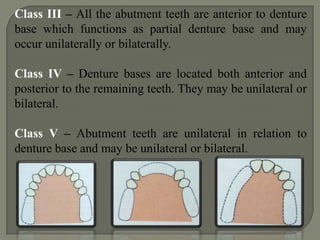
Class III – All the abutment teeth are anterior to denture base which functions as partial denture base and may occur unilaterally or bilaterally.Class IV – Denture bases are located both anterior and posterior to the remaining teeth. They may be unilateral or bilateral.Class V – Abutment teeth are unilateral in relation to denture base and may be unilateral or bilateral.
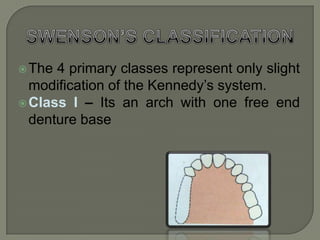
SWENSON’S CLASSIFICATION The 4 primary classes represent only slight modification of the Kennedy’s system. Class I – Its an arch with one free end denture base
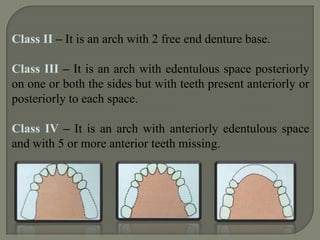
Class II – It is an arch with 2 free end denture base.Class III – It is an arch with edentulous space posteriorly on one or both the sides but with teeth present anteriorly or posteriorly to each space.Class IV – It is an arch with anteriorly edentulous space and with 5 or more anterior teeth missing.
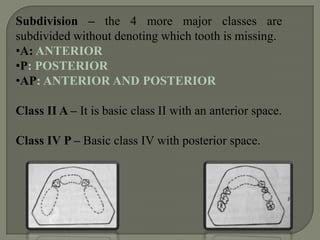
Subdivision – the 4 more major classes are subdivided without denoting which tooth is missing. A: ANTERIOR
P: POSTERIOR
AP: ANTERIOR AND POSTERIORClass II A – It is basic class II with an anterior space.Class IV P – Basic class IV with posterior space.
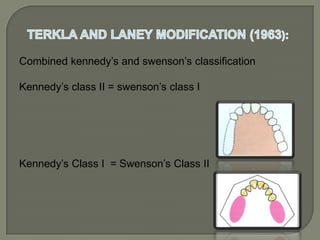
TERKLA AND LANEY MODIFICATION (1963):Combined kennedy’s and swenson’s classificationKennedy’s class II = swenson’s class IKennedy’s Class I  = Swenson’s Class II
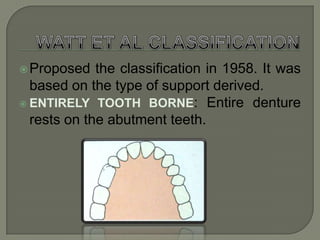
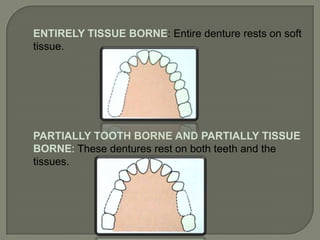
WATT ET AL CLASSIFICATIONProposed the classification in 1958. It was based on the type of support derived.ENTIRELY TOOTH BORNE: Entire denture rests on the abutment teeth.
ENTIRELY TISSUE BORNE: Entire denture rests on soft tissue.PARTIALLY TOOTH BORNE AND PARTIALLY TISSUE BORNE: These dentures rest on both teeth and the tissues.
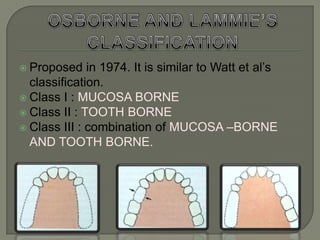
OSBORNE AND LAMMIE’S CLASSIFICATIONProposed in 1974. It is similar to Watt et al’s classification.Class I : MUCOSA BORNEClass II : TOOTH BORNEClass III : combination of MUCOSA –BORNE AND TOOTH BORNE.
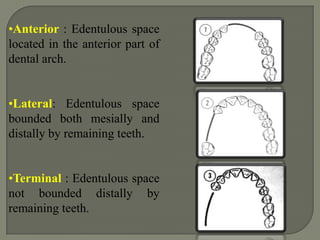
COSTA’S CLASSIFICATIONThis system developed in 1974 was based on describing rather than classifying partially dentulous arches.
Anterior: Edentulous space located in the anterior part of dental arch.
Lateral: Edentulous space bounded both mesially and distally by remaining teeth.
Terminal : Edentulous space not bounded distally by remaining teeth.THANK YOU!!
Prosthodontic diagnostic index	The American College of Prosthodontists (ACP) has developed a classification system for partial edentulism based on diagnostic findings.                                                             J Prosthodont 2002;11:181-193.
This partially edentulous classification system offers the following potential benefits:Improved intra-operator consistency.Improved professional communication.An objective method for patient screening in dental education.Standardized criteria for outcome assessment and research.Improved diagnostic consistency .Simplified, organized aid in the decision to refer a patient.
Classification System for the Partially Edentulous PatientDIAGNOSTIC CRITERIA Location and extent of the edentulous area(s)Condition of the abutment teethOcclusal schemeResidual ridge
Criteria 1 Location and extent of edentulous area(s)
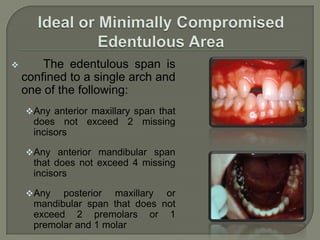
Ideal or Minimally Compromised Edentulous AreaThe edentulous span is confined to a single arch and one of the following:
Any anterior maxillary span that does not exceed 2 missing incisors
Any anterior mandibular span that does not exceed 4 missing incisors
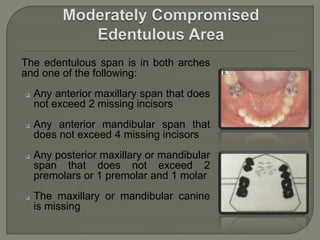
Any posterior maxillary or mandibular span that does not exceed 2 premolars or 1 premolar and 1 molarModerately Compromised Edentulous AreaThe edentulous span is in both arches and one of the following:Any anterior maxillary span that does not exceed 2 missing incisors
Any anterior mandibular span that does not exceed 4 missing incisors
Any posterior maxillary or mandibular span that does not exceed 2 premolars or 1 premolar and 1 molar
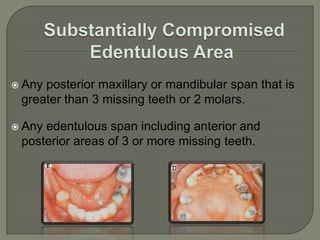
The maxillary or mandibular canine is missingSubstantially Compromised Edentulous AreaAny posterior maxillary or mandibular span that is greater than 3 missing teeth or 2 molars.Any edentulous span including anterior and posterior areas of 3 or more missing teeth.
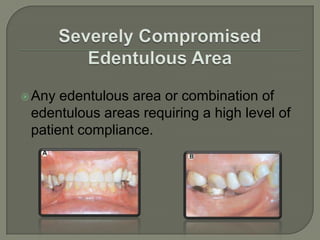
Severely Compromised Edentulous AreaAny edentulous area or combination of edentulous areas requiring a high level of patient compliance.
Criteria 2Abutment Teeth Condition
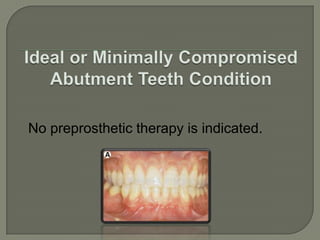
Ideal or Minimally Compromised Abutment Teeth ConditionNo preprosthetic therapy is indicated.
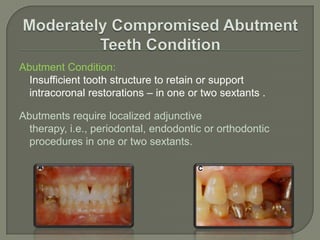
Moderately Compromised Abutment Teeth ConditionAbutment Condition:Insufficient tooth structure to retain or support intracoronal restorations – in one or two sextants .Abutments require localized adjunctive therapy, i.e., periodontal, endodontic or orthodontic procedures in one or two sextants.
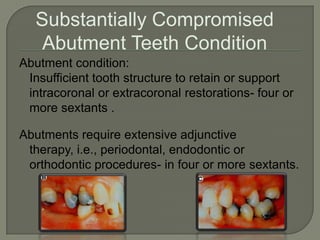
Substantially Compromised Abutment Teeth ConditionAbutment condition:Insufficient tooth structure to retain or support intracoronal or extracoronal restorations- four or more sextants .Abutments require extensive adjunctive therapy, i.e., periodontal, endodontic or orthodontic procedures- in four or more sextants.
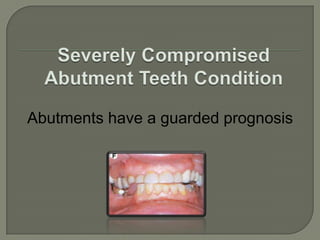
Severely Compromised Abutment Teeth ConditionAbutments have a guarded prognosis
Criteria 3Occlusal Scheme
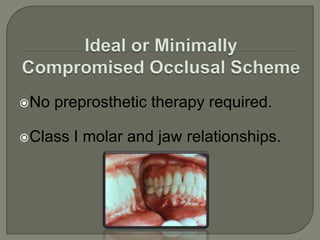
Ideal or Minimally Compromised Occlusal SchemeNo preprosthetic therapy required.Class I molar and jaw relationships.
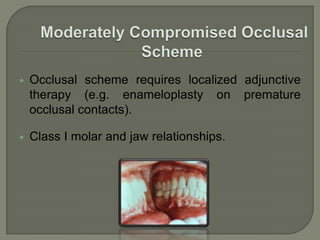
Moderately Compromised Occlusal SchemeOcclusal scheme requires localized adjunctive therapy (e.g. enameloplasty on premature occlusal contacts).
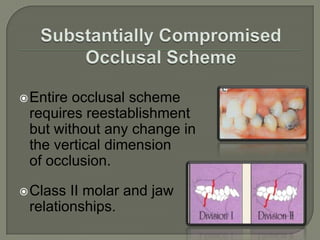
Class I molar and jaw relationships.Substantially Compromised Occlusal SchemeEntire occlusal scheme requires reestablishment but without any change in the vertical dimension of occlusion.Class II molar and jaw relationships.
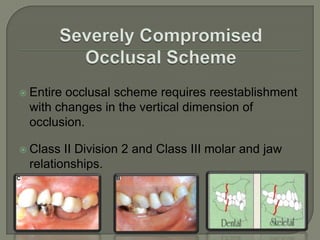
Severely Compromised Occlusal SchemeEntire occlusal scheme requires reestablishment with changes in the vertical dimension of occlusion.Class II Division 2 and Class III molar and jaw relationships.
Criteria 4Residual Ridge
   The criteria published for the Classification System for Complete Edentulism are used to categorize any edentulous span present in the partially edentulous patient.
Classification System for Partial Edentulism
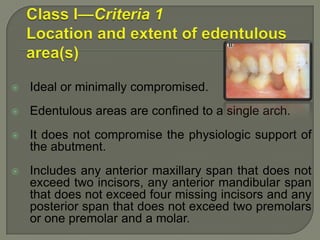
Class I—Criteria 1Location and extent of edentulous area(s)Ideal or minimally compromised.Edentulous areas are confined to a single arch.It does not compromise the physiologic support of the abutment.Includes any anterior maxillary span that does not exceed two incisors, any anterior mandibular span that does not exceed four missing incisors and any posterior span that does not exceed two premolars or one premolar and a molar.
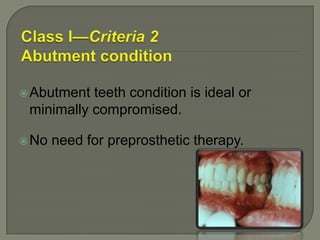
Class I—Criteria 2Abutment conditionAbutment teeth condition is ideal or minimally compromised. No need for preprosthetictherapy.
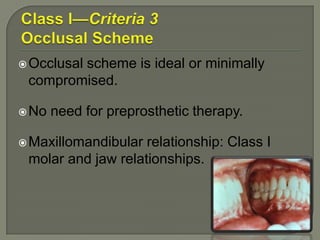
Class I—Criteria 3Occlusal SchemeOcclusal scheme is ideal or minimally compromised. No need for preprosthetictherapy.Maxillomandibular relationship: Class I molar and jaw relationships.
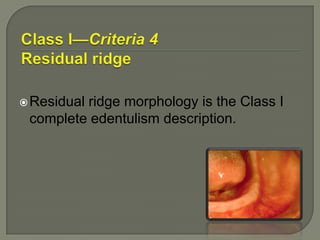
Class I—Criteria 4Residual ridgeResidual ridge morphology is the Class I complete edentulismdescription.
Class II
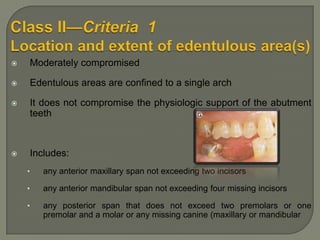
Class II—Criteria  1Location and extent of edentulous area(s)Moderately compromisedEdentulous areas are confined to a single archIt does not compromise the physiologic support of the abutment teethIncludes:any anterior maxillary span not exceeding two incisors
any anterior mandibular span not exceeding four missing incisors
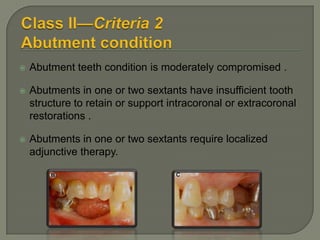
any posterior span that does not exceed two premolars or one premolar and a molar or any missing canine (maxillary or mandibularClass II—Criteria 2Abutment conditionAbutment teeth condition is moderately compromised .Abutments in one or two sextants have insufficient tooth structure to retain or support intracoronal or extracoronal restorations .Abutments in one or two sextants require localized adjunctive therapy.
Class II—Criteria 3Occlusal SchemeOcclusal scheme is moderately compromised.Occlusal scheme requires localized adjunctive therapy.Maxillomandibular relationship:Class I molar and jaw relationships.
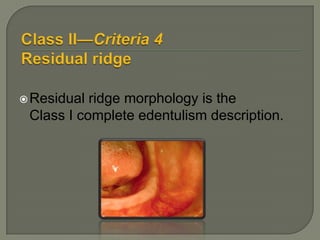
Class II—Criteria 4Residual ridgeResidual ridge morphology is the Class I complete edentulismdescription.
Class III
Class III—Criteria 1Location and extent of edentulous area(s)Substantially compromised.Edentulous areas may be in one or both arches.It does compromise the physiologic support of the abutment teeth.
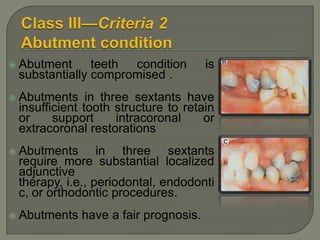
Class III—Criteria 2Abutment conditionAbutment teeth condition is substantially compromised .Abutments in three sextants have insufficient tooth structure to retain or support intracoronal or extracoronal restorations  Abutments in three sextants require more substantial localized adjunctive therapy, i.e., periodontal, endodontic, or orthodontic procedures.Abutments have a fair prognosis.
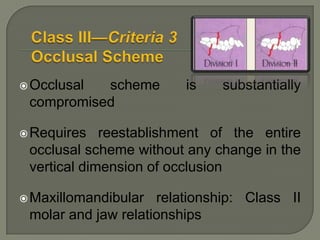
Class III—Criteria 3Occlusal SchemeOcclusal scheme is substantially compromisedRequires reestablishment of the entire occlusal scheme without any change in the vertical dimension of occlusionMaxillomandibular relationship: Class II molar and jaw relationships
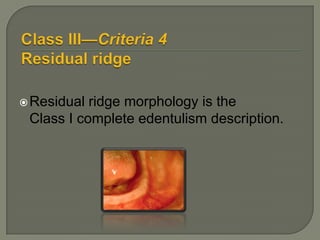
Class III—Criteria 4Residual ridgeResidual ridge morphology is the Class I complete edentulismdescription.
Class IV
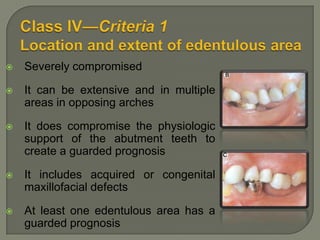
Class IV—Criteria 1Location and extent of edentulous areaSeverely compromisedIt can be extensive and in multiple areas in opposing archesIt does compromise the physiologic support of the abutment teeth to create a guarded prognosisIt includes acquired or congenital maxillofacial defectsAt least one edentulous area has a guarded prognosis
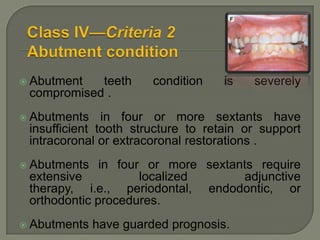
Class IV—Criteria 2Abutment conditionAbutment teeth condition is severely compromised .Abutments in four or more sextants have insufficient tooth structure to retain or support intracoronal or extracoronal restorations . Abutments in four or more sextants require extensive localized adjunctive therapy, i.e., periodontal, endodontic, or orthodontic procedures.Abutments have guarded prognosis.
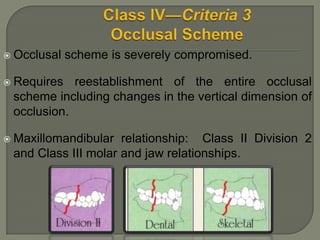
Class IV—Criteria 3Occlusal SchemeOcclusal scheme is severely compromised.Requires reestablishment of the entire occlusal scheme including changes in the vertical dimension of occlusion.Maxillomandibular relationship:  Class II Division 2 and Class III molar and jaw relationships.
Class IV—Criteria 4Residual ridgeResidual ridge morphology is the Class I complete edentulismdescription.

Classification of rpd

  • 1.
    Classification of partiallyedentulous arches By Bibinbhaskaran
  • 2.
  • 3.
  • 4.
    Requirements of aclassification
  • 5.
  • 6.
  • 7.
  • 8.
    ConclusionIntroductionPrime purpose: to enable dentist to clearly communicate to a listener. A workable Classification helps to create order from the many number of possible combinations of missing teeth and edentulous spaces.An aid in learning of the fundamentals of design
  • 9.
    Need for classificationToformulate a good treatment plan.To anticipate the difficulties common to occur for that particular design.To communicate with a professional about a case.To design the denture according to the occlusal load usually expected for a particular group.
  • 10.
    Requirements of aClassificationAllow visualization of type of partially edentulous arches that is being considered.Allow differentiation between tooth supported and tooth-tissue supported partial dentures.Serve as a guide to the type of design to be used.Be universally accepted.
  • 11.
    Various classification systemsThereare many classifications available for classifying edentulous arches. The most common ones are:CummerKennedy’sApplegate-KennedyBailynNeurohrMaukFriedman GodfreySkinner Austin and LidgeCraddockWildWatt et alCosta Osborne and LammieBeckettSwenson ACP classification ICK classification
  • 12.
    Cummer’s classification systemProposedBy CUMMERIn 1920.Cummer stated “ for working purposes all the cases may be made to fall into 4 simple classes, which have as their basis the choice of number and position of the direct retainer”.
  • 13.
    Class I –DIAGONAL: 2 diagonally opposite teethare chosen as abutment teeth for the attachment of direct retainerClass II –DIAMETRIC: 2 diametrically opposite teethare chosen as abutment teeth for the attachment of the direct retainers
  • 14.
    Class III –UNILATERAL: one or more teeth on the same sideare chosen as abutment teeth for the attachment of the direct retainers Class IV –MULTILATERAL: three or more teeth are chosen as abutment teeth for the attachment of the direct retainers. The teeth are disposed in a triangular or quadrilateral relationship
  • 15.
    Kennedy’s classification:Mostwidely used method of classificationProposed in 1923 by Dr. Edward Kennedy of New York. It is based on the relationship of the edentulous spaces to the abutment teeth.
  • 16.
    Class I- Bilateral edentulous areas located posterior to the remaining natural teeth.Class II- Unilateral edentulous area located posterior to the remaining natural teeth.Class III- Unilateral edentulous area with natural teeth both anterior and posterior to it.Class IV- Single, bilateral edentulous area located anterior to the remaining natural teeth.
  • 17.
    Applegate Kennedy’s system:Itis a modification of the Kennedy’s system.It is based less on the number and location of the remaining teeth and edentulous spaces. It takes into consideration the capabilities of the teeth, which bound the spaces to serve as abutments for the prosthesis
  • 18.
    DR. O.C APPLEGATE(1960) later attempted to expand the kennedy system by adding class V and VI.Class V: Edentulous area bounded anteriorly and posteriorly by the natural teeth but in which the anterior abutment (the lateral incisor) is not suitable for the support.Class VI: an edentulous situation in which the teeth adjacent to the space are capable of total support of the required prosthesis
  • 19.
    Applegate’s Rules:Applegate alsoprovided the following 8 rules to govern the application of the Kennedy system:Rule 1: Classification should follow rather than precede extractions that might alter the original classification.Rule 2:If the third molar is missing and not to be replaced it is not considered in the classification.Rule 3:If the third molar is present and is to be used as an abutment, it is considered in the classification.
  • 20.
    Rule 4:If thesecond molar is missing not to be replaced that is the opposing second molar is also missing and is not considered in the classification.Rule 5 – The most posterior edentulous area or areas always determines the classification.Rule 6 –Edentulous areas other than those determining the classification are referred to as the modification spaces and are designated by their number.
  • 21.
    Rule 7 –Theextent of the modification is not considered, only the number of additional edentulous areas.Rule 8 –There can be no modification areas in class IV arches. Because any edentulous area lying posterior to the single bilateral area determines the classification.
  • 22.
    Bailyn’s system:Based onwhether the prosthesis is tooth borne, tissue borne or a combination of the two:Bailyn divided all R.P.Ds into-A: Anterior restorations: saddle area anterior to the 1st bicuspidsP: Posterior restorations: saddle area posterior to the cuspids.
  • 23.
    Subdivided as:ClassI:Bounded saddle(notmore than 3 teeth missing)Eg: P.IClass II: Free end saddle(no distal abutment)Eg: P.IIClassIII : Bounded saddle(more than 3 teeth missing)Eg P.III
  • 24.
    Class A.III :Edentulous space anterior to the 1st bicuspid
  • 25.
    Bounded saddle(more thanthree teeth missing)Class A.I. P.II – Edentulous area anterior to the first bicuspid and not more than 3 teeth missing
  • 26.
    other edentulous spacebeing posterior to the cuspid with only one tooth available as an abutment.Class P.I. P.II– Both the edentulous spaces are posterior to the cuspids, one with only one tooth for anchorage
  • 27.
    other with twoavailable teeth separated by a distance of less than three teeth.Neurohr’s classification:Proposed in 1939, this classification is also based on the support derived. It is not commonly used due to its complexity. Many of his denture designs did not match his principles of classification.
  • 28.
    Class I: TOOTHBEARING A unilateral or bilateral case falls into the above classification when there are teeth posterior to all spans, and when there are not more than four teeth missing in any space.
  • 29.
    There are twopossible variation in this class.Variation 1 : Missing posteriors predominatePosteriors missing, anteriors in placePosteriors missing, some anteriors missing
  • 30.
    Variation 2 :missing anteriors predominateAnteriors missing, posteriors present
  • 31.
    Anteriors missing, someposteriors missingClass II : TOOTH-AND-TISSUE BEARINGA unilateral or bilateral case comes under the above classification when there are no teeth posterior to one or more spans
  • 32.
    more than4 teeth(which include a canine) in one or more spans. Class II is further subdivided into divisions with variation under each.DIVISION 1: When there are no teeth posterior to 1 or more span.VARIATION1 : Missing posteriors predominateposteriors missing, anteriors in placeposteriors missing, some anteriors missing VARIATION 2 : missing anteriors predominatenoneanteriors missing, some posteriors missing
  • 33.
    DIVISION 2: whenthere are teeth posterior in all spans, but when there are more than 4 teeth in any one or more spans.VARIATION 1 : missing posteriors predominatea.noneb.posteriors missing, some anteriors missingVARIATION 2 : missing anteriors predominateanteriors missing, posteriors in place
  • 34.
    anteriors missing, someposteriors missingCLASS III : tissue bearing complete dentures
  • 35.
    Mauk’s systembased onnumber, length and position of the spaces and number and position of the remaining teeth.Class I – Bilateral posterior spaces and teeth remaining in a segment in the anterior region.Class II – Bilateral posterior spaces and one or more teeth at the posterior end of one space.
  • 36.
    Class III -Bilateral posterior spaces and one or more teeth at the posterior end of both spaces.Class IV – Unilateral posterior space with or without teeth at the posterior end of the space. Opposing arch is unbroken.
  • 37.
    Class V –It has an anterior space only. Posterior part of the arch is unbroken on either side.Class VI – Has irregular spaces around the arch. The missing teeth are single or in groups.
  • 38.
    WILD’S CLASSIFICATIONProposed simpleyet self explanatory classification. It is not very well known in English dental literature.Class I : Interruption of the dental arch(ieBOUNDED)Class II : shortening of the dental arch (ieFREE END)Class III : combination of I & II
  • 39.
    Godfrey’s system (1951)Basedon the location and the extent of the edentulous spaces .Class A – Class A has tooth borne denture bases in the anterior part of the mouth. It may be an unbroken 5- tooth space; a broken 5-tooth space; or an unbroken 4-tooth space.
  • 40.
    Class B –MUCOSABORNE denture base area in anterior of the mouth.Unbroken six tooth space; an unbroken 5-tooth space; a broken 5-tooth space.Class C –TOOTH BORNE denture base in the posterior part of the mouth. unbroken 3-tooth space; a broken 3-tooth space; an unbroken 2-tooth space; a broken 2-tooth space.
  • 41.
    Class D –Class D has mucosa borne denture bases in the posterior part of the mouth. It may be an unbroken 4-tooth space or a 3 tooth; 2 tooth or single tooth space.
  • 42.
    FRIEDMAN’S CLASSIFICATION Introduced‘ABC’ classification in 1953. According to this classification-A: AnteriorB: Bounded posteriorC: Cantilever
  • 43.
    BECKETT AND WILSONCLASSIFICATIONBeckett (1953) and Wilson(1957) based their ideas on bailyn’s classification(1928).Based on proportionate amount of support provided by the teeth and tissues.
  • 44.
    Class I :BOUNDED SADDLE. Abutment teeth qualified to support the denture. Mucosa is not used for support.Class II: FREE ENDa. Tooth and tissue borneb. Tissue borne
  • 45.
    Class III :BOUNDED SADDLE. Abutment teeth not so qualified to support the denture as described in class I.Wilson in 1957 elaborated the classification as follows:Mandibularkennedy’s class III should be treated as class I
  • 46.
    Maxillary kennedy’s classIII should be treated as class I or IIICRADDOCK’S CLASSIFICATION In 1954. Class I – saddle supported on both sides by substantial abutment teeth.Class II – vertical biting forces applied to denture resisted entirely by soft tissue.Class III– tooth supported at only 1 end of the saddle. 
  • 47.
    AUSTIN AND LIDGECLASSIFICATIONIn 1957.Describes the position of teeth.Class A: missing anteriors.A1 : Missing anteriors on one side.A2 : Missing anteriors on both sides.A B1: Missing anteriors with bilateral. construction.
  • 48.
    Class P: MissingposteriorsP1 – Missing posteriors on one side.P2 – Missing posteriors on both sides.P B1 : Posterior missing on both sides(distal extension).
  • 49.
    ClassAP: missing anteriorsand posteriors.AP1 – missing anteriors and posteriors on one side.AP2 – missing anteriors and posteriors on both sides.
  • 50.
    SKINNER’S SYSTEM:(1957)This systemwas based on the relationship of the abutment teeth to the supporting residual alveolar ridge.He said that the value of RPD is directly related to quantity and the degree of support, which it receives, from the abutment teeth and residual ridge.
  • 51.
    Class I –Abutment teeth are located both anterior and posterior to the denture bases, spaces may be unilateral or bilateral.Class II –All teeth areposterior to the denture base, which function as partial denture unit. It may be unilateral or bilateral.
  • 52.
    Class III –All the abutment teeth are anterior to denture base which functions as partial denture base and may occur unilaterally or bilaterally.Class IV – Denture bases are located both anterior and posterior to the remaining teeth. They may be unilateral or bilateral.Class V – Abutment teeth are unilateral in relation to denture base and may be unilateral or bilateral.
  • 53.
    SWENSON’S CLASSIFICATION The 4primary classes represent only slight modification of the Kennedy’s system. Class I – Its an arch with one free end denture base
  • 54.
    Class II –It is an arch with 2 free end denture base.Class III – It is an arch with edentulous space posteriorly on one or both the sides but with teeth present anteriorly or posteriorly to each space.Class IV – It is an arch with anteriorly edentulous space and with 5 or more anterior teeth missing.
  • 55.
    Subdivision – the4 more major classes are subdivided without denoting which tooth is missing. A: ANTERIOR
  • 56.
  • 57.
    AP: ANTERIOR ANDPOSTERIORClass II A – It is basic class II with an anterior space.Class IV P – Basic class IV with posterior space.
  • 58.
    TERKLA AND LANEYMODIFICATION (1963):Combined kennedy’s and swenson’s classificationKennedy’s class II = swenson’s class IKennedy’s Class I = Swenson’s Class II
  • 59.
    WATT ET ALCLASSIFICATIONProposed the classification in 1958. It was based on the type of support derived.ENTIRELY TOOTH BORNE: Entire denture rests on the abutment teeth.
  • 60.
    ENTIRELY TISSUE BORNE:Entire denture rests on soft tissue.PARTIALLY TOOTH BORNE AND PARTIALLY TISSUE BORNE: These dentures rest on both teeth and the tissues.
  • 61.
    OSBORNE AND LAMMIE’SCLASSIFICATIONProposed in 1974. It is similar to Watt et al’s classification.Class I : MUCOSA BORNEClass II : TOOTH BORNEClass III : combination of MUCOSA –BORNE AND TOOTH BORNE.
  • 62.
    COSTA’S CLASSIFICATIONThis systemdeveloped in 1974 was based on describing rather than classifying partially dentulous arches.
  • 63.
    Anterior: Edentulous spacelocated in the anterior part of dental arch.
  • 64.
    Lateral: Edentulous spacebounded both mesially and distally by remaining teeth.
  • 65.
    Terminal : Edentulousspace not bounded distally by remaining teeth.THANK YOU!!
  • 66.
    Prosthodontic diagnostic index TheAmerican College of Prosthodontists (ACP) has developed a classification system for partial edentulism based on diagnostic findings. J Prosthodont 2002;11:181-193.
  • 67.
    This partially edentulousclassification system offers the following potential benefits:Improved intra-operator consistency.Improved professional communication.An objective method for patient screening in dental education.Standardized criteria for outcome assessment and research.Improved diagnostic consistency .Simplified, organized aid in the decision to refer a patient.
  • 68.
    Classification System forthe Partially Edentulous PatientDIAGNOSTIC CRITERIA Location and extent of the edentulous area(s)Condition of the abutment teethOcclusal schemeResidual ridge
  • 69.
    Criteria 1 Locationand extent of edentulous area(s)
  • 70.
    Ideal or MinimallyCompromised Edentulous AreaThe edentulous span is confined to a single arch and one of the following:
  • 71.
    Any anterior maxillaryspan that does not exceed 2 missing incisors
  • 72.
    Any anterior mandibularspan that does not exceed 4 missing incisors
  • 73.
    Any posterior maxillaryor mandibular span that does not exceed 2 premolars or 1 premolar and 1 molarModerately Compromised Edentulous AreaThe edentulous span is in both arches and one of the following:Any anterior maxillary span that does not exceed 2 missing incisors
  • 74.
    Any anterior mandibularspan that does not exceed 4 missing incisors
  • 75.
    Any posterior maxillaryor mandibular span that does not exceed 2 premolars or 1 premolar and 1 molar
  • 76.
    The maxillary ormandibular canine is missingSubstantially Compromised Edentulous AreaAny posterior maxillary or mandibular span that is greater than 3 missing teeth or 2 molars.Any edentulous span including anterior and posterior areas of 3 or more missing teeth.
  • 77.
    Severely Compromised EdentulousAreaAny edentulous area or combination of edentulous areas requiring a high level of patient compliance.
  • 78.
  • 79.
    Ideal or MinimallyCompromised Abutment Teeth ConditionNo preprosthetic therapy is indicated.
  • 80.
    Moderately Compromised AbutmentTeeth ConditionAbutment Condition:Insufficient tooth structure to retain or support intracoronal restorations – in one or two sextants .Abutments require localized adjunctive therapy, i.e., periodontal, endodontic or orthodontic procedures in one or two sextants.
  • 81.
    Substantially Compromised AbutmentTeeth ConditionAbutment condition:Insufficient tooth structure to retain or support intracoronal or extracoronal restorations- four or more sextants .Abutments require extensive adjunctive therapy, i.e., periodontal, endodontic or orthodontic procedures- in four or more sextants.
  • 82.
    Severely Compromised AbutmentTeeth ConditionAbutments have a guarded prognosis
  • 83.
  • 84.
    Ideal or MinimallyCompromised Occlusal SchemeNo preprosthetic therapy required.Class I molar and jaw relationships.
  • 85.
    Moderately Compromised OcclusalSchemeOcclusal scheme requires localized adjunctive therapy (e.g. enameloplasty on premature occlusal contacts).
  • 86.
    Class I molarand jaw relationships.Substantially Compromised Occlusal SchemeEntire occlusal scheme requires reestablishment but without any change in the vertical dimension of occlusion.Class II molar and jaw relationships.
  • 87.
    Severely Compromised OcclusalSchemeEntire occlusal scheme requires reestablishment with changes in the vertical dimension of occlusion.Class II Division 2 and Class III molar and jaw relationships.
  • 88.
  • 89.
    The criteria published for the Classification System for Complete Edentulism are used to categorize any edentulous span present in the partially edentulous patient.
  • 90.
    Classification System forPartial Edentulism
  • 91.
    Class I—Criteria 1Locationand extent of edentulous area(s)Ideal or minimally compromised.Edentulous areas are confined to a single arch.It does not compromise the physiologic support of the abutment.Includes any anterior maxillary span that does not exceed two incisors, any anterior mandibular span that does not exceed four missing incisors and any posterior span that does not exceed two premolars or one premolar and a molar.
  • 92.
    Class I—Criteria 2AbutmentconditionAbutment teeth condition is ideal or minimally compromised. No need for preprosthetictherapy.
  • 93.
    Class I—Criteria 3OcclusalSchemeOcclusal scheme is ideal or minimally compromised. No need for preprosthetictherapy.Maxillomandibular relationship: Class I molar and jaw relationships.
  • 94.
    Class I—Criteria 4ResidualridgeResidual ridge morphology is the Class I complete edentulismdescription.
  • 95.
  • 96.
    Class II—Criteria 1Location and extent of edentulous area(s)Moderately compromisedEdentulous areas are confined to a single archIt does not compromise the physiologic support of the abutment teethIncludes:any anterior maxillary span not exceeding two incisors
  • 97.
    any anterior mandibularspan not exceeding four missing incisors
  • 98.
    any posterior spanthat does not exceed two premolars or one premolar and a molar or any missing canine (maxillary or mandibularClass II—Criteria 2Abutment conditionAbutment teeth condition is moderately compromised .Abutments in one or two sextants have insufficient tooth structure to retain or support intracoronal or extracoronal restorations .Abutments in one or two sextants require localized adjunctive therapy.
  • 99.
    Class II—Criteria 3OcclusalSchemeOcclusal scheme is moderately compromised.Occlusal scheme requires localized adjunctive therapy.Maxillomandibular relationship:Class I molar and jaw relationships.
  • 100.
    Class II—Criteria 4ResidualridgeResidual ridge morphology is the Class I complete edentulismdescription.
  • 101.
  • 102.
    Class III—Criteria 1Locationand extent of edentulous area(s)Substantially compromised.Edentulous areas may be in one or both arches.It does compromise the physiologic support of the abutment teeth.
  • 103.
    Class III—Criteria 2AbutmentconditionAbutment teeth condition is substantially compromised .Abutments in three sextants have insufficient tooth structure to retain or support intracoronal or extracoronal restorations Abutments in three sextants require more substantial localized adjunctive therapy, i.e., periodontal, endodontic, or orthodontic procedures.Abutments have a fair prognosis.
  • 104.
    Class III—Criteria 3OcclusalSchemeOcclusal scheme is substantially compromisedRequires reestablishment of the entire occlusal scheme without any change in the vertical dimension of occlusionMaxillomandibular relationship: Class II molar and jaw relationships
  • 105.
    Class III—Criteria 4ResidualridgeResidual ridge morphology is the Class I complete edentulismdescription.
  • 106.
  • 107.
    Class IV—Criteria 1Locationand extent of edentulous areaSeverely compromisedIt can be extensive and in multiple areas in opposing archesIt does compromise the physiologic support of the abutment teeth to create a guarded prognosisIt includes acquired or congenital maxillofacial defectsAt least one edentulous area has a guarded prognosis
  • 108.
    Class IV—Criteria 2AbutmentconditionAbutment teeth condition is severely compromised .Abutments in four or more sextants have insufficient tooth structure to retain or support intracoronal or extracoronal restorations . Abutments in four or more sextants require extensive localized adjunctive therapy, i.e., periodontal, endodontic, or orthodontic procedures.Abutments have guarded prognosis.
  • 109.
    Class IV—Criteria 3OcclusalSchemeOcclusal scheme is severely compromised.Requires reestablishment of the entire occlusal scheme including changes in the vertical dimension of occlusion.Maxillomandibular relationship: Class II Division 2 and Class III molar and jaw relationships.
  • 110.
    Class IV—Criteria 4ResidualridgeResidual ridge morphology is the Class I complete edentulismdescription.