17© Springer International Publishing Switzerland 2016
O. Şakar (ed.), Removable Partial Dentures: A Practitioners’ Manual,
DOI 10.1007/978-3-319-20556-4_3
Classification of Partially
Edentulous Arches
Olcay Şakar
Classification of partially edentulous arches is
vital in order to ensure effective communication
between dental professionals and to discuss the
most suitable treatment plan for patients. Partially
edentulous arches have been classified according
to several methods. The Kennedy classification
proposed by Dr. E. Kennedy is the most widely
accepted and used classification method due to
its simplicity and ease of application, with nearly
65,000 possible combinations of partially eden-
tulous arches. Although this system does not give
information about the condition of the teeth and
periodontal tissues, it allows easy visualization of
the arches, differentiation between free-end and
tooth-bounded partially edentulous arches, and
logical approach to design. Therefore, only
Kennedy classification is described in this book.
Additionally, a classification system (Implant-
Corrected Kennedy/ICK) for partially edentulous
arches incorporating implants placed or to be
placed for an RPD is described and used. It is
proposed by Al-Johany SS. and Andres C. and
based, with modifications, on the Kennedy clas-
sification system.
3.1 Kennedy Classification
Partially edentulous arches are divided into four
classes:
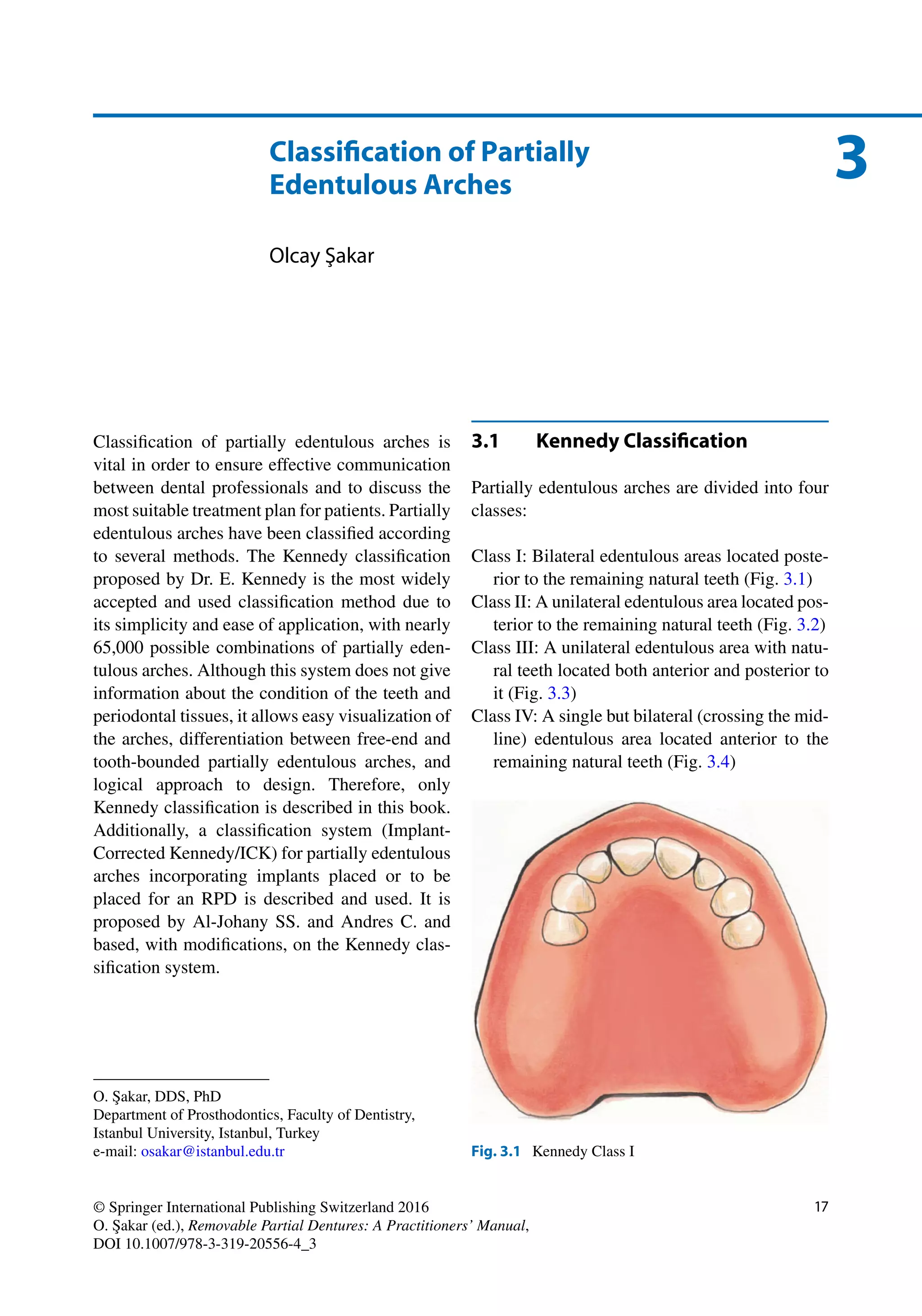
Class I: Bilateral edentulous areas located poste-
rior to the remaining natural teeth (Fig. 3.1)
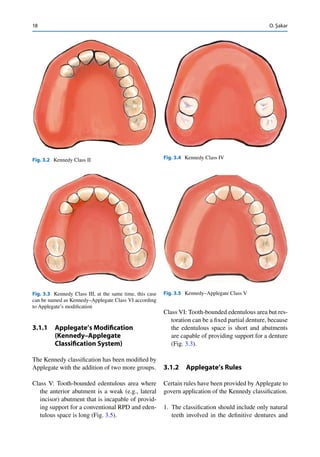
Class II: A unilateral edentulous area located pos-
terior to the remaining natural teeth (Fig. 3.2)
Class III: A unilateral edentulous area with natu-
ral teeth located both anterior and posterior to
it (Fig. 3.3)
Class IV: A single but bilateral (crossing the mid-
line) edentulous area located anterior to the
remaining natural teeth (Fig. 3.4)
O. Şakar, DDS, PhD
Department of Prosthodontics, Faculty of Dentistry,
Istanbul University, Istanbul, Turkey
e-mail: osakar@istanbul.edu.tr
3
Fig. 3.1 Kennedy Class I
18
3.1.1 Applegate’s Modification
(Kennedy–Applegate
Classification System)
The Kennedy classification has been modified by
Applegate with the addition of two more groups.
Class V: Tooth-bounded edentulous area where
the anterior abutment is a weak (e.g., lateral
incisor) abutment that is incapable of provid-
ing support for a conventional RPD and eden-
tulous space is long (Fig. 3.5).
Class VI: Tooth-bounded edentulous area but res-
toration can be a fixed partial denture, because
the edentulous space is short and abutments
are capable of providing support for a denture
(Fig. 3.3).
3.1.2 Applegate’s Rules
Certain rules have been provided by Applegate to
govern application of the Kennedy classification.
1. The classification should include only natural
teeth involved in the definitive dentures and
Fig. 3.2 Kennedy Class II
Fig. 3.3 Kennedy Class III, at the same time, this case
can be named as Kennedy–Applegate Class VI according
to Applegate’s modification
Fig. 3.4 Kennedy Class IV
Fig. 3.5 Kennedy–Applegate Class V
O. Şakar
19
should follow rather than precede extraction.
(Classification is identified after extraction(s).)
2. If the third and second molars are missing and
not to be replaced, they are not considered in
the classification. But if they are present and
used as an abutment, they are considered in
the classification.
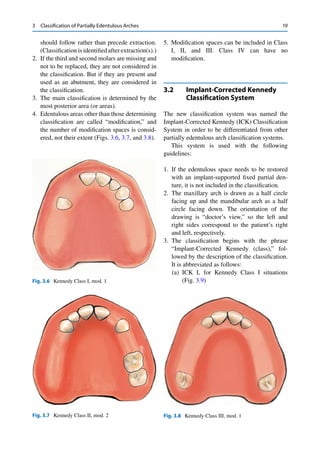
3. The main classification is determined by the
most posterior area (or areas).
4. Edentulous areas other than those determining
classification are called “modification,” and
the number of modification spaces is consid-
ered, not their extent (Figs. 3.6, 3.7, and 3.8).
5. Modification spaces can be included in Class
I, II, and III. Class IV can have no
modification.
3.2 Implant-Corrected Kennedy
Classification System
The new classification system was named the
Implant-Corrected Kennedy (ICK) Classification
System in order to be differentiated from other
partially edentulous arch classification systems.
This system is used with the following
guidelines:
1. If the edentulous space needs to be restored
with an implant-supported fixed partial den-
ture, it is not included in the classification.
2. The maxillary arch is drawn as a half circle
facing up and the mandibular arch as a half
circle facing down. The orientation of the
drawing is “doctor’s view,” so the left and
right sides correspond to the patient’s right
and left, respectively.
3. The classification begins with the phrase
“Implant-Corrected Kennedy (class),” fol-
lowed by the description of the classification.
It is abbreviated as follows:
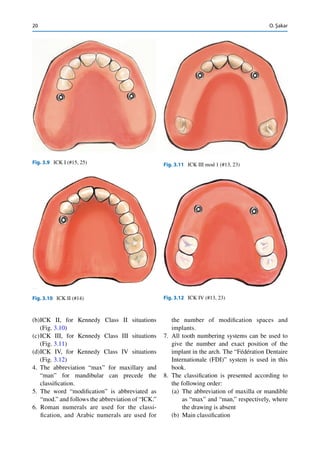
(a) ICK I, for Kennedy Class I situations
(Fig. 3.9)Fig. 3.6 Kennedy Class I, mod. 1
Fig. 3.7 Kennedy Class II, mod. 2 Fig. 3.8 Kennedy Class III, mod. 1
3 Classification of Partially Edentulous Arches
20
(b)ICK II, for Kennedy Class II situations
(Fig. 3.10)
(c)ICK III, for Kennedy Class III situations
(Fig. 3.11)
(d)ICK IV, for Kennedy Class IV situations
(Fig. 3.12)
4. The abbreviation “max” for maxillary and
“man” for mandibular can precede the
classification.
5. The word “modification” is abbreviated as
“mod.” and follows the abbreviation of “ICK.”
6. Roman numerals are used for the classi-
fication, and Arabic numerals are used for
the number of modification spaces and
implants.
7. All tooth numbering systems can be used to
give the number and exact position of the
implant in the arch. The “Fédération Dentaire
Internationale (FDI)” system is used in this
book.
8. The classification is presented according to
the following order:
(a) The abbreviation of maxilla or mandible
as “max” and “man,” respectively, where
the drawing is absent
(b) Main classification
Fig. 3.9 ICK I (#15, 25)
Fig. 3.10 ICK II (#14) Fig. 3.12 ICK IV (#13, 23)
Fig. 3.11 ICK III mod 1 (#13, 23)
O. Şakar
21
(c) The number of modification spaces as
“mod”
(d) The number of implants in parentheses
according to their position in the arch
(according to the FDI numbering system)
preceded by the number sign (#) (e.g.,
ICK I mod. 2 (# 16, 27)
9. The classification can be used both before and
after placement of implants to discuss the
treatment plan or to indicate the number and
position of implants to be placed for implant-
assisted RPDs.
Bibliography
Al-Johany SS, Andres C. ICK classification system for
partially edentulous arches. J Prosthodont. 2008;17:
502–7.
Applegate O. Essentials of removable partial denture
prostheses. 1st ed. Philadelphia, PA: Saunders; 1954.
Galagali G, Mahoorkar S. Critical evaluation of classifica-
tion systems of partially edentulous arches. Int J Dent
Clin. 2010;2:45–52.
Kennedy E. Partial denture construction. Dent Items
Interest. 1928;1:3–8.
Miller EL. Systems for classifying partially dentulous
arches. J Prosthet Dent. 1970;24:25–40.
Nallaswamy D. Textbook of prosthodontics. 1st ed. New
Delhi: Jaypee Brothers Medical Publishers Ltd; 2003.
Shifman A, Ben-Ur Z. Prosthodontic treatment for the
Applegate-Kennedy class V partially edentulous
patient. J Prosthet Dent. 1996;76:212–8.
The glossary of prosthodontics terms. J Prosthet Dent.
2005;94:10–92.
3 Classification of Partially Edentulous Arches

Classification of partially edentulous space

  • 1.
    17© Springer InternationalPublishing Switzerland 2016 O. Şakar (ed.), Removable Partial Dentures: A Practitioners’ Manual, DOI 10.1007/978-3-319-20556-4_3 Classification of Partially Edentulous Arches Olcay Şakar Classification of partially edentulous arches is vital in order to ensure effective communication between dental professionals and to discuss the most suitable treatment plan for patients. Partially edentulous arches have been classified according to several methods. The Kennedy classification proposed by Dr. E. Kennedy is the most widely accepted and used classification method due to its simplicity and ease of application, with nearly 65,000 possible combinations of partially eden- tulous arches. Although this system does not give information about the condition of the teeth and periodontal tissues, it allows easy visualization of the arches, differentiation between free-end and tooth-bounded partially edentulous arches, and logical approach to design. Therefore, only Kennedy classification is described in this book. Additionally, a classification system (Implant- Corrected Kennedy/ICK) for partially edentulous arches incorporating implants placed or to be placed for an RPD is described and used. It is proposed by Al-Johany SS. and Andres C. and based, with modifications, on the Kennedy clas- sification system. 3.1 Kennedy Classification Partially edentulous arches are divided into four classes: Class I: Bilateral edentulous areas located poste- rior to the remaining natural teeth (Fig. 3.1) Class II: A unilateral edentulous area located pos- terior to the remaining natural teeth (Fig. 3.2) Class III: A unilateral edentulous area with natu- ral teeth located both anterior and posterior to it (Fig. 3.3) Class IV: A single but bilateral (crossing the mid- line) edentulous area located anterior to the remaining natural teeth (Fig. 3.4) O. Şakar, DDS, PhD Department of Prosthodontics, Faculty of Dentistry, Istanbul University, Istanbul, Turkey e-mail: osakar@istanbul.edu.tr 3 Fig. 3.1 Kennedy Class I
  • 2.
    18 3.1.1 Applegate’s Modification (Kennedy–Applegate ClassificationSystem) The Kennedy classification has been modified by Applegate with the addition of two more groups. Class V: Tooth-bounded edentulous area where the anterior abutment is a weak (e.g., lateral incisor) abutment that is incapable of provid- ing support for a conventional RPD and eden- tulous space is long (Fig. 3.5). Class VI: Tooth-bounded edentulous area but res- toration can be a fixed partial denture, because the edentulous space is short and abutments are capable of providing support for a denture (Fig. 3.3). 3.1.2 Applegate’s Rules Certain rules have been provided by Applegate to govern application of the Kennedy classification. 1. The classification should include only natural teeth involved in the definitive dentures and Fig. 3.2 Kennedy Class II Fig. 3.3 Kennedy Class III, at the same time, this case can be named as Kennedy–Applegate Class VI according to Applegate’s modification Fig. 3.4 Kennedy Class IV Fig. 3.5 Kennedy–Applegate Class V O. Şakar
  • 3.
    19 should follow ratherthan precede extraction. (Classification is identified after extraction(s).) 2. If the third and second molars are missing and not to be replaced, they are not considered in the classification. But if they are present and used as an abutment, they are considered in the classification. 3. The main classification is determined by the most posterior area (or areas). 4. Edentulous areas other than those determining classification are called “modification,” and the number of modification spaces is consid- ered, not their extent (Figs. 3.6, 3.7, and 3.8). 5. Modification spaces can be included in Class I, II, and III. Class IV can have no modification. 3.2 Implant-Corrected Kennedy Classification System The new classification system was named the Implant-Corrected Kennedy (ICK) Classification System in order to be differentiated from other partially edentulous arch classification systems. This system is used with the following guidelines: 1. If the edentulous space needs to be restored with an implant-supported fixed partial den- ture, it is not included in the classification. 2. The maxillary arch is drawn as a half circle facing up and the mandibular arch as a half circle facing down. The orientation of the drawing is “doctor’s view,” so the left and right sides correspond to the patient’s right and left, respectively. 3. The classification begins with the phrase “Implant-Corrected Kennedy (class),” fol- lowed by the description of the classification. It is abbreviated as follows: (a) ICK I, for Kennedy Class I situations (Fig. 3.9)Fig. 3.6 Kennedy Class I, mod. 1 Fig. 3.7 Kennedy Class II, mod. 2 Fig. 3.8 Kennedy Class III, mod. 1 3 Classification of Partially Edentulous Arches
  • 4.
    20 (b)ICK II, forKennedy Class II situations (Fig. 3.10) (c)ICK III, for Kennedy Class III situations (Fig. 3.11) (d)ICK IV, for Kennedy Class IV situations (Fig. 3.12) 4. The abbreviation “max” for maxillary and “man” for mandibular can precede the classification. 5. The word “modification” is abbreviated as “mod.” and follows the abbreviation of “ICK.” 6. Roman numerals are used for the classi- fication, and Arabic numerals are used for the number of modification spaces and implants. 7. All tooth numbering systems can be used to give the number and exact position of the implant in the arch. The “Fédération Dentaire Internationale (FDI)” system is used in this book. 8. The classification is presented according to the following order: (a) The abbreviation of maxilla or mandible as “max” and “man,” respectively, where the drawing is absent (b) Main classification Fig. 3.9 ICK I (#15, 25) Fig. 3.10 ICK II (#14) Fig. 3.12 ICK IV (#13, 23) Fig. 3.11 ICK III mod 1 (#13, 23) O. Şakar
  • 5.
    21 (c) The numberof modification spaces as “mod” (d) The number of implants in parentheses according to their position in the arch (according to the FDI numbering system) preceded by the number sign (#) (e.g., ICK I mod. 2 (# 16, 27) 9. The classification can be used both before and after placement of implants to discuss the treatment plan or to indicate the number and position of implants to be placed for implant- assisted RPDs. Bibliography Al-Johany SS, Andres C. ICK classification system for partially edentulous arches. J Prosthodont. 2008;17: 502–7. Applegate O. Essentials of removable partial denture prostheses. 1st ed. Philadelphia, PA: Saunders; 1954. Galagali G, Mahoorkar S. Critical evaluation of classifica- tion systems of partially edentulous arches. Int J Dent Clin. 2010;2:45–52. Kennedy E. Partial denture construction. Dent Items Interest. 1928;1:3–8. Miller EL. Systems for classifying partially dentulous arches. J Prosthet Dent. 1970;24:25–40. Nallaswamy D. Textbook of prosthodontics. 1st ed. New Delhi: Jaypee Brothers Medical Publishers Ltd; 2003. Shifman A, Ben-Ur Z. Prosthodontic treatment for the Applegate-Kennedy class V partially edentulous patient. J Prosthet Dent. 1996;76:212–8. The glossary of prosthodontics terms. J Prosthet Dent. 2005;94:10–92. 3 Classification of Partially Edentulous Arches