Reporter:
Reina Joy F. Simon
The purpose of this system of classification is to facilitate treatment
decisions on the basis of treatment complexity.
Complexity is determined from four broad diagnostic categories:
othat include location and extent of the edentulous areas,
ocondition of the abutments,
oocclusal characteristics and requirements, and
oresidual ridge characteristics
NEED FOR CLASSIFICATION
• Ease of communication between dentist and laboratory personal.
• Facilitates case history recording and immediate visualization of the
edentulous arches
• Formulate a good treatment plan
• Formulate basic design principles which might be applied to similar
situations.
• Anticipate the difficulties commonly to occur for that particular design.
Requirements of an Acceptable
Method of Classification
1. It should permit immediate visualization of the type of
partially edentulous arch that is being considered.
2. It should permit immediate differentiation between the
tooth-supported and the tooth- and tissue-supported
removable partial denture.
3. It should be universally acceptable.
Kennedy Classification
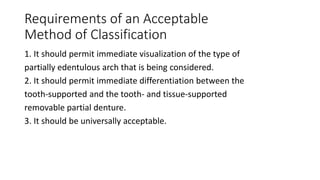
• Class I : Bilateral edentulous areas
located posterior to the remaining
natural teeth. Highest incidence in
mandible
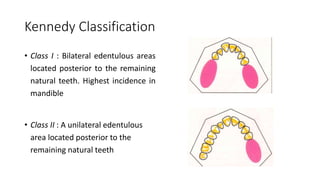
• Class II : A unilateral edentulous
area located posterior to the
remaining natural teeth
Kennedy Classification
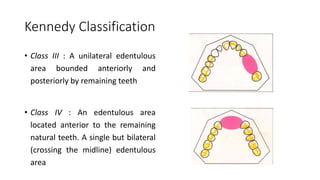
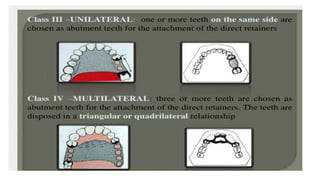
• Class III : A unilateral edentulous
area bounded anteriorly and
posteriorly by remaining teeth
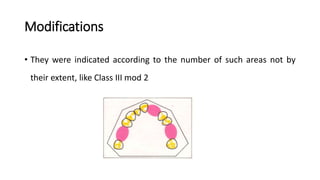
• Class IV : An edentulous area
located anterior to the remaining
natural teeth. A single but bilateral
(crossing the midline) edentulous
area
Modifications
• They were indicated according to the number of such areas not by
their extent, like Class III mod 2
Rules Governing Application of the Kennedy
Method
Rule 1
Classification should follow
rather than precede any
extractions of teeth that
might alter the original
classification.
Rule 2
If a third molar is missing
and is not to be
replaced, it is not considered
in the classification.
Rule 3
If a third molar is present
and is to be used as an
abutment, it is considered in
the classification.
Rule 4
If a second molar is missing
and is not to be replaced,
it is not considered in the
classification (e.g., if the
opposing second molar is
likewise missing and is not
to be replaced).
Rules Governing Application of the Kennedy
Method
Rule 5
The most posterior
edentulous area (or areas)
always determines the
classification.
Rule 6
Edentulous areas other than
those that determine the
classification are referred to
as modifications and are
designated by their number.
Rule 7
The extent of the modification
is not considered, only the
number of additional edentulous
areas.
Rule 8
No modification areas can be
included in Class IV arches.
(Other edentulous areas that lie
posterior to the single bilateral
areas crossing the midline would
instead determine the
classification; see Rule 5.)
Classification of Partially Edentulous Teeth

Classification of Partially Edentulous Teeth

  • 1.
  • 2.
    The purpose ofthis system of classification is to facilitate treatment decisions on the basis of treatment complexity. Complexity is determined from four broad diagnostic categories: othat include location and extent of the edentulous areas, ocondition of the abutments, oocclusal characteristics and requirements, and oresidual ridge characteristics
  • 3.
    NEED FOR CLASSIFICATION •Ease of communication between dentist and laboratory personal. • Facilitates case history recording and immediate visualization of the edentulous arches • Formulate a good treatment plan • Formulate basic design principles which might be applied to similar situations. • Anticipate the difficulties commonly to occur for that particular design.
  • 4.
    Requirements of anAcceptable Method of Classification 1. It should permit immediate visualization of the type of partially edentulous arch that is being considered. 2. It should permit immediate differentiation between the tooth-supported and the tooth- and tissue-supported removable partial denture. 3. It should be universally acceptable.
  • 5.
    Kennedy Classification • ClassI : Bilateral edentulous areas located posterior to the remaining natural teeth. Highest incidence in mandible • Class II : A unilateral edentulous area located posterior to the remaining natural teeth
  • 6.
    Kennedy Classification • ClassIII : A unilateral edentulous area bounded anteriorly and posteriorly by remaining teeth • Class IV : An edentulous area located anterior to the remaining natural teeth. A single but bilateral (crossing the midline) edentulous area
  • 7.
    Modifications • They wereindicated according to the number of such areas not by their extent, like Class III mod 2
  • 8.
    Rules Governing Applicationof the Kennedy Method Rule 1 Classification should follow rather than precede any extractions of teeth that might alter the original classification. Rule 2 If a third molar is missing and is not to be replaced, it is not considered in the classification. Rule 3 If a third molar is present and is to be used as an abutment, it is considered in the classification. Rule 4 If a second molar is missing and is not to be replaced, it is not considered in the classification (e.g., if the opposing second molar is likewise missing and is not to be replaced).
  • 9.
    Rules Governing Applicationof the Kennedy Method Rule 5 The most posterior edentulous area (or areas) always determines the classification. Rule 6 Edentulous areas other than those that determine the classification are referred to as modifications and are designated by their number. Rule 7 The extent of the modification is not considered, only the number of additional edentulous areas. Rule 8 No modification areas can be included in Class IV arches. (Other edentulous areas that lie posterior to the single bilateral areas crossing the midline would instead determine the classification; see Rule 5.)