DR SATYANARAYANA NAIK
MDS
DEPT OF PROSTHODONTICD
NAVODAYA DENTAL COLLEGE
Introduction To Removable Partial
Denture
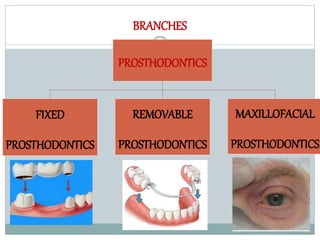
BRANCHES
PROSTHODONTICS
FIXED
PROSTHODONTICS
REMOVABLE
PROSTHODONTICS
MAXILLOFACIAL
PROSTHODONTICS
What is removable prosthodontics???
“The branch of prosthodontics concerned with the replacement of
teeth & contiguous structures for edentulous or partially
edentulous patients by artificial substitutes that are readily
removable from the mouth”
GPT 9
Removable Partial denture (RPD)
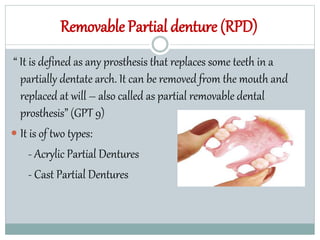
“ It is defined as any prosthesis that replaces some teeth in a
partially dentate arch. It can be removed from the mouth and
replaced at will – also called as partial removable dental
prosthesis” (GPT 9)
 It is of two types:
- Acrylic Partial Dentures
- Cast Partial Dentures
TERMINOLOGIES
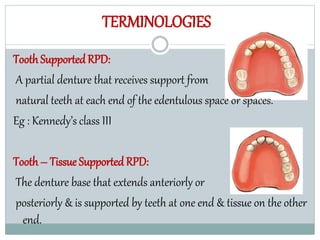
ToothSupported RPD:
A partial denture that receives support from
natural teeth at each end of the edentulous space or spaces.
Eg : Kennedy’s class III
Tooth – Tissue Supported RPD:
The denture base that extends anteriorly or
posteriorly & is supported by teeth at one end & tissue on the other
end.
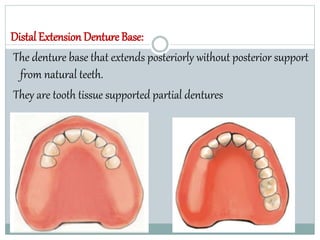
Distal Extension Denture Base:
The denture base that extends posteriorly without posterior support
from natural teeth.
They are tooth tissue supported partial dentures
“ The preservation of that which remains is of
utmost importance and not the meticulous
replacement of that which has been lost”
Muller De Van (1952)
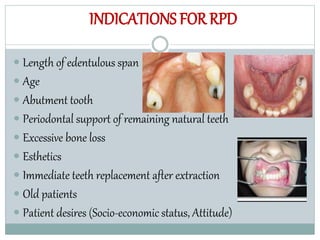
INDICATIONS FOR RPD
 Length of edentulous span
 Age
 Abutment tooth
 Periodontal support of remaining natural teeth
 Excessive bone loss
 Esthetics
 Immediate teeth replacement after extraction
 Old patients
 Patient desires (Socio-economic status, Attitude)
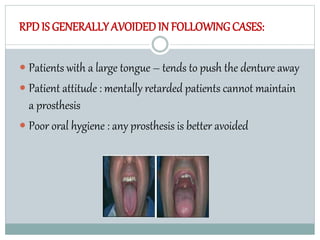
RPDIS GENERALLY AVOIDED IN FOLLOWING CASES:
 Patients with a large tongue – tends to push the denture away
 Patient attitude : mentally retarded patients cannot maintain
a prosthesis
 Poor oral hygiene : any prosthesis is better avoided
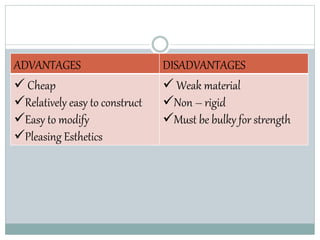
ADVANTAGES DISADVANTAGES
 Cheap
Relatively easy to construct
Easy to modify
Pleasing Esthetics
 Weak material
Non – rigid
Must be bulky for strength
Need For Classification
 To communicate the condition of the oral cavity
 To formulate a good treatment plan
 To anticipate the difficulties commonly to occur for that
particular design
 To design the denture according to the occlusal load usually
expected for a particular group
Requirements Of An Acceptable MethodOf Classification
 It should permit immediate visualization of the type of partially
edentulous arch being considered
 It should permit immediate differentiation between the tooth
supported and tooth tissue supported RPD
 Serve as a guide to the type of design to be used
 It should be universally acceptable
Classifications
 Cummer’s classification
 Kennedy’s classification
 Bailyn’s classification
 Neurohr’s classification
 Mauk’s classification
 Wild’s classification
 Godfrey’s classification
 Friedman’s classification
 Beckett & Wilson’s classification
 Craddock’s classification
 Skinner’s classification
 Austin & Lidge classification
 Watt et al classification
 Swenson’s classification
 Avant’s classification
 Costa’s classification
 Osborne & Lammie’s classification
Kennedy’s Classification
 Widely acceptable classification
 Devised by Edward Kennedy of New York in 1923
 Although relatively simple, it can be applied to nearly all semi
edentulous conditions.
 It is composed of 4 major categories
- Class I
- Class II
- Class III
- Class IV
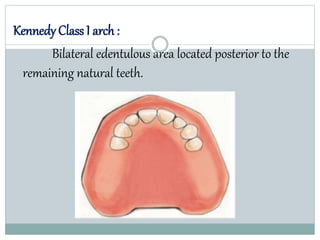
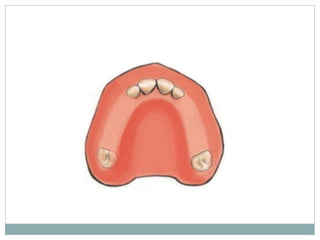
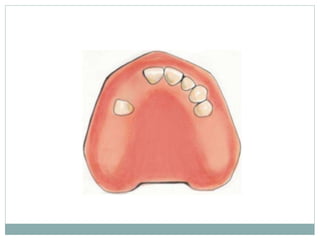
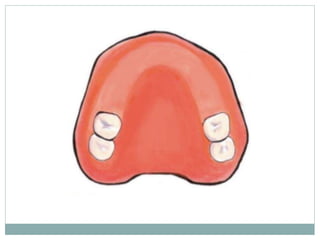
Kennedy Class I arch :
Bilateral edentulous area located posterior to the
remaining natural teeth.
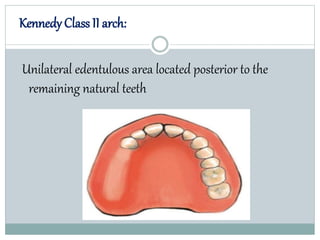
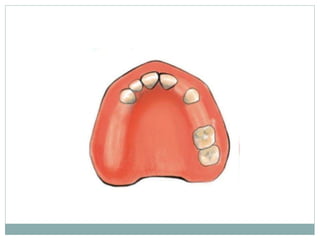
Kennedy Class II arch:
Unilateral edentulous area located posterior to the
remaining natural teeth
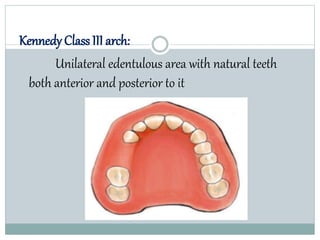
Kennedy Class III arch:
Unilateral edentulous area with natural teeth
both anterior and posterior to it
Kennedy ‘s Class IV arch:
Single, bilateral edentulous area located anterior to the
remaining natural teeth.
It is important to note that the edentulous space must
cross the midline
Merits of Kennedy ‘s classification
Allows visualization of partially edentulous arch
Differentiates b/w tooth and tooth tissue supported
Type of design can be decided
Universally accepted
Aids in discussing, identifying and planning the design
Easy to apply the system to any situation
Widely used system
Demerits
Does not assess the choice, number, location and
condition of the abutment teeth.
Assessment of hard and soft tissue status not possible.
Does not indicate the position of individual tooth.
Does not permit assessment of occlusion.
Applegate’s Modification (1960)
Applegate modified the above classification based on the condition
of abutment to include two more additional groups:
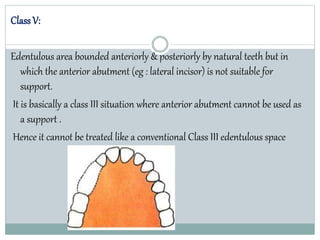
Class V:
Edentulous area bounded anteriorly & posteriorly by natural teeth but in
which the anterior abutment (eg : lateral incisor) is not suitable for
support.
It is basically a class III situation where anterior abutment cannot be used as
a support .
Hence it cannot be treated like a conventional Class III edentulous space
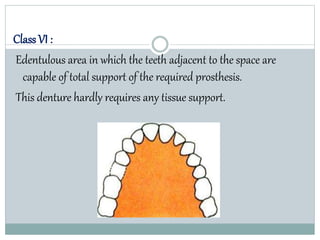
Class VI :
Edentulous area in which the teeth adjacent to the space are
capable of total support of the required prosthesis.
This denture hardly requires any tissue support.
Applegate’s Rules
Following rules should be considered to classify partially edentulous
arches based on Kennedy’s Classification
If extraction of hopeless teeth is required, then it should be done
prior to classification
Rule 1: Classification should follow rather than precede extractions
that might alter the original classification
Rule 2 : If third molar is missing & not to be replaced, it is not
considered in the classification
Rule 3 : If third molar is present & is to be used as an abutment, it is
considered in the classification
Rule 4 : If the Second molar is missing & is not to be replaced, it is not
considered in the classification
Rule 5 : The most posterior edentulous area or areas always determine
the classification
Rule 6 : Edentulous areas other than those, which determine the
classification, are referred to as modification spaces & are
designated by their number
Rule 7 : The extent of the modification is not considered, only the
number of additional edentulous areas are considered
Rule 8 : There can be no modification areas in Class IV. Because any
additional edentulous space will definitely be posterior to it and
will determine the classification.
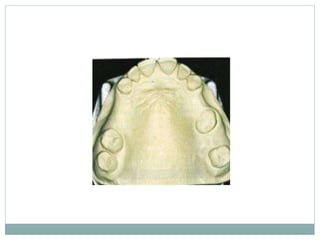
RECOGNIZE THE
CLASSIFICATION
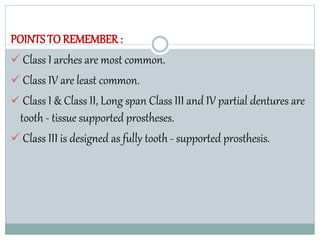
POINTS TO REMEMBER :
 Class I arches are most common.
 Class IV are least common.
 Class I & Class II, Long span Class III and IV partial dentures are
tooth - tissue supported prostheses.
 Class III is designed as fully tooth - supported prosthesis.
THANKU

RPD BASICS.ppt

  • 1.
    DR SATYANARAYANA NAIK MDS DEPTOF PROSTHODONTICD NAVODAYA DENTAL COLLEGE Introduction To Removable Partial Denture
  • 2.
  • 3.
    What is removableprosthodontics??? “The branch of prosthodontics concerned with the replacement of teeth & contiguous structures for edentulous or partially edentulous patients by artificial substitutes that are readily removable from the mouth” GPT 9
  • 4.
    Removable Partial denture(RPD) “ It is defined as any prosthesis that replaces some teeth in a partially dentate arch. It can be removed from the mouth and replaced at will – also called as partial removable dental prosthesis” (GPT 9)  It is of two types: - Acrylic Partial Dentures - Cast Partial Dentures
  • 5.
    TERMINOLOGIES ToothSupported RPD: A partialdenture that receives support from natural teeth at each end of the edentulous space or spaces. Eg : Kennedy’s class III Tooth – Tissue Supported RPD: The denture base that extends anteriorly or posteriorly & is supported by teeth at one end & tissue on the other end.
  • 6.
    Distal Extension DentureBase: The denture base that extends posteriorly without posterior support from natural teeth. They are tooth tissue supported partial dentures
  • 7.
    “ The preservationof that which remains is of utmost importance and not the meticulous replacement of that which has been lost” Muller De Van (1952)
  • 8.
    INDICATIONS FOR RPD Length of edentulous span  Age  Abutment tooth  Periodontal support of remaining natural teeth  Excessive bone loss  Esthetics  Immediate teeth replacement after extraction  Old patients  Patient desires (Socio-economic status, Attitude)
  • 9.
    RPDIS GENERALLY AVOIDEDIN FOLLOWING CASES:  Patients with a large tongue – tends to push the denture away  Patient attitude : mentally retarded patients cannot maintain a prosthesis  Poor oral hygiene : any prosthesis is better avoided
  • 10.
    ADVANTAGES DISADVANTAGES  Cheap Relativelyeasy to construct Easy to modify Pleasing Esthetics  Weak material Non – rigid Must be bulky for strength
  • 11.
    Need For Classification To communicate the condition of the oral cavity  To formulate a good treatment plan  To anticipate the difficulties commonly to occur for that particular design  To design the denture according to the occlusal load usually expected for a particular group
  • 12.
    Requirements Of AnAcceptable MethodOf Classification  It should permit immediate visualization of the type of partially edentulous arch being considered  It should permit immediate differentiation between the tooth supported and tooth tissue supported RPD  Serve as a guide to the type of design to be used  It should be universally acceptable
  • 13.
    Classifications  Cummer’s classification Kennedy’s classification  Bailyn’s classification  Neurohr’s classification  Mauk’s classification  Wild’s classification  Godfrey’s classification  Friedman’s classification
  • 14.
     Beckett &Wilson’s classification  Craddock’s classification  Skinner’s classification  Austin & Lidge classification  Watt et al classification  Swenson’s classification  Avant’s classification  Costa’s classification  Osborne & Lammie’s classification
  • 15.
    Kennedy’s Classification  Widelyacceptable classification  Devised by Edward Kennedy of New York in 1923  Although relatively simple, it can be applied to nearly all semi edentulous conditions.  It is composed of 4 major categories - Class I - Class II - Class III - Class IV
  • 16.
    Kennedy Class Iarch : Bilateral edentulous area located posterior to the remaining natural teeth.
  • 17.
    Kennedy Class IIarch: Unilateral edentulous area located posterior to the remaining natural teeth
  • 18.
    Kennedy Class IIIarch: Unilateral edentulous area with natural teeth both anterior and posterior to it
  • 19.
    Kennedy ‘s ClassIV arch: Single, bilateral edentulous area located anterior to the remaining natural teeth. It is important to note that the edentulous space must cross the midline
  • 20.
    Merits of Kennedy‘s classification Allows visualization of partially edentulous arch Differentiates b/w tooth and tooth tissue supported Type of design can be decided Universally accepted Aids in discussing, identifying and planning the design Easy to apply the system to any situation Widely used system
  • 21.
    Demerits Does not assessthe choice, number, location and condition of the abutment teeth. Assessment of hard and soft tissue status not possible. Does not indicate the position of individual tooth. Does not permit assessment of occlusion.
  • 22.
    Applegate’s Modification (1960) Applegatemodified the above classification based on the condition of abutment to include two more additional groups:
  • 23.
    Class V: Edentulous areabounded anteriorly & posteriorly by natural teeth but in which the anterior abutment (eg : lateral incisor) is not suitable for support. It is basically a class III situation where anterior abutment cannot be used as a support . Hence it cannot be treated like a conventional Class III edentulous space
  • 24.
    Class VI : Edentulousarea in which the teeth adjacent to the space are capable of total support of the required prosthesis. This denture hardly requires any tissue support.
  • 25.
    Applegate’s Rules Following rulesshould be considered to classify partially edentulous arches based on Kennedy’s Classification If extraction of hopeless teeth is required, then it should be done prior to classification
  • 26.
    Rule 1: Classificationshould follow rather than precede extractions that might alter the original classification Rule 2 : If third molar is missing & not to be replaced, it is not considered in the classification Rule 3 : If third molar is present & is to be used as an abutment, it is considered in the classification Rule 4 : If the Second molar is missing & is not to be replaced, it is not considered in the classification Rule 5 : The most posterior edentulous area or areas always determine the classification
  • 27.
    Rule 6 :Edentulous areas other than those, which determine the classification, are referred to as modification spaces & are designated by their number Rule 7 : The extent of the modification is not considered, only the number of additional edentulous areas are considered Rule 8 : There can be no modification areas in Class IV. Because any additional edentulous space will definitely be posterior to it and will determine the classification.
  • 28.
  • 34.
    POINTS TO REMEMBER:  Class I arches are most common.  Class IV are least common.  Class I & Class II, Long span Class III and IV partial dentures are tooth - tissue supported prostheses.  Class III is designed as fully tooth - supported prosthesis.
  • 35.