R . K . H A R I T H A
I V Y E A R
C D C R I
BEVEL
CONTENT
 Introduction
 Definition
 Classification
 Advantages & disadvantages
 Bevels in
Cast restoration
Composites
Veneers/Laminates
INTRODUCTION
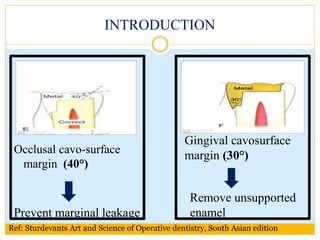
Occlusal cavo-surface
margin (40°)
Gingival cavosurface
margin (30°)
Remove unsupported
enamelPrevent marginal leakage
Ref: Sturdevants Art and Science of Operative dentistry, South Asian edition
DEFINITION
“Any abrupt incline between the two surfaces of a
prepared tooth or between the cavity wall and the cavo-
surface margins in the prepared cavity.”
Ref: Sturdevant’s Art and Science of Operative dentistry
 Based on shape and tissue surface
involved
 Based on the surface they are
placed on
CLASSIFICATION
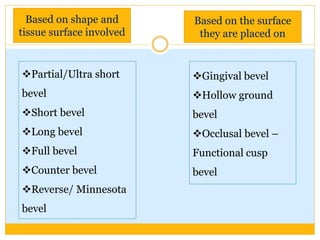
Based on the surface
they are placed on
Based on shape and
tissue surface involved
Partial/Ultra short
bevel
Short bevel
Long bevel
Full bevel
Counter bevel
Reverse/ Minnesota
bevel
Gingival bevel
Hollow ground
bevel
Occlusal bevel –
Functional cusp
bevel
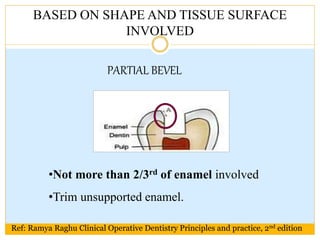
BASED ON SHAPE AND TISSUE SURFACE
INVOLVED
•Not more than 2/3rd of enamel involved
•Trim unsupported enamel.
PARTIAL BEVEL
Ref: Ramya Raghu Clinical Operative Dentistry Principles and practice, 2nd edition
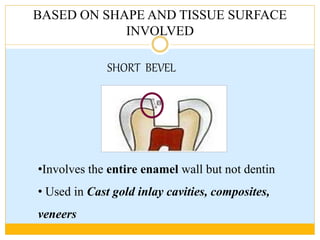
BASED ON SHAPE AND TISSUE SURFACE
INVOLVED
•Involves the entire enamel wall but not dentin
• Used in Cast gold inlay cavities, composites,
veneers
SHORT BEVEL
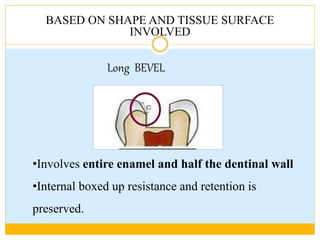
•Involves entire enamel and half the dentinal wall
•Internal boxed up resistance and retention is
preserved.
Long BEVEL
BASED ON SHAPE AND TISSUE SURFACE
INVOLVED
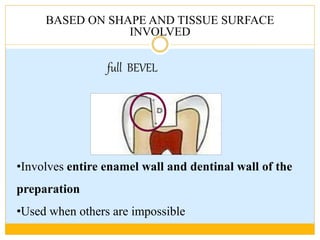
•Involves entire enamel wall and dentinal wall of the
preparation
•Used when others are impossible
full BEVEL
BASED ON SHAPE AND TISSUE SURFACE
INVOLVED
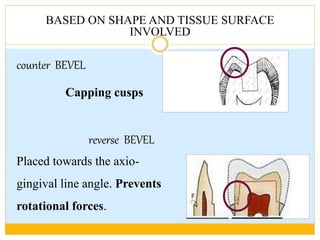
Capping cusps
Placed towards the axio-
gingival line angle. Prevents
rotational forces.
counter BEVEL
reverse BEVEL
BASED ON SHAPE AND TISSUE SURFACE
INVOLVED
2. BASED ON THE SURAFACE THEY ARE
PLACED ON
GINGIVAL BEVEL:
 Remove unsupported enamel
 30 degree gingival margin burnishable
 Lap sliding fit – improve the fit of casting
 Used for Inlay preparation
HOLLOW GROUND (CONCAVE) BEVEL:
 More space for bulk of cast metal
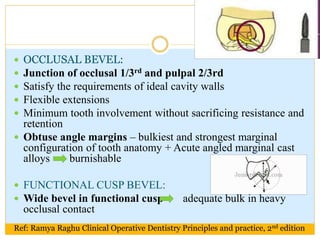
 OCCLUSAL BEVEL:
 Junction of occlusal 1/3rd and pulpal 2/3rd
 Satisfy the requirements of ideal cavity walls
 Flexible extensions
 Minimum tooth involvement without sacrificing resistance and
retention
 Obtuse angle margins – bulkiest and strongest marginal
configuration of tooth anatomy + Acute angled marginal cast
alloys burnishable
 FUNCTIONAL CUSP BEVEL:
 Wide bevel in functional cusp adequate bulk in heavy
occlusal contact
Ref: Ramya Raghu Clinical Operative Dentistry Principles and practice, 2nd edition
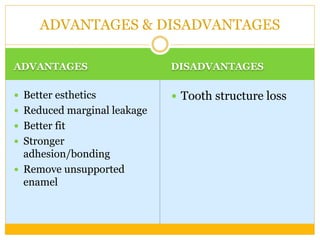
ADVANTAGES DISADVANTAGES
 Better esthetics
 Reduced marginal leakage
 Better fit
 Stronger
adhesion/bonding
 Remove unsupported
enamel
 Tooth structure loss
ADVANTAGES & DISADVANTAGES
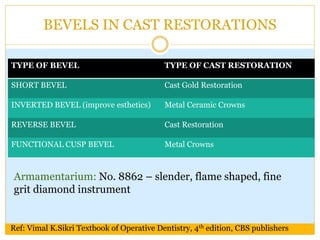
BEVELS IN CAST RESTORATIONS
Armamentarium: No. 8862 – slender, flame shaped, fine
grit diamond instrument
TYPE OF BEVEL TYPE OF CAST RESTORATION
SHORT BEVEL Cast Gold Restoration
INVERTED BEVEL (improve esthetics) Metal Ceramic Crowns
REVERSE BEVEL Cast Restoration
FUNCTIONAL CUSP BEVEL Metal Crowns
Ref: Vimal K.Sikri Textbook of Operative Dentistry, 4th edition, CBS publishers
BEVELS IN PARTIAL VENEERS/ LAMINATES
SHORT BEVEL
Ref: Vimal K.Sikri Textbook of Operative Dentistry, 4th edition, CBS publishers
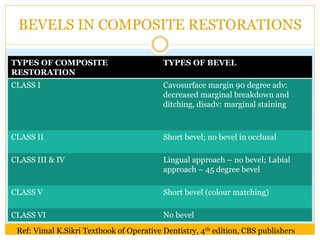
BEVELS IN COMPOSITE RESTORATIONS
TYPES OF COMPOSITE
RESTORATION
TYPES OF BEVEL
CLASS I Cavosurface margin 90 degree adv:
decreased marginal breakdown and
ditching, disadv: marginal staining
CLASS II Short bevel; no bevel in occlusal
CLASS III & IV Lingual approach – no bevel; Labial
approach – 45 degree bevel
CLASS V Short bevel (colour matching)
CLASS VI No bevel
Ref: Vimal K.Sikri Textbook of Operative Dentistry, 4th edition, CBS publishers
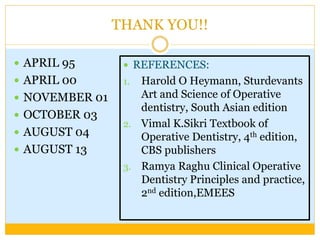
THANK YOU!!
 APRIL 95
 APRIL 00
 NOVEMBER 01
 OCTOBER 03
 AUGUST 04
 AUGUST 13
 REFERENCES:
1. Harold O Heymann, Sturdevants
Art and Science of Operative
dentistry, South Asian edition
2. Vimal K.Sikri Textbook of
Operative Dentistry, 4th edition,
CBS publishers
3. Ramya Raghu Clinical Operative
Dentistry Principles and practice,
2nd edition,EMEES

Bevels in Dental Restorations

  • 1.
    R . K. H A R I T H A I V Y E A R C D C R I BEVEL
  • 2.
    CONTENT  Introduction  Definition Classification  Advantages & disadvantages  Bevels in Cast restoration Composites Veneers/Laminates
  • 3.
    INTRODUCTION Occlusal cavo-surface margin (40°) Gingivalcavosurface margin (30°) Remove unsupported enamelPrevent marginal leakage Ref: Sturdevants Art and Science of Operative dentistry, South Asian edition
  • 4.
    DEFINITION “Any abrupt inclinebetween the two surfaces of a prepared tooth or between the cavity wall and the cavo- surface margins in the prepared cavity.” Ref: Sturdevant’s Art and Science of Operative dentistry
  • 5.
     Based onshape and tissue surface involved  Based on the surface they are placed on CLASSIFICATION
  • 6.
    Based on thesurface they are placed on Based on shape and tissue surface involved Partial/Ultra short bevel Short bevel Long bevel Full bevel Counter bevel Reverse/ Minnesota bevel Gingival bevel Hollow ground bevel Occlusal bevel – Functional cusp bevel
  • 7.
    BASED ON SHAPEAND TISSUE SURFACE INVOLVED •Not more than 2/3rd of enamel involved •Trim unsupported enamel. PARTIAL BEVEL Ref: Ramya Raghu Clinical Operative Dentistry Principles and practice, 2nd edition
  • 8.
    BASED ON SHAPEAND TISSUE SURFACE INVOLVED •Involves the entire enamel wall but not dentin • Used in Cast gold inlay cavities, composites, veneers SHORT BEVEL
  • 9.
    •Involves entire enameland half the dentinal wall •Internal boxed up resistance and retention is preserved. Long BEVEL BASED ON SHAPE AND TISSUE SURFACE INVOLVED
  • 10.
    •Involves entire enamelwall and dentinal wall of the preparation •Used when others are impossible full BEVEL BASED ON SHAPE AND TISSUE SURFACE INVOLVED
  • 11.
    Capping cusps Placed towardsthe axio- gingival line angle. Prevents rotational forces. counter BEVEL reverse BEVEL BASED ON SHAPE AND TISSUE SURFACE INVOLVED
  • 12.
    2. BASED ONTHE SURAFACE THEY ARE PLACED ON GINGIVAL BEVEL:  Remove unsupported enamel  30 degree gingival margin burnishable  Lap sliding fit – improve the fit of casting  Used for Inlay preparation HOLLOW GROUND (CONCAVE) BEVEL:  More space for bulk of cast metal
  • 13.
     OCCLUSAL BEVEL: Junction of occlusal 1/3rd and pulpal 2/3rd  Satisfy the requirements of ideal cavity walls  Flexible extensions  Minimum tooth involvement without sacrificing resistance and retention  Obtuse angle margins – bulkiest and strongest marginal configuration of tooth anatomy + Acute angled marginal cast alloys burnishable  FUNCTIONAL CUSP BEVEL:  Wide bevel in functional cusp adequate bulk in heavy occlusal contact Ref: Ramya Raghu Clinical Operative Dentistry Principles and practice, 2nd edition
  • 14.
    ADVANTAGES DISADVANTAGES  Betteresthetics  Reduced marginal leakage  Better fit  Stronger adhesion/bonding  Remove unsupported enamel  Tooth structure loss ADVANTAGES & DISADVANTAGES
  • 15.
    BEVELS IN CASTRESTORATIONS Armamentarium: No. 8862 – slender, flame shaped, fine grit diamond instrument TYPE OF BEVEL TYPE OF CAST RESTORATION SHORT BEVEL Cast Gold Restoration INVERTED BEVEL (improve esthetics) Metal Ceramic Crowns REVERSE BEVEL Cast Restoration FUNCTIONAL CUSP BEVEL Metal Crowns Ref: Vimal K.Sikri Textbook of Operative Dentistry, 4th edition, CBS publishers
  • 16.
    BEVELS IN PARTIALVENEERS/ LAMINATES SHORT BEVEL Ref: Vimal K.Sikri Textbook of Operative Dentistry, 4th edition, CBS publishers
  • 17.
    BEVELS IN COMPOSITERESTORATIONS TYPES OF COMPOSITE RESTORATION TYPES OF BEVEL CLASS I Cavosurface margin 90 degree adv: decreased marginal breakdown and ditching, disadv: marginal staining CLASS II Short bevel; no bevel in occlusal CLASS III & IV Lingual approach – no bevel; Labial approach – 45 degree bevel CLASS V Short bevel (colour matching) CLASS VI No bevel Ref: Vimal K.Sikri Textbook of Operative Dentistry, 4th edition, CBS publishers
  • 18.
    THANK YOU!!  APRIL95  APRIL 00  NOVEMBER 01  OCTOBER 03  AUGUST 04  AUGUST 13  REFERENCES: 1. Harold O Heymann, Sturdevants Art and Science of Operative dentistry, South Asian edition 2. Vimal K.Sikri Textbook of Operative Dentistry, 4th edition, CBS publishers 3. Ramya Raghu Clinical Operative Dentistry Principles and practice, 2nd edition,EMEES