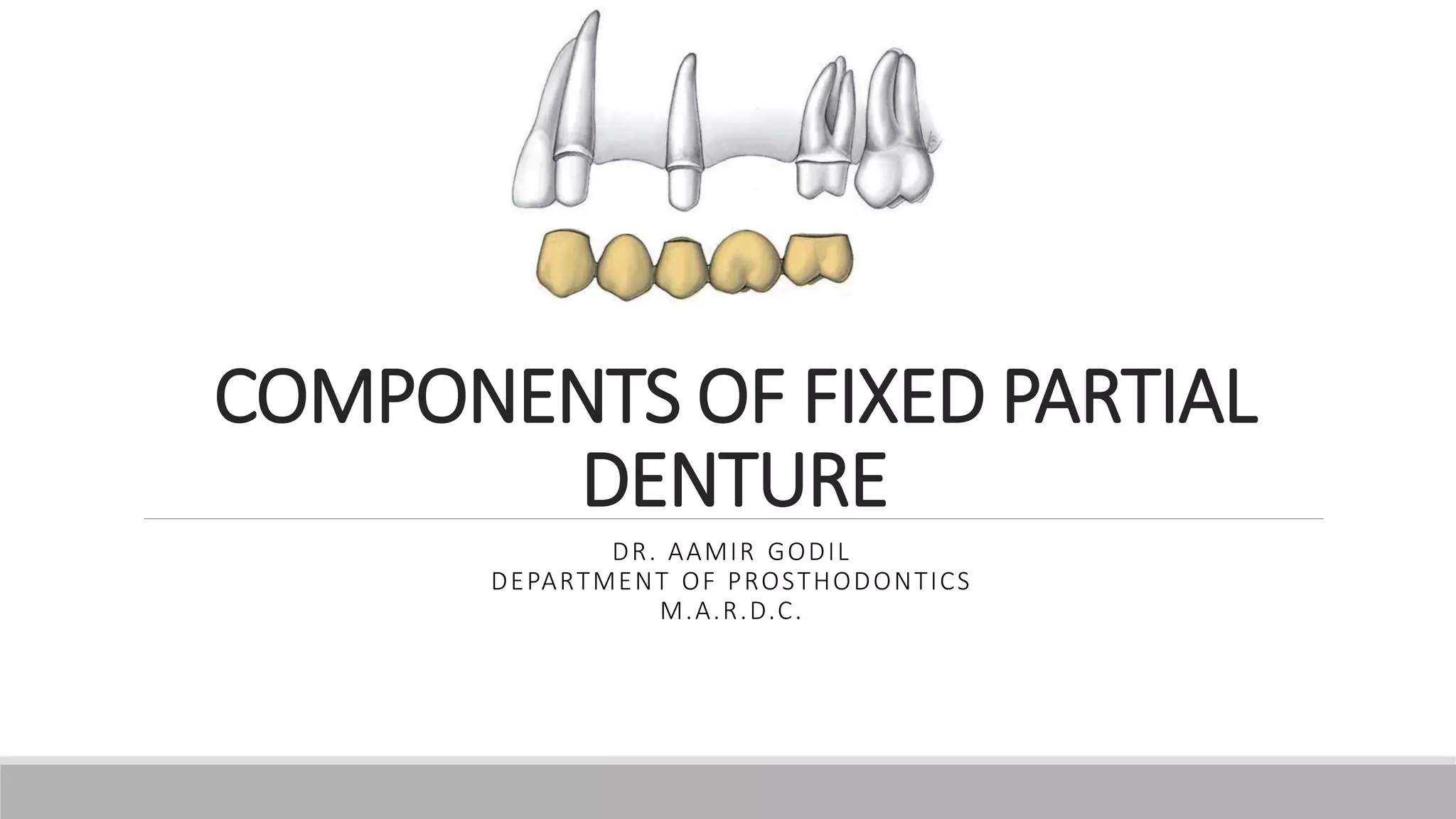
COMPONENTS OF FIXED PARTIAL
DENTURE
DR. AAMIR GODIL
DEPARTMENT OF PROSTHODONTICS
M.A.R.D.C.
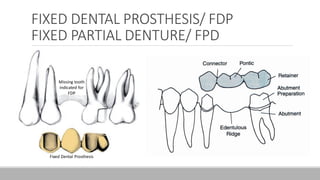
FIXED DENTAL PROSTHESIS/ FDP
FIXED PARTIAL DENTURE/ FPD
Missing tooth
indicated for
FDP
Fixed Dental Prosthesis
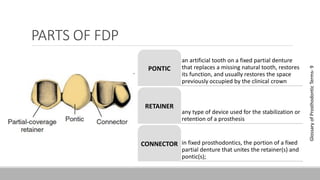
PARTS OF FDP
an artificial tooth on a fixed partial denture
that replaces a missing natural tooth, restores
its function, and usually restores the space
previously occupied by the clinical crown
PONTIC
any type of device used for the stabilization or
retention of a prosthesis
RETAINER
in fixed prosthodontics, the portion of a fixed
partial denture that unites the retainer(s) and
pontic(s);
CONNECTOR
Glossary
of
Prosthodontic
Terms-
9
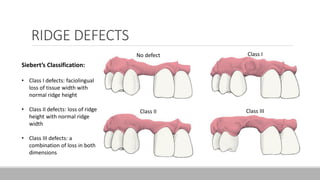
RIDGE DEFECTS
Siebert’s Classification:
• Class I defects: faciolingual
loss of tissue width with
normal ridge height
• Class II defects: loss of ridge
height with normal ridge
width
• Class III defects: a
combination of loss in both
dimensions
No defect Class I
Class II Class III
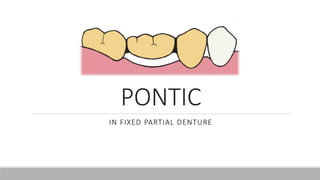
PONTIC
IN FIXED PARTIAL DENTURE
CLASSIFICATION OF PONTICS
I) According to Rosenstiel (Based on mucosal contact):
Mucosal Contact
◦ Ridge-lap
◦ Modified ridge-lap
◦ Ovate
◦ Conical
No Mucosal Contact
◦ Sanitary (hygienic)
◦ Modified sanitary (hygienic)
CLASSIFICATION OF PONTICS
II) Based on type of material used:
• Metal and porcelain- veneered pontic
• Metal and resin veneered pontic
• All metal pontic
• All ceramic pontic
III) Based on method of fabrication:
◦ Custom made pontic
◦ Prefabricated pontic
◦ - Trupontic
◦ - Interchangeable facing
◦ - Pin-facing pontic
◦ - Modified pin-facing pontic
◦ - Reverse pin- facing pontic
◦ Prefabricated custom modified pontic
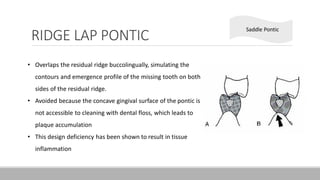
RIDGE LAP PONTIC
• Overlaps the residual ridge buccolingually, simulating the
contours and emergence profile of the missing tooth on both
sides of the residual ridge.
• Avoided because the concave gingival surface of the pontic is
not accessible to cleaning with dental floss, which leads to
plaque accumulation
• This design deficiency has been shown to result in tissue
inflammation
Saddle Pontic
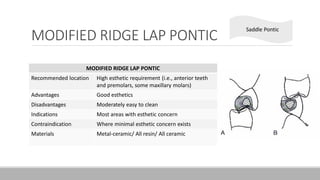
MODIFIED RIDGE LAP PONTIC
Recommended location High esthetic requirement (i.e., anterior teeth
and premolars, some maxillary molars)
Advantages Good esthetics
Disadvantages Moderately easy to clean
Indications Most areas with esthetic concern
Contraindication Where minimal esthetic concern exists
Materials Metal-ceramic/ All resin/ All ceramic
Saddle Pontic
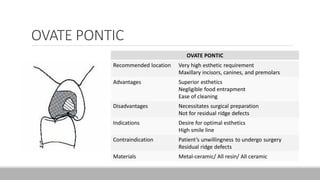
OVATE PONTIC
OVATE PONTIC
Recommended location Very high esthetic requirement
Maxillary incisors, canines, and premolars
Advantages Superior esthetics
Negligible food entrapment
Ease of cleaning
Disadvantages Necessitates surgical preparation
Not for residual ridge defects
Indications Desire for optimal esthetics
High smile line
Contraindication Patient’s unwillingness to undergo surgery
Residual ridge defects
Materials Metal-ceramic/ All resin/ All ceramic
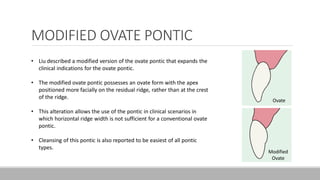
MODIFIED OVATE PONTIC
• Liu described a modified version of the ovate pontic that expands the
clinical indications for the ovate pontic.
• The modified ovate pontic possesses an ovate form with the apex
positioned more facially on the residual ridge, rather than at the crest
of the ridge.
• This alteration allows the use of the pontic in clinical scenarios in
which horizontal ridge width is not sufficient for a conventional ovate
pontic.
• Cleansing of this pontic is also reported to be easiest of all pontic
types.
Ovate
Modified
Ovate
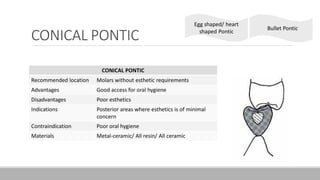
CONICAL PONTIC
CONICAL PONTIC
Recommended location Molars without esthetic requirements
Advantages Good access for oral hygiene
Disadvantages Poor esthetics
Indications Posterior areas where esthetics is of minimal
concern
Contraindication Poor oral hygiene
Materials Metal-ceramic/ All resin/ All ceramic
Bullet Pontic
Egg shaped/ heart
shaped Pontic
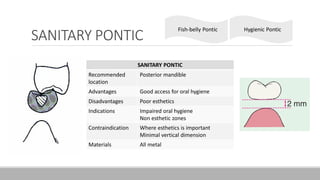
SANITARY PONTIC
SANITARY PONTIC
Recommended
location
Posterior mandible
Advantages Good access for oral hygiene
Disadvantages Poor esthetics
Indications Impaired oral hygiene
Non esthetic zones
Contraindication Where esthetics is important
Minimal vertical dimension
Materials All metal
Hygienic Pontic
Fish-belly Pontic
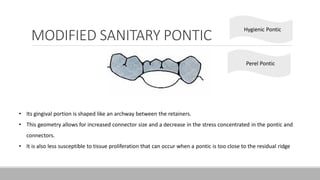
MODIFIED SANITARY PONTIC
Hygienic Pontic
• Its gingival portion is shaped like an archway between the retainers.
• This geometry allows for increased connector size and a decrease in the stress concentrated in the pontic and
connectors.
• It is also less susceptible to tissue proliferation that can occur when a pontic is too close to the residual ridge
Perel Pontic
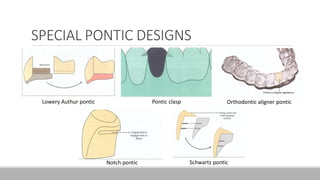
SPECIAL PONTIC DESIGNS
Lowery Authur pontic Pontic clasp Orthodontic aligner pontic
Notch pontic Schwartz pontic
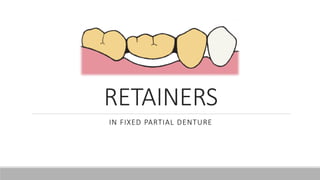
RETAINERS
IN FIXED PARTIAL DENTURE
CLASSIFICATION OF RETAINERS IN FPD
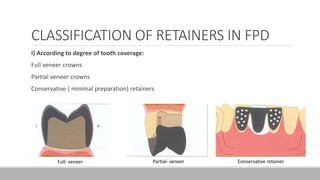
I) According to degree of tooth coverage:
•Full veneer crowns
•Partial veneer crowns
•Conservative ( minimal preparation) retainers
Full- veneer Partial- veneer Conservative retainer
CLASSIFICATION OF RETAINERS IN FPD
II) According to material of fabrication
• All metal retainers
• Metal ceramic retainers
• All ceramic retainers
• All acrylic retainers
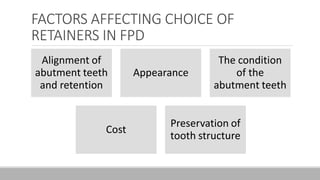
FACTORS AFFECTING CHOICE OF
RETAINERS IN FPD
Alignment of
abutment teeth
and retention
Appearance
The condition
of the
abutment teeth
Cost
Preservation of
tooth structure
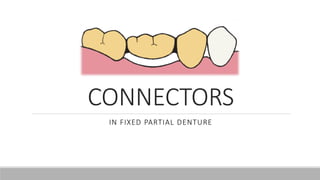
CONNECTORS
IN FIXED PARTIAL DENTURE
CLASSIFICATION OF CONNECTORS IN FPD
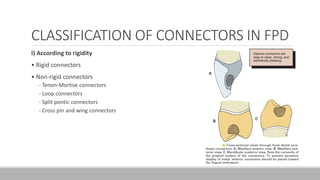
I) According to rigidity
• Rigid connectors
• Non-rigid connectors
◦ - Tenon-Mortise connectors
◦ - Loop connectors
◦ - Split pontic connectors
◦ - Cross pin and wing connectors
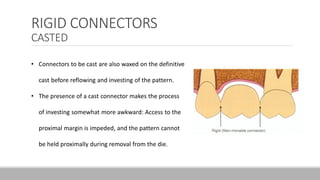
RIGID CONNECTORS
CASTED
• Connectors to be cast are also waxed on the definitive
cast before reflowing and investing of the pattern.
• The presence of a cast connector makes the process
of investing somewhat more awkward: Access to the
proximal margin is impeded, and the pattern cannot
be held proximally during removal from the die.
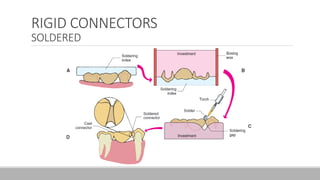
RIGID CONNECTORS
SOLDERED
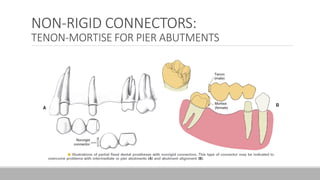
NON-RIGID CONNECTORS:
TENON-MORTISE FOR PIER ABUTMENTS
NON-RIGID CONNECTORS:
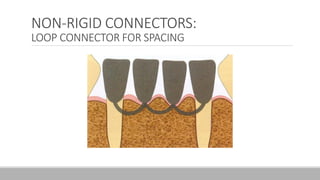
LOOP CONNECTOR FOR SPACING
NON-RIGID CONNECTORS:
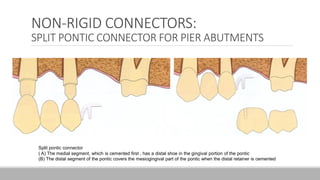
SPLIT PONTIC CONNECTOR FOR PIER ABUTMENTS
Split pontic connector
( A) The medial segment, which is cemented first , has a distal shoe in the gingival portion of the pontic
(B) The distal segment of the pontic covers the mesiogingival part of the pontic when the distal retainer is cemented
NON-RIGID CONNECTORS:
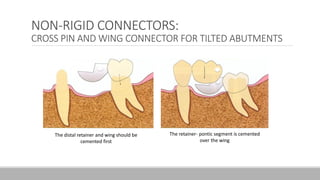
CROSS PIN AND WING CONNECTOR FOR TILTED ABUTMENTS
The distal retainer and wing should be
cemented first
The retainer- pontic segment is cemented
over the wing
THANK YOU

Components of Fixed Partial Denture

  • 1.
    COMPONENTS OF FIXEDPARTIAL DENTURE DR. AAMIR GODIL DEPARTMENT OF PROSTHODONTICS M.A.R.D.C.
  • 2.
    FIXED DENTAL PROSTHESIS/FDP FIXED PARTIAL DENTURE/ FPD Missing tooth indicated for FDP Fixed Dental Prosthesis
  • 3.
    PARTS OF FDP anartificial tooth on a fixed partial denture that replaces a missing natural tooth, restores its function, and usually restores the space previously occupied by the clinical crown PONTIC any type of device used for the stabilization or retention of a prosthesis RETAINER in fixed prosthodontics, the portion of a fixed partial denture that unites the retainer(s) and pontic(s); CONNECTOR Glossary of Prosthodontic Terms- 9
  • 4.
    RIDGE DEFECTS Siebert’s Classification: •Class I defects: faciolingual loss of tissue width with normal ridge height • Class II defects: loss of ridge height with normal ridge width • Class III defects: a combination of loss in both dimensions No defect Class I Class II Class III
  • 5.
  • 6.
    CLASSIFICATION OF PONTICS I)According to Rosenstiel (Based on mucosal contact): Mucosal Contact ◦ Ridge-lap ◦ Modified ridge-lap ◦ Ovate ◦ Conical No Mucosal Contact ◦ Sanitary (hygienic) ◦ Modified sanitary (hygienic)
  • 7.
    CLASSIFICATION OF PONTICS II)Based on type of material used: • Metal and porcelain- veneered pontic • Metal and resin veneered pontic • All metal pontic • All ceramic pontic III) Based on method of fabrication: ◦ Custom made pontic ◦ Prefabricated pontic ◦ - Trupontic ◦ - Interchangeable facing ◦ - Pin-facing pontic ◦ - Modified pin-facing pontic ◦ - Reverse pin- facing pontic ◦ Prefabricated custom modified pontic
  • 8.
    RIDGE LAP PONTIC •Overlaps the residual ridge buccolingually, simulating the contours and emergence profile of the missing tooth on both sides of the residual ridge. • Avoided because the concave gingival surface of the pontic is not accessible to cleaning with dental floss, which leads to plaque accumulation • This design deficiency has been shown to result in tissue inflammation Saddle Pontic
  • 9.
    MODIFIED RIDGE LAPPONTIC MODIFIED RIDGE LAP PONTIC Recommended location High esthetic requirement (i.e., anterior teeth and premolars, some maxillary molars) Advantages Good esthetics Disadvantages Moderately easy to clean Indications Most areas with esthetic concern Contraindication Where minimal esthetic concern exists Materials Metal-ceramic/ All resin/ All ceramic Saddle Pontic
  • 10.
    OVATE PONTIC OVATE PONTIC Recommendedlocation Very high esthetic requirement Maxillary incisors, canines, and premolars Advantages Superior esthetics Negligible food entrapment Ease of cleaning Disadvantages Necessitates surgical preparation Not for residual ridge defects Indications Desire for optimal esthetics High smile line Contraindication Patient’s unwillingness to undergo surgery Residual ridge defects Materials Metal-ceramic/ All resin/ All ceramic
  • 11.
    MODIFIED OVATE PONTIC •Liu described a modified version of the ovate pontic that expands the clinical indications for the ovate pontic. • The modified ovate pontic possesses an ovate form with the apex positioned more facially on the residual ridge, rather than at the crest of the ridge. • This alteration allows the use of the pontic in clinical scenarios in which horizontal ridge width is not sufficient for a conventional ovate pontic. • Cleansing of this pontic is also reported to be easiest of all pontic types. Ovate Modified Ovate
  • 12.
    CONICAL PONTIC CONICAL PONTIC Recommendedlocation Molars without esthetic requirements Advantages Good access for oral hygiene Disadvantages Poor esthetics Indications Posterior areas where esthetics is of minimal concern Contraindication Poor oral hygiene Materials Metal-ceramic/ All resin/ All ceramic Bullet Pontic Egg shaped/ heart shaped Pontic
  • 13.
    SANITARY PONTIC SANITARY PONTIC Recommended location Posteriormandible Advantages Good access for oral hygiene Disadvantages Poor esthetics Indications Impaired oral hygiene Non esthetic zones Contraindication Where esthetics is important Minimal vertical dimension Materials All metal Hygienic Pontic Fish-belly Pontic
  • 14.
    MODIFIED SANITARY PONTIC HygienicPontic • Its gingival portion is shaped like an archway between the retainers. • This geometry allows for increased connector size and a decrease in the stress concentrated in the pontic and connectors. • It is also less susceptible to tissue proliferation that can occur when a pontic is too close to the residual ridge Perel Pontic
  • 15.
    SPECIAL PONTIC DESIGNS LoweryAuthur pontic Pontic clasp Orthodontic aligner pontic Notch pontic Schwartz pontic
  • 16.
  • 17.
    CLASSIFICATION OF RETAINERSIN FPD I) According to degree of tooth coverage: •Full veneer crowns •Partial veneer crowns •Conservative ( minimal preparation) retainers Full- veneer Partial- veneer Conservative retainer
  • 18.
    CLASSIFICATION OF RETAINERSIN FPD II) According to material of fabrication • All metal retainers • Metal ceramic retainers • All ceramic retainers • All acrylic retainers
  • 19.
    FACTORS AFFECTING CHOICEOF RETAINERS IN FPD Alignment of abutment teeth and retention Appearance The condition of the abutment teeth Cost Preservation of tooth structure
  • 20.
  • 21.
    CLASSIFICATION OF CONNECTORSIN FPD I) According to rigidity • Rigid connectors • Non-rigid connectors ◦ - Tenon-Mortise connectors ◦ - Loop connectors ◦ - Split pontic connectors ◦ - Cross pin and wing connectors
  • 22.
    RIGID CONNECTORS CASTED • Connectorsto be cast are also waxed on the definitive cast before reflowing and investing of the pattern. • The presence of a cast connector makes the process of investing somewhat more awkward: Access to the proximal margin is impeded, and the pattern cannot be held proximally during removal from the die.
  • 23.
  • 24.
  • 25.
  • 26.
    NON-RIGID CONNECTORS: SPLIT PONTICCONNECTOR FOR PIER ABUTMENTS Split pontic connector ( A) The medial segment, which is cemented first , has a distal shoe in the gingival portion of the pontic (B) The distal segment of the pontic covers the mesiogingival part of the pontic when the distal retainer is cemented
  • 27.
    NON-RIGID CONNECTORS: CROSS PINAND WING CONNECTOR FOR TILTED ABUTMENTS The distal retainer and wing should be cemented first The retainer- pontic segment is cemented over the wing
  • 28.