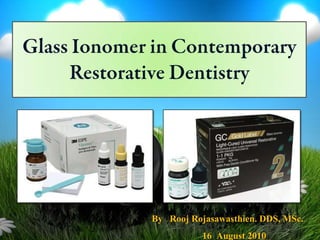
Glass Ionomer in Contemporary Restorative DentistryBy   RoojRojasawasthien. DDS, MSc.16  August 2010
Direct Tooth Colored MaterialResin compositeCompomer (Polyacid Modified Resin)Glass IonomerResin Modified Glass Ionomer
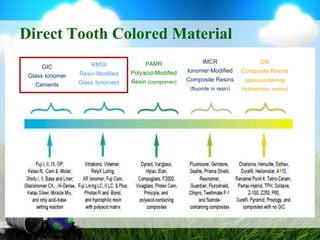
Direct Tooth Colored MaterialIMCRIonomer-ModifiedComposite Resins(fluoride in resin)CRComposite Resins(glass-containingHydrophobic resins)PAMRPolyacid-ModifiedResin (compomer)RMGIResin-ModifiedGlass IonomersGICGlass IonomerCements
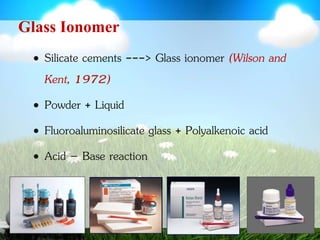
Glass IonomerSilicate cements ---> Glass ionomer(Wilson and Kent, 1972)Powder + LiquidFluoroaluminosilicate glass + Polyalkenoic acidAcid – Base reaction
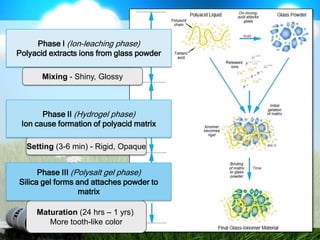
Phase I (Ion-leaching phase)Polyacid extracts ions from glass powderMixing - Shiny, GlossyPhase II (Hydrogel phase)Ion cause formation of polyacid matrixSetting (3-6 min) - Rigid, OpaquePhase III (Polysalt gel phase)Silica gel forms and attaches powder to matrixMaturation (24 hrs – 1 yrs) More tooth-like color
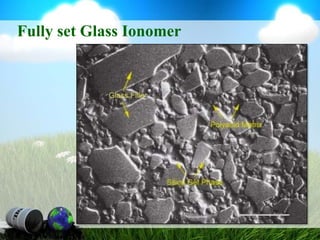
Fully set Glass Ionomer
AdvantagesLess shrinkage than polymerizing resinNo free monomers, Non-irritating to pulpCoefficient of thermal expansion similar to dentinHigh compressive strength
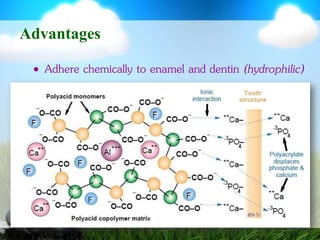
AdvantagesAdhere chemically to enamel and dentin (hydrophilic)
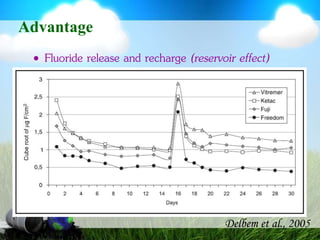
AdvantageFluoride release and recharge (reservoir effect)Delbem et al., 2005
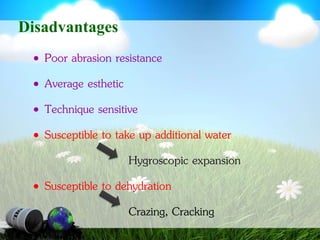
DisadvantagesPoor abrasion resistanceAverage estheticTechnique sensitiveSusceptible to take up additional waterHygroscopic expansionSusceptible to dehydrationCrazing, Cracking
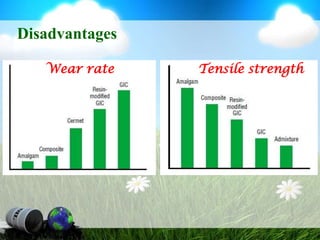
DisadvantagesWear rateTensile strength
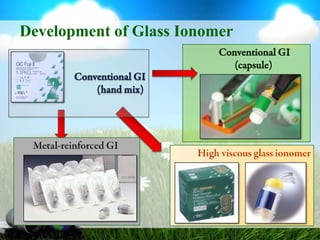
Development of Glass IonomerConventional GI(capsule) Conventional GI(hand mix) Metal-reinforced GIHigh viscous glass ionomer
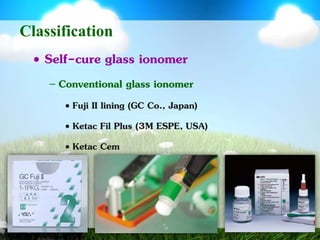
ClassificationSelf-cure glass ionomerConventional glass ionomerFuji II lining (GC Co., Japan)KetacFil Plus (3M ESPE, USA)KetacCem
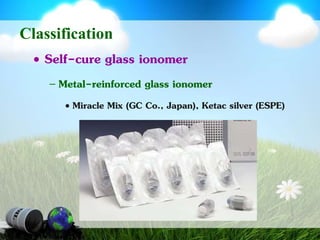
ClassificationSelf-cure glass ionomerMetal-reinforced glass ionomerMiracle Mix (GC Co., Japan),Ketac silver (ESPE)
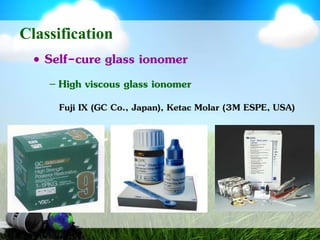
ClassificationSelf-cure glass ionomerHigh viscous glass ionomerFuji IX (GC Co., Japan), Ketac Molar (3M ESPE, USA)
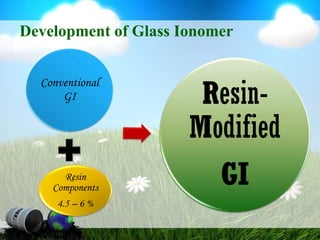
Development of Glass Ionomer
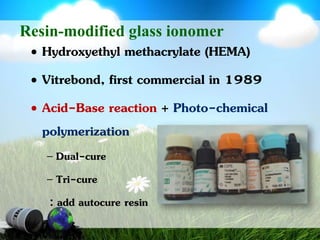
Resin-modified glass ionomerHydroxyethylmethacrylate (HEMA)Vitrebond, first commercial in 1989Acid-Base reaction + Photo-chemical polymerizationDual-cureTri-cure: add autocure resin
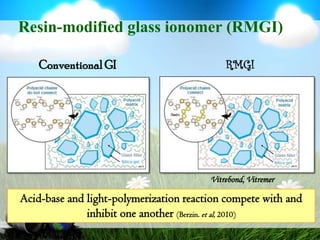
Resin-modified glass ionomer (RMGI)Conventional GIRMGIVitrebond, VitremerAcid-base and light-polymerization reaction compete with and inhibit one another (Berzin. et al, 2010)
Resin-modified glass ionomer (RMGI)Improve propertiesSet on demandFewer desiccation and hydration problemsImmediate finishingBetter estheticsTensile strength, fracture toughnessResistance to microleakageBond to resin composite
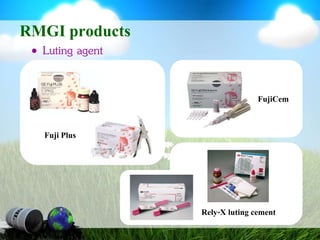
RMGI productsLuting agentFuji PlusFujiCem    Rely-X luting cement
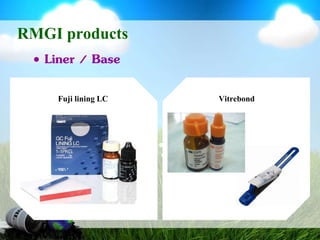
RMGI productsLiner / Base                Fuji lining LCVitrebond
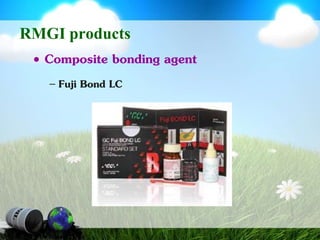
RMGI productsComposite bonding agentFuji Bond LC
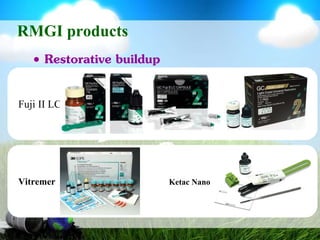
RMGI productsRestorative buildupFuji II LCVitremerKetacNano
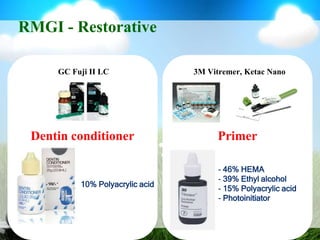
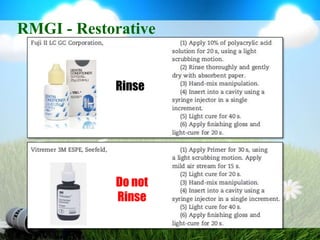
RMGI - Restorative GC Fuji II LCDentin conditioner  3M Vitremer, KetacNanoPrimer 46% HEMA
 39% Ethyl alcohol
 15% Polyacrylic acid
Photoinitiator10% Polyacrylic acid
RMGI - RestorativeRinseDo notRinse
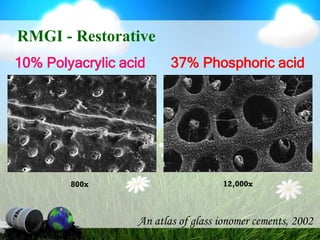
RMGI - Restorative10% Polyacrylic acid37% Phosphoric acid12,000x800xAn atlas of glass ionomer cements, 2002
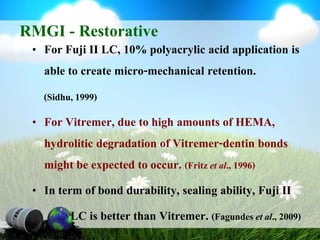
RMGI - RestorativeFor Fuji II LC, 10% polyacrylic acid application is able to create micro-mechanical retention.(Sidhu, 1999)For Vitremer, due to high amounts of HEMA, hydrolitic degradation of Vitremer-dentin bonds might be expected to occur. (Fritz et al., 1996)In term of bond durability, sealing ability, Fuji II              LC is better than Vitremer. (Fagundeset al., 2009)
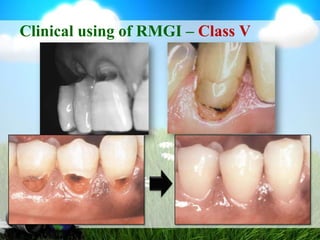
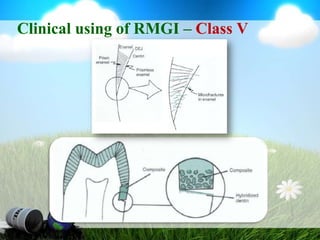
Clinical using of RMGI – Class V
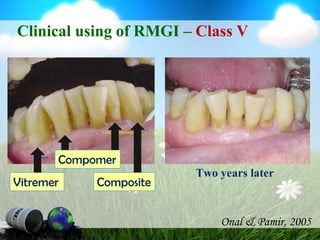
Clinical using of RMGI – Class VCompomerTwo years laterVitremerCompositeOnal & Pamir, 2005
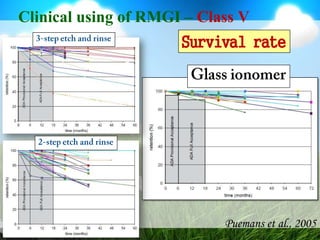
Clinical using of RMGI – Class VSurvival rate3-step etch and rinseGlass ionomer2-step etch and rinsePuemans et al., 2005
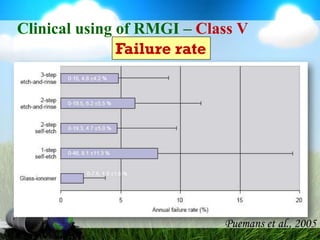
Clinical using of RMGI – Class VFailure ratePuemans et al., 2005
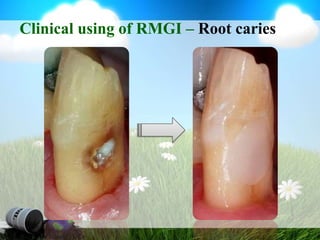
Clinical using of RMGI – Root caries
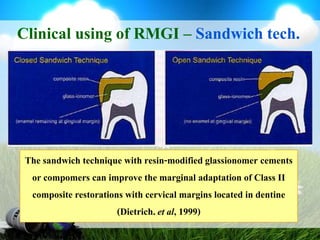
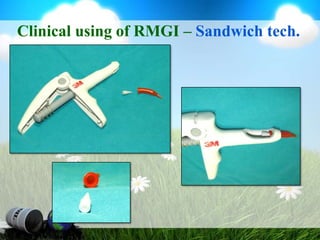
Clinical using of RMGI – Sandwich tech.The sandwich technique with resin-modified glassionomer cements or compomers can improve the marginal adaptation of Class II composite restorations with cervical margins located in dentine (Dietrich. et al, 1999)
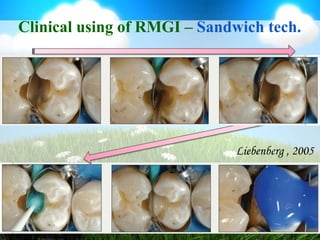
Clinical using of RMGI – Sandwich tech.Liebenberg , 2005
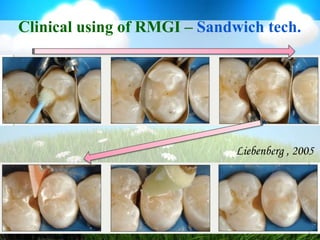
Clinical using of RMGI – Sandwich tech.
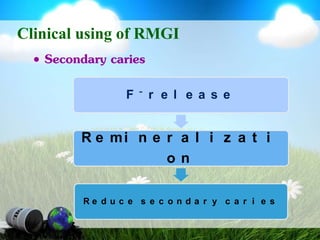
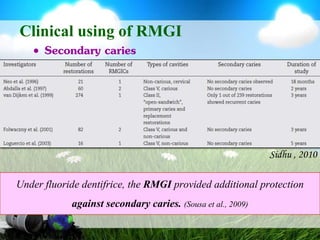
Clinical using of RMGISecondary caries
Clinical using of RMGISecondary cariesSidhu , 2010Under fluoride dentifrice, the RMGI provided additional protection against secondary caries. (Sousa et al., 2009)

Resin Modified Glassionomer cement

Editor's Notes

  • #35 ข้อดี1. ลด shrinkage 2. bond ในตำแหน่ง root dentin ได้ดีกว่า adhesive 3. ปลดปล่อย FClose sandwich - F release สู่ oral environment จะลดลง แต่มีข้อดีในแง่ esthetic, wear resistance
  • #40 There is some evidence that they maybe associated with a reduced incidence of secondary caries (Randall RC . J Dent Res 1999)
  • #43 RMGIC have been characterized as havinga longer working time, a rapid set, improved esthetic appearance and translucency, and higher earlystrength