Dr. Ibadat Jamil
Assistant professor
Dep. Of Prothodontics
CLASSIFICATION OF PARTIAL
EDENTULOUS ARCHES
Removable prosthodontics is defined as the
replacement of missing teeth and supporting
tissue with a prosthesis designed to be removed
by the wearer.
It can be broadly classified as :
1. Removable complete denture prosthodontics
2. Removable partial denture prosthodontics
• Extra coronal
• Intra coronal
• RATIONALE:-
• Classification of partially edentulous arch should
be done for the following reasons:-
 To formulate a good treatment plan
 To anticipate the difficulties commonly to occur
for that particular design
To communicate with a professional about a case.
To design a denture according to the occlusal load
usually expected for a particular group
REQUIREMENTS OF A CLASSIFICATION:-
A classification must satisfy the following norms:-
 Allow visualization of the type of partially
edentulous arch that is being considered.
 Allow differentiation between tooth supported
and tissue supported partial dentures
 Serve as a guide to the type of design to be
used
 Be universally accepted
there are many classifications available for
classifying edentulous arches, the most common
ones are:-
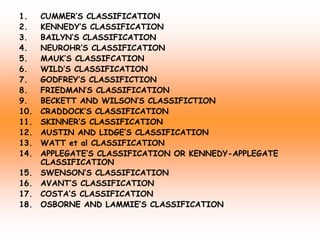
1. CUMMER’S CLASSIFICATION
2. KENNEDY’S CLASSIFICATION
3. BAILYN’S CLASSIFICATION
4. NEUROHR’S CLASSIFICATION
5. MAUK’S CLASSIFCATION
6. WILD’S CLASSIFICATION
7. GODFREY’S CLASSIFICTION
8. FRIEDMAN’S CLASSIFICATION
9. BECKETT AND WILSON’S CLASSIFICTION
10. CRADDOCK’S CLASSIFICATION
11. SKINNER’S CLASSIFICATION
12. AUSTIN AND LIDGE’S CLASSIFICATION
13. WATT et al CLASSIFICATION
14. APPLEGATE’S CLASSIFICATION OR KENNEDY-APPLEGATE
CLASSIFICATION
15. SWENSON’S CLASSIFICATION
16. AVANT’S CLASSIFICATION
17. COSTA’S CLASSIFICATION
18. OSBORNE AND LAMMIE’S CLASSIFICATION
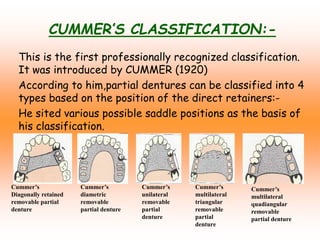
CUMMER’S CLASSIFICATION:-
This is the first professionally recognized classification.
It was introduced by CUMMER (1920)
According to him,partial dentures can be classified into 4
types based on the position of the direct retainers:-
He sited various possible saddle positions as the basis of
his classification.
Cummer’s
Diagonally retained
removable partial
denture
Cummer’s
diametric
removable
partial denture
Cummer’s
unilateral
removable
partial
denture
Cummer’s
multilateral
triangular
removable
partial
denture
Cummer’s
multilateral
quadiangular
removable
partial denture
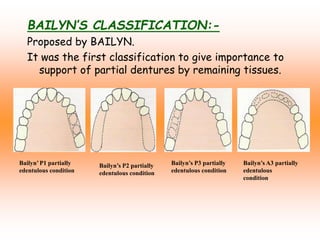
BAILYN’S CLASSIFICATION:-
Proposed by BAILYN.
It was the first classification to give importance to
support of partial dentures by remaining tissues.
Bailyn’P1 partially
edentulous condition
Bailyn’s P2 partially
edentulous condition
Bailyn’s P3 partially
edentulous condition
Bailyn’s A3 partially
edentulous
condition
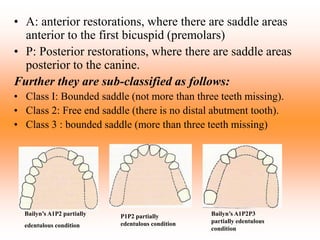
• A: anterior restorations, where there are saddle areas
anterior to the first bicuspid (premolars)
• P: Posterior restorations, where there are saddle areas
posterior to the canine.
Further they are sub-classified as follows:
• Class I: Bounded saddle (not more than three teeth missing).
• Class 2: Free end saddle (there is no distal abutment tooth).
• Class 3 : bounded saddle (more than three teeth missing)
Bailyn’s A1P2 partially
edentulous condition
P1P2 partially
edentulous condition
Bailyn’s A1P2P3
partially edentulous
condition
NEUROHR’S CLASSIFICATION:-
Proposed by NEUROHR(1939)
Based on the support derived.
DISADVANTAGE:-it is not commonly used due to it’s
unnecessary complexity.
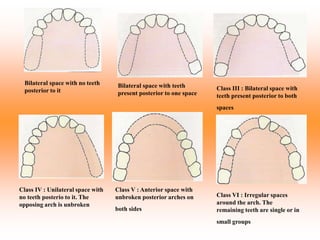
MAUK’S CLASSIFICATION:-
Proposed by MAUK(1942)
Based on number,length and position of the
edentulous spaces and the number and position
of the remaining teeth.
Bilateral space with no teeth
posterior to it
Bilateral space with teeth
present posterior to one space
Class III : Bilateral space with
teeth present posterior to both
spaces
Class IV : Unilateral space with
no teeth posterio to it. The
opposing arch is unbroken
Class V : Anterior space with
unbroken posterior arches on
both sides
Class VI : Irregular spaces
around the arch. The
remaining teeth are single or in
small groups
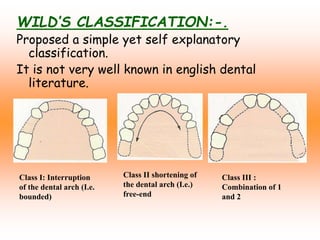
WILD’S CLASSIFICATION:-.
Proposed a simple yet self explanatory
classification.
It is not very well known in english dental
literature.
Class I: Interruption
of the dental arch (I.e.
bounded)
Class II shortening of
the dental arch (I.e.)
free-end
Class III :
Combination of 1
and 2
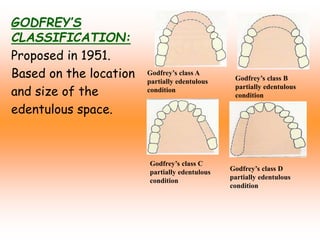
GODFREY’S
CLASSIFICATION:
Proposed in 1951.
Based on the location
and size of the
edentulous space.
Godfrey’s class B
partially edentulous
condition
Godfrey’s class C
partially edentulous
condition
Godfrey’s class A
partially edentulous
condition
Godfrey’s class D
partially edentulous
condition
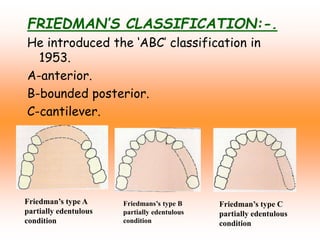
FRIEDMAN’S CLASSIFICATION:-.
He introduced the ‘ABC’ classification in
1953.
A-anterior.
B-bounded posterior.
C-cantilever.
Friedman’s type A
partially edentulous
condition
Friedmans’s type B
partially edentulous
condition
Friedman’s type C
partially edentulous
condition
BECKETT AND WILSON’S
CLASSIFICATION:-.
Beckett(1953) and Wilson(1957) based their
ideas on Bailyn’s classification(1928).
CRADDOCK’S CLASSIFICATION:-
Craddock proposed his classification in 1954
He classified partial dentures as:-
SKINNER’S CLASSIFICATION:-
He introduced the classification in 1959.
His classification was influenced by Cummer’s
classification.
AUSTIN AND LIDGE
CLASSIFICATION:-
It was proposed in 1957
They suggested a classification that described the
position of the teeth.
WATT et al CLASSIFICATION:-
He proposed the classification in 1958
It was based on the type of support derived.
SWENSON’S CLASSIFICATION:-
It is a simple classification proposed by Swenson and
Terkla(1955)
It was not widely used.
It is similar to Kennedy’s classification.
AVANT’S CLASSIFICATION:-
It was proposed in 1966
The classification was based on the anterior and
posterior segments of the arch.
It resembled Kennedy’ s classification without any
improvements.
COSTA’S CLASSIFICATION:-
Proposed in 1974
It was based on the anterior, lateral and terminal spaces.
OSBORNE’S AND LAMMIE’S
CLASSIFICATION:-
It was proposed in 1974
It is similar to Watt et al’s classification,.
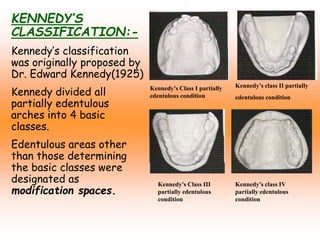
Kennedy’s Class I partially
edentulous condition
Kennedy’s class II partially
edentulous condition
Kennedy’s Class III
partially edentulous
condition
Kennedy’s class IV
partially edentulous
condition
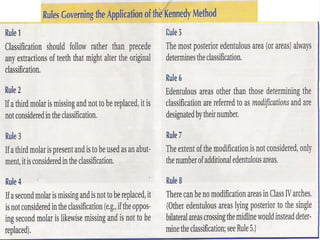
KENNEDY’S
CLASSIFICATION:-
Kennedy’s classification
was originally proposed by
Dr. Edward Kennedy(1925)
Kennedy divided all
partially edentulous
arches into 4 basic
classes.
Edentulous areas other
than those determining
the basic classes were
designated as
modification spaces.
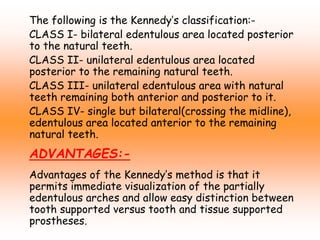
The following is the Kennedy’s classification:-
CLASS I- bilateral edentulous area located posterior
to the natural teeth.
CLASS II- unilateral edentulous area located
posterior to the remaining natural teeth.
CLASS III- unilateral edentulous area with natural
teeth remaining both anterior and posterior to it.
CLASS IV- single but bilateral(crossing the midline),
edentulous area located anterior to the remaining
natural teeth.
ADVANTAGES:-
Advantages of the Kennedy’s method is that it
permits immediate visualization of the partially
edentulous arches and allow easy distinction between
tooth supported versus tooth and tissue supported
prostheses.
This method permits a logical approach to the problems
of designs.
It makes possible the application of sound principles of
partial denture design and is therefore a logical method
of classification.
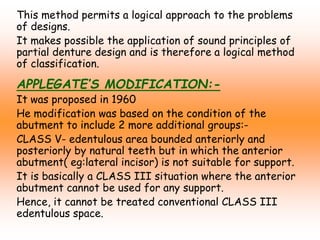
APPLEGATE’S MODIFICATION:-
It was proposed in 1960
He modification was based on the condition of the
abutment to include 2 more additional groups:-
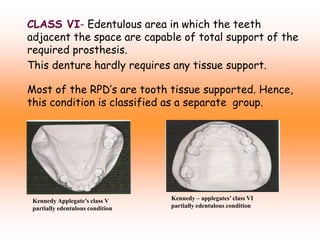
CLASS V- edentulous area bounded anteriorly and
posteriorly by natural teeth but in which the anterior
abutment( eg:lateral incisor) is not suitable for support.
It is basically a CLASS III situation where the anterior
abutment cannot be used for any support.
Hence, it cannot be treated conventional CLASS III
edentulous space.
CLASS VI- Edentulous area in which the teeth
adjacent the space are capable of total support of the
required prosthesis.
This denture hardly requires any tissue support.
Most of the RPD’s are tooth tissue supported. Hence,
this condition is classified as a separate group.
Kennedy Applegate’s class V
partially edentulous condition
Kennedy – applegates’ class VI
partially edentulous condition
CLASSIFICATION OF RPD.ppt

CLASSIFICATION OF RPD.ppt

  • 1.
    Dr. Ibadat Jamil Assistantprofessor Dep. Of Prothodontics
  • 2.
    CLASSIFICATION OF PARTIAL EDENTULOUSARCHES Removable prosthodontics is defined as the replacement of missing teeth and supporting tissue with a prosthesis designed to be removed by the wearer. It can be broadly classified as : 1. Removable complete denture prosthodontics 2. Removable partial denture prosthodontics • Extra coronal • Intra coronal
  • 3.
    • RATIONALE:- • Classificationof partially edentulous arch should be done for the following reasons:-  To formulate a good treatment plan  To anticipate the difficulties commonly to occur for that particular design To communicate with a professional about a case. To design a denture according to the occlusal load usually expected for a particular group
  • 4.
    REQUIREMENTS OF ACLASSIFICATION:- A classification must satisfy the following norms:-  Allow visualization of the type of partially edentulous arch that is being considered.  Allow differentiation between tooth supported and tissue supported partial dentures  Serve as a guide to the type of design to be used  Be universally accepted there are many classifications available for classifying edentulous arches, the most common ones are:-
  • 5.
    1. CUMMER’S CLASSIFICATION 2.KENNEDY’S CLASSIFICATION 3. BAILYN’S CLASSIFICATION 4. NEUROHR’S CLASSIFICATION 5. MAUK’S CLASSIFCATION 6. WILD’S CLASSIFICATION 7. GODFREY’S CLASSIFICTION 8. FRIEDMAN’S CLASSIFICATION 9. BECKETT AND WILSON’S CLASSIFICTION 10. CRADDOCK’S CLASSIFICATION 11. SKINNER’S CLASSIFICATION 12. AUSTIN AND LIDGE’S CLASSIFICATION 13. WATT et al CLASSIFICATION 14. APPLEGATE’S CLASSIFICATION OR KENNEDY-APPLEGATE CLASSIFICATION 15. SWENSON’S CLASSIFICATION 16. AVANT’S CLASSIFICATION 17. COSTA’S CLASSIFICATION 18. OSBORNE AND LAMMIE’S CLASSIFICATION
  • 6.
    CUMMER’S CLASSIFICATION:- This isthe first professionally recognized classification. It was introduced by CUMMER (1920) According to him,partial dentures can be classified into 4 types based on the position of the direct retainers:- He sited various possible saddle positions as the basis of his classification. Cummer’s Diagonally retained removable partial denture Cummer’s diametric removable partial denture Cummer’s unilateral removable partial denture Cummer’s multilateral triangular removable partial denture Cummer’s multilateral quadiangular removable partial denture
  • 7.
    BAILYN’S CLASSIFICATION:- Proposed byBAILYN. It was the first classification to give importance to support of partial dentures by remaining tissues. Bailyn’P1 partially edentulous condition Bailyn’s P2 partially edentulous condition Bailyn’s P3 partially edentulous condition Bailyn’s A3 partially edentulous condition
  • 8.
    • A: anteriorrestorations, where there are saddle areas anterior to the first bicuspid (premolars) • P: Posterior restorations, where there are saddle areas posterior to the canine. Further they are sub-classified as follows: • Class I: Bounded saddle (not more than three teeth missing). • Class 2: Free end saddle (there is no distal abutment tooth). • Class 3 : bounded saddle (more than three teeth missing) Bailyn’s A1P2 partially edentulous condition P1P2 partially edentulous condition Bailyn’s A1P2P3 partially edentulous condition
  • 9.
    NEUROHR’S CLASSIFICATION:- Proposed byNEUROHR(1939) Based on the support derived. DISADVANTAGE:-it is not commonly used due to it’s unnecessary complexity. MAUK’S CLASSIFICATION:- Proposed by MAUK(1942) Based on number,length and position of the edentulous spaces and the number and position of the remaining teeth.
  • 10.
    Bilateral space withno teeth posterior to it Bilateral space with teeth present posterior to one space Class III : Bilateral space with teeth present posterior to both spaces Class IV : Unilateral space with no teeth posterio to it. The opposing arch is unbroken Class V : Anterior space with unbroken posterior arches on both sides Class VI : Irregular spaces around the arch. The remaining teeth are single or in small groups
  • 11.
    WILD’S CLASSIFICATION:-. Proposed asimple yet self explanatory classification. It is not very well known in english dental literature. Class I: Interruption of the dental arch (I.e. bounded) Class II shortening of the dental arch (I.e.) free-end Class III : Combination of 1 and 2
  • 12.
    GODFREY’S CLASSIFICATION: Proposed in 1951. Basedon the location and size of the edentulous space. Godfrey’s class B partially edentulous condition Godfrey’s class C partially edentulous condition Godfrey’s class A partially edentulous condition Godfrey’s class D partially edentulous condition
  • 13.
    FRIEDMAN’S CLASSIFICATION:-. He introducedthe ‘ABC’ classification in 1953. A-anterior. B-bounded posterior. C-cantilever. Friedman’s type A partially edentulous condition Friedmans’s type B partially edentulous condition Friedman’s type C partially edentulous condition
  • 14.
    BECKETT AND WILSON’S CLASSIFICATION:-. Beckett(1953)and Wilson(1957) based their ideas on Bailyn’s classification(1928). CRADDOCK’S CLASSIFICATION:- Craddock proposed his classification in 1954 He classified partial dentures as:- SKINNER’S CLASSIFICATION:- He introduced the classification in 1959. His classification was influenced by Cummer’s classification.
  • 15.
    AUSTIN AND LIDGE CLASSIFICATION:- Itwas proposed in 1957 They suggested a classification that described the position of the teeth. WATT et al CLASSIFICATION:- He proposed the classification in 1958 It was based on the type of support derived. SWENSON’S CLASSIFICATION:- It is a simple classification proposed by Swenson and Terkla(1955) It was not widely used. It is similar to Kennedy’s classification.
  • 16.
    AVANT’S CLASSIFICATION:- It wasproposed in 1966 The classification was based on the anterior and posterior segments of the arch. It resembled Kennedy’ s classification without any improvements. COSTA’S CLASSIFICATION:- Proposed in 1974 It was based on the anterior, lateral and terminal spaces. OSBORNE’S AND LAMMIE’S CLASSIFICATION:- It was proposed in 1974 It is similar to Watt et al’s classification,.
  • 17.
    Kennedy’s Class Ipartially edentulous condition Kennedy’s class II partially edentulous condition Kennedy’s Class III partially edentulous condition Kennedy’s class IV partially edentulous condition KENNEDY’S CLASSIFICATION:- Kennedy’s classification was originally proposed by Dr. Edward Kennedy(1925) Kennedy divided all partially edentulous arches into 4 basic classes. Edentulous areas other than those determining the basic classes were designated as modification spaces.
  • 18.
    The following isthe Kennedy’s classification:- CLASS I- bilateral edentulous area located posterior to the natural teeth. CLASS II- unilateral edentulous area located posterior to the remaining natural teeth. CLASS III- unilateral edentulous area with natural teeth remaining both anterior and posterior to it. CLASS IV- single but bilateral(crossing the midline), edentulous area located anterior to the remaining natural teeth. ADVANTAGES:- Advantages of the Kennedy’s method is that it permits immediate visualization of the partially edentulous arches and allow easy distinction between tooth supported versus tooth and tissue supported prostheses.
  • 19.
    This method permitsa logical approach to the problems of designs. It makes possible the application of sound principles of partial denture design and is therefore a logical method of classification. APPLEGATE’S MODIFICATION:- It was proposed in 1960 He modification was based on the condition of the abutment to include 2 more additional groups:- CLASS V- edentulous area bounded anteriorly and posteriorly by natural teeth but in which the anterior abutment( eg:lateral incisor) is not suitable for support. It is basically a CLASS III situation where the anterior abutment cannot be used for any support. Hence, it cannot be treated conventional CLASS III edentulous space.
  • 20.
    CLASS VI- Edentulousarea in which the teeth adjacent the space are capable of total support of the required prosthesis. This denture hardly requires any tissue support. Most of the RPD’s are tooth tissue supported. Hence, this condition is classified as a separate group. Kennedy Applegate’s class V partially edentulous condition Kennedy – applegates’ class VI partially edentulous condition