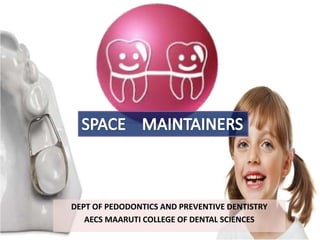
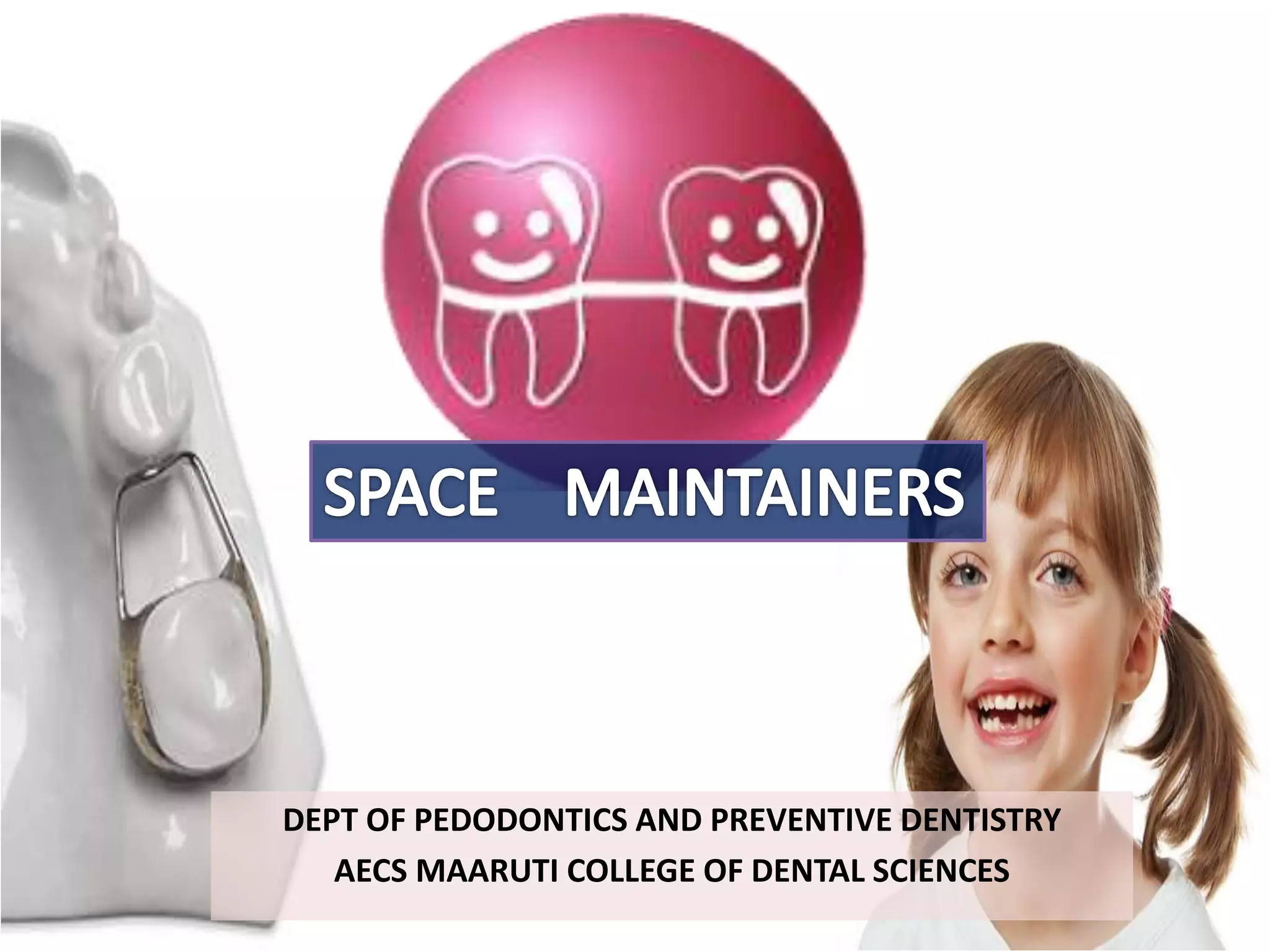
DEPT OF PEDODONTICS AND PREVENTIVE DENTISTRY
AECS MAARUTI COLLEGE OF DENTAL SCIENCES
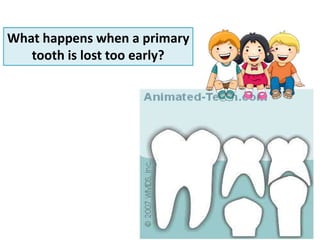
What happens when a primary
tooth is lost too early?
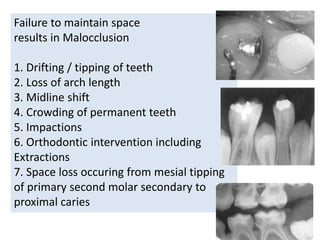
Failure to maintain space
results in Malocclusion
1. Drifting / tipping of teeth
2. Loss of arch length
3. Midline shift
4. Crowding of permanent teeth
5. Impactions
6. Orthodontic intervention including
Extractions
7. Space loss occuring from mesial tipping
of primary second molar secondary to
proximal caries
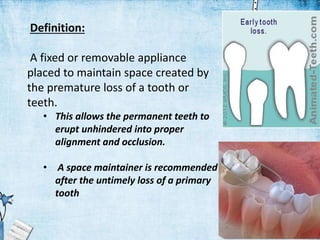
Definition:
A fixed or removable appliance
placed to maintain space created by
the premature loss of a tooth or
teeth.
• This allows the permanent teeth to
erupt unhindered into proper
alignment and occlusion.
• A space maintainer is recommended
after the untimely loss of a primary
tooth
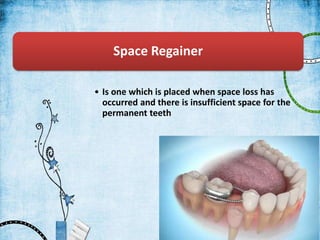
Space Regainer
• Is one which is placed when space loss has
occurred and there is insufficient space for the
permanent teeth
Requirements of Space maintainers
• Should maintain desired proximal dimensions of space created by
loss of teeth
• Should be functional
• Should not interfere with eruption of opposing tooth
• Should not interfere with eruption of erupting teeth
• Should not interfere with speech or mastication
• Should be simple and strong
• Should not impose excessive stress on adjacent tooth
• Easily cleansable
• Should not restrict normal growth and function
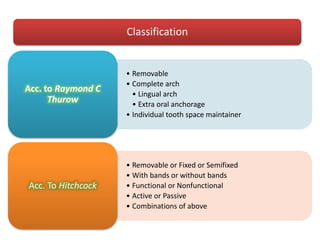
Classification
• Removable
• Complete arch
• Lingual arch
• Extra oral anchorage
• Individual tooth space maintainer
Acc. to Raymond C
Thurow
• Removable or Fixed or Semifixed
• With bands or without bands
• Functional or Nonfunctional
• Active or Passive
• Combinations of above
Acc. To Hitchcock
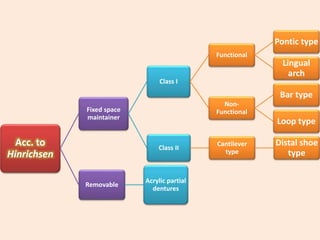
Acc. to
Hinrichsen
Fixed space
maintainer
Class I
Functional
Pontic type
Lingual
arch
Non-
Functional
Bar type
Loop type
Class II
Cantilever
type
Distal shoe
type
Removable
Acrylic partial
dentures
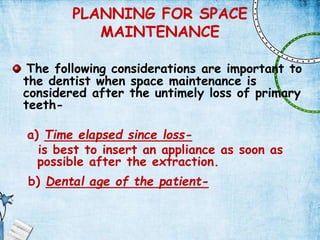
PLANNING FOR SPACE
MAINTENANCE
The following considerations are important to
the dentist when space maintenance is
considered after the untimely loss of primary
teeth-
a) Time elapsed since loss-
is best to insert an appliance as soon as
possible after the extraction.
b) Dental age of the patient-
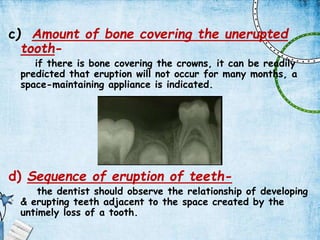
c) Amount of bone covering the unerupted
tooth-
if there is bone covering the crowns, it can be readily
predicted that eruption will not occur for many months, a
space-maintaining appliance is indicated.
d) Sequence of eruption of teeth-
the dentist should observe the relationship of developing
& erupting teeth adjacent to the space created by the
untimely loss of a tooth.
e) Delayed eruption of the permanent tooth-
in case of impacted permanent tooth,it
is necessary to extract the primary
tooth,construct a space maintainer & allow the
permanent tooth to erupt at its normal position.
f) Congenital absence of the permanent tooth-
• Easy to clean
• Maintains and restores vertical
dimension
• Can be used in combination with other
preventive measures
• Worn part time – maintaining
circulation to soft tissues
• Stimulates eruption of permanent
teeth
• Band construction is not necessary
• Room can be made for erupting
permanent teeth with out changing the
appliance
• may be lost or broken
• May not wear the
appliance
• Lateral jaw growth may be
affected
• May irritate the
underlying tissue
Removable space maintainer
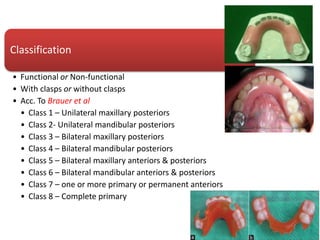
Classification
• Functional or Non-functional
• With clasps or without clasps
• Acc. To Brauer et al
• Class 1 – Unilateral maxillary posteriors
• Class 2- Unilateral mandibular posteriors
• Class 3 – Bilateral maxillary posteriors
• Class 4 – Bilateral mandibular posteriors
• Class 5 – Bilateral maxillary anteriors & posteriors
• Class 6 – Bilateral mandibular anteriors & posteriors
• Class 7 – one or more primary or permanent anteriors
• Class 8 – Complete primary
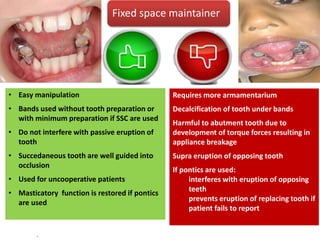
Fixed space maintainer
.
• Easy manipulation
• Bands used without tooth preparation or
with minimum preparation if SSC are used
• Do not interfere with passive eruption of
tooth
• Succedaneous tooth are well guided into
occlusion
• Used for uncooperative patients
• Masticatory function is restored if pontics
are used
Requires more armamentarium
Decalcification of tooth under bands
Harmful to abutment tooth due to
development of torque forces resulting in
appliance breakage
Supra eruption of opposing tooth
If pontics are used:
interferes with eruption of opposing
teeth
prevents eruption of replacing tooth if
patient fails to report
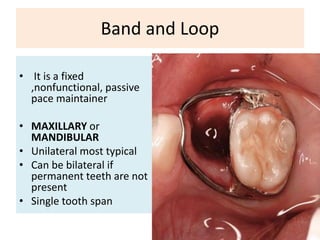
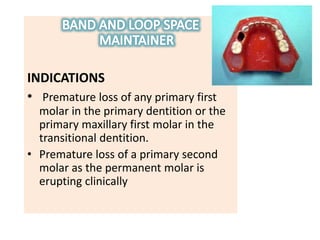
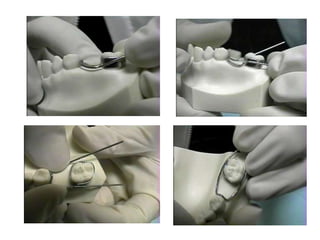
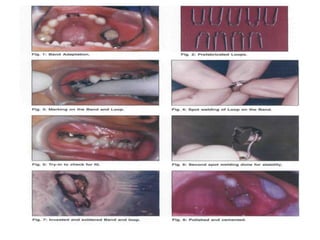
Band and Loop
• It is a fixed
,nonfunctional, passive
pace maintainer
• MAXILLARY or
MANDIBULAR
• Unilateral most typical
• Can be bilateral if
permanent teeth are not
present
• Single tooth span
INDICATIONS
• Premature loss of any primary first
molar in the primary dentition or the
primary maxillary first molar in the
transitional dentition.
• Premature loss of a primary second
molar as the permanent molar is
erupting clinically
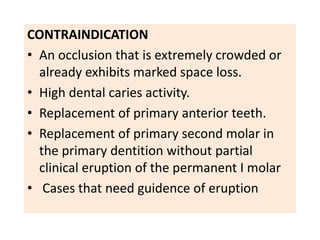
CONTRAINDICATION
• An occlusion that is extremely crowded or
already exhibits marked space loss.
• High dental caries activity.
• Replacement of primary anterior teeth.
• Replacement of primary second molar in
the primary dentition without partial
clinical eruption of the permanent I molar
• Cases that need guidence of eruption
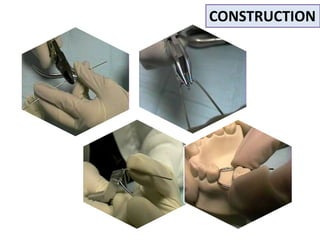
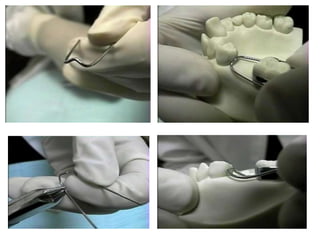
CONSTRUCTION
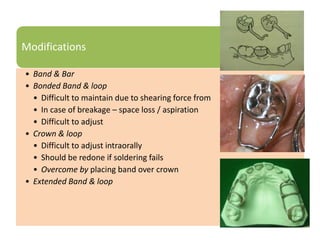
Modifications
• Band & Bar
• Bonded Band & loop
• Difficult to maintain due to shearing force from occlusion
• In case of breakage – space loss / aspiration
• Difficult to adjust
• Crown & loop
• Difficult to adjust intraorally
• Should be redone if soldering fails
• Overcome by placing band over crown
• Extended Band & loop
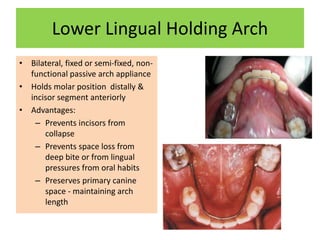
Lower Lingual Holding Arch
• Bilateral, fixed or semi-fixed, non-
functional passive arch appliance
• Holds molar position distally &
incisor segment anteriorly
• Advantages:
– Prevents incisors from
collapse
– Prevents space loss from
deep bite or from lingual
pressures from oral habits
– Preserves primary canine
space - maintaining arch
length
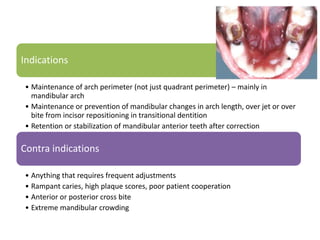
Indications
• Maintenance of arch perimeter (not just quadrant perimeter) – mainly in
mandibular arch
• Maintenance or prevention of mandibular changes in arch length, over jet or over
bite from incisor repositioning in transitional dentition
• Retention or stabilization of mandibular anterior teeth after correction
Contra indications
• Anything that requires frequent adjustments
• Rampant caries, high plaque scores, poor patient cooperation
• Anterior or posterior cross bite
• Extreme mandibular crowding
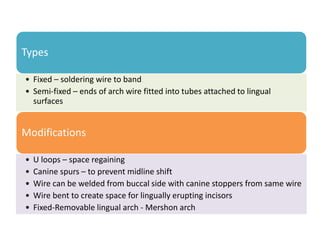
Types
• Fixed – soldering wire to band
• Semi-fixed – ends of arch wire fitted into tubes attached to lingual
surfaces
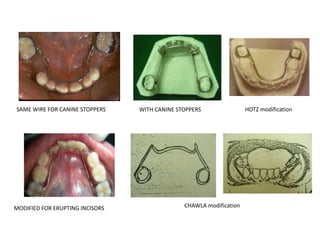
Modifications
• U loops – space regaining
• Canine spurs – to prevent midline shift
• Wire can be welded from buccal side with canine stoppers from same wire
• Wire bent to create space for lingually erupting incisors
• Fixed-Removable lingual arch - Mershon arch
SAME WIRE FOR CANINE STOPPERS WITH CANINE STOPPERS
MODIFIED FOR ERUPTING INCISORS CHAWLA modification
HOTZ modification
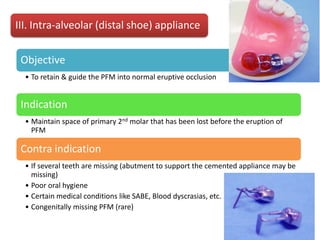
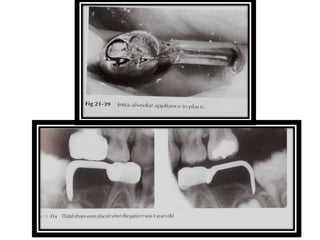
III. Intra-alveolar (distal shoe) appliance
Objective
• To retain & guide the PFM into normal eruptive occlusion
Indication
• Maintain space of primary 2nd molar that has been lost before the eruption of
PFM
Contra indication
• If several teeth are missing (abutment to support the cemented appliance may be
missing)
• Poor oral hygiene
• Certain medical conditions like SABE, Blood dyscrasias, etc.
• Congenitally missing PFM (rare)
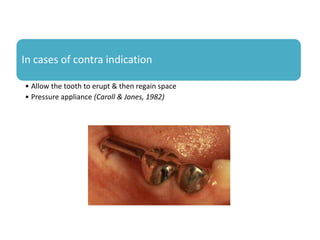
In cases of contra indication
• Allow the tooth to erupt & then regain space
• Pressure appliance (Caroll & Jones, 1982)
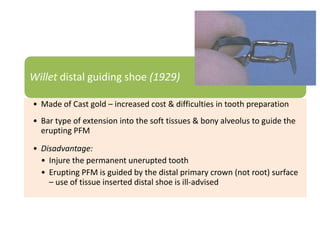
Willet distal guiding shoe (1929)
• Made of Cast gold – increased cost & difficulties in tooth preparation
• Bar type of extension into the soft tissues & bony alveolus to guide the
erupting PFM
• Disadvantage:
• Injure the permanent unerupted tooth
• Erupting PFM is guided by the distal primary crown (not root) surface
– use of tissue inserted distal shoe is ill-advised
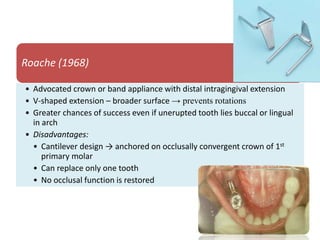
Roache (1968)
• Advocated crown or band appliance with distal intragingival extension
• V-shaped extension – broader surface → prevents rotations
• Greater chances of success even if unerupted tooth lies buccal or lingual
in arch
• Disadvantages:
• Cantilever design → anchored on occlusally convergent crown of 1st
primary molar
• Can replace only one tooth
• No occlusal function is restored
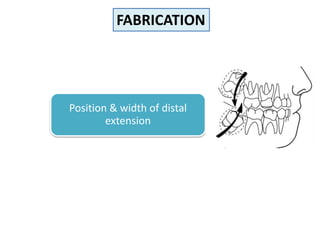
Position & width of distal
extension
FABRICATION
• If not removed before
A] Measuring the 2nd primary molar
• distance between distal surface of primary 1st molar & unerupted
PFM (if already missing)
• May force the tooth to erupt too far distally (if fabricated at 3 to 4
years of age) → disto-occlusion of molars
B] Measured from the radiograph
Length of distal extension (horizontal bar)
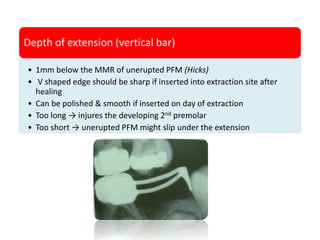
Depth of extension (vertical bar)
• 1mm below the MMR of unerupted PFM (Hicks)
• V shaped edge should be sharp if inserted into extraction site after
healing
• Can be polished & smooth if inserted on day of extraction
• Too long → injures the developing 2nd premolar
• Too short → unerupted PFM might slip under the extension
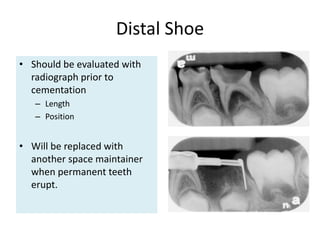
Distal Shoe
• Should be evaluated with
radiograph prior to
cementation
– Length
– Position
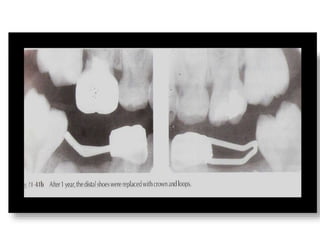
• Will be replaced with
another space maintainer
when permanent teeth
erupt.
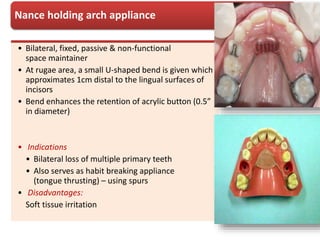
• Bilateral, fixed, passive & non-functional
space maintainer
• At rugae area, a small U-shaped bend is given which
approximates 1cm distal to the lingual surfaces of
incisors
• Bend enhances the retention of acrylic button (0.5”
in diameter)
• Indications
• Bilateral loss of multiple primary teeth
• Also serves as habit breaking appliance
(tongue thrusting) – using spurs
• Disadvantages:
Soft tissue irritation
Nance holding arch appliance
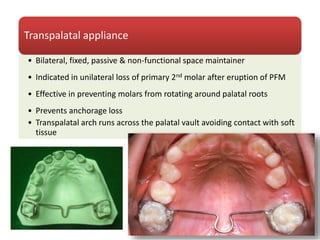
Transpalatal appliance
• Bilateral, fixed, passive & non-functional space maintainer
• Indicated in unilateral loss of primary 2nd molar after eruption of PFM
• Effective in preventing molars from rotating around palatal roots
• Prevents anchorage loss
• Transpalatal arch runs across the palatal vault avoiding contact with soft
tissue
Space Regainers
• Active space maintainers – brings about active tooth movement
• Removable or fixed; unilateral or bilateral
• Indication: need to re-establish about 3mm or less of space
• Easy to regain space in maxilla than in mandible
• Increased anchorage provided by palatal vault
• Maxilla – cancellous bone; Mandible – cortical bone
• Types:
• Removable – Hawleys appliance; Head gear
• Fixed - Gerber space regainer; Jackscrew space regainer
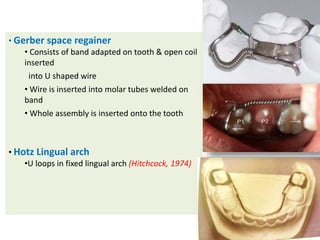
• Gerber space regainer
• Consists of band adapted on tooth & open coil
inserted
into U shaped wire
• Wire is inserted into molar tubes welded on
band
• Whole assembly is inserted onto the tooth
• Hotz Lingual arch
•U loops in fixed lingual arch (Hitchcock, 1974)
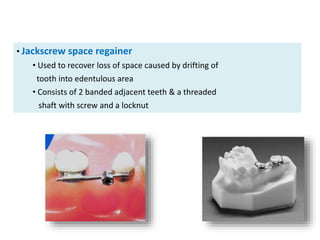
• Jackscrew space regainer
• Used to recover loss of space caused by drifting of
tooth into edentulous area
• Consists of 2 banded adjacent teeth & a threaded
shaft with screw and a locknut
Removable space regainer
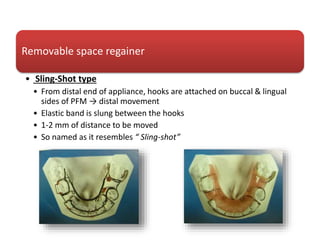
• Sling-Shot type
• From distal end of appliance, hooks are attached on buccal & lingual
sides of PFM → distal movement
• Elastic band is slung between the hooks
• 1-2 mm of distance to be moved
• So named as it resembles “ Sling-shot”
Removable space regainer
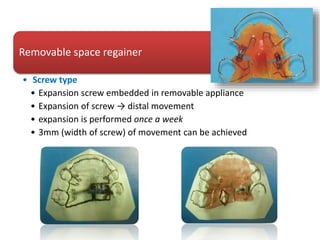
• Screw type
• Expansion screw embedded in removable appliance
• Expansion of screw → distal movement
• expansion is performed once a week
• 3mm (width of screw) of movement can be achieved
Removable space regainer
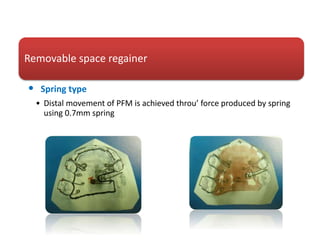
• Spring type
• Distal movement of PFM is achieved throu’ force produced by spring
using 0.7mm spring
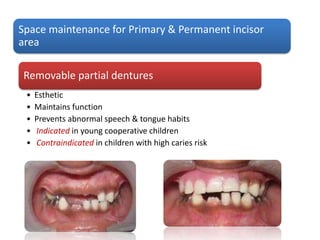
Removable partial dentures
• Esthetic
• Maintains function
• Prevents abnormal speech & tongue habits
• Indicated in young cooperative children
• Contraindicated in children with high caries risk
Space maintenance for Primary & Permanent incisor
area
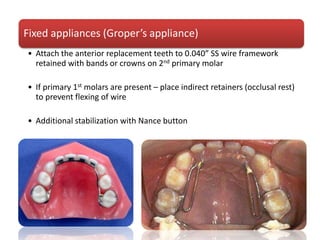
Fixed appliances (Groper’s appliance)
• Attach the anterior replacement teeth to 0.040” SS wire framework
retained with bands or crowns on 2nd primary molar
• If primary 1st molars are present – place indirect retainers (occlusal rest)
to prevent flexing of wire
• Additional stabilization with Nance button
Bonded space maintainer
• Overcome problems of
• Multiple visit
• Loosening of bands
• Decalcification of abutment tooth
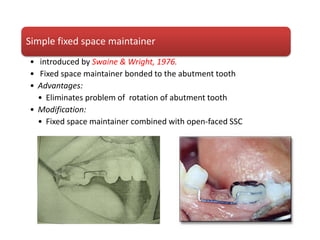
Simple fixed space maintainer
• introduced by Swaine & Wright, 1976.
• Fixed space maintainer bonded to the abutment tooth
• Advantages:
• Eliminates problem of rotation of abutment tooth
• Modification:
• Fixed space maintainer combined with open-faced SSC
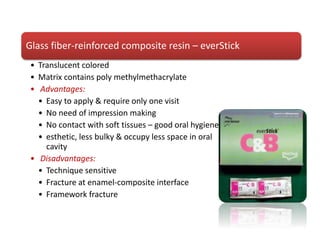
Glass fiber-reinforced composite resin – everStick
• Translucent colored
• Matrix contains poly methylmethacrylate
• Advantages:
• Easy to apply & require only one visit
• No need of impression making
• No contact with soft tissues – good oral hygiene
• esthetic, less bulky & occupy less space in oral
cavity
• Disadvantages:
• Technique sensitive
• Fracture at enamel-composite interface
• Framework fracture
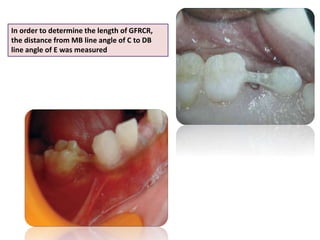
In order to determine the length of GFRCR,
the distance from MB line angle of C to DB
line angle of E was measured
CONCLUSION

Space maintainers

  • 1.
    DEPT OF PEDODONTICSAND PREVENTIVE DENTISTRY AECS MAARUTI COLLEGE OF DENTAL SCIENCES
  • 3.
    What happens whena primary tooth is lost too early?
  • 4.
    Failure to maintainspace results in Malocclusion 1. Drifting / tipping of teeth 2. Loss of arch length 3. Midline shift 4. Crowding of permanent teeth 5. Impactions 6. Orthodontic intervention including Extractions 7. Space loss occuring from mesial tipping of primary second molar secondary to proximal caries
  • 5.
    Definition: A fixed orremovable appliance placed to maintain space created by the premature loss of a tooth or teeth. • This allows the permanent teeth to erupt unhindered into proper alignment and occlusion. • A space maintainer is recommended after the untimely loss of a primary tooth
  • 6.
    Space Regainer • Isone which is placed when space loss has occurred and there is insufficient space for the permanent teeth
  • 8.
    Requirements of Spacemaintainers • Should maintain desired proximal dimensions of space created by loss of teeth • Should be functional • Should not interfere with eruption of opposing tooth • Should not interfere with eruption of erupting teeth • Should not interfere with speech or mastication • Should be simple and strong • Should not impose excessive stress on adjacent tooth • Easily cleansable • Should not restrict normal growth and function
  • 9.
    Classification • Removable • Completearch • Lingual arch • Extra oral anchorage • Individual tooth space maintainer Acc. to Raymond C Thurow • Removable or Fixed or Semifixed • With bands or without bands • Functional or Nonfunctional • Active or Passive • Combinations of above Acc. To Hitchcock
  • 10.
    Acc. to Hinrichsen Fixed space maintainer ClassI Functional Pontic type Lingual arch Non- Functional Bar type Loop type Class II Cantilever type Distal shoe type Removable Acrylic partial dentures
  • 11.
    PLANNING FOR SPACE MAINTENANCE Thefollowing considerations are important to the dentist when space maintenance is considered after the untimely loss of primary teeth- a) Time elapsed since loss- is best to insert an appliance as soon as possible after the extraction. b) Dental age of the patient-
  • 12.
    c) Amount ofbone covering the unerupted tooth- if there is bone covering the crowns, it can be readily predicted that eruption will not occur for many months, a space-maintaining appliance is indicated. d) Sequence of eruption of teeth- the dentist should observe the relationship of developing & erupting teeth adjacent to the space created by the untimely loss of a tooth.
  • 13.
    e) Delayed eruptionof the permanent tooth- in case of impacted permanent tooth,it is necessary to extract the primary tooth,construct a space maintainer & allow the permanent tooth to erupt at its normal position. f) Congenital absence of the permanent tooth-
  • 14.
    • Easy toclean • Maintains and restores vertical dimension • Can be used in combination with other preventive measures • Worn part time – maintaining circulation to soft tissues • Stimulates eruption of permanent teeth • Band construction is not necessary • Room can be made for erupting permanent teeth with out changing the appliance • may be lost or broken • May not wear the appliance • Lateral jaw growth may be affected • May irritate the underlying tissue Removable space maintainer
  • 15.
    Classification • Functional orNon-functional • With clasps or without clasps • Acc. To Brauer et al • Class 1 – Unilateral maxillary posteriors • Class 2- Unilateral mandibular posteriors • Class 3 – Bilateral maxillary posteriors • Class 4 – Bilateral mandibular posteriors • Class 5 – Bilateral maxillary anteriors & posteriors • Class 6 – Bilateral mandibular anteriors & posteriors • Class 7 – one or more primary or permanent anteriors • Class 8 – Complete primary
  • 16.
    Fixed space maintainer . •Easy manipulation • Bands used without tooth preparation or with minimum preparation if SSC are used • Do not interfere with passive eruption of tooth • Succedaneous tooth are well guided into occlusion • Used for uncooperative patients • Masticatory function is restored if pontics are used Requires more armamentarium Decalcification of tooth under bands Harmful to abutment tooth due to development of torque forces resulting in appliance breakage Supra eruption of opposing tooth If pontics are used: interferes with eruption of opposing teeth prevents eruption of replacing tooth if patient fails to report
  • 17.
    Band and Loop •It is a fixed ,nonfunctional, passive pace maintainer • MAXILLARY or MANDIBULAR • Unilateral most typical • Can be bilateral if permanent teeth are not present • Single tooth span
  • 18.
    INDICATIONS • Premature lossof any primary first molar in the primary dentition or the primary maxillary first molar in the transitional dentition. • Premature loss of a primary second molar as the permanent molar is erupting clinically
  • 19.
    CONTRAINDICATION • An occlusionthat is extremely crowded or already exhibits marked space loss. • High dental caries activity. • Replacement of primary anterior teeth. • Replacement of primary second molar in the primary dentition without partial clinical eruption of the permanent I molar • Cases that need guidence of eruption
  • 20.
  • 24.
    Modifications • Band &Bar • Bonded Band & loop • Difficult to maintain due to shearing force from occlusion • In case of breakage – space loss / aspiration • Difficult to adjust • Crown & loop • Difficult to adjust intraorally • Should be redone if soldering fails • Overcome by placing band over crown • Extended Band & loop
  • 25.
    Lower Lingual HoldingArch • Bilateral, fixed or semi-fixed, non- functional passive arch appliance • Holds molar position distally & incisor segment anteriorly • Advantages: – Prevents incisors from collapse – Prevents space loss from deep bite or from lingual pressures from oral habits – Preserves primary canine space - maintaining arch length
  • 26.
    Indications • Maintenance ofarch perimeter (not just quadrant perimeter) – mainly in mandibular arch • Maintenance or prevention of mandibular changes in arch length, over jet or over bite from incisor repositioning in transitional dentition • Retention or stabilization of mandibular anterior teeth after correction Contra indications • Anything that requires frequent adjustments • Rampant caries, high plaque scores, poor patient cooperation • Anterior or posterior cross bite • Extreme mandibular crowding
  • 27.
    Types • Fixed –soldering wire to band • Semi-fixed – ends of arch wire fitted into tubes attached to lingual surfaces Modifications • U loops – space regaining • Canine spurs – to prevent midline shift • Wire can be welded from buccal side with canine stoppers from same wire • Wire bent to create space for lingually erupting incisors • Fixed-Removable lingual arch - Mershon arch
  • 28.
    SAME WIRE FORCANINE STOPPERS WITH CANINE STOPPERS MODIFIED FOR ERUPTING INCISORS CHAWLA modification HOTZ modification
  • 29.
    III. Intra-alveolar (distalshoe) appliance Objective • To retain & guide the PFM into normal eruptive occlusion Indication • Maintain space of primary 2nd molar that has been lost before the eruption of PFM Contra indication • If several teeth are missing (abutment to support the cemented appliance may be missing) • Poor oral hygiene • Certain medical conditions like SABE, Blood dyscrasias, etc. • Congenitally missing PFM (rare)
  • 30.
    In cases ofcontra indication • Allow the tooth to erupt & then regain space • Pressure appliance (Caroll & Jones, 1982)
  • 31.
    Willet distal guidingshoe (1929) • Made of Cast gold – increased cost & difficulties in tooth preparation • Bar type of extension into the soft tissues & bony alveolus to guide the erupting PFM • Disadvantage: • Injure the permanent unerupted tooth • Erupting PFM is guided by the distal primary crown (not root) surface – use of tissue inserted distal shoe is ill-advised
  • 32.
    Roache (1968) • Advocatedcrown or band appliance with distal intragingival extension • V-shaped extension – broader surface → prevents rotations • Greater chances of success even if unerupted tooth lies buccal or lingual in arch • Disadvantages: • Cantilever design → anchored on occlusally convergent crown of 1st primary molar • Can replace only one tooth • No occlusal function is restored
  • 33.
    Position & widthof distal extension FABRICATION
  • 34.
    • If notremoved before A] Measuring the 2nd primary molar • distance between distal surface of primary 1st molar & unerupted PFM (if already missing) • May force the tooth to erupt too far distally (if fabricated at 3 to 4 years of age) → disto-occlusion of molars B] Measured from the radiograph Length of distal extension (horizontal bar)
  • 35.
    Depth of extension(vertical bar) • 1mm below the MMR of unerupted PFM (Hicks) • V shaped edge should be sharp if inserted into extraction site after healing • Can be polished & smooth if inserted on day of extraction • Too long → injures the developing 2nd premolar • Too short → unerupted PFM might slip under the extension
  • 36.
    Distal Shoe • Shouldbe evaluated with radiograph prior to cementation – Length – Position • Will be replaced with another space maintainer when permanent teeth erupt.
  • 40.
    • Bilateral, fixed,passive & non-functional space maintainer • At rugae area, a small U-shaped bend is given which approximates 1cm distal to the lingual surfaces of incisors • Bend enhances the retention of acrylic button (0.5” in diameter) • Indications • Bilateral loss of multiple primary teeth • Also serves as habit breaking appliance (tongue thrusting) – using spurs • Disadvantages: Soft tissue irritation Nance holding arch appliance
  • 41.
    Transpalatal appliance • Bilateral,fixed, passive & non-functional space maintainer • Indicated in unilateral loss of primary 2nd molar after eruption of PFM • Effective in preventing molars from rotating around palatal roots • Prevents anchorage loss • Transpalatal arch runs across the palatal vault avoiding contact with soft tissue
  • 42.
    Space Regainers • Activespace maintainers – brings about active tooth movement • Removable or fixed; unilateral or bilateral • Indication: need to re-establish about 3mm or less of space • Easy to regain space in maxilla than in mandible • Increased anchorage provided by palatal vault • Maxilla – cancellous bone; Mandible – cortical bone • Types: • Removable – Hawleys appliance; Head gear • Fixed - Gerber space regainer; Jackscrew space regainer
  • 43.
    • Gerber spaceregainer • Consists of band adapted on tooth & open coil inserted into U shaped wire • Wire is inserted into molar tubes welded on band • Whole assembly is inserted onto the tooth • Hotz Lingual arch •U loops in fixed lingual arch (Hitchcock, 1974)
  • 44.
    • Jackscrew spaceregainer • Used to recover loss of space caused by drifting of tooth into edentulous area • Consists of 2 banded adjacent teeth & a threaded shaft with screw and a locknut
  • 45.
    Removable space regainer •Sling-Shot type • From distal end of appliance, hooks are attached on buccal & lingual sides of PFM → distal movement • Elastic band is slung between the hooks • 1-2 mm of distance to be moved • So named as it resembles “ Sling-shot”
  • 46.
    Removable space regainer •Screw type • Expansion screw embedded in removable appliance • Expansion of screw → distal movement • expansion is performed once a week • 3mm (width of screw) of movement can be achieved
  • 47.
    Removable space regainer •Spring type • Distal movement of PFM is achieved throu’ force produced by spring using 0.7mm spring
  • 48.
    Removable partial dentures •Esthetic • Maintains function • Prevents abnormal speech & tongue habits • Indicated in young cooperative children • Contraindicated in children with high caries risk Space maintenance for Primary & Permanent incisor area
  • 49.
    Fixed appliances (Groper’sappliance) • Attach the anterior replacement teeth to 0.040” SS wire framework retained with bands or crowns on 2nd primary molar • If primary 1st molars are present – place indirect retainers (occlusal rest) to prevent flexing of wire • Additional stabilization with Nance button
  • 50.
    Bonded space maintainer •Overcome problems of • Multiple visit • Loosening of bands • Decalcification of abutment tooth
  • 51.
    Simple fixed spacemaintainer • introduced by Swaine & Wright, 1976. • Fixed space maintainer bonded to the abutment tooth • Advantages: • Eliminates problem of rotation of abutment tooth • Modification: • Fixed space maintainer combined with open-faced SSC
  • 52.
    Glass fiber-reinforced compositeresin – everStick • Translucent colored • Matrix contains poly methylmethacrylate • Advantages: • Easy to apply & require only one visit • No need of impression making • No contact with soft tissues – good oral hygiene • esthetic, less bulky & occupy less space in oral cavity • Disadvantages: • Technique sensitive • Fracture at enamel-composite interface • Framework fracture
  • 53.
    In order todetermine the length of GFRCR, the distance from MB line angle of C to DB line angle of E was measured
  • 54.