By
-Abhijit H Jadhav (Roll no 02)
*Karnaugh Map
 Introduction
 Sum Of Product
 Product of Sum
 Properties
 Types
 Two Variable
 Three Variable
 Rules
 Advantages and disadvantages
 Application
 Biblography
*
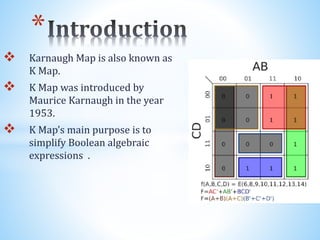
 Karnaugh Map is also known as
K Map.
 K Map was introduced by
Maurice Karnaugh in the year
1953.
 K Map’s main purpose is to
simplify Boolean algebraic
expressions .
*
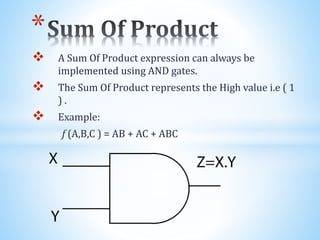
 A Sum Of Product expression can always be
implemented using AND gates.
 The Sum Of Product represents the High value i.e ( 1
) .
 Example:
f (A,B,C ) = AB + AC + ABC
*
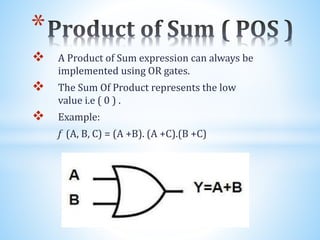
 A Product of Sum expression can always be
implemented using OR gates.
 The Sum Of Product represents the low
value i.e ( 0 ) .
 Example:
f (A, B, C) = (A +B). (A +C).(B +C)
*
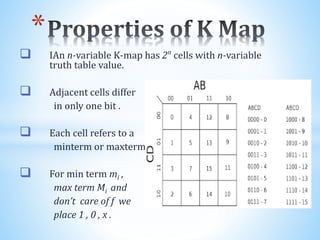
 IAn n-variable K-map has 2n
cells with n-variable
truth table value.
 Adjacent cells differ
in only one bit .
 Each cell refers to a
minterm or maxterm.
 For min term mi ,
max term Mi and
don’t care of f we
place 1 , 0 , x .
*
1. Groups may not include any cell containing a zero
2. Groups may be horizontal or vertical, but not
3. diagonal.
4. Groups must contain 1, 2, 4, 8, or in general 2n cells.
That is if n = 1, a group will contain two 1's since 21 =
2.
5. If n = 2, a group will contain four 1's since 22 = 4
6. Each group should be as large as possible.
7. Each cell containing a one must be in at least one
group
8. Groups may overlap
9. Groups may wrap around the table.
10. There should be as few groups as possible, as long as
this does not contradict any of the previous rules.
*
 K Map Having Two Variable.
 K map having three Variable.
*
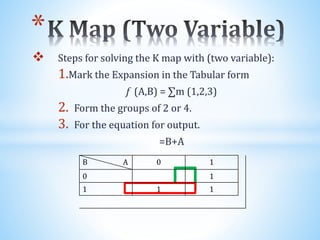
 Steps for solving the K map with (two variable):
1.Mark the Expansion in the Tabular form
f (A,B) = ∑m (1,2,3)
2. Form the groups of 2 or 4.
3. For the equation for output.
=B+A
*
B A 0 1
0 1
1 1 1
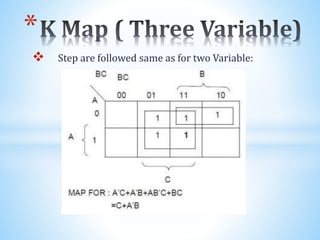
 Step are followed same as for two Variable:
*
 Data representation’s simplicity.
 Easy and Convenient to implement.
 Reduces the cost and quantity of logical gates.
 Less number of steps when compared to
algebraic minimization technique.
 Does not demand for the knowledge of boolean
algebraic theorems.
*
* Complexity of K-map simplification process increases
with the increase in the number of variables.
 Demonstrating concepts used in computer
Program to simplify large circuit.
 Visualizing concepts related to manupilating
Boolean alegebra
 Simplification of Half Adder and Full Adder
*
 www.wikipedia.org
 www.falstad.com
 www.microelectronics.com
 www.stelectronics.com
 www.IEEEsignalprocessing/Kmap
 www.falstad.com
*
K map

K map

  • 1.
    By -Abhijit H Jadhav(Roll no 02) *Karnaugh Map
  • 2.
     Introduction  SumOf Product  Product of Sum  Properties  Types  Two Variable  Three Variable  Rules  Advantages and disadvantages  Application  Biblography *
  • 3.
     Karnaugh Mapis also known as K Map.  K Map was introduced by Maurice Karnaugh in the year 1953.  K Map’s main purpose is to simplify Boolean algebraic expressions . *
  • 4.
     A SumOf Product expression can always be implemented using AND gates.  The Sum Of Product represents the High value i.e ( 1 ) .  Example: f (A,B,C ) = AB + AC + ABC *
  • 5.
     A Productof Sum expression can always be implemented using OR gates.  The Sum Of Product represents the low value i.e ( 0 ) .  Example: f (A, B, C) = (A +B). (A +C).(B +C) *
  • 6.
     IAn n-variableK-map has 2n cells with n-variable truth table value.  Adjacent cells differ in only one bit .  Each cell refers to a minterm or maxterm.  For min term mi , max term Mi and don’t care of f we place 1 , 0 , x . *
  • 7.
    1. Groups maynot include any cell containing a zero 2. Groups may be horizontal or vertical, but not 3. diagonal. 4. Groups must contain 1, 2, 4, 8, or in general 2n cells. That is if n = 1, a group will contain two 1's since 21 = 2. 5. If n = 2, a group will contain four 1's since 22 = 4 6. Each group should be as large as possible. 7. Each cell containing a one must be in at least one group 8. Groups may overlap 9. Groups may wrap around the table. 10. There should be as few groups as possible, as long as this does not contradict any of the previous rules. *
  • 8.
     K MapHaving Two Variable.  K map having three Variable. *
  • 9.
     Steps forsolving the K map with (two variable): 1.Mark the Expansion in the Tabular form f (A,B) = ∑m (1,2,3) 2. Form the groups of 2 or 4. 3. For the equation for output. =B+A * B A 0 1 0 1 1 1 1
  • 10.
     Step arefollowed same as for two Variable: *
  • 11.
     Data representation’ssimplicity.  Easy and Convenient to implement.  Reduces the cost and quantity of logical gates.  Less number of steps when compared to algebraic minimization technique.  Does not demand for the knowledge of boolean algebraic theorems. * * Complexity of K-map simplification process increases with the increase in the number of variables.
  • 12.
     Demonstrating conceptsused in computer Program to simplify large circuit.  Visualizing concepts related to manupilating Boolean alegebra  Simplification of Half Adder and Full Adder *
  • 13.
     www.wikipedia.org  www.falstad.com www.microelectronics.com  www.stelectronics.com  www.IEEEsignalprocessing/Kmap  www.falstad.com *