Application of Trigonometry
-Abhijit H Jadhav (Roll no 02 )
- Vasudev Bagal(Roll no 03 )
- Rupesh K Bandal(Roll no 04 )
“Mathematics may not teach us how to add love or minus
hate. But it gives us every reason to hope that every problem
has a solution.”
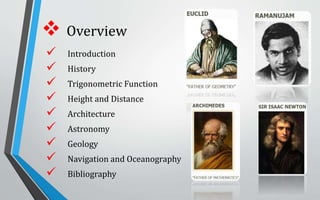
 Overview
 Introduction
 History
 Trigonometric Function
 Height and Distance
 Architecture
 Astronomy
 Geology
 Navigation and Oceanography
 Bibliography
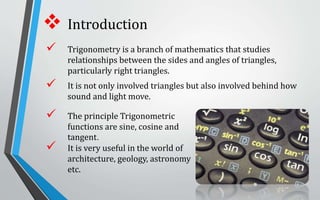
 Introduction
 Trigonometry is a branch of mathematics that studies
relationships between the sides and angles of triangles,
particularly right triangles.
 It is not only involved triangles but also involved behind how
sound and light move.
 The principle Trigonometric
functions are sine, cosine and
tangent.
 It is very useful in the world of
architecture, geology, astronomy
etc.
 History
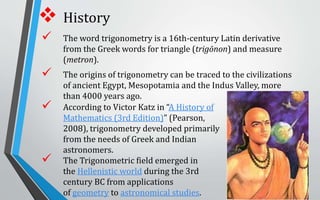
 The word trigonometry is a 16th-century Latin derivative
from the Greek words for triangle (trigōnon) and measure
(metron).
 The origins of trigonometry can be traced to the civilizations
of ancient Egypt, Mesopotamia and the Indus Valley, more
than 4000 years ago.
 According to Victor Katz in “A History of
Mathematics (3rd Edition)” (Pearson,
2008), trigonometry developed primarily
from the needs of Greek and Indian
astronomers.
 The Trigonometric field emerged in
the Hellenistic world during the 3rd
century BC from applications
of geometry to astronomical studies.
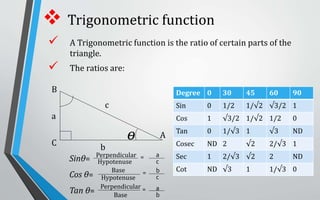
 A Trigonometric function is the ratio of certain parts of the
triangle.
 The ratios are:
 Trigonometric function
a
c
b
ө A
B
C
Sinθ=
Cos θ=
Tan θ=
Perpendicular
Base
Base
Perpendicular
Hypotenuse
Hypotenuse
=
=
= a
b
c
a
b
c
Degree 0 30 45 60 90
Sin 0 1/2 1/√2 √3/2 1
Cos 1 √3/2 1/√2 1/2 0
Tan 0 1/√3 1 √3 ND
Cosec ND 2 √2 2/√3 1
Sec 1 2/√3 √2 2 ND
Cot ND √3 1 1/√3 0
 Application of Trigonometry
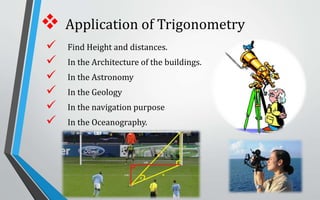
 Find Height and distances.
 In the Architecture of the buildings.
 In the Astronomy
 In the Geology
 In the navigation purpose
 In the Oceanography.
 Height and distances
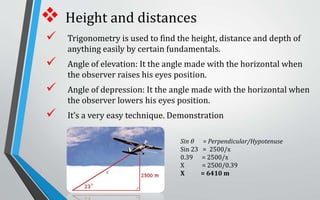
 Trigonometry is used to find the height, distance and depth of
anything easily by certain fundamentals.
 Angle of elevation: It the angle made with the horizontal when
the observer raises his eyes position.
 Angle of depression: It the angle made with the horizontal when
the observer lowers his eyes position.
 It’s a very easy technique. Demonstration
Sin θ = Perpendicular/Hypotenuse
Sin 23 = 2500/x
0.39 = 2500/x
X = 2500/0.39
X = 6410 m
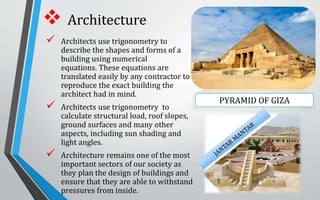
 Architecture
 Architects use trigonometry to
describe the shapes and forms of a
building using numerical
equations. These equations are
translated easily by any contractor to
reproduce the exact building the
architect had in mind.
 Architects use trigonometry to
calculate structural load, roof slopes,
ground surfaces and many other
aspects, including sun shading and
light angles.
 Architecture remains one of the most
important sectors of our society as
they plan the design of buildings and
ensure that they are able to withstand
pressures from inside.
PYRAMID OF GIZA
 Astronomy
 Trigonometry was used in astronomy since ancient time.
 Trigonometry is used to measure the distance to nearby stars.
 In 240 B.C , a mathematician named Eratosthenes discovered the
radius if the earth using trigonometry and geometry.
 In 2001, a group of European astronomers did an experiment to
find the distance of Venus from the Sun about 10,50,00,000 Km.
 Astronomers use the
method of parallax, or the
movement of the star against
the background as we orbit
the sun, to discover new
information about galaxies.
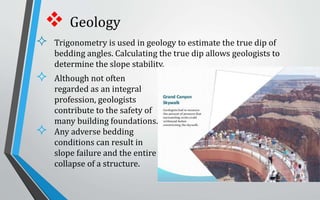
 Geology
 Trigonometry is used in geology to estimate the true dip of
bedding angles. Calculating the true dip allows geologists to
determine the slope stability.
 Although not often
regarded as an integral
profession, geologists
contribute to the safety of
many building foundations.
 Any adverse bedding
conditions can result in
slope failure and the entire
collapse of a structure.
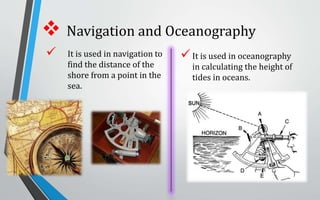
 Navigation and Oceanography
 It is used in navigation to
find the distance of the
shore from a point in the
sea.
It is used in oceanography
in calculating the height of
tides in oceans.
 Bibliography
 https://en.wikipedia.org/wiki/Trigonometry
 http://malini-math.blogspot.in
 http:// www.mathsisfun.com
 https:// www.mathwarehouse.com/trigonometry/
 https:// www.mathportal.org
 https:// www.analyzemath.com/Trigonometry
Applications of trignometry

Applications of trignometry

  • 1.
    Application of Trigonometry -AbhijitH Jadhav (Roll no 02 ) - Vasudev Bagal(Roll no 03 ) - Rupesh K Bandal(Roll no 04 ) “Mathematics may not teach us how to add love or minus hate. But it gives us every reason to hope that every problem has a solution.”
  • 2.
     Overview  Introduction History  Trigonometric Function  Height and Distance  Architecture  Astronomy  Geology  Navigation and Oceanography  Bibliography
  • 3.
     Introduction  Trigonometryis a branch of mathematics that studies relationships between the sides and angles of triangles, particularly right triangles.  It is not only involved triangles but also involved behind how sound and light move.  The principle Trigonometric functions are sine, cosine and tangent.  It is very useful in the world of architecture, geology, astronomy etc.
  • 4.
     History  Theword trigonometry is a 16th-century Latin derivative from the Greek words for triangle (trigōnon) and measure (metron).  The origins of trigonometry can be traced to the civilizations of ancient Egypt, Mesopotamia and the Indus Valley, more than 4000 years ago.  According to Victor Katz in “A History of Mathematics (3rd Edition)” (Pearson, 2008), trigonometry developed primarily from the needs of Greek and Indian astronomers.  The Trigonometric field emerged in the Hellenistic world during the 3rd century BC from applications of geometry to astronomical studies.
  • 5.
     A Trigonometricfunction is the ratio of certain parts of the triangle.  The ratios are:  Trigonometric function a c b ө A B C Sinθ= Cos θ= Tan θ= Perpendicular Base Base Perpendicular Hypotenuse Hypotenuse = = = a b c a b c Degree 0 30 45 60 90 Sin 0 1/2 1/√2 √3/2 1 Cos 1 √3/2 1/√2 1/2 0 Tan 0 1/√3 1 √3 ND Cosec ND 2 √2 2/√3 1 Sec 1 2/√3 √2 2 ND Cot ND √3 1 1/√3 0
  • 6.
     Application ofTrigonometry  Find Height and distances.  In the Architecture of the buildings.  In the Astronomy  In the Geology  In the navigation purpose  In the Oceanography.
  • 7.
     Height anddistances  Trigonometry is used to find the height, distance and depth of anything easily by certain fundamentals.  Angle of elevation: It the angle made with the horizontal when the observer raises his eyes position.  Angle of depression: It the angle made with the horizontal when the observer lowers his eyes position.  It’s a very easy technique. Demonstration Sin θ = Perpendicular/Hypotenuse Sin 23 = 2500/x 0.39 = 2500/x X = 2500/0.39 X = 6410 m
  • 8.
     Architecture  Architectsuse trigonometry to describe the shapes and forms of a building using numerical equations. These equations are translated easily by any contractor to reproduce the exact building the architect had in mind.  Architects use trigonometry to calculate structural load, roof slopes, ground surfaces and many other aspects, including sun shading and light angles.  Architecture remains one of the most important sectors of our society as they plan the design of buildings and ensure that they are able to withstand pressures from inside. PYRAMID OF GIZA
  • 9.
     Astronomy  Trigonometrywas used in astronomy since ancient time.  Trigonometry is used to measure the distance to nearby stars.  In 240 B.C , a mathematician named Eratosthenes discovered the radius if the earth using trigonometry and geometry.  In 2001, a group of European astronomers did an experiment to find the distance of Venus from the Sun about 10,50,00,000 Km.  Astronomers use the method of parallax, or the movement of the star against the background as we orbit the sun, to discover new information about galaxies.
  • 10.
     Geology  Trigonometryis used in geology to estimate the true dip of bedding angles. Calculating the true dip allows geologists to determine the slope stability.  Although not often regarded as an integral profession, geologists contribute to the safety of many building foundations.  Any adverse bedding conditions can result in slope failure and the entire collapse of a structure.
  • 11.
     Navigation andOceanography  It is used in navigation to find the distance of the shore from a point in the sea. It is used in oceanography in calculating the height of tides in oceans.
  • 12.
     Bibliography  https://en.wikipedia.org/wiki/Trigonometry http://malini-math.blogspot.in  http:// www.mathsisfun.com  https:// www.mathwarehouse.com/trigonometry/  https:// www.mathportal.org  https:// www.analyzemath.com/Trigonometry