By
-Abhijit H Jadhav (Roll no 02)
*Transformers:
Basics and Types
“ Transformers are the heart of the
alternating current system.”
- William Stanley Jr. .
* Overview
 Need of transformer
 Introduction
 History
 Principle
 Construction and Working
 Types of transformers
 Applications
 Auto transformer
 Bibliography
* Need of transformer
In most cases, appliances are manufactured to work under
some specific voltages. Transformers are used to adjust
the voltages to a proper level.
The transformers are the basic
components for the transmission of
the electricity.
 Transformer is used to increase the
voltage at the power generating
station(Step up) and used to decrease
the voltage(Step down) for house
hold purpose.
 By increasing the voltages the loss of the electricity in
the transmission purpose is minimized.
* Introduction
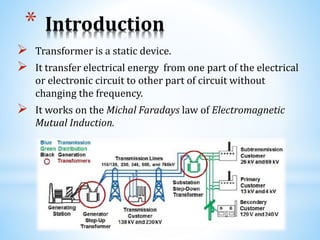
 Transformer is a static device.
 It transfer electrical energy from one part of the electrical
or electronic circuit to other part of circuit without
changing the frequency.
 It works on the Michal Faradays law of Electromagnetic
Mutual Induction.
* History
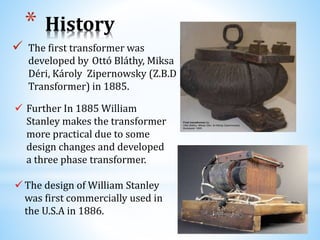
 The first transformer was
developed by Ottó Bláthy, Miksa
Déri, Károly Zipernowsky (Z.B.D
Transformer) in 1885.
 Further In 1885 William
Stanley makes the transformer
more practical due to some
design changes and developed
a three phase transformer.
 The design of William Stanley
was first commercially used in
the U.S.A in 1886.
* Principle
* It works on the principle of Electromagnetic Mutual
Induction.
Electromagnetic Mutual Induction:
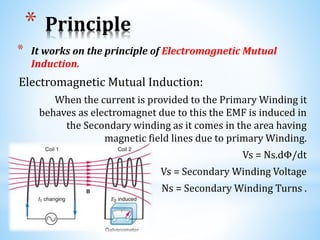
When the current is provided to the Primary Winding it
behaves as electromagnet due to this the EMF is induced in
the Secondary winding as it comes in the area having
magnetic field lines due to primary Winding.
Vs = Ns.dΦ/dt
Vs = Secondary Winding Voltage
Ns = Secondary Winding Turns .
* Construction
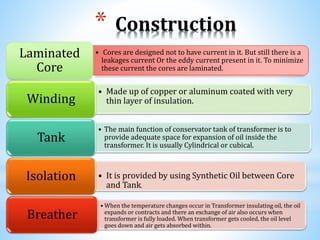
• Cores are designed not to have current in it. But still there is a
leakages current Or the eddy current present in it. To minimize
these current the cores are laminated.
Laminated
Core
• Made up of copper or aluminum coated with very
thin layer of insulation.Winding
• The main function of conservator tank of transformer is to
provide adequate space for expansion of oil inside the
transformer. It is usually Cylindrical or cubical.
Tank
• It is provided by using Synthetic Oil between Core
and Tank.
Isolation
• When the temperature changes occur in Transformer insulating oil, the oil
expands or contracts and there an exchange of air also occurs when
transformer is fully loaded. When transformer gets cooled, the oil level
goes down and air gets absorbed within.
Breather
* Types of Transformers
Transformer
Basis of
Construction
Core type
transformer
Shell type
transformer
Spiral core
transformer
Basis of Winding
Step up
transformer
Step down
transformer
Isolation
transformer
Basis of coolant
material used
Oil filled self
cooling
Oil filled
water cooling
Air blast
* Basis of construction
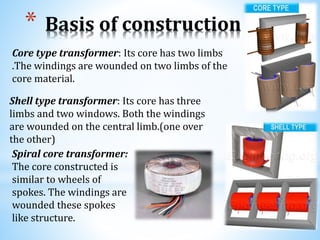
Core type transformer: Its core has two limbs
.The windings are wounded on two limbs of the
core material.
Shell type transformer: Its core has three
limbs and two windows. Both the windings
are wounded on the central limb.(one over
the other)
Spiral core transformer:
The core constructed is
similar to wheels of
spokes. The windings are
wounded these spokes
like structure.
* Basis of Windings
* Step up Transformer: The no of
windings on Primary side is less than
the no. of windings on the secondary
side.
Np < Ns
* Step down Transformer: The no. of
winding on Primary side are more
than the no. of windings on the
secondary side.
Np > Ns
* Isolation Transformer: The no. of
winding on Primary side are equal to
the no. of windings on the secondary
side.
Np = Ns
* Basis of coolant
*Oil filled self cooling: Oil filled self
cooled type uses small and medium-sized
distribution transformers. The assembled
windings and core of such transformers
are mounted in a welded, oil-tight steel
tanks provided with a steel cover.. The oil
helps in transferring the heat from the core
and the windings to the case from where it
is radiated out to the surroundings.
*Oil filled water cooled: This type is
used for much more economic
construction of large transformers. The
cooling coil is mounted near the surface of
the oil, through which cold water keeps
circulating. This water carries the heat
from the device.
*Air Blast: This type is used for
transformers that use voltages below
25,000 volts. The transformer is used at
houses.
* Applications
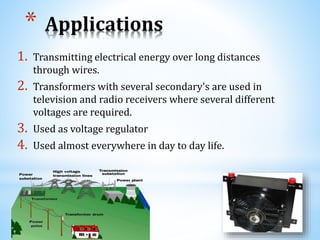
1. Transmitting electrical energy over long distances
through wires.
2. Transformers with several secondary's are used in
television and radio receivers where several different
voltages are required.
3. Used as voltage regulator
4. Used almost everywhere in day to day life.
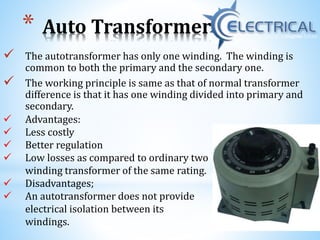
* Auto Transformer
 The autotransformer has only one winding. The winding is
common to both the primary and the secondary one.
 The working principle is same as that of normal transformer
difference is that it has one winding divided into primary and
secondary.
 Advantages:
 Less costly
 Better regulation
 Low losses as compared to ordinary two
winding transformer of the same rating.
 Disadvantages;
 An autotransformer does not provide
electrical isolation between its
windings.
 The secondary winding is not insulated from the primary
winding.
 Used only in the limited places where a slight variation of
the output voltage from input voltage is required.
 Applications
 It is used as a starter to give upto
50 to 60% of full voltage to the
stator of a squirrel cage induction
motor during starting.
 It is used to give a small boost to
a distribution cable, to correct
the voltage drop.
 Changing fan speed over a
narrow range.
 www.wikipedia.org/wiki/transformers
 www.cnet.com/transformers
 www.electricalengineeringinfo.com/transformers
 www.electrical4u.com/transformers
 www.electronics-tutorials.ws/transformers
Transformers

Transformers

  • 1.
    By -Abhijit H Jadhav(Roll no 02) *Transformers: Basics and Types “ Transformers are the heart of the alternating current system.” - William Stanley Jr. .
  • 2.
    * Overview  Needof transformer  Introduction  History  Principle  Construction and Working  Types of transformers  Applications  Auto transformer  Bibliography
  • 3.
    * Need oftransformer In most cases, appliances are manufactured to work under some specific voltages. Transformers are used to adjust the voltages to a proper level. The transformers are the basic components for the transmission of the electricity.  Transformer is used to increase the voltage at the power generating station(Step up) and used to decrease the voltage(Step down) for house hold purpose.  By increasing the voltages the loss of the electricity in the transmission purpose is minimized.
  • 4.
    * Introduction  Transformeris a static device.  It transfer electrical energy from one part of the electrical or electronic circuit to other part of circuit without changing the frequency.  It works on the Michal Faradays law of Electromagnetic Mutual Induction.
  • 5.
    * History  Thefirst transformer was developed by Ottó Bláthy, Miksa Déri, Károly Zipernowsky (Z.B.D Transformer) in 1885.  Further In 1885 William Stanley makes the transformer more practical due to some design changes and developed a three phase transformer.  The design of William Stanley was first commercially used in the U.S.A in 1886.
  • 6.
    * Principle * Itworks on the principle of Electromagnetic Mutual Induction. Electromagnetic Mutual Induction: When the current is provided to the Primary Winding it behaves as electromagnet due to this the EMF is induced in the Secondary winding as it comes in the area having magnetic field lines due to primary Winding. Vs = Ns.dΦ/dt Vs = Secondary Winding Voltage Ns = Secondary Winding Turns .
  • 7.
    * Construction • Coresare designed not to have current in it. But still there is a leakages current Or the eddy current present in it. To minimize these current the cores are laminated. Laminated Core • Made up of copper or aluminum coated with very thin layer of insulation.Winding • The main function of conservator tank of transformer is to provide adequate space for expansion of oil inside the transformer. It is usually Cylindrical or cubical. Tank • It is provided by using Synthetic Oil between Core and Tank. Isolation • When the temperature changes occur in Transformer insulating oil, the oil expands or contracts and there an exchange of air also occurs when transformer is fully loaded. When transformer gets cooled, the oil level goes down and air gets absorbed within. Breather
  • 8.
    * Types ofTransformers Transformer Basis of Construction Core type transformer Shell type transformer Spiral core transformer Basis of Winding Step up transformer Step down transformer Isolation transformer Basis of coolant material used Oil filled self cooling Oil filled water cooling Air blast
  • 9.
    * Basis ofconstruction Core type transformer: Its core has two limbs .The windings are wounded on two limbs of the core material. Shell type transformer: Its core has three limbs and two windows. Both the windings are wounded on the central limb.(one over the other) Spiral core transformer: The core constructed is similar to wheels of spokes. The windings are wounded these spokes like structure.
  • 10.
    * Basis ofWindings * Step up Transformer: The no of windings on Primary side is less than the no. of windings on the secondary side. Np < Ns * Step down Transformer: The no. of winding on Primary side are more than the no. of windings on the secondary side. Np > Ns * Isolation Transformer: The no. of winding on Primary side are equal to the no. of windings on the secondary side. Np = Ns
  • 11.
    * Basis ofcoolant *Oil filled self cooling: Oil filled self cooled type uses small and medium-sized distribution transformers. The assembled windings and core of such transformers are mounted in a welded, oil-tight steel tanks provided with a steel cover.. The oil helps in transferring the heat from the core and the windings to the case from where it is radiated out to the surroundings. *Oil filled water cooled: This type is used for much more economic construction of large transformers. The cooling coil is mounted near the surface of the oil, through which cold water keeps circulating. This water carries the heat from the device. *Air Blast: This type is used for transformers that use voltages below 25,000 volts. The transformer is used at houses.
  • 12.
    * Applications 1. Transmittingelectrical energy over long distances through wires. 2. Transformers with several secondary's are used in television and radio receivers where several different voltages are required. 3. Used as voltage regulator 4. Used almost everywhere in day to day life.
  • 13.
    * Auto Transformer The autotransformer has only one winding. The winding is common to both the primary and the secondary one.  The working principle is same as that of normal transformer difference is that it has one winding divided into primary and secondary.  Advantages:  Less costly  Better regulation  Low losses as compared to ordinary two winding transformer of the same rating.  Disadvantages;  An autotransformer does not provide electrical isolation between its windings.
  • 14.
     The secondarywinding is not insulated from the primary winding.  Used only in the limited places where a slight variation of the output voltage from input voltage is required.  Applications  It is used as a starter to give upto 50 to 60% of full voltage to the stator of a squirrel cage induction motor during starting.  It is used to give a small boost to a distribution cable, to correct the voltage drop.  Changing fan speed over a narrow range.
  • 15.
     www.wikipedia.org/wiki/transformers  www.cnet.com/transformers www.electricalengineeringinfo.com/transformers  www.electrical4u.com/transformers  www.electronics-tutorials.ws/transformers

Editor's Notes

  • #5 A transformer is an electrical device that transfers electrical energy between two or more circuits through electromagnetic induction. A transformer is a static device which is use to convert high alternatic voltage to a low alternatic voltage and vice versa, keeping the frequency same
  • #6 William Stanley makes the transformer more practical due to some design changes: "Stanley's first patented design was for induction coils with single cores of soft iron and adjustable gaps to regulate the EMF present in the secondary winding. This design was first used commercially in the USA in 1886". William Stanley explains to Franklin L. Pope (advisor to Westinghouse and patent lawyer) that is designwas salable and a great improvement. Pope disagrees but Westinghouse decides to trust Stanley anyway. 
  • #8 Laminated Core Winding Tank Isolation Breather
  • #14 An Auto Transformer is a transformer with only one winding wound on a laminated core. An auto transformer is similar to a two winding transformer but differ in the way the primary and secondary winding are interrelated. A part of the winding is common to both primary and secondary sides. On load condition, a part of the load current is obtained directly from the supply and the remaining part is obtained by transformer action. An Auto transformer works as a voltage regulator. Read more: http://circuitglobe.com/what-is-an-auto-transformer.html#ixzz4PhgmFVKy