Unit -3
                  Multiplexing


WCB/McGraw-Hill            © The McGraw-Hill Companies, Inc., 1998
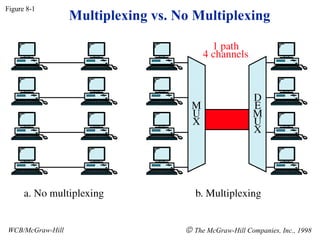
Figure 8-1
                  Multiplexing vs. No Multiplexing


WCB/McGraw-Hill                     © The McGraw-Hill Companies, Inc., 1998
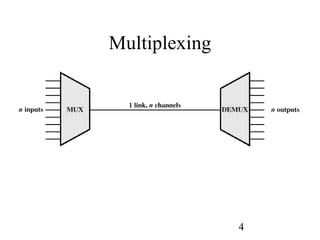
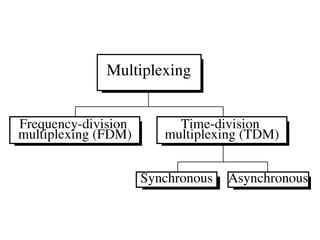
Multiplexing
• Enable two or more transmission sources to
  share a common circuit
• Most common forms – FDM and TDM
• FDM – associated with analog signal,
  simultaneous transmission
• TDM – associated with digital signal (could
  also be analog) with time slices

                                    3
Multiplexing


               4
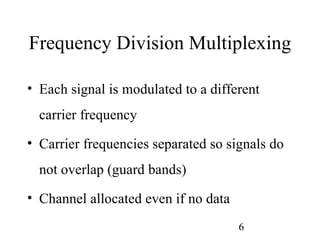
Frequency Division Multiplexing

• Each signal is modulated to a different
  carrier frequency
• Carrier frequencies separated so signals do
  not overlap (guard bands)
• Channel allocated even if no data
                                      6
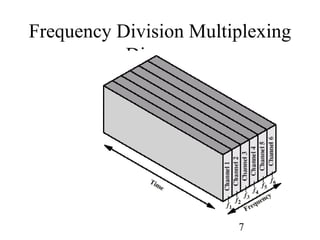
Frequency Division Multiplexing
           Diagram


                        7
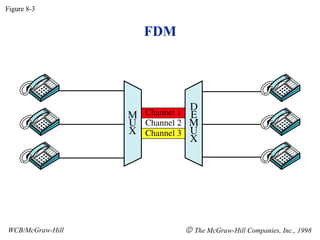
Figure 8-3


                  FDM


WCB/McGraw-Hill         © The McGraw-Hill Companies, Inc., 1998
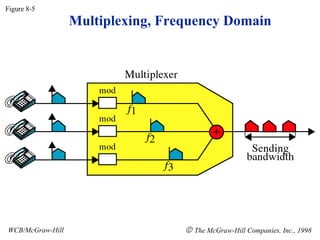
Figure 8-5
                  Multiplexing, Frequency Domain


WCB/McGraw-Hill                    © The McGraw-Hill Companies, Inc., 1998
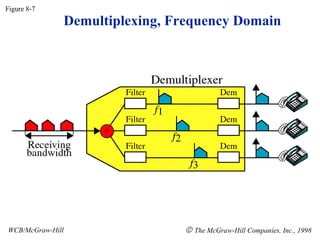
Figure 8-7
              Demultiplexing, Frequency Domain


WCB/McGraw-Hill                © The McGraw-Hill Companies, Inc., 1998
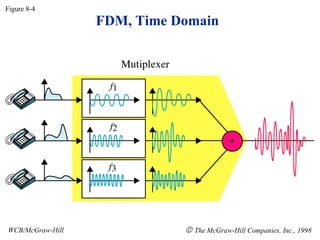
Figure 8-4
                  FDM, Time Domain


WCB/McGraw-Hill              © The McGraw-Hill Companies, Inc., 1998
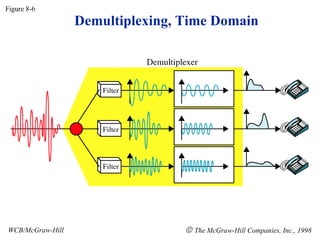
Figure 8-6
                  Demultiplexing, Time Domain


WCB/McGraw-Hill                   © The McGraw-Hill Companies, Inc., 1998
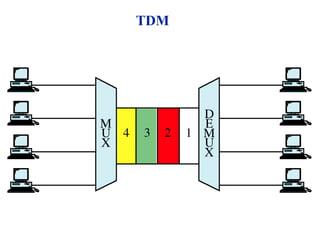
TDM
Synchronous Time Division
          Multiplexing
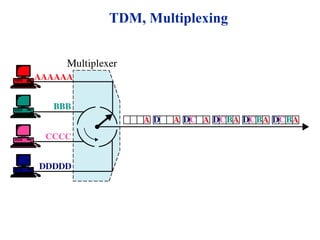
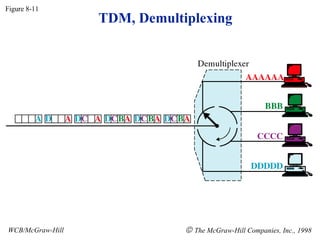
• Multiple digital signals interleaved in time
• May interleave bits, so not necessarily
  synchronous transmission
• Time slots pre-assigned to sources and
  fixed
• Time slots allocated even if no data
• Time slots do not have to be evenly
  distributed amongst sources
                                      14
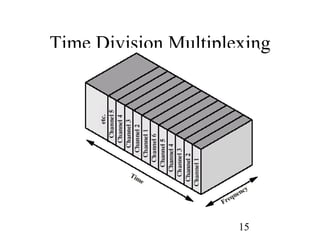
Time Division Multiplexing


                      15
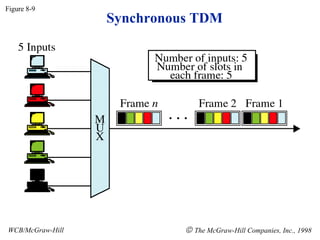
Figure 8-9
                  Synchronous TDM


WCB/McGraw-Hill             © The McGraw-Hill Companies, Inc., 1998
TDM, Multiplexing
Figure 8-11
                  TDM, Demultiplexing


WCB/McGraw-Hill               © The McGraw-Hill Companies, Inc., 1998
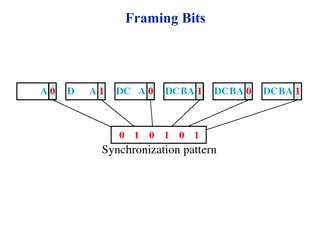
Framing Bits
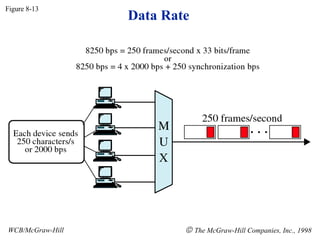
Figure 8-13
                  Data Rate


WCB/McGraw-Hill           © The McGraw-Hill Companies, Inc., 1998
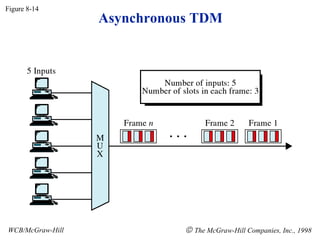
Figure 8-14
                  Asynchronous TDM


WCB/McGraw-Hill              © The McGraw-Hill Companies, Inc., 1998
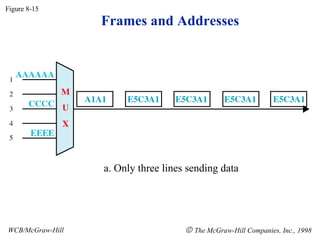
Figure 8-15
                  Frames and Addresses


                  a. Only three lines sending data


WCB/McGraw-Hill                      © The McGraw-Hill Companies, Inc., 1998
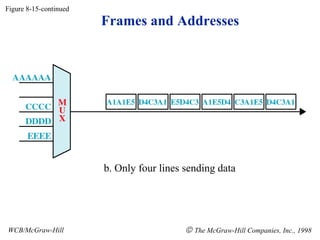
Figure 8-15-continued
                        Frames and Addresses


                        b. Only four lines sending data


WCB/McGraw-Hill                            © The McGraw-Hill Companies, Inc., 1998
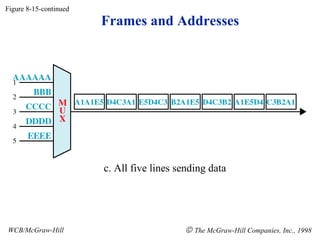
Figure 8-15-continued
                        Frames and Addresses


                        c. All five lines sending data


WCB/McGraw-Hill                            © The McGraw-Hill Companies, Inc., 1998
Wavelength Division
               Multiplexing
• Multiple beams of light at different frequency

• Carried by optical fiber

• A form of FDM

• Each colour of light (wavelength) carries separate data

  channel

                                                   25
WDM Operation
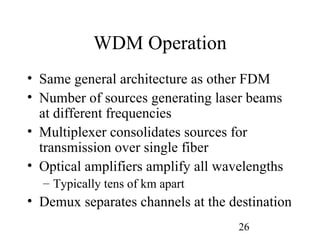
• Same general architecture as other FDM
• Number of sources generating laser beams
  at different frequencies
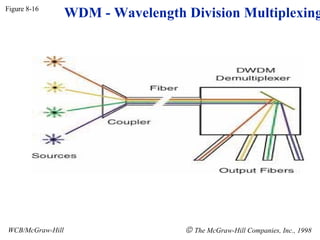
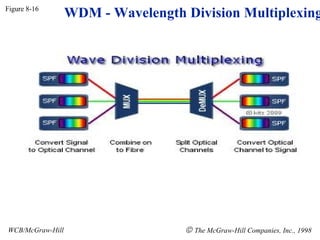
• Multiplexer consolidates sources for
  transmission over single fiber
• Optical amplifiers amplify all wavelengths
  – Typically tens of km apart
• Demux separates channels at the destination
                                    26
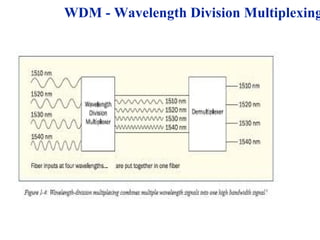
Figure 8-16
                  WDM - Wavelength Division Multiplexing


WCB/McGraw-Hill                    © The McGraw-Hill Companies, Inc., 1998
Figure 8-16
                  WDM - Wavelength Division Multiplexing


WCB/McGraw-Hill                    © The McGraw-Hill Companies, Inc., 1998
WDM - Wavelength Division Multiplexing

1 multiplexing

  • 1.
    Unit -3 Multiplexing WCB/McGraw-Hill © The McGraw-Hill Companies, Inc., 1998
  • 2.
    Figure 8-1 Multiplexing vs. No Multiplexing WCB/McGraw-Hill © The McGraw-Hill Companies, Inc., 1998
  • 3.
    Multiplexing • Enable twoor more transmission sources to share a common circuit • Most common forms – FDM and TDM • FDM – associated with analog signal, simultaneous transmission • TDM – associated with digital signal (could also be analog) with time slices 3
  • 4.
  • 6.
    Frequency Division Multiplexing •Each signal is modulated to a different carrier frequency • Carrier frequencies separated so signals do not overlap (guard bands) • Channel allocated even if no data 6
  • 7.
  • 8.
    Figure 8-3 FDM WCB/McGraw-Hill © The McGraw-Hill Companies, Inc., 1998
  • 9.
    Figure 8-5 Multiplexing, Frequency Domain WCB/McGraw-Hill © The McGraw-Hill Companies, Inc., 1998
  • 10.
    Figure 8-7 Demultiplexing, Frequency Domain WCB/McGraw-Hill © The McGraw-Hill Companies, Inc., 1998
  • 11.
    Figure 8-4 FDM, Time Domain WCB/McGraw-Hill © The McGraw-Hill Companies, Inc., 1998
  • 12.
    Figure 8-6 Demultiplexing, Time Domain WCB/McGraw-Hill © The McGraw-Hill Companies, Inc., 1998
  • 13.
  • 14.
    Synchronous Time Division Multiplexing • Multiple digital signals interleaved in time • May interleave bits, so not necessarily synchronous transmission • Time slots pre-assigned to sources and fixed • Time slots allocated even if no data • Time slots do not have to be evenly distributed amongst sources 14
  • 15.
  • 16.
    Figure 8-9 Synchronous TDM WCB/McGraw-Hill © The McGraw-Hill Companies, Inc., 1998
  • 17.
  • 18.
    Figure 8-11 TDM, Demultiplexing WCB/McGraw-Hill © The McGraw-Hill Companies, Inc., 1998
  • 19.
  • 20.
    Figure 8-13 Data Rate WCB/McGraw-Hill © The McGraw-Hill Companies, Inc., 1998
  • 21.
    Figure 8-14 Asynchronous TDM WCB/McGraw-Hill © The McGraw-Hill Companies, Inc., 1998
  • 22.
    Figure 8-15 Frames and Addresses a. Only three lines sending data WCB/McGraw-Hill © The McGraw-Hill Companies, Inc., 1998
  • 23.
    Figure 8-15-continued Frames and Addresses b. Only four lines sending data WCB/McGraw-Hill © The McGraw-Hill Companies, Inc., 1998
  • 24.
    Figure 8-15-continued Frames and Addresses c. All five lines sending data WCB/McGraw-Hill © The McGraw-Hill Companies, Inc., 1998
  • 25.
    Wavelength Division Multiplexing • Multiple beams of light at different frequency • Carried by optical fiber • A form of FDM • Each colour of light (wavelength) carries separate data channel 25
  • 26.
    WDM Operation • Samegeneral architecture as other FDM • Number of sources generating laser beams at different frequencies • Multiplexer consolidates sources for transmission over single fiber • Optical amplifiers amplify all wavelengths – Typically tens of km apart • Demux separates channels at the destination 26
  • 27.
    Figure 8-16 WDM - Wavelength Division Multiplexing WCB/McGraw-Hill © The McGraw-Hill Companies, Inc., 1998
  • 28.
    Figure 8-16 WDM - Wavelength Division Multiplexing WCB/McGraw-Hill © The McGraw-Hill Companies, Inc., 1998
  • 29.
    WDM - WavelengthDivision Multiplexing