Chapter 3
Simplification and minimization
of Boolean functions
1
Topics to be covered
 Introduction
 Karnaugh map representation of logical functions
 Simplification of logical functions using K-maps.
 Minimization of Boolean functions specified in minterms/
Maxterms or truth table
 Don't-care Combinations
 EX-OR and EX-NOR simplification of k-maps
 The tabulation method of minimization
2
Introduction
 Since there is no a set of rules for minimizing a Boolean function
using identities, sometimes it is difficult to know whether the
minimum expression is obtained.
 We have seen in the preceding chapter about simplification using
Boolean algebraic laws and theorems. But, in general the following
methods can be used to simplify the Boolean function.
1. Algebraic method
2. Karnaugh map technique(mapping method)
3. Variable entered map(VEM) technique
4. Quine-MCClusky method(Tabular method)
 We have introduced the algebraic method of simplification using Boolean
algebraic theorems.
 In this chapter, we will discuss about the simplification of logic functions using
Karnaugh map method Quine-MCClusky method.
 The Karnaugh map or simply K-map is the simple and most commonly used
method. It can be used up to six variables. The VEM technique is beyond the scope
of this course.
K-map representation of logic functions
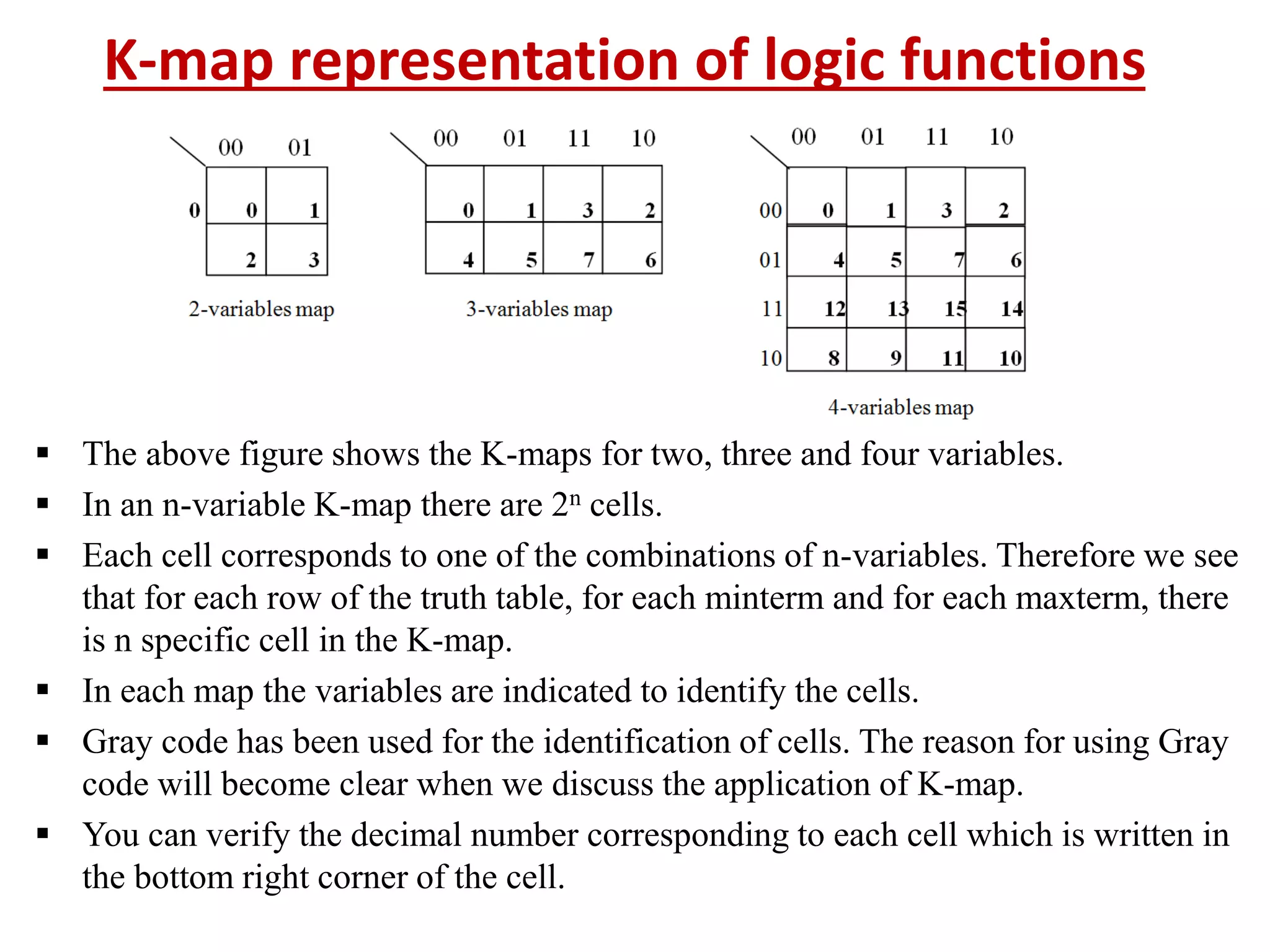
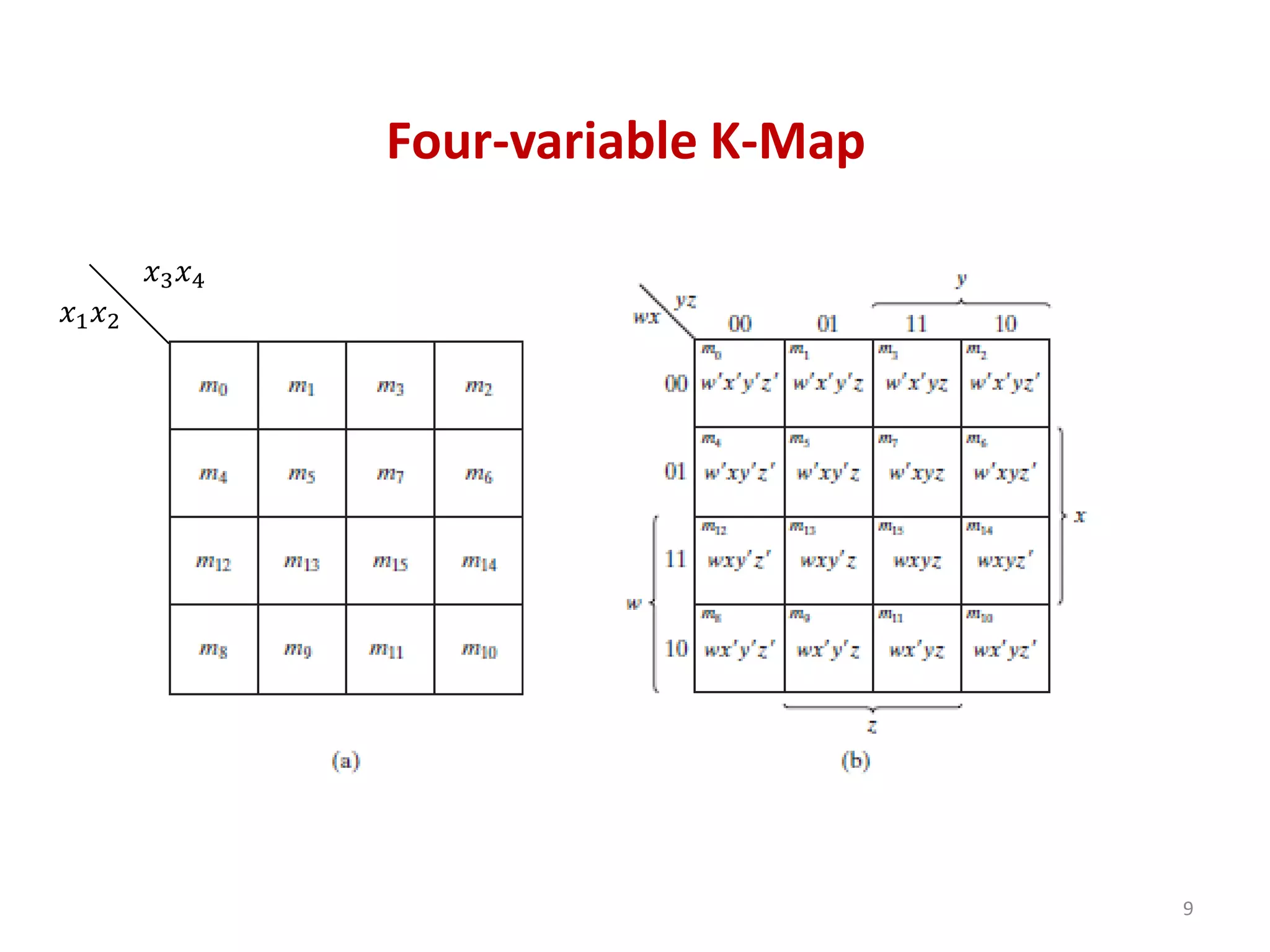
 The above figure shows the K-maps for two, three and four variables.
 In an n-variable K-map there are 2n cells.
 Each cell corresponds to one of the combinations of n-variables. Therefore we see
that for each row of the truth table, for each minterm and for each maxterm, there
is n specific cell in the K-map.
 In each map the variables are indicated to identify the cells.
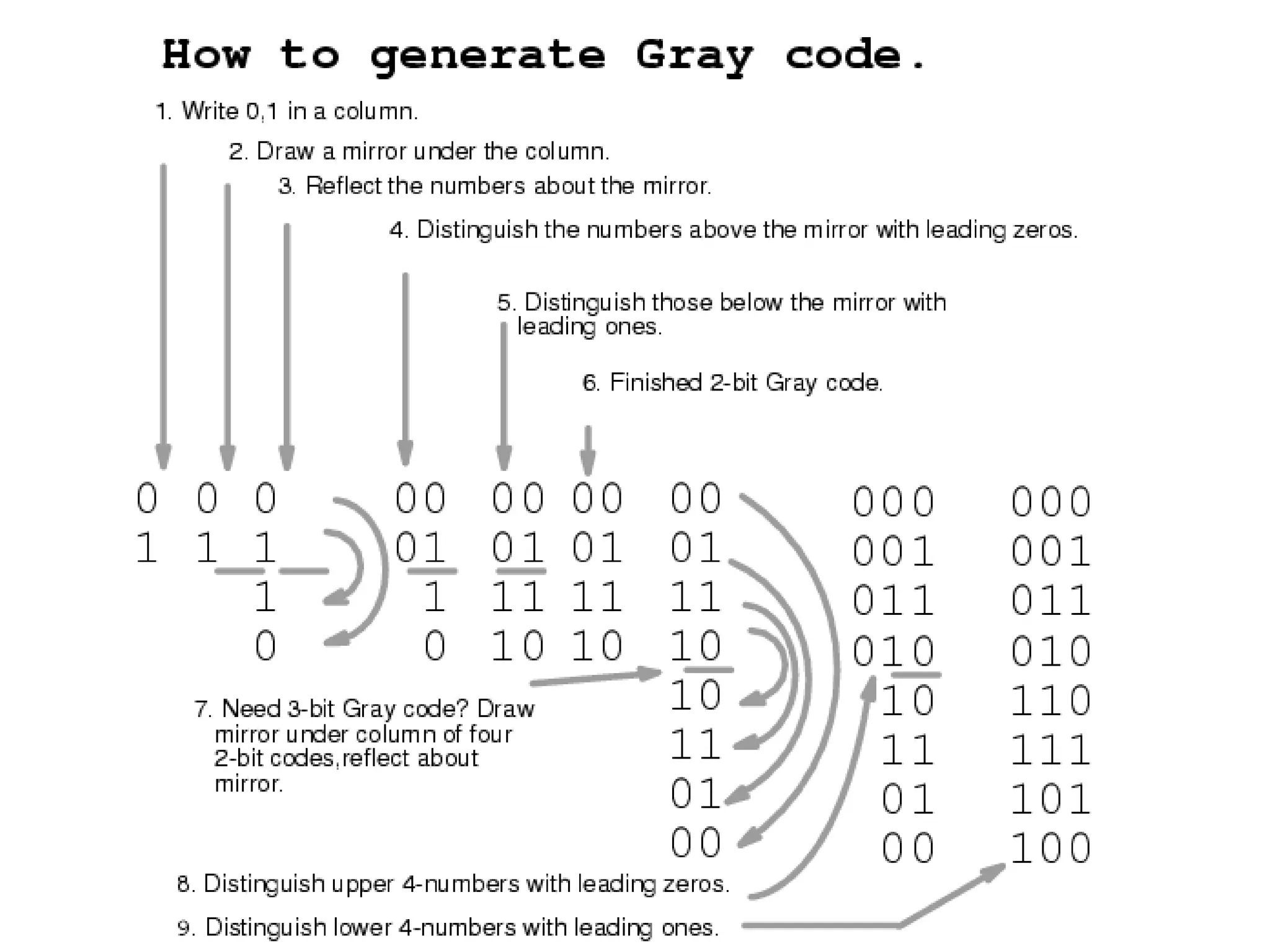
 Gray code has been used for the identification of cells. The reason for using Gray
code will become clear when we discuss the application of K-map.
 You can verify the decimal number corresponding to each cell which is written in
the bottom right corner of the cell.
y
(b) Karnaugh map
0
1
0 1
m0 m2
m3
m1
x
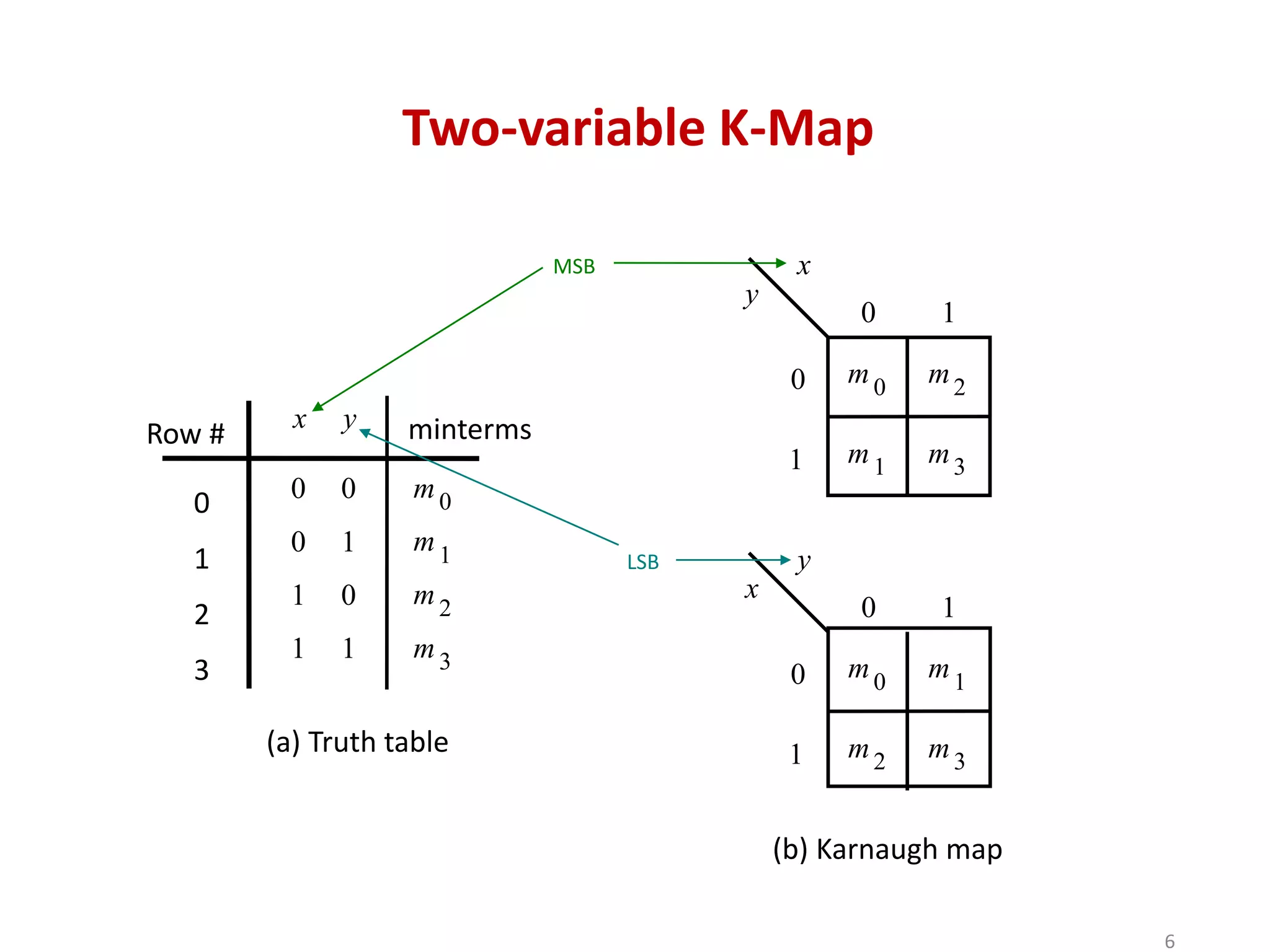
Two-variable K-Map
(a) Truth table
x y
0 0
0 1
1 0
1 1
m0
m1
m3
m2
Row #
0
1
2
3
minterms
MSB
LSB
x
0
1
0 1
m0 m1
m3
m2
y
6
x1
x2
x3 00 01 11 10
0
1
(b) Karnaugh map
x2
x3
0 0
0 1
1 0
1 1
m
0
m
1
m
3
m
2
0
0
0
0
0 0
0 1
1 0
1 1
1
1
1
1
m
4
m
5
m
7
m
6
x1
(a) Truth table
m
0
m
1 m
3
m
2 m
6
m
7
m
4
m
5
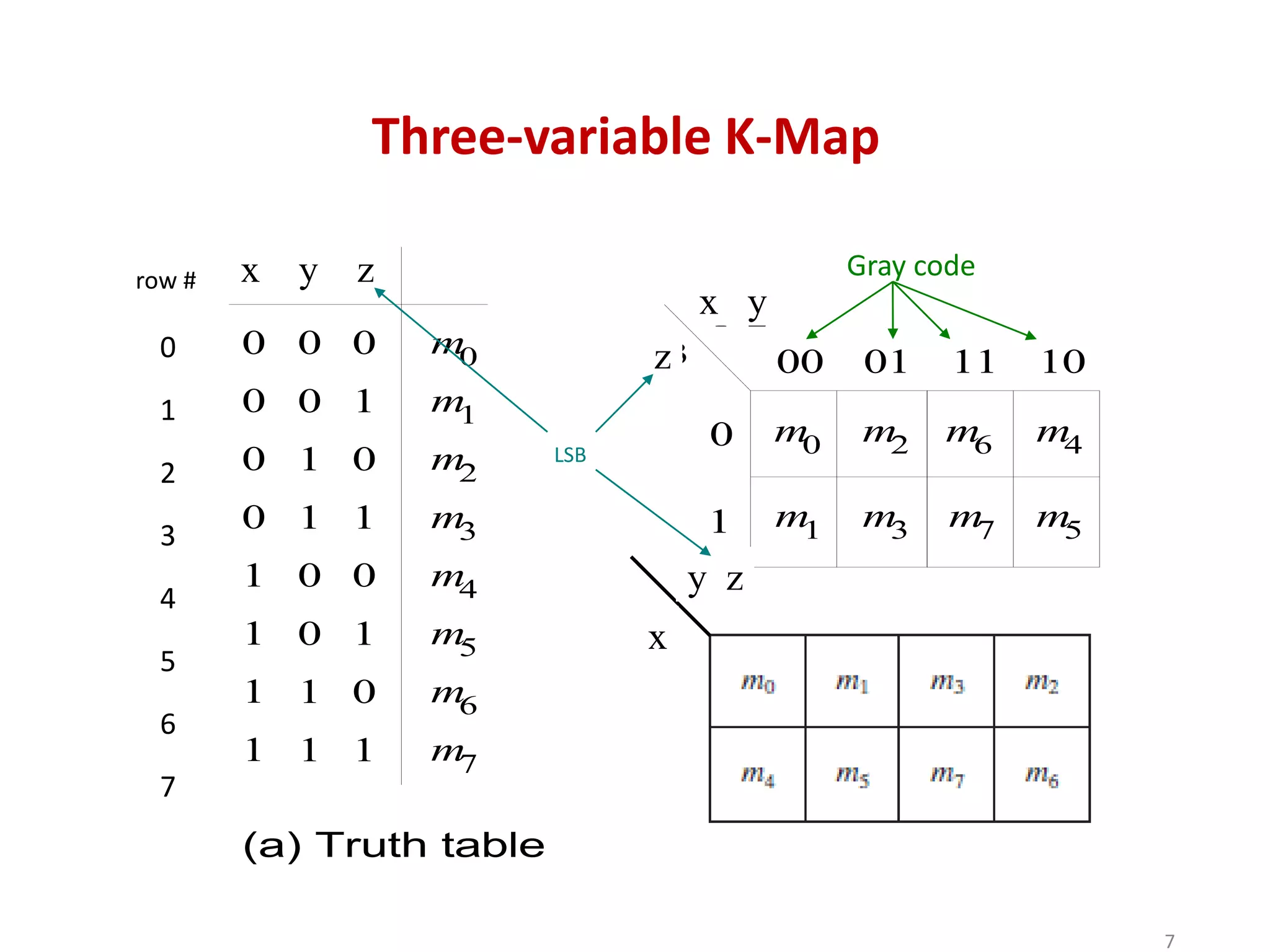
Three-variable K-Map
0
1
2
3
4
5
6
7
row #
LSB
Gray code
x y z
x y
z
x
y z
7
x1
x2
x3
x4 00 01 11 10
00
01
11
10
x2
x4
x1
x3
m 0
m 1 m 5
m 4 m 12
m 13
m 8
m 9
m 3
m 2 m 6
m 7 m 15
m 14
m 11
m 10
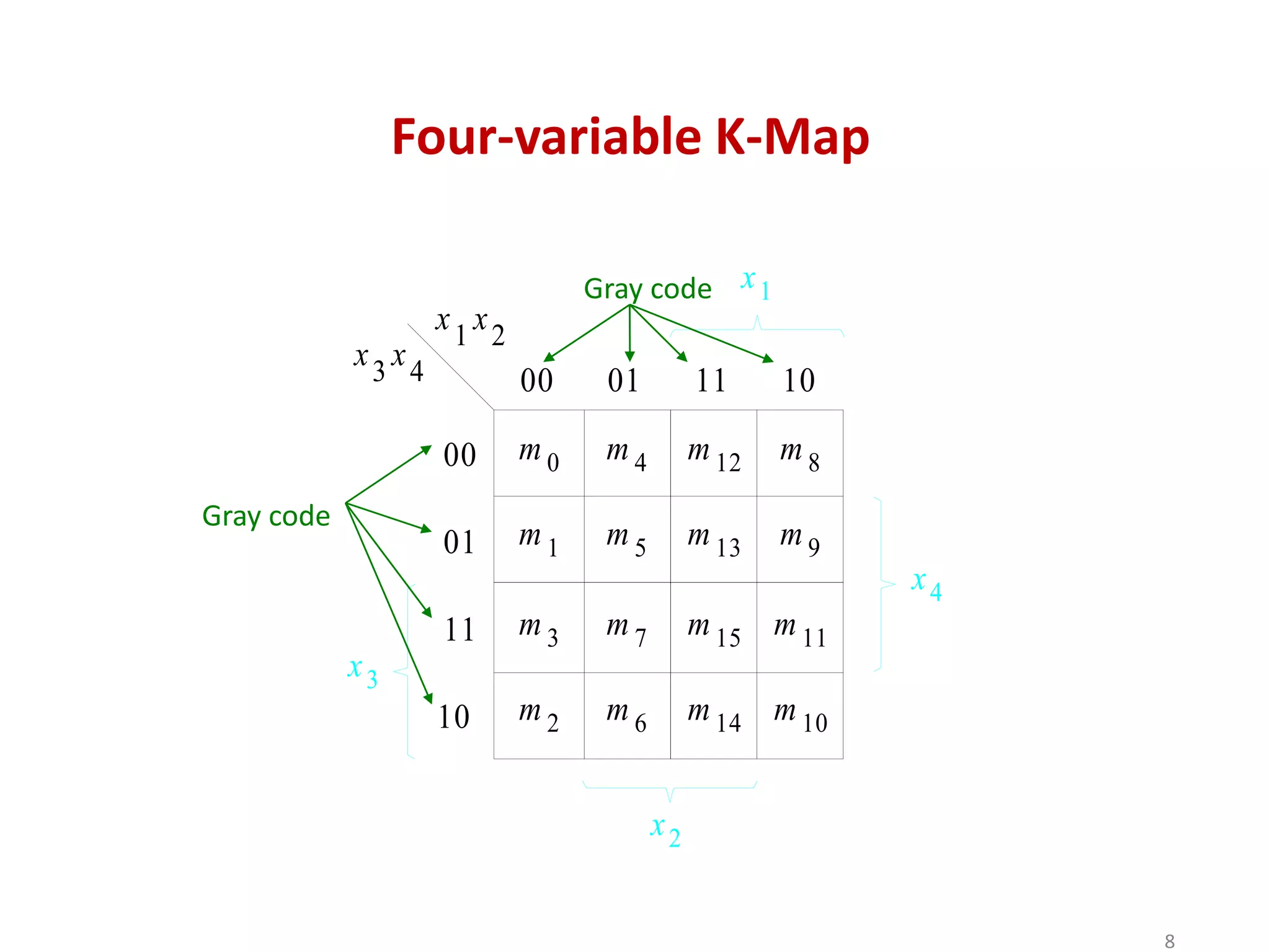
Four-variable K-Map
Gray code
Gray code
8
Four-variable K-Map
9
𝑥1𝑥2
𝑥3𝑥4
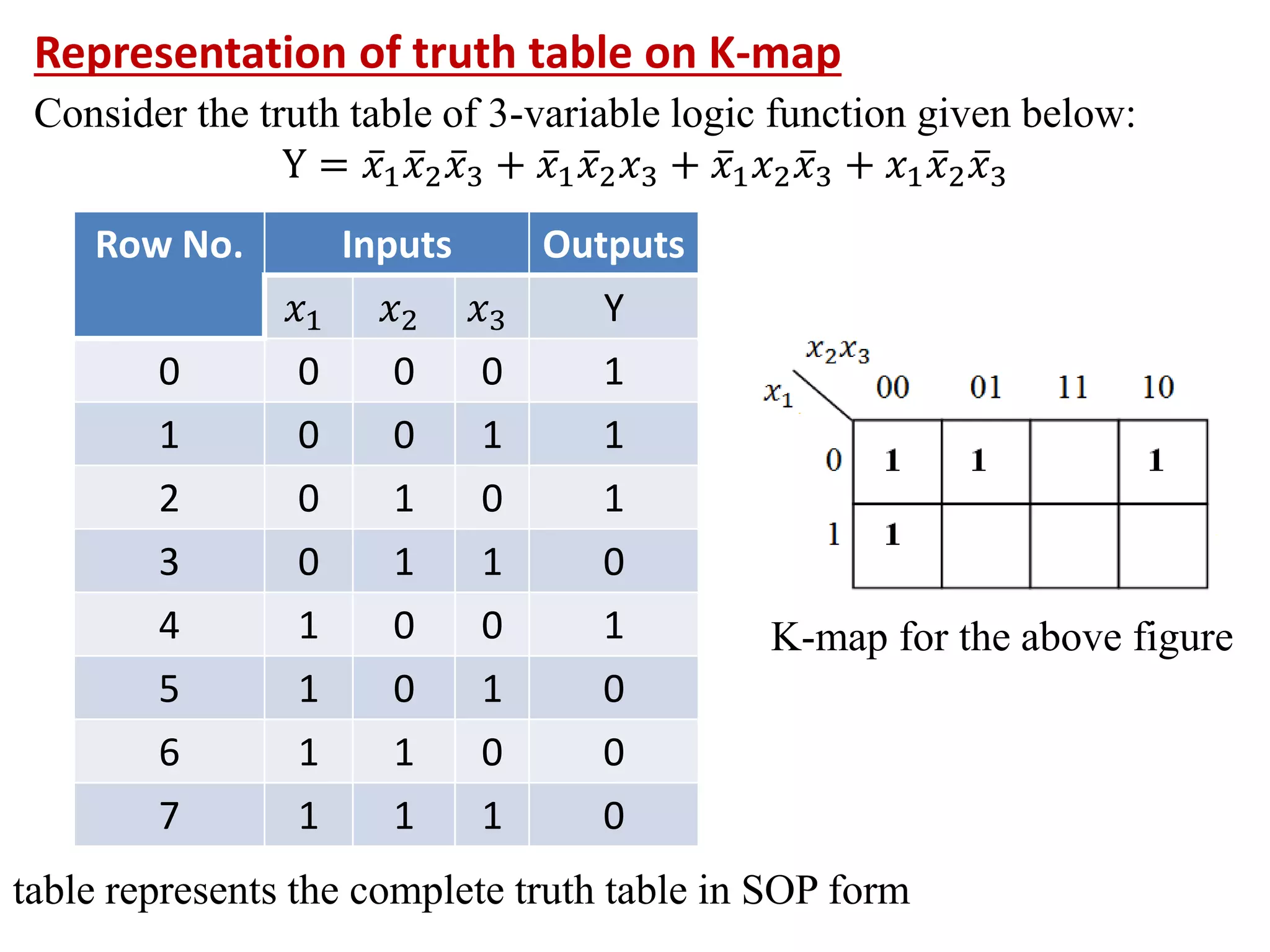
Representation of truth table on K-map
Consider the truth table of 3-variable logic function given below:
Y = 𝑥1𝑥2𝑥3 + 𝑥1𝑥2𝑥3 + 𝑥1𝑥2𝑥3 + 𝑥1𝑥2𝑥3
Row No. Inputs Outputs
𝑥1 𝑥2 𝑥3 Y
0 0 0 0 1
1 0 0 1 1
2 0 1 0 1
3 0 1 1 0
4 1 0 0 1
5 1 0 1 0
6 1 1 0 0
7 1 1 1 0
table represents the complete truth table in SOP form
K-map for the above figure
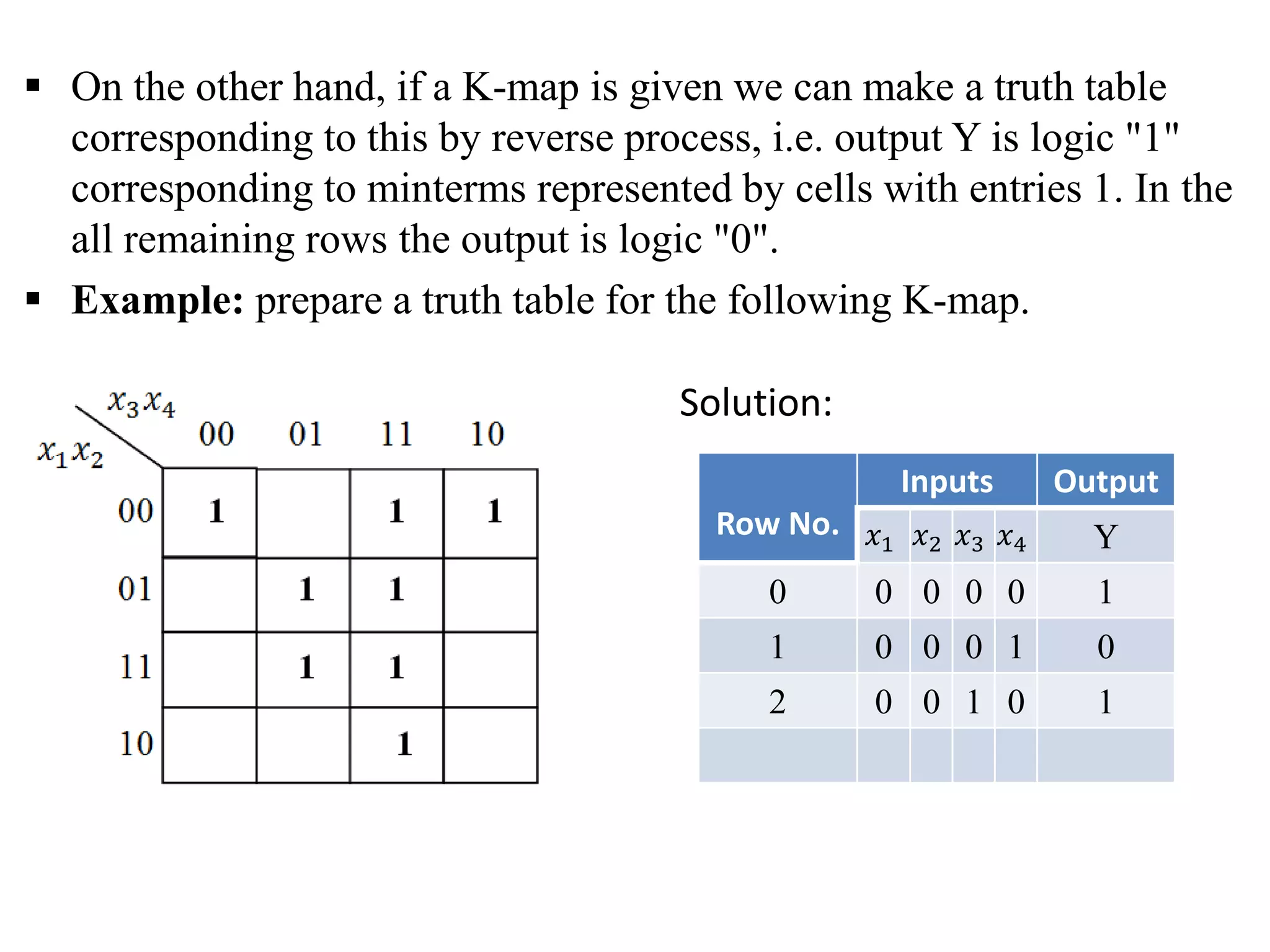
 On the other hand, if a K-map is given we can make a truth table
corresponding to this by reverse process, i.e. output Y is logic "1"
corresponding to minterms represented by cells with entries 1. In the
all remaining rows the output is logic "0".
 Example: prepare a truth table for the following K-map.
Row No.
Inputs Output
𝑥1 𝑥2 𝑥3 𝑥4 Y
0 0 0 0 0 1
1 0 0 0 1 0
2 0 0 1 0 1
Solution:
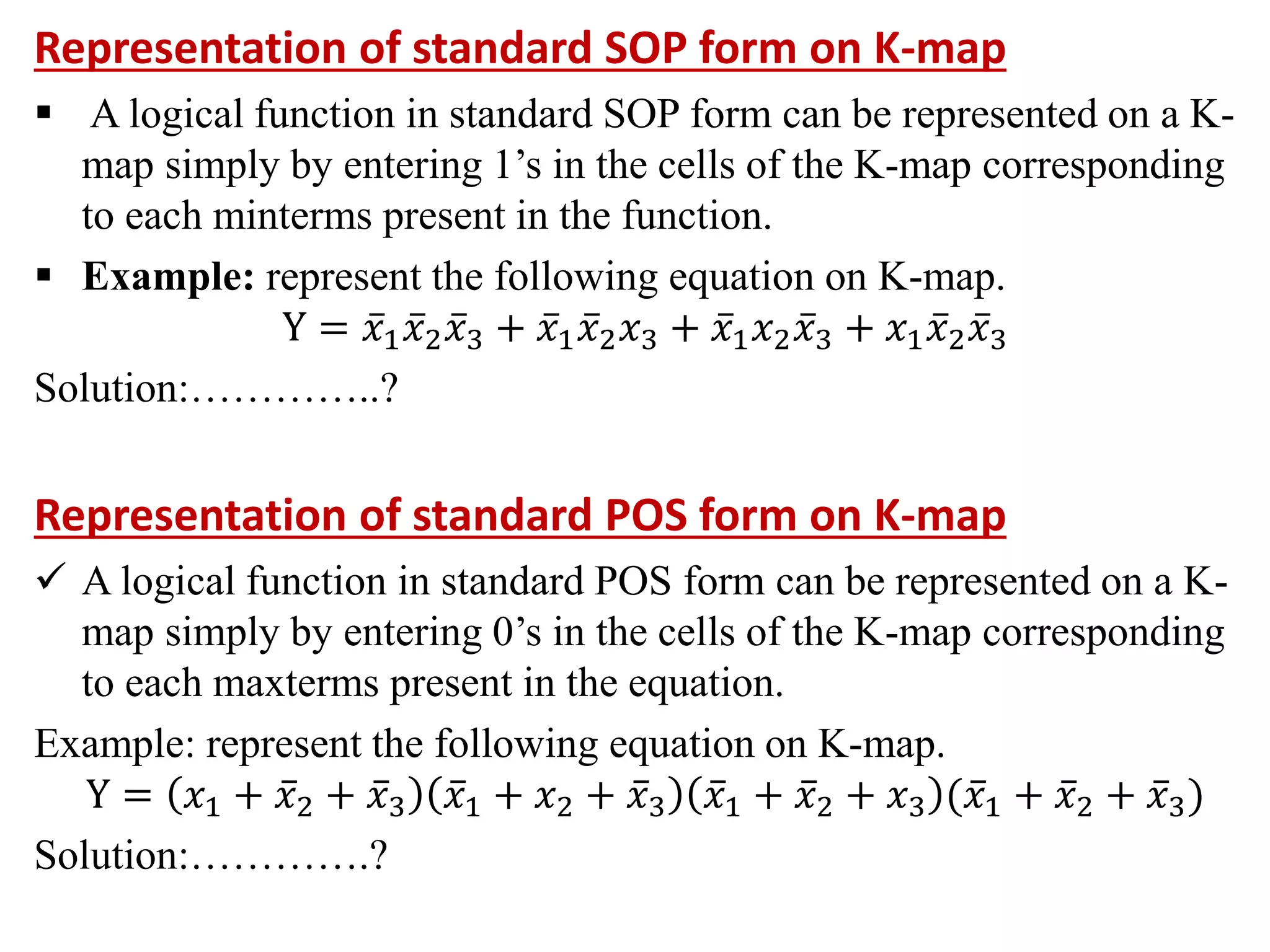
Representation of standard SOP form on K-map
 A logical function in standard SOP form can be represented on a K-
map simply by entering 1’s in the cells of the K-map corresponding
to each minterms present in the function.
 Example: represent the following equation on K-map.
Y = 𝑥1𝑥2𝑥3 + 𝑥1𝑥2𝑥3 + 𝑥1𝑥2𝑥3 + 𝑥1𝑥2𝑥3
Solution:…………..?
Representation of standard POS form on K-map
 A logical function in standard POS form can be represented on a K-
map simply by entering 0’s in the cells of the K-map corresponding
to each maxterms present in the equation.
Example: represent the following equation on K-map.
Y = 𝑥1 + 𝑥2 + 𝑥3 𝑥1 + 𝑥2 + 𝑥3 𝑥1 + 𝑥2 + 𝑥3 (𝑥1 + 𝑥2 + 𝑥3)
Solution:………….?
Simplification and minimization of Boolean functions
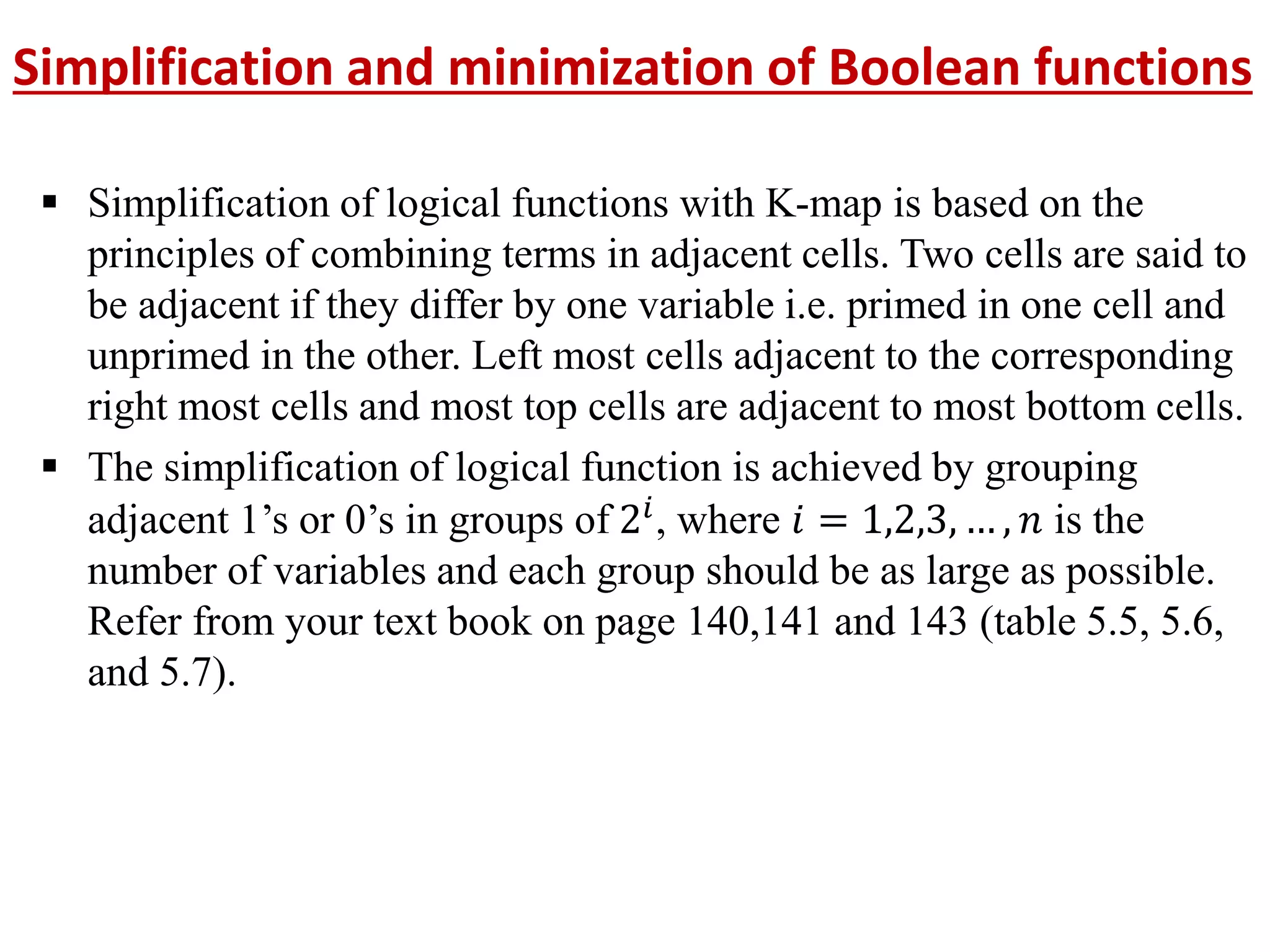
 Simplification of logical functions with K-map is based on the
principles of combining terms in adjacent cells. Two cells are said to
be adjacent if they differ by one variable i.e. primed in one cell and
unprimed in the other. Left most cells adjacent to the corresponding
right most cells and most top cells are adjacent to most bottom cells.
 The simplification of logical function is achieved by grouping
adjacent 1’s or 0’s in groups of 2𝑖, where 𝑖 = 1,2,3, … , 𝑛 is the
number of variables and each group should be as large as possible.
Refer from your text book on page 140,141 and 143 (table 5.5, 5.6,
and 5.7).
14
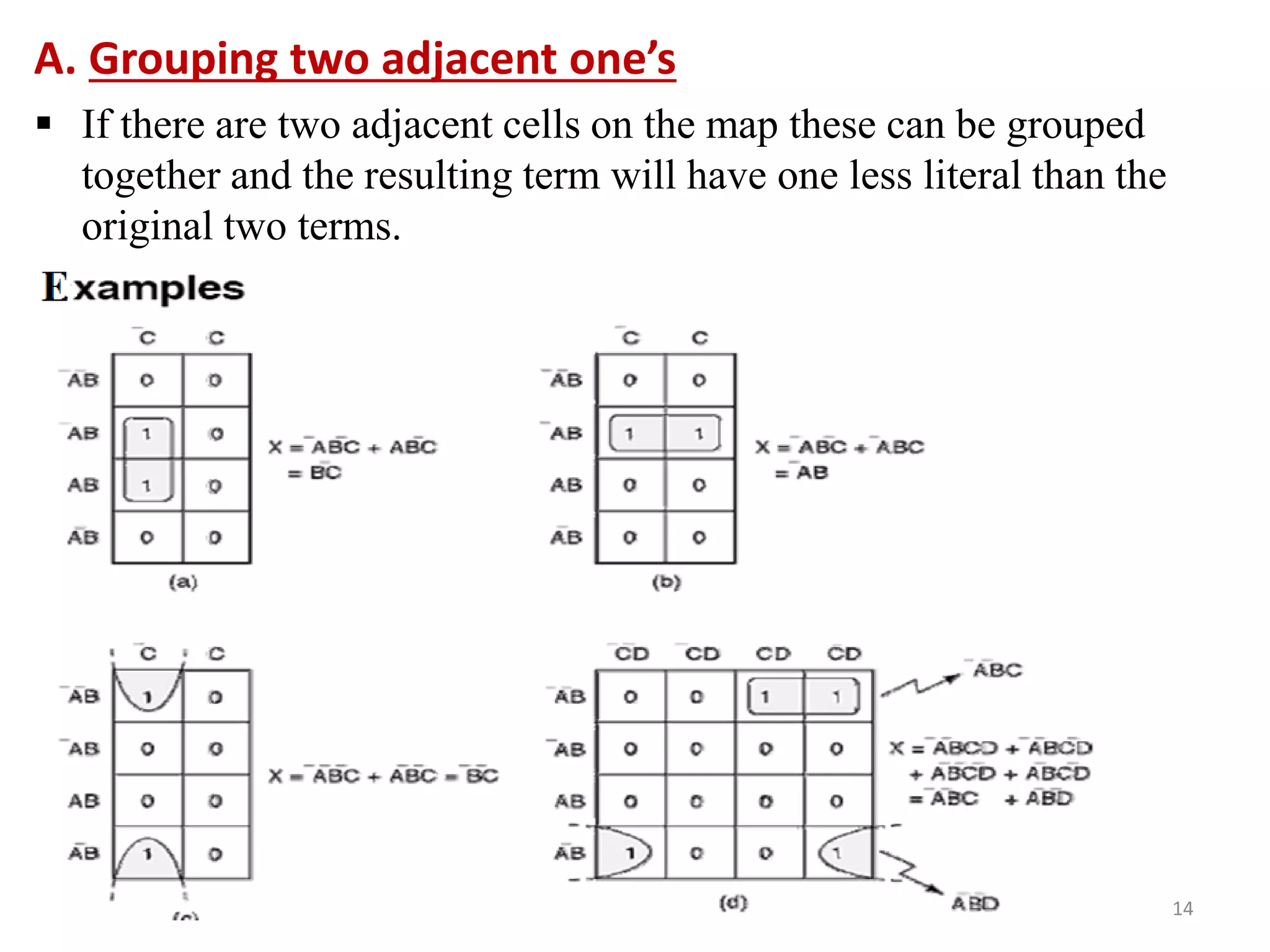
A. Grouping two adjacent one’s
 If there are two adjacent cells on the map these can be grouped
together and the resulting term will have one less literal than the
original two terms.
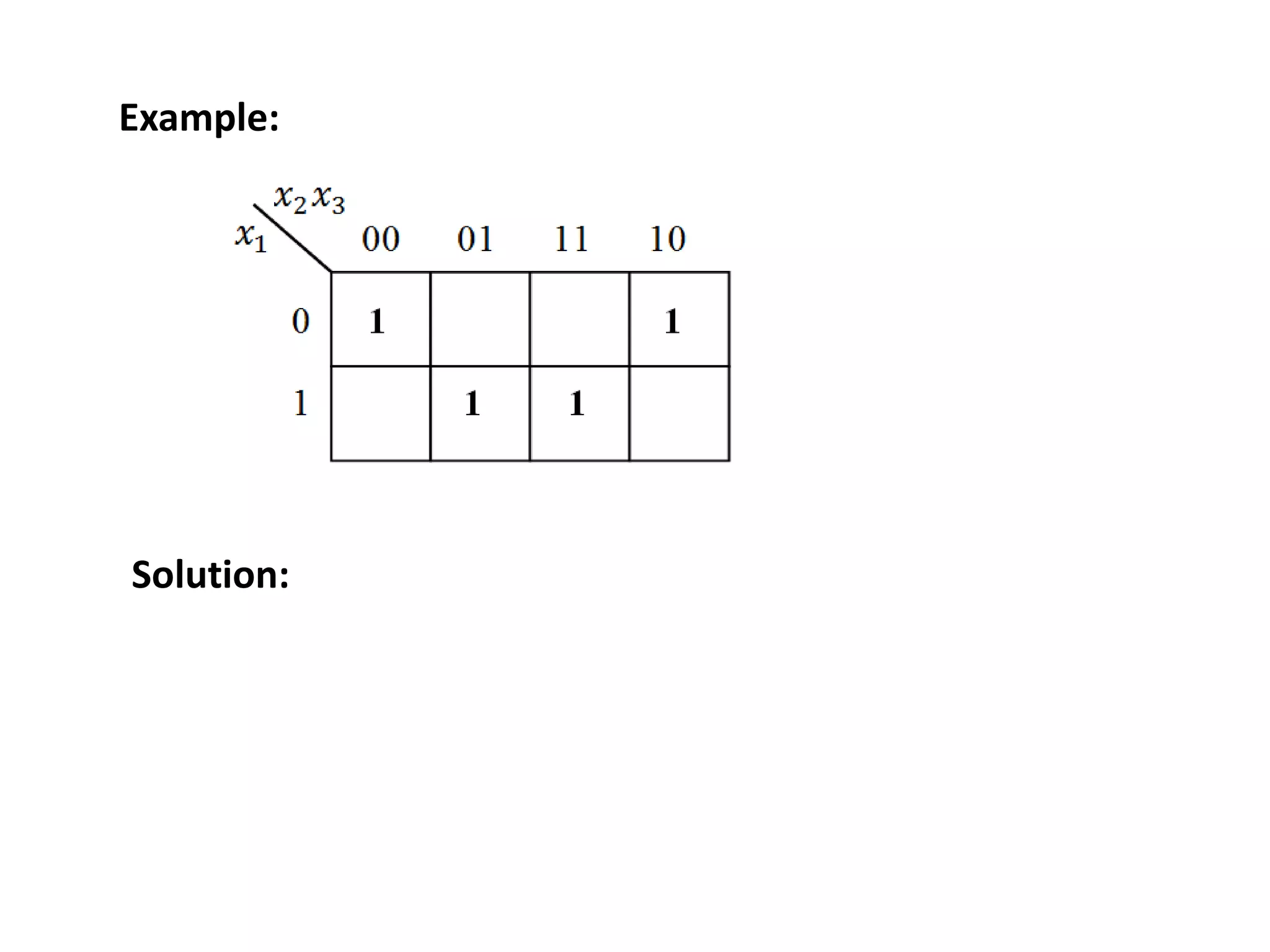
Example:
Solution:
16
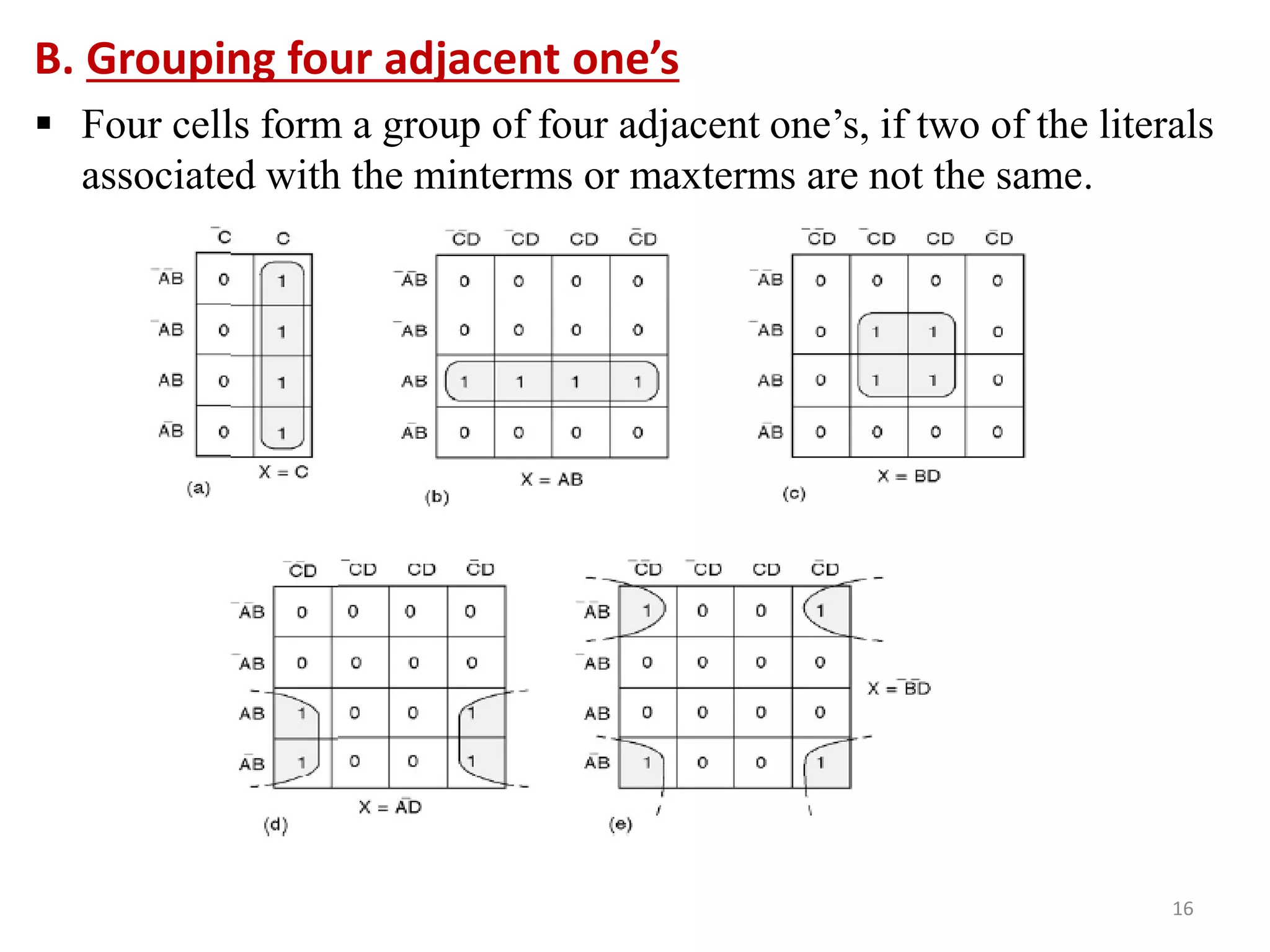
B. Grouping four adjacent one’s
 Four cells form a group of four adjacent one’s, if two of the literals
associated with the minterms or maxterms are not the same.
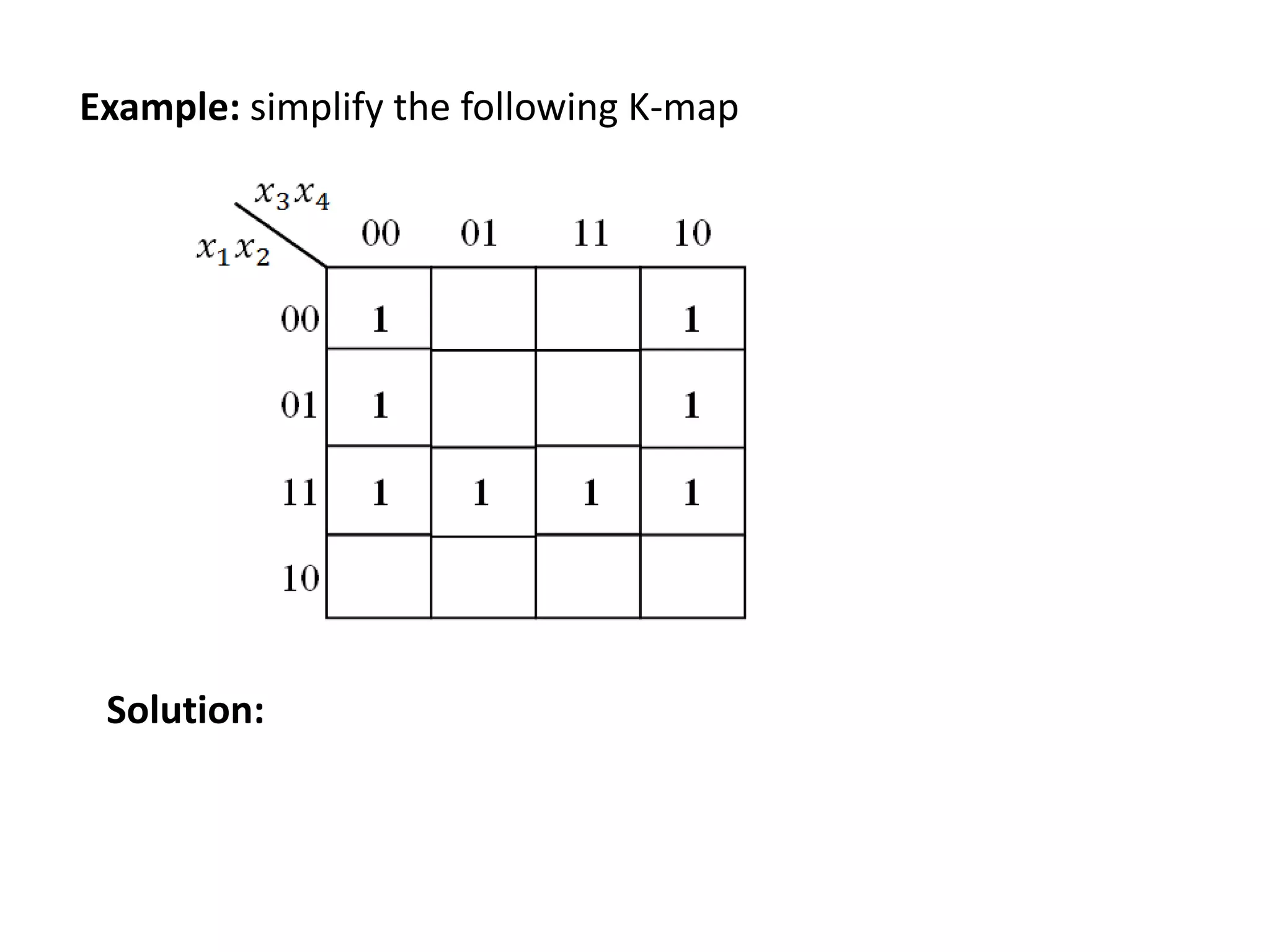
Example: simplify the following K-map
Solution:
C. Grouping eight adjacent one’s
 Eight cells form a group of eight adjacent one’s, if three of the
literals associated with the minterms/maxterms are not the same and
the other literals are the same.
For 3-variable K-map, there is only one possibility of eight
one’s corresponding in the K-map and this corresponds to
output Y = 1, irrespective of the values of the inputs.
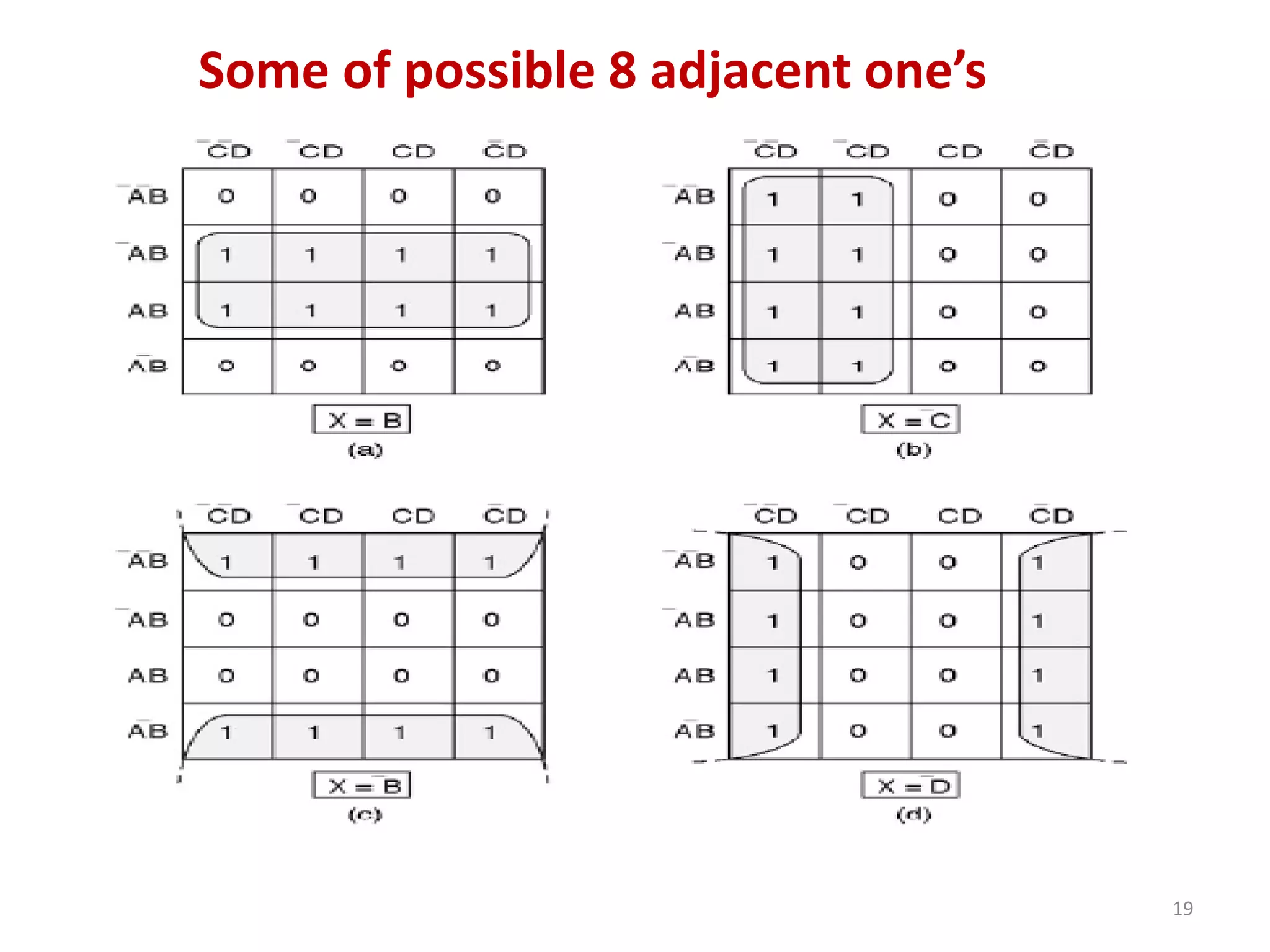
For 4-variable K-map, there are eight possible grouping of eight
adjacent one’s. (see table 4.7 on page 143)
Some of possible 8 adjacent one’s
19
D. Grouping 2, 4, and 8 adjacent zero’s
 In the above discussion, we have considered groups of 2, 4, and 8
adjacent one’s. Instead of making the groups of one’s, we can also
make groups of zero’s. the procedure is similar to the one used
above.
Example:
1. Given the following Boolean function
𝐹 = 𝐴′
𝐶 + 𝐴′
𝐵 + 𝐴𝐵′
𝐶 + 𝐵𝐶
a. Express it in sum of minterms
b. Find the minimal sum of products expression
2. Minimize the following expression using K-map
𝐹 𝑥1, 𝑥2, 𝑥3 = 𝑚(2,4,5,6,7)
3. Simplify using K-map
𝐹 𝑥1, 𝑥2, 𝑥3, 𝑥4 = 𝑚(0,2,3,7,11,13,14,15)
Minimization of Boolean functions
specified in minterms/ Maxterms or
truth table
Minimization using K-Maps
(Deriving a SOP Expression using the Maxterms)
 Enter minterms (for SOP) into K-map
 Identify adjacent cells
– Minterms differ in only one bit
 Use adjacency to minimize logic function
– Gray code used for enumeration
• Specifies the location of each minterm in K-map
– Horizontal and Vertical adjacency
• Both are logically adjacent
– K-map wraps
• Left and right columns are logically adjacent
• Top and bottom rows are logically adjacent
22
Minimization using K-Maps
 Group adjacent cells to reduce
– the number of literals in a term
– the number of terms in a Boolean expression
 Adjacencies are of size 1, 2, 4, 8, …
 Number of adjacent cells is a power of 2
 Adjacent cells form a rectangle
 The larger the grouping of adjacent cells the greater
the minimization of the logical function.
23
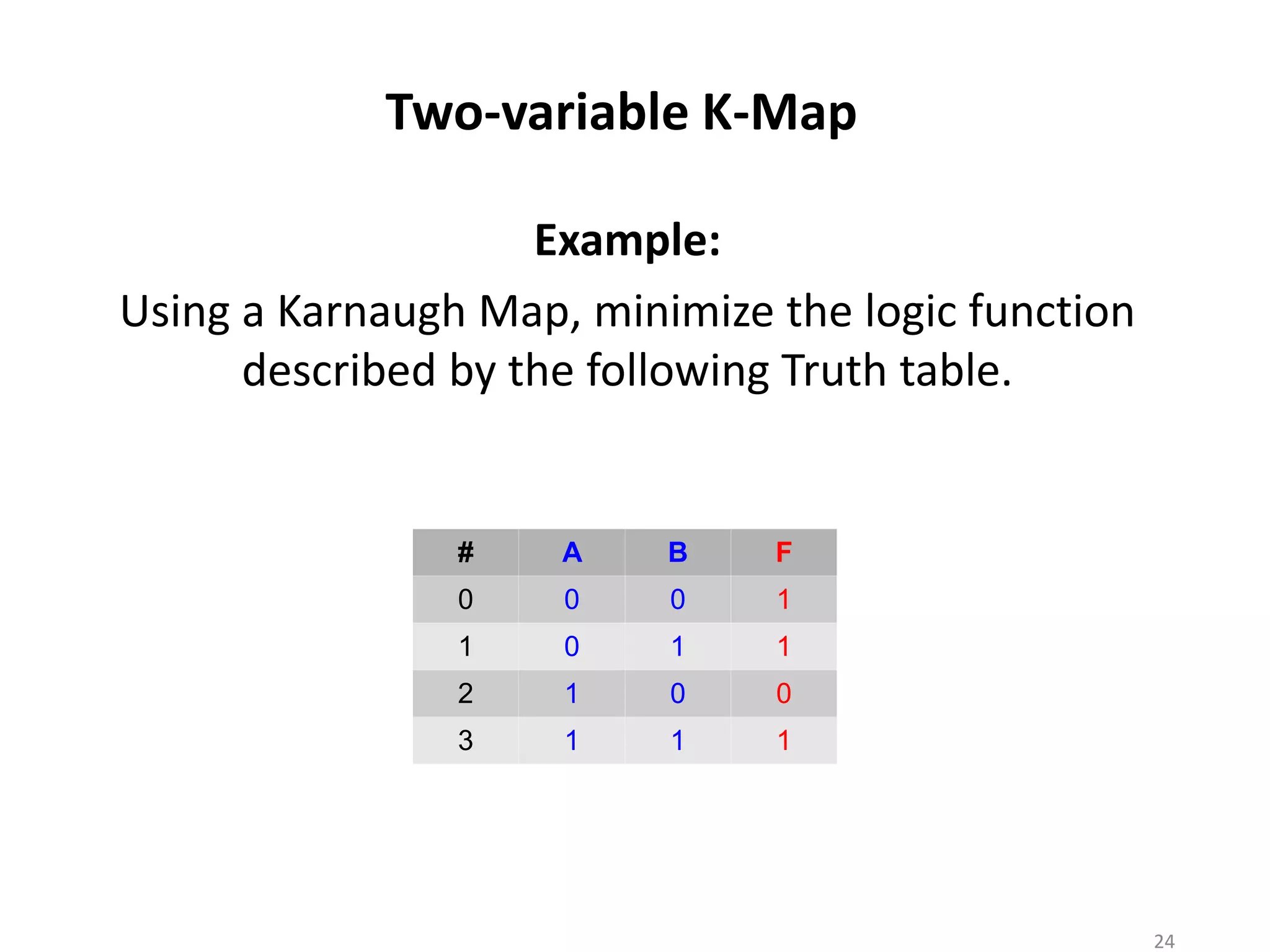
Two-variable K-Map
Example:
Using a Karnaugh Map, minimize the logic function
described by the following Truth table.
# A B F
0 0 0 1
1 0 1 1
2 1 0 0
3 1 1 1
24
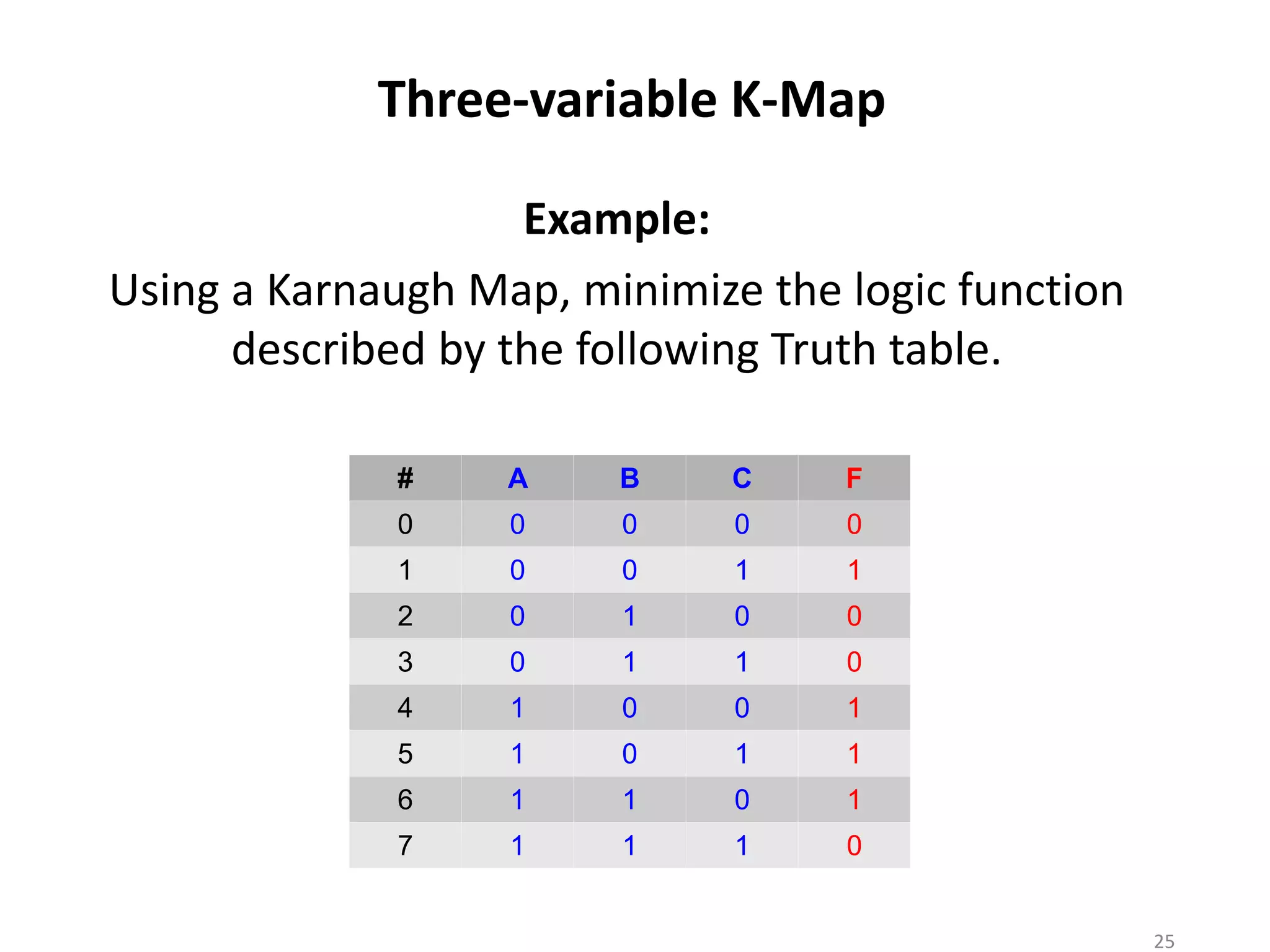
Three-variable K-Map
Example:
Using a Karnaugh Map, minimize the logic function
described by the following Truth table.
# A B C F
0 0 0 0 0
1 0 0 1 1
2 0 1 0 0
3 0 1 1 0
4 1 0 0 1
5 1 0 1 1
6 1 1 0 1
7 1 1 1 0
25
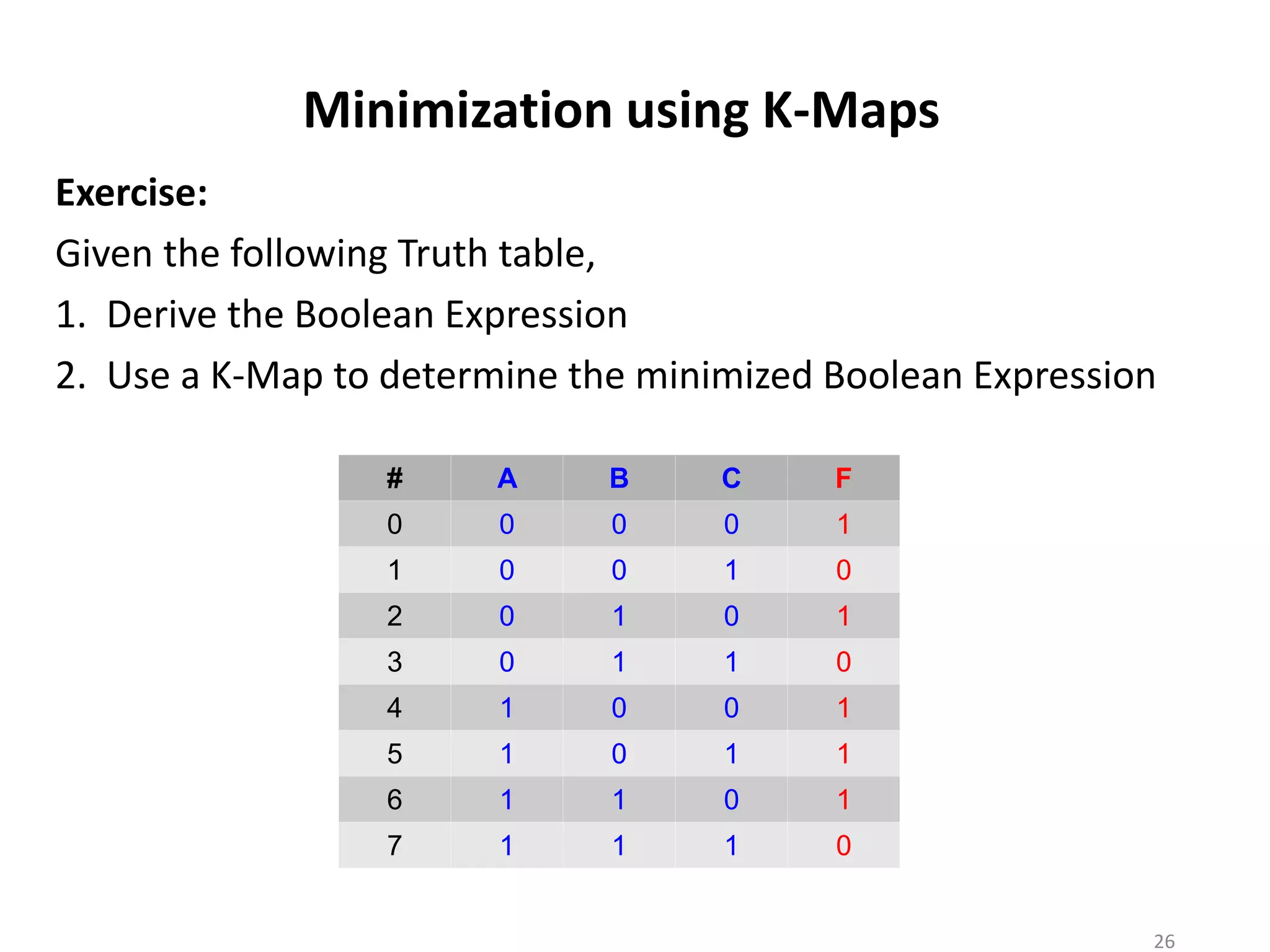
Exercise:
Given the following Truth table,
1. Derive the Boolean Expression
2. Use a K-Map to determine the minimized Boolean Expression
Minimization using K-Maps
# A B C F
0 0 0 0 1
1 0 0 1 0
2 0 1 0 1
3 0 1 1 0
4 1 0 0 1
5 1 0 1 1
6 1 1 0 1
7 1 1 1 0
26
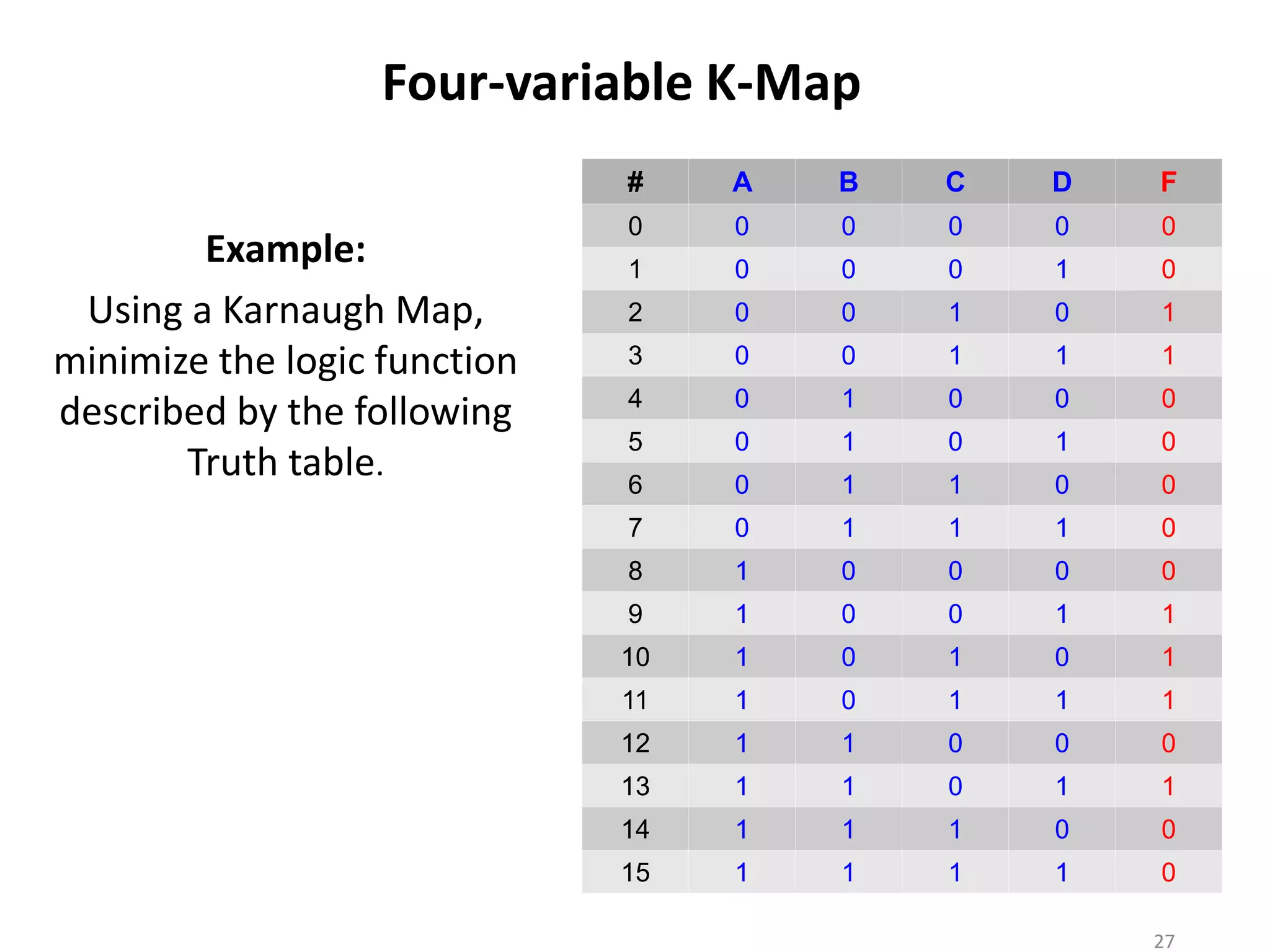
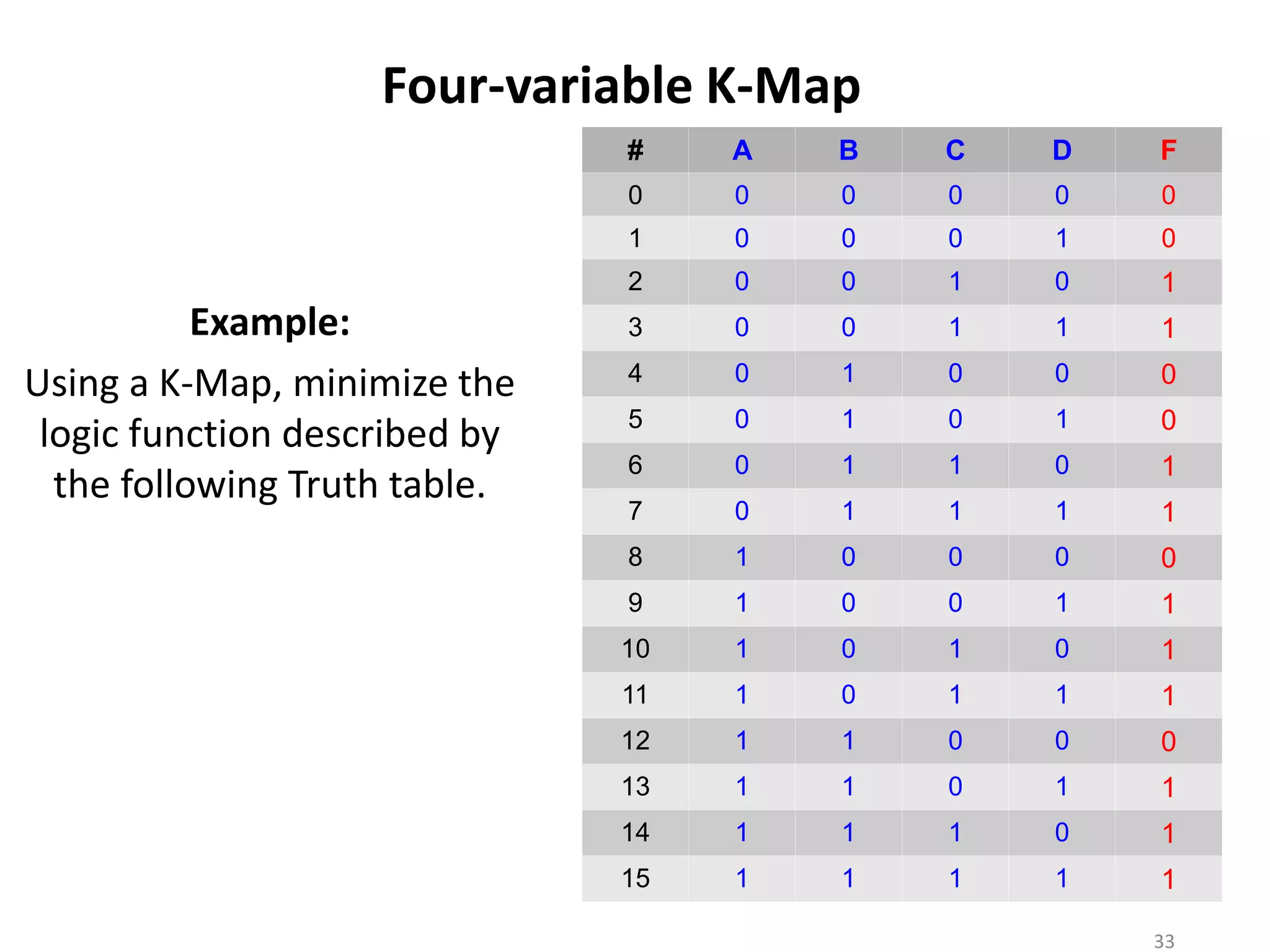
Four-variable K-Map
Example:
Using a Karnaugh Map,
minimize the logic function
described by the following
Truth table.
# A B C D F
0 0 0 0 0 0
1 0 0 0 1 0
2 0 0 1 0 1
3 0 0 1 1 1
4 0 1 0 0 0
5 0 1 0 1 0
6 0 1 1 0 0
7 0 1 1 1 0
8 1 0 0 0 0
9 1 0 0 1 1
10 1 0 1 0 1
11 1 0 1 1 1
12 1 1 0 0 0
13 1 1 0 1 1
14 1 1 1 0 0
15 1 1 1 1 0
27
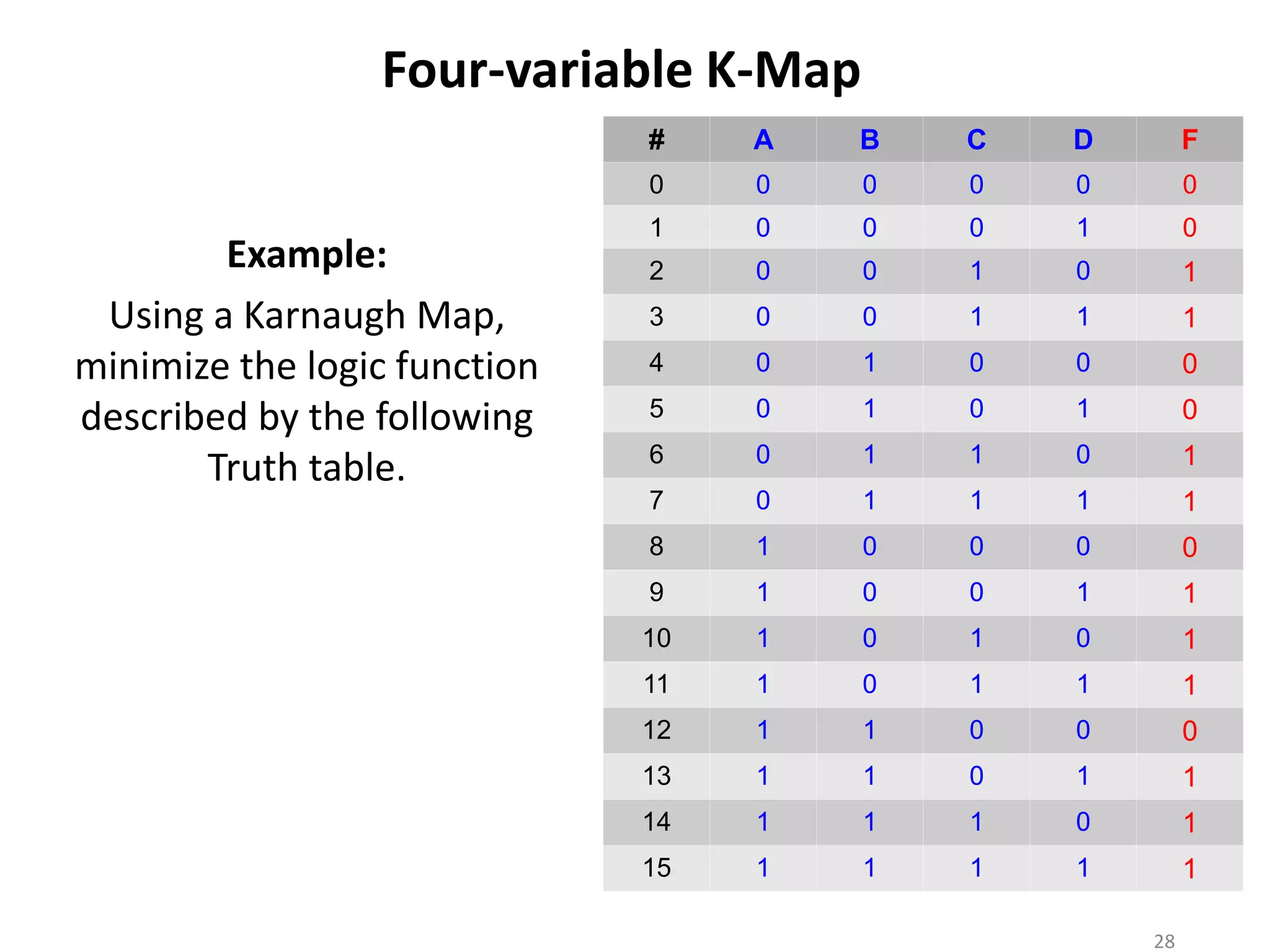
Four-variable K-Map
Example:
Using a Karnaugh Map,
minimize the logic function
described by the following
Truth table.
# A B C D F
0 0 0 0 0 0
1 0 0 0 1 0
2 0 0 1 0 1
3 0 0 1 1 1
4 0 1 0 0 0
5 0 1 0 1 0
6 0 1 1 0 1
7 0 1 1 1 1
8 1 0 0 0 0
9 1 0 0 1 1
10 1 0 1 0 1
11 1 0 1 1 1
12 1 1 0 0 0
13 1 1 0 1 1
14 1 1 1 0 1
15 1 1 1 1 1
28
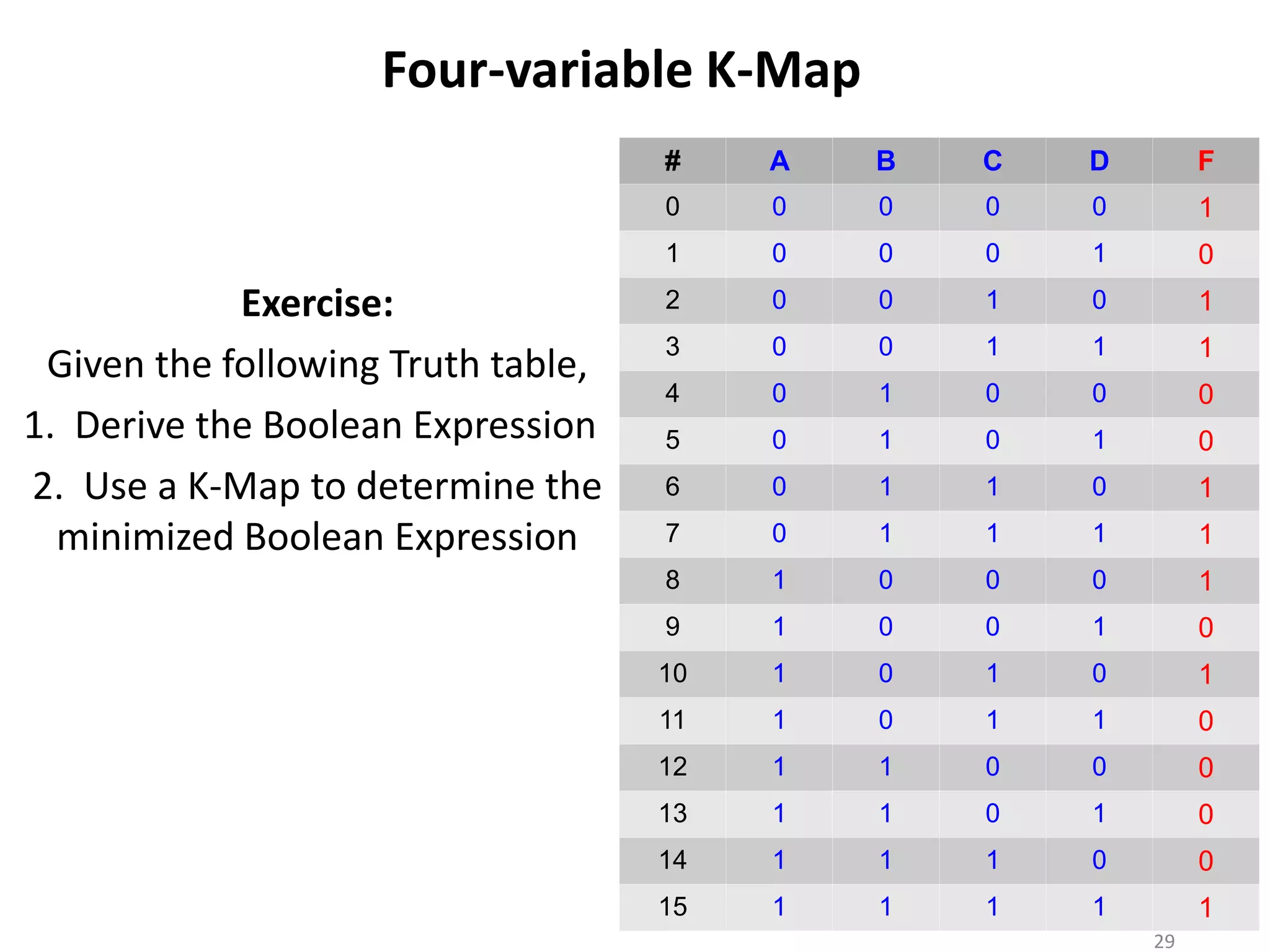
Exercise:
Given the following Truth table,
1. Derive the Boolean Expression
2. Use a K-Map to determine the
minimized Boolean Expression
# A B C D F
0 0 0 0 0 1
1 0 0 0 1 0
2 0 0 1 0 1
3 0 0 1 1 1
4 0 1 0 0 0
5 0 1 0 1 0
6 0 1 1 0 1
7 0 1 1 1 1
8 1 0 0 0 1
9 1 0 0 1 0
10 1 0 1 0 1
11 1 0 1 1 0
12 1 1 0 0 0
13 1 1 0 1 0
14 1 1 1 0 0
15 1 1 1 1 1
29
Four-variable K-Map
Minimization using K-Maps
(Deriving a POS Expression using the Maxterms)
30
Minimization using K-maps
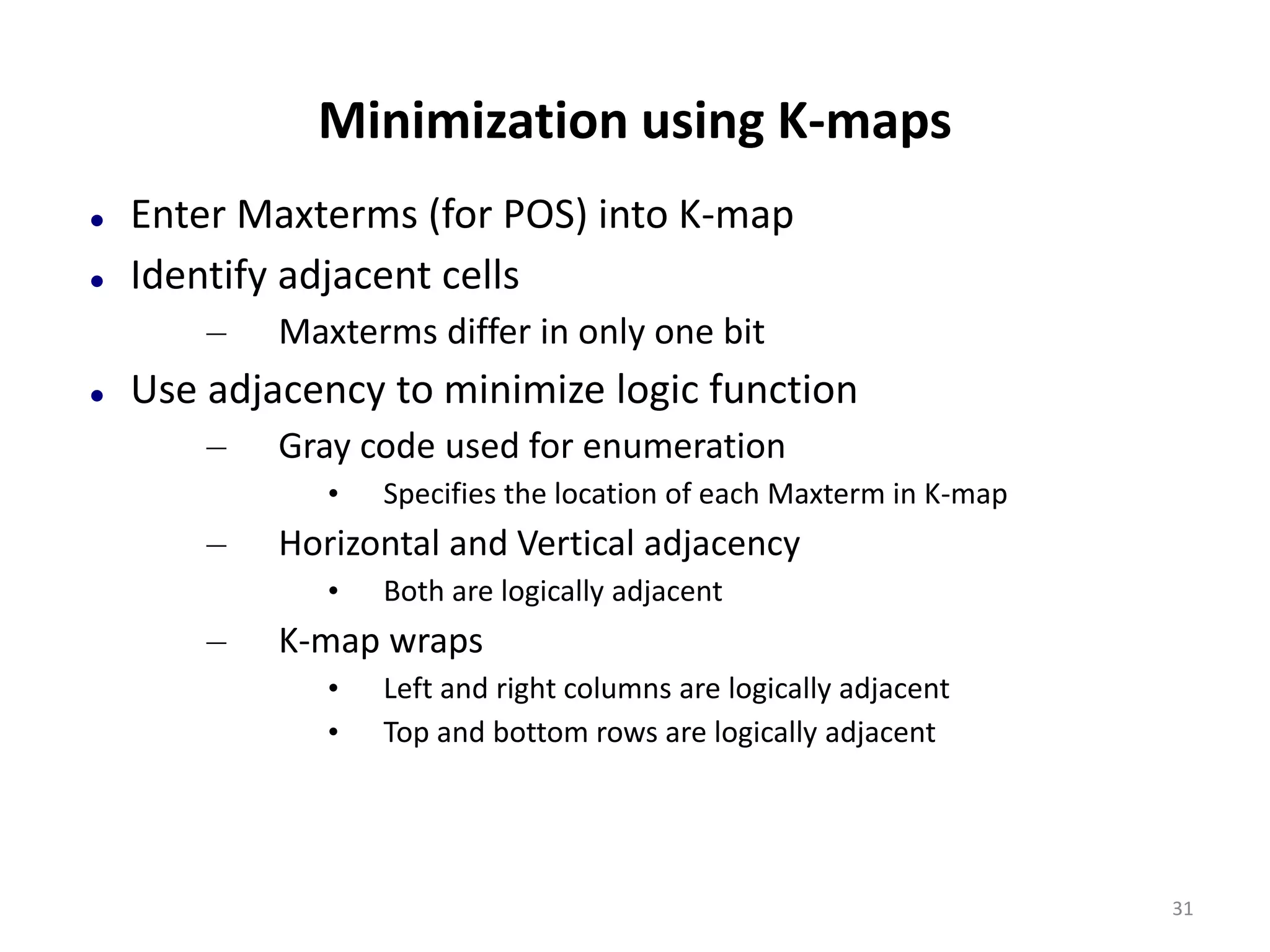
 Enter Maxterms (for POS) into K-map
 Identify adjacent cells
– Maxterms differ in only one bit
 Use adjacency to minimize logic function
– Gray code used for enumeration
• Specifies the location of each Maxterm in K-map
– Horizontal and Vertical adjacency
• Both are logically adjacent
– K-map wraps
• Left and right columns are logically adjacent
• Top and bottom rows are logically adjacent
31
Three-variable K-Map
Example:
Using a K-Map, minimize the logic function described by
the following Truth table.
# A B C F
0 0 0 0 0
1 0 0 1 1
2 0 1 0 0
3 0 1 1 0
4 1 0 0 1
5 1 0 1 1
6 1 1 0 1
7 1 1 1 0
32
Four-variable K-Map
Example:
Using a K-Map, minimize the
logic function described by
the following Truth table.
# A B C D F
0 0 0 0 0 0
1 0 0 0 1 0
2 0 0 1 0 1
3 0 0 1 1 1
4 0 1 0 0 0
5 0 1 0 1 0
6 0 1 1 0 1
7 0 1 1 1 1
8 1 0 0 0 0
9 1 0 0 1 1
10 1 0 1 0 1
11 1 0 1 1 1
12 1 1 0 0 0
13 1 1 0 1 1
14 1 1 1 0 1
15 1 1 1 1 1
33
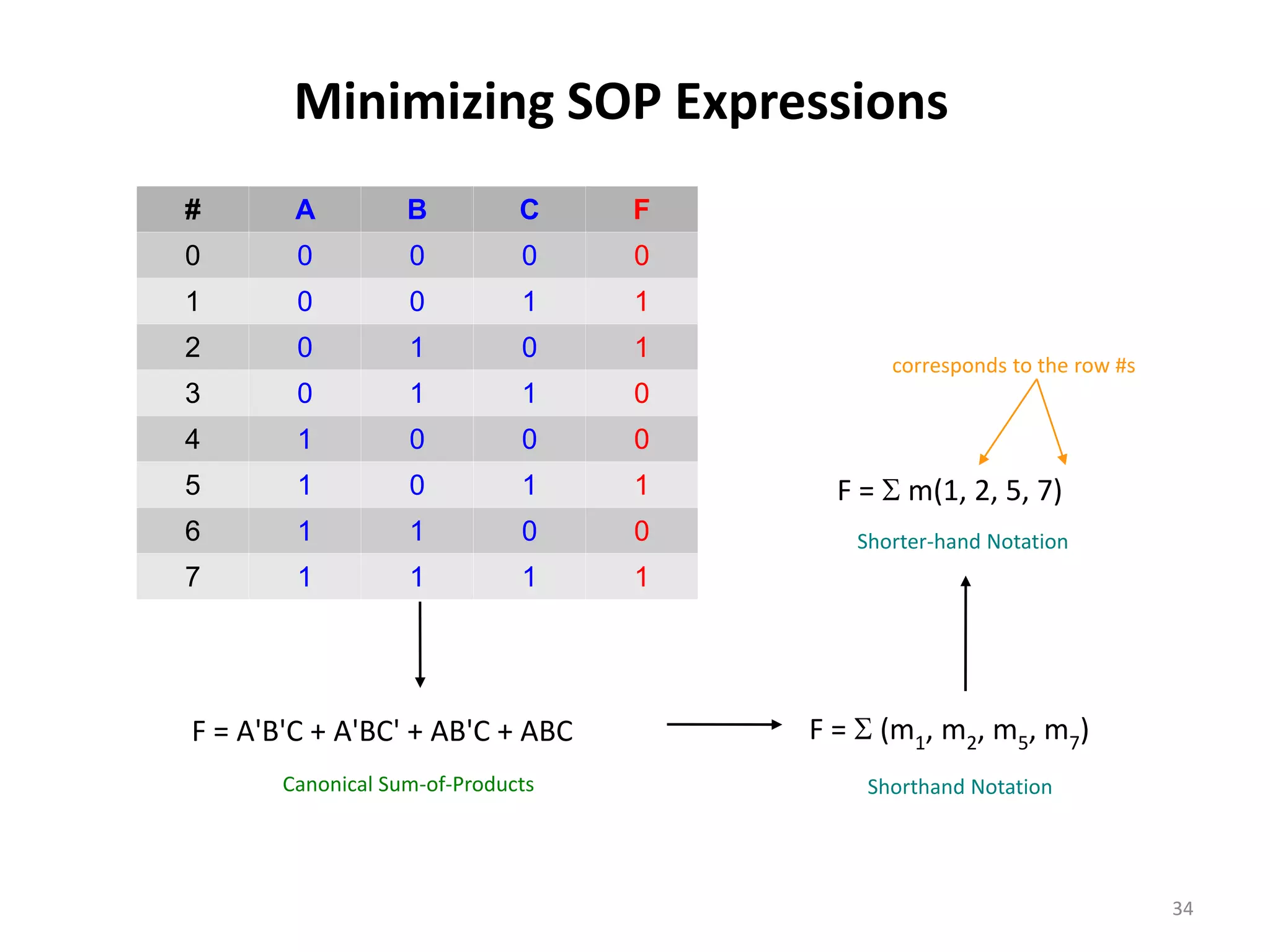
Minimizing SOP Expressions
# A B C F
0 0 0 0 0
1 0 0 1 1
2 0 1 0 1
3 0 1 1 0
4 1 0 0 0
5 1 0 1 1
6 1 1 0 0
7 1 1 1 1
F = A'B'C + A'BC' + AB'C + ABC
Canonical Sum-of-Products
F = S (m1, m2, m5, m7)
Shorthand Notation
F = S m(1, 2, 5, 7)
Shorter-hand Notation
corresponds to the row #s
34
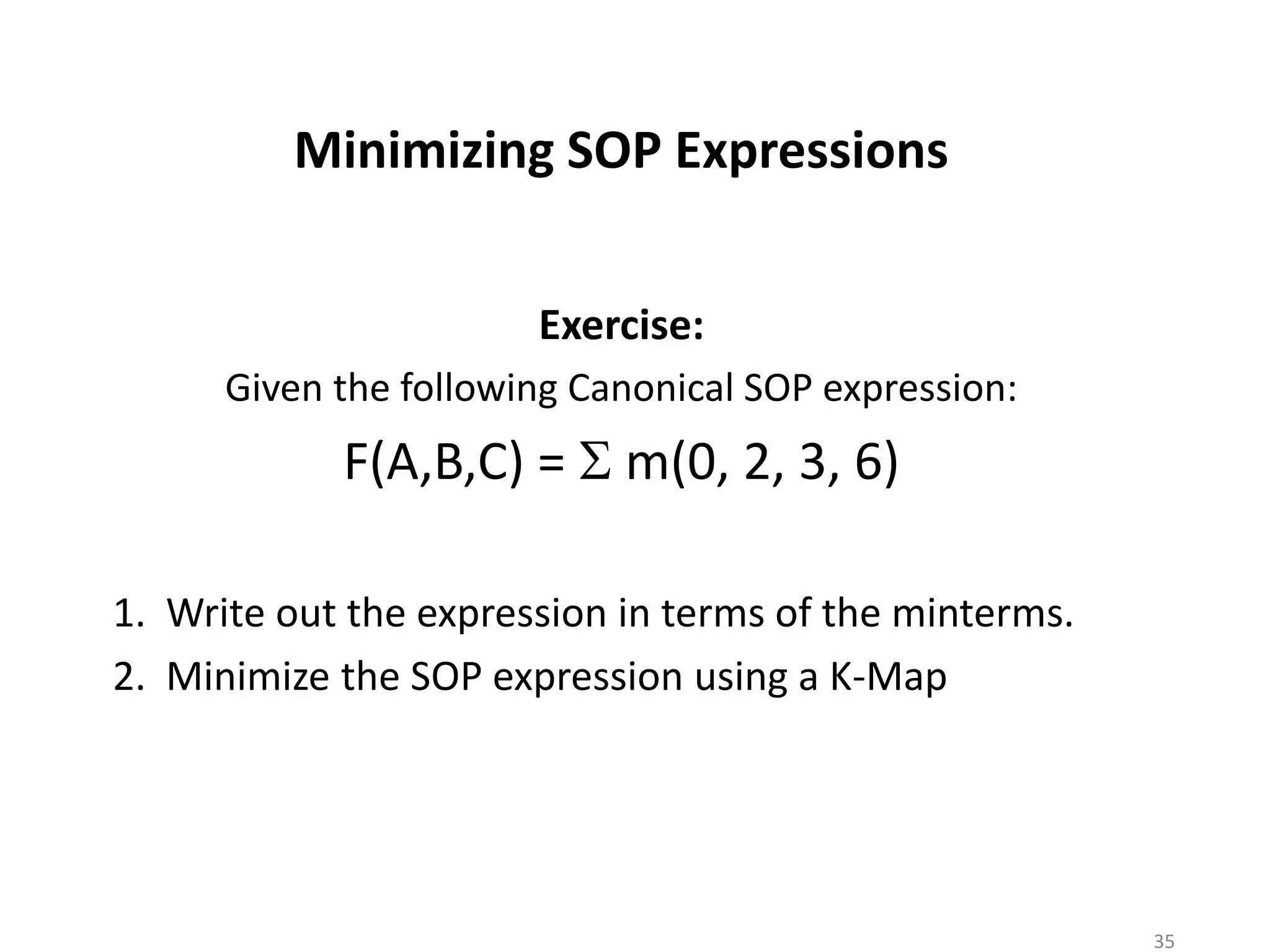
Minimizing SOP Expressions
Exercise:
Given the following Canonical SOP expression:
F(A,B,C) = S m(0, 2, 3, 6)
1. Write out the expression in terms of the minterms.
2. Minimize the SOP expression using a K-Map
35
Minimizing SOP Expressions
Exercise: Given the following Canonical SOP expression,
F(A,B,C) = S m(1, 4, 5, 6, 7)
1. Write out the expression in terms of the minterms.
2. Minimize the SOP expression using a K-Map
Exercise: Given the following Canonical SOP expression,
F(A,B,C,D) = S m(0, 4, 8, 10, 11, 12, 13, 15)
1. Write out the expression in terms of the minterms.
2. Minimize the SOP expression using a K-Map
36
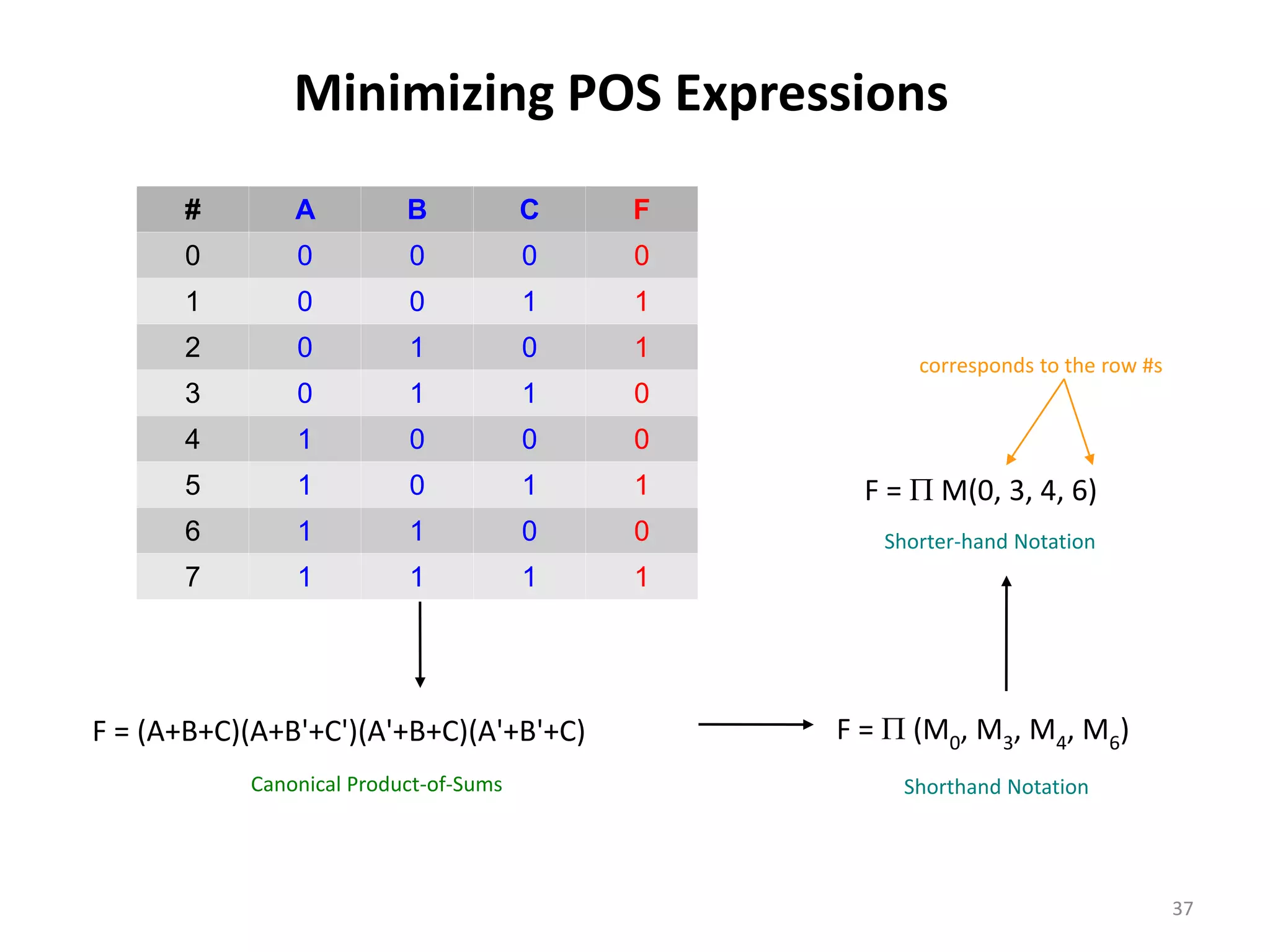
Minimizing POS Expressions
# A B C F
0 0 0 0 0
1 0 0 1 1
2 0 1 0 1
3 0 1 1 0
4 1 0 0 0
5 1 0 1 1
6 1 1 0 0
7 1 1 1 1
F = (A+B+C)(A+B'+C')(A'+B+C)(A'+B'+C)
Canonical Product-of-Sums
F = P (M0, M3, M4, M6)
Shorthand Notation
F = P M(0, 3, 4, 6)
Shorter-hand Notation
corresponds to the row #s
37
Minimizing POS Expressions
Exercise:
Given the following Canonical POS expression:
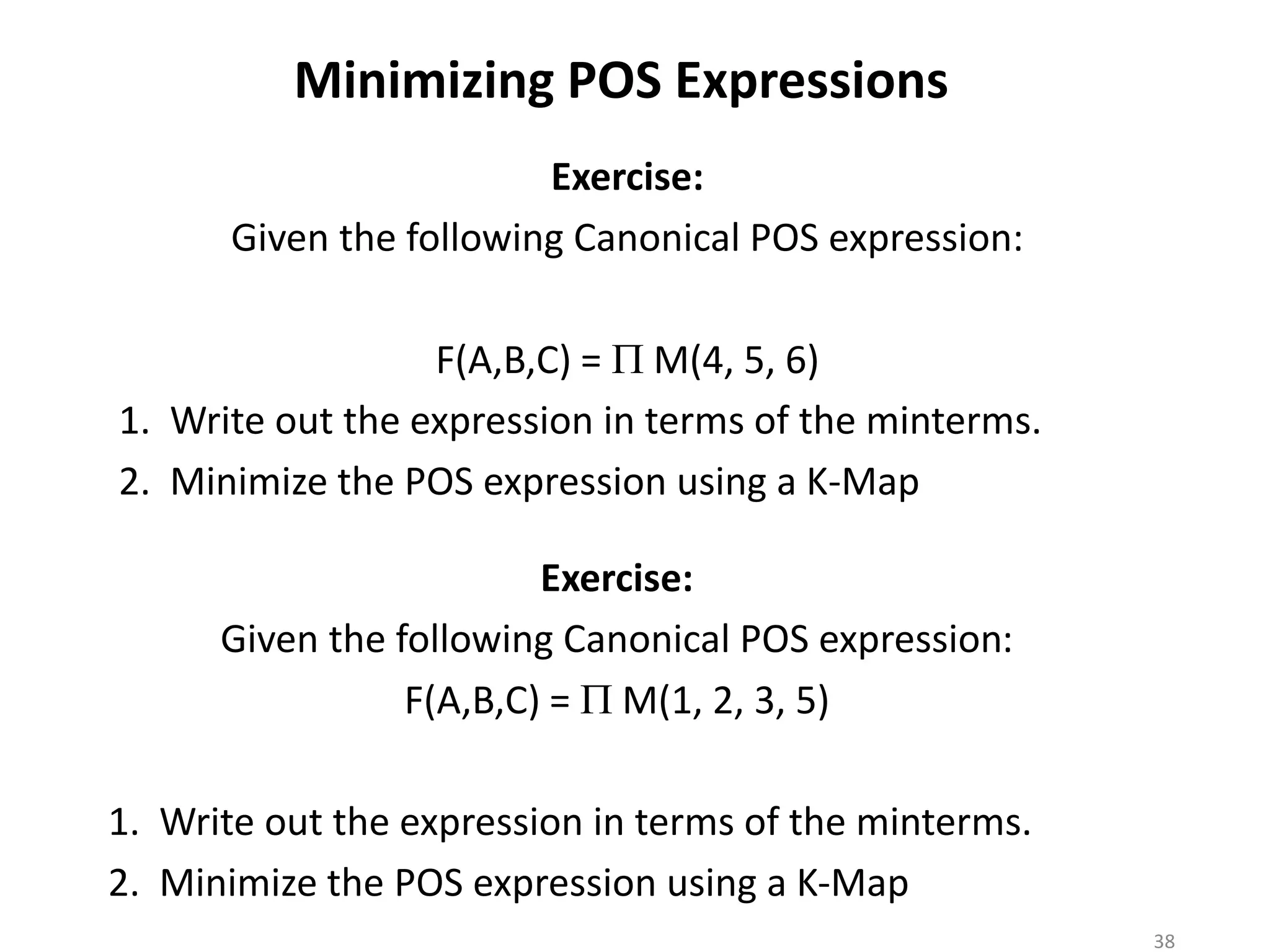
F(A,B,C) = P M(4, 5, 6)
1. Write out the expression in terms of the minterms.
2. Minimize the POS expression using a K-Map
Exercise:
Given the following Canonical POS expression:
F(A,B,C) = P M(1, 2, 3, 5)
1. Write out the expression in terms of the minterms.
2. Minimize the POS expression using a K-Map
38
Minimizing POS Expressions
Exercise:
Given the following Canonical POS expression:
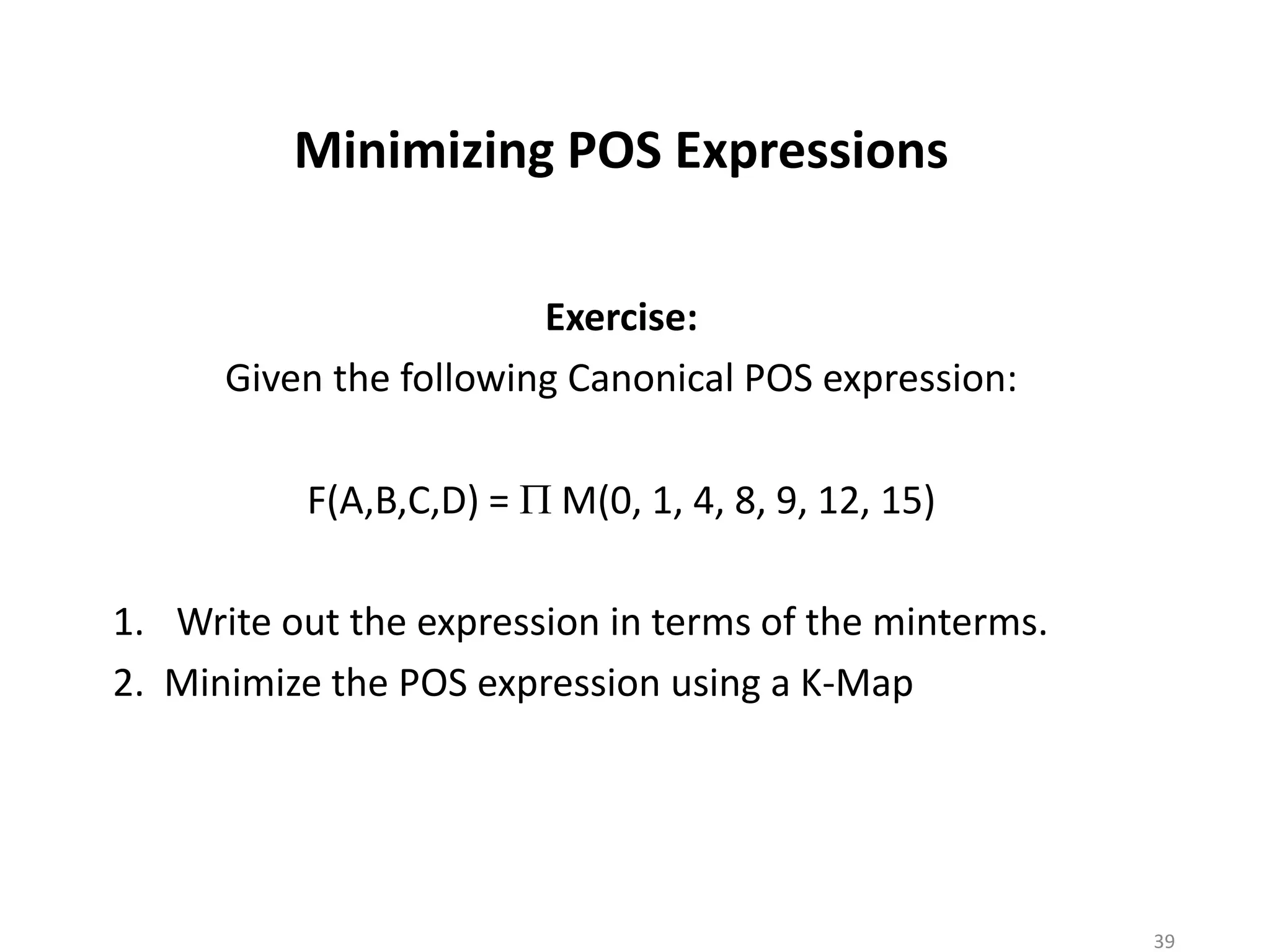
F(A,B,C,D) = P M(0, 1, 4, 8, 9, 12, 15)
1. Write out the expression in terms of the minterms.
2. Minimize the POS expression using a K-Map
39
Minimizing Boolean Expressions using
K-maps for
Incompletely Specified Functions
40
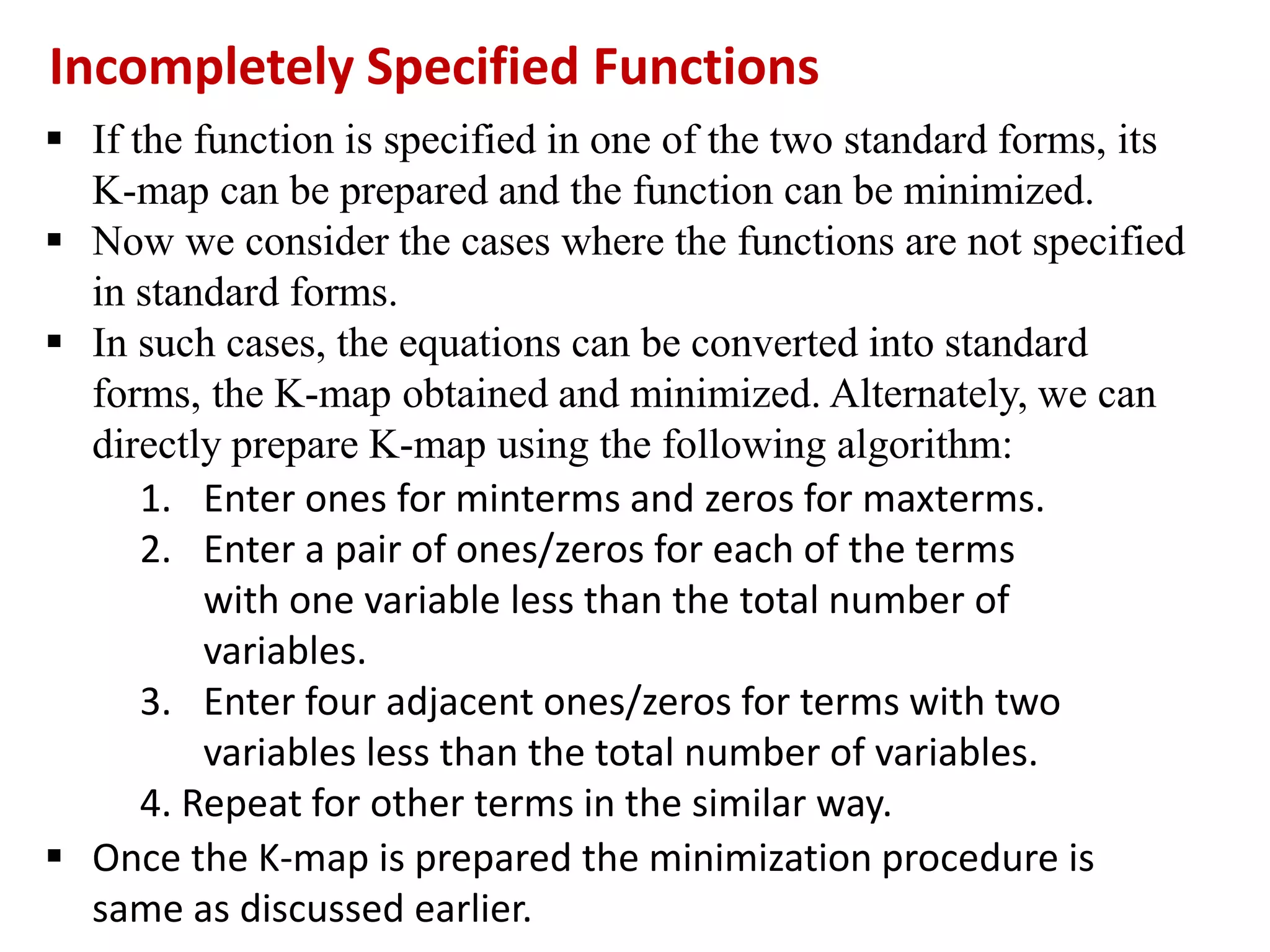
 If the function is specified in one of the two standard forms, its
K-map can be prepared and the function can be minimized.
 Now we consider the cases where the functions are not specified
in standard forms.
 In such cases, the equations can be converted into standard
forms, the K-map obtained and minimized. Alternately, we can
directly prepare K-map using the following algorithm:
Incompletely Specified Functions
1. Enter ones for minterms and zeros for maxterms.
2. Enter a pair of ones/zeros for each of the terms
with one variable less than the total number of
variables.
3. Enter four adjacent ones/zeros for terms with two
variables less than the total number of variables.
4. Repeat for other terms in the similar way.
 Once the K-map is prepared the minimization procedure is
same as discussed earlier.
Example :Minimize the following four variable logic function
𝑓 𝐴, 𝐵, 𝐶, 𝐷 = 𝐴𝐵𝐶′𝐷 + 𝐴′𝐵𝐶𝐷 + 𝐴′𝐵′𝐶′ + 𝐴′𝐵′𝐷′ + 𝐴𝐶′ + 𝐵′
Solution: The method for obtaining K-map is
1. Enter 1 in the cell corresponding to the miniterms 𝐴𝐵𝐶′𝐷 and 𝐴′𝐵𝐶𝐷
2. Enter 1 in the two cells corresponding to the miniterm 𝐴′𝐵′𝐶′
3. Enter 1 in the two cells (one of these is already entered) corresponding to the
miniterm 𝐴′𝐵′𝐷′
4. Enter 1 in the two cells corresponding to the miniterm 𝐴𝐵′𝐶
5. Enter 1 in the four cells (one of these is already entered) corresponding to the
miniterm 𝐴𝐶′
6. Enter 1 in the eight cells (all of them except one have already been entered)
corresponding to the miniterm 𝐵′
Incompletely Specified Functions
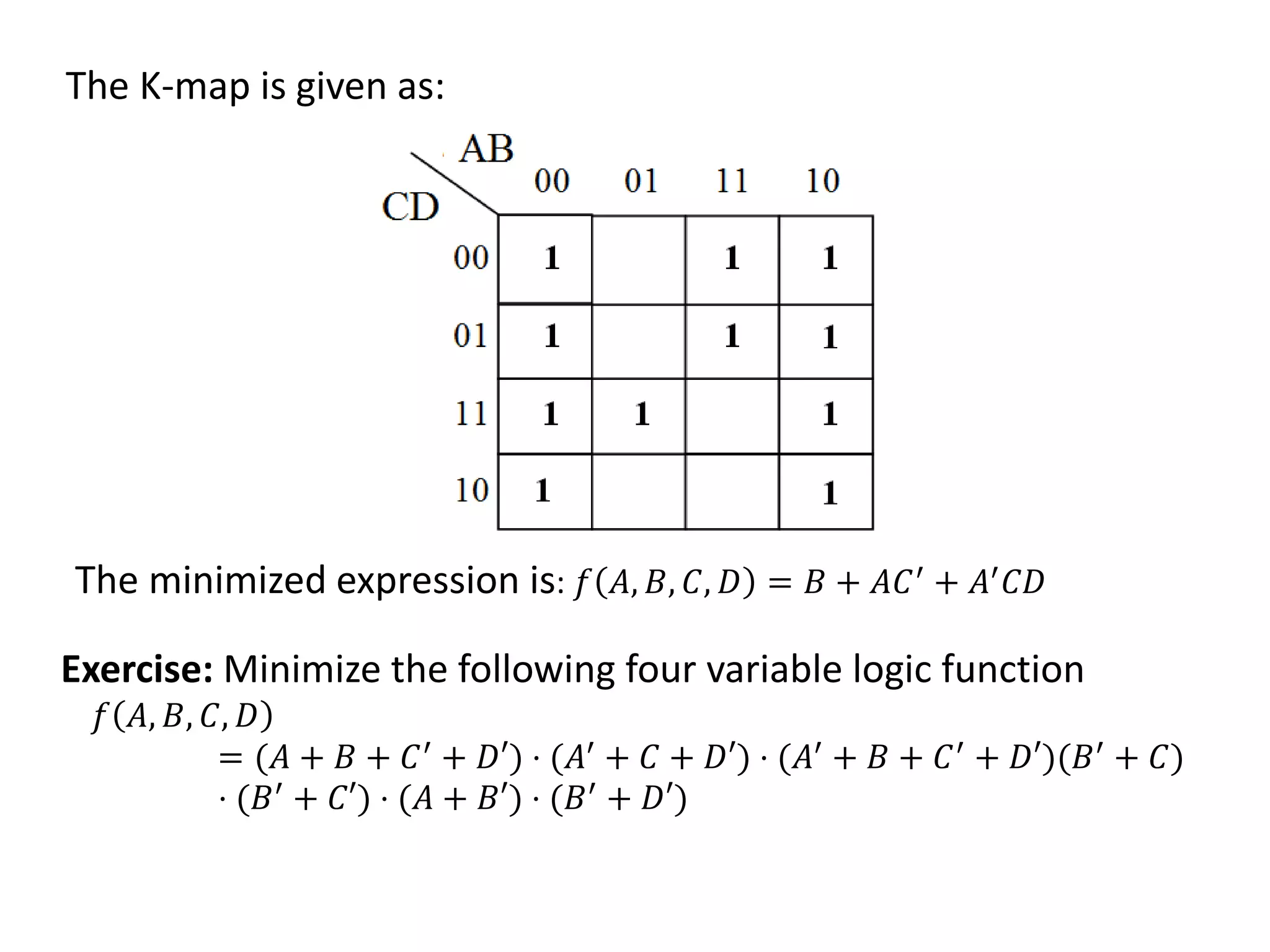
The K-map is given as:
Exercise: Minimize the following four variable logic function
𝑓 𝐴, 𝐵, 𝐶, 𝐷
= (𝐴 + 𝐵 + 𝐶′ + 𝐷′) ⋅ (𝐴′ + 𝐶 + 𝐷′) ⋅ (𝐴′ + 𝐵 + 𝐶′ + 𝐷′)(𝐵′ + 𝐶)
⋅ (𝐵′ + 𝐶′) ⋅ (𝐴 + 𝐵′) ⋅ (𝐵′ + 𝐷′)
The minimized expression is: 𝑓 𝐴, 𝐵, 𝐶, 𝐷 = 𝐵 + 𝐴𝐶′ + 𝐴′𝐶𝐷
Don’t Care Conditions
45
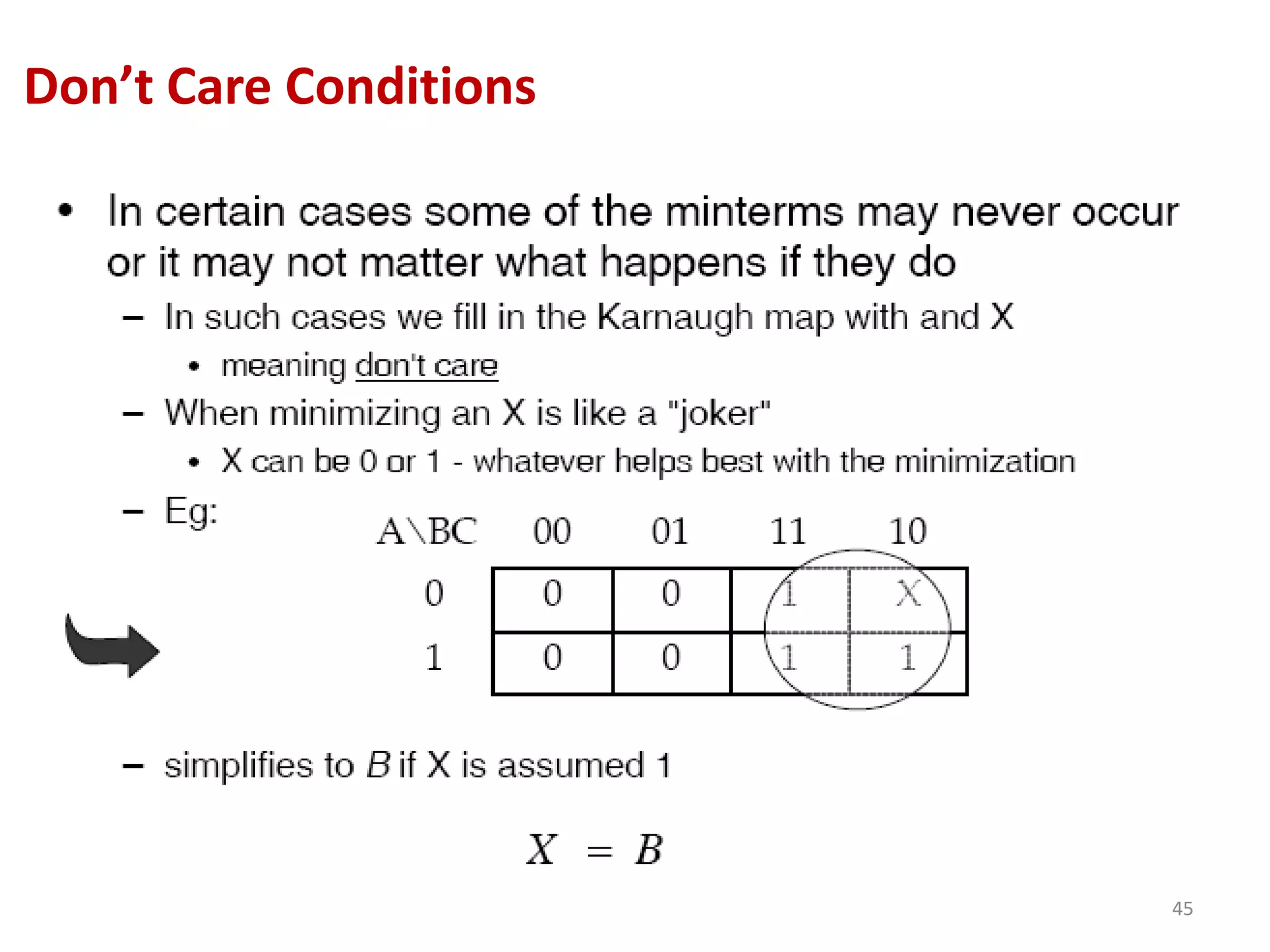
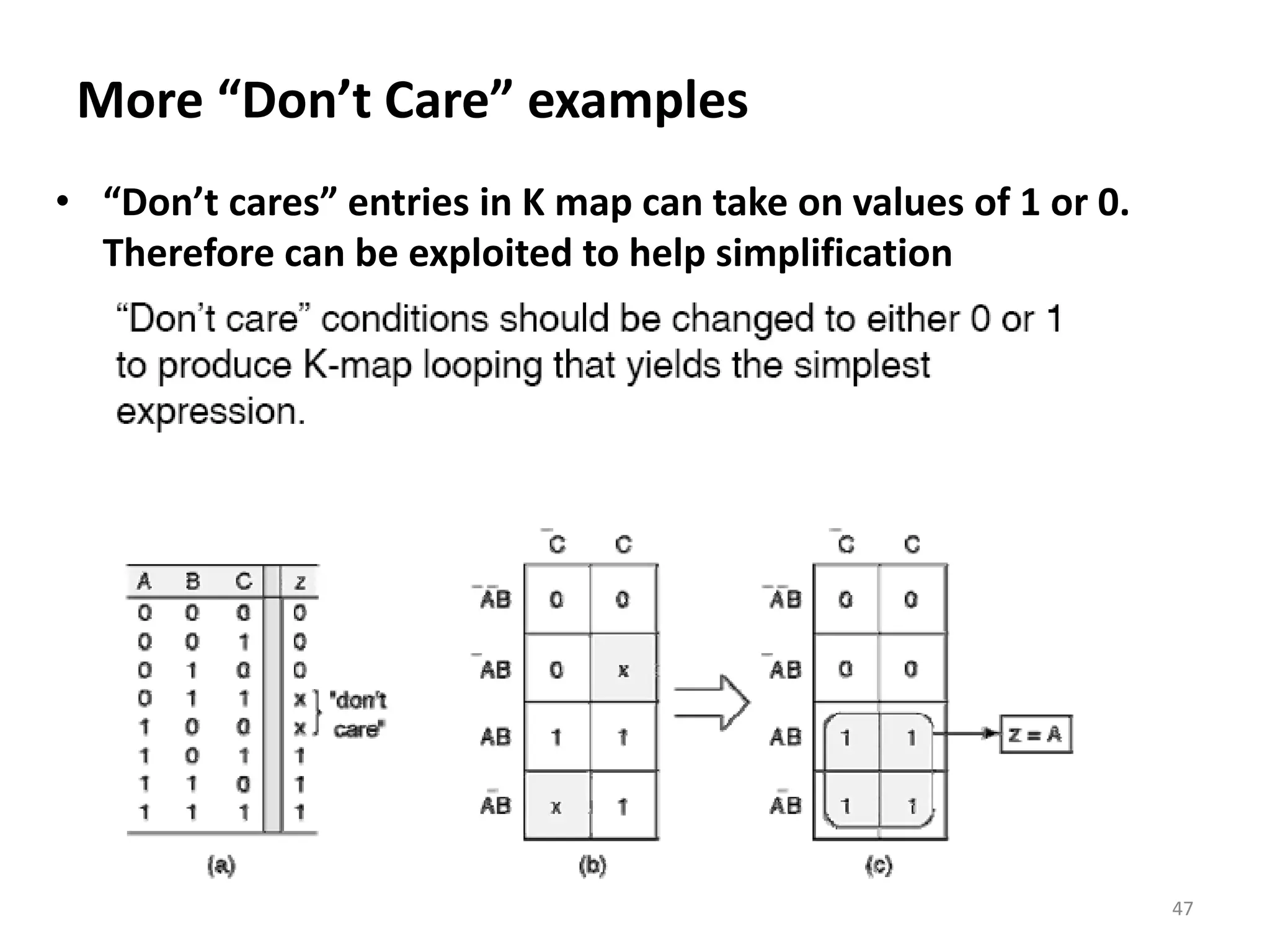
Don’t Care Conditions
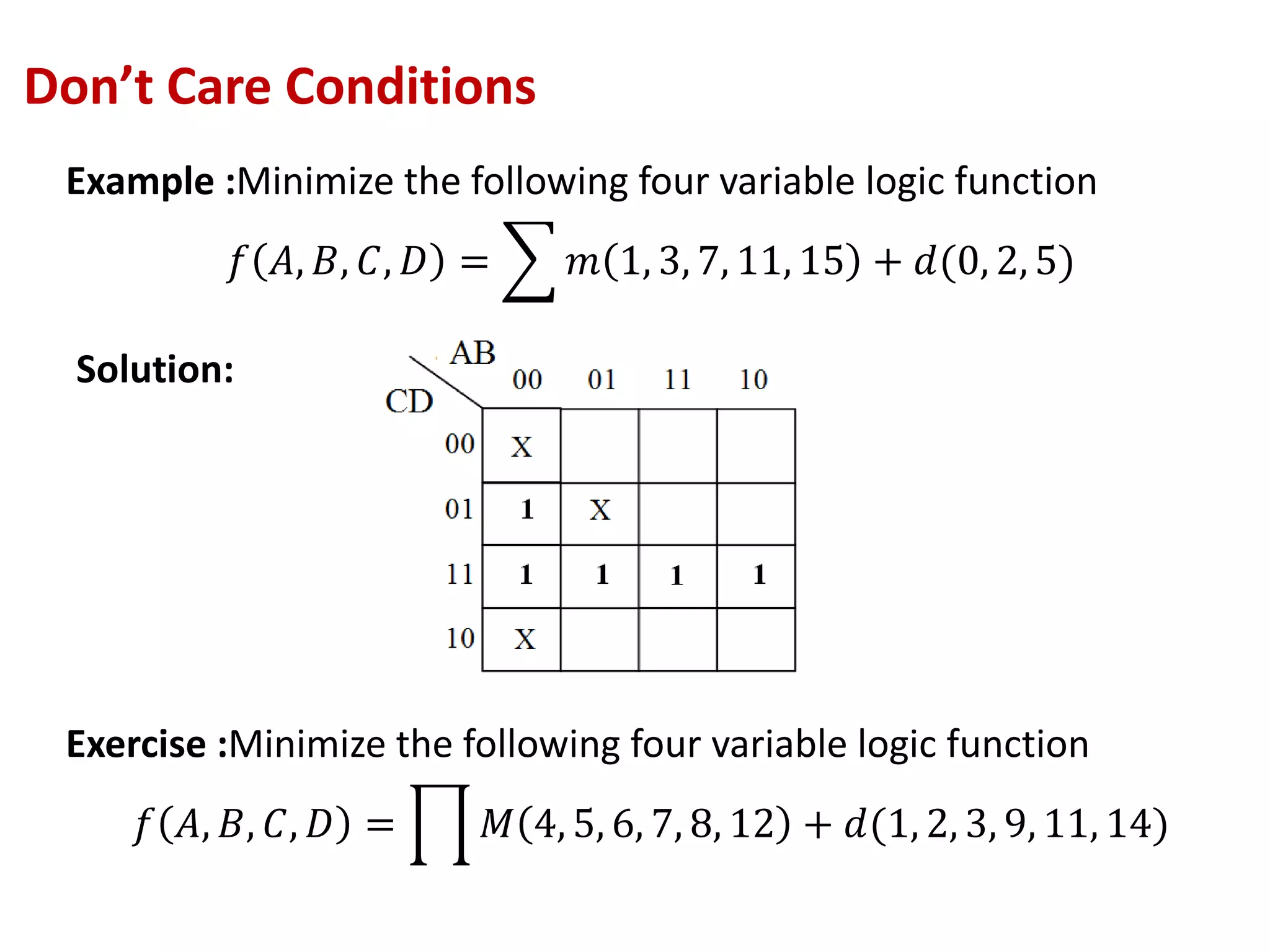
Example :Minimize the following four variable logic function
𝑓 𝐴, 𝐵, 𝐶, 𝐷 = 𝑚 1, 3, 7, 11, 15 + 𝑑(0, 2, 5)
Exercise :Minimize the following four variable logic function
𝑓 𝐴, 𝐵, 𝐶, 𝐷 = 𝑀 4, 5, 6, 7, 8, 12 + 𝑑(1, 2, 3, 9, 11, 14)
Solution:
More “Don’t Care” examples
• “Don’t cares” entries in K map can take on values of 1 or 0.
Therefore can be exploited to help simplification
47
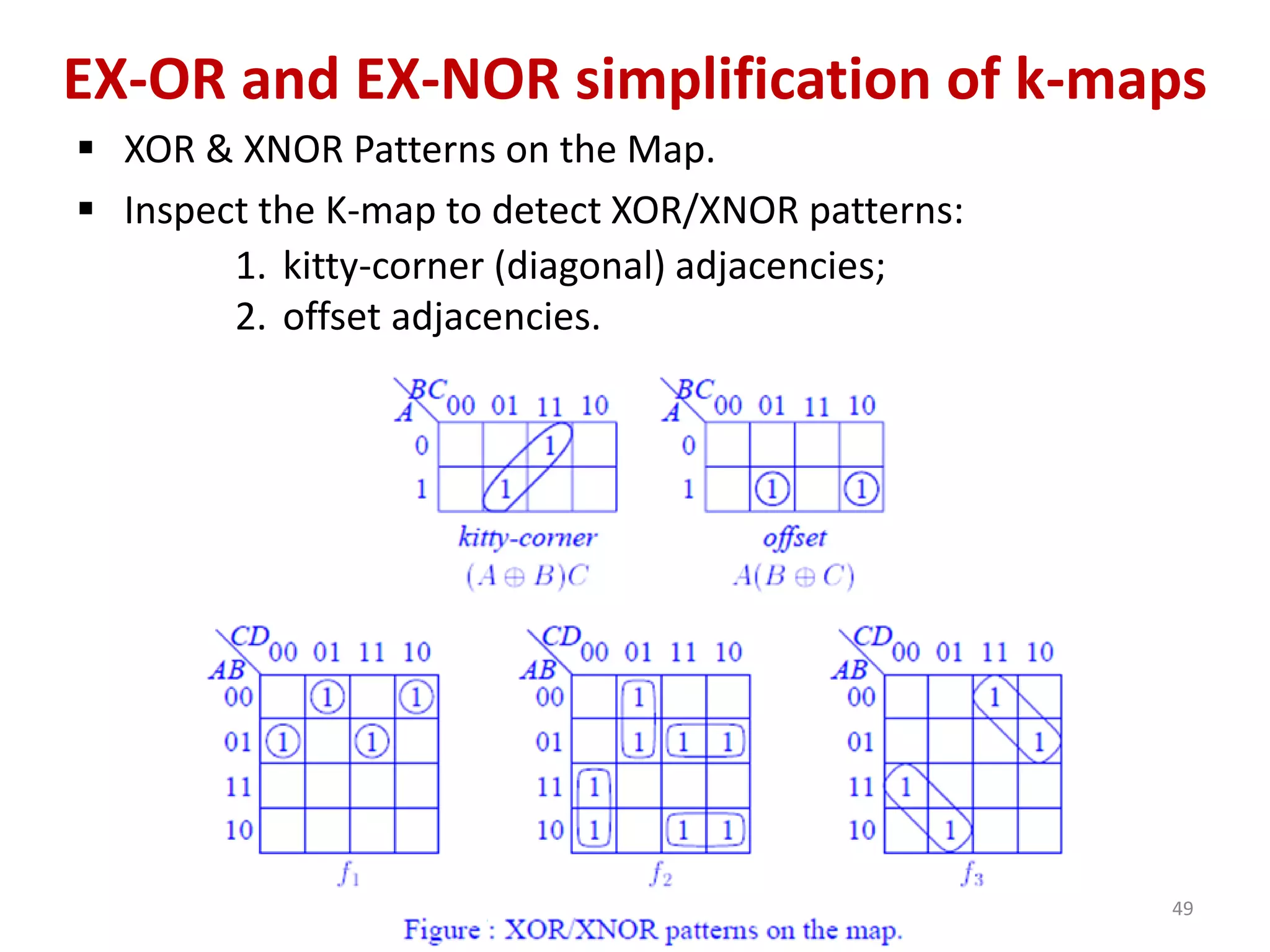
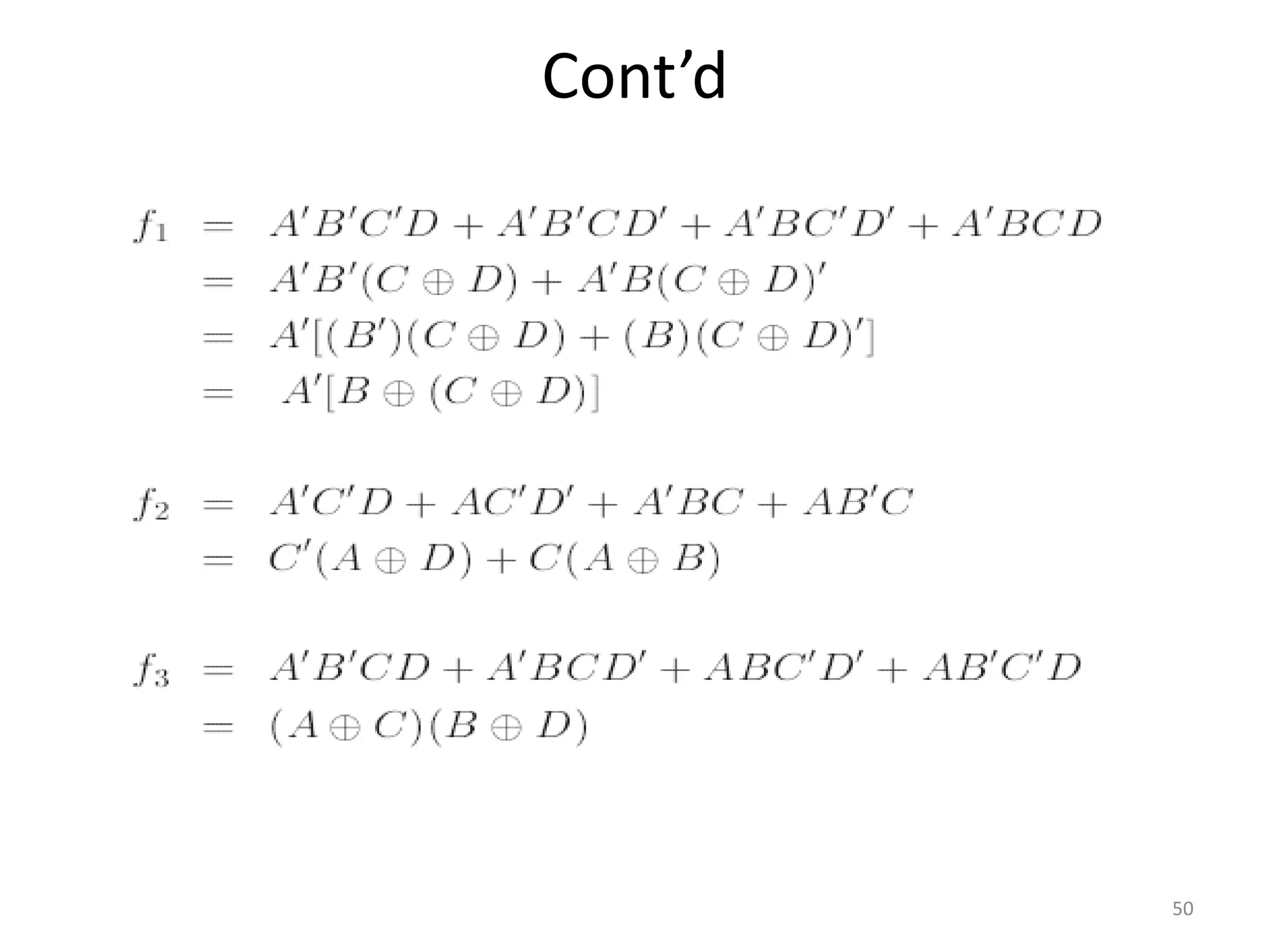
EX-OR and EX-NOR simplification of k-maps
 XOR & XNOR Patterns on the Map.
 Inspect the K-map to detect XOR/XNOR patterns:
49
1. kitty-corner (diagonal) adjacencies;
2. offset adjacencies.
Cont’d
50

Chapter-3.pdf

  • 1.
    Chapter 3 Simplification andminimization of Boolean functions 1
  • 2.
    Topics to becovered  Introduction  Karnaugh map representation of logical functions  Simplification of logical functions using K-maps.  Minimization of Boolean functions specified in minterms/ Maxterms or truth table  Don't-care Combinations  EX-OR and EX-NOR simplification of k-maps  The tabulation method of minimization 2
  • 3.
    Introduction  Since thereis no a set of rules for minimizing a Boolean function using identities, sometimes it is difficult to know whether the minimum expression is obtained.  We have seen in the preceding chapter about simplification using Boolean algebraic laws and theorems. But, in general the following methods can be used to simplify the Boolean function. 1. Algebraic method 2. Karnaugh map technique(mapping method) 3. Variable entered map(VEM) technique 4. Quine-MCClusky method(Tabular method)  We have introduced the algebraic method of simplification using Boolean algebraic theorems.  In this chapter, we will discuss about the simplification of logic functions using Karnaugh map method Quine-MCClusky method.  The Karnaugh map or simply K-map is the simple and most commonly used method. It can be used up to six variables. The VEM technique is beyond the scope of this course.
  • 5.
    K-map representation oflogic functions  The above figure shows the K-maps for two, three and four variables.  In an n-variable K-map there are 2n cells.  Each cell corresponds to one of the combinations of n-variables. Therefore we see that for each row of the truth table, for each minterm and for each maxterm, there is n specific cell in the K-map.  In each map the variables are indicated to identify the cells.  Gray code has been used for the identification of cells. The reason for using Gray code will become clear when we discuss the application of K-map.  You can verify the decimal number corresponding to each cell which is written in the bottom right corner of the cell.
  • 6.
    y (b) Karnaugh map 0 1 01 m0 m2 m3 m1 x Two-variable K-Map (a) Truth table x y 0 0 0 1 1 0 1 1 m0 m1 m3 m2 Row # 0 1 2 3 minterms MSB LSB x 0 1 0 1 m0 m1 m3 m2 y 6
  • 7.
    x1 x2 x3 00 0111 10 0 1 (b) Karnaugh map x2 x3 0 0 0 1 1 0 1 1 m 0 m 1 m 3 m 2 0 0 0 0 0 0 0 1 1 0 1 1 1 1 1 1 m 4 m 5 m 7 m 6 x1 (a) Truth table m 0 m 1 m 3 m 2 m 6 m 7 m 4 m 5 Three-variable K-Map 0 1 2 3 4 5 6 7 row # LSB Gray code x y z x y z x y z 7
  • 8.
    x1 x2 x3 x4 00 0111 10 00 01 11 10 x2 x4 x1 x3 m 0 m 1 m 5 m 4 m 12 m 13 m 8 m 9 m 3 m 2 m 6 m 7 m 15 m 14 m 11 m 10 Four-variable K-Map Gray code Gray code 8
  • 9.
  • 10.
    Representation of truthtable on K-map Consider the truth table of 3-variable logic function given below: Y = 𝑥1𝑥2𝑥3 + 𝑥1𝑥2𝑥3 + 𝑥1𝑥2𝑥3 + 𝑥1𝑥2𝑥3 Row No. Inputs Outputs 𝑥1 𝑥2 𝑥3 Y 0 0 0 0 1 1 0 0 1 1 2 0 1 0 1 3 0 1 1 0 4 1 0 0 1 5 1 0 1 0 6 1 1 0 0 7 1 1 1 0 table represents the complete truth table in SOP form K-map for the above figure
  • 11.
     On theother hand, if a K-map is given we can make a truth table corresponding to this by reverse process, i.e. output Y is logic "1" corresponding to minterms represented by cells with entries 1. In the all remaining rows the output is logic "0".  Example: prepare a truth table for the following K-map. Row No. Inputs Output 𝑥1 𝑥2 𝑥3 𝑥4 Y 0 0 0 0 0 1 1 0 0 0 1 0 2 0 0 1 0 1 Solution:
  • 12.
    Representation of standardSOP form on K-map  A logical function in standard SOP form can be represented on a K- map simply by entering 1’s in the cells of the K-map corresponding to each minterms present in the function.  Example: represent the following equation on K-map. Y = 𝑥1𝑥2𝑥3 + 𝑥1𝑥2𝑥3 + 𝑥1𝑥2𝑥3 + 𝑥1𝑥2𝑥3 Solution:…………..? Representation of standard POS form on K-map  A logical function in standard POS form can be represented on a K- map simply by entering 0’s in the cells of the K-map corresponding to each maxterms present in the equation. Example: represent the following equation on K-map. Y = 𝑥1 + 𝑥2 + 𝑥3 𝑥1 + 𝑥2 + 𝑥3 𝑥1 + 𝑥2 + 𝑥3 (𝑥1 + 𝑥2 + 𝑥3) Solution:………….?
  • 13.
    Simplification and minimizationof Boolean functions  Simplification of logical functions with K-map is based on the principles of combining terms in adjacent cells. Two cells are said to be adjacent if they differ by one variable i.e. primed in one cell and unprimed in the other. Left most cells adjacent to the corresponding right most cells and most top cells are adjacent to most bottom cells.  The simplification of logical function is achieved by grouping adjacent 1’s or 0’s in groups of 2𝑖, where 𝑖 = 1,2,3, … , 𝑛 is the number of variables and each group should be as large as possible. Refer from your text book on page 140,141 and 143 (table 5.5, 5.6, and 5.7).
  • 14.
    14 A. Grouping twoadjacent one’s  If there are two adjacent cells on the map these can be grouped together and the resulting term will have one less literal than the original two terms.
  • 15.
  • 16.
    16 B. Grouping fouradjacent one’s  Four cells form a group of four adjacent one’s, if two of the literals associated with the minterms or maxterms are not the same.
  • 17.
    Example: simplify thefollowing K-map Solution:
  • 18.
    C. Grouping eightadjacent one’s  Eight cells form a group of eight adjacent one’s, if three of the literals associated with the minterms/maxterms are not the same and the other literals are the same. For 3-variable K-map, there is only one possibility of eight one’s corresponding in the K-map and this corresponds to output Y = 1, irrespective of the values of the inputs. For 4-variable K-map, there are eight possible grouping of eight adjacent one’s. (see table 4.7 on page 143)
  • 19.
    Some of possible8 adjacent one’s 19
  • 20.
    D. Grouping 2,4, and 8 adjacent zero’s  In the above discussion, we have considered groups of 2, 4, and 8 adjacent one’s. Instead of making the groups of one’s, we can also make groups of zero’s. the procedure is similar to the one used above. Example: 1. Given the following Boolean function 𝐹 = 𝐴′ 𝐶 + 𝐴′ 𝐵 + 𝐴𝐵′ 𝐶 + 𝐵𝐶 a. Express it in sum of minterms b. Find the minimal sum of products expression 2. Minimize the following expression using K-map 𝐹 𝑥1, 𝑥2, 𝑥3 = 𝑚(2,4,5,6,7) 3. Simplify using K-map 𝐹 𝑥1, 𝑥2, 𝑥3, 𝑥4 = 𝑚(0,2,3,7,11,13,14,15)
  • 21.
    Minimization of Booleanfunctions specified in minterms/ Maxterms or truth table
  • 22.
    Minimization using K-Maps (Derivinga SOP Expression using the Maxterms)  Enter minterms (for SOP) into K-map  Identify adjacent cells – Minterms differ in only one bit  Use adjacency to minimize logic function – Gray code used for enumeration • Specifies the location of each minterm in K-map – Horizontal and Vertical adjacency • Both are logically adjacent – K-map wraps • Left and right columns are logically adjacent • Top and bottom rows are logically adjacent 22
  • 23.
    Minimization using K-Maps Group adjacent cells to reduce – the number of literals in a term – the number of terms in a Boolean expression  Adjacencies are of size 1, 2, 4, 8, …  Number of adjacent cells is a power of 2  Adjacent cells form a rectangle  The larger the grouping of adjacent cells the greater the minimization of the logical function. 23
  • 24.
    Two-variable K-Map Example: Using aKarnaugh Map, minimize the logic function described by the following Truth table. # A B F 0 0 0 1 1 0 1 1 2 1 0 0 3 1 1 1 24
  • 25.
    Three-variable K-Map Example: Using aKarnaugh Map, minimize the logic function described by the following Truth table. # A B C F 0 0 0 0 0 1 0 0 1 1 2 0 1 0 0 3 0 1 1 0 4 1 0 0 1 5 1 0 1 1 6 1 1 0 1 7 1 1 1 0 25
  • 26.
    Exercise: Given the followingTruth table, 1. Derive the Boolean Expression 2. Use a K-Map to determine the minimized Boolean Expression Minimization using K-Maps # A B C F 0 0 0 0 1 1 0 0 1 0 2 0 1 0 1 3 0 1 1 0 4 1 0 0 1 5 1 0 1 1 6 1 1 0 1 7 1 1 1 0 26
  • 27.
    Four-variable K-Map Example: Using aKarnaugh Map, minimize the logic function described by the following Truth table. # A B C D F 0 0 0 0 0 0 1 0 0 0 1 0 2 0 0 1 0 1 3 0 0 1 1 1 4 0 1 0 0 0 5 0 1 0 1 0 6 0 1 1 0 0 7 0 1 1 1 0 8 1 0 0 0 0 9 1 0 0 1 1 10 1 0 1 0 1 11 1 0 1 1 1 12 1 1 0 0 0 13 1 1 0 1 1 14 1 1 1 0 0 15 1 1 1 1 0 27
  • 28.
    Four-variable K-Map Example: Using aKarnaugh Map, minimize the logic function described by the following Truth table. # A B C D F 0 0 0 0 0 0 1 0 0 0 1 0 2 0 0 1 0 1 3 0 0 1 1 1 4 0 1 0 0 0 5 0 1 0 1 0 6 0 1 1 0 1 7 0 1 1 1 1 8 1 0 0 0 0 9 1 0 0 1 1 10 1 0 1 0 1 11 1 0 1 1 1 12 1 1 0 0 0 13 1 1 0 1 1 14 1 1 1 0 1 15 1 1 1 1 1 28
  • 29.
    Exercise: Given the followingTruth table, 1. Derive the Boolean Expression 2. Use a K-Map to determine the minimized Boolean Expression # A B C D F 0 0 0 0 0 1 1 0 0 0 1 0 2 0 0 1 0 1 3 0 0 1 1 1 4 0 1 0 0 0 5 0 1 0 1 0 6 0 1 1 0 1 7 0 1 1 1 1 8 1 0 0 0 1 9 1 0 0 1 0 10 1 0 1 0 1 11 1 0 1 1 0 12 1 1 0 0 0 13 1 1 0 1 0 14 1 1 1 0 0 15 1 1 1 1 1 29 Four-variable K-Map
  • 30.
    Minimization using K-Maps (Derivinga POS Expression using the Maxterms) 30
  • 31.
    Minimization using K-maps Enter Maxterms (for POS) into K-map  Identify adjacent cells – Maxterms differ in only one bit  Use adjacency to minimize logic function – Gray code used for enumeration • Specifies the location of each Maxterm in K-map – Horizontal and Vertical adjacency • Both are logically adjacent – K-map wraps • Left and right columns are logically adjacent • Top and bottom rows are logically adjacent 31
  • 32.
    Three-variable K-Map Example: Using aK-Map, minimize the logic function described by the following Truth table. # A B C F 0 0 0 0 0 1 0 0 1 1 2 0 1 0 0 3 0 1 1 0 4 1 0 0 1 5 1 0 1 1 6 1 1 0 1 7 1 1 1 0 32
  • 33.
    Four-variable K-Map Example: Using aK-Map, minimize the logic function described by the following Truth table. # A B C D F 0 0 0 0 0 0 1 0 0 0 1 0 2 0 0 1 0 1 3 0 0 1 1 1 4 0 1 0 0 0 5 0 1 0 1 0 6 0 1 1 0 1 7 0 1 1 1 1 8 1 0 0 0 0 9 1 0 0 1 1 10 1 0 1 0 1 11 1 0 1 1 1 12 1 1 0 0 0 13 1 1 0 1 1 14 1 1 1 0 1 15 1 1 1 1 1 33
  • 34.
    Minimizing SOP Expressions #A B C F 0 0 0 0 0 1 0 0 1 1 2 0 1 0 1 3 0 1 1 0 4 1 0 0 0 5 1 0 1 1 6 1 1 0 0 7 1 1 1 1 F = A'B'C + A'BC' + AB'C + ABC Canonical Sum-of-Products F = S (m1, m2, m5, m7) Shorthand Notation F = S m(1, 2, 5, 7) Shorter-hand Notation corresponds to the row #s 34
  • 35.
    Minimizing SOP Expressions Exercise: Giventhe following Canonical SOP expression: F(A,B,C) = S m(0, 2, 3, 6) 1. Write out the expression in terms of the minterms. 2. Minimize the SOP expression using a K-Map 35
  • 36.
    Minimizing SOP Expressions Exercise:Given the following Canonical SOP expression, F(A,B,C) = S m(1, 4, 5, 6, 7) 1. Write out the expression in terms of the minterms. 2. Minimize the SOP expression using a K-Map Exercise: Given the following Canonical SOP expression, F(A,B,C,D) = S m(0, 4, 8, 10, 11, 12, 13, 15) 1. Write out the expression in terms of the minterms. 2. Minimize the SOP expression using a K-Map 36
  • 37.
    Minimizing POS Expressions #A B C F 0 0 0 0 0 1 0 0 1 1 2 0 1 0 1 3 0 1 1 0 4 1 0 0 0 5 1 0 1 1 6 1 1 0 0 7 1 1 1 1 F = (A+B+C)(A+B'+C')(A'+B+C)(A'+B'+C) Canonical Product-of-Sums F = P (M0, M3, M4, M6) Shorthand Notation F = P M(0, 3, 4, 6) Shorter-hand Notation corresponds to the row #s 37
  • 38.
    Minimizing POS Expressions Exercise: Giventhe following Canonical POS expression: F(A,B,C) = P M(4, 5, 6) 1. Write out the expression in terms of the minterms. 2. Minimize the POS expression using a K-Map Exercise: Given the following Canonical POS expression: F(A,B,C) = P M(1, 2, 3, 5) 1. Write out the expression in terms of the minterms. 2. Minimize the POS expression using a K-Map 38
  • 39.
    Minimizing POS Expressions Exercise: Giventhe following Canonical POS expression: F(A,B,C,D) = P M(0, 1, 4, 8, 9, 12, 15) 1. Write out the expression in terms of the minterms. 2. Minimize the POS expression using a K-Map 39
  • 40.
    Minimizing Boolean Expressionsusing K-maps for Incompletely Specified Functions 40
  • 41.
     If thefunction is specified in one of the two standard forms, its K-map can be prepared and the function can be minimized.  Now we consider the cases where the functions are not specified in standard forms.  In such cases, the equations can be converted into standard forms, the K-map obtained and minimized. Alternately, we can directly prepare K-map using the following algorithm: Incompletely Specified Functions 1. Enter ones for minterms and zeros for maxterms. 2. Enter a pair of ones/zeros for each of the terms with one variable less than the total number of variables. 3. Enter four adjacent ones/zeros for terms with two variables less than the total number of variables. 4. Repeat for other terms in the similar way.  Once the K-map is prepared the minimization procedure is same as discussed earlier.
  • 42.
    Example :Minimize thefollowing four variable logic function 𝑓 𝐴, 𝐵, 𝐶, 𝐷 = 𝐴𝐵𝐶′𝐷 + 𝐴′𝐵𝐶𝐷 + 𝐴′𝐵′𝐶′ + 𝐴′𝐵′𝐷′ + 𝐴𝐶′ + 𝐵′ Solution: The method for obtaining K-map is 1. Enter 1 in the cell corresponding to the miniterms 𝐴𝐵𝐶′𝐷 and 𝐴′𝐵𝐶𝐷 2. Enter 1 in the two cells corresponding to the miniterm 𝐴′𝐵′𝐶′ 3. Enter 1 in the two cells (one of these is already entered) corresponding to the miniterm 𝐴′𝐵′𝐷′ 4. Enter 1 in the two cells corresponding to the miniterm 𝐴𝐵′𝐶 5. Enter 1 in the four cells (one of these is already entered) corresponding to the miniterm 𝐴𝐶′ 6. Enter 1 in the eight cells (all of them except one have already been entered) corresponding to the miniterm 𝐵′ Incompletely Specified Functions
  • 43.
    The K-map isgiven as: Exercise: Minimize the following four variable logic function 𝑓 𝐴, 𝐵, 𝐶, 𝐷 = (𝐴 + 𝐵 + 𝐶′ + 𝐷′) ⋅ (𝐴′ + 𝐶 + 𝐷′) ⋅ (𝐴′ + 𝐵 + 𝐶′ + 𝐷′)(𝐵′ + 𝐶) ⋅ (𝐵′ + 𝐶′) ⋅ (𝐴 + 𝐵′) ⋅ (𝐵′ + 𝐷′) The minimized expression is: 𝑓 𝐴, 𝐵, 𝐶, 𝐷 = 𝐵 + 𝐴𝐶′ + 𝐴′𝐶𝐷
  • 44.
  • 45.
    Don’t Care Conditions Example:Minimize the following four variable logic function 𝑓 𝐴, 𝐵, 𝐶, 𝐷 = 𝑚 1, 3, 7, 11, 15 + 𝑑(0, 2, 5) Exercise :Minimize the following four variable logic function 𝑓 𝐴, 𝐵, 𝐶, 𝐷 = 𝑀 4, 5, 6, 7, 8, 12 + 𝑑(1, 2, 3, 9, 11, 14) Solution:
  • 46.
    More “Don’t Care”examples • “Don’t cares” entries in K map can take on values of 1 or 0. Therefore can be exploited to help simplification 47
  • 47.
    EX-OR and EX-NORsimplification of k-maps  XOR & XNOR Patterns on the Map.  Inspect the K-map to detect XOR/XNOR patterns: 49 1. kitty-corner (diagonal) adjacencies; 2. offset adjacencies.
  • 48.