JOB DESIGNJOB DESIGN
APPROACHESAPPROACHES
GROUP MEMBERS:GROUP MEMBERS:
AJASAJAS
BRINDABRINDA
CARMELCARMEL
JOB DESIGN APPROACHESJOB DESIGN APPROACHES
Five popular approaches are
• Job rotation
• Job engineering
• Job enlargement
• Job enrichment
• Socio-technical system
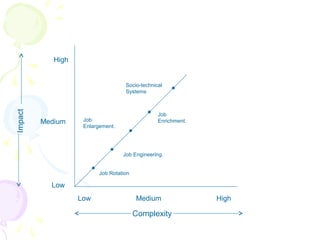
Job Rotation
Job Engineering.
Job
Enlargement.
Job
Enrichment.
Socio-technical
Systems
Low Medium High
Complexity
Low
Medium
High
Impact
JOB ROTATIONJOB ROTATION
• Job rotation refers to moving employees
from job to job to add variety and reduce
boredom by allowing them to perform a
variety of tasks.
• It reduces boredom and disinterest through
diversifying the employee’s activities.
• Employees with a wider range of skills give
the management more flexibility in
scheduling work, adapting to changes and
filling vacancies.
• Job rotation is also practiced to allow
qualified employees to gain more insights in
to the process of a company.
DISADVANTAGESDISADVANTAGES
• Training costs are increased.
• work is disrupted as rotated employees
take time to adjust to a new set up.
• It can demotivate intelligent and ambitious
trainees who seek specific responsibilities in
their chosen speciality.
DISADVANTAGESDISADVANTAGES
• Training costs are increased.
• work is disrupted as rotated employees
take time to adjust to a new set up.
• It can demotivate intelligent and ambitious
trainees who seek specific responsibilities in
their chosen speciality.

Job design

  • 1.
    JOB DESIGNJOB DESIGN APPROACHESAPPROACHES GROUPMEMBERS:GROUP MEMBERS: AJASAJAS BRINDABRINDA CARMELCARMEL
  • 2.
    JOB DESIGN APPROACHESJOBDESIGN APPROACHES Five popular approaches are • Job rotation • Job engineering • Job enlargement • Job enrichment • Socio-technical system
  • 3.
  • 4.
    JOB ROTATIONJOB ROTATION •Job rotation refers to moving employees from job to job to add variety and reduce boredom by allowing them to perform a variety of tasks. • It reduces boredom and disinterest through diversifying the employee’s activities. • Employees with a wider range of skills give the management more flexibility in scheduling work, adapting to changes and filling vacancies. • Job rotation is also practiced to allow qualified employees to gain more insights in to the process of a company.
  • 5.
    DISADVANTAGESDISADVANTAGES • Training costsare increased. • work is disrupted as rotated employees take time to adjust to a new set up. • It can demotivate intelligent and ambitious trainees who seek specific responsibilities in their chosen speciality.
  • 6.
    DISADVANTAGESDISADVANTAGES • Training costsare increased. • work is disrupted as rotated employees take time to adjust to a new set up. • It can demotivate intelligent and ambitious trainees who seek specific responsibilities in their chosen speciality.