JOB DESIGN
• It is an organization of activities to create the optimum
level of performance.
• Can also be defined as “specification of the contents,
methods, and relationships of jobs in order to satisfy
technological and organizational requirements as well as
the social and personal requirements of the job holder.”
Buchanan, D. (1979) - The Development of Job Design
Theories and Techniques.
• It primarily focuses in on designing the process of
transformation of inputs into outputs and considers the
human and organizational factors that impact that
transformation.
 It involves systematic attempts to organize tasks,
duties, and responsibilities in to a unit of work to
achieve certain objectives (profit/wealth/value
maximization, job satisfaction, productivity).
 In short, it is the process by which managers
decide individual job tasks and authority.
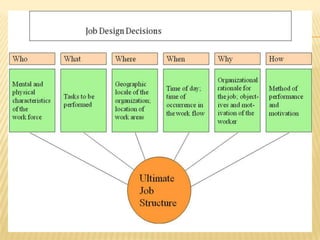
 In overall, it should address these basic
questions:
 What motivates people to work?
 What job characteristics are significant?
 How are job design alternatives to be identified?
 What job design changes are to be implemented?
Contd….
GOALS OF JOB DESIGN
 High Level of Job Satisfaction
 High level of Job Performance
ELEMENTS OF JOB DESIGN
 Task Analysis
 Worker Analysis
 Environmental Analysis
TASK ANALYSIS
 Determines
 What tasks will be done
 How each task will be done
 How the tasks fit together to form a job
WORKER ANALYSIS
 Determines
 Capabilities the worker must possess
 Responsibilities the worker will have
ENVIRONMENTAL ANALYSIS
 Used to analyze physical environment
including:
 Location
 Lighting
 Temperature
 Noise
 Ventilation
FACTORS AFFECTING JOB DESIGN
Organizational Factor
Environmental Factor
Behavioral Factor
ORGANIZATIONAL FACTOR
 Work Flow
 Ergonomics (study of how a workplace and
the equipment used there can best be
designed for comfort, efficiency, safety, and
productivity)
 Work Practices
ENVIRONMENTAL FACTOR
 Employee Abilities and Availability
 Social and Cultural Expectation
BEHAVIORAL FACTOR
 Feedback
 Use of abilities
 Variety
CHARACTERISTICS OF JOB DESIGN
 Variety
 removal of repetitiveness
 skill variety
 Autonomy
 removal of no choice of tools or methods
 removal of mechanical pacing
 decision making
 Use of Capacities
 removal of minimum skill requirements
 removal of surface mental attention
 learning time
 challenge
CONTD…
 Progress/Career Path
 achievement
 perceived opportunities for advancement
 growth in competence
 continuous learning
 desirable future
 Intrinsically Meaningful Work
 removal of minute subdivision of
product/process
 task identity (seeing relationship of task to
whole/end product)
CONTD…
 Socially Meaningful Work
 task significance
 need to relate work and social life
 Interaction
 interaction opportunities
 social support and recognition
 Knowledge of Results
 recognition
 Feedback
 Responsibility
 accountability
 choice over tools and methods
HOW ARE JOB DESIGN ALTERNATIVES TO BE
IDENTIFIED?
(HILL, 1971; TAYLOR, 1975; SUSMAN, 1976)Includes 5 steps:
1. Scanning (initial analysis of system inputs, outputs,
organization structure and workplace layout)
2. Technical Analysis (similar to process mapping...identifies
system operations and key variances. Variances are
classified as having an affect on output quality, output
quantity, operating costs and social costs)
3. Internal Systems Analysis (social system analysis; survey of
perceptions of work roles; maintenance system analysis;
supply and user system analysis)
4. Proposals for Change and Implementation
Sample Outputs: Work Flow Re-Design; Re-organization/Work
Group Implementation; Revised Job Descriptions; Revised
Career Paths
TECHNIQUES OF JOB DESIGN
 Individual Design Option
 Job Simplification
 Job Specialization
 Job Enlargement
 Job Enrichment
 Job Rotation
 Group Design Option
 Work Teams
 Autonomous Work Group
INDIVIDUAL DESIGN OPTION
 Job Simplification
The variety and difficulty of task performed
by a single person are reduced .
 Job Specialization
 It involves breaking jobs into small component
parts, assigning specialists to do each tasks.
 It is found specially in manufacturing and
service industry.
 Advantages:
 More efficiency
 Lowe training cost
 People learn jobs more quickly
 Better person/job matching
 Disadvantages:
 Less Flexibility
 Repetitive, boring tasks
 No opportunities to develop and acquire new skills
 Job Enlargement
 It is an expansion of the number
of different tasks preformed by
an employee.
 Fewer workers are needed with
the new technology, and each
employee has to be able to
perform a greater number and
variety of task.
 It increases the scope of job
through extending the range of
its job duties and
responsibilities.
 Job Enrichment
 More advanced technology
tends to cause job enrichment.
 It provides greater
responsibility, recognition and
opportunities for growth and
development.
JOB ENRICHMENT STRATEGIES
 Empowering employees
 Giving employees more autonomy
 Feeling of control and self – efficacy
 Forming natural work units
 Completing an entire task
 Assigning employees to specific clients
 Establishing client relationship
 Employees put in direct contact with clients
 Job Rotation
 Moving employees from one job to another to
give them greater variety of tasks so that to help
preventing boredom and increase flexibility.
 It is aimed to meet the overall equal at work
program objective of attempting to develop new
and more inclusive models of recruitment and in
work progression.
GROUPDESIGN OPTION
 Work Teams
 Effective work teams magnify the
accomplishment of individual employees.
 Cross-functional, multi skilled, and self
directed employees.
 Autonomous Work Group
 It encourages work group to manage its own
work and working practice
JOB DESIGN CONTINUUM
Specialization
Enlargement
Self-directed
teams
Empowerment
Enrichment
Figure 10.3
Job expansion
Increasing
reliance on
employee’s
contribution
and increasing
responsibility
accepted by
employee
TOOLS OF JOB DESIGN
Process Flowchart
Motion Study
Work measurement
Stopwatch time study
Standard elemental times
Work Sampling
Learning Curve
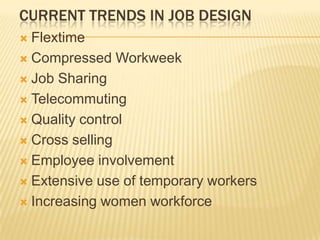
CURRENT TRENDS IN JOB DESIGN
 Flextime
 Compressed Workweek
 Job Sharing
 Telecommuting
 Quality control
 Cross selling
 Employee involvement
 Extensive use of temporary workers
 Increasing women workforce
OUTCOMES OF JOB DESIGN
•Greater job control = increased subjective and objective
job performance, lower absenteeism, and lower turnover
•Better social support = increased subjective and
objective job performance, lower absenteeism, and lower
turnover
•Better working relationships = lower withdrawal
behavior, better team performance, lower absenteeism,
and lower turnover
•Well-designed job roles = lower withdrawal behavior,
better self-rated performance, and lower turnover
•Greater job demands = increased subjective and
objective job performance and lower absenteeism
OUTCOMES OF JOB DESIGN … CONTD…
•Performance and productivity (move beyond how much is produced
to issues about quality, efficiency, reduced costs, responsiveness to
customers, effectiveness of product, reduction of waste, etc.; will also
include aspects such as innovativeness, entrepreneurship (internal
mobility and innovativeness), spontaneity, use of initiative, flexibility,
and adaptation to change)
•Safety and accident reduction (effectiveness is also assessed in
terms of the reduction in accidents or incidents and valuing safety of
employees as an important organizational outcome)
•Learning and development (focus on longer term outcomes such as
career development, employee development)
•Outside work (understanding that work and non-work are inter-related;
effective organizations are those that value non-work life, leisure
activities, family involvement, reduced travel time, improved overall
physical health and well-being)
REFERENCE
1. Foundation of Human Resource Management
by Dr. Govind Ram Agrawal
2. Kul Narsingh Shrestha
3. Devid A. Decenzo
4. Stephen P. Robbins
Job design   copy

Job design copy

  • 2.
    JOB DESIGN • Itis an organization of activities to create the optimum level of performance. • Can also be defined as “specification of the contents, methods, and relationships of jobs in order to satisfy technological and organizational requirements as well as the social and personal requirements of the job holder.” Buchanan, D. (1979) - The Development of Job Design Theories and Techniques. • It primarily focuses in on designing the process of transformation of inputs into outputs and considers the human and organizational factors that impact that transformation.
  • 3.
     It involvessystematic attempts to organize tasks, duties, and responsibilities in to a unit of work to achieve certain objectives (profit/wealth/value maximization, job satisfaction, productivity).  In short, it is the process by which managers decide individual job tasks and authority.  In overall, it should address these basic questions:  What motivates people to work?  What job characteristics are significant?  How are job design alternatives to be identified?  What job design changes are to be implemented? Contd….
  • 5.
    GOALS OF JOBDESIGN  High Level of Job Satisfaction  High level of Job Performance
  • 6.
    ELEMENTS OF JOBDESIGN  Task Analysis  Worker Analysis  Environmental Analysis
  • 7.
    TASK ANALYSIS  Determines What tasks will be done  How each task will be done  How the tasks fit together to form a job
  • 8.
    WORKER ANALYSIS  Determines Capabilities the worker must possess  Responsibilities the worker will have
  • 9.
    ENVIRONMENTAL ANALYSIS  Usedto analyze physical environment including:  Location  Lighting  Temperature  Noise  Ventilation
  • 10.
    FACTORS AFFECTING JOBDESIGN Organizational Factor Environmental Factor Behavioral Factor
  • 11.
    ORGANIZATIONAL FACTOR  WorkFlow  Ergonomics (study of how a workplace and the equipment used there can best be designed for comfort, efficiency, safety, and productivity)  Work Practices
  • 12.
    ENVIRONMENTAL FACTOR  EmployeeAbilities and Availability  Social and Cultural Expectation
  • 13.
    BEHAVIORAL FACTOR  Feedback Use of abilities  Variety
  • 14.
    CHARACTERISTICS OF JOBDESIGN  Variety  removal of repetitiveness  skill variety  Autonomy  removal of no choice of tools or methods  removal of mechanical pacing  decision making  Use of Capacities  removal of minimum skill requirements  removal of surface mental attention  learning time  challenge
  • 15.
    CONTD…  Progress/Career Path achievement  perceived opportunities for advancement  growth in competence  continuous learning  desirable future  Intrinsically Meaningful Work  removal of minute subdivision of product/process  task identity (seeing relationship of task to whole/end product)
  • 16.
    CONTD…  Socially MeaningfulWork  task significance  need to relate work and social life  Interaction  interaction opportunities  social support and recognition  Knowledge of Results  recognition  Feedback  Responsibility  accountability  choice over tools and methods
  • 17.
    HOW ARE JOBDESIGN ALTERNATIVES TO BE IDENTIFIED? (HILL, 1971; TAYLOR, 1975; SUSMAN, 1976)Includes 5 steps: 1. Scanning (initial analysis of system inputs, outputs, organization structure and workplace layout) 2. Technical Analysis (similar to process mapping...identifies system operations and key variances. Variances are classified as having an affect on output quality, output quantity, operating costs and social costs) 3. Internal Systems Analysis (social system analysis; survey of perceptions of work roles; maintenance system analysis; supply and user system analysis) 4. Proposals for Change and Implementation Sample Outputs: Work Flow Re-Design; Re-organization/Work Group Implementation; Revised Job Descriptions; Revised Career Paths
  • 18.
    TECHNIQUES OF JOBDESIGN  Individual Design Option  Job Simplification  Job Specialization  Job Enlargement  Job Enrichment  Job Rotation  Group Design Option  Work Teams  Autonomous Work Group
  • 19.
    INDIVIDUAL DESIGN OPTION Job Simplification The variety and difficulty of task performed by a single person are reduced .
  • 20.
     Job Specialization It involves breaking jobs into small component parts, assigning specialists to do each tasks.  It is found specially in manufacturing and service industry.  Advantages:  More efficiency  Lowe training cost  People learn jobs more quickly  Better person/job matching  Disadvantages:  Less Flexibility  Repetitive, boring tasks  No opportunities to develop and acquire new skills
  • 21.
     Job Enlargement It is an expansion of the number of different tasks preformed by an employee.  Fewer workers are needed with the new technology, and each employee has to be able to perform a greater number and variety of task.  It increases the scope of job through extending the range of its job duties and responsibilities.
  • 22.
     Job Enrichment More advanced technology tends to cause job enrichment.  It provides greater responsibility, recognition and opportunities for growth and development.
  • 23.
    JOB ENRICHMENT STRATEGIES Empowering employees  Giving employees more autonomy  Feeling of control and self – efficacy  Forming natural work units  Completing an entire task  Assigning employees to specific clients  Establishing client relationship  Employees put in direct contact with clients
  • 24.
     Job Rotation Moving employees from one job to another to give them greater variety of tasks so that to help preventing boredom and increase flexibility.  It is aimed to meet the overall equal at work program objective of attempting to develop new and more inclusive models of recruitment and in work progression.
  • 25.
    GROUPDESIGN OPTION  WorkTeams  Effective work teams magnify the accomplishment of individual employees.  Cross-functional, multi skilled, and self directed employees.  Autonomous Work Group  It encourages work group to manage its own work and working practice
  • 26.
    JOB DESIGN CONTINUUM Specialization Enlargement Self-directed teams Empowerment Enrichment Figure10.3 Job expansion Increasing reliance on employee’s contribution and increasing responsibility accepted by employee
  • 27.
    TOOLS OF JOBDESIGN Process Flowchart Motion Study Work measurement Stopwatch time study Standard elemental times Work Sampling Learning Curve
  • 28.
    CURRENT TRENDS INJOB DESIGN  Flextime  Compressed Workweek  Job Sharing  Telecommuting  Quality control  Cross selling  Employee involvement  Extensive use of temporary workers  Increasing women workforce
  • 29.
    OUTCOMES OF JOBDESIGN •Greater job control = increased subjective and objective job performance, lower absenteeism, and lower turnover •Better social support = increased subjective and objective job performance, lower absenteeism, and lower turnover •Better working relationships = lower withdrawal behavior, better team performance, lower absenteeism, and lower turnover •Well-designed job roles = lower withdrawal behavior, better self-rated performance, and lower turnover •Greater job demands = increased subjective and objective job performance and lower absenteeism
  • 30.
    OUTCOMES OF JOBDESIGN … CONTD… •Performance and productivity (move beyond how much is produced to issues about quality, efficiency, reduced costs, responsiveness to customers, effectiveness of product, reduction of waste, etc.; will also include aspects such as innovativeness, entrepreneurship (internal mobility and innovativeness), spontaneity, use of initiative, flexibility, and adaptation to change) •Safety and accident reduction (effectiveness is also assessed in terms of the reduction in accidents or incidents and valuing safety of employees as an important organizational outcome) •Learning and development (focus on longer term outcomes such as career development, employee development) •Outside work (understanding that work and non-work are inter-related; effective organizations are those that value non-work life, leisure activities, family involvement, reduced travel time, improved overall physical health and well-being)
  • 32.
    REFERENCE 1. Foundation ofHuman Resource Management by Dr. Govind Ram Agrawal 2. Kul Narsingh Shrestha 3. Devid A. Decenzo 4. Stephen P. Robbins