JobAnalysis & JobDesign
Learning Objective
• Clear understanding of difference between job
description and job specification
• Why it is important to exercise job analysis in
an organization
• Linkage of job analysis with other HR functions
Basics of Job Analysis
• Collection of details such as:
– Work activities
– Human behaviors
– Machines, tools, equipments
– Performance standards
– Job context
– Human requirements
Job Analysis, Job Description, Job Specification –
Difference?
Let’s try!
You are required to carry out a quick job analysis
of University Faculty.
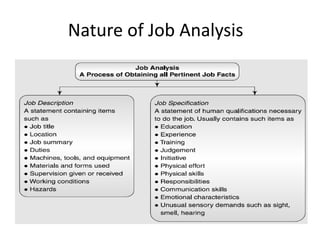
Nature of Job Analysis )
Job Description and Job Specification
Source:DaleS.Beach,Personnel—TheManagementofPeople
atWork,p.166
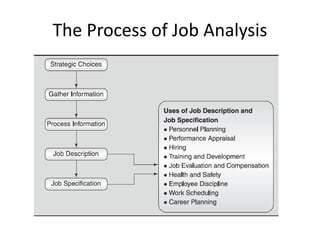
The Process of Job Analysis
Process of Job Analysis
Source:AdaptedfromPersonnel/HumanResource
ManagementbyLeapandCrino,p.121
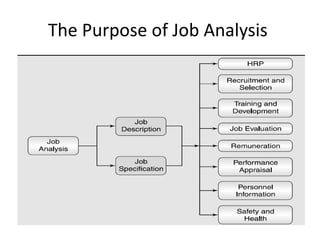
The Purpose of Job Analysis)
Methods of Collecting Job Analysis
Information
• Interview
• Questionnaires
• Observation
• Participant Diary/Logs
Potential Problems with Job Analysis
• Support from Top Management
• Single Means and Source
• No Training or Motivation
• Activities may be Distorted
Job Analysis in a “Jobless” World
• Job Enlargement
• Job Rotation
• Job Enrichment
Job Design
• It integrates work content (tasks, functions, relationships), the
rewards (extrinsic and intrinsic), and the qualifications
required (skills, knowledge, abilities) for each job in a way that
meets the needs employees and the organizations.
Thus, job design involves three steps;
• The specification of individual tasks,
• The specification of the method(s) of performing each task,
and
• The combination of tasks into specific jobs to be assigned to
individuals.
15
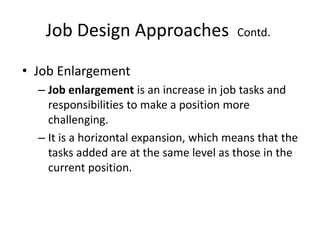
Job Design Approaches (Contd.)
• Job Enlargement
– Job enlargement is an increase in job tasks and
responsibilities to make a position more
challenging.
– It is a horizontal expansion, which means that the
tasks added are at the same level as those in the
current position.
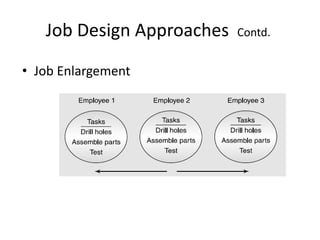
Job Design Approaches (Contd.)
• Job Enlargement
An Example of Job Enlargement
Source:BasedonHumanResource
ManagementbyJohnBrattonand
JeffreyGold,p.123
Job Enrichment
• Job enrichment is a management concept
that involves redesigning jobs so that they are
more challenging to the employee and have
less repetitive work.
18
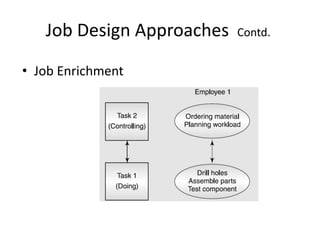
Job Design Approaches (Contd.)
• Job Enrichment
An Example of Job Enrichment
Source:BasedonHumanResourceManagementby
JohnBrattonandJeffreyGold,p.123
20
Enlargement Vs Enrichment
21
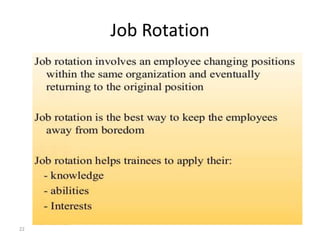
Job Rotation
22
23
Job Design
24
Why Managers are “Dejobbing” their
Companies?
• Flatter organizations – wide span of control
• Self-managing work teams
• Reengineering
• Today’s world – Competency Based Job
Analysis
job analysis
job analysis

job analysis

  • 1.
  • 2.
    Learning Objective • Clearunderstanding of difference between job description and job specification • Why it is important to exercise job analysis in an organization • Linkage of job analysis with other HR functions
  • 4.
    Basics of JobAnalysis • Collection of details such as: – Work activities – Human behaviors – Machines, tools, equipments – Performance standards – Job context – Human requirements Job Analysis, Job Description, Job Specification – Difference?
  • 5.
    Let’s try! You arerequired to carry out a quick job analysis of University Faculty.
  • 6.
    Nature of JobAnalysis ) Job Description and Job Specification Source:DaleS.Beach,Personnel—TheManagementofPeople atWork,p.166
  • 7.
    The Process ofJob Analysis Process of Job Analysis Source:AdaptedfromPersonnel/HumanResource ManagementbyLeapandCrino,p.121
  • 8.
    The Purpose ofJob Analysis)
  • 11.
    Methods of CollectingJob Analysis Information • Interview • Questionnaires • Observation • Participant Diary/Logs
  • 13.
    Potential Problems withJob Analysis • Support from Top Management • Single Means and Source • No Training or Motivation • Activities may be Distorted
  • 14.
    Job Analysis ina “Jobless” World • Job Enlargement • Job Rotation • Job Enrichment
  • 15.
    Job Design • Itintegrates work content (tasks, functions, relationships), the rewards (extrinsic and intrinsic), and the qualifications required (skills, knowledge, abilities) for each job in a way that meets the needs employees and the organizations. Thus, job design involves three steps; • The specification of individual tasks, • The specification of the method(s) of performing each task, and • The combination of tasks into specific jobs to be assigned to individuals. 15
  • 16.
    Job Design Approaches(Contd.) • Job Enlargement – Job enlargement is an increase in job tasks and responsibilities to make a position more challenging. – It is a horizontal expansion, which means that the tasks added are at the same level as those in the current position.
  • 17.
    Job Design Approaches(Contd.) • Job Enlargement An Example of Job Enlargement Source:BasedonHumanResource ManagementbyJohnBrattonand JeffreyGold,p.123
  • 18.
    Job Enrichment • Jobenrichment is a management concept that involves redesigning jobs so that they are more challenging to the employee and have less repetitive work. 18
  • 19.
    Job Design Approaches(Contd.) • Job Enrichment An Example of Job Enrichment Source:BasedonHumanResourceManagementby JohnBrattonandJeffreyGold,p.123
  • 20.
  • 21.
  • 22.
  • 23.
  • 24.
  • 25.
    Why Managers are“Dejobbing” their Companies? • Flatter organizations – wide span of control • Self-managing work teams • Reengineering • Today’s world – Competency Based Job Analysis

Editor's Notes

  • #6 The students are suppose to classify the Jon Analysis in two parts through brainstorming – Job Description & Job Specification