CRYSTALLISATION &
SEEDING OF SUGAR
CRYSTALLISATION
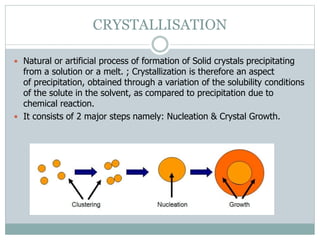
 Natural or artificial process of formation of Solid crystals precipitating
from a solution or a melt. ; Crystallization is therefore an aspect
of precipitation, obtained through a variation of the solubility conditions
of the solute in the solvent, as compared to precipitation due to
chemical reaction.
 It consists of 2 major steps namely: Nucleation & Crystal Growth.
Nucleation
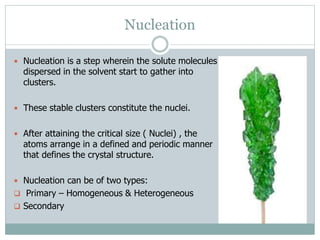
 Nucleation is a step wherein the solute molecules
dispersed in the solvent start to gather into
clusters.
 These stable clusters constitute the nuclei.
 After attaining the critical size ( Nuclei) , the
atoms arrange in a defined and periodic manner
that defines the crystal structure.
 Nucleation can be of two types:
 Primary – Homogeneous & Heterogeneous
 Secondary
Primary Nucleation
Secondary
Nucleation/Seeding
 Homogeneous
• Due to random movement
through the medium, few
particles stick together to form
a crystal.
 Heterogeneous
 Assisted by suspended particles
of foreign substance such as
rod immersed in a solution.
These objects catalyse the
process of nucleation.
 Occurs when seed crystals are
added.
 Requires lower super saturation
than primary nucleation.
 Due to impact with agitator or
vessel wall. Nuclei are created
by striking a crystal.
 Embryos are created & swept
away that would have
incorporated the existing
crystal.
Types of Nucleation
Crystal Growth
 Is the subsequent growth of the Nuclei that succeeds in achieving the
critical cluster size.
 Crystal growth ( Shape and Size) depends upon the conditions of super
saturation .
 Once the super saturation is exhausted , the solid – liquid system
reaches equilibrium and the crystallisation is complete.
Sugar Formation
(Vacuum Pan Processes)
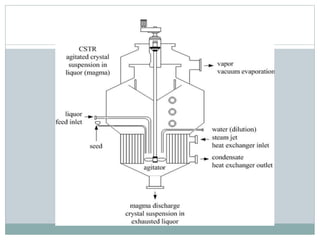
 Initially, a sub saturated standard liquor is pumped in the vacuum pan.
 To heat the juice & evaporate the water, vacuum pans are equipped
with CALANDRIA. Here, steam flows at a pressure greater than the
atm. Pressure and as the steam condenses, it releases heat to the
massecuite (mixture of raw sugar and syrup).
 BAROMETRIC CONDENSER helps in maintaining the partial vacuum
(0.2-0.3 bar) and 65-70°C temperature, as it absorbs the steam and
condenses it by means of cooling.
Working of a Vacuum Pan
 LOADING- Standard liquor is made to enter the vacuum pan followed
by supplying steam which increases the temp.
 CONCENTRATION- Evaporation of water leads to an increase in the
concentration of the juice from 0.6-0.7 to super saturation level of 1.2-
1.3.
 SEEDING- Seeds of sucrose crystals dissolved in alcoholic solution are
added to the vacuum pan. The sucrose mass generally added is around
10gm and the size of the crystals is about 5μm.
 STABILIZATION- Super saturation conditions are maintained till the
crystals attain their final size 0.5μm and a brix level of 90.4.
Working of a Vacuum Pan
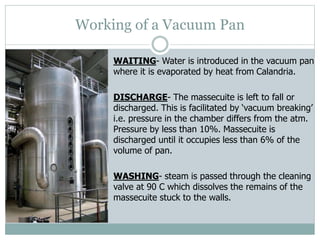
 WAITING- Water is introduced in the vacuum pan
where it is evaporated by heat from Calandria.
 DISCHARGE- The massecuite is left to fall or
discharged. This is facilitated by ‘vacuum breaking’
i.e. pressure in the chamber differs from the atm.
Pressure by less than 10%. Massecuite is
discharged until it occupies less than 6% of the
volume of pan.
 WASHING- steam is passed through the cleaning
valve at 90 C which dissolves the remains of the
massecuite stuck to the walls.
Centrifugation
 The centrifuge is filled with the massecuite and centrifuged at
150rpm.
 This presses the massecuite against the wall.
 Centrifuge is accelerated to a max. speed of 1100rpm.
 Sugar crystals and the syrup is separated and is made to pass
through centrifugal screens.
 Sugar is washed with water. Remains of the syrup are
eliminated by injecting hot water.
 Speed of rotation is decreased to 100rpm, sugar is then
discharged and dried.
Sugar- formation
 Sugar crystals separated in A centrifugals constitute “ white sugar”.
 The residual mother liquor obtained known as A molasses is again
crystallised in vacuum pan B and passed through sugar centrifuges to
yield B strike and B molasses.
 The molasses obtained is converted into alcohol.

Sugar crystallisation

  • 1.
  • 2.
    CRYSTALLISATION  Natural orartificial process of formation of Solid crystals precipitating from a solution or a melt. ; Crystallization is therefore an aspect of precipitation, obtained through a variation of the solubility conditions of the solute in the solvent, as compared to precipitation due to chemical reaction.  It consists of 2 major steps namely: Nucleation & Crystal Growth.
  • 3.
    Nucleation  Nucleation isa step wherein the solute molecules dispersed in the solvent start to gather into clusters.  These stable clusters constitute the nuclei.  After attaining the critical size ( Nuclei) , the atoms arrange in a defined and periodic manner that defines the crystal structure.  Nucleation can be of two types:  Primary – Homogeneous & Heterogeneous  Secondary
  • 4.
    Primary Nucleation Secondary Nucleation/Seeding  Homogeneous •Due to random movement through the medium, few particles stick together to form a crystal.  Heterogeneous  Assisted by suspended particles of foreign substance such as rod immersed in a solution. These objects catalyse the process of nucleation.  Occurs when seed crystals are added.  Requires lower super saturation than primary nucleation.  Due to impact with agitator or vessel wall. Nuclei are created by striking a crystal.  Embryos are created & swept away that would have incorporated the existing crystal. Types of Nucleation
  • 5.
    Crystal Growth  Isthe subsequent growth of the Nuclei that succeeds in achieving the critical cluster size.  Crystal growth ( Shape and Size) depends upon the conditions of super saturation .  Once the super saturation is exhausted , the solid – liquid system reaches equilibrium and the crystallisation is complete.
  • 6.
    Sugar Formation (Vacuum PanProcesses)  Initially, a sub saturated standard liquor is pumped in the vacuum pan.  To heat the juice & evaporate the water, vacuum pans are equipped with CALANDRIA. Here, steam flows at a pressure greater than the atm. Pressure and as the steam condenses, it releases heat to the massecuite (mixture of raw sugar and syrup).  BAROMETRIC CONDENSER helps in maintaining the partial vacuum (0.2-0.3 bar) and 65-70°C temperature, as it absorbs the steam and condenses it by means of cooling.
  • 8.
    Working of aVacuum Pan  LOADING- Standard liquor is made to enter the vacuum pan followed by supplying steam which increases the temp.  CONCENTRATION- Evaporation of water leads to an increase in the concentration of the juice from 0.6-0.7 to super saturation level of 1.2- 1.3.  SEEDING- Seeds of sucrose crystals dissolved in alcoholic solution are added to the vacuum pan. The sucrose mass generally added is around 10gm and the size of the crystals is about 5μm.  STABILIZATION- Super saturation conditions are maintained till the crystals attain their final size 0.5μm and a brix level of 90.4.
  • 9.
    Working of aVacuum Pan  WAITING- Water is introduced in the vacuum pan where it is evaporated by heat from Calandria.  DISCHARGE- The massecuite is left to fall or discharged. This is facilitated by ‘vacuum breaking’ i.e. pressure in the chamber differs from the atm. Pressure by less than 10%. Massecuite is discharged until it occupies less than 6% of the volume of pan.  WASHING- steam is passed through the cleaning valve at 90 C which dissolves the remains of the massecuite stuck to the walls.
  • 10.
    Centrifugation  The centrifugeis filled with the massecuite and centrifuged at 150rpm.  This presses the massecuite against the wall.  Centrifuge is accelerated to a max. speed of 1100rpm.  Sugar crystals and the syrup is separated and is made to pass through centrifugal screens.  Sugar is washed with water. Remains of the syrup are eliminated by injecting hot water.  Speed of rotation is decreased to 100rpm, sugar is then discharged and dried.
  • 12.
    Sugar- formation  Sugarcrystals separated in A centrifugals constitute “ white sugar”.  The residual mother liquor obtained known as A molasses is again crystallised in vacuum pan B and passed through sugar centrifuges to yield B strike and B molasses.  The molasses obtained is converted into alcohol.