Job Evaluation
Defined as a practical technique, designed to enable trained and experienced
staff to judge the size/worth of one job relative to others
It does not directly determine pay levels, but will establish the basis for an
internal ranking of jobs
It is essentially a comparative process
Evaluation is done by assessing the job pressure
Factors that contribute to this job pressure, e.g. physical strength required,
knowledge required, are assessed and the result is a numerical estimate of the
total job pressure
Job Evaluation- Principles
• Job evaluation is concerned with jobs, not people. It is not the person that is
being
evaluated
• All jobs in an organisation will be evaluated using an agreed job evaluation
scheme
• Job evaluators will need to gain a thorough understanding of the job
• The job is assessed as if it were being carried out in a fully competent and
acceptable manner
Job Evaluation- Principles Cont..
• Job evaluation is based on judgement and is not scientific
• The real test of the evaluation results is their acceptability to all participants
• Job evaluation can aid organisational problem solving as it highlights duplication
of tasks and gaps between jobs and functions
Job Evaluation-Process
• Establish Job Evaluation Objectives
• Conduct Job Analysis – Results in Job Description & Job Specification
• Job evaluation Programme
• Wage Survey
• Employee Classsification
Job Analysis
Defined as the process of studying and collection information
relating to the operations and responsibilities of a specific job
The main focus of Job analysis is on the Job, not on the
individual holding the job
Products – Job Description & Job Specifications
Job Description
Defined as a statement that explains the job
Include:
 Job Title
 Location
 Job Summary
 Machines, Tools & Equipment to be used
 Materials to be used
 Supervision needed
 Working conditions
 Hazards
Job Specification
Defined as a statement that indicates human qualifications necessary to do the job
Include:
 Educational Qualification
 Experience
 Training
 Physical Effort
 Physical Skills
 Communication Skills
 Emotional Characteristics
 Sensory demands such as sight, smell, hearing
Job Evaluation- Methods
• Analytical Methods
Point Ranking Method
Factor Comparison Method
• Non-Analytical Methods
Ranking Method
Job-grading Method
Job Evaluation- Methods
• Analytical Methods
Point Ranking Method
 In this method the number of grades is first decided
Select key jobs. Identify the factors common to all the identified jobs such as
skill, effort, responsibility, working conditions etc
 Fix a relative value for each key factor
 Divide each major factor into a number of sub factors. Each sub factor is
defined and expressed clearly in the order of importance, preferably along a
scale
 Construct degrees for each subfactors
 Assign points to each degree
 A given job is placed in a particular grade depending on the number of points it
scores
Job Evaluation- Methods
Sub factors
Skill :Education, Training required, Breadth/Depth of experience required,
Social skills required, Problem-solving skills, Degree of discretion/use of
judgment, Creative thinking
Responsibility/Accountability: Breadth of responsibility, Specialised
responsibility, Complexity of the work, Degree of freedom to act, Number and
nature of subordinate staff, Extent of accountability for equipment/plant,
Extent of accountability for product/materials
Effort: Mental demands of a job, Physical demands of a job, Degree of
potential stress
Job Evaluation- Methods
Degrees of Subfactor - Educational Requirement expressed in the order of
importance
Degree Define
1. Able to carry out simple calculations; High School educated
2. Does all the clerical operations; computer literate; Graduate
3. Handles mail, develops contacts, takes initiative and does work
independently; Post Graduate
Job Evaluation- Methods
Example
Assign point values to degrees after fixing a relative value for each key factor
Point values for Degrees Total
Factor 1 2 3
Skill (Education) 10 20 30 60
Physical effort 8 16 24 48
Mental effort 5 10 15 30
Responsibility 7 14 21 42
Working conditions 6 12 18 36
Maximum total points of all factors depending on their importance to job = 216
Job Evaluation- Methods
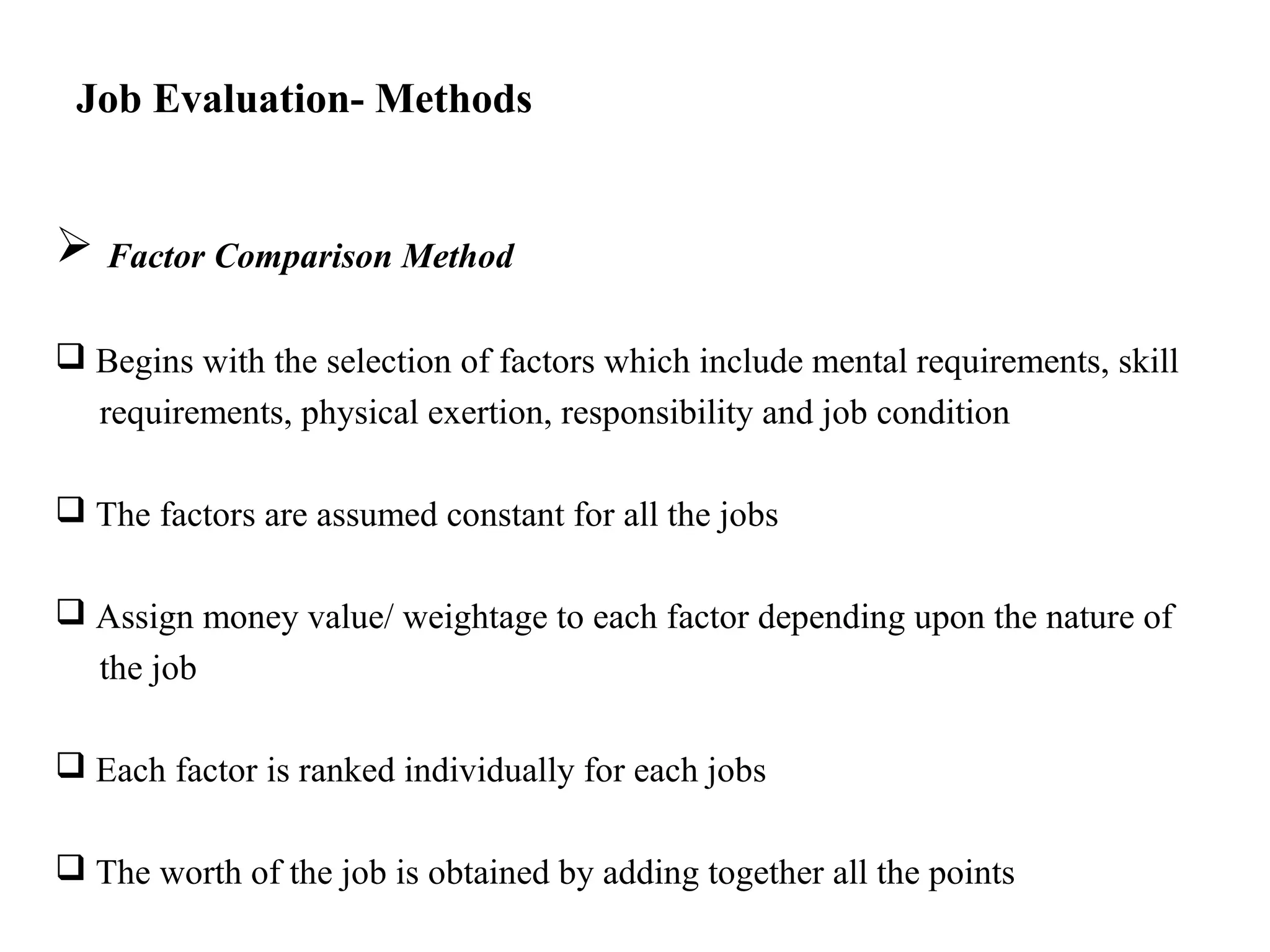
 Factor Comparison Method
 Begins with the selection of factors which include mental requirements, skill
requirements, physical exertion, responsibility and job condition
 The factors are assumed constant for all the jobs
 Assign money value/ weightage to each factor depending upon the nature of
the job
 Each factor is ranked individually for each jobs
 The worth of the job is obtained by adding together all the points
Job Evaluation- Methods
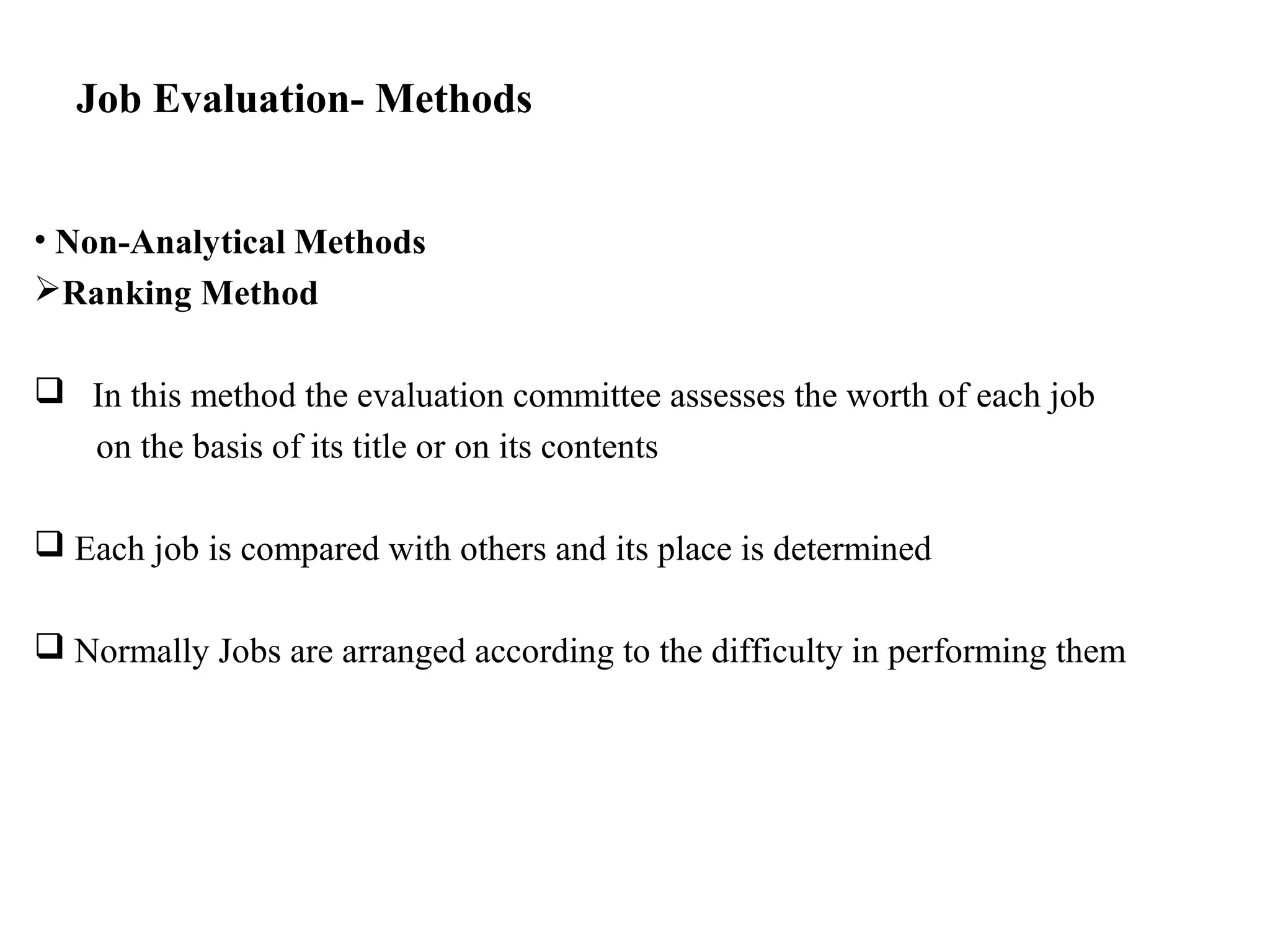
• Non-Analytical Methods
Ranking Method
 In this method the evaluation committee assesses the worth of each job
on the basis of its title or on its contents
 Each job is compared with others and its place is determined
 Normally Jobs are arranged according to the difficulty in performing them
Job Evaluation- Methods
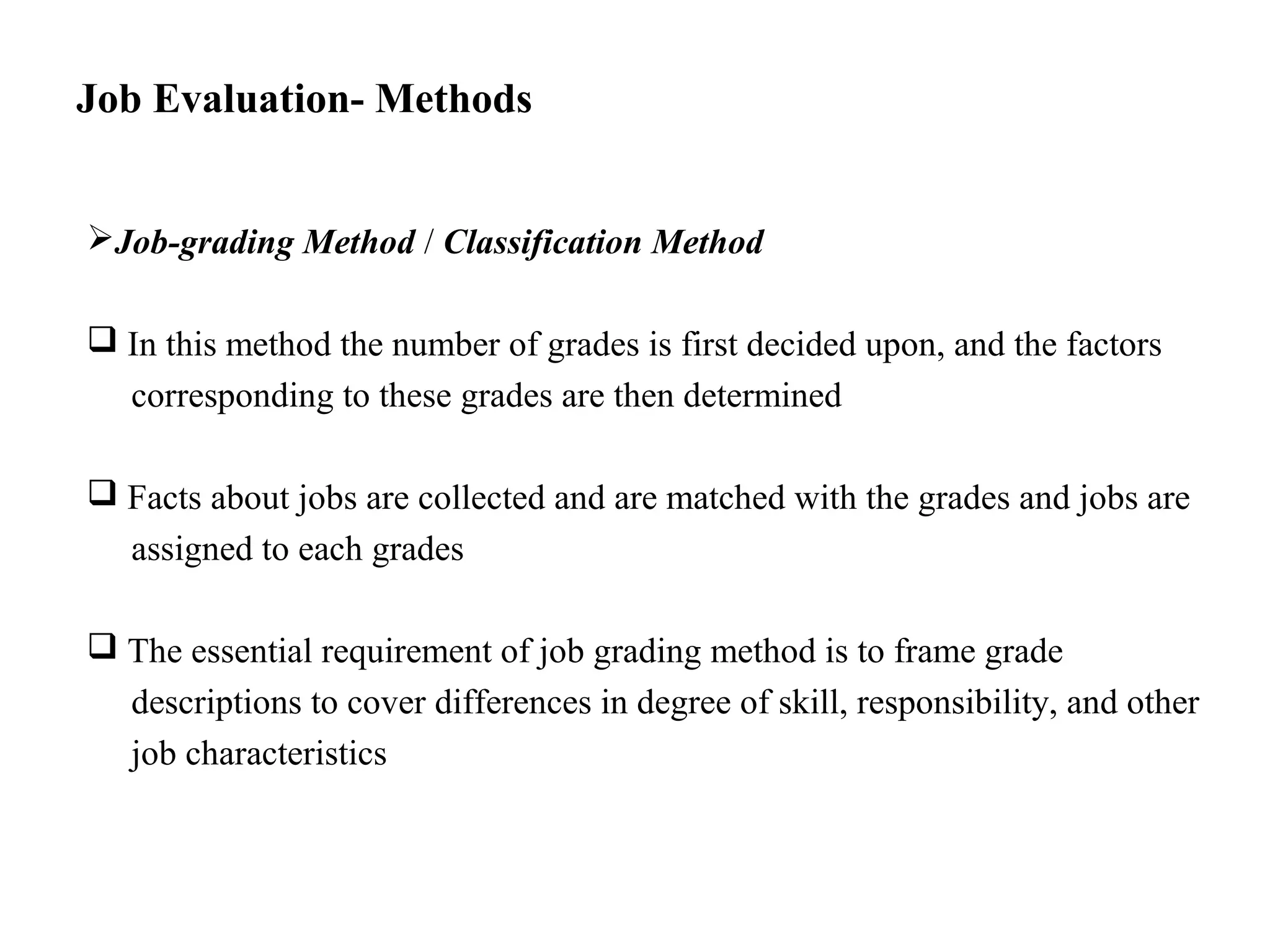
Job-grading Method / Classification Method
 In this method the number of grades is first decided upon, and the factors
corresponding to these grades are then determined
 Facts about jobs are collected and are matched with the grades and jobs are
assigned to each grades
 The essential requirement of job grading method is to frame grade
descriptions to cover differences in degree of skill, responsibility, and other
job characteristics
Job Evaluation- Methods
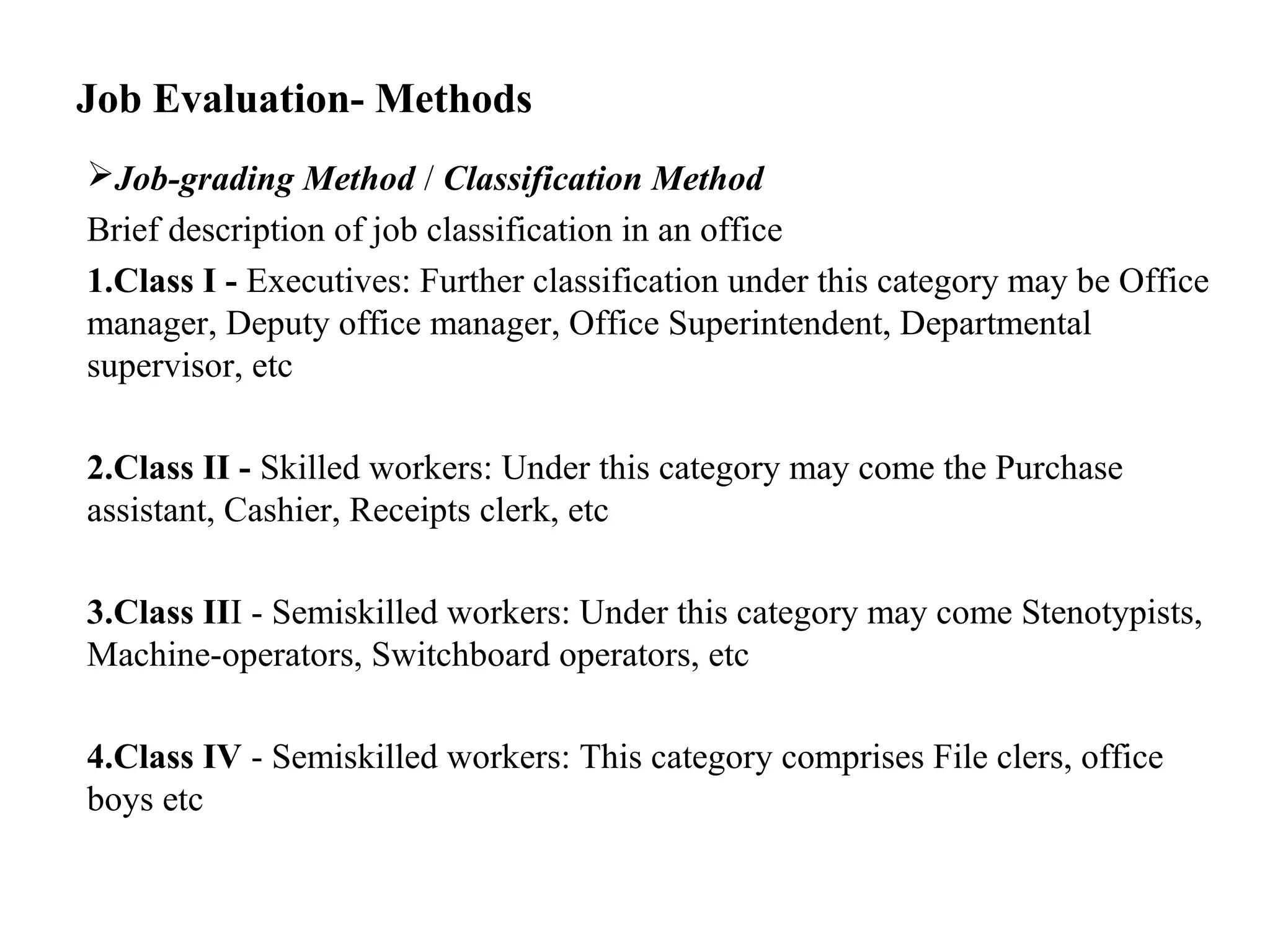
Job-grading Method / Classification Method
Brief description of job classification in an office
1.Class I - Executives: Further classification under this category may be Office
manager, Deputy office manager, Office Superintendent, Departmental
supervisor, etc
2.Class II - Skilled workers: Under this category may come the Purchase
assistant, Cashier, Receipts clerk, etc
3.Class III - Semiskilled workers: Under this category may come Stenotypists,
Machine-operators, Switchboard operators, etc
4.Class IV - Semiskilled workers: This category comprises File clers, office
boys etc
Merit Rating
Defined as a payment system in which the personal qualities of an employee are
rated according to organisational requirements, and a pay increase or bonus is made
against the results of this rating
Merit rating has been in use since the 1950s
Unlike new performance-related pay systems, which focus rewards on the output of
an employee, merit rating examines an employee's input to the organisation
For example, their attendance, adaptability, or aptitude as well as the quality or
quantity of work produced
In merit rating programs, these factors may be weighted to reflect their relative
importance and the resultant points score determines whether the employee earns a
bonus or pay increase

Job evaluation & merit rating

  • 1.
    Job Evaluation Defined asa practical technique, designed to enable trained and experienced staff to judge the size/worth of one job relative to others It does not directly determine pay levels, but will establish the basis for an internal ranking of jobs It is essentially a comparative process Evaluation is done by assessing the job pressure Factors that contribute to this job pressure, e.g. physical strength required, knowledge required, are assessed and the result is a numerical estimate of the total job pressure
  • 2.
    Job Evaluation- Principles •Job evaluation is concerned with jobs, not people. It is not the person that is being evaluated • All jobs in an organisation will be evaluated using an agreed job evaluation scheme • Job evaluators will need to gain a thorough understanding of the job • The job is assessed as if it were being carried out in a fully competent and acceptable manner
  • 3.
    Job Evaluation- PrinciplesCont.. • Job evaluation is based on judgement and is not scientific • The real test of the evaluation results is their acceptability to all participants • Job evaluation can aid organisational problem solving as it highlights duplication of tasks and gaps between jobs and functions
  • 4.
    Job Evaluation-Process • EstablishJob Evaluation Objectives • Conduct Job Analysis – Results in Job Description & Job Specification • Job evaluation Programme • Wage Survey • Employee Classsification
  • 5.
    Job Analysis Defined asthe process of studying and collection information relating to the operations and responsibilities of a specific job The main focus of Job analysis is on the Job, not on the individual holding the job Products – Job Description & Job Specifications
  • 6.
    Job Description Defined asa statement that explains the job Include:  Job Title  Location  Job Summary  Machines, Tools & Equipment to be used  Materials to be used  Supervision needed  Working conditions  Hazards
  • 7.
    Job Specification Defined asa statement that indicates human qualifications necessary to do the job Include:  Educational Qualification  Experience  Training  Physical Effort  Physical Skills  Communication Skills  Emotional Characteristics  Sensory demands such as sight, smell, hearing
  • 8.
    Job Evaluation- Methods •Analytical Methods Point Ranking Method Factor Comparison Method • Non-Analytical Methods Ranking Method Job-grading Method
  • 9.
    Job Evaluation- Methods •Analytical Methods Point Ranking Method  In this method the number of grades is first decided Select key jobs. Identify the factors common to all the identified jobs such as skill, effort, responsibility, working conditions etc  Fix a relative value for each key factor  Divide each major factor into a number of sub factors. Each sub factor is defined and expressed clearly in the order of importance, preferably along a scale  Construct degrees for each subfactors  Assign points to each degree  A given job is placed in a particular grade depending on the number of points it scores
  • 10.
    Job Evaluation- Methods Subfactors Skill :Education, Training required, Breadth/Depth of experience required, Social skills required, Problem-solving skills, Degree of discretion/use of judgment, Creative thinking Responsibility/Accountability: Breadth of responsibility, Specialised responsibility, Complexity of the work, Degree of freedom to act, Number and nature of subordinate staff, Extent of accountability for equipment/plant, Extent of accountability for product/materials Effort: Mental demands of a job, Physical demands of a job, Degree of potential stress
  • 11.
    Job Evaluation- Methods Degreesof Subfactor - Educational Requirement expressed in the order of importance Degree Define 1. Able to carry out simple calculations; High School educated 2. Does all the clerical operations; computer literate; Graduate 3. Handles mail, develops contacts, takes initiative and does work independently; Post Graduate
  • 12.
    Job Evaluation- Methods Example Assignpoint values to degrees after fixing a relative value for each key factor Point values for Degrees Total Factor 1 2 3 Skill (Education) 10 20 30 60 Physical effort 8 16 24 48 Mental effort 5 10 15 30 Responsibility 7 14 21 42 Working conditions 6 12 18 36 Maximum total points of all factors depending on their importance to job = 216
  • 13.
    Job Evaluation- Methods Factor Comparison Method  Begins with the selection of factors which include mental requirements, skill requirements, physical exertion, responsibility and job condition  The factors are assumed constant for all the jobs  Assign money value/ weightage to each factor depending upon the nature of the job  Each factor is ranked individually for each jobs  The worth of the job is obtained by adding together all the points
  • 14.
    Job Evaluation- Methods •Non-Analytical Methods Ranking Method  In this method the evaluation committee assesses the worth of each job on the basis of its title or on its contents  Each job is compared with others and its place is determined  Normally Jobs are arranged according to the difficulty in performing them
  • 15.
    Job Evaluation- Methods Job-gradingMethod / Classification Method  In this method the number of grades is first decided upon, and the factors corresponding to these grades are then determined  Facts about jobs are collected and are matched with the grades and jobs are assigned to each grades  The essential requirement of job grading method is to frame grade descriptions to cover differences in degree of skill, responsibility, and other job characteristics
  • 16.
    Job Evaluation- Methods Job-gradingMethod / Classification Method Brief description of job classification in an office 1.Class I - Executives: Further classification under this category may be Office manager, Deputy office manager, Office Superintendent, Departmental supervisor, etc 2.Class II - Skilled workers: Under this category may come the Purchase assistant, Cashier, Receipts clerk, etc 3.Class III - Semiskilled workers: Under this category may come Stenotypists, Machine-operators, Switchboard operators, etc 4.Class IV - Semiskilled workers: This category comprises File clers, office boys etc
  • 17.
    Merit Rating Defined asa payment system in which the personal qualities of an employee are rated according to organisational requirements, and a pay increase or bonus is made against the results of this rating Merit rating has been in use since the 1950s Unlike new performance-related pay systems, which focus rewards on the output of an employee, merit rating examines an employee's input to the organisation For example, their attendance, adaptability, or aptitude as well as the quality or quantity of work produced In merit rating programs, these factors may be weighted to reflect their relative importance and the resultant points score determines whether the employee earns a bonus or pay increase