• What is Job Design?
• What are the approaches involved in
Job Design?
• What is Job Analysis?
• What are the steps in Job Analysis?
• What are the uses of Job Analysis
Information?
• Job design has been defined by Davis (1966) as:
‗The specification of the contents, methods, and
relationships of jobs in order to satisfy technological
and organizational requirements as well as the social
and personal requirements of the job holder‘.
• Job design is the process of defining the way work
will be performed and the tasks that will be required
in a given job.
• Job design may be defined as the function of
specifying the work activities of an individual or
group in an organizational setting.
It is a group of related activities and duties held by a
single employee or a number of incumbents.

 First, to satisfy the requirements of the organization
for productivity, operational efficiency and quality of
product or service, and
 Second, to satisfy the needs of the individual for
interest, challenge and accomplishment, thus
providing for ‗job engagement‘ – commitment to
carrying out the job well.
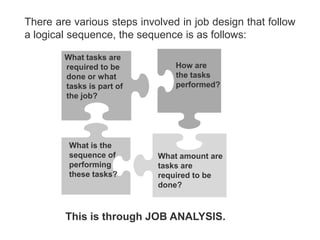
There are various steps involved in job design that follow
a logical sequence, the sequence is as follows:
What tasks are
required to be
done or what
tasks is part of
the job?

What is the
sequence of
performing
these tasks?

How are
the tasks
performed?

What amount are
tasks are
required to be
done?

This is through JOB ANALYSIS.
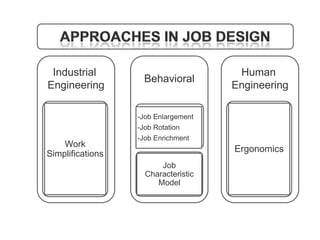
Industrial
Engineering

Behavioral

Human
Engineering

-Job Enlargement
-Job Rotation

Work
Simplifications

-Job Enrichment

Ergonomics
Job
Characteristic
Model
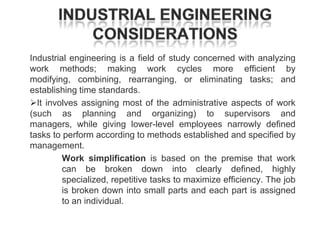
Industrial engineering is a field of study concerned with analyzing
work methods; making work cycles more efficient by
modifying, combining, rearranging, or eliminating tasks; and
establishing time standards.
It involves assigning most of the administrative aspects of work
(such as planning and organizing) to supervisors and
managers, while giving lower-level employees narrowly defined
tasks to perform according to methods established and specified by
management.
Work simplification is based on the premise that work
can be broken down into clearly defined, highly
specialized, repetitive tasks to maximize efficiency. The job
is broken down into small parts and each part is assigned
to an individual.
• Can increase operating efficiency in a stable
environment,
• It is not effective in a changing environment in
which
customers/clients
demand
customdesigned products and/or high-quality services or
one in which employees want challenging work.
• Among educated employees, simplified jobs often
lead to lower satisfaction, higher rates of
absenteeism, and turnover and demands for
premium pay to compensate for the repetitive
nature of the work.
Job Enlargement: (horizontal loading)
• the worker performs a greater number or variety of tasks
in the same level of difficulty
• Also known as horizontal loading,
• Job enlargement reduces monotony and fatigue by
expanding the job cycle and drawing on a wider range
of employee skills.
Example:
A Phlebotomist works for 4 hours in the laboratory but in Job
enlargement he will work for 8 hours.
 Same skills but taking more responsibilities
Job Rotation:
• Another technique to relieve monotony and
employee boredom, which involves systematically
moving employees from one job to another.
• Although
the
jobs
themselves
don‘t
change,
workers
experience
more
task
variety, motivation, and productivity. The company
gains by having more versatile, multi-skilled
employees who can cover for one another
efficiently.
Job Enrichment (vertical loading)
• any effort that makes an employee‘s job more rewarding or
satisfying by adding more meaningful tasks and duties.
• Also known as vertical loading,
• Job enrichment involves increasing autonomy and
responsibility by allowing employees to assume a greater
role in the decision-making process.
• best way to motivate workers is to build opportunities for
challenge and achievement into jobs- Frederick Herzberg
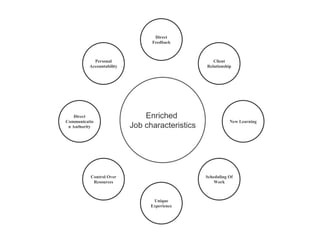
Direct
Feedback

Personal
Accountability

Direct
Communicatio
n Authority

Client
Relationship

Enriched
Job characteristics

Control Over
Resources

New Learning

Scheduling Of
Work

Unique
Experience
Job Enrichment

Job Enlargement

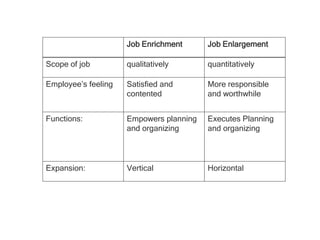
Scope of job

qualitatively

quantitatively

Employee’s feeling

Satisfied and
contented

More responsible
and worthwhile

Functions:

Empowers planning
and organizing

Executes Planning
and organizing

Expansion:

Vertical

Horizontal
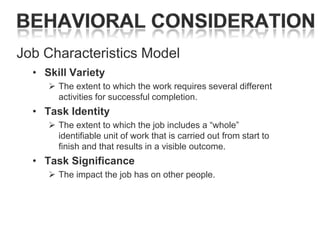
Job Characteristics Model
• Skill Variety
 The extent to which the work requires several different
activities for successful completion.

• Task Identity
 The extent to which the job includes a ―whole‖
identifiable unit of work that is carried out from start to
finish and that results in a visible outcome.

• Task Significance
 The impact the job has on other people.
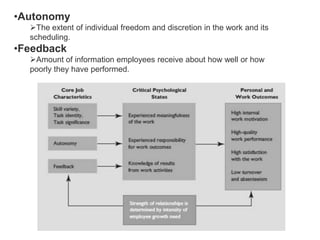
•Autonomy
The extent of individual freedom and discretion in the work and its
scheduling.

•Feedback
Amount of information employees receive about how well or how
poorly they have performed.
• An interdisciplinary approach that seeks to
integrate and accommodate the physical
needs of workers into the design of jobs. It
aims to adapt the entire job system—the
work, environment, machines, equipment, an
d
processes—to
match
human
characteristics.
Ergonomics:
•

is the term used to describe the study of the
physical arrangement of the work space together
with the tools used to perform a task.
• In applying ergonomics, we strive to fit the work to
the body rather than forcing the body to conform to
the work. As logical as this may sound, it is actually
a recent point of view.
• Once jobs have been designed or redesigned, an
employer‘s performance-related expectations
need to be defined and communicated based on
job analysis,
• a process by which information about jobs is
systematically gathered and organized.
• is the procedure firms use to determine the
tasks, duties, and responsibilities of each job and
the
human
attributes
(in
terms
of
knowledge, skills, and abilities) required to
perform it.
• Job Design reflects subjective opinions about the ideal
requirements of a job
• Job analysis is concerned with objective and verifiable
information about the actual requirements.
• Once this information has been gathered, it is used for
developing :
• Job Descriptions (what the job entails) and
• Job Specifications (what the human
requirements are)
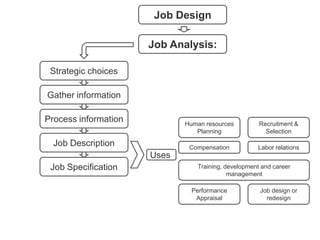
Job Design
Job Analysis:
Strategic choices
Gather information
Process information

Human resources
Planning
Compensation

Job Description

Recruitment &
Selection
Labor relations

Uses
Job Specification

Training, development and career
management
Performance
Appraisal

Job design or
redesign
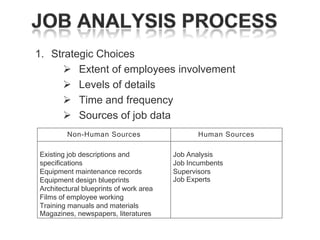
1. Strategic Choices
 Extent of employees involvement
 Levels of details
 Time and frequency
 Sources of job data
Non-Human Sources
Existing job descriptions and
specifications
Equipment maintenance records
Equipment design blueprints
Architectural blueprints of work area
Films of employee working
Training manuals and materials
Magazines, newspapers, literatures

Human Sources
Job Analysis
Job Incumbents
Supervisors
Job Experts
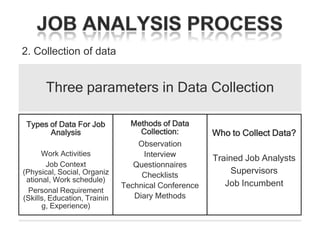
2. Collection of data

Three parameters in Data Collection
Types of Data For Job
Analysis
Work Activities
Job Context
(Physical, Social, Organiz
ational, Work schedule)
Personal Requirement
(Skills, Education, Trainin
g, Experience)

Methods of Data
Collection:

Observation
Interview
Questionnaires
Checklists
Technical Conference
Diary Methods

Who to Collect Data?
Trained Job Analysts
Supervisors
Job Incumbent
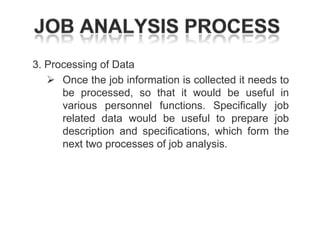
3. Processing of Data
 Once the job information is collected it needs to
be processed, so that it would be useful in
various personnel functions. Specifically job
related data would be useful to prepare job
description and specifications, which form the
next two processes of job analysis.
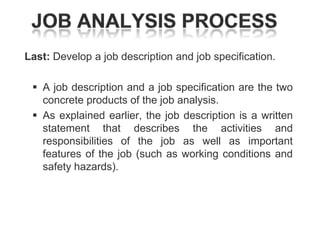
Last: Develop a job description and job specification.

 A job description and a job specification are the two
concrete products of the job analysis.
 As explained earlier, the job description is a written
statement that describes the activities and
responsibilities of the job as well as important
features of the job (such as working conditions and
safety hazards).
Job Description and Job Specification
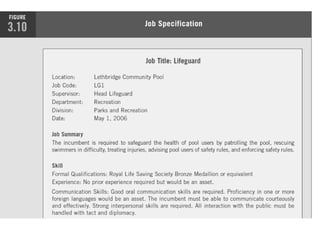
• The job specification summarizes the personal
qualities, traits, skills, and background required.
While there may be a separate
document
describing the human qualifications, job descriptions
and specifications are often combined in a single
document, generally titled ―Job Description
 ―Job Description implies objective listing of the job
title, tasks, and responsibilities involved in a job.‖

 Job description is a word picture in writing of the
duties,
responsibilities
and
organizational
relationships that constitutes a given job or position.
 Job description is a broad statement of purpose,
scope, duties and responsibilities of a particular job.
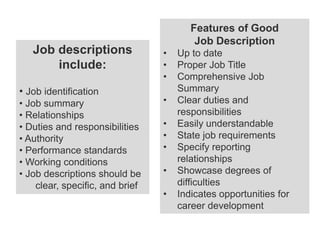
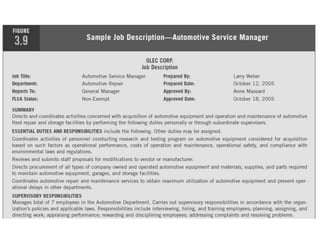
Job descriptions
include:
• Job identification
• Job summary
• Relationships
• Duties and responsibilities
• Authority
• Performance standards
• Working conditions
• Job descriptions should be
clear, specific, and brief

Features of Good
Job Description
•
•
•
•
•
•
•

•
•

Up to date
Proper Job Title
Comprehensive Job
Summary
Clear duties and
responsibilities
Easily understandable
State job requirements
Specify reporting
relationships
Showcase degrees of
difficulties
Indicates opportunities for
career development
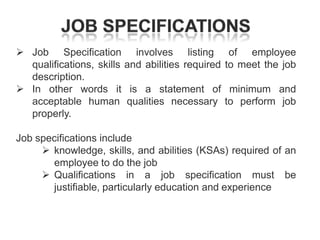
 Job Specification involves listing
qualifications, skills and abilities required
description.
 In other words it is a statement of
acceptable human qualities necessary
properly.

of employee
to meet the job
minimum and
to perform job

Job specifications include
 knowledge, skills, and abilities (KSAs) required of an
employee to do the job
 Qualifications in a job specification must be
justifiable, particularly education and experience
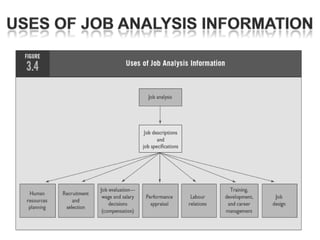
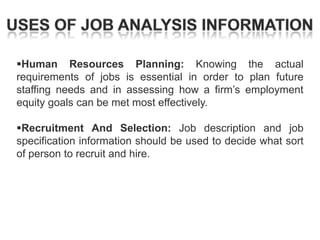
Human Resources Planning: Knowing the actual
requirements of jobs is essential in order to plan future
staffing needs and in assessing how a firm‘s employment
equity goals can be met most effectively.
Recruitment And Selection: Job description and job
specification information should be used to decide what sort
of person to recruit and hire.
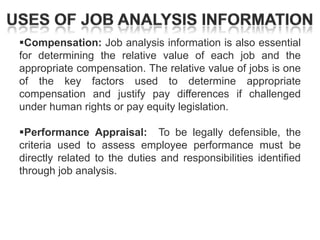
Compensation: Job analysis information is also essential
for determining the relative value of each job and the
appropriate compensation. The relative value of jobs is one
of the key factors used to determine appropriate
compensation and justify pay differences if challenged
under human rights or pay equity legislation.

Performance Appraisal: To be legally defensible, the
criteria used to assess employee performance must be
directly related to the duties and responsibilities identified
through job analysis.
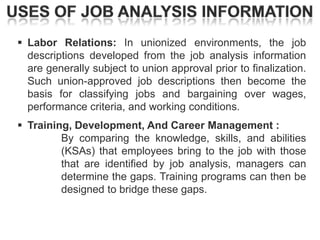
 Labor Relations: In unionized environments, the job
descriptions developed from the job analysis information
are generally subject to union approval prior to finalization.
Such union-approved job descriptions then become the
basis for classifying jobs and bargaining over wages,
performance criteria, and working conditions.
 Training, Development, And Career Management :
By comparing the knowledge, skills, and abilities
(KSAs) that employees bring to the job with those
that are identified by job analysis, managers can
determine the gaps. Training programs can then be
designed to bridge these gaps.
http://www.managementstudyguide.com/job-rotation.htm
•

A Handbook of Human Resource Management
Practice 10th edition by Michael Armstrong 2006

• Human Resource Management v. 1.0 by Laura
Portolese Dias
•

Part 2 Meeting Human Resources
Requirements; Chapter 3 by Anne MacInnis

Job design report white

  • 2.
    • What isJob Design? • What are the approaches involved in Job Design? • What is Job Analysis? • What are the steps in Job Analysis? • What are the uses of Job Analysis Information?
  • 3.
    • Job designhas been defined by Davis (1966) as: ‗The specification of the contents, methods, and relationships of jobs in order to satisfy technological and organizational requirements as well as the social and personal requirements of the job holder‘. • Job design is the process of defining the way work will be performed and the tasks that will be required in a given job. • Job design may be defined as the function of specifying the work activities of an individual or group in an organizational setting.
  • 4.
    It is agroup of related activities and duties held by a single employee or a number of incumbents.  First, to satisfy the requirements of the organization for productivity, operational efficiency and quality of product or service, and  Second, to satisfy the needs of the individual for interest, challenge and accomplishment, thus providing for ‗job engagement‘ – commitment to carrying out the job well.
  • 5.
    There are varioussteps involved in job design that follow a logical sequence, the sequence is as follows: What tasks are required to be done or what tasks is part of the job? What is the sequence of performing these tasks? How are the tasks performed? What amount are tasks are required to be done? This is through JOB ANALYSIS.
  • 6.
  • 7.
    Industrial engineering isa field of study concerned with analyzing work methods; making work cycles more efficient by modifying, combining, rearranging, or eliminating tasks; and establishing time standards. It involves assigning most of the administrative aspects of work (such as planning and organizing) to supervisors and managers, while giving lower-level employees narrowly defined tasks to perform according to methods established and specified by management. Work simplification is based on the premise that work can be broken down into clearly defined, highly specialized, repetitive tasks to maximize efficiency. The job is broken down into small parts and each part is assigned to an individual.
  • 8.
    • Can increaseoperating efficiency in a stable environment, • It is not effective in a changing environment in which customers/clients demand customdesigned products and/or high-quality services or one in which employees want challenging work. • Among educated employees, simplified jobs often lead to lower satisfaction, higher rates of absenteeism, and turnover and demands for premium pay to compensate for the repetitive nature of the work.
  • 9.
    Job Enlargement: (horizontalloading) • the worker performs a greater number or variety of tasks in the same level of difficulty • Also known as horizontal loading, • Job enlargement reduces monotony and fatigue by expanding the job cycle and drawing on a wider range of employee skills. Example: A Phlebotomist works for 4 hours in the laboratory but in Job enlargement he will work for 8 hours.  Same skills but taking more responsibilities
  • 10.
    Job Rotation: • Anothertechnique to relieve monotony and employee boredom, which involves systematically moving employees from one job to another. • Although the jobs themselves don‘t change, workers experience more task variety, motivation, and productivity. The company gains by having more versatile, multi-skilled employees who can cover for one another efficiently.
  • 11.
    Job Enrichment (verticalloading) • any effort that makes an employee‘s job more rewarding or satisfying by adding more meaningful tasks and duties. • Also known as vertical loading, • Job enrichment involves increasing autonomy and responsibility by allowing employees to assume a greater role in the decision-making process. • best way to motivate workers is to build opportunities for challenge and achievement into jobs- Frederick Herzberg
  • 12.
  • 13.
    Job Enrichment Job Enlargement Scopeof job qualitatively quantitatively Employee’s feeling Satisfied and contented More responsible and worthwhile Functions: Empowers planning and organizing Executes Planning and organizing Expansion: Vertical Horizontal
  • 14.
    Job Characteristics Model •Skill Variety  The extent to which the work requires several different activities for successful completion. • Task Identity  The extent to which the job includes a ―whole‖ identifiable unit of work that is carried out from start to finish and that results in a visible outcome. • Task Significance  The impact the job has on other people.
  • 15.
    •Autonomy The extent ofindividual freedom and discretion in the work and its scheduling. •Feedback Amount of information employees receive about how well or how poorly they have performed.
  • 16.
    • An interdisciplinaryapproach that seeks to integrate and accommodate the physical needs of workers into the design of jobs. It aims to adapt the entire job system—the work, environment, machines, equipment, an d processes—to match human characteristics.
  • 17.
    Ergonomics: • is the termused to describe the study of the physical arrangement of the work space together with the tools used to perform a task. • In applying ergonomics, we strive to fit the work to the body rather than forcing the body to conform to the work. As logical as this may sound, it is actually a recent point of view.
  • 18.
    • Once jobshave been designed or redesigned, an employer‘s performance-related expectations need to be defined and communicated based on job analysis, • a process by which information about jobs is systematically gathered and organized. • is the procedure firms use to determine the tasks, duties, and responsibilities of each job and the human attributes (in terms of knowledge, skills, and abilities) required to perform it.
  • 19.
    • Job Designreflects subjective opinions about the ideal requirements of a job • Job analysis is concerned with objective and verifiable information about the actual requirements. • Once this information has been gathered, it is used for developing : • Job Descriptions (what the job entails) and • Job Specifications (what the human requirements are)
  • 20.
    Job Design Job Analysis: Strategicchoices Gather information Process information Human resources Planning Compensation Job Description Recruitment & Selection Labor relations Uses Job Specification Training, development and career management Performance Appraisal Job design or redesign
  • 21.
    1. Strategic Choices Extent of employees involvement  Levels of details  Time and frequency  Sources of job data Non-Human Sources Existing job descriptions and specifications Equipment maintenance records Equipment design blueprints Architectural blueprints of work area Films of employee working Training manuals and materials Magazines, newspapers, literatures Human Sources Job Analysis Job Incumbents Supervisors Job Experts
  • 22.
    2. Collection ofdata Three parameters in Data Collection Types of Data For Job Analysis Work Activities Job Context (Physical, Social, Organiz ational, Work schedule) Personal Requirement (Skills, Education, Trainin g, Experience) Methods of Data Collection: Observation Interview Questionnaires Checklists Technical Conference Diary Methods Who to Collect Data? Trained Job Analysts Supervisors Job Incumbent
  • 23.
    3. Processing ofData  Once the job information is collected it needs to be processed, so that it would be useful in various personnel functions. Specifically job related data would be useful to prepare job description and specifications, which form the next two processes of job analysis.
  • 24.
    Last: Develop ajob description and job specification.  A job description and a job specification are the two concrete products of the job analysis.  As explained earlier, the job description is a written statement that describes the activities and responsibilities of the job as well as important features of the job (such as working conditions and safety hazards).
  • 25.
    Job Description andJob Specification • The job specification summarizes the personal qualities, traits, skills, and background required. While there may be a separate document describing the human qualifications, job descriptions and specifications are often combined in a single document, generally titled ―Job Description
  • 26.
     ―Job Descriptionimplies objective listing of the job title, tasks, and responsibilities involved in a job.‖  Job description is a word picture in writing of the duties, responsibilities and organizational relationships that constitutes a given job or position.  Job description is a broad statement of purpose, scope, duties and responsibilities of a particular job.
  • 27.
    Job descriptions include: • Jobidentification • Job summary • Relationships • Duties and responsibilities • Authority • Performance standards • Working conditions • Job descriptions should be clear, specific, and brief Features of Good Job Description • • • • • • • • • Up to date Proper Job Title Comprehensive Job Summary Clear duties and responsibilities Easily understandable State job requirements Specify reporting relationships Showcase degrees of difficulties Indicates opportunities for career development
  • 30.
     Job Specificationinvolves listing qualifications, skills and abilities required description.  In other words it is a statement of acceptable human qualities necessary properly. of employee to meet the job minimum and to perform job Job specifications include  knowledge, skills, and abilities (KSAs) required of an employee to do the job  Qualifications in a job specification must be justifiable, particularly education and experience
  • 33.
    Human Resources Planning:Knowing the actual requirements of jobs is essential in order to plan future staffing needs and in assessing how a firm‘s employment equity goals can be met most effectively. Recruitment And Selection: Job description and job specification information should be used to decide what sort of person to recruit and hire.
  • 34.
    Compensation: Job analysisinformation is also essential for determining the relative value of each job and the appropriate compensation. The relative value of jobs is one of the key factors used to determine appropriate compensation and justify pay differences if challenged under human rights or pay equity legislation. Performance Appraisal: To be legally defensible, the criteria used to assess employee performance must be directly related to the duties and responsibilities identified through job analysis.
  • 35.
     Labor Relations:In unionized environments, the job descriptions developed from the job analysis information are generally subject to union approval prior to finalization. Such union-approved job descriptions then become the basis for classifying jobs and bargaining over wages, performance criteria, and working conditions.  Training, Development, And Career Management : By comparing the knowledge, skills, and abilities (KSAs) that employees bring to the job with those that are identified by job analysis, managers can determine the gaps. Training programs can then be designed to bridge these gaps.
  • 36.
    http://www.managementstudyguide.com/job-rotation.htm • A Handbook ofHuman Resource Management Practice 10th edition by Michael Armstrong 2006 • Human Resource Management v. 1.0 by Laura Portolese Dias • Part 2 Meeting Human Resources Requirements; Chapter 3 by Anne MacInnis