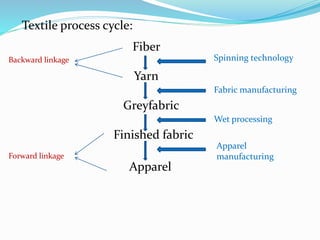
Textile process cycle:
Fiber
Yarn
Greyfabric
Finished fabric
Apparel
Spinning technology
Fabric manufacturing
Wet processing
Apparel
manufacturing
Backward linkage
Forward linkage
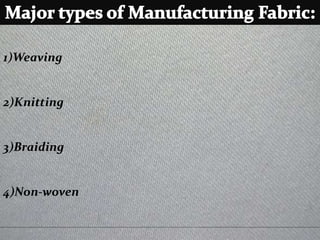
1)Weaving
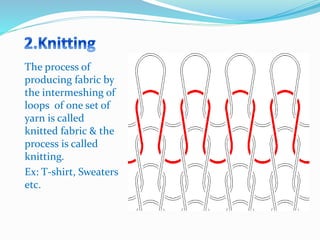
2)Knitting
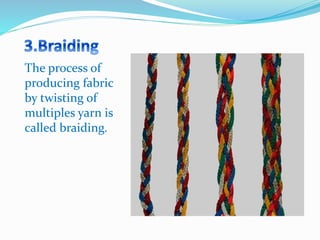
3)Braiding
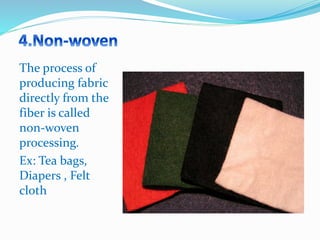
4)Non-woven
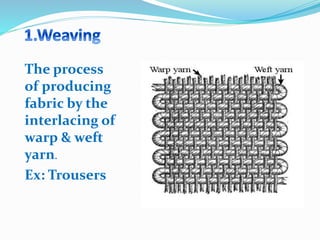
The process
of producing
fabric by the
interlacing of
warp & weft
yarn.
Ex: Trousers
The process of
producing fabric by
the intermeshing of
loops of one set of
yarn is called
knitted fabric & the
process is called
knitting.
Ex: T-shirt, Sweaters
etc.
The process of
producing fabric
by twisting of
multiples yarn is
called braiding.
The process of
producing fabric
directly from the
fiber is called
non-woven
processing.
Ex: Tea bags,
Diapers , Felt
cloth
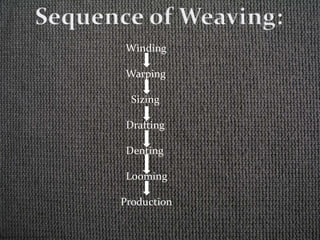
Winding
Warping
Sizing
Drafting
Denting
Looming
Production
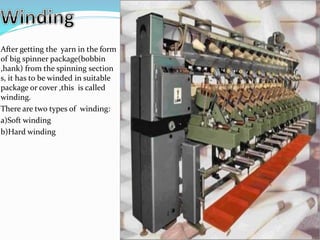
After getting the yarn in the form
of big spinner package(bobbin
,hank) from the spinning section
s, it has to be winded in suitable
package or cover ,this is called
winding.
There are two types of winding:
a)Soft winding
b)Hard winding
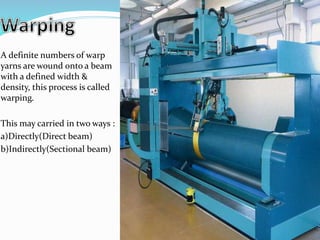
A definite numbers of warp
yarns are wound onto a beam
with a defined width &
density, this process is called
warping.
This may carried in two ways :
a)Directly(Direct beam)
b)Indirectly(Sectional beam)
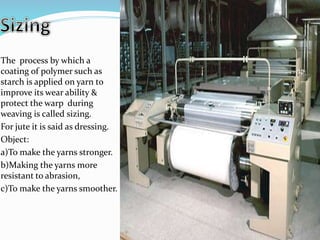
The process by which a
coating of polymer such as
starch is applied on yarn to
improve its wear ability &
protect the warp during
weaving is called sizing.
For jute it is said as dressing.
Object:
a)To make the yarns stronger.
b)Making the yarns more
resistant to abrasion,
c)To make the yarns smoother.
Warp yarns are drawn
in the correct order
through the healed
eyes, this process is
called drafting,
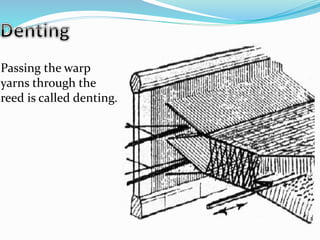
Passing the warp
yarns through the
reed is called denting.

Fabric preparatory process (FPP) Presentation , BUTex